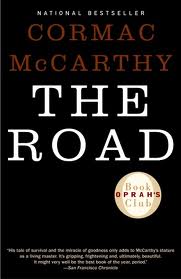
Is Cormac McCarthy a Terrible Writer?

roadFor the record, I don’t think so. In fact, I think he’s brilliant. Mind you, so far I’ve read only The Road. [Update: now I’ve also read No Country for Old Men.] Still, though I had my doubts when I began it for the first time, by the time I finished it I was under the spell of its strange, difficult, deeply poetic language. I’ve been reading and rereading it as I work through it with my class, and for me it just gets better—I find McCarthy’s prose weirder and more interesting and more affecting on each pass.

At the same time, paradoxically, as I reread it I’ve also been very aware that my admiration is a decision on my part, and that it’s one that could quite conceivably have gone the other way: I can see perfectly well that the same prose could be experienced as awkward, pretentious, and affected. I’m not sure I can objectively justify my own belief that it is written with integrity and redolent with artistic significance. There are certainly moments in the novel that I don’t like, sentences I can’t make sense of or that seem to me near misses, if not outright failures. “The snow fell nor did it cease to fall” is one. The last sentence of this passage is another (I’m quoting the whole bit to give it its best chance):

He took great marching steps into the nothingness, counting them against his return. Eyes closed, arms soaring. Upright to what? Something nameless in the night, lode or matrix. To which he and the stars were common satellite. Like the great pendulum in its rotunda scribing through the long day movements of the universe of which you may say it knows nothing and yet know it must.

But despite the bits that make me stumble or wince, The Road reads to me like writing that matters, that deserves to be taken seriously. I don’t mind the sentence fragments, or the eccentric punctuation (though I do find the absent apostrophes distracting). I enjoy the dense vocabulary and the occasionally florid imagery. I find the oscillation between severe minimalism and poetic expansion exhilarating. This week I did an exercise with my class on “found poetry” in the novel. One reason I thought it would work is that we accept or forgive irregularities and difficulties in verse to a degree we don’t, typically, in prose; reading The Road as poetry freed us up to appreciate its peculiarities without fretting too much about lucid intelligibility or standard syntax. Consider the novel’s first sentence, for example:

When he woke in the woods in the dark and the cold of the night he’d reach out to touch the child sleeping beside him.

Or, just a bit further along,

Tolling in the silence the minutes of the earth and the hours and the days of it and the years without cease.

The cadence of the lines makes poetic sense of them, doesn’t it? I also think they’d sound just right read in an Irish brogue – again, it’s something about the rhythm, the rise and fall and slight excess of them. Yet I can see how they could strike another reader as mannered, almost self-aggrandizing: look at me, writing!

I haven’t done a systematic survey of critical responses to The Road, but what I have seen shows judgments divided over just this problem of whether the writing is good (even brilliant) or bad (awful, even). In the NYTBR, Janet Maslin is appreciative:

Since the cataclysm has presumably incinerated all dictionaries, Mr. McCarthy’s affinity for words like rachitic and crozzled has as much visceral, atmospheric power as precise meaning. His use of language is as exultant as his imaginings are hellish, a hint that “The Road” will ultimately be more radiant than it is punishing. Somehow Mr. McCarthy is able to hold firm to his pessimism while allowing the reader to see beyond it. This is art that both frightens and inspires.

In The New Republic, James Wood argues that McCarthy’s “dumbly questing, glacially heuristic approach matches its subject, a world in which nothing is left standing. . . . Short phrasal sentences, often just fragments, savagely paint the elements of this voided world.” He doesn’t find it entirely successful:

The second register is the one familiar to readers of Blood Meridian or Suttree, and again seems somewhat Conradian. Hard detail and a fine eye is combined with exquisite, gnarled, slightly antique (and even slightly clumsy or heavy) lyricism. It ought not to work, and sometimes it does not. But many of its effects are beautiful — and not only beautiful, but powerfully efficient as poetry. . . .

Yet McCarthy’s third register is more problematic. He is also an American ham. When critics laud him for being biblical, they are hearing sounds that are more often than not merely antiquarian, a kind of vatic histrionic groping, in which the prose plumes itself up and flourishes an ostentatiously obsolete lexicon. (Blood fustian, this style might be called.)

Closer to home, one of my colleagues said she is convinced McCarthy is a genius (to be strictly accurate, she was speaking about Blood Meridian, but the stylistic features she described sounded very familiar). But wise Colleen at Bookphilia maintains that The Road “is bad because the writing is bad and because the plot in no way makes up for this deficiency”, and others express the same opinion with less economy, as in this blog comment I turned up while idly googling opinions on the apostrophe issue:

 I just tried to read this book and had to put it down after around thirty pages due to the absolute atrocious writing style and complete disregard for language structure. Fragments, overuse of conjunctions, lack of multiple different kinds of punctuation. Overall it makes the book a very slow read due to having to re-read passages multiple times.

Language structure is there to aid communication, it should not be modified willy nilly by some hack author as a literary device in a way to inject what he is unable to convey through language. In this case all you have is a clumsy, choppy, piece of sub-par writing.

And speaking of language, the text reads like it was written by a freshman with a thesaurus. There is excessive use of bizarre adjectives and over-description. Simple sentence structure with over use of a inappropriate descriptors just reeks of poor undergrad writing.

 Or there’s this post:

McCarthy’s writing is full of incomplete sentences and anastrophe, completely lacks quotation marks, and frequently embeds dialogue in the middle of paragraphs. What truly annoys me, though, is McCarthy’s inconsistent use of apostrophes for contractions. Each of these conventions is a barrier to straightforward reading (though I finished The Road in only a few hours). If they made me stop and think about the language, characters, or plot, I wouldn’t object, but they’re merely distracting.

We’re looking at the same evidence but drawing very different conclusions. I wish I could assert confidently that I’m reading right and the naysayers are ill-informed, mistaken, or obtuse. I do think that fixating on non-standard grammar, unfamiliar vocabulary, or other technicalities is a superficial way to evaluate the quality of literary writing. And McCarthy’s odd prose did make me stop and think—not so much about “the language, characters, or  plot,” but about the themes and values of the work, and also about the role of language itself, in making meaning and in creating aesthetic and emotional effects. Can I do better, though, than saying “it worked for me”? Can the haters really get past “it didn’t work for me”?

This is the reason I think debating “literary merit,” or ranking or rating books, quickly becomes an exercise in either folly, futility, or bullying. If you’re going to ask “but is it any good?” you need to flesh out the question: good at what? for what? for whom? There are myriad ways a novel can be. A much more interesting discussion will come from asking “what does McCarthy’s prose do?” or “what are the connections between McCarthy’s literary strategies and the central ideas of The Road?” then from asking if he is a good or a bad writer. Why would you even ask those questions, though, if you didn’t think the work was worth spending that kind of time and thought on? By assigning The Road to my class, I’ve implicitly endorsed it as good writing, haven’t I? And, to return to where I began, I think it is good writing. Good at what? Good for what? Well, one of the things it is unequivocally good at, or good for, is provoking discussions about good (or bad) writing.

Update: More Critical Views

Ron Charles in the Washington Post:

even with its flaws, there’s just no getting around it: The Road is a frightening, profound tale that drags us into places we don’t want to go, forces us to think about questions we don’t want to ask. Readers who sneer at McCarthy’s mythic and biblical grandiosity will cringe at the ambition of The Road. At first I kept trying to scoff at it, too, but I was just whistling past the graveyard. Ultimately, my cynicism was overwhelmed by the visceral power of McCarthy’s prose and the simple beauty of this hero’s love for his son.

Jennifer Egan in Slate (the review overall asks thought-provoking questions about the novel’s “literary masculinity”):

There is no limit to the devastation, only new forms of its expression, and McCarthy renders these up in lush, sensuous prose that belies the inertness of its object and keeps the reader in a constant state of longing and alarm.

Gail Caldwell in the Boston Globe:

Unfolding in a spartan, precise narrative that mirrors the bleakness of its nuclear winter . . . even with his lapses into grandiloquence, McCarthy is too seasoned a writer to over dramatize what may be the last drama of all . . . he has written this last waltz with enough elegant reserve to capture what matters most.

Mark Holcomb in the Village Voice:

[McCarthy’s fans] should be satisfied with the current offering’s characteristic helpings of hypnotic, gut-punching prose and bracing depictions of emotional longing (“She held his hand in her lap and he could feel the tops of her stockings through the thin stuff of her summer dress. Freeze this frame. Now call down your dark and your cold and be damned” )—qualities McCarthy’s detractors seem bizarrely content to underestimate or overlook.

Sycorax Pine:

His prose is plain, but shows the almost baroque love of unusual and archaic language amidst this plainness that I have always heard associated with him (this is my first finished McCarthy novel). At a certain point in the novel, it was teaching me an average of one new word per 8 pages: discalced (unshod!), fire-drake, lave, mastic, rachitic, siwash, skift,claggy, quoits. The boy picks up clichés out of nowhere, it seems, magically resurrecting conventions of language that died in the cataclysms of his pre-speaking life. From time to time, a turn of speech will seep through from our time, revealing the possibility that this is an allegory for our politically embattled world

 Further Update (2/18): A thoughtful dissenter:

In setting The Road in a post-apocalyptic world where plot is beside the point and the two main characters are — given their hazily remembered past, monochrome present, and probable lack of a future —inevitably archetypal, McCarthy overuses the stark-but-somehow-simultaneously-baroque tone that eventually threatens to send all his work off the rails. McCarthy is a writer who could make a casual brunch read like the end of the world, so when he’s actually writing about the end of the world, his grandiosity grows numbing. In this sense, his language fails The Road, distracting from the emotional potency it might have had. (Clearly, there are many who disagree.) [from John Williams at A Special Way of Being Afraid]

And yet another update (2/27): At least two commenters (so far) in this FlavorWire thread are not fans.

This Week In My Classes: Information and Education

cranfordWe’re starting new books in both of my classes this week (well, weather permitting, we are, anyway!): The Road in Introduction to Literature and Cranford in 19th-Century Fiction. What makes this a particularly exciting but also daunting prospect for me is that they aren’t just the next books on our syllabus but they are also both novels that I have not taught before, in any course. So: no lecture notes, worksheets, handouts, discussion questions, slides, or other materials lurk in my archive of teaching materials. Also, I have no experience of, and therefore no expectations for, what ‘works’ or ‘doesn’t work’ about these books for students: what will be the sticking points? what will get them fired up? what will I discover, as we go along, that I need to know more about?

I’m not just going to show up, book in hand, of course. I’ve read them both before, and reread them both last week (and will reread them again in the assigned installments as we go along in class). For The Road, I’ve been collecting background information from books and scholarly articles as well as from online resources such as the website of the Cormac McCarthy Society or Oprah’s Book Club guide to The Road (which, just by the way, has some pretty good stuff, including these bits on ‘Fiction and Science’ in the novel and clips from McCarthy’s apparently very rare interview with Oprah). I’ve got some of my own materials on Gaskell, but they focus on Mary Barton and North and South, both of which I’ve taught fairly often, so though I don’t need to look up much general background, I’ve been surveying academic sources specific to Cranford (which are not nearly as abundant as for her social-problem fiction — something we’ll talk about in class, actually) and, again, peering around online for things to help get me thinking. One stimulating source is one of my long-time favorite bloggers, Amateur Reader, whose posts on Cranford at Wuthering Expectations are models of insightful brevity: here, for instance, on ‘Cranford and the Strong Female Character‘, or here on the trickier-than-she-seems narrator, Mary Smith.

This process of class preparation has had me thinking (not for the first time!) of the odd way our work as professors is often characterized. Recently, to give just one example, Melonie Fullick tweeted a link to an article proclaiming that recent developments in online education signal “the coming end of the monopoly of information held by professors in classrooms.” If it were true that professors believed they held some kind of monopoly on information, and that suddenly there was an unprecedented challenge to that monopoly because of the internet, a lot of the end-of-the-university-as-we-know-it rhetoric would ring true — but there have always been abundant sources of information outside of classrooms, and outside of universities altogether. It’s true that some of what I’ll be doing is passing along to my students information that they could get for themselves somewhere else — if they knew where to look, and, more important, if they knew what to choose from the flood of information out there. One of the things I’m doing is filtering information for them: for our purposes, here are the kinds of things we need to know, or know enough about that we can follow up in other venues. Another thing I’m doing is framing that information: what are our purposes, after all? what do we want to be able to do with these texts? And I’m synthesizing and shaping it for them, and looking for new directions it could send us in — and here’s where it gets more idiosyncratic, because the ways I will do this are not exactly the same as someone else would do it, because I am who I am — and because they are who they are, and so I’ll be responding to them as we go along. Information transfer is part of my job, but it’s silly and reductive to imagine that it’s a straightforward part of my job, or that students new to this material, and beginners in this discipline, could effectively (never mind efficiently) conduct the process of finding, sorting, and making meaning from available information without any guidance. Also, that transfer of information is only the beginning of what we will do together, because ultimately my goal is not for them to memorize facts about Elizabeth Gaskell or Cormac McCarthy but for them to become better readers and critics, which means they have to engage independently with the texts, framing their own questions and trying out their own answers. They can get a lot of information from Wikipedia (I get some of mine there, too), and if that was all our classroom time was about, then sure, that’s the beginning of the end. But that’s not education: not really. I strongly agree with Melonie’s characterization of education in her post “Can education be sold?“:

My friend Dr. Alex Sevigny has an analogy that I think works much better: education is like a fitness program. Yes, you can pay for access to a gym with top-of-the-line facilities. You can pay for a trainer to take you through the best possible individualized regimen. You can buy the shoes and expensive gym clothes. But ultimately if you don’t get yourself to the gym, multiple days a week, and push yourself to get fit–there’s no benefit in any of it.

Education works in much the same way: it is a process, one in which the student plays a necessary part, and an experience, in which the student plays a major role in the “outcome”. In fact every student actually receives a different “education”, with different outcomes, even if they’re all paying the same amount. What you pay for with tuition money is not “education”, but access to resources–libraries, expert staff, teaching and mentorship, even social contact–and access to a formal credential. Even the credential isn’t guaranteed, since students must complete academic requirements in addition to paying tuition and fees.

Another common way to dismiss what happens in ‘traditional’ classrooms is to scoff at the ‘sage on the stage’ model. I don’t agree that there’s never a good time, or a good way, to lecture. In addition to offering information, lecturing can model ways to argue, or, in my field, ways to build and support an interpretation. Even when transferring information, as I’ve said, there’s a process of filtering and framing that makes a thoughtful lecture something more than a list of facts or claims. Passivity in the face of information, though, is never the point, the process, or the purpose. It’s the interaction between a thinking person and information that really matters, and that we aim to promote, ultimately, in our students. Professors don’t have a monopoly on that process either, but it’s what we train for, it’s what we stand for, and it looks like it’s also what we’re going to have to fight for, as the pressure mounts for ways to automate, commodify, and depersonalize our classrooms. It’s frustrating to see how often the arguments for a revolution in higher education turn on reductive stereotypes of the work we actually do.

This Week In My Classes: The Value of F2F

The Student (Dixon)Last week I cancelled two regular class meetings for my Introduction to Literature Class and instead set up individual conferences, 15 minutes per students. (If you want to do the math, of the 26 registered students 24 ended up meeting with me, so that was six actual contact hours in place of two, and since it wasn’t possible to run the meetings entirely consecutively, overall I had about eight hours of my schedule taken up with this exercise.)

In a previous post I wrote quite a bit about my motivations and goals for these conferences. It will be a while before I can tell if they made much difference in terms of how students respond in the classroom. Many of them set as one of their goals that they would like to participate more in discussion — yet on Monday things were not especially lively, even though I thought the readings (Randall’s “Ballad of Birmingham” and Hughes’s “A Dream Deferred”) were reasonably provocative. Whatever happens, I think the process had value for them, because it prompted them to reflect on their work for last term and to consider what role they might have in making this term successful. All of them seemed to take the exercise seriously, and some of them realized important things about their work habits or about relationships between different course requirements (such as reading journals) and outcomes (such as understanding of material or grades on papers). So that’s good!

And the process had value for me too, not least because meeting with them face to face renewed my conviction that teaching is a very personal activity. “Content delivery” is not nothing, but it’s far from everything; skills development is also something, but it too is not sufficient. Education is an internal process as much as anything: something has to change within, and while no avid reader is going to say face to face interaction is the only route to inner transformation, I really believe that there’s something special about speaking directly to another human being who takes a sincere interest in you. I was at a faculty meeting today where we were invited by our university’s president to imagine the program we would create if we could do anything we wanted, without constraints. It was an ironic suggestion, really, as the meeting was about dealing with a looming budget crisis–it was all about constraints! The problem is that what I imagine is a program in which that kind of personal interaction is routine–if not throughout a student’s entire degree, at least at key moments, and I’d consider their first year just such a moment. My “blue sky thinking” always brings me back to something like a “freshman seminar” model, with maybe 15 students around a table with a dedicated, experienced instructor with plenty of time and attention for them. But I can’t figure out how such a dream is compatible with our need to (as our Dean put it) “do less with less,” especially when the only recipe for financial flourishing appears to be more students and fewer faculty.

Anyway, I’m glad I worked these meetings into my plans for this term. If nothing else, they know there’s one person on campus who’s really paying attention to them! And it’s a rarity for me to have any class, much less an intro class, small enough to make this logistically feasible.

Now we’re back to our regularly scheduled programming, with another week of poetry before beginning Elie Wiesel’s Night next week. This week’s poem are something of a build-up to Night, in that they all deal with difficult realities, from Randall and Hughes yesterday to the horrors of trench warfare on Friday, with Owen’s “Dulce et decorum est.” One thing we’ll talk a lot about with Night is how (and even whether) to transform suffering into art, and how choices of literary form and representation are also choices about the meaning of real events. After that we’ll move on to The Road — so basically we’ll all be depressed for about the next month.

In 19thC Fiction I won’t be having conferences, but I am having the students write regular reading journals, and that gives me at least a little sense of them individually to add to what I can glean from class discussion. I’ve had just a few submitted so far but I like reading them: they seem to be just formal enough that the students have put some thought into them, but not so high stakes that they (or I) need to stress out over them. That said, I’m going to be reading a lot of them this term: if every student submits the three required entries for every novel, that’s 630 journal postings at approximately 150 words each, for a grand total of … eek, about 94,500 words. Will I end up regretting not just assigning more standard essays? But these have other purposes, and they come in small and so far quite tasty doses. And if any students in this class want to meet with me one on one (which I will emphatically encourage them to do when they are working on their longer papers), they’ll be welcome — and, in case they need any extra incentive, I’ll let them know that I have a stash of extraneous books in my office from which visiting students are always welcome to help themselves…

From the Archives: The Last Time I Taught Bleak House…

bleakhouseoupFor some reason this phrase has been running through my head to the tune of “The Last Time I Saw Paris.” I don’t know why I would be feeling nostalgic about teaching Bleak House, though it was rather a while ago–it was Fall 2008, to be precise. Because we’ve started work on it in my 19th-century fiction class this week, I’ve been reviewing old notes and also old blog posts, which prove (among other things) to be a valuable archive. Because (so far at least) my ideas about the novel haven’t really changed in the meantime, and because a lot of people who might stop by and read this post almost certainly never read my earlier ones, I thought I’d repost a couple of them, starting with this one about the beginning of the novel and the beginning of my class discussions of it.


From the Novel Readings Archives: Fog. Mud. Smoke. Soot. Gas. Fog.

Bleak House Shadows (Phiz)

No, that’s not today’s prediction from Environment Canada (though there is something implacable about today’s weather, even if it’s not yet November). This week in one of my classes, it’s time for Bleak House–by comparison with which, nothing else I’m doing at work really matters. The introduction to our Oxford World’s Classics edition remarks that the opening ‘set piece’ is ‘too famous to need quotation.’ Well, I don’t know about that, especially because I consider it an aesthetic accomplishment self-sufficient enough to render critical commentary not just redundant, but irritating. Here are the first four paragraphs, then (three of them composed entirely, it’s worth noting, of sentence fragments).

London. Michaelmas term lately over, and the Lord Chancellor sitting in Lincoln’s Inn Hall. Implacable November weather. As much mud in the streets as if the waters had but newly retired from the face of the earth, and it would not be wonderful to meet a Megalosaurus, forty feet long or so, waddling like an elephantine lizard up Holborn Hill. Smoke lowering down from chimney-pots, making a soft black drizzle, with flakes of soot in it as big as full-grown snowflakes–gone into mourning, one might imagine, for the death of the sun. Dogs, undistinguishable in mire. Horses, scarcely better; splashed to their very blinkers. Foot passengers, jostling one another’s umbrellas in a general infection of ill temper, and losing their foot-hold at street-corners, where tens of thousands of other foot passengers have been slipping and sliding since the day broke (if this day ever broke), adding new deposits to the crust upon crust of mud, sticking at those points tenaciously to the pavement, and accumulating at compound interest.

Fog everywhere. Fog up the river, where it flows among green aits and meadows; fog down the river, where it rolls deified among the tiers of shipping and the waterside pollutions of a great (and dirty) city. Fog on the Essex marshes, fog on the Kentish heights. Fog creeping into the cabooses of collier-brigs; fog lying out on the yards and hovering in the rigging of great ships; fog drooping on the gunwales of barges and small boats. Fog in the eyes and throats of ancient Greenwich pensioners, wheezing by the firesides of their wards; fog in the stem and bowl of the afternoon pipe of the wrathful skipper, down in his close cabin; fog cruelly pinching the toes and fingers of his shivering little ‘prentice boy on deck. Chance people on the bridges peeping over the parapets into a nether sky of fog, with fog all round them, as if they were up in a balloon and hanging in the misty clouds.

Gas looming through the fog in divers places in the streets, much as the sun may, from the spongey fields, be seen to loom by husbandman and ploughboy. Most of the shops lighted two hours before their time–as the gas seems to know, for it has a haggard and unwilling look.

The raw afternoon is rawest, and the dense fog is densest, and the muddy streets are muddiest near that leaden-headed old obstruction, appropriate ornament for the threshold of a leaden-headed old corporation, Temple Bar. And hard by Temple Bar, in Lincoln’s Inn Hall, at the very heart of the fog, sits the Lord High Chancellor in his High Court of Chancery.

Sure, there’s plenty to be remarked about this passage, beginning with its literary virtuosity and metaphoric ingenuity. Dinosaurs and compound interest? Snowflakes in mourning? ‘Fog’ used 13 times in one paragraph? Gas that’s ‘haggard and unwilling’? I’m reduced to the exclamatory mode some critics objected to in James Wood’s How Fiction Works: “What a piece of writing that is!” It puts to shame other writers called ‘Dickensian’ for no apparent reason except that they write multiplot novels with quirky characters and lots of emotion. There’s also its extraordinary efficiency at launching both governing ideas and dominant images of the vast novel it introduces; fog, mud, and infection order the thinking of Bleak House as much as webs do the same for Middlemarch. But really, the point of this passage is just to read it, to experience it, and then to carry the impression of it with you as you read on. (Is this response ‘aesthetic’? I’m not sure, or at least I’m not sure I could separate my admiration for the literary features of this passage from my sense of its ethics–or, better, its ethos.)

Today I’ll give a brief introduction to Dickens and some context for the first publication of Bleak House. Then my chief concern is to help my students find some reading (and note-taking) strategies to make their experience of the novel rewarding, which means helping them organize the mass of material (and the array of characters) they will be rapidly confronted with. We’ll do some ‘getting to know you’ work first of all: who do we meet in each of the first few chapters, and how are they connected? I’ll encourage them to keep a list of characters in each plot or location and to draw lines between them as relationships are discovered. They will have a chaotic criss-cross of lines before too long, which of course is the point–everything and everyone is connected, as Dickens challenges us to realize with his disingenous questions in Chapter 16:

What connexion can there be, between the place in Lincolnshire, the house in town, the Mercury in powder, and the whereabout of Jo the outlaw with the broom, who had that distant ray of sunshine on him when he swept the churchyard-step? What connexion can there have been between many people in the innumerable histories of this world, who, from opposite sides of great gulfs, have, nevertheless, been very curiously brought together!

My other main strategy is to get them thinking in terms of themes and variations. Today, for instance, we’ll look at how many ways the idea of housekeeping is refracted across the different story lines. Finally (though this is certainly not my last priority) I will try to convey, and make contagious, my enthusiasm for Dickens’s language in the novel, and to get them thinking about how his literary strategies (including the kinds of wild metaphors we get in the first few paragraphs) are important to his conception of the ‘condition of England question,’ and to his answer to it.

[originally posted October 27, 2008]

This Week In My Classes: Wrapping Up

The last ten days or so have been all about evaluating the final assignments for my two fall-term classes, Mystery and Detective Fiction and The Somerville Novelists. The students in my Intro to Literature class wrote a last essay for the term too, but that came in earlier and so I was able to turn it around before the final exams and essays and projects came in from the other groups. That means, though, that basically, for about two weeks, I’ve been in what we refer to on Twitter with the hashtag “#gradingjail.”

I went to a teaching workshop a few years ago where the very helpful advice offered was not to assign any writing you won’t want to read when students turn it in. That’s a good idea, but it’s also a ridiculous idea, as any writing instructor knows: there is no assignment so meticulously conceived, there are no instructions so compellingly worded, that every student will be motivated to, much less able to, do a wonderful job. And it’s not the well-intentioned imperfections in assignments by motivated students that drag us down at this time of year: it’s the lame-ass ‘I’m only doing this because you’re making me’ ones, or the ‘everything else was a higher priority so I threw this together at the last minute’ ones, or the ‘I really have no idea how to do this but even though I never came class or to your office hours, I’m still turning something in to see if I can pass’ ones. It’s the ones in which even the authors’ names are misspelled, despite being right there on the book cover for easy reference, or the advice on three previous assignments was ignored, or that show beyond a reasonable doubt that the student never finished the book they are writing about. Though it would be fun (and fast!) to grade a batch of final essays or exams all of which deserved A+ grades, we don’t expect perfect work: these are students, after all, and they’re learning — that’s the point of their being in our classrooms in the first place. But learning really is a two-way street. Exciting as a truly great assignment by an already flourishing student can be, often it’s the students who have, by effort and persistence and caring, and also by consultation, just made their work better who give me the best feeling when I’m marking.

mosley

Happily, I did see some examples of that this term, and overall my sense of all three classes was that most students were doing their level best. One of the biggest surprises of my recent marking was that a significant majority of the answers to the essay question on the Mystery and Detective Fiction exam (on social justice in Devil in a Blue Dress and Indemnity Only, in case you wondered) were very good: smart, articulate, and supported with detailed discussion of examples. It was hard work going through the entire stack of exams, and it took a long time (between students who did the optional final paper and students who mysteriously vanished from the course over time, there were 74 exams in the end, which certainly felt like plenty) but it was a familiar experience, and I think it gave me a good sense of who was really on top of the course material and who really wasn’t, which after all is the point of the exercise.

south riding

Evaluating the wiki projects for the Somerville Seminar, on the other hand, was a new kind of effort. As my Twitter friends know, I felt a lot of stress about these projects while they were still in progress, mostly because despite my urging, not a lot of students put even draft material up early, thus making ‘gardening’ as well as some aspects of collaborating and conceptualizing difficult. But it was also stressful because of the difficulties I knew some groups were having organizing meetings and getting everyone to participate. As I said, rather defensively, to people who responded to my stress by wondering why I assigned group projects in the first place, I have included a group project of some kind in nearly every 4th-year seminar I’ve taught in my 17 years at Dalhousie, and they have always seemed to go very well! So what was different this time? A couple of things, I think. First of all, this time I had a backstage pass: the projects were going up on a shared PBWorks site, so not only could I see posted content, but I got daily reports of which users had been doing what – including, sometimes, discussions among group members about logistics and frustrations. If I had seen only the finished product, as in the past (not counting the mandatory ‘confer with me at least once about your plans’ sessions that are always part of the process), I might never have known it wasn’t a seamless, harmonious process.

Would it have been better for me to hide my eyes? More important, would it have been better for them? In both cases, I think the answer is no. Because the assignment was experimental, for one thing, I needed to know if clarification or intervention was required, which sometimes it was. Also, because one aspect of the assignment was precisely ‘good collaboration among group members,’ I needed to see if this was going on. Without watching the sausage get made, too, there would be no way for me to learn if I had done my part well, in terms of designing the assignment, laying out the instructions, and supporting the class in meeting the requirements. From their point of view, I think my surveillance, though no doubt occasionally felt as intrusive, was mostly a good thing: I did step in with suggestions when I felt they were heading in unhelpful directions, and when I realized how imbalanced the (visible) contributions were getting, I did some covert, as well as some overt, er, motivating.

All in all, then, I think it was not just useful but responsible of me to pay attention to how things were unfolding. Looking over the final projects, which range from good to outstanding, I’m not sorry, either, to have put everyone (myself included) through this difficult process. But I have certainly been thinking about whether I could have made it any less stressful, and this leads me to another way in which these projects differed from previous group assignments: instead of being staggered across the term, they all came due at once; and though there were multiple components, there was really only one explicit deadline. I thought that it would suffice to address the various components through in-class workshops aimed at developing concepts and getting people started, but clearly, though that was not wasted time, people didn’t (mostly) get started. Probably 75% of the final content on the wikis went up in the 2-3 days before the final deadline, and as far as I could tell, a pretty significant amount of the research was done during those days as well. I talked and talked about the importance of doing the projects in stages, and especially about putting content up early so that others could ‘garden’ it, but I think this advice was just too abstract, the required work too amorphous or theoretical. Also, I think most of them wildly underestimated how much work would actually be involved in building the different components (something earlier attempts would, of course, have alerted them to). As a result, these projects lost out in the day-to-day triage, as they did other work that felt more urgent because it had concrete deadlines coming right up. Lesson learned: when (indeed, if) I do anything similar again, I’ll build in more staged deadlines. To me that goes against the atmosphere of open creativity I was trying to foster: setting deadlines means spelling out exactly what has to be done by then, and that’s tricky if you want them to make decisions about what needs to be done in the first place. That’s why I didn’t have more interim deadlines this time–that, and because I thought they would be better at managing their own time. Some of them were, amazingly so, but that didn’t help them too much when they were dependent on others to do their parts. I’m of two minds, really, about how much responsibility to take for some students’ work habits, which is really what we’re talking about here. But ultimately what I want (what I wanted) is to see everyone involved and successful and excited: it made me sad to see, instead, people feeling frustrated, stymied, and harried. If there’s a next time, I’ll see what I can do to structure their time better for them.

Evaluating these projects was challenging for me. There was a lot of content (eventually!) and there were a lot of different aspects to take into account, from layout to research to clarity and focus to effective linking between sections: it made reading a traditional essay seem like a reductively linear process! But in many ways it was a much more interesting task than reading a stack of critical analyses. One reason is that a lot of students wrote about quite obscure books, so I learned a lot myself from the work they had done. Another is that several of the components were more reportage than literary criticism, which meant that the prose was crisper and more straightforward and didn’t need to be read with a painstaking eye to argument or interpretation. One of the hardest parts of commenting on literary essays is trying to grasp what thesis would have worked to unify the examples, or even just to understand what a conceptually garbled sentence or paragraph might have been intended to mean, in order to propose a better version of it. There wasn’t much of that involved here, and that was great! Freed from the obligation to write academic-ese, they proved perfectly capable of saying very insightful things and making all kinds of good connections between texts and contexts and concepts we worked on in the course. That was very satisfying to see, and it encourages me to keep looking for different kinds of writing to assign. Hardly anybody in my classes is going to become an academic critic, after all, so teaching them to write like one seems less and less like it should be my priority. As far as that goes, in fact, everything about these assignments still, in spite of everything, seems like a good idea.

And now my final grades are filed for the two courses that ended, and I’m going to take a break from fretting about teaching for a few days before I turn my attention to the final planning for the winter term. My Introduction to Literature class continues, and I start another round of The 19th-Century British Novel From Dickens to Hardy. As usual, I’ve tweaked the reading list by a book or two, and I have ideas for yet another twist on course requirements … but first, I’m looking forward to returning to Anna Karenina.

This Week in My Classes: Year 6 Begins!

I find this hard to believe, but 2012-13 will be the sixth year for my series on ‘this week in my classes.’ I began this series as a straightforward attempt to document and reflect on what goes on in an actual university English class, as opposed to the phantom indoctrination factory some people seemed to imagine we run. Though I still run into occasional examples of ‘bad old English professors talk nonsense and/or ruin all the fun’ comments, I’ve been thinking that there’s a different context now that makes it newly relevant for me to think about what it means to be ‘in my classes’: the much-hyped, much-debated, perhaps much-exaggerated disruption that is online teaching, and particularly MOOCs.

All summer there’s been an endless stream of commentary about what MOOCs can and can’t do, what they’re good for and what they aren’t–and, directly or by implication, about what, if anything, is the special value of actually being in a classroom face to face with a professor. Often, especially on the pro-MOOC side, and sometimes even in pieces that aspire to be even-handed (like this one, just yesterday), there are a lot of casually dismissive generalizations about the so-called “sage on the stage” model of teaching that supposedly dominates the contemporary academy–just for example, that recent piece talks about in-person education as “a classroom-based activity with a tweed-clad professor at a lectern.” I read these comments (which are then used, more often than not, to argue that face-to-face teaching is old-fashioned and overdue for disruption) and wonder whose teaching they are talking about. It’s true there are huge lectures, mostly (but not altogether) in subjects other than English, and that it is a stretch to call such classes “face-to-face” if one of the faces you mean is the professor’s. But it’s also true that there isn’t a lot of nuance in the claims I’ve seen about which classes might as well be scaled up to 10,000, or 40,000. Humanities classes raise significant pedagogical challenges for the MOOC fantasists; for a thought-provoking chronicle of one university teacher’s experience as a student in an online literature class, see here (I’m tempted to add “read it and weep!”). But it’s early days yet and who knows how things will develop.

At any rate, as I head back into my physical classrooms for the start of term, inevitably I’ve been thinking about whether I’m justified in believing that it’s not just more sociable but also pedagogically valuable to spend a few hours a week actually with my students, looking at their faces as they listen and react to what I say, watching them as I listen to them and respond to what they say. I believe it’s possible to build relationships, form communities, share ideas and knowledge, and get work done online–because I have done all these things myself. Maybe it’s because I know how much reciprocal effort and logistical precision is involved in a successful online venture that I can’t imagine undertaking it on a large scale. Or maybe it’s mostly that, as my grandmother always said, I’m a “people person,” which means I thrive on being around, well, people. I flatter myself (or do I?) that my students would (with exceptions, of course) rather be in a room with me–even on the occasions when I do just lecture (which are pretty occasional)–than watching a video of me (heaven forfend!) or posting on discussion boards. But maybe they wouldn’t! It’s probably salutary for me to have in mind that whatever exactly I do in my classes, it should be something more–more interactive, more spontaneous, more attentive, more in-their-faces–then they could get if they weren’t actually in the room. As a good first step, I can honestly state that I have never, to my recollection, worn anything tweed, and that I am rarely, if ever, sage.

As for specifics, this week is mostly about starting up. Last Friday was the first day in this term’s three courses: Introduction to Literature, Mystery and Detective Fiction, and The Somerville Novelists. Everything seems fine so far. The one I’m most preoccupied with is the Somerville seminar, and I will admit I found it unnerving today, in our first discussion of some readings, when I came up shaky on answers to a couple of straight factual questions–such as when, exactly, Testament of Youth was first published! I should have been ready with this detail, and I thought I knew, but in the moment I wasn’t sure I knew (I said I thought it was published in the early 193os, and the precise date is 1933–so I was OK!). This is the kind of thing I know pretty much cold in my 19thC fiction classes, in which I have taught the same two dozen or so novels in different combinations for about 17 years! I guess I shouldn’t expect to be as good at this new material right away, but that disconcerting moment was a good reminder that when preparing for these sessions, I need to pay as much attention to the basic facts as I do to the larger questions I’m trying to raise, because though they are certainly somewhere in my notes, I can’t count on their being cemented in my memory.

From the Archives: My Teachers — An Appreciation

My daughter starts Grade 6 tomorrow, which for her is the beginning of the end of elementary school. Talking to her about that tonight reminded me of my own Grade 6 year, which was a turning point for me both personally and academically. This thought, in turn, reminded me of this earlier post. As I head into another teaching term myself, it’s both humbling and inspiring to reflect on the lasting impact a teacher can have. I’d love to hear in the comments about teachers who have made a difference to you!


From the Novel Readings Archives:

This post is my 200th at Novel Readings, and I’d like to turn it into something of a special occasion.

A month or so ago, finding myself in “a bit of a posting slump” after wrapping up my series on “This Week in My Classes,” I asked for suggestions about things to write about. I recently received this nice suggestion by email from Tom Wood: “How about a post on a teacher/scholar whose work has had a significant influence on you?” I really liked this idea, because I still think with admiration and gratitude of several teachers whose influence, support, and guidance shaped my life in ways exceeded only by the love and direction provided by my parents. So, for this 200th post, I thought I’d take up Tom’s suggestion and celebrate them.* Now that I’m a teacher myself, I reflect often on the potential we have, in this profession, for making a difference in someone’s development. If you had a particularly memorable or influential teacher, I hope you’ll post a comment telling me about them!

It is impossible to overestimate the importance the right teacher at the right time can have on a student, though it may be impossible to foresee what will turn to be “right” ahead of time. In my own case, I think of my sixth grade teacher, Mr. James. I hadn’t wanted to be assigned to his class, as he had a reputation for being brilliant but eccentric and sort of scary–all of which he was, and indeed still is! But he was the right teacher for me after all: he saw something in my moody, bookish 12-year-old self that caught his interest enough for him to lend me extra books and encourage me to be less fearful about the differences between my own strengths and the qualities that earned other students ease and popularity with their peers. I think, too, of the indomitable Joni MacDougall, who browbeat me into being a better writer and let me, as a nerdy tenth grader, visit her History 12 class to give a presentation on Richard III (when I say “nerdy,” I mean that I was the youngest member–at least to my knowledge–of the Richard III Society of Canada). Later, when she had moved to a different school, she invited me to speak to her social studies class on the Industrial Revolution. Both teachers intimidated, bullied, and pressured me; both also, in equal measure, inspired and motivated me. Somehow, they had an idea of what I was capable of that exceeded my own, and by urging me to cultivate my own interest in reading and history, they started me along my career path well before I could have articulated anything like academic ambition for myself.

But probably the most influential moment, and the one I never saw coming, was my enrollment in D. G. Stephens’s first-year English class at UBC. I nearly missed it: I had registered for another section, but after the first class meeting I was told that I had to switch to what they called a “Z” section (I had done well on a placement test, I think). So I showed up in Dr. Stephens’s class for the next meeting (and, I distinctly remember, had to write an in-class essay on the seven deadly sins, about which everyone else had been forewarned). Prior to taking his class I had fully intended to major in history. I was a lifelong avid reader, but a complete skeptic about literary interpretation: when I thought about literary criticism at all, which was almost never, it seemed to me an exercise in second-guessing, or just plain guessing–in seeing what wasn’t there. In retrospect, I think this dismissive attitude was partly the result of growing up in a house full of devoted readers: I took reading for granted and didn’t see why or how it could be complicated.

So what happened to me in Dr. Stephens’s class? Obviously, whatever it was, it changed my mind about a lot of things. But it wasn’t because he was messianic. His teaching style is probably best described as “understated,” in fact.** I particularly remember the way he would make a comment and then scan the room, looking for responses, which were slow and hesitant in coming (his demeanor was, or I remember it as being, a bit intimidating–wryly ironic, a bit cynical). Many of his remarks were actually very funny, and I came to believe he was looking around to see if anyone got the joke. (I do that too, now: it’s a good way to see who’s paying attention.) But I don’t remember that he ever cracked a real smile himself. When he asked the class a question, I often wondered what mysterious answer he had in mind. Whatever I was thinking seemed too obvious to be right, and clearly hardly anybody else would hazard a guess. But it was frustrating not to have more discussion, and one day we had read a poem I really liked (it was Robert Graves’s “The Cool Web“) and I finally put my hand up and ventured some replies to his questions about Graves’s language and how particular words fit the central ideas of the poem. He seemed pleased! My answers were good! I knew what he was talking about! Things started to fall into place. He wasn’t making things up, because I could see them there too, in the poem, and thinking about how the details of form and language built up the whole piece made the poem better, more pleasurable, more exciting to read. It was like something coming into focus, something I (as someone who had always loved to read both fiction and poetry) had always seen, but had never really looked at.

I actually have all of my old undergraduate essays (it’s a good exercise in humility to look them over, especially during marking season). I certainly didn’t get all As in his class. What I did get was a sense of the rewards of interpretation, of lingering over details, of making a specific connection with a text. It probably helped me that Dr. Stephens was not a showy teacher, and it certainly helped me that he was a rigorous one as well as a witty one. I didn’t give up the idea of majoring in history. Instead, I became the first UBC student to do a combined Honours degree in English and History (back in the olden days, interdisciplinarity was not the norm). I had many excellent teachers in both departments, and superb mentors for my Honours thesis in James Winter and Jonathan Wisenthal. But I dedicated my thesis to Dr. Stephens, with gratitude.

*I realize that Tom’s question may have been meant to elicit more about scholarly and critical, rather than personal, influences. I’m still thinking about that dimension of influence. No question, I have learned a lot from many teachers and scholars. But is that the same as having been “influenced” by them? And have any of them actually inspired, moved, or motivated me? (If not, is that a problem or a loss?) [Update: I did eventually write a post about Writing and Life – Influential Critics.]

**My search of the UBC website for pictures or other details about Dr. Stephens to link to revealed that he won a “Master Teacher” award in 1974 and 1977 (fully a decade before I took his class), so clearly I wasn’t the only student he impressed. This raises the further question for me of whether UBC had, at that time, a deliberate policy of putting senior and well-regarded faculty in their first-year classrooms.

Originally posted June 5, 2008

This Week in My Class Prep: Sorting, Drafting, and Pondering

The beginning of classes is getting close enough that working on class prep no longer seems like just a way of avoiding more amorphous (and thus more stressful) tasks like research and writing. All summer, of course, I’ve been doing reading and thinking with my seminar on the Somerville novelists in mind, but now I’ve got a draft syllabus including a tentative assignment sequence. I’ve also been working on a prezi to accompany my opening remarks on the first day. At this point my plan is to sketch out the contexts that I think will be most relevant to our discussions of our four main texts: the history of women at Oxford, the suffrage movement, World War I, and modernism. As I work out details for the course requirements (still only provisionally decided) I am trying to balance a more open-ended attitude than is typical of even my upper-level courses with enough structure that everyone feels confident about expectations and standards.

Right now I’m feeling a bit panicky about this course, to be honest: I am personally very interested in the material, and I’m hopeful that the students will also find it interesting and have enough genuine curiosity and drive to make it work. But at the same time I worry that my expertise won’t be deep enough to support them if their interests take them too far afield, and that what seems enticingly open-ended to me will feel aimless or vague to them. Still, I’m glad not to be doing yet another round of one of my more familiar seminars: even though I could set up and run ‘The Victorian Woman Question’ or ‘Sensation Fiction’ or even ‘Women and Detective Fiction’ quite easily, as I’ve taught each of these seminars multiple times now, it is more exciting and intellectually challenging to be trying something new, and my being fresh has got to be beneficial to the students at some level. As I finalize the organizational details, I’ll keep reading background and critical sources to build up my confidence in the course content. This week I solicited advice on Twitter and got a great list of recommendations for books on World War I, most of which I was able to round up from the library. This week I’ll be adding to my collection of sources on women and modernism, and doing some reviewing of our four primary texts to help me decide on the reading installments for the schedule. And tidying up instructions for the wiki assignment. And … so many other things.

Because I won’t be changing much at all in this year’s version of the Mystery and Detective Fiction class (I shook up the reading list last year), my other main worry right now is my section of English 1000, Introduction to Literature. It hasn’t been that long since I taught an intro class, but most recently I’ve been doing one of our half-year versions, whereas in 2012-13 I’m doing a full-year section for the first time since 2000-2001! The half-year course I did was just “prose and fiction” (there’s a second course on poetry and drama that completes the intro requirement for students). The full-year version is supposed to address all of the major genres, so that’s one difference. The other difference, of course, is just having a lot more time with the same group, which is a great opportunity to develop both relationships and skills. Because book orders were due in the spring, that part of the course planning was already done (and there too I got very helpful input from people on Twitter, especially about choosing a contemporary novel to round out the syllabus). Now I’m sorting the readings into some kind of order and mapping out writing assignments, keeping in mind the various rules for the university’s Writing Requirements and our departmental policies on first-year courses.

The objectives for Introduction to Literature are quite broad and include both literary and composition skills. Aside from having to work on all the major genres, practice writing about literature, and give explicit attention to grammar, punctuation, and citations, what we do in Intro is pretty much up to us–which is nice, of course, but it also leaves every decision pretty wide open. So far I’ve decided to use the fall term for units on essays, short fiction, and poetry, drawing on the anthologies I’ve ordered, and to bundle the longer readings in the winter term. I’m pairing Night and The Road, and doing a poetry interval on grief, despair, and death to go along with them; and then I’m pairing Unless and A Room of One’s Own, with a women’s poetry cluster including Adrienne Rich, Sylvia Plath, and Margaret Atwood to set that up. We won’t be spending a lot of time on drama, but we’ll be reading one short play in the fall term. There’s time for me to add another one for the winter, but I’ve already discovered that once I set aside time for writing workshops, peer editing, and so forth, there’s not enough time to read all the poetry I’d like to cover, so I’m reluctant to crowd the schedule even more. I know some of my colleagues don’t assign any essays in their intro sections, so I figure I’m following the rules at least as well as they are! I really look forward to teaching poetry, which I don’t typically get much chance to do (last year, with English 3000, was another welcome opportunity). Students often mutter things about not “getting” poetry, or simply declare that they don’t like it–to which I typically reply that they should not, then, be English majors! Though novels are my first love as a reader, I do consider poetry the highest form of literary art.

At 30 students, my intro section this year will be the smallest first-year class I’ve ever taught at Dal: as part of a curriculum restructuring a couple of years ago, we introduced one extremely large section (largely with the aim of guaranteeing our TA allotment and thus funding for our graduate students) and (the silver lining) turned some of the remaining sections into these little baby ones. 30 isn’t really tiny, of course: at Cornell, I got to teach a writing seminar capped at 17, and that’s a size that makes serious one-on-one attention possible. Our sections of 30 will have no TA support, so it will be just me and them–all year long! Though with no TA I’ll have the same marking load as in the formerly-standard sections of 60, I will certainly be able to give them more personalized attention overall, especially during class discussion and workshops.

Demand for these small sections has been very strong: I think they all have waiting lists of at least 20. I hope that the students who get spaces in them appreciate that it is increasingly rare to be face to face with a (relatively senior!) professor like this for a full year. Inevitably I’ve been reflecting on all the hype around MOOCs as I plan my classes this year and trying to understand why it is so easy for some pundits to talk as if a teacher’s personal interaction with her students is an expendable part of the learning process. I know that many kinds of interaction are possible online (given my own range of online activities, I hardly need to be told that!), and for years I have supplemented my classroom time with a variety of technological options, from holding office hours in chat rooms to curating discussion boards or hosting class blogs and Twitter feeds. So much of the inspiration and motivation for students’ learning, though, comes from what happens between us when we look each other in the eye! And I don’t mean just for them: for me, too, it is often critical to be focused completely on the student, which often includes interpreting what they are trying to say, rather than what words are actually coming out. Moving towards understanding is a very fluid, dynamic, interactive process. And I do so much more with their writing than mark things right or wrong–and it takes so much time! With adequate resources, I suppose much of this could be done in some virtual way, but at some point, without that live classroom experience, this would cease to be a job I’d want to do. I guess I feel that way particularly at this point in the summer, when my own energy and motivation is flagging from sheer lack of human contact. When colleagues ask me how my summer’s going, they typically look shocked when I reply that it’s going slowly and I miss the energy of the teaching term (even though I do  rather dread the hectic pace of it!).  I had just this conversation again just yesterday, in fact. But it’s true!

My Somerville Summer Continues: Course Planning!

I continue to read both primary and secondary sources in preparation for my fall seminar on “The Somerville Novelists.” Most recently I’ve been going through Holtby’s Women and a Changing Civilization and Brittain’s Lady into Woman: A History of Women from Victoria to Elizabeth II, as well as reviewing some of their journalism: my idea at this point is to launch the course with some excerpts that will both give a sense of their voices and use their own work to set up some of the major themes and contexts, from the history of women at Oxford to the relationship between gender and literary form. Ideally, the bits and pieces I choose will show off their personalities and get the group excited to learn more about them. Then I think we’ll read a small sampling of some relevant critical writing, again to set up themes and contexts and to give us some frameworks for discussion going forward into our four common texts: Testament of YouthSouth RidingGaudy Night, and The Constant Nymph.

I often organize my upper-level seminars around group presentations, usually one for each major reading, with individual reading responses and final papers for the other assignments. This time I’m thinking that one major component will be a collaborative wiki: given the relative obscurity of our readings, I think it’s apt (and hope it will be motivating) if we think about the class as an opportunity for genuine knowledge creation, building what might actually be a resource for other people interested in our authors and topics. I’ve used wikis in a larger lecture class before (following very much the model used by Jason Jones, described here) but that was less about generating ideas (though I hoped there would be some of that, and there was) and more about recording and synthesizing. In this case, with a smaller group of more advanced students, I imagine deciding as a group, after we’ve been reading and talking for a while, what kinds of information and what kind of organization will best serve what we are thinking and talking about. I’ll have to frame it carefully to make sure we have a shared sense of what we hope to accomplish and how their contributions will be evaluated–that’s going to be the tricky part, balancing what I want to be more open-ended and creative participation with the pragmatic bottom line that I have to give them grades and my expectations thus need to be clear and specific.

Continue reading

My Somerville Summer: Update

Six weeks into my ‘Summer of Somerville,’ it seems like time to take stock. In my previous post, I identified two main areas I need to focus on: pedagogical strategies (concrete course-planning things like readings, schedules, and assignments) and research in a whole range of topics (my own expertise will be needed partly to inform the class but also, more important, to guide and direct the students in their own work). I’ve been doing both at once, reading source materials related to some of the topics on the list I had brainstormed, and jotting down ideas for possible exercises and assignments.

In terms of course design, at this point I have in mind a basic structure along the lines of what I’ve done in my seminar on Victorian sensation fiction a couple of times: front-loading the assigned reading in the first half or two-thirds of the term, using that early phase to establish a core of common ideas and questions, and then doing hands-on workshops and break-out groups to work on a more diverse set of projects that are then brought back for presentation to the whole class at the end of term. In this case, I’ve ordered four texts that will be our core reference points: Testament of Youth, South Riding, Gaudy Night, and The Constant Nymph. It’s a disparate group of books, and making sense of (or questioning) them as a coherent group will be a running theme and one that will, I hope, help us build up a set of broader questions about periodization, canonicity, genre, and women’s writing as a category, as well as generating good discussion about thematic and contextual issues particular to each book. Right now I like the idea of building a collaborative wiki for our major course project, one that we would conceptualize together and then build with groups working on each specific section. Workshops would focus on the how-to aspects of wiki creation and then on the specific components we want to include.

Because I can’t assume anything in particular about the background preparation of students in the class, I think I have to start the term with some kind of orientation session. In the sensation fiction seminar, I usually talk about the history of the 19th-century novel and then about the appearance, definition, and reception of sensation novels as a subcategory (this includes some discussion of whether they really are a distinct subcategory, though that discussion is sometimes best held at the end of term when we’ve gone through our examples). In this case I think I’ll start with a skeletal history of women’s higher education, some generalizations about women’s social and political position around the time “our” writers went to Oxford (with special reference to the suffrage movement, and to the impact of World War I), and some comments on the literary history of “our” period (which I’ll probably define, for simplicity, as 1914-1939), with reference in particular to the ‘rise of Modernism’ narrative that still, I think, dominates. This would serve to introduce, in a preliminary way, the issues that were most immediately important to the writers we’ll be studying and that frame most of the scholarly work on them. The reading I’ve been doing is helping me build up my own understanding of these contexts. So far I’ve mostly focused on education, with books like Judy Batson’s very thorough Her Oxford, but I’m moving into literary-historical material and also commentaries on the ‘Great War’ and its effects on women and on literature (yesterday I read Sandra Gilbert’s essay “Soldier’s Heart: Literary Men, Literary Women, and the Great War,” for instance).

I’ve been thinking of ways to bring in some of the multitude of other related authors and works I’ve been reading, or reading about. One of my assignment ideas is an individual project on a book not assigned for everyone to read, including preparing a wiki entry and giving a short class presentation, so each student would have the experience of becoming expert and producing knowledge to add to the cumulative learning project of the class. It’s not hard to come up with a list of 20 or so options, and I can imagine students enjoying making their individual selections and taking ownership of them, but I’m worried that overall the results might be too diffuse for us to discuss productively as a group. An alternative would be small group projects on a narrower set of alternative texts, but then I might need to rethink the overall idea for the class wiki. My experience is that students vary in their enthusiasm for group work, so I want to be sure there’s a good balance of individual components too. I also expect to require a critical essay, probably involving one of our four common texts, but the relationship of the essay to our other work is something I’m still thinking about.

As I brood about possible assignments, what I’m most concerned about is finding a good balance between curiosity-driven exploration and well-defined expectations. I really do want the students to share my sense of discovery, and I’d love a high degree of “buy-in,” self-motivation, and self-direction from them, but at the same time, I know that most students appreciate plenty of structure and clear ground-rules: they flourish when they feel confident working within the framework established by the syllabus. I also have to consider some realities of my own: I’ll be teaching three courses with a total of around 150 students in the fall term, with no TA support, and I need to manage my own time and workload, which means among other things being able to stagger deadlines across my courses and having made things clear and specific enough for students at the start of term that they don’t need constant consultation with me to move forward with their work outside of class. For my own peace of mind, that probably means not doing things like letting students set their own deadlines or devise individual assignment contracts or portfolios with unpredictable or widely varying components.

Now I’m starting to feel anxious rather than enthusiastic, not least because writing that last paragraph reminded me that I haven’t yet done any concrete preparations for my other fall classes. I’d better get back to work! Right now I’m reading the rest of Brittain’s Honourable Estate, which continues to surprise me with its raw, angry edginess.