 It’s that time of year again for academics around here: the fall term is closing in, and that means it’s time to finalize the syllabi for our classes.
For me, this is a process that generates equal parts enthusiasm and irritation. I enjoy the optimism of course planning: it’s fun to anticipate the intellectual sparks that can fly if you juxtapose readings in a clever way; it’s exciting to review the readings themselves and be reminded of how interesting and provocative and artful they are; it’s challenging to think hard about what you hope students will learn and practice and achieve in a class, and then to tweak and add and structure assignment sequences and course requirements that you believe will support those goals.
At the same time, it is frustrating trying to formulate class policies that often have little to do with those educational goals and a lot to do with managing student behavior and expectations — not to mention anticipating complaints and appeals. Rebecca Schuman is right that once upon a time, a course syllabus was a much more minimalist document. I still have the one-page (mimeographed!) outlines distributed at the outset of my own undergraduate classes. Things they usually didn’t include: attendance policies; policies on late assignments; statements on plagiarism and academic integrity; deadlines for (or detailed information about) course assignments; explanations of course objectives or ‘learning outcomes’ … the list could go on.
I actually think there are good reasons to include most of these things — I think it’s progress, not a problem, that (for instance) it is now standard to include information about accessibility and accommodation and many of the other support systems in place to help students succeed, while expanding our syllabi to explain academic matters in more detail implicitly acknowledges that students arrive in a classroom from a range of backgrounds. A lot of what used to be taken for granted shouldn’t have been assumed then either. Just saying, as Schuman suggests (facetiously, of course, as is her style, but also with some serious intent) that “what you need is to learn and learn well” is to mystify both the process and the goals of our work in an unproductive way. I also find it very helpful, just in practical terms, to have a common document we can all turn to when there’s a question about how the class operates. Everyone, I always point out (especially when being asked for special treatment), is bound by the terms of the syllabus, including me.
At the same time, I worry that the more we try to spell everything out, the more we unintentionally send the message that anything not made explicit in the syllabus does not apply. And I get frustrated at some of the things it now seems to be necessary to spell out. Why should I need to tell students that they are expected to attend class, do the readings, and turn in their assignments? What else would they think is required of them? Indeed, why else did they register in the course in the first place? Why, too, does my individual syllabus have to reiterate the terms of university-wide policies, as if (and indeed, this can turn out to be the finding, on appeal) a student isn’t bound by Dalhousie’s policies on plagiarism if I didn’t say so in so many words? Where is the role of common sense, in some of this, and of basic respect — not just for everyone else in the classroom, but for the underlying purpose of the whole enterprise? So much of my syllabus is actually aimed, not at the students working in good faith to make as much of the opportunity as they can (and occasionally needing some consideration, because life happens), but at students who would rather not — not do the reading, not show up, not do preparatory work that will make their longer assignments better, not, not, not … unless I coerce them. I try to make the syllabus a positive document, but 20 years of teaching has taught me that it is most needed in the negative situations.
One of the things I had to do for my promotion file (now, thank goodness, all assembled) was collect copies of the syllabi for every class I’ve taught at Dalhousie since I started here in 1995. It was more interesting than I expected, looking them over. I haven’t changed my approach dramatically: I’ve always tried to be clear, specific, and detailed. The tone has varied somewhat, though, as I have experimented with being more formal or more friendly, more rule-oriented or more goal-oriented. At this point I don’t think there is one right way of writing a syllabus. (I’m also very aware that context makes a big difference: for instance, this instructor has a lot more control than I do over who joins her class and when — our add-drop period is over 2 weeks long, and students do not need my permission to enroll, so I have to think about students’ relationship to the syllabus differently. Also, and this is just personal, I guess, I hate the idea of spending that much time reading a boring document aloud. I prefer to hit on the key points then come back to larger issues of purpose and motivation over the term, as we approach different tasks.) The only rule I’d stand behind absolutely is clarity — both in how you actually write the document and in how you understand and communicate its purpose to your class. I now think of the syllabus as one important part of the scaffolding of a successful course. Ideally, it’s both stable and open enough that you and your students can rely on it and yet go beyond it to the real course content.
If you’re curious what my current fall syllabi look like, I’ve posted drafts of them here (and last fall’s are here).
 I started teaching at Dalhousie in 1995-96, which means that 2014-15 will be my twentieth academic year at the university. What with maternity leaves and sabbaticals, that doesn’t mean 40 consecutive terms (though for many years I did also do summer teaching), but that’s still a long time to be in one place doing the same thing.
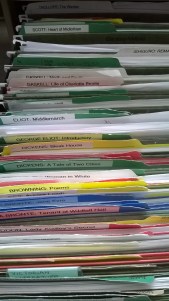 The other thing I have to show for my twenty years — something I benefit from every day I’m at work — is experience! It’s easy to forget, now, how new to all this I was in 1995-96. I was hired while still “ABD” (all but dissertation), and my hands-on teaching experience was limited to two of Cornell’s Freshman Writing Seminars (both capped — ah, luxury — at 17 students) and one stint as a TA (in a 19thC fiction class, too, because there were no first year writing classes big enough to use teaching assistants). The class on Browning’s “My Last Duchess” that I taught as part of my on-campus interview here was quite literally the first time I’d ever stood up in front of a room full of students (not to mention a back row of professors there to see how I did). So my first full-time term was really jumping into the deep end for me. I don’t recall any massive screw-ups beyond assigning way too much reading in my first section of Introduction to Literature and way too much writing in almost every class, because I had no idea how much time it would take to mark multiple papers for a class of 50 or 60. I had the time at first: I was keen to throw myself into a job I was excited about and knew I was lucky to have, and at first I had no children, either. But the hours and hours of marking … on top of having no files of teaching notes or materials to draw on, so absolutely every part of absolutely every class had to be prepared entirely from scratch. Good thing I was so young and energetic! (I was 28 when I came here, which means I was barely older than the first crop of graduate students I taught — in fact, now that I think back, I was actually younger than some of them.)
 Another very simple thing I do is designate one shelf space for each course. Often coming back from class is a distracting time, with students tagging along for conferences or somewhere else to get to in a hurry, so I don’t have time to do fine sorting. Instead, I dump all the class material onto its shelf and organize it when I get my next chance — but in the meantime if I need to find a book or paper from it, my search is neatly delimited. Again, less scrambling! I have a pretty low tolerance for stress and confusion, so for me it’s well worth the little bit of forethought required. When I see offices with indistinguishable brown folders piled in heaps all over the place, I know that — while it must work for the office’s own occupant — I would be a nervous wreck by the end of a single day in there.

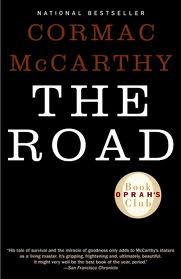

 The second full week of term has gone by already: it’s amazing how time seems to accelerate when things get busier. In both my classes we have moved from throat-clearing and context-setting to richer discussions about our readings: in The 19th-Century Novel from Austen to Dickens, we’ve wrapped up our work on Persuasion, and in Mystery and Detective Fiction we’ve got only one more class on The Moonstone. Starting the term with these two novels eases the transition from summer’s languors to fall’s stresses because both are so delightful. At least, I think so — and it seems as if a lot of students are enjoying them as well. Discussion in the Mystery class has been particularly good so far this term, especially considering it’s a big class (capped at 90), which can sometimes be inhibiting. I hope they keep putting their hands up!
 One thing I’ve been thinking about as our work gets underway, and as I contemplate my own non-teaching ambitions for this term, is trying to make the process as meaningful and rewarding as possible, shifting some emphasis away from the product — which for students is often the course credit or the grade, and for me is the finished piece of writing. I’ve been reading Donald Hall’s The Academic Self: An Owner’s Manual (thanks to



 Novel Readings