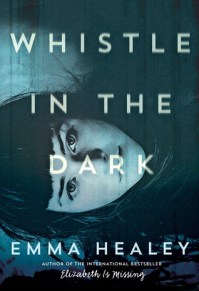
 Once again the two novels I’ve read most recently have, quite coincidentally, something in common, but this time it’s a matter of form rather than content. Both Emma Healey’s Whistle in the Dark and Oyinkan Braithwaite’s My Sister, the Serial Killer are composed of assembled pieces — too long to be fragments, too short (mostly) to be chapters, always with a suggestive or quirky ‘headline.’ This structure made me slightly irritable in both cases. Why is this a thing to do? What’s the point–aesthetic or thematic? It seems to me the novelist equivalent of those long essays (we’ve all read them) that have little rows of asterisks instead of actual transitions between their parts. It looks unfinished to me. Go on, write the whole novel! We can wait to read it until then. 🙂


I find I don’t have a great deal else to say about the novels themselves. I read them both fairly fast and with fairly rapt attention, which is something of an endorsement, though to some extent I think it’s also an acknowledgment that small brisk pieces are easier to consume than dense sustained narratives. (Could that be why … ?) Of the two of them, my strong favorite is Healey’s, which is a searching (literally and figuratively) story about a mother and her difficult teenage daughter, who goes missing for four days and then refuses to say where she was or what happened. Like Elizabeth Is Missing, Whistle in the Dark effectively captures the stress of disorientation, of not knowing, of grasping at an elusive and also frightening truth. It also seems to me a very realistic portrayal of a mother’s frustration with being shut out and criticized precisely because she wants more than anything else in the world to help someone she loves. Even in situations less dire than that in the novel, that kind of emotional push and pull can be exhausting. Whistle in the Dark is grimmer than Elizabeth Is Missing: it has none of the whimsy and poignancy of Healey’s first novel and it takes us (again, both literally and figuratively) to darker places–even though in the end I suppose it tends in a happier direction, as there’s no escape, no epiphany, that can bring Maud back from her lost state, whereas we are left feeling hopeful about Jen and Lana.
My Sister, the Serial Killer seemed to me a deft piece of rather morbid and mordant entertainment: fast-paced, funny–in that “I can’t believe this is happening” way that isn’t really (IMHO) a particularly valuable form of wit, because it relies so much on shock–and superficially provocative. I think I would have liked and admired a novel that really grappled with the kind of conflict Braithwaite toys with: how far do you stand by someone committing unpardonable acts? What context, what background, what loyalty, what principle is worth more to you than holding someone accountable for murder? (This is a standard tool in the crime fiction kit, of course.) To me, however, Braithwaite’s treatment seemed glib and shallow and her protagonist’s choice morally indefensible without being interesting in any other way. Meh. YMMV.
 When you don’t blog for a while, or at least when I don’t, one of the obstacles to getting back into a routine is the clutter of possible things to blog about, which becomes strangely unmotivating because it’s hard to pick one topic and just get started. This is an attempt to clear out some of that clutter!
 The one stand-out experience in my recent romance reading was Kate Clayborn’s Best of Luck, which I did not pick up haphazardly at the library but had pre-ordered on the strength of the first two books in the series, Beginner’s Luck and Luck of the Draw. I liked the first one just fine and then really liked the second one a lot; both have also stood up well to rereading. Best of Luck is a good finale for the trilogy. Like the first two, its biggest strength is its characters, who have both distinct and plausibly complicated personalities and histories and genuinely interesting work to do–something Clayborn gives a lot of attention to. I like that: I have a documented fondness for ‘neepery’ and each of her books offers it in spades. The books are not particularly funny or witty, but they are not ponderous, and they earn their angst rather than piling it on (which is what I thought happened in my one excursion into Alisha Rai). The pacing is good and the alternating points of view for each chapter keeps things interesting as the conflicts develop and then resolve. I realize these comments are sort of generic! But that’s because reading and liking Best of Luck after reading and either not liking or not caring much about a handful of other books in the same genre got me thinking about what makes a romance work for me. Voice has a lot to do with it, and so does freshness, and for me the ‘Chance of a Lifetime’ books get high marks for both.
 The other book I was reading for a while (inspired by my not entirely successful experience with N. K. Jemison’s The Fifth Season) was The Hobbit. It turns out that The Hobbit (like Little Women) is a book I know so well from my childhood that it is almost impossible for me to really see the words on the page. It isn’t so much that I read it often as that my brother had the marvelous
  I’ve been in a bit of a reading slump lately, which has been reflected in the slow pace of my blogging. I’m not sure exactly what is behind it this time, but I think it happens to all of us occasionally, and it always passes eventually. Still, it’s a disheartening phase when it comes, to be picking up books and putting them down again without much caring!
 I also started Lee Child’s Killing Floor, the first of his hugely popular Jack Reacher thrillers. I admit it had never occurred to me to try this series until Stig Abell, the editor of the TLS, sang its praises. I had no particular assumptions about Lee Child, good or bad, it’s just that the books had never stood out to me until Abell said how much he’d enjoyed reading through them all last year–so I picked up a couple at a book sale. I got about half way through Killing Floor before I lost interest. I don’t think there’s anything really wrong with this book any more than there is anything wrong with The Mirror Thief: in fact, I thought Killing Floor seemed quite good of its kind. But for whatever reason I just wasn’t gripped–I wasn’t even slightly curious about how the knotty plot was going to turn out, and so I eventually stopped picking it up again after I put it down. When I started it, it reminded me of Robert B. Parker’s Spenser mysteries, which I love. It is much wordier, and it may be that I wouldn’t enjoy Parker’s books if it took a lot longer for things to happen in them–or if Parker spent as much more time on the really grim bits as Child does here. I also didn’t bond with Reacher. I was intrigued by Child’s introduction, in which he outlines his own motivations for the style of the series as a whole and for Reacher’s character in particular. Reacher is deliberately both arrogant and hard to like, which are not qualities I’m against in principle, in a main character–but again, I don’t imagine I would like Parker’s books if I didn’t find Spenser’s combination of strength and honor so appealing. Maybe I’ll appreciate Reacher more as a character if/when I get to know him better. For now, though, I’ve put him on hold.
 It’s not as if I haven’t read any books all the way through since classes ended. One thing that works is coercion! I’ve read two books for reviews, one an interesting study of Agatha Christie, the other a new novel by Canadian writer Merilyn Simonds. (My review of the former has been filed; my review of the latter is underway.) I’m also making good progress on Margaret Drabble’s The Radiant Way, which I need to finish for next weekend’s meeting of my book club. Deadlines are useful things. In the interstices of my days I’ve also reread all three of

 Over the past week I read three novels. Only one, Michele Roberts’s
 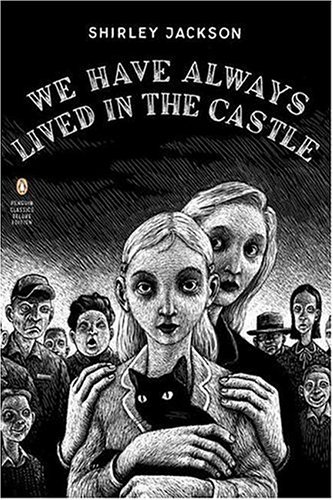 For my book club, I read Shirley Jackson’s We Have Always Lived in the Castle. What a treat that was. It’s like a perverse inside-out fairy tale. In our discussion of it, we got particularly interested in the way it destabilizes our sympathies. There’s the initial instinct to side with the narrator, which of course quickly turns out to be a mistake, except that she is being persecuted–though not unfairly, since after all, she is a murderer. Jackson evokes the horror of mob violence as well here as she does in “The Lottery”: the scene that begins with the fire chief throwing the first stone unfolds in an equally horrifying way–except that at least one of the targets is in no way an innocent victim, and later on, some of the villagers seem to be horrified, in their turn, at what they’ve done. We puzzled over Merricat’s motivation, or rather, over whether she has one, for killing her family. The suggestion seems to be that she didn’t much like being sent to her room without dinner, or in any way being thwarted or crossed. So the murders may be the act of a vengeful narcissist, a spoiled brat gone rogue. On the other hand, maybe there is no reason, which in its own way is even scarier. It’s a brilliantly written little book. I was hooked from the first paragraph, which is a perfect combination of whimsy and menace:
 I expected Sarah MacLean’s The Day of the Duchess to be a lot of fun too, but I really didn’t enjoy it and ended up skimming the last third or so of it just to get to the end. I have liked some of MacLean’s romances a lot, including The Rogue Not Taken, the first one in this series, but this book tilted too far towards the “feels” for me: it’s all angst and yearning, without any frolicking. I’m not necessarily saying it isn’t well done. It’s just that my own taste in romance tilts instead towards comedy. Also, more than I remember noticing in MacLean’s books before, The Day of the Duchess is full of the kind of writing that seems meant to force feelings on you, rather than allow you to arrive at your own reactions–lots of fragments, and lots of single line paragraphs, devices which to me almost always backfire: rather than increasing the impact of the line, they make it seem artificial, especially if the trick is used over and over again. I’ve been trying to think if there are any consistently serious romances that I really like. Laura Kinsale’s Flowers from the Storm is the only one I can come up with. Blame my inner cynic, which, as I’ve said before, makes me accept an HEA only if it doesn’t take itself too seriously.
 Once again, you wouldn’t know it from this blog but I have been reading a lot! Quite a bit of it, though, has been for writing projects — including both reviews I know will be published elsewhere and essays I hope will find good homes. It’s not so much that I don’t want to “scoop” myself; it’s that I have some concerns about repeating myself, particularly if I say something here that I then wish I could put the exact same way somewhere else. Would it matter if I did? Probably not if it was just a phrase here and there, but it is still an inhibiting factor. If there’s just a bit of overlap, surely nobody would care, but it’s something that I do try to keep in mind.
 Today I finished reading Sarah Perry’s The Essex Serpent, which I will be writing up for the July issue of Open Letters Monthly. My initial impression is that it didn’t quite live up to my expectations, or to the hype, but I thought it had a lot of good ingredients — both stylistically and thematically — so my task over the next few days is to articulate what I think they added up to. Sometimes during this process my estimation of a book rises: it can take a little time to discover or understand the kind of whole the parts make. This was certainly my experience with Sarah Moss’s Signs for Lost Children, which I wrote about for
 Finally, last night, for no reason besides personal interest, I started reading Susan Bordo’s
  You’d think from my recent blog posts that I wasn’t doing anything but teaching these days! That’s not quite true, but like a lot of people I know, I’m finding myself too distracted to get a lot of “quality” reading done in my leisure time – what ability I have to concentrate hard I’m expending on work, and on books I am reading for off-blog reviews that have deadlines. The rest of the time my reading alternates between anxiety-inducing news stories and pleasantly diverting romance novels.
 I have some completed reviews that should see the light of day in the near future. One of those is my TLS review of Danielle Dutton’s Margaret the First (which I loved); another is my Quill & Quire review of Jean McNeil’s The Dhow House (which is strange and uncomfortable and gripping); and the last is my review of Yasmine El Rashidi’s Chronicle of a Last Summer, which I wrote last summer and is expected to show up, at long last, in The Kenyon Review Online in early March. Though there are some down sides to all this reviewing, one definite up side is that it has made me a bit more sure-footed as a critic, including with books that are not obvious “fits.” I can’t really say if I am developing my critical voice or style: I’m not deliberately trying to do anything other than what I’ve always done here and at OLM, which is find the best way to express whatever I think about the book. I don’t focus on answering “should I buy this book or not?” — because that’s the kind of review I find the least interesting to read — but instead I try to figure out what kind of book it is and what’s the most interesting conversation for me to have with it or about it. Academics (myself included) often hesitate to get into conversations outside their official area of expertise: this is an anxiety I have largely overcome when it comes to fiction, partly because blogging loosened me up so much as a reader and a writer, and partly because the more I teach, the more I’m aware that my expertise is as a reader — it’s my skill and experience at reading, as much as or more than my body of scholarly knowledge, that equips me to do this kind of criticism.
 As for my romance reading, I’ve been rereading some favorites, just for the good cheer (Georgette Heyer’s Devil’s Cub, for instance, and Tessa Dare’s Any Duchess Will Do), but I’ve also read a scattering of new ones. I have all of Courtney Milan’s Brothers Sinister novels but hadn’t gotten to
  I read Eloisa James’s Seven Minutes in Heaven and thought it was fine — as I mentioned on Twitter, I especially appreciated the heroine’s competence, which is a quality not often portrayed as attractive, and I enjoyed following the character through to their HEA. I also read Fool for Love, which I chose somewhat at random from the ebooks the library had available: I liked the set up but was a bit let down by the conclusion, for reasons I won’t give in case they are spoilers! I have yet to really fall in love with one of James’s novels. They seem very competent and usually keep me interested to the end, but they don’t make me laugh the way Loretta Chase’s do, and I don’t find them as entertaining as Tessa Dare’s (which seem more sprightly, somehow) or as touching as my favorite among Mary Balogh’s. Maybe I haven’t found the right one for me (not all of Dare’s work well for me either, after all).
 Now I’m rereading Ruthie Knox’s Truly: I liked it the first time, partly for the beekeeping ‘neepery,’ and it’s holding up well on a reread. I am starting to feel a bit restless, though, as if it’s almost time for me to read something else again. I picked up Lillian Boxfish Takes a Walk on a recent trip to the bookstore: it looks like it might be a good intermediate step between light and really serious reading.
 It has been a while since I’ve posted, and also a while since I posted a reading roundup! The two things are related: because I haven’t been posting often, it might seem as if I haven’t been reading much, but I have — it’s just that much of my recent reading has been for reviews, which means it feels redundant to post about it, or else it has been light reading I don’t have much to say about. Or, in a couple of cases, it has been books that deserve more to say than I’ve got in me, or that I hoped to have a lot to say about but that came up short. These are the rare converging conditions that are just right for a roundup post!
 My light reading has included some good contemporary romances: Ruthie Knox’s Truly, which I really enjoyed, and two of Molly O’Keefe’s ‘Boys of Bishop’ novels — Between the Sheets and Never Been Kissed. O’Keefe’s are just a tiny bit too angst-ridden to become real favorites of mine: I like my romance with a bit more comedy and a lot less suffering. But both of these authors write well and create convincing characters, and Truly had some really excellent “neepery” about urban bee-keeping. I’ve started several historical romances but tired of them all before the half-way point — including Julia Quinn’s Because of Miss Bridgerton and a forthcoming Mary Balogh, Someone to Love. Not too long ago I read Sarah MacLean’s The Rogue Not Taken, and I did really like that; I think it’s just that for me right now, I’ve had enough of that particular flavor and none of the ones I tried seemed novel enough. I also just finished Sue Grafton’s X, which some of you may have seen me griping about on Twitter. When I say “finished” I mean that once I realized it wasn’t going to pick up, I skipped along hastily until I finally reached its big climactic scene, about 5 pages before the last of its nearly 500. Grafton assembles her pieces competently, and Kinsey’s still a pretty good character, but that book was way too long to be so completely lacking in interest or suspense.
 A book that deserves better than I can give it is
  Novel Readings