Catching Up: Storm Warnings and Summer Reading

arthurbranchesHurricane Arthur passed over us yesterday. Happily, he was “only” a post-tropical storm when he got this far north, but he still packed a wallop. Our particular neighborhood in Halifax doesn’t seem to have been very hard hit. There are some branches down, including some pretty big ones, and we were without power for a few hours, but we got back on the grid before it became necessary to eat all the ice cream (shucks!). We got off lightly, then, compared to many. Here at least, too, the storm was pretty insignificant compared to 2003’s Hurricane Juan, which came onshore full force pretty much right where we live and took out 70% of the trees in nearby Point Pleasant Park as well as many of the biggest and most beautiful ones along our street (the before and after pictures here show clearly what a difference 70% makes).

Juan taught us respect for hurricane-force winds: the high reported gusts yesterday seemed to us good enough reason to keep off the streets and out of the way. So we had a quiet family day inside. Maddie and I did a sorting and reorganizing project in the basement while the lights were still on: its ostensible purpose was clearing out toys and supplies the kids have outgrown (brace yourself for donations, Salvation Army!), but a beneficent side effect is that we cleared three shelves in the bookcases down there, so my next project is reorganizing my mystery collection so the books aren’t two-deep. I also read deeper into King Hereafter (about which more in a moment). Then once we lost power it was, happily, still bright enough by the window to read most of the latest New York Review of Books. Owen has been spending most of his time lately turning a computer game he made into an iOS app (I’m counting on him to finance my early retirement through this or some similar project!) — a nice consequence of his losing power to his desktop is that he headed to the piano for amusement instead, so we whiled away the afternoon listening to his improvs plus some practice time on another of his summer projects, the cadenzas from the Ravel left-hand piano concerto.

We weren’t expecting power back until 9 p.m., but everything lit up again around 7, which was a relief. During winter storms you always have the reassurance that you can keep food fresh just by putting it outside, but the freezer packs we use to keep things chilled in summer wouldn’t probably get us through much more than a day. In then end, then, our storm day was just kind of a quiet break from routine. But we’re back in business today, which, along with making up for yesterday’s missed chores and errands, includes packing Owen off for math camp at Dalhousie. Here’s hoping the restored sunshine doesn’t turn his residence room into a sauna, and (more important) that he has fun bonding with other kids who really like math. He’s read math books for years, starting with picture books like G is for Google and moving on to books like Clifford Pickover’s Wonders of Numbers. He and his dad have also worked their way through most of the Great Courses math options. I did well in math through high school but met my match in first-year calculus, so they leave me behind pretty quickly with this stuff. But in case your kid ever says “what will I ever use this for in real life?” it might be helpful to know that just this week Owen apparently solved a graphics problem in the design of his new game using calculus. Hard as it is for us to believe, he will be applying to Dalhousie for real this fall, presumably as either a math or a computer science major — or both! So this time on campus will be a good preview.

juliejamesweddingAnother summer routine in our household is the library’s summer reading club. Maddie has signed up for it regularly in the past, and I was very happy that she agreed to do it again this year. Like last year, we’ve picked a small quantity of books for her to aim for (10) so that she doesn’t compromise on their quality — also, as usual, she’s got several weeks scheduled for summer camps that never leave time for reading during the day. As always, I’ve pledged to match her book for book (which shouldn’t be any problem for me, I hope!); our last day to meet our goal is September 6. You can see here how things have gone for us in previous years. We’ve both read our first book for this year’s tally: hers was Judy Blume’s Forever, and mine was Julie James’s It Happened One Wedding (which I quite enjoyed, though not as much as her Practice Makes Perfect). I’ve been reading a lot besides that one, but I’m not going to officially count books I read only as “filler” (familiar books I skim through for distraction when it’s too busy to concentrate properly, usually a Dick Francis or a Robert B. Parker, or, nowadays, a Jennifer Crusie or a Mary Balogh). The other real reading I’ve been doing is King Hereafter.  Though it is going very slowly, I’m not at all sorry to be reading it: the first 250 pages were really tough, and even now, at 400 pages in, I still can’t always remember who’s who, or who’s related to whom, but it is working its inexorable Dunnett magic on me, and it’s wonderful to see her working through her great themes (leadership, nation building, love, war) in a different landscape. I’m also part way through A Time of Gifts: it got put aside for other things but not because I wasn’t interested in it. Next up after King Hereafter will be Miriam Toews’s All My Puny Sorrows, though, which my book club has chosen for its July meeting.
The Silver Spoons and the Joy of a Loving Letter

WP_20140625_002Here, as promised, is the story of Stewart and Joan and their silver spoons.

Each Christmas the lot at the condominium get together for a huge dinner, catered, at the swanky social suite on the main floor. Each brings his own plate and cutlery. Stewart donned his neat green jacket and red tie and off they went. That night they discovered the heirloom silver spoons from Joan’s grandfather (who left her the fortune she is enjoying now) were missing. Stewart wanted to post a notice on the board but Joan held him back. “We will be making out everyone is a thief,” she cried. Time passed and now they are in the airport on February 1, ready to go through the gun frisking. Joan slides through then the machine let out a scream when Stewart’s body got in. They frisked him again, more screams as Stewart kept crying he had nothing on his body. Finally he found a few silver coins which went in a saucer and more tests. More screams. Passengers were now getting edgy and the official took a hand-held explorer and went over Stewart’s body pocket by pocket. Lo, when he hit one pocket the machine went berserk, and lo, there was a hole in the lining and in went the silver spoons where they had lain since Christmas. As the official drew them out and all heads craned to see what Stewart was trying to sneak into Hawaii, there was a loud cry from Joan: “MY SPOONS! MY SPOONS!” The official’s face was full of disbelief as Stewart tried to explain the long story and he hustled them through the turnstile. By now red-faced and overheated, they scurried down the aisle to the plane when loud cries brought them up short as the official came up with the silver change they had forgotten to pick up.

I wonder if the pleasure I take in these anecdotes is because when I read them, I seem to hear my grandmother recounting them. “No one can hide themselves in their writing,” she noted in one of her letters; “you just read them, then you know them.” Don’t you think that’s true? I suppose it does assume a fairly direct relationship between writing and identity, without due caution for the conscious and unconscious ways we construct ourselves in words. And yet it also seems a common-sense version of Booth’s theory of ethical criticism: writing always conveys an ethos, a sense of self. From my grandmother’s letters, I can pick out her flaws and blind spots, certainly, but what I see most of all is her zest for life, with all its ups and downs and mysteries and revelations. “I don’t envy people who have tension-free lives,” she writes in one; “how dull it must be.” No one with her flair for making drama out of the mundane could ever be dull, but also growing up in the Depression taught her to appreciate the little things. Reminiscing about her life-long friend Dorothy (shown with her in the 1929 photo on my previous post), she noted that when they were young “the biggest thing was to walk from the west end where we lived up to the old Carnegie library on Hastings Street for me to get my books. . . all we needed was an excuse to go somewhere.” Both the need and the destination sound just about right to me!

Anyway, as I said, I have only a small selection of her letters left, but I treasure them. How she would have loved email! I have a vast archive of messages from friends and family — especially from my dear mother, another excellent correspondent. The form really doesn’t matter: what counts is the connection. As my grandmother says, “Why is it so hard to explain to anyone what a joy a loving and news-filled letter does to the soul? It really is magic.”

“Baking has assumed a sinister character in my life”: Remembering My Grandmother the Writer

hugginsanddorothy
My grandmother (right) c. 1929

My grandmother Louise Spratley was a real force in my young life: one particularly memorable thing she was responsible for was arranging for me to go backstage at the Vancouver Opera to meet Joan Sutherland. She died in 1993; I’m reminded of her often, not least because as I get older I look more and more like her. June 24 was her birthday, so in memory and celebration, I’m reposting this piece about her from my archives. When I posted it originally I said that I would follow it up with her story of Stewart and Joan and the silver spoons; this time I will do that, I promise, so stay tuned.


My grandmother was a remarkable woman–energetic, vivacious, difficult, independent. Above all, she was what she called a “word person”: she loved to read, and nearly half way through her life she discovered that she also loved to write. In 1955, after staying home for years to raise my father (her only child), she launched a new career for herself by offering to do a gardening column for the local paper, the Lions Gate Times. As she tells it, the editor learned she had once trained as an accountant and asked her to help with the books. Eventually she was sent on her first assignment, to cover a municipal council meeting. She had no training as either a writer or a reporter.  She recalls,

I carefully wrote down every word, shaking with insecurity and fright, and filled the front page on press day. The mayor commented, “the best coverage we have ever had.” That was the beginning of my writing career. . . . The writing was easy. My drive came from an insatiable curiosity and an unquenchable urge to tell everyone what I found interesting.

Everyone who knew her would agree that she never lost either that curiosity or that urge to share her enthusiasms, which is one reason her letters were always such fun.

Editor, Lions Gate Times, c. 1965

In 1959, she became editor of the paper, which under her management was named “best community service paper” by the Canadian Weekly Newspaper Association,  and her features on local issues won awards–including the MacMillan-Bloedel journalism award in 1966. She also did travel features, including several pieces on a trip to Germany in 1964. This anecdote, sadly, was not in the published version, but she wrote it up for a scrapbook she made for me about her work. It gives a great sense of her indomitable spirit, headlong writing style, and sense of humor:

My first trip to Germany was done in style–six people on Air Canada’s biggest jet; champagne all the way; playing bridge with the crew and ending up with a police escort to our destination in Hamburg.

It was a heady experience. The reporter from Sports Illustrated, NY, Tom (the CBC engineer from Montreal) and myself stayed at the same hotel for the ten days we were there. Near the end, the New Yorker went off to Denmark and I wanted to see West Berlin so Tom crept along. Tom was about my age, very tall with a small moustache. He was not an outgoing person, sort of mentally huddled, but pleasant enough to drag around with. He was drawn to the beer halls and me to the opera. Neither of us could understand the other’s tastes.

We had a small crisis in Berlin. We sought out the efficient hotel advice expert at the airport when we landed to find the city crawling with conventions. Not a hotel room to be found. I cried out in despair. What would we do? More phoning brought up a room in a pension with a double bed.

Tom had been lounging at the door but at this good news he turned linen white and seemed about to faint. However, I had no urge to sleep on a bench in the park all night and briskly took the room, feeling we could cope with the facilities later that night. . . .

Tom was inside our room reading when I got back and I decided on strategy. I had no illusions that my elderly presence and pinched face would set his blood boiling, so I just said, “Tom, you put the paper over your head while I get undressed, then it will be your turn.” He uttered not a sound and promptly obeyed.

I got into bed, he mumbled he was going to read, and I lay, stiff and uncomfortable, on the edge of the mattress. But I had forgotten the toll on a body of an early flight, incessant sightseeing, the Mexican show, and the tension of one bed. The next thing I knew it was 8 a.m. and Tom was snoring merrily beside me. We had a big laugh, launched into the trip to East Berlin and then flew back to Hamburg.

The newspaper stories themselves are wonderful time capsule pieces. “West Berlin is one city in the world where a tourist will never see a ‘Yankee Go Home sign,'” one of them opens,

Why? Because this free city, in an unfree, Russian-occupied East German zone, owes its very life to the benevolent protection of the United States.

It is true that the three western allies are committed to defend Berlin. But a traveller quickly learns it is to strong and democratic America that Berliners have given their hearts.

The flight from Hamburg to Berlin–it only takes an hour–is an eerie one along the 20-mile-wide corridor paced off by the Russians. . . .The Wall, an unbelievable object, runs 30 miles through the heart of this beautiful city. A German businessman told me passionately that it was not a wall but a wound cut across the body of Berlin, with the flesh dying on either side of it.

She loved politics (“I found I was what is called ‘a political animal,'” she says), and in 1968 she took a position as Special Assistant to Jack Davis, the federal minister of Fisheries and Forestry. After her ‘retirement’ in 1974 she continued to do freelance writing and editing projects, the biggest of which was the 1980 West Vancouver Community Plan, a project which reflected her deep love for local history and for the community where she lived.

At my U.B.C. graduation, 1990

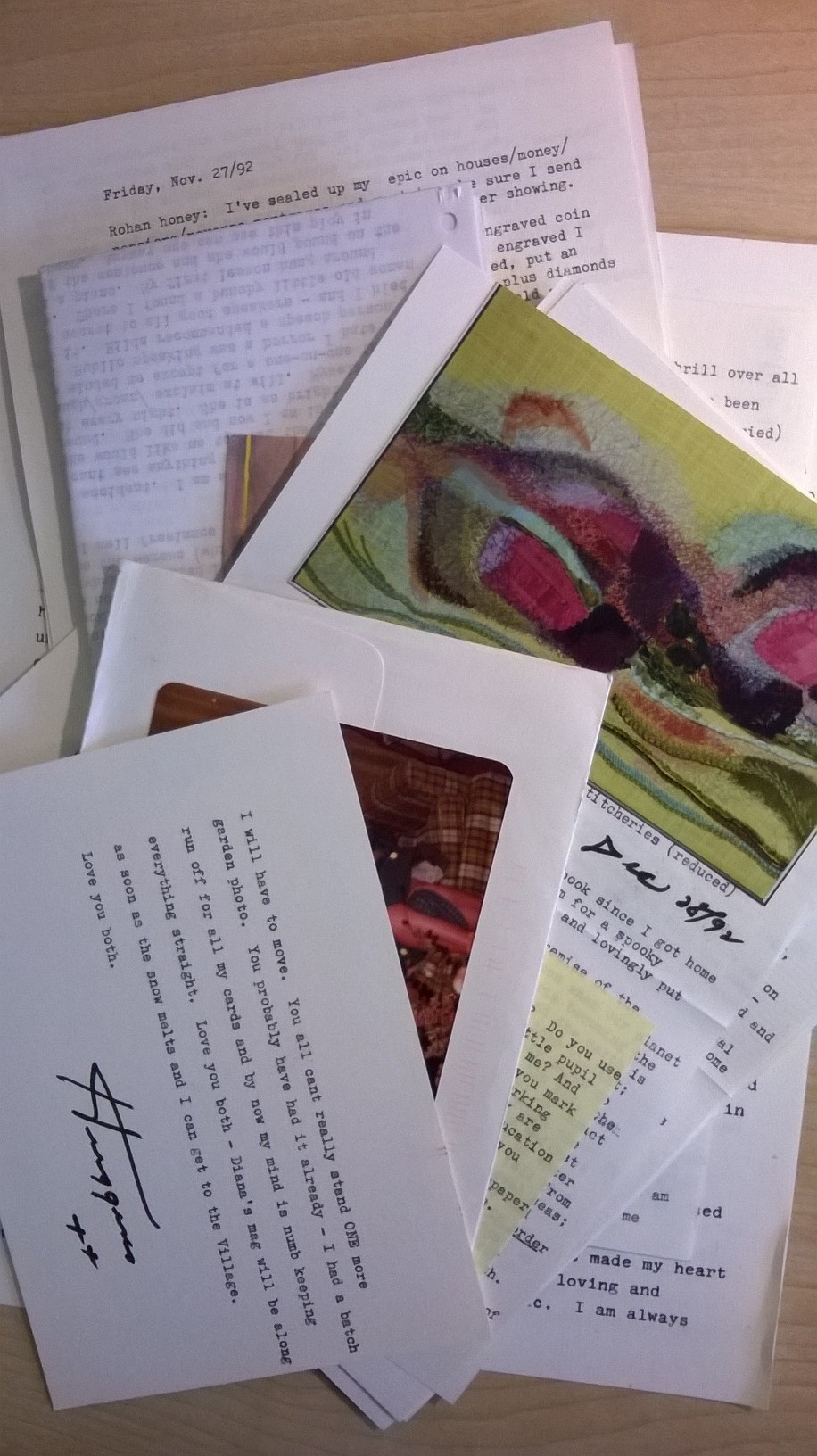
I wish I had more of the letters she sent me over the years. We used to have long phone conversations too, but she always loved to rattle off her correspondence on her trusty manual typewriter, full of anecdotes and excerpts from her current reading. An ardent natural history enthusiast, she had a particular fondness for earthworms and often wrote about their contributions to our world (she would have loved George Levine’s podcast on ‘worm excrement,’ I know). In one of the letters I do have still in my box of family papers she has been reading a Carl Sagan book we’d sent her for Christmas–it was 1992, so I think the book may have been Shadows of Our Forgotten Ancestors–and after several paragraphs of excited summary there’s this:

I’ve come to the part where Sagan says, “It seems clear there is only one hereditary line leading to all life now on earth. Every organism is a relative, a distant cousin of every other. This is manifest when we compare how all organisms on earth do business, what genetic language they speak. All life is kin.”

I love that. Rohan, we are brethren of our worms that so fascinated us.

She was always so confident that her fascination would be contagious–and usually it was. She also could not resist making a story out of everything that happened, a trait that could sometimes be tiresome if you happened to be a character in one of them and weren’t sure her version represented your truth, never mind the truth. Here’s one that made me laugh and then cry a little bit, because it brings her back so vividly. It features her very best friend of many years and his long-suffering wife, who patiently tolerated their great closeness.

My news is all wrapped up with Stewart. He and Joan went to Hawaii for 2 weeks and arrived home Monday. It was the day I decided to make muffins. Baking has assumed a sinister character in my life. I hate it now and am glad my feelings parallel Dorothy’s so I know it is endemic with the elderly. Anything to put off even boiling an egg. But I decided to make bran muffins for health’s sake and my doctor’s orders and instead of getting dressed and clearing off the sink and lining up the ingredients like sensible people do I rushed into it in my usual sloppy fashion with my old dressing gown with its floppy sleeves in the act as well. I became depressed when I forgot if I had put 2 cups or 1 of brown sugar into what I was blending then hand beat up the eggs and when the handle got caught in my sleeve and whipped the eggs onto the carpet I was ready to throw everything into the garbage. But I pressed on which turned out to be a bad decision. I floundered along with the huge recipe — it makes 30 muffins — and flour and bran and chopped dates were all over the place as I got sick of the act and dumped everything in one huge bowl instead of folding and delicately coupling wet with dry as the recipe says. I then got the muffin cases in the pans, all 30 of them, and started to ladle out the sticky dough. By now it was over my fingers and I was wiping them on my dressing gown when the phone rang and I rushed to answer it. WHY? Don’t ask. Over the wire came the thrilling, sonorous voice — “greetings from Aloha!” It was Stewart, fresh off the plane and full of joy and good will. My eyes looked at the mess of dough and the 30 little beds awaiting it and decided it was not the time to have one of our long visits so cried that I was muffining and would call him back. He did not understand and waited 5 minutes with phone in hand for the sound of my voice. We finally got connected again and well into the news of Hawaii. . . . By this time my muffins were busy in the oven and a nice fragrance came into the office, followed by a darkening overtone. I searched my soul to cut my friend of 35 years short in his high-spirited saga of lotus land and felt the damn muffins were not worth such a long friendship. . . . We finished our talk on a high note and I drew the muffins out — burned thoroughly at the bottom and around the edges, and so well-cooked they fell apart when I tasted one. I stuffed the 29 in a plastic bag and threw them in the freezer and cleaned up the joint. Well, I had to, as Stewart was on his way, “with a gift,” he says.

 There’s a lot more to be known about my grandmother and her family. For instance, my great-aunt, her sister Hilda Cryderman, received the Order of Canada for her efforts on behalf of women’s rights, especially her advocacy for equal pay for women teachers. If some enterprising historian with B.C. roots ever wants to undertake a family history, let me know! (Helen? What do you think?)

Back from Boston Bearing More Books!

photo

I’m back again from another trip to Boston, where I went for another of our more-or-less-biannual Open Letters Monthly editorial summits. Along with the pleasure of seeing my colleagues face to face comes the treat of visiting some of Boston’s many excellent bookstores. I brought back a more modest stack than last time (or the time before that): it’s dimly possible that I was chastened by my awareness that I have only just read some of the books from those previous expeditions (not that the others are wasting away – they are just still ripening on the shelf!). It was as much fun as ever lingering luxuriously over my options, though, and I had very good luck finding some things I have been particularly looking for.

One writer I’ve often been advised to try, especially because of my interest in philosophical fiction, is Iris Murdoch. I’ve gotten a lot of different recommendations on which novel to start with; of these, The Sea, The Sea (which won the Booker Prize in 1978) has always seemed like a good option, so when I saw a nice copy of it at the Brattle I grabbed it up. My recent reading of Angle of Repose had me on the look-out for more Wallace Stegner (the only other one I have is Crossing to Safety), so The Spectator Bird (which won the National Book Award in 1976) was also a happy find. My other Brattle pick was Janice Radway’s Reading the Romance, which I spotted on one of the dollar carts. It’s clearly a student copy (there’s a Brown Bookstore tag inside, and a lot of purple underlining), but it’s otherwise in good shape.  Even before I started reading romance novels  I knew that Radway’s was one of the key studies of the genre, and now that I have a little more experience both with the books themselves and with the interesting conversations people have about them, I’m curious to have a look at her arguments for myself. (The book is 30 years old now, and I know the field of romance studies has changed and grown a lot since it came out. But my guess is that a lot of those conversations still start with frameworks she set up.)

I usually love browsing the vast stretches of shelves at the Harvard Coop, but this time I actually found it a bit too much trying to make my way along them. Instead, I hunted up a few titles I have been wanting but unable to get a look at locally and finally settled on Dorothy Dunnett’s King Hereafter. It’s no secret that I am a ridiculous fan girl about Dunnett’s Lymond series. I love it so much I have never really wanted to read anything else by her…which is irrational in all kinds of ways! I have the first in the House of Niccolo series and one day may follow through on those, but I’ve heard from a few readers that King Hereafter (in which, the blurb tells us, she “peels away a thousand years of legend to uncover the historical figure of Macbeth”) is actually her very best historical novel. Better than The Ringed Castle? Incontheivable! But OK, I’m game. Stay tuned for a full report.

I was specifically hoping to find W. G. Sebald’s The Emigrants on this trip. I looked for it a few places and finally spotted it at the Barnes & Noble in the Prudential Center (where one or two of the OLM team can be found working most days of the week). Sebald is a writer I hear about often (most recently, in Tom’s comment here).  I bought Austerlitz a few years ago and have started it once or twice but put it aside — it’s still ripening! The Emigrants looks like it might be a bit more accessible to me. Again, stay tuned!

We made a pilgrimage to the OLM post office box, where Steve unpacks an astonishing haul of books almost every day. Fortuitously, the day I was with him one of them was an advance copy of the third book in Elena Ferrante‘s Neapolitan trilogy, Those Who Leave and Those Who Stay, which I promptly took possession of. Then at the Harvard Book Store I picked up The Days of Abandonment. So I’m all set for harshly unsentimental Italian fiction.

I guess I’d better start reading if I’m going to get through all of these before my next trip! Though maybe I should start with those Ivy Compton-Burnett novels from my first visit…

This Winter Term: Some Small Good Things

1005017_10152126924015803_2115018870_nI may have been in Nova Scotia almost 20 years, but it’s no secret that I have not adapted well to east coast winters. I complain about them a lot! It’s not even the cold and damp I hate so much as the stress of driving in snow and ice. If I could hibernate, or just opt out of work, school, appointments, and grocery shopping whenever the roads are bad, I might shut up about winter!

However, this particular winter (though the weather so far has been dreadful) I’m feeling grateful for a number of small things that are making my term easier. If I write them up here that will make it harder for me to forget them the next time there’s freezing drizzle on top of a foot of snow and everything starts looking bleak.

1. This is my first full term with a reserved parking spot. What a relief! Not only can I drop my kids at school without either forcing them to be uncomfortably early or fretting that I’ll arrive on campus too late and be stranded, but I can even leave and come back during the day if I want. Or make a morning appointment off campus and still come in to my office after. This flexibility would have been even nicer when the kids were smaller, but even now it sure feels liberating not to be worrying about this logistical issue every day.

2. This is my first term in many years without a 9:30 class. Happily, I have long managed to avoid 8:30 classes (by nature I’m a night owl, not a morning person), but even a 9:30 class means having very little prep time in the morning, which means knowing you have to arrive on campus basically ready to go, which means often doing prep in the evenings. I’m sure I’ll still do some reading or marking or making up handouts after dinner, but not as often, and at the very least I’ll know I have plenty of time to do things like finalize notes or print and copy materials on campus before I have to head into my first class.

3. And speaking of classrooms, for the first time that I can remember my classes are all meeting in the same building that my office is in. This is a huge break during the winter term! Not only will I save all kinds of time putting on winter gear and trekking across campus and back (and, of course, also miss the unpleasantness of going outside repeatedly in cold, wet, blustery weather), but I don’t have to teach in my winter boots in my usually overheated classrooms. Plus if I forget something, it’s literally right upstairs, so I don’t have to check and re-check the contents of my folders and bags quite so obsessively. Win! This is possible because …

4. I have a very modest number of students this term: only 2 classes, with 30 in one and 22 in the other. Classrooms in this building officially hold 36 students; my classes capped at 40 used to get scheduled in here regularly anyway but apparently the fire marshal has gotten serious and as a result (because they are pretty much always full) I’ve been exiled for them – and classes capped at 60 or 90 (like Mystery and Detective Fiction) of course always have to be elsewhere. So: more intimate groups, less marking, more discussion instead of lecturing, and all in one building. Hooray!

5. Finally, and not specifically teaching or work related, I just discovered Sun Butter. It really does taste just like peanut butter! I used to love peanut butter, but since my daughter was diagnosed with a severe peanut (and tree nut) allergy over a decade ago, we haven’t had any nut products in the house. Sun Butter is completely nut free! (It’s made of sesame seeds.) I always doubted the nut-free alternatives but a friend assured me she even preferred this to the real thing so I finally risked it … and it’s good! I’ve never resented going without nuts at home (it’s actually easier, too, than worrying about cross-contamination — we can all just relax and eat), but it’s nice to have an old favorite so nearly restored to me. And if I get more protein in the morning and that gives me extra energy, that may indeed be a plus for my teaching term.

You see? I said these were small good things*, but they add up! I’ve been surprised, actually, what a difference the first three especially are making to my frame of mind during what is usually such a stressful time. Do you have any small (or big!) changes this term that make your days a little better? Or any that you wish you could make?

*A small bad thing is that the fiction anthology I’m using doesn’t include “A Small, Good Thing,” which is one of my favorite short stories. But you can’t have everything!

Holiday Traditions

Tree 2013

On Sunday, while the snow and sleet and freezing rain made a mess of things outside, we stayed cheerful inside as we carried on one of our favorite holiday traditions: decorating our Christmas tree while listening to Michael Bawtree’s recording of A Christmas Carol. There aren’t a lot of activities, holiday-related or otherwise, that all four of us are equally enthusiastic about, so one reason this is such a special time is that we really feel together during it — even though we all  participate in different ways (Maddie and I do the actual decorating, while the other two get cozy and just listen).

Rituals of one kind or another are of course fundamental to a sense of belonging, whether to a family or to a community, and one feature of academic life that I’ve written about here before is that because you rarely get to choose where you settle, you’re likely to be transplanted, and thus to be disconnected from the traditions that helped shape your identity. That’s not always a bad thing, I realize: when you are separated from your family it’s perfectly possible to idealize proximity! But rituals are something my own family was (is!) always very good at. Things weren’t absolutely the same every year (we used to joke about coming up with “brand new traditions”) but when I think back on my childhood I remember fondly (to give just one example) how we would “always” play charades until midnight on New Year’s Eve and then wait on the front porch until we heard the ships in the harbor before banging wildly on pots and pans to welcome in the new year. (We weren’t the only ones in the neighborhood who did this, so it didn’t make us pariahs…I don’t think!)

When my husband and I were first married, we usually traveled to stay with one or the other of our families at Christmas, but winter is not a good time for trips, especially if you’re teaching on both sides of the break. Then after we had children, the increasing costs and complications made our decision to stay home overdetermined. We’ve had the occasional visitor out here, if not for Christmas itself, at least for the lead-up to it (and one memorable year, because my brother was also living in Halifax, all the rest of my family came out!), but now by and large the four of us are on our own through the holidays, and we’ve gradually figured out what traditions work for us. The tree decorating is one. Another is an adaptation from my past: one of our traditions was “Advent Brunch,” a festive occasion usually on the first Sunday in December which marked (for our wholly secular family) the launch of the Christmas season. We broke out the holly-patterned china and the Santa decorations and the Christmas mugs and all the other paraphernalia that of course can’t have been, but seemed, eternal. We unpacked the Christmas records, too, and the books, and we got tiny presents (I especially remember, because I still have most of them, the new holiday pin tradition!).

Advent Treats

Something like this (though with a more modest menu and not quite so many trappings) has also become part of the Maitzen Family Christmas. We try to stick to the rule that there’s no (or very little) Christmas activity before then: though local stores had their Christmas stuff up before the Halloween decorations had quite come down, there were no carols or decorations in our house before December 1!  (I’m with Monica: “Rules help control the fun!”) The kids mock me about this rigidity sometimes, but I think they actually appreciate that special occasions stay special because they aren’t every day.

One ritual we came up with ourselves is our unusual strategy for gifts: we dole them out one per day once school gets out, keeping things relaxed and allowing time for appreciation and gratitude. We used to go on a Christmas lights drive around town on a suitably ice-free night; this tradition was cut short by a tragic car-sickness episode a couple of years ago … but we used to really enjoy it, so we are weighing the risks of trying again. Or maybe bundling up for a Christmas lights walk around our quiet neighborhood: that might make an excellent brand new tradition! Then there are the Christmas movies: we all love The Muppet Christmas Carol, so that’s another good time for togetherness, and then different combinations of us can be counted on to watch ScroogedWhite ChristmasA Miracle on 34th Street, National Lampoon’s Christmas Vacation and It’s a Wonderful Life at least once over the school break. All through December, we also enjoy our Advent calendar routine: we have one that has an (abridged) installment of A Christmas Carol for each day, so the kids take turns reading it — and, lately, acting it out (as of today we’re up to the Ghost of Christmas Yet to Come). This year we got another beautiful calendar that has an ornament in every window that then gets hung on the tree you can see as the centerpiece in the picture of our Advent Brunch table.

Holidays 2010 028

Because of our one-a-day present opening, Christmas Day itself is not the hyped-up occasion it is in many households, but we do keep up the tradition of putting out and filling Christmas stockings. I find it’s an excellent way to restock the kids with socks! I have a lot of fun picking out other little goodies for them too, and I keep up another of my family’s traditions by always topping the stockings off with a book. We have a traditional Christmas breakfast (pancakes) and dinner (roast pork with fixings), and dessert (apple crumble). The predictability adds to the pleasure: for one thing, it makes the preparation easier, and we all know we will enjoy the results. (Last year I actually made the radical decision to serve lamb instead. It turned out well, but it also turned out that Maddie doesn’t like lamb and we don’t like it a lot, or not as much as we like the pork — so this year we’re going back to the usual, though I have flirted with doing roast beef, which is what my grandmother “always” served us when we went over to her house for Christmas dinner.)

We’ve arrived at our family traditions through some trial and error. It was important to realize that we needed to find rituals that worked for us, with all our quirks and idiosyncrasies, rather than trying to relive our childhoods (or at least not entirely!) or live up to some imaginary ideal of what families should do on holidays. It turns out that we like things quiet: we’d rather see a few friends than have a big party (or go to one); we have no urge to stand outside in a crowd to cheer in the new year but prefer to watch a movie and turn in when we’re tired;  a holiday for us means time with fewer obligations and stresses, not more. Every so often it seems a bit too quiet to me, especially when I get reports from back home about everyone going to and fro and having all kinds of sociable fun. But we rush around a lot as it is, and so now, really, my favorite tradition of all is just taking my book and my Baileys and sitting to read where I can bask in the calming beauty of the tree.

Do you have holiday traditions you particularly enjoy? I know I’m not the only one who’s far from the people and places, and thus rituals, that I grew up with: what brand new traditions have you developed that work for you where you are now in your life? Do you embrace the quiet or relish the social whirl?

Open Letters Monthly: The December Issue (With Bonus Crochet)

brattle

Once again we mark the beginning of a new month with a bright shiny new issue of Open Letters! And once again it shows off the range of readers and writers involved with the site.

We lead off this time with our annual Year in Reading feature (Part I, Part II). My contribution won’t surprise any regular readers of this blog, but there’s lots else to interest you: Colleen of Jam and Idleness (and now of Open Letters! hooray!) reports on reading time happily spent in 19th-century France; Steve Donoghue reminds us that for sheer physical pleasure, print books still beat out digital; John Cotter has been reading short stories that blew his socks off; Lisa Peet has been in a Jane Gardam phase; and that’s only for starters. Other pieces address Chagall’s Christian iconography, Doris Kearns Godwin’s The Bully Pulpit (that’s Steve again!), Michael Johnson’s extraordinary search for Solzhenitsyn, John Ford’s ‘Tis Pity She’s a Whore (that’s Colleen again!), Helen Fielding’s new Bridget Jones novel (me again!), the life and writings of Giacomo Leopardi, and more that you’ll have to click on over to find for yourself.

I was proud of myself for getting a review done during this fairly busy month. It became conspicous to me towards the end of the month that the real casualty is actually this blog: if I’m working on a review, it takes up a lot of the time I have for non-work-related reading and writing. So on the one hand, it’s a good thing to be turning out more polished pieces more often and building up experience writing more ‘on demand’ and less on my whim — but on the other hand, especially since it has been a while since I reviewed a book I was really enthusiastic about, it makes me feel a bit stifled.

Crochet
Look what I made!

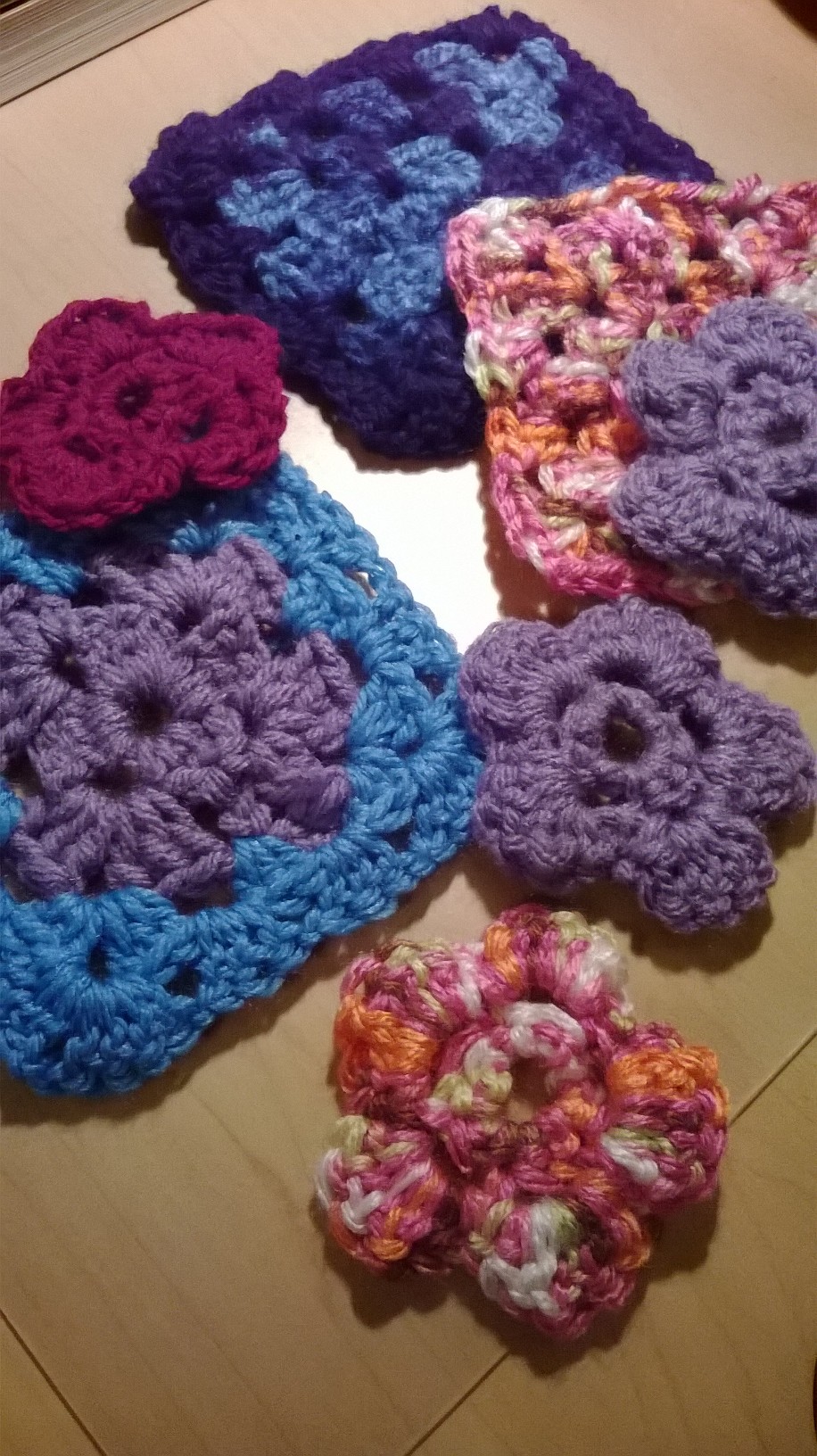
In unrelated news, when I’m not reading, writing, or working (or reading and writing for work!) I’ve been trying my hand at crochet. I got it into my head to learn crochet a couple of months ago, on the theory that it might be something I could do better than I knit (I like knitting but have no head for patterns or fancy stitches, and after a while ribbed scarves aren’t that fun to make). I like doing cross-stitch but it’s fussy and hard to do when I’m very tired (which is when I stop reading / writing / working) or while watching old episodes of ER* (which is how I currently recuperate from too much reading / writing / working). I think I was right that crochet will suit! I had a rocky — or perhaps I should say a tangled — start, but I have more or less got the knack of the basic stitches now, and a couple of weeks ago I successfully completed a basic “granny square.” It probably says something about the ways in which other aspects of my life are fraught with intangible frustrations and deferred outcomes that I am so very pleased with learning how to make something I can quite literally hold on to – even if by serious crochet standards my technique probably has a long way to go. I’ve gotten very ambitious and started stockpiling coordinated squares for an afghan, to give my father as a Christmas present. I’ve warned him, however, that at my current rate of production it may be just a little late.

deptmtgcrochet
Afghan-in-progress!

*Speaking of ER, I’m realizing all over again what a good show it was — much better than Gray’s Anatomy. Are there other ER fans out there?

(Flickr photo of the Brattle Bookshop courtyard.)


Vancouver: By the Books!

I’m back from my trip to Vancouver. Including travel days, I was on vacation for 11 days, making this the longest trip I’ve taken in ages. It was wonderful to spend so much time with my family and to meet up with so many of my friends — among them the wonderful Liz of Something More, who is every bit as smart and witty and energetic in person as she is online. A special treat was getting to know my newest nephew, who made it to almost three  before coming face to face with his Aunt Rohan. There was lots of good food and drink and general conviviality; the weather was spectacular, and so, as always, was the scenery. A small sample will make you wonder why anyone bothers vacationing (or, for that matter, living) anywhere else:

IMG_1810
Sunset at Kits Beach


IMG_1868
Along the Seawall


IMG_1817
The Beach at Spanish Banks


IMG_1798
Along Kits Point


Plaza at Granville Island
My happy place:
the deck at Granville Island Market


But enough about all that! This is a book blog, so of course what you want to know about is whether I had any bookish adventures along with all that socializing and sightseeing. Well, of course I did. Here’s the stack of books I either read, bought, or borrowed on my trip:

Vancouver Books I

The Woman Upstairs and Jane and Prudence were the books I brought along to read on the plane. Barbara Pym was excellent company from Halifax to Toronto: I appreciated her much more after reading Harrison Solow’s Felicity & Barbara Pym, so I was happy to find when I arrived in Vancouver that my mother had helpfully picked Excellent Women and A Glass of Blessings from her collection and put them out for me. As you can see from the picture, I have “borrowed” them to read at my leisure! (I promise, I will give them back to her … next time she visits me here. See how cleverly I’m adding in incentives for her to come all this way?) The Magnificent Spinster is hers as well: one of the fun things about visiting my parents is exploring their incredibly well-stocked and various shelves, from the rows of vintage Penguin Classics in the living room to the mysteries shelved two deep in the study to my mother’s Bloomsbury nook:

Bloomsbury Corner

From Toronto to Vancouver I made good progress on The Woman Upstairs, which I had suggested for my F2F book club for August; I finished it up a day or two after I got there. I was pretty disappointed in it: it seemed heavy-handed and straining towards significance. Nora’s anger was particularly uninteresting to me, largely because it was so insistent. Though the overt allusion is to Jane Eyre, I found myself thinking more about Villette as I read it. Lucy Snowe is a much more layered and complex character — or perhaps I should say characterization: Brontë gives us mysteries, deception, and self-deception where I felt that Messud gives us mostly clichés and plot twists. And speaking of twists, the one at the end is painfully predictable, isn’t it? I ended up feeling that I had once again made the mistake of following the hype. But perhaps as I think it over more, and after we’ve discussed it in our group, I’ll realize how this preliminary reaction is inadequate.

Also in the pile is Arabella, which I bought myself as a treat at the big Chapters downtown. I ended up reading most of it on the flights home: it was sweet and cheerful and not too demanding, which is just about right for a stressful flying day. (Overall I was pleased with how well I handled the flying on this trip — there was a minimum of armrest clutching, for one thing, and my “self-talk” strategies were more effective than usual, even during turbulence. Still, even at its best it’s a crowded, uncomfortable, and disconcerting experience, isn’t it?)

My other purchases were from Hager Books, one of the very few independent stores left in Vancouver. From their carefully curated selection, I chose Gift from the Sea, which I was inspired to buy because of Litlove’s wonderful essay on Anne Morrow Lindbergh in the April issue of Open Letters Monthly. I had planned to read it on the plane home but didn’t feel well enough to concentrate on it, so now I have it to look forward too. And I chose Robert Hellenga’s The Sixteen Pleasures for the contrasting reason that I’d never heard of it (or him) before and was intrigued that Hager had several of his titles in stock, as if he’s a readerly favorite. Besides that, of course, I also thought it looked interesting! Has anyone read any of Hellenga’s novels? If you hated them, probably best not to tell me that I may have wasted my Hager’s opportunity on the wrong thing!

In the Woods is there because I ordered a book for a gift to be sent to Vancouver ahead of my arrival, and I wanted something to add it so I’d get free shipping! I chose it because Tana French is a name that keeps coming up when I ask for mystery recommendations. I’d been avoiding it because it begins with bad things happening to young children, but I need to refresh my mystery reading. (Pretty soon, in fact, I have to order books for another round of the ‘Women & Detective Fiction’ seminar, so you’ll be seeing more questions about that here later.)

palfreyThe book I liked best of the ones I read on my trip is actually not shown here because I finished it and decided I really shouldn’t kidnap yet another of my mother’s books. It was Elizabeth Taylor’s Mrs. Palfrey at the Claremont, and it is by far my favorite of the novels by Taylor that I’ve read. It’s got the same clear-eyed, almost ruthless perspective on people’s foibles and self-deceptions but is also both funny and poignant. It was on the shelf next to Mollie Panter-Downes’s One Fine Day, which I did make off with. Really, if I lived in Vancouver, I would hardly need bookstores or libraries at all!

And now, back to my regular life. . I’m pleased with how much I got done on different projects before I left, including the Middlemarch for Book Clubs site, the reviews for Open Letters, and the draft of the Dick Francis essay (now in the editor’s hands); it’s time to think about how I want to use the rest of the time I have before teaching once again becomes the #1 priority. First, though, I have to get over my jet lag …