Open Letters Monthly and Other December Reading

Books

It’s up: another new issue, and this one is as wide-ranging but also as deep as any we’ve published in a while. A small sampling:

Sam Sacks on James Wood and the Fall of Man:

But Wood’s story works brilliantly if it is taken as just that, a story—if it is read conditionally and gleaned for the truths of a work of fiction. Wood personifies the novel; he sets it on a quest, as in a Bildungsroman. He puts it through a crisis of faith and then follows it past obstacles and blind alleys, through low periods of stasis, and into the fugitive joys of innovation and discovery. Most powerfully, he animates the novel with a very human desire: like Thomas Bunting, and like Wood himself, it seeks freedom—from the outdated customs of its upbringing and the fear of public disapproval. Most of all it looks to throw off the chains of self-consciousness, or, to borrow a description from his collection The Fun Stuff, to get away from “the overbearing presence of the self, the insistent internal volume of the self, the dunning inescapability of being who one is.”

Alice Brittan on Colm Tóibìn’s Nora Webster:

Like the painters he admires, Tóibín is devoted to revealing the interior life of the individual, the emotions and thoughts that people hide even from themselves and that you can only see by looking closely and for a very long time. He writes the calmest prose I know. There is nothing showy or grabby about his sentences, and his narrative structures are fairly straightforward. Yet no living writer seems wiser. Few are as moving. “You want plot, read the newspaper!” he said in a recent interview. Tóibín is more interested in the moment when the action stops, and in people who look forward to getting home, shutting the front door, and quietly thinking it all over.

Steve Donoghue on yet another biography of that ‘pestiferous little Corsican,’ Napoleon Bonaparte:

veteran biographer Andrew Roberts this book season has produced an 800-page biography of Napoleon Bonaparte, and the mere thought of such a thing, let alone the brick-solid reality of it, is an extravagant, almost insulting imposition on the carefully-rationed spare time of his readers. Bonaparte is one of the most exhaustively-studied people in history; in less than a decade, we’ve had gigantic one-volume biographies, gigantic two-volume biographiesgigantic reprints of earlier biographies, studies of the Russian campaignthe Egyptian campaign and dozens of other studies large and small. Bonaparte’s every move has been scrutinized, his every utterance parsed, his locks of hair CT-scanned as often as any Egyptian mummy; no matter how galling it might be for professional historians to admit, there are no substantial secrets remaining in his life.

Greg Waldmann on Leon Panetta’s unworthy Worthy Fights:

Just as Panetta writes himself as a cliché, many of the people he writes about become clichés, and most of his ideas are clichés, too. Political memoirs are often badly written, so in a sense this is no surprise. The genre, however, is a deformed species of apologetic literature, and the way in which these former leaders go about justifying themselves is usually revealing in other ways. George W. Bush’s Decision Points was like its author: Manichean and self-righteous, yet fundamentally insecure. Dick Cheney’s memoirs were contemptuous and not a little sinister. Donald Rumsfeld’s were combative and condescending, quarreling in end notes about semantic minutiae. Worthy Fights, like its author, is stultifyingly conventional, cozy in its Washington milieu, grinding on for page after page of received wisdom and unexamined assumptions about people and the role of American power in the world.

There’s much more equally interesting and worthy of your attention, on topics from Norman Mailer’s letters to contemporary Serbian fiction, from new poetry to the collected stories of Frank Herbert: I hope you’ll head over and explore for yourself. I’m represented this month only through my behind the scenes editing work and my contribution to our annual Year in Reading feature, where my comments about discovering that there’s Dorothy Dunnett beyond Lymond won’t surprise any regular readers of this blog.
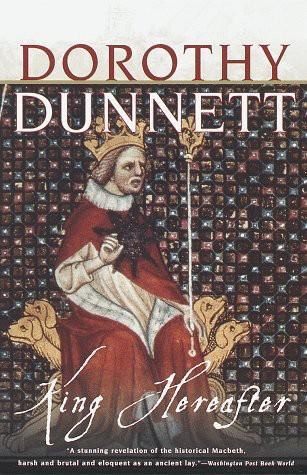
kinghereafterI am, however, represented in a couple of other publications this month — one of which is actually Whispering Gallery, the journal of the Dorothy Dunnett Society, where my essay on King Hereafter is being reprinted. Whispering Gallery is available in hard copy only, to members of the Society. I’ve never been much of a joiner (I don’t even belong to the George Eliot Fellowship! and I’m just a little bit scared of the enthusiasm manifested by the members of the Jane Austen Society of North America …) but Whispering Gallery looks like it’s a lot of fun. The last issue included an article called “Jerott Blyth: Dashing Hero or Dumb Idealist?  Part 2,” for instance, which certainly got me thinking, not just about how I’d answer this question (“a bit of both,” maybe?) but also about how great it is that Dunnett has readers who care enough to make this a 2-part feature. (Lymond was just voted “Scotland’s favourite literary character,” by the way, which is as it should be.)

And you’ll also find my byline on an essay in 3:AM Magazine this month: “Sex, Style, and Sewage Farms: Winifred Holtby and Virginia Woolf.”

Woolf, of course, dominates our picture of early twentieth-century women writers: Holtby paid a price in prestige for her commitment to the kind of social realism Woolf eloquently dismissed in essays such as “Modern Fiction” or “Mr Bennett and Mrs Brown.” Holtby’s novels offer us not the “luminous halo” of consciousness, but the materiality Woolf rejected as lifeless; to Woolf’s rhetorical question “Must novels be like this?” Holtby implicitly replies that at any rate they can be like this and still convey something important, that the “series of gig lamps symmetrically arranged” may reveal social patterns of genuine significance — not just artistically but politically.

It’s exciting to contribute to another great online journal, and also gratifying to see all that work I did on Brittain, Holtby, and the Somerville novelists bearing new fruit. I’m actually working on another short piece on Brittain for another site, so more about that when it goes live early in the New Year.

Open Letters Monthly, September 2014 Edition

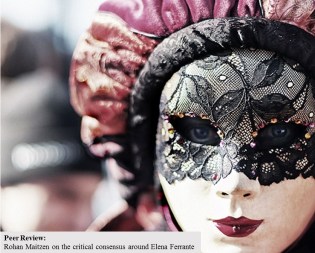
FerranteGraphicAnother new month, another new issue of Open Letters Monthly! As always, I hope you’ll check it out; I think almost anyone could find something of interest in it! Among my favorites this month are Laura Tanenbaum’s review of Julie Hayden’s The Lists of the Past, and Erin Wunker and Hannah McGregor’s essay on Joseph Boyden’s The Orenda. You’ll also find Steve Donoghue on 13 Days in September, Lawrence Wright’s new book on the Camp David negotiations; Justin Hickey on Nick Harkaway’s Tigerman; Robert Minto on a new book on the Hundred Years War; two new poems; and more! My own contribution this month is a ‘peer review’ feature on the critical reception of Elena Ferrante. The more of her reviews I read, the more I felt that something was going on that deserved some closer scrutiny. My conclusion? Well, you’ll have to pop over and read the piece, won’t you?

August in Open Letters Monthly — and an Interview

OMNI_DEC_1980_027

Once again it’s a new month and so we’ve got our new issue up. One neat new thing is the graphic “slider” at the top of the site, which showcases a range of pieces from the magazine (and which will also include new blog posts and highlights from Open Letters Weekly). We think this adds a bit of dynamism to the front page and we hope it will help visitors to the site spot things they’re interested in reading easily — though scrolling down the page to see the full Table of Contents and links to recent posts remains the best way not to miss anything.

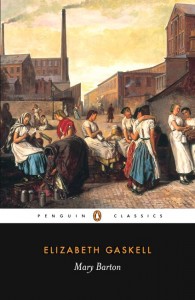
MaryBarton-195x300As always, I think there are a lot of pieces well worth your time. Favorites of mine include Jessica Miller‘s smart and probing review of Rebecca Newberger Goldstein’s Plato at the Googleplex; Dorian Stuber‘s thorough piece — as much essay as review — on Bernard Wasserstein’s The Ambiguity of Virtue (about Gertrude van Tijn, whose work with the Jewish Council during WWII helped over 20,000 Jews escape the Holocaust but also involved her to a vexing degree in what some have seen as collaboration with the Nazis); Elisa Gabbert’s typically sharp critique of Ben Lerner’s regressively metafictional 10:04; and our collective feature on ‘minor’ works by major writers from Shakespeare to Muriel Spark. My contribution to this list is Gaskell’s Mary Barton; as I say there, in its day there was nothing obscure about Mary Barton, but thanks to Masterpiece Theater, today it’s North and South and Cranford that most people know, and I’d guess (though this may just be me) that these are also taught more often than Mary Barton.

I thought I’d also mention here, for those of you who might have missed it, that writer and editor Matt Jakubowski interviewed me for a series he’s beginning on the role of critics and criticism. We did the interview by email and then he cut and tidied my long responses into a single rather more manageable and coherent piece. I really appreciated his thoughtful questions; it was useful to me to look at my trajectory in the way his inquiries prompted me to, and also his interest in my critical work and approach was encouraging in a way I hadn’t quite expected — the internet is a big place and it’s easy to feel a bit lost in the crowd, so knowing that someone like Matt cared enough to single me out for a chat was a real boost. I’m looking forward to seeing his other interviews as they appear.

Open Letters Monthly July 2014!

Julycoverphoto

We did it again! And though I think this almost every month, this issue is a particularly good one. As has become traditional for our July issue, we all pitched in for a summer reading feature: this time we each recommend a book or two that’s hot hot hot! (My romance-reading friends will appreciate that one of my recommendations is Loretta Chase’s Mr. Impossible: I’ve come a long way!) A significant highlight is editor John Cotter’s account of what it’s like to lose music — gradually, stutteringly, but inexorably — in which he manages the very difficult feat of writing poignantly about personal loss without becoming lachrymose or sentimental. My colleague Alice Brittan reviews Michael Cunningham’s latest novel, The Snow Queen: how I love the graceful, meditative way she writes. Steve Danziger adds to his OLM credits with a look at the obsessive eccentrics who collect 78 rpms: Steve is another favorite contributor for me because he writes about subjects I don’t expect to be interested in but always draws me right in. Greg Waldmann takes on the Taliban; Justin Hickey continues his work on science fiction with Robogenesis; Steve Donoghue covers what sounds like a great book on jazz age New York; there are two new poems; and that’s not all!

My own main contribution is an essay on K. M. Peyton’s Pennington trilogy, a “YA” series that continues to be a favorite of mine. Inevitably, I found myself reflecting on the recent debate about whether adults should be embarrassed to read YA fiction, but rather than focusing on that argument in broad or abstract terms, I decided to write about Peyton’s books as I would any other. As far as I’m concerned, the proof is in the pudding: either they stand up to that kind of critical attention or they don’t.

June Updates: a New Open Letters Monthly and a Fun Q&A!

Junecover

First of all, the June issue of Open Letters Monthly is up! I won’t itemize all of its contents, because I hope you’ll come over and have a look for yourself. But I will mention that it is the first issue in a while to include something by every editor. We’re pretty proud about that. My own contribution is this month’s “Title Menu” feature. We’ve always talked a lot about the popularity of the so-called “listicle,” but most of the ones we’d seen around just didn’t seem substantial enough for the lofty aspirations we have for long-form writing at OLM. Then it occurred to us that there’s no reason a list has to be trivial, or that long(er)-form writing can’t be fun. So we’ve been experimenting with our own version of the listicle since January, with all kinds of cool topics from memorable birth scenes to art crime to books that might (or might not) be poetry. Mine lists eight books inspired by George Eliot — there are others, I know, but these are ones I’ve particularly enjoyed.

In other news, I had mentioned not long ago that I would be participating in a Q&A on Twitter organized by the folks who run the Atlantic’s #1book140 club.* For a while I thought maybe it wasn’t going to happen after all, since #1book140 decided not to officially read to the end of Middlemarch (I’m not sure how much participation they usually get in their discussions, but it did seem to me that things weren’t exactly hopping on the hashtag). But it did! They talked Stephen Burt into being the Q to my A, and he and I had a grand old time going back and forth for an hour last night. He had a lot of interesting questions for me. One in particular that I had never thought about before was how the most famous “takeout quotations” from the novel change when you look at them actually in the novels. The Atlantic people are putting together a ‘Storify’ of our conversation, so when it’s ready I’ll be sure to post a link to it so you can find out not just what I said about that but which character in the novel I most identified with at 18, and what quotation I would choose if I ever opted to get a Middlemarch tattoo! I so much enjoyed exchanging ideas and favorite moments from the novel with someone else who’s excited about it: it made me realize that I’ve been thinking about it in the abstract recently more than I’ve actually been reading it. Hooray for having put it on my book list for 19thC Fiction in the fall term and having an excuse to go once more into all the details.

*In case you’re wondering how good this has been for the stats over at Middlemarch for Book Clubs, you’ll be glad to know that it has increased the hits there by literally dozens. 🙂

Open Letters Monthly: April 2014!

cotterleader

Does anyone who reads Novel Readings still need to be reminded to check out the new issue of Open Letters Monthly every month? Surely not! Love me, love my friends, right? But just in case, here’s the regular notice that we did it again: a new issue is live.

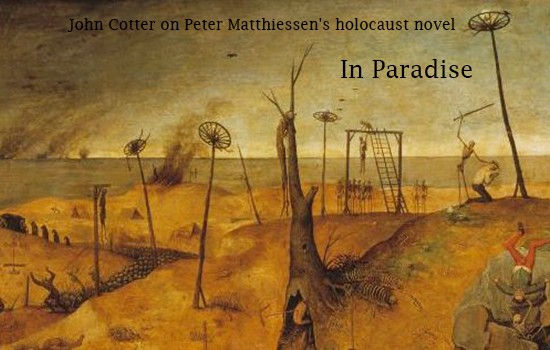
This seems like a particularly rich month. There’s a good showing from “the masthead,” with our editors all playing to their strengths: John Cotter on Peter Matthiessen’s In Paradise, Greg Waldmann on The Struggle for Iraq’s Future, Steve Donoghue on Bart Ehrman’s How Jesus Became God, Maureen Thorson on two new books of poetry, Elisa Gabbert with this month’s “Title Menu” on 10 books that might be poetry. Dorian Stuber weighs in on yet another contribution to the never-ending ‘crisis in the humanities’ (“wasn’t it always thus”?) and finds it opportunistic and clichéd; my Dal colleague Jerry White looks at the remarkable institution that is the Irish Presidency; Steve Danziger explores William S. Burroughs’s notorious Cut-up Trilogy; our own foreign correspondent Michael Johnson feels some déjà vu as he watches events unfold in Ukraine. And that’s not all, so I hope you’ll check it out.

Open Letters Monthly, March 2014

b_j__novak

The March issue is up! Please come on over and take a look. And while you’re there, wish us a happy birthday: now we are seven! In internet years, I think that’s about eighty, but all in all we’re still feeling pretty spry. We didn’t do a special birthday issue this time, but for our fifth anniversary, in 2012, we put out our Criticism issue, which I still think is one of the best we’ve ever done.

In case I haven’t said this often enough, we are always keen to work with new contributors, so if you have ideas for essays or reviews, just get in touch with me and we can confer! One of my favorite things about Open Letters is that we aren’t constrained to the newest, shiniest literary things but also relish pieces for our ‘Second Glance‘ or ‘Absent Friends‘ features. Basically, if you want to follow your (reading) bliss and are willing to expose yourself to the editing process we fondly call “the shark tank,” we’re interested.

But if you just like to read what we put up every month — or much more often, if you also consider Steve’s astonishing output at Open Letters Weekly and the regular posts from our four affiliated blogs, including this one — do help us get the word out by sharing links with your friends. Finally, if you really like us, consider contributing a little through our PayPal button to help cover our operating costs.

Open Letters Monthly: The February 2014 Issue!

It’s up! Go read it!

SaccoNovo1In case you need more detailed encouragement, here are some highlights:

One of my favourite contributors, Joanna Scutts, is back with a wonderful piece on Joe Sacco’s The Great War, which is a remarkable-sounding panoramic drawing of the first day of the Battle of the Somme inspired by the Bayeux Tapestry:

Unlike other drawings of the war, like Otto Dix’s Der Krieg cycle, the horror isn’t etched on the faces of men in pain; few expressions are visible, and we never get closer. Nor is it in the depiction of the explosions, which are delicately rendered, pointilliste swirls: artillery bombardment by Hokusai or Seurat. You just keep folding over the accordion pages, and gradually the battlefield becomes a casualty clearing station, the Red Cross wagons waiting, a white flag waving from a broken tree branch. And further on, past the walking wounded and the hospital tents and the lines of men on stretchers, there’s the end of the line—new trenches being dug, for bodies this time, and crosses nailed in. One gravedigger pauses with his arm across his face, exhausted by the heat or the horror. In the background a column of ants: innumerable new troops marching to the line in a loop that leads back to the beginning.

Steve Donoghue continues his series on the Tudors with Chris Skidmore’s The Rise of the Tudors; as usual he has as much fun (and does as good a job) telling us the story as telling us about the book under review:

According to a legend that’s too pleasing to be disbelieved, that story had its beginning in a moment of lust. Catherine of Valois, the pretty young widow of England’s King Henry V and mother of his son Henry VI, was living in the confines of Windsor Castle (as Skidmore points out, this in itself was cause for worry among the peers of the realm, since Catherine was young and strong-willed and kept calling herself Queen – English society hadn’t seen a setup like that in two centuries and didn’t quite know what to do with it) when she happened to glimpse a minor court functionary, Owen Tudor, swimming in the river with some friends, his long auburn hair plastered wet across his back. The girl was instantly smitten, and in due course there were Tudor children by the half-dozen, including two strapping sons, Edmund and Jasper, whose half-brother Henry VI gave them both rapid preferment at Court.

Ivan Keneally writes on Flannery O’ Connor’s A Prayer Journal:

O’Connor notes that the principal purpose of the letters is to express “adoration” for God, but much of their substance swings from distressed supplication to self-effacing confession. She sometimes prayed for guidance in prayer itself, to learn to love and draw near to a personal being who resists full comprehension. She seems to grope for a more visceral commitment and for the courage to surrender herself to God in a way that inspires rather than constrains her artistic creativity and rational powers; she pines to be “intelligently holy,” anticipating a preoccupation she would revisit ten years later in her essay “The Church and the Fiction Writer” (1957), which investigates “what effect Catholic dogma has on the fiction writer who is Catholic.” She hungers for a beatitude that nurtures her creativity, not doctrinal shackles that constrain it. She even entreats God to supply her with a surfeit of inspiration, going as far as to describe the divine as the epiphanic source of her creative output, reducing herself to a mere vessel of God’s will:

Dear God, tonight it is not disappointing because you have given me a story. Don’t let me ever think, dear God, that I was anything but the instrument for Your story—just like the typewriter was mine.

Greg Waldmann scrutinizes Andrew Sullivan’s I Was Wrong:

Viewers of The Dish today may find it hard to believe that this is the same person they read every day. (In fact, several have written to say they considered cancelling their subscriptions after they read I Was Wrong.) Today Sullivan is skeptical of intervention abroad, and generally wary of extreme political speech at home. But more than that, he – along with his staff – have fashioned The Dish into an almost bewildering cacophony of voices on the issues of the moment, and reserved its weekends for posts about and links to ruminations on philosophical, social and spiritual issues. It has become what he recently called “a very rare place online that takes some time in the week to gather and air the best ideas, arguments, insights in online writing about literature, love, death, philosophy, faith, art, atheism, and sexuality.” It is the most consistently interesting site on the web, and one of the more fair-minded as well. Iraq is at the heart of this transformation, but there are other reasons which this narrowly-focused e-book understandably leaves out.

 And the editors all pitched in to help you find the perfect verse for your Valentine. I like my own choices, of course (I have heard students mock those lines of Aurora Leigh, but I simply pity them for not appreciating the wonderful convergence of erotic ecstasy and prosody) — but of the others, I especially like Colleen’s contribution, by the 11th-century “poetess-courtezan” Izumi Shikibu:

It would console me
to see your face,
even fleetingly, between
lightning flashes at dusk

mylifeinmiddlemarch

Also included: my review of Rebecca Mead’s My Life in Middlemarch. Long-time readers of this blog will know I’ve been lying in wait for this book ever since Mead’s New Yorker essay appeared three years ago. I use that predatory metaphor deliberately but also ironically, because by the time the book was officially announced as ‘forthcoming’ I was already less inclined to pounce. Though I stand by my New Yorker critique as an honest and rigorous reflection of my priorities for writing about Middlemarch, I have learned — from the comments on that post and from the evolution of my own thinking — to be (somewhat) more open-minded about how other people choose to write about it (or what they want to read about it).

This doesn’t mean that everything has changed! As I say in my review, I began the book feeling pretty skeptical. But how pleasantly surprised I was! As I say in the review, “Mead won me over.” And I do think it’s not just that the book is “more expansive than the New Yorker essay . . . better balanced, more thought-provoking, and, unexpectedly, more self-effacing.” It’s that I feel more positive and less defensive myself. Most importantly, I have done a lot more of my own non-academic writing about George Eliot since 2011, but  I have also come to feel more connected to a greater variety of conversations about books, not just through my blog but through the people I now know on Twitter (full disclosure: including Mead herself). I can see now, too, that it’s a good thing that Mead hasn’t written same kind of book I want to write. If she did, after all, there wouldn’t be any need for my book! I admit that amidst the flurry of publicity and praise for her book, I am finding it harder to hang on to my ideas about what my book should be, and especially to imagine what the audience for it would be, if her kind of book is the kind of book so many people like. But, putting my own selfish preoccupations aside (which is what Middlemarch teaches, after all), I can say that hers is a lovely book of its kind. I think my review is scrupulous, and I know it to be completely sincere:

What My Life in Middlemarch ultimately offered me — what I cherished about it — was its celebration of the continuities as well as the changes that mark our growing into ourselves, and of the special role books so often have in this process as tangible symbols of who we have been, are, and aspire to be. “Most serious readers,” Mead rightly notes, “can point to one book that has a place in their life like the one Middlemarch has in mine. I chose Middlemarch — or Middlemarch chose me — and I cannot imagine life without it.”

Open Letters Monthly: The December Issue (With Bonus Crochet)

brattle

Once again we mark the beginning of a new month with a bright shiny new issue of Open Letters! And once again it shows off the range of readers and writers involved with the site.

We lead off this time with our annual Year in Reading feature (Part I, Part II). My contribution won’t surprise any regular readers of this blog, but there’s lots else to interest you: Colleen of Jam and Idleness (and now of Open Letters! hooray!) reports on reading time happily spent in 19th-century France; Steve Donoghue reminds us that for sheer physical pleasure, print books still beat out digital; John Cotter has been reading short stories that blew his socks off; Lisa Peet has been in a Jane Gardam phase; and that’s only for starters. Other pieces address Chagall’s Christian iconography, Doris Kearns Godwin’s The Bully Pulpit (that’s Steve again!), Michael Johnson’s extraordinary search for Solzhenitsyn, John Ford’s ‘Tis Pity She’s a Whore (that’s Colleen again!), Helen Fielding’s new Bridget Jones novel (me again!), the life and writings of Giacomo Leopardi, and more that you’ll have to click on over to find for yourself.

I was proud of myself for getting a review done during this fairly busy month. It became conspicous to me towards the end of the month that the real casualty is actually this blog: if I’m working on a review, it takes up a lot of the time I have for non-work-related reading and writing. So on the one hand, it’s a good thing to be turning out more polished pieces more often and building up experience writing more ‘on demand’ and less on my whim — but on the other hand, especially since it has been a while since I reviewed a book I was really enthusiastic about, it makes me feel a bit stifled.

Crochet
Look what I made!

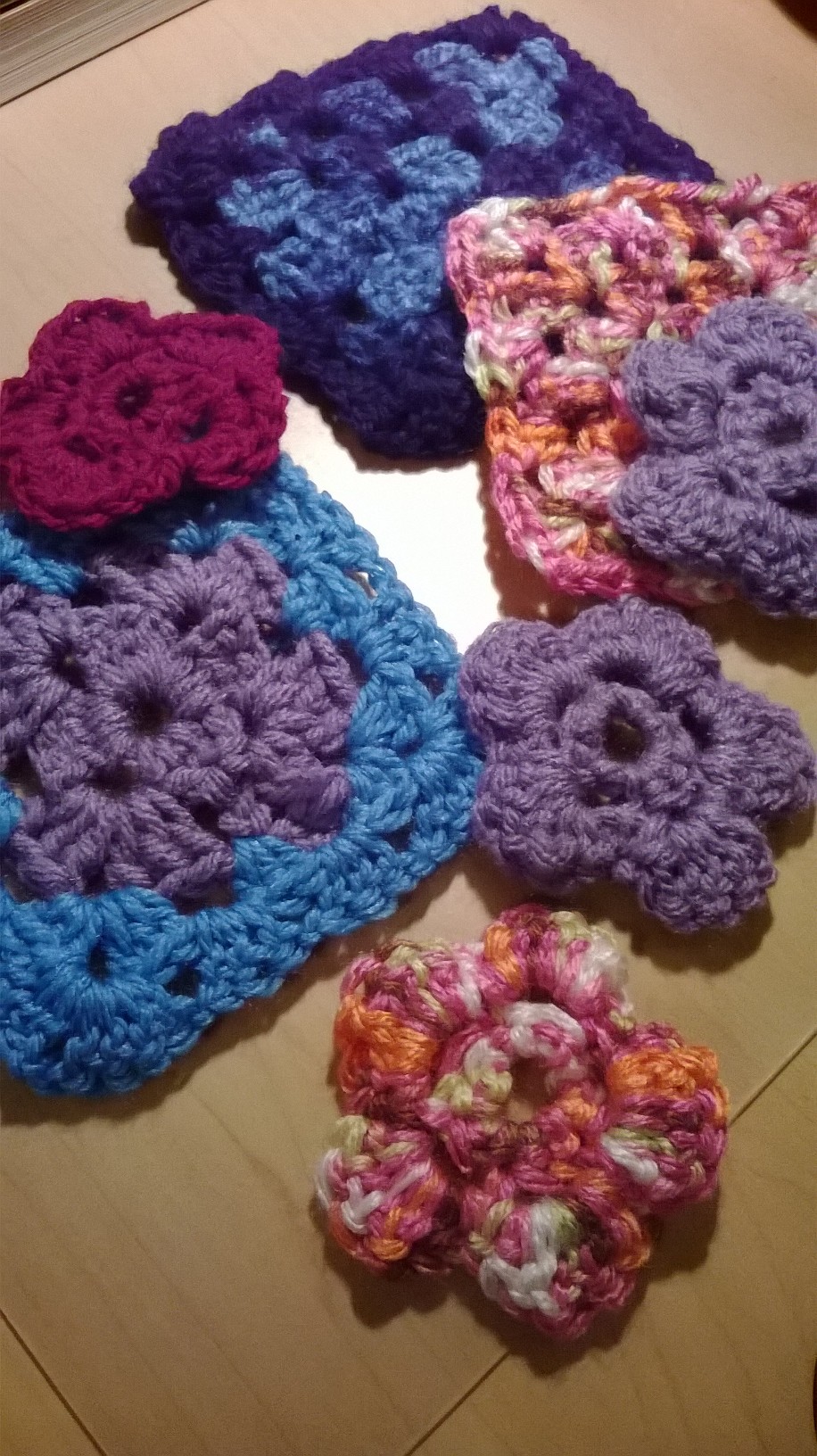
In unrelated news, when I’m not reading, writing, or working (or reading and writing for work!) I’ve been trying my hand at crochet. I got it into my head to learn crochet a couple of months ago, on the theory that it might be something I could do better than I knit (I like knitting but have no head for patterns or fancy stitches, and after a while ribbed scarves aren’t that fun to make). I like doing cross-stitch but it’s fussy and hard to do when I’m very tired (which is when I stop reading / writing / working) or while watching old episodes of ER* (which is how I currently recuperate from too much reading / writing / working). I think I was right that crochet will suit! I had a rocky — or perhaps I should say a tangled — start, but I have more or less got the knack of the basic stitches now, and a couple of weeks ago I successfully completed a basic “granny square.” It probably says something about the ways in which other aspects of my life are fraught with intangible frustrations and deferred outcomes that I am so very pleased with learning how to make something I can quite literally hold on to – even if by serious crochet standards my technique probably has a long way to go. I’ve gotten very ambitious and started stockpiling coordinated squares for an afghan, to give my father as a Christmas present. I’ve warned him, however, that at my current rate of production it may be just a little late.

deptmtgcrochet
Afghan-in-progress!

*Speaking of ER, I’m realizing all over again what a good show it was — much better than Gray’s Anatomy. Are there other ER fans out there?

(Flickr photo of the Brattle Bookshop courtyard.)