“A Place Like This”: Steve Burrows, A Siege of Bitterns

bitterns

“It’s this area, you see, the birds and the people, we’re all intertwined, caught up in one another’s history. We could never let it perish, a place like this.”

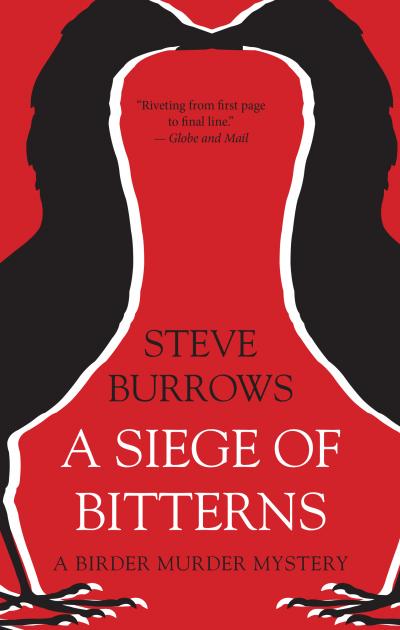
Despite my wariness of new (or just new-to-me) mysteries, I took a chance on Steve Burrows’ A Siege of Bitterns because when I peered at it in Bookmark, I was immediately caught up in the opening pages. It’s not that Burrows leaps right into any suspenseful action — quite the opposite, in fact, though obedient to the rules of the genre he doesn’t take very long to get to a corpse. What I liked was the description of the Norfolk marshland:

At its widest point, the marsh stretched almost a quarter of a mile across the north Norfolk coastline. Here, the river that had flowed like a silver ribbon through the rolling farmlands to the west finally came to rest, spilling its contents across the flat terrain, smoothing out the uneven contours, seeping silently into every corner….

At the margins of land and water, the marsh belonged to neither, and it carried the disquieting wildness of all forsaken things. Onshore winds rattled the dry reeds like hollow bones. The peaty tang of decaying vegetation and wet earth hung in the air. An hour earlier, the watery surface of the wetland had shimmered like polished copper; a fluid mirror for the last rays of the setting sun. But now, the gathering gloom had transformed the marsh into a dark, featureless emptiness.

That’s really good scene-setting: it’s full of specific details addressing all the senses, and it’s elegantly but not floridly written. The scene is full of both beauty and menace, the images suffused with unease but with no heavy-handed ka-thumps of threat or suspense. Here, I thought, is a place I’d like to go — both the marshes and the fictional world this author has created.

cleymarshes

And overall I was not disappointed in A Siege of Bitterns. It is well-written throughout, particularly its descriptions of the landscape, which are consistently both evocative and precise:

Jejeune looked out at the night sky, mesmerized. If he had to give up everything about this part of the world, it would be the skies he would hold onto until the last; the endless, blue, forever skies of the days, and these nights, vast and clear and soft with stars spangled across them as far as the eye could see. The day’s thin tracery of white clouds had been peeled away by the evening’s breezes, and above him now was a spectacular velvety black tapestry shot through with glittering points of light.

The marshes are not just the backdrop to the novel’s crimes: Burrows does a good job at integrating the crimes — the people involved, their motives — with the setting so that we feel that the violence has arisen, in some sense, from the place itself and requires  an understanding of and appreciation for the landscape to solve it. It’s a useful device to have a lead detective who is new to the area, so that our knowledge can grow along with his, even as our interest in it is piqued by seeing it through his birder’s eyes. The birding, too, is not just an accessory, a novel but ultimately unnecessary bit of characterization. It does contribute to our sense of the kind of man Jejeune is — a “watcher,” as he himself thinks at one point, but also someone curious, questing, patient, and moved by flashes of beauty. But it’s part of the case, too, which makes sense in the context of the marshes where, as we’re reminded several times, there’s a particularly high density and variety of birds and thus a correspondingly high number of birders, resident and itinerant.

I really enjoyed the birding material in A Siege of Bitterns. It played right into my general fondness for “neepery” of all kind, for one thing, but Burrows also conveys its specific appeal very well — again, there’s a useful device in the form of Jejeuene’s partner, Lindy, a non-birder, who thus gives the many birders they encounter an excuse to proselytize. I read most of the novel sitting on our back deck, and I admit that I became increasingly aware of the birds around me: there are lots of them around at this time of year, but I can’t identify most of them better than “sea gull” or “blue jay.” I’m pretty sure I saw a humming bird this morning, and sometimes I definitely hear woodpeckers. But which kinds exactly? This site could presumably help me figure it out …

The only element of the novel that I wasn’t really convinced by was Inspector Jejeune himself. On Twitter last night Liz commented that, reading the novel, she “felt like I was coming into a series in progress.” Now that I’ve finished the book, I know what she means: I wondered if the many hints dropped in the first half about things that happened before the story’s own timeline would be resolved, but we never really do get a clear account, either of Jejeune’s family situation or of the case that has turned him into “media darling.” Perhaps this reflects the awkwardness of starting up a new series when some really fine ones in the same style have been running for so long (P. D. James’s Dalgliesh series launched in 1962, for instance, and Peter Robinson’s Inspector Banks novels in 1987). It seems preferable to me to let your character build over time, but maybe relative newcomers feel the pressure to create a kind of instant depth. It didn’t work all that well for me, at any rate: we have to take a fair amount about Jejeune’s brilliance on faith, and sometimes Burrows seemed a bit too insistent on what he’d clearly chosen as Jejeune’s trademark qualities. The secondary characters too felt a bit forced.
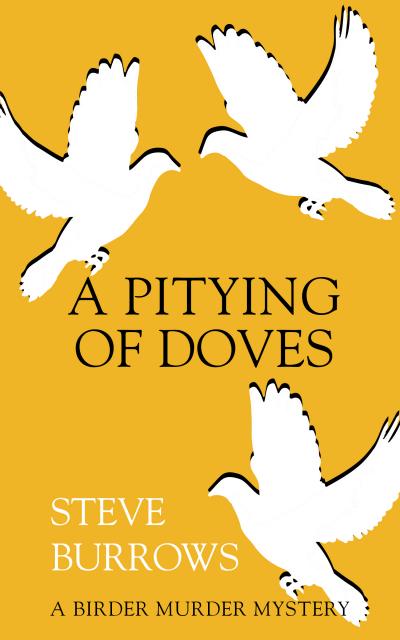
dovesThe plot is good, though, and the writing is good, and the concept is original — though I wonder how long you can sustain birding as a genuine theme, without its lapsing into a gimmick. I liked A Siege of Bitterns enough to want to read A Pitying of Doves, the next in the series. If that goes as well as the first one, I might press on to A Cast of Falcons. And who knows — I might even see if I can figure out just what birds are in my own backyard.

At least as a footnote, I do have to say that there is a very shocking error on page 67 of  A Siege of Bitterns! Dundurn Press should be pretty pleased about this series, but they should also be sure to fix that as soon as they can.

Mistakes Were Made: Louise Penny, Bury Your Dead

pennyburyyourdead

I so want to love Louise Penny’s mysteries! She is one of the biggest names in Canadian crime fiction, which means (among other things) she has long been in my sights as a contender for my mystery class. And she has a lot of fervent admirers, including many of my friends. Also, of course, it’s always a pleasure to find books of any kind that I really enjoy, and even better to find a whole series. But after a few tries, I just don’t think it is going to work out that way for me with Penny.

I read Still Life first and thought it was just OK. Since then, I’ve started several others, picking them up almost dutifully on trips to the library, but I’ve always abandoned them after a couple of chapters. I did better with Bury Your Dead: I persisted to the end (though by half way through I wasn’t reading very carefully) because there was actually quite a lot I liked about it. For one thing, my personal taste doesn’t really run to the “village mystery” or cozy, and that’s more or less what Still Life and the other ‘Three Pines’ ones I’ve tried feel like (though formally they are hybridized with the police procedural). Bury Your Dead, however, takes us (mostly) out of Three Pines to Quebec City. There it tackles pretty ambitious historical and political themes with its focus on the beleaguered-feeling Anglophone community, Quebec separatism, and the symbolic significance of the “Father of New France,” Samuel de Champlain. Penny’s use of this broader context to motivate her specific murder mystery reminded me of Ian Rankin’s books dealing with Scottish nationalism.

I also liked Chief Inspector Gamache a lot: if I try another of Penny’s books, it will because he’s the kind of protagonist I enjoy following. Mind you, he’s also a pretty predictable type — not, in this case, like Rankin’s anti-heroic Rebus, but a close cousin to, say, P. D. James’s Adam Dalgleish. That’s OK: I like my detectives tall, dark, and brooding. Since my experience with the series is so limited, I don’t have a strong sense of Gamache’s relationships with the rest of his team, but what I saw seemed well-developed. I was also impressed with Penny’s obvious competence at plotting, and at the way she unified the three central stories of the book around the theme of mistakes — making them, dealing with their consequences, moving past them.

But! Despite these points in its favor, two features of Bury Your Dead really put me off. One was Penny’s stilted prose style, particularly its heavy reliance on portentous sentence fragments. To me, these always come across as cheap gimmicks, as a device an inexperienced writer imagines will create suspense and look stylish, but which really doesn’t and thus should always be edited, if not completely out, at least down to a bare minimum. Then, when it occurs, it would be genuinely striking. This is the sort of thing I mean:

He wished he could take that hand and hold it steady and tell him it would be all right. Because it would, he knew.

With time.

Or,

And now here he was, beneath the Literary and Historical Society, that bastion of Anglo Quebec. With a shovel.

Dead himself. Murdered.

Once or twice in a novel, in moments of extreme emotion, this kind of thing is OK. But Penny relies on this trick a lot, as if she doesn’t trust her readers to feel appropriately worked up without a signal. It got pretty tedious and detracted, I thought, from some of the novel’s most potentially moving or gripping moments. I wonder if her editors have ever resisted this habit — or maybe they like it.

I also got fed up with the manipulative way Penny strung out the novel’s backstory about a botched response to what turns out to be a terrorist plot. The aftershocks are significant and compelling, but because everyone in the novel already knows about it, keeping it from us felt really artificial — a trick, to play on our nerves, rather than a structural or thematic necessity. It’s true that I kept reading because I wanted to know what had happened, but I felt impatient rather than invested, which is not a good thing. It’s also not something I can ever remember having felt reading a Rebus novel, even though they have gotten longer and denser over the years.

Between the clunky writing and the contrived suspense, then, Penny might have forfeited her chance with me! If I’m underestimating the series, well, that’s my mistake and will be my loss. As I’ve said before, though, I have a lot of reading relationships to sustain as it is. Sara Paretsky has a new novel out, for instance, and V.I. and I actually have some catching up to do. I’ve got a lot of Ellis Peters still to read, too …

To Teach or Not to Teach: The Case of Case Histories

case_historiesAs promised, I have reread Kate Atkinson’s first Jackson Brodie novel, Case Histories, and I’m reporting back. My motive in rereading it was partly just to refresh my experience of it, as I remembered having thought it was very good. It is! But I was also rereading it to see if I thought it would work as an assigned text in my class on mystery and detective fiction, and I don’t think it will. Or, at any rate, I don’t think I’ll try it.

There are various reasons for this, none of which reflect badly on Case Histories and some of which may reflect badly on me, or on the way I teach my class. The main reason is that while Case Histories is a very good novel about crime, it’s fairly odd as a ‘crime novel.’ I might even go so far as to say that it isn’t really a crime novel, in the (admittedly narrow) sense that a crime novel is a novel primarily dedicated to presenting and then solving a crime (or crimes). Definitions like this are at once pointless and essential, especially when selecting a reading list. It’s pointless for reasons that Case Histories illustrates perfectly — about which, more in a moment. But it’s necessary because (as I discuss with my class in the first session or two) we always need a reason to focus on one thing rather than another, and though the boundaries around crime fiction as a genre are uncertain, porous, misleading, you name it, nonetheless we do recognize it as a genre, as definable in some sense, to some degree, which is why we can have sections for it in the book store or talk about it as our favorite kind of reading or award prizes for writing it especially well. One of the ways we can differentiate between crime fiction and other kinds of novels that include crimes in them (Adam Bede, say, or — to pick a nearby example — A God in Ruins) is by the extent to which a specific crime and its solution are a novel’s raison d’être — its primary interest, its organizational principle. That’s a simple rubric that distinguishes the vast majority of the books we confidently refer to as crime novels, detective novels, or mysteries.

“But wait,” I hear you protesting. “Doesn’t Case Histories fit that model?” You’re right, it does — kind of. Yes, it is organized around specific crimes, and around solving them, if by “solving” you mean “finding out what actually happened.” Like a more conventional crime novel, it has a central character who acts as chief investigator for the crimes, and whose personality and processes shape our sense, or the novel’s sense, of values by testing and perhaps redefining ideas about law, justice, crime, and punishment. (In Case Histories, for instance, Brodie decides not to turn over his discovery about one of the novel’s crimes to the authorities, keeping it instead inside the family most affected by it.) Brodie himself fits easily into a well-established pattern: he’s a former soldier and police officer, divorced, depressed, with a young daughter whose vulnerability chafes at him — it’s like hanging out with Rebus’s first cousin! (In fact, on this reading, I was struck by the many echoes of Knots and Crosses, particularly the emphasis on missing girls. “Lock up your daughters,” say the headlines as the Edinburgh Strangler terrifies the town. “If only you could lock girls away,” we hear in Case Histories, “in towers, in dungeons, in their bedrooms, anywhere that would keep them safe.”) There are clues (sort of) and the novel as a whole is shaped by revelations about where they lead.

So why would I hesitate to call Case Histories a crime novel? Because it seems to me more a novel about loss, for which crime becomes the vehicle, and about character, especially as revealed by crimes and their aftermaths. There’s relatively little attention given to the investigations, most of which are taking place so long after the crimes themselves that the solutions matter very little except as opportunities for closure — it’s too late for justice, too late for retribution. The weight of Case Histories is on its people, not its cases, and while that may sound like a meaningless distinction (what are “cases,” after all, if not things done by or happening to people?), I think the reading experience nonetheless bears it out.

As I said, this is not a knock against Case Histories. It’s a very good novel. I’m just not sure how I would approach it as an example in my class. The best way, the right way, would probably be to use it to push against too restrictive an idea of the genre: to discuss what difference it makes when the puzzle element is subordinated this thoroughly to other concerns, to examine Case Histories as a possible test case of the putative distinction between “literary” and “genre” fiction, one marker of which is sometimes taken to be exactly this kind of difference in priorities. Like Ian Rankin, I don’t like the implicit hierarchy of terms like “transcending the genre,” but Case Histories challenges us to keep thinking about how we define it. That would be a good conversation to have — and in fact other books on my reading list provoke it already (including P. D. James’s An Unsuitable Job for a Woman, which I teach as both a crime novel and a variation on the Bildungsroman, or Knots and Crosses, which Rankin claims not to have written as a crime novel).

Case Histories would give us at least as much else to talk about as any of our other readings: the links (thematic and emplotted) between the different cases, provocations about what justice means or is worth, explorations of identity, particularly for women, of sexuality, and of family. There’s a lot going on in the novel, including a lot that is relevant to the fundamental issues of my class. And yet… Talking about Case Histories in these ways would be intrinsically interesting, but I’m not convinced it would further my objective in the course of exposing students to as many varieties of detective fiction as I can: the class is a lower-level survey course, and we have a lot of subgenres to cover. Which one would Case Histories represent? Also, a related question: which book would it displace? Knots and Crosses, probably, especially since lately I have another police procedural on the list (The Terrorists). But Knots and Crosses is a crowdpleaser in ways I doubt Case Histories would be. When I assign An Unsuitable Job for a Woman in this class, it’s usually the least popular book on the list: if students find it too slow, how would they fare with Case Histories’ slow burn? The book never really picks up much momentum, either, despite the occasional burst of drama. The crimes are brutal and disturbing, but the time-shifting of the narrative means that we keep starting and stopping with them, circling around, not so much accumulating information as accreting emotional residue. It works as a novel — but is it teachable as a crime novel?

Of course, the only way to find out for sure would be to assign it, set it up as well as I could, and see how it went.

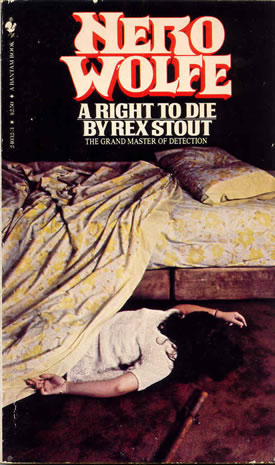
“They’ve got that word in them”: Rex Stout, A Right to Die

righttodieA while ago word got out that I hadn’t read any of Rex Stout’s Nero Wolfe mysteries. It didn’t take long for a certain thoughtful someone to make sure I had a good selection to choose from — and now I have read 1.5 of them! Why the .5,you ask? Because I started (dutiful as always) with the first one, Fer de Lance, and couldn’t finish it. I liked Nero and Archie just fine, but the mystery itself was too far the wrong side of absurd, and to top it off, the style seemed stilted. Also, in general I have difficulty making new detective friends: there are so many, after all, and I’ve been in my relationships with some of them for so long. It takes a lot to make me want to persist, especially if my first impressions are not great.

But I suspected I wasn’t done with these fellows (so many other smart readers can hardly be wrong!) so I kept the stack nearby, and recently I picked up A Right to Die more or less at random as I was heading to an appointment and needed a small book to stash in my purse for the waiting room. (We all know never to go anywhere without a book, right?) It turns out to be quite a leap forward from Fer de Lance — literally, as it’s both written and set 30 years later (though, as the Wikipedia page for A Right to Die points out, Wolfe and Goodwin haven’t aged a bit). I wouldn’t say it’s light years beyond the earlier book in other ways, but it certainly seemed more smoothly written and constructed, not to mention more grounded in reality. In fact, its specificity was its most striking feature: it is very deliberately about current events, and keeps reminding us just how current they are by having Archie regularly forget and then remind himself that Idlewild Airport has recently been renamed in honor of JFK.

RexStoutThe case involves two members of a civil rights organization, a black man and his white fiancée, Susan Brooke, who is the (first) victim. It seems pretty likely at first that race is a key factor in her death: I think it’s not giving away too much to say that this assumption is itself a symptom of the racial tensions the novel depicts, while the resolution of the mystery seems designed, not necessarily to move us past race, but to remind us that there are plenty of other sources of homicidal hatred that a preoccupation with race ought not to blind us to. The plot is set up by a visit from Paul Whipple, who was inspired to give Wolfe some crucial information in a long-ago case after Wolfe made an impassioned speech against shielding a murderer “because he is your color.” Whipple shows up and quotes the speech verbatim, including this bit:
You are helping to perpetuate and aggravate the very exclusions which you justly resent. The ideal human agreement is one in which distinctions of race and color and religion are totally disregarded; anyone helping to preserve those distinctions is postponing that ideal; and you are certainly helping to preserve them.

Racist assumptions get Paul’s son Dunbar accused of Susan’s murder: “Because she and I — we were friends. Because she was white and I’m black.” Wolfe, on the other hand, doesn’t assume anything. While his investigation (or, Archie’s investigation, really, since he does 90% of the actual work) does turn up plenty of nasty prejudice, the puzzle’s solution eventually turns on a diphthong and the culprit’s motives … well, that would be telling!

In a way, I think Stout’s choice of plot depoliticizes the novel (though you could also argue that Wolfe’s stated ideal of making race irrelevant is itself a political position, a particular vision that emphasizes ignoring or erasing, rather than understanding or celebrating, difference). By comparison, the crime story in Walter Mosley’s Devil in a Blue Dress is very much about race and identity, and the novel as a whole emphasizes systemic injustices that make solving one crime seem like not much. It’s not that Stout ignores such systemic problems, but by not tying his murder to them he reduces them to context or setting, rather than developing them as a theme, and as a result A Right to Die ends up being less interesting, just as a novel, than it might have been. It’s still got some pretty powerful moments arising from that context, though, including the impassioned explanation from the accused about why he hesitated to call the police after finding the body. “About motive, with a Negro they take motive for granted,” he tells Wolfe. “He’s a shine, he’s a mistake, he was born with motives white men don’t have. It may be nonsense, but it’s the way it is.” “With the scum, yes,” agrees Wolfe. “With dolts and idiots.” “With everybody,” Dunbar replies:

Lots of them don’t know it. Most of them up here wouldn’t say that word, nigger, but they’ve got that word in them. Everybody. It’s in them buried somewhere, but it’s not dead. Some of them don’t know they’ve got it and they wouldn’t believe it, but it’s there. That’s what I knew I’d have to face when I sat there on the bed last night and tried to decide what to do.

I was initially tempted to label A Right to Die a “period piece,” but like Mosley’s “historical” Los Angeles, there’s a strong enough resemblance to our own period, to our present, that it would be much too easy to set it aside and say “case closed.”

“I Have Married England”: Dorothy L. Sayers, Busman’s Honeymoon,” Part II

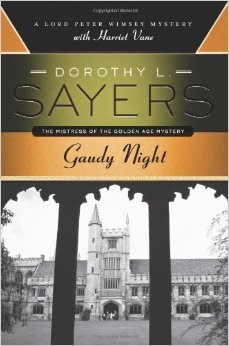
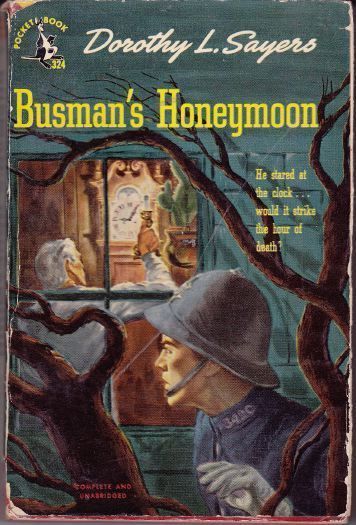
busmans2Now for the things I don’t love about Busman’s Honeymoon. [If you missed it, Part I, “Love with Honour,” explains the things I do love.] Some of these I’ve always noticed, some stood out particularly on this reread; some are small irritations, and some make me uneasy that, in spite of them, I still love the book. In the discussion that followed my earlier post about making excuses for Gaudy Night I suggested that some books are “like a slightly embarrassing relative you still adore.” I think it’s not just loyalty that keeps Busman’s Honeymoon in my good books (so to speak!): I think the good in it really does outweigh the bad. But I can’t deny that it has some real problems.

Worst is the novel’s off-hand antisemitism, which surfaces in the context of not one but two “financial gentlemen” who get involved in squabbling over the victim’s estate. The first, Mr. MacBride, is anticipated as “an inquisitive Hebrew”; he turns out to be”a brisk young man, bowler-hatted, with sharp black eyes that seemed to inventory everything they encountered, and a highly regrettable tie.” He also has “a trifling difficulty with his sibilants.” The second, Mr. Solomons, is “a stout, elderly Hebrew” with a pronounced lisp (“Very thorry to intrude . . . I have here a bill of thale on the furniture . . .”). They are both presented as slightly comical figures and treated with perfect, if faintly condescending, amiability by our main characters, but there’s no doubt that they are meant to represent an exotic and not altogether desirable genus characterized by money-grubbing and sharp dealing. This is the kind of thing that could be shrugged off as “a product of its times” but is more appropriately pointed out as a symptom of what was wrong with those times, or at least with too many people living in those times. In Gaudy Night villainy is strongly associated with Nazism, but antisemitism and fascism had a pretty strong hold in 1930s England too: Mr. MacBride and Mr. Solomons could come across as quaintly offensive anachronisms, but they are also salutary reminders of the conditions that made Oswald Mosley’s Blackshirts possible.

Next up is the novel’s snobbery. In Gaudy Night, where so much of what matters is educational and intellectual, I tend to think in terms of elitism instead, and to see Oxford as a place that (in Sayers’s admittedly idealized version) renders class barriers, if not irrelevant, at least less relevant. But in Busman’s Honeymoon you really can’t ignore the power of class hierarchies. Though there are references to Harriet’s past life as an ordinary person (you know, the kind who buys tea biscuits in a shop and so knows which ones from the package have the cheese in the middle), she’s living in Peter’s world now, and she adapts with discomfiting ease. It takes no apparent effort at all for her to refer to the gardener simply as “Crutchley,” to accept Bunter’s deferential services, or to be high-handed with the (admittedly dreadful) housekeeper Mrs. Ruddle.

In taking on Peter’s rank, Harriet is taking up a new place in a strictly ordered world, one the novel portrays with more nostalgia and idealism than mistrust or critique:

Whatever fantastic pictures she had from time to time conjured up of married life with Peter, none of them had ever included attendance at village concerts. But of course they would go. She understood now why it was that with all his masquing attitudes, all his cosmopolitan self-adaptations, all his odd spiritual reticences and escapes, he yet carried about with him that permanent atmosphere of security. He belonged to an ordered society, and this was it. More than any of the friends in her own world, he spoke the familiar language of her childhood. In London, anybody, at any moment, might do or become anything. But in a village — no matter what village — they were all immutably themselves; parson, organist, sweep, duke’s son and doctor’s daughter, moving like chessmen upon their allotted squares. She was curiously excited. She thought, “I have married England.” Her fingers tightened on his arm.

vintagebusmanIt’s one thing to be “immutably yourself” when you’re the duke’s son (or his new bride), but it’s another if you are a struggling mechanic or anyone else who might like to “do or become” something else. Even though Harriet’s own story could be read as one of disruptive social mobility (and that’s exactly how she is seen by the more hidebound of Peter’s family and aristocratic peers), in Busman’s Honeymoon social aspiration is cause for ridicule (the absurdly pathetic Miss Twitterton, for instance, who gives herself airs because her mother was a school teacher) or a sign of villainy; the cynicism of a world in which Mrs. Ruddle initially suspects Harriet and Peter of being film stars and “no better than they should be” is contrasted unfavorably with the noblesse oblige that requires dutiful attendance at village concerts and the vicar’s sherry party.

Peter is often a bit awkward or apologetic about the anachronism of his aristocratic identity, but he’s also profoundly attached to the continuity it represents, and Busman’s Honeymoon really indulges that feeling, particularly when he brings Harriet at long last to visit the family “pile,” Duke’s Denver, with its antiques and its peacocks and its well-mannered ghosts. The tour of the family portrait gallery brings to mind Trollope’s remarks about the wealth of the church: “Who could lie basking in the cloisters of Salisbury, and gaze on Jewel’s library, and that unequalled spire, without feeling that Bishops should sometimes be rich?”

The afternoon sun slanted in through the long windows of the gallery, picking out here a blue Garter ribbon, there a scarlet uniform, lighting up a pair of slender hands by Van Dyck, playing among the powdered curls of a Gainsborough, or throwing into sudden startling brilliance some harsh white face set in a sombre black periwig.

We are all, in some ways, beneficiaries of such privilege: shouldn’t we be glad that some people have, historically, been able to collect and preserve so much beauty, to patronize artists and commission great buildings? But while it’s true that Busman’s Honeymoon does include reminders that democratic forces are at work — that in London, as Harriet observes, for instance, this “ordered society” is in flux — there’s something conservative about its yearning to keep those forces at bay and to protect “impeccable Inigo Jones staircases” from the encroachments of modern life. Along with the novel’s other nastier prejudices, this raises questions about just what kind of England Harriet has married: it doesn’t seem an altogether welcoming or progressive place.

Finally, there’s the crime itself, which Chandler was quite right to point to as contrived. The Golden Age aspects of the mystery are mostly good fun. I especially like Peter’s self-consciously Holmes-like reading of the vicar:

 “This is magnificent,” said Peter. “I collect vicars.” He joined Harriet at her observation post. “This is a very well-grown specimen, six foot four or thereabouts, short-sighted, a great gardener, musical, smokes a pipe — “

“Good gracious,” cried Miss Twitterton, “do you know Mr Goodacre?”

” — untidy, with a wife who does her best on a small stipend; a product of one of our older seats of learning — 1890 vintage — Oxford at a guess, but not, I fancy, Keble, though as high in his views as the parish allows him to be.”

“You know my methods, Watson,” he says self-deprecatingly to Harriet when she exclaims that “to the best of my knowledge and belief you’re right.” Unrealistic as they may be, too, the array of clues including clocks and cacti and wireless settings make for a good puzzle, Inspector Kirk is excellent, and the subplot with Constable Sellon adds a nice human touch. But it all feels like a puzzle set up to be solved, not (as Chandler wanted) a story of a murder by “the kind of people that commit it for reasons, not just to provide a corpse.” Our killer does have his reasons, but given them, and given his character, there are much simpler, more obvious methods he’s more likely to have resorted to. There’s also the typical Golden Age implausibility of a body turning up on the sleuth’s honeymoon in the first place, not to mention in his own home. These are, of course, the kinds of things about which this subgenre of crime fiction requires suspension of disbelief, but there’s too much genuine human drama and feeling in Busman’s Honeymoon for them to sit quite right. While Gaudy Night elegantly fuses its mystery plot with its other elements, Busman’s Honeymoon feels like a mish-mash, an uneasy and ultimately unsuccessful compromise between two kinds of books.

“Love with Honour”: Dorothy L. Sayers, Busman’s Honeymoon (Part I)

busmansI’ve written at length about my love for Gaudy Night, but I have never really tried to sort out my views on its sequel, Busman’s Honeymoon. As I have owned and loved Busman’s Honeymoon as long as I have Gaudy Night (I have them in matching editions, inscribed to me on my 13th birthday), I thought it would be an appropriate book to write on for my 1000th post here at Novel Readings! But it turns out that I have so much to say that I’m going to do it in two posts.

I think the general consensus, even among Sayers fans, is that Busman’s Honeymoon is a bit of a let-down, not just as a detective story but for the ways it carries forward the relationship between Peter and Harriet — though I may be extrapolating much too far from the dismissive comments of critics like Julian Symons, who complained about the ‘dismal sentimentality’ of Sayers’s later novels. Still, it seems to be Gaudy Night that’s usually cited as the pinnacle, not of Sayers’s whole oeuvre necessarily, but of the four that make up the Harriet Quartet. I actually used to prefer Busman’s Honeymoon, which makes sense given how much more abstract some of the issues are in Gaudy Night, and how cerebral its romance. Busman’s Honeymoon has more going on right on the surface: both emotionally and criminally, it has more blunt objects! I don’t know quite what my 13-year-old self made of some of its details, such as the discussions of “shabby tigers,” or Peter’s “fits of exigent and exhausting passion” during the agonizing wait for the killer’s execution. There weren’t many limits on my youthful reading, so my guess is that these allusions to Harriet and Peter’s sex life raised fewer questions for me than their struggles to define their marriage as a relationship of equals. Rereading the novel now, it’s those struggles that stand out, and that remind me why Peter and Harriet have so long seemed to me one of the most interesting and important literary couples I know.

Gaudy Night makes a powerful case for finding a balance between head and heart – but accepting that as the ideal isn’t the same as living up to it in perpetuity. Busman’s Honeymoon is the next step: what does this really look like in practice? One thing I really liked about Busman’s Honeymoon this time (in my next post, I’ll get to the things I really disliked) is that we see these two fiercely independent and highly intelligent people trying very self-consciously to make sure their romantic relationship reflects their principles, not just their passions. The personal equality they value isn’t an easy thing to achieve in a world that is otherwise defined by inequalities — not least of wealth and power, of which Peter has a disproportionate share. Once they are married, of course, Harriet enjoys much of the same privilege (about which more next time), but Sayers is savvy about the challenges she faces to both her finances and her pride as she prepares for the wedding. “Oh, Mr. Rochester!” she says to Peter on receiving his extravagant gift of a mink coat, while she earns the money for the Donne manuscript that is her gift to him by writing “three five-thousand-word shorts at forty guineas each for the Thrill Magazine.” At Oxford, in Gaudy Night, none of that mattered: the interchangeability of their academic gowns stands for the meeting of their minds, for the freedom to face and love each other as peers. It’s very clear in Busman’s Honeymoon that they aren’t at Oxford any more.

Neither Harriet nor Peter wants marriage to mean compromise. After their first real disagreement — which arises when Harriet questions whether Peter needs to get involved in investigating the sordid murder that turns out to have taken place in their honeymoon home just before their arrival — she backs off quickly when faced with his argument that he shouldn’t “pick and choose what I’ll meddle in” to suit his own convenience. “This business of adjusting oneself was not so easy after all,” she thinks, and she can’t smooth things over with girlish ploys:

He wasn’t the kind of man to whom you could say, ‘Darling, you’re wonderful, and whatever you do is right’ — whether you thought so or not. He would write you down a fool. . . . He wanted you to agree with him intelligently or not at all.

Imagine that! Later, when the argument recurs, with the added stress that now there are real suspects who stand to pay the price for Peter’s “meddling,” Harriet rejects the power she wields because of his love for her, scorning to be the kind of woman who boasts “My husband would do anything for me.” “What kind of life could we have,” she demands, “if I knew that you had become less than yourself by marrying me?” “Love with honour” is their goal, and they know it’s not a conventional one: “If you go on behaving with all this reason and generosity,” Peter says admiringly to Harriet, “everybody will think we don’t give a damn for one another.”

newgaudynightIn Gaudy Night another sign of their equality is their collaboration on solving the mystery. It’s true that in the grand reveal it’s Peter who dominates, and the attack on Harriet could be seen as marking her as a victim in need of rescue (and there’s the whole dog collar thing too). Harriet works on her own at first, though, and prepares the dossier on which the solution depends. That they work so closely on the mystery reinforces both the novel’s overall theme of balance and its promise that the two of them are truly partners. In Busman’s Honeymoon the investigation is more clearly Peter’s turf: in those quarrels, he’s the one insisting that detection is his work, his vocation; it’s Peter who really puts the pieces of the puzzle together and who carries the guilt, in the end, of having brought the criminal to justice and thus (after due process) to his own violent death. Harriet still has a lot of input, though: it’s not the case that she simply stands by and observes. I don’t think she needs to get redefined as a sleuth herself to sustain the balance of their relationship: she has a career, as a writer, and that’s the expertise she brings to the case.

Something else Harriet’s presence does in Busman’s Honeymoon that has real generic significance, particularly for a novel that belongs to the “Golden Age,” is galvanize Peter’s transformation from sleuth into complex, flawed, and intensely vulnerable human being. This is a process Sayers herself undertook deliberately once she’d introduced Harriet into her novels. I don’t much like the early Wimsey books, as Peter’s such a chattering fop in them compared to the layered character he eventually becomes (he does still play the part of upper-class twit occasionally). Sayers knew he had to become someone Harriet could say yes to; that’s only accomplished by the end of Gaudy Night (in Have His Carcase, there are moments, but overall he’s not quite there). The implications of that for him as a detective are particularly interesting in Busman’s Honeymoon, as the ending of the novel is anything but triumphant for Peter even though he has solved the puzzle. Instead of this “success” setting him up as a heroic avenger, it brings back all the trauma of his wartime experience and leaves him broken and weeping. In “The Simple Art of Murder” Raymond Chandler quite reasonably mocks the artifice of English puzzle mysteries, including Sayers’s — in fact, he singles out Busman’s Honeymoon for its admittedly absurd scenario (“a murderer who needs that much help from Providence must be in the wrong business”). It’s interesting that he doesn’t comment on the novel’s conclusion, which could surely be read as a repudiation of the entire form of the book itself, or at least of the type of mystery it sort of is, which as Chandler noted, could force “real people” (which he admits Sayers could create) to “do unreal things in order to form the artificial pattern required by the plot.”

With all this attention on reason and intelligence and principles and genre, I don’t want to miss the one other thing I have always loved about Busman’s Honeymoon, which rather pushes against the more intellectual merits I’ve been highlighting: it is utterly sentimental, full of declarations of love, some playful, some breathtakingly sincere. How wonderful to be caught up in these moments with Harriet and Peter, to be in a world, and a relationship, and a novel, in which the demands of reason and intelligence, and the conflicts that inevitably arise between two strong wills, don’t rule out the emotional abandonment — the ecstasy –of love. Peter and Harriet are both ever-ready with literary quotations, a game that’s played perhaps to excess (and sometimes to comic effect) in Busman’s Honeymoon. But it’s also here that poetry becomes, at last, the truth of their experience. “How can I find words?” asks Peter, in frustration at his own struggle to articulate his feelings on his own behalf. “Poets have taken them all, and left me with nothing to say or do — ”

“Except to teach me for the first time what they meant.”

He found it hard to believe.

“Have I done that?”

“Oh, Peter — ” Somehow she must make him believe it, because it mattered so much that he should. “All my life I have been wandering in the dark — but now I have found your heart — and am satisfied.”

“And what do all the great words come to in the end, but that? — I love you — I am at rest with you — I have come home.”

It seems fitting that Donne (that most cerebral of love poets) is always their touchstone. “This is joy’s bonfire, then,” reads his “Eclogue for the Marriage of the Earl of Somerset,” which ends the novel,

where love’s strong arts
Make of so noble individual parts
One fire of four inflaming eyes, and of two loving hearts.


Ausma Zehanat Khan, The Unquiet Dead

khanunquietdeadI have really mixed feelings about Ausma Zehanat Khan’s debut mystery The Unquiet Dead. For starters, I think it’s built around a good concept, one with a lot of potential for drama and moral seriousness. The contemporary crime turns out to be rooted in the evil and cruelty of the Bosnian War, particularly the massacre at Srebrenica; there’s a lot of historical back story, then, based in those events, as well as reflection on the inadequate international response at the time and since. The author’s expertise in these areas means that the novel is rich in chilling details, the accuracy of which is borne out by her footnotes. The generic form of a mystery sets up good opportunities for exploring connections between past and present as well as abstract problems, such as the interplay of justice and vengeance. The particular crime story Khan tells, too, invites debate about vigilantism in the face of bureaucratic inertia or, worse, indifference.

Also in the novel’s favor: the parts of The Unquiet Dead that are directly about the war and genocide are gripping in the way terrible true things are, the flashback interludes especially — though I found them a bit heavy-handed in the telling. The interspersed witness statements that form part of the case are an artful device, as well. And the mystery certainly aspires to be the kind I usually like: character-driven, multi-faceted, specific to a time and place and community, embedding its whodunit in socially and morally provocative material.

But notice that I say it “aspires to be” this kind: it doesn’t seem to me to succeed, quite, and so I felt really frustrated reading it, because I so wanted it to be better than it is. The characters that drive it, especially the detectives, never seemed entirely believable to me, never really came to life, despite the author’s insistent efforts to make them complicated and three-dimensional. I have a hard time putting my finger on just what doesn’t work: there are too many things going on at once, maybe, including family backgrounds that aren’t relevant to the unfolding crime story, and references to previous events and cases that we’re told resonate deeply for the characters but that can’t possibly do the same for us. The main detective pairing is too pat and familiar in too many ways: Rachel Getty, in particular, seemed like a watered-down Barbara Havers. Finally, the prose isn’t quite good enough to carry the book along. It too seemed to be trying too hard, insisting on profundity but falling into melodrama and cliches. By far the best part of the book for me was the “Author’s Note” at the end, where Khan reviews the story of the Bosnian War: it’s written with such clarity and unpretentious energy that I wished she had stuck to non-fiction for the whole project.

But (again), as her note makes evident, there are already plenty of non-fiction books about these events (some of which I’ve read), and yet I don’t think this is a particularly well-known or well-understood context, at least to North American audiences — not, at any rate, compared to the First World War, or the Holocaust, or other common settings for historical fiction and film. Popular fiction can reach readers who might never pick up Michael Sells’s The Bridge Betrayed or Samantha Powers’s A Problem from Hell — so from that angle, The Unquiet Dead is doing something important in drawing attention to the horrors of what happened and provoking consideration of what could ever count as “solving” a crime with such origins. Still, what matters most, since Khan did choose to write fiction, is whether the result is a good novel, and I just don’t think The Unquiet Dead is, much as (given how many things are smart and interesting about it) I wish it were.

Reading it I found myself wondering: what must it be like to a book editor working on a project like this? Clearly the editor at Minotaur (which is an imprint of St. Martin’s Press) thought the book was done, ready to face readers and critics. So maybe I’m just being unduly hard on it! Or else the conclusion was reached that this particular book was as good as it was ever going to be — something that any graduate supervisor has probably thought about at least one thesis at some point. I have no idea what specific advice I could have given Khan to make the book better in the ways I wanted: “make your characters seem like people, not ideas for people” or “write better” both seem too vague to be genuinely helpful, while “give Ian Rankin your idea and research and let him write the book” would probably have been an unwelcome suggestion!

Jo Walton, Ha’Penny: My Two Cents’ Worth

waltonI didn’t love Jo Walton’s Farthing: in my brief review at GoodReads I admired the ingenuity of the premise and the “nice economy” of Walton’s development of her alternative history, but I thought the mystery itself wasn’t very interesting, and that it lined up too neatly with the predictions you would readily make about a crime story set in a Britain that has made peace with Hitler. But I know a lot of people who are big fans of Walton’s work, and “not loving” is not at all the same as “not liking at all,” so I thought I’d have a go at Ha’Penny, the second in the “Small Change” series.

And, again, I find myself a bit let down. It too is neatly executed, but again it felt obvious — not so much in the details of the plot, but in the larger story it’s telling us about the creeping moral paralysis of appeasement and the evils of tyranny. It is certainly possible in theory to introduce moral complexity into a novel about a plan to blow up Hitler, but I didn’t find any here, except, I guess, for the structural irony Inspector Carmichael recognizes at the end — that by doing his job as an officer of the law, he has preserved the very devil’s bargain under which so many (himself included) are suffering. But that’s not particularly subtle, and neither are the lessons our narrator Viola gets from the man fondly coercing her into violent resistance. “I don’t know if you’ll understand,” he says, with condescension that, unhappily, Viola deserves,

 but there’s a thing it’s hard to give a name. It’s what we fought for in Ireland when you wouldn’t give it to us, and it’s what’s been lost on the Continent — I could call it freedom, or self-determination, but that’s too abstract. It’s the idea that one man’s as good as the next, before the law, whoever he is. It’s the idea behind the French Revolution, but it’s lost now in France, where old Petain licks Hitler’s boots. It’s the idea that built America, but they’re too frightened over there now even to elect old Joe Kennedy instead of Lindbergh with his talk of keeping down the Jews and the blacks.

“This isn’t going in, is it, love?” he asks Viola, who replies, “I don’t know . . . I do care about individual liberty. . . . But I don’t think liberty is something you get by blowing people up.” This is all hardly breathtaking, either for the sophistication of the dialogue itself or for the depth of the moral and political insights on either side — and that’s how I felt about the book as a whole too. Tyranny bad, liberty good, appeasement corrupting: we get it!

To be fair, I think some of this simple-mindedness comes from Viola, who is another of the ingenue narrators Walton alternates with her third-person account of Carmichael’s investigation. Carmichael himself is a sympathetically rendered character whose personal situation nicely encapsulates the insidiously encroaching pressures of dictatorship. As Ha’Penny ends, for instance, he has resigned himself to running an English equivalent of the Gestapo — to be called, with nice historical resonance, “The Watch” — partly because he has little choice and partly because he hopes he might have “the chance to do some good — to turn judicious blind eyes, and to make it better than it might have been.” It’s obviously a deal with the devil (did I mention that the bad guys in these novels are Nazis, or near enough?) and the road to hell is paved with good intentions … and the temptation to lapse into cliches when explaining what’s up is symptomatic of the problem I have with these novels.

It’s not that Walton is wrong about tyranny or Nazism or appeasement, or that her vision of this alternative future isn’t both plausible and a kind of cautionary tale for our present — but she hardly needed to create an alternative history to demonstrate any of her points, and the scenarios she comes up with are much less interesting than so many stories of actual people who cooperated with the Nazis in different ways and for various good purposes, stories that swamp us with the kind of moral complexity that I think these two books have notably lacked.

This Week In My Classes: What Makes a “Teachable” Novel?

This week I decided to call my own bluff.

knots_crossesI spend a lot of time fretting about which books I assign in my Mystery and Detective Fiction course — because once you get past the few absolute “must haves” (something by Poe, some Sherlock Holmes, The Moonstone, something to represent the Golden Age, one of the hard-boiled essentials) there are many good reasons but no real imperatives to help me choose from the tens of thousands of possibilities. My guiding principles are coverage (of the major subgenres, such as the police procedural) and diversity (of voice or point of view), but that doesn’t really narrow things down that much. I’ve asked for suggestions quite a few times here, with great results: I have readers like Dorian to thank, for instance, for prodding me to read Sjöwall and Wahlöö, whose The Terrorists is currently a staple of my course reading list.
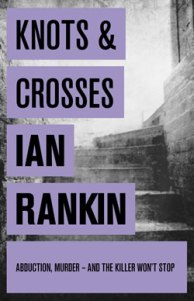
I tweak that list pretty regularly, and I’m always turning over alternatives in my mind. One of the books I’ve assigned the most is Ian Rankin’s Knots and Crosses, which is his first Rebus novel. As often the case with the first books in a series, it is in some ways his most self-conscious, and it doesn’t assume any prior knowledge of Rebus on our part, which is useful for classroom purposes. It’s also a nifty little book in its own way, neatly constructed, with lots of clever twists; its deliberate invocations of the Scottish gothic tradition make it nicely literary and its inquiry into masculine identity, military “bonding,” and repression usually spark good discussion. It’s not the best Rebus novel, though (I know Rankin doesn’t think so either): the others, especially the more recent ones, have a broader social and political reach and do more as police procedurals, while Knots and Crosses (which was not intended as a “crime novel” to begin with) is really more of a psychological thriller. Every time I teach Knots and Crosses, then, I mutter to myself (and sometimes remark to the class) that to really see what Rankin and Rebus can do, we should read something else. Yet I have never acted on that conviction.

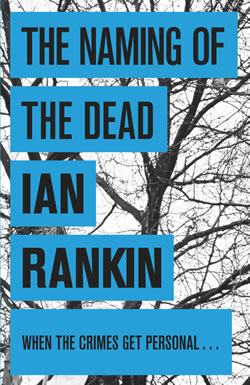
This week, then, I decided I should reread one of the others that has long been in my mind as an alternative: 2006’s The Naming of the Dead. Set in Edinburgh during the 2005 G8 meeting, it balances its murder investigations against political crimes and misdemeanors of all kinds. Siobhan Clarke is on the case too, but involved personally as well as professionally, and Rebus’s old antagonist, “Big Ger” Cafferty, becomes an uneasy ally. My recollection of the book is that it explored lots of themes we’re always interested in in this class, especially gray areas between crime and detection, or tensions between the law and real justice. Rereading it, this impression has been confirmed, as has my sense that its political context gives Rankin the opportunity to do something similar to what Sjöwall and Wahlöö do, that is, extend particular criminal investigations to larger critiques of systems of power. Rankin’s novels have been acknowledged as contemporary versions of the Victorian ‘condition of England’ novel: with Knots and Crosses, you can’t see why, but with The Naming of the Dead, the genealogy works and would, I think, be really interesting to discuss.

namingofthedeadAnd yet … I am not convinced that I should replace Knots and Crosses after all! Much as I’m enjoying rereading it, I’m not sure it would be as teachable as Knots and Crosses, and my hesitation over this has had me wondering: what do I mean by “teachable”? It’s not something I ever really consider about Victorian novels when choosing among them for my 19th-century fiction classes, but when I’m scouting for mystery novels to assign — or contemplating assigning some new (or new to me) novel for an intro course — “How would this work in the classroom?” is always a concern. And for the majority of mystery novels I read, the (usually unarticulated) response to this question is “it wouldn’t”: I put most of them aside without seriously considering them for my syllabus, which strikes me as interesting. Why would that be? Might it (she says a little nervously) have something to do with the “literary” vs. “genre” fiction distinction? Or, to be more precise, with the ways that methods for “teaching” a novel (at least for me) align with qualities that are more likely to occur in “literary” fiction?

What qualities am I looking for in a novel I assign? I suppose the fundamental requirement is that there be something in it for us to talk about — not just for a few minutes, but for enough classroom hours that we can spread our work on the novel across whatever seems like a reasonable amount of time for the students to read the whole thing. The formula for this will vary depending on the level and nature of the class, of course, but anything that will take up a week or more of class time has to be of a certain complexity — and not just of plot, because just rehearsing what happened is not particularly valuable or interesting. It might sound foolish to put it this way, but to teach a book there also has to be something about it that needs explaining, as well as something that rewards discussion. Not all of this has to be generated by the intrinsic qualities of the book: a book might get some of its interest from external contexts — (literary) historical, for instance, or theoretical. But you don’t (well, I don’t) want to spend a lot of time on stuff around the book and only point to the book itself in passing: you want to dig in and really get to know it!

One way of labeling the process I’m most used to, pedagogically, would be “deep reading,” or “close reading.” Not all books reward that particular kind of reading equally. An alternative is “horizontal reading,” where the individual text is seen as part of a broad array of related and perhaps even quite similar material. Its interest arises at least in part, in that case, by comparison: among things of this kind, how is this particular one different or interesting? In Mystery and Detective Fiction we actually do a combination of the two. I spend a fair amount of time describing a broad horizon of comparison (because we don’t have time to read lots and lots of examples to establish it on our own) and then we consider how our specific example fits into or revises common conventions and tropes. Mystery fiction really is strongly governed by recognizable patterns which in their least interesting versions seem simply formulaic — which is not to say that there aren’t tropes and conventions and formulas in “literary” fiction too, and one reason I’m using scare-quotes is that I am very aware that the distinction I’m invoking is a vexed and imperfect one. But it seems silly to pretend there aren’t books that are very clearly of a kind, perhaps even repetitively or predictably so, and that whatever the pleasures they afford many readers, they don’t individually hold up under the kind of scrutiny I am inclined to give them in class. Or, in another variation on the problem, they don’t do something new and thought-provoking enough to those tropes and conventions that they jump out as examples we need to consider. I’m not judging these books in any absolute way, of course. I’m just measuring them by what I perceive as my pedagogical goals.

moonstone-oupThen there are other constraints on teachability: more pragmatic ones. Again, with Victorian novels I mostly don’t worry too much about these, though I am wise, or cautious, or jaded, enough never to assign two genuine door-stoppers in the same term  (say, Bleak House and Middlemarch). Students who sign up for “The 19th-Century Novel from Dickens to Hardy” have to know what they are getting into! But the mystery class is a lower-level course that is purely an elective for everybody in it. I can barely get them all through The Moonstone (and in fact I am confident there are always some who never make it to the end) — and that’s a book that’s so interesting I can barely stop talking about it myself! It earns its two weeks of class time by being not just important but really complex and (for the class) quite challenging. This is actually where I fear The Naming of the Dead  falls apart as an option (though I’m not 100% sure yet). Its nearly 500 pages are not nearly as dense as The Moonstone‘s, but in a way that’s just the problem: it goes on for almost as long a time without actually being as complex. It is broad, I might say, and it’s smart, but it’s not particularly deep. I’m not sure about this, because I haven’t tried to map out any lecture topics, but it would be a bad idea to assign 500 pages and then end up feeling like we were spinning our wheels in class.

It’s true that you can find something to say about almost anything, and that there is no one uniform approach that works for teaching all novels. The Naming of the Dead seems to me an in-between case: I’m ruling it out (I think) because it requires too big an investment for the likely payoff in this particular course. It also matters to me that Knots and Crosses — which is both short and suspenseful — is always very popular with students: it is often singled out in course evaluations as a favorite, for instance, and class discussions about it tend to be pretty lively. (This year The Terrorists has been our most-discussed book so far, though.) Maybe it will inspire students to go on and read more of Rankin’s (better) novels on their own; I’m guessing that the number who are inspired to read more Wilkie Collins is very small! I suppose I could swap it out for a different example of the police procedural. I’ve tried that before, actually: one year we read Ed McBain’s Cop Hater, which earned its spot on the list because the 87th Precinct series was ground-breaking of its kind. But for all that is interesting about it, Cop Hater is a really badly written novel, or so we ended up thinking by the time we’d talked it through. In that case, being teachable turned out not to be enough to teach it again!

If you’re curious about which books I’ve chosen over the years, in Mystery and Detective Fiction or in my other classes, you can get a good sense of the range by scanning the On Teaching page of this blog.

This Week In My Classes: Lots of Reading

It’s not so much that we are doing a lot of reading this week in particular, but that cumulatively by now, in both classes, we have done a lot of reading. I like this middle phase of term: the logistical confusion of the first couple of weeks is behind us, the frameworks for our class discussions have been established, we have a body of completed work to lean on (bounce off?) as we move along — and the end of term is still far enough away that we aren’t distracted by planning for it.

greatexpectationsIn 19th-Century Fiction we’ve finished our first two novels, Villette and Great Expectations. Although Villette is a fascinating novel, I had more fun (rather to my surprise) rereading Great Expectations. I’ve read and taught it so often that my own expectations were kind of low as we started it up, but I fell right into it, especially the climactic confrontation between Pip, Estella, and Miss Havisham after Pip’s world has been up-ended:

‘You are part of my existence, part of myself. You have been in every line I have ever read, since I first came here, the rough common boy whose poor heart you wounded even then. You have been in every prospect I have ever seen since — on the river, on the sails of the ships, on the marshes, in the clouds, in the light, in the darkness, in the wind, in the woods, in the sea, in the streets. You have been the embodiment of every graceful fancy that my mind has ever become acquainted with. The stones of which the strongest London buildings are made, are not more real, or more impossible to be displaced by your hands, than your presence and influence have been to me, there and everywhere, and will be. Estella, to the last hour of my life, you cannot choose but remain part of my character, part of the little good in me, part of the evil. But, in this separation I associate you only with the good, and I will faithfully hold you to that always, for you must have done me far more good than harm, let me feel now what sharp distress I may. O God bless you, God forgive you!’

In what ecstasy of unhappiness I got these broken words out of myself, I don’t know. The rhapsody welled up within me, like blood from an inward wound, and gushed out. I held her hand to my lips some lingering moments, and so I left her. But ever afterwards, I remembered — and soon afterwards with stronger reason — that while Estella looked at me merely with incredulous wonder, the spectral figure of Miss Havisham, her hand still covering her heart, seemed all resolved into a ghastly stare of pity and remorse.

I know some people recoil from Dickens’s rhetorical excesses and emotional manipulation, and when my defenses are up I can feel the same impatience. But he’s also better than any other novelist I know at ripping the bandage off our wounded humanity and creating moments as morally thrilling as this one. There’s also something fantastic (in both senses of that word) about just how fearless his language and his stories are: his relish for both is practically tangible.

I’ve been thinking about Dickens a lot in the context of the ongoing discussions about YA fiction: why, for instance, should Henry James be the touchstone for grown-up reading? There’s a quality in Dickens that runs afoul of that rarefied, over-intellectualized ideal, but Christopher Beha’s description of the rewards of reading James (and other “adult” fiction) describes Great Expectations astonishingly well:

Much is taken from us as we pass out of childhood, but other human beings who have suffered these losses have created great works of art, works that can only be truly appreciated by those who have suffered the same losses in turn. These works are among the great recompenses that experience offers us.

One of the things we discussed in our last session on Great Expectations is whether it’s worth having made Pip’s mistakes, having suffered as he suffers, because in the end he is capable of narrating the novel — something Joe, for all his admirable qualities, could never do. Dickens, in other words, has built his own novel around just that trade-off between pleasures that can “easily be enjoyed by a child” and hard-won moral and literary maturity. I’m not necessarily disagreeing with Beha’s commentary on James (though I’m on record as not finding James that pleasurable to read — for me, he’s more on the mortgage-payment side of adulthood): I’ve just been thinking Dickens has a more interesting role to play in this conversation than he is usually given (in Beha’s essay, a passing reference to him as someone who wrote “inviting, event-packed novels”).Oxford

Next up for us in this class: Middlemarch. As you can imagine, I’m looking forward to this! I’ve spent a lot of time in the last couple of years thinking and talking about Middlemarch, but I haven’t actually reread it patiently for a while. I started on it this morning while the class was writing their short test on Great Expectations, and even as I winced watching Dorothea be so, so wrong, I was reminded all over again how funny the first few chapters are.

Houn-05_-_Hound_of_Baskervilles,_page_24In Mystery and Detective Fiction we’ve wrapped up not only The Moonstone but Sherlock Holmes and a sampler of other great detectives as well (we read one story each by G. K Chesterton, R. Austen Freeman, and Jacques Futrelle). Today we started our discussion of Agatha Christie’s The Murder of Roger Ackroyd.  I enjoy using Christie to spark discussion about canonicity: I point out that despite being possibly the best-selling novelist of all time, she has no literary standing compared to her contemporaries Henry James, Virginia Woolf or James Joyce, which gives me a chance to suggest that modernism set a lot of the terms for discussions of literary merit that we now often take for granted. This means talking about things like linguistic or syntactical difficulty, which on the face of it, Christie is having none of: her prose is remarkably lucid. Next time, though, when all is known, we’ll go over just how tricky she actually is — telling us everything while keeping everything from us. Is this its own kind of difficulty, or is it just trickery, and if so, is that somehow a lower order of skill? To some extent I am playing devil’s advocate in asking why she should be taken any less seriously than Woolf: for me, conversation about Christie flags pretty quickly once the game is played out, and for my money there are other mystery novelists who are a lot more interesting to think about. But she’s excellent of her kind, and I think it’s worth provoking a conversation about whether it makes sense to value some kinds more than others. This is the “genre fiction” version of the YA debates, of course.

Once we wrap up Ackroyd, it’s midterm time in this class, and then we turn to Hammett and Chandler.