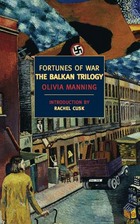
From the Archives: Olivia Manning, The Fortunes of War

One of the many enticing volumes in the NYRB Classics series is Olivia Manning’s The Balkan Trilogy. I wish this nice edition had been available when I went on a quest for The Balkan Trilogy and its sequel, The Levant Trilogy, to read a couple of years ago; I had to settle for musty second-hand copy of the old Penguin editions. They proved well worth looking for, though, despite (or perhaps because of) not being at all what I expected. My write-up of the series follows; for further reading, the NYRB edition of The Balkan Trilogy comes with a very perceptive introduction by Rachel Cusk:

Indifference, injustice, cruelty, hatred, neglect: in The Balkan Trilogy these are the constituents both of personal memory and of social reality, of private unhappiness and of public violence. In Olivia Manning’s analogy, war is the work of unhappy children; but while Harriet embodies the darkness of this perception, she represents too the individual struggle to refute it.

After reading and then writing about this series, I went looking for critical work on Manning and found very little. Perhaps this release of The Balkan Trilogy, as well as her earlier novel School for Love, will turn more attention her way.


This two-volume set is actually a sextet of shorter novels, the first three comprising The Balkan Trilogy, the second The Levant Trilogy. According to my Penguin editions, Anthony Burgess described this series as “the finest fictional record of the war produced by a British writer.” The war in question is, of course, the second World War, but if Burgess’s remark leads you to expect a sweeping war-time saga full of action, heroism, drama and suspense, you’ll be surprised–as I was. In the first volume, set first in Romania and then in Greece, our protagonists are at the periphery of the conflict, which is spreading through Europe and gradually encroaches on their lives without ever directly reaching it, as they leave both Bucharest and then Athens on the eve of German occupation. All of the motley array of characters are versions of Rosencrantz and Guildenstern, bit players with no important part to play in the real story, except that theirs is the story, and it’s not comic–or tragic, either. (Some textual evidence that Manning herself conceived of her characters in this way comes in the Coda to The Levant Trilogy, in which she compares them to “the stray figures left on the stage at the end of a great tragedy”). The novels unfold in a strangely muted register that matches the characters’ global insignificance even as the interest, and pathos of their circumstances and their endearing and irritating individual characteristics eventually win us over to believing in and caring about them.

I was fascinated with the picture Manning offers of the British abroad in this particular historical moment; the novels are highly autobiographical, or at any rate follow closely the historical and geographical situations she and her husband experienced, and Manning was clearly an astute observer of the both the local and the expatriat cultures she participated in. She is particularly understated and yet pointed (if that’s not too paradoxical a description) about the anti-Semitism in Romania, illustrating its character and effects while keeping its worst realities just off-stage. The horrible truths are shown most explicitly through the story of the banker Drucker, whose son Sasha the Pringles eventually shelter in their flat. Imprisoned by the Romanians ostensibly for trading in currency on the black market but really, it is clear, for the crime of being a rich Jew, he is eventually released for trial, and Harriet Pringle goes on Sasha’s behalf to get a look at how he has fared:

Harriet, who had seen Drucker only once, ten months before, remembered him as a man in fresh middle age, tall, weighty, elegant, handsome, who had welcomed her with a warm gaze of admiration.

What appeared was an elderly stooping skeleton, a cripple who descended the steps by dropping the same foot each time and dragging the other after. The murmurs of ‘Drucker’ told her that, whether she could believe it or not, this was he. Then she recognised the suit of English tweed he had been wearing when he had entertained the Pringles to luncheon. The suit was scarcely a suit at all now….

From the bottom step he half-smiled, as if in apology, at his audience, then, seeing Harriet, the only woman present, he looked puzzled. He paused and one of the warders gave him a kick that sent him sprawling over the narrow pavement. As he picked himself up, there came from him a stench like the stench of a carrion bird. The warder kicked at him again and he fell forward, clutching at the van steps and murmuring “Da, da,” in zealous obedience.

Harriet’s specific emotional response is not elaborated on, and why should it be? We have, presumably, shared it, and we understand her decision, arriving home, to “deceive Sasha. He was never likely to see his father again.” She reports only “‘Your father looked very well,'” and that kind, protective lie speaks eloquently of the destructive inhumanity of the truth. Key moments of high suspense or emotion are treated in this cool, matter-of-fact way throughout, as when the Pringles arrive home to find that Sasha has been taken in a raid:

The bed-covers were on the floor, and as Harriet piled them back on to the bed, the mouth-organ fell from among them. She handed it to Guy as proof that he had been taken, and forcibly. Under the bed-covers was the forged passport, torn in half – derisively, it seemed.

Remembering her childhood pets whose deaths had broken her heart, she said: “They’ll murder him, of course.”

The next day, “Harriet [is] surprised that she felt nothing.” The risk, in both her consciousness and the narrative, seems to be that, in such circumstances, the only options are feeling nothing or being overwhelmed with feeling. Cumulatively, though, for this reader anyway, the effect of the persistent resistance to melodrama is a story nearly stripped of its human essentials and thus of a sense of what the novels stand for in the face of totalitarianism. Towards the end of their stay in Athens, for example, a major character whose quirks and (mis)fortunes we have followed since the first pages is unexpectedly and unnecessarily shot, more or less accidentally and at random. Is it because destruction and death are always at the margins of their lives, because the war has taken normalcy from them, that his companions feel more inconvenienced than anything else?

The manager agreed to let the body rest for the night in one of the hotel bathrooms. The four friends followed as it was carried away from the terrace and placed on a bathroom floor. As the door was locked upon it, the all clear sounded. The manager, offering his commiserations, shook hands all round and the English party left the hotel. Alan, hourly expecting an evacuation order, had decided to spend the night in his office. Ben Phipps, on his way to Psychico, dropped the Pringles off at the academy.

Pop psychology terms like “coping strategies” come to mind: these non-combatants are struggling for survival themselves, but their enemies are not the Nazis so much as the moral and social rootlessness they experience, with military victory, and thus the survival of their ‘home’ countries and values, uncertain, and with reminders of their own mortality and insignificance nearly constant.

In this context, Guy Pringle is a fascinating figure (though I don’t see why he’s the one Burgess highlights as “one of the major characters in modern fiction,” given the much greater priority given to the experience and perspective of his wife). Guy is a lecturer in English literature notable for his expansive energy, which in The Balkan Trilogy he invests in two major theatrical productions. The one treated in most detail is an amateur production of Shakespeare’s Troilus and Cressida, a project for which he recruits many of the other major characters–but, tellingly, not Harriet, with whom he declares he cannot work, because she will not take him or his effort seriously enough. His goals include raising the morale of the British residents and their friends in Bucharest as well as asserting the importance of British culture and history in the face of the military setbacks that have eroded the nation’s stature abroad–they are, after all, on the losing side at this point. The German Propaganda Bureau keeps a map in its window indicating German advances across France with “broad arrows.” “For Bucharest,” we are told, “the fall of France was the fall of civilization….With France lost, there would be no stay or force against savagery….the victory of Nazi Germany would be the victory of darkness.” In this context, Guy’s preoccupation with his play is suggestive of fiddling while Rome burns, and yet at the same time it seems defiant, an assertion of the value of art and beauty and imagination. Emerging from the theatre, the audience learns that Paris has fallen: “Chastened, they emerged into the summer night and met reality, avoiding each others’ eyes, guilty because they had escaped the last calamitous hours.” They have been experiencing freedom of the mind, the kind of freedom that these novels make you feel is the most to be cherished in wartime. And yet where is the heroism in going to the theatre while around you suffer millions unable to escape in the most literal way?

Ambivalence to Guy’s cultural projects, and indeed to Guy more generally, intensifies in The Levant Trilogy, written more than a decade after The Balkan Trilogy but picking up the story of most of the same characters as they move through another phase of displacement, this time in Egypt. Harriet’s relationship with Guy has always been strained by his inability to put her needs even on the same level as the demands placed on him by everyone else he knows, as well as by his own obsession with his work. Harriet’s discontent takes concrete form occasionally, as in a near-romance that evolves in Athens in the third novel of The Balkan Trilogy. In The Levant Trilogy, we see more of Harriet’s efforts to develop an independent identity in the face of Guy’s physical and emotional absence. In this series, though the war is brought much closer, through the character of Simon Boulderstone (is the redundancy of his surname significant?), with whom we travel to the front at last. Simon comes literally face to face with the horrors of the desert campaign:

Before him was a flat expanse of desert where the light was rolling out like a wave across the sand. Two tanks stood in the middle distance and imagining they had stopped for a morning brew-up, he decided to cross to them and ask if they had seen anything of the patrol or the batman’s truck. It was too far to walk so he went by car, following the track till he was level with the tanks, then walking across the mardam. A man was standing in one of the turrets, motionless, as if unaware of Simon’s approach. Simon stopped at a few yards’ distance to observe the figure, then saw it was not a man. It was a man-shaped cinder that faced him with white and perfect teeth set in a charred black skull. He could make out the eye-sockets and the triangle that had once supported a nose then, returning at a run, he swung the car round and drove back between the batteries, so stunned that for a little while his own private anxiety was forgotten.

We see, too, that the violence of war has the capacity to reach ‘civilians’ with no easing of its horrors. Very early in this volume, for instance, a child is brought in who has been killed by the explosion of a hand grenade he picked up while playing in the desert. In what may be the most surrealistically gruesome and disturbing scene I’ve ever read, his distraught parents refuse to interpret the signs that he has been fatally wounded and attempt to revive him by pouring gruel into a hole blown into his cheek: “The gruel poured out again. This happened three times before Sir Desmond gave up and, gathering the child into his arms, said, ‘He wants to sleep. I’ll take him to his room.'” His death prompts Harriet to think of “all the other boys who were dying in the desert before they had had a chance to live. And yet, though there was so much death at hand, she felt the boy’s death was a death apart.” Suffering was nearby throughout The Balkan Trilogy, but here we live in a community of the physically and spiritually wounded.

Yet even as the action and emotion of this trilogy had an intensity not often displayed in the earlier volume, it also seemed to me more directed at the unfolding of interior dramas for the characters, many of whom are struggling to define themselves against the expectations of others, or in the absence of well-defined or well-understood roles for themselves in the war-time conditions and foreign locations they are negotiating: Simon himself, for example, who has come to Egypt in part to follow in his brother’s footsteps, or Harriet, who eventually hitches a lift into Syria in an attempt to claim some meaning for herself beyond being Guy’s wife. Guy’s obtuseness about Harriet’s independent needs is highlighted more specifically here and his incessant busyness seems more irresponsible than it did in the first volume, perhaps because it’s not seen as serving any greater purpose. The one major cultural event ends…unexpectedly…without any of the triumphant possibilities of Troilus and Cressida, though perhaps it has as much symbolic significance of its own, maybe even marking a rejection of the idealism that Guy represented.

I haven’t really reached many interpretive conclusions about these books, but I have a lot of lingering questions. How far, for instance, do these books seek simply to chronicle how people lived through the exile from home and from normalcy imposed by the war, and how far do they prompt us to think about the global conflict as a reflection, an externalization, of abstract forces and values playing out on a personal scale as well? Is Manning’s understated style itself some kind of statement about the limitations of aesthetic responses to catastrophe, or about the necessity we are under of living life on our own small scale, however grand the larger narrative? Is Guy offered up as the embodiment of some essentially British quality, and if so, how far is it critiqued and how far accepted or encouraged?

How happy the lot of the mathematician!

From W. H. Auden’s essay “Writing”:

How happy the lot of the mathematician! He is judged solely by his peers, and the standard is so high that no colleague or rival can ever win a reputation he does not deserve. No cashier writes a letter to the press complaining about the incomprehensibility of Modern Mathematics and comparing it unfavorably with the good old days when mathematicians were content to paper irregularly shaped rooms and fill bathtubs without closing the waste pipe.

I bet that Great Achievements in Math are debated by mathematicians, too, and not, say, by former Olympians, doctors, or journalists.

Reading Slumps and Other Blogging Blocks

I’ve been in a bit of a blogging slump lately. Part of it is just that it’s that crazy end-of-term time. Not only are there this term’s courses to wrap (which, thanks to a very late exam, I won’t be able to do until next week), but next term’s courses are looming, and any “extra” time I might usually take to do some posting is getting eaten up by seasonal events–with my son now in junior high, that means two holiday concerts, for instance, and then this weekend my daughter’s piano teacher held an end-of-year student recital. With family and close friends all approximately 14 days away by Canada Post, there’s also the effort (mostly cheerful, if sometimes a bit frantic) to get Christmas gifts organized and shipped off–a task I completed with one final order in to Amazon.Ca last night, hooray. Friday is the last day of school for the kids, so there’s an incentive to be well ahead on, well, everything, before the madness family fun begins. And I’m working hard on another piece for Open Letters in between marking papers and fussing with Blackboard sites.

Another significant factor in the blogging slump is that I’ve also been in a bit of a reading slump. I finished Wolf Hall a while back and thought it was surprisingly good (I know, I shouldn’t be surprised if a much-hyped award-winning book by a serious author is good, and yet … more about that later). But as more and more smart and interesting reviews came out from other sources, I got discouraged about pitching in my own two-cents worth (if I had, I think the only thing I would have emphasized that didn’t seem to get a whole lot of play is how intensely written a book it is, and how much, too, it seemed to take up an obliquely Scott-like interest in the neutrality of history, by which I mean that like Waverley, Wolf Hall evokes a moment of historical transition, particularly towards a more secular, political (dare I say, modern?) world, and makes the movement feel inevitable, avoiding either nostalgia or triumphalism, something played out on the pulses of people who manage to feel extraordinarily real–a task in which much contemporary historical fiction fails, about which, also, more in a bit). Anyway, I didn’t review it, and since Wolf Hall, I really haven’t read anything that I wanted to write about. Ian Rankin’s The Complaints was OK, well-conceived, typically well written and plotted, but nothing special. Really, by the time I finished it, I had almost forgotten it wasn’t a Rebus novel, so similar were the unifying issues and themes and also the central characters (hmm, a personally troubled cop who pushes the boundaries of his job? where have I read about that before?). Diana Abu-Jaber’s Crescent looked really enticing, but I didn’t find the central love story very convincing, the politics seemed evasive, and I got annoyed with the interspersed tale-spinning (though I realize this idea of how stories are woven together was meant to be a key idea about the book). I tried Detective Inspector Huss for the second time and still didn’t make it past Chapter Three because the writing (or at least the translation) was so wooden. And now I’m nearly finished Kate Pullinger’s The Mistress of Nothing and I’m so disappointed in it that although I think I will do a full write-up of it soon, because it is, or could have been, pertinent to the thinking I’ve been doing about Ahdaf Soueif and Anglophone representations of Egypt (but The Map of Love is so much better) I’m not looking forward to the exercise. The gist of the review will be (unless something changes in the last 20 or so pages) that the book is far too thin, the characters underdeveloped and thus their actions desperately unmotivated, and the cliches in both plot and writing deeply distressing–not least because about two days after I ordered the book (which looked so perfect for me!), it won a major literary award here in Canada.

I think I may be wrong to wait for a book I want to blog about. For some time I disciplined myself to write up everything I read, just to get the practice and to see what I had to say as a reviewer (rather than an academic). Almost always, I did find something to say, and the mental challenge as well as the writing experience was usually exhilirating. And really good books, or even really interesting books, are few and far between. So I’m going to try to get back into that habit. But in the meantime, I’m going to try to finish that little essay for Open Letters, as I promised to have it ready by tomorrow, mark as many papers on Jude the Obscure as I can bear, and try not to panic that in less than a month, I have to give some kind of a lecture on Romanticism and sound as if I know what I’m talking about. Wish me luck!

“Sir Rohan Left Literature”

First of all, don’t get your hopes up.

A proper new post is due soon (things have been a bit busy over at The Valve), but just in passing: why did I not know until this week (when someone mentioned it in passing on the VICTORIA listserv) that such a book as this existed? Here I thought I’d run into every possible permutation on and alleged source for my given name over the years, and all the while there’s a whole book about “Sir Rohan” just sitting in the Harvard library. OK, it’s another case in which it’s a man’s name, but I’ve pretty much accepted that I will deal my whole life with mail addressed to “Mr Rohan Maitzen.” Given that, I think “Sir Rohan” would be an acceptable alternative.*

Here’s an excerpt, then, from Harriet Prescott Spofford’s Sir Rohan’s Ghost (1860). I’m not sure if I’ll have the fortitude to read the whole thing.

In determined attempts to lay this Ghost, Sir Rohan threw himself into the heat of foray and battle. Braver knight there was not in the kingdom; but he left the army, for the shape glided perpetually between his sword and his foe, breathless and with glistening eyes beside him, rode with the same glitter as earnestly in retreat, covered him with its oppressive vacancy when he fell, till sense ebbed away with his blood. Then Sir Rohan essayed oratory and statesmanship; but the shape, so distinct that it seemed as if others too must see it, swayed its long arm beside him as he spoke, and sobbed Banshee-like, with a rustling inspiration, in his pauses. Sir Rohan left the bench and bar. Dissipation opened its arms to receive him, midnight drawing rooms were proud to hold him, gay dances wreathed themselves to his motions, rosy cheeks flushed at his approach. But a pale cheek was beside the rosy ones, an airier form glided through the dancers and did not disturb the set, and with the red wine before him a long white finger plunged down the glass and brought up the glittering trophy of a golden ring. Sir Rohan reformed. Yet perhaps in the dry recesses of old libraries he might be alone, and so he delved deep among musty tomes, striving to bury his heart with the dust of ages that he found there; but another hand shifted the leaves as he read, and eyes devoid of speculation met his as he unconsciously turned for sympathy in the page. When on some rude map he traced the route of conquerors, another finger followed his pointing out spots at which he did not glance, and resting wearily on places he would gladly have blotted from existence; and as his eye wandered in quest of some desired volume on higher shelves, the Ghost fluttered up and down below it. Sir Rohan left literature.


*And, of course, the proper pronunciation remains “Rowan.” None of that aspirated ‘h’ stuff, please.

Red Hot Classics


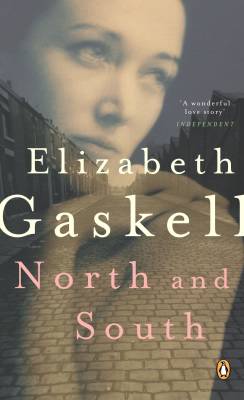
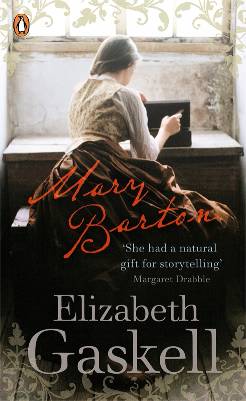
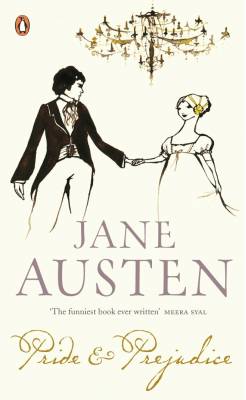
Somehow I hadn’t seen any of these editions before today, when I ran into a couple of them as I was browsing through Chapters (thanks, again, to parents who hold their children’s birthday parties at The Putting Edge across the way!). I’m fascinated by the marketing approach: an unwary reader might well pick these up not even realizing they are “classics” …which is not necessarily a bad thing, of course. I’m also interested that Jane Austen gets such different covers:

Weekday Miscellany: Reading, Writing, Teaching

It sure is quiet around the blogosphere, including around here. Must be summer! It’s not that I haven’t been reading, but for some reason–no particular reason–I haven’t been writing up as many of the books I read as I used to. At this point I’m more likely to do a full write-up only if a book has deeply engaged me, for better or for worse. This approach makes some sense, but it also means a certain slackening of discipline, so perhaps I’ll try to get back in the habit of finding at least something to say about most of my current reading….we’ll see. Right now I’m working on quite a varied collection, including Evidence, by fellow Dalhousian Ian Colford, Stieg Larsson’s The Girl with the Dragon Tattoo (I’m only 400 pages in, but I’m pretty sure I disagree with Val McDermid’s claim that I won’t “read a better book this year”), and, of course, Villette. I just finished re-reading Villette this afternoon, and I was completely drawn in by the intensity of both the language and the vicarious experience of Lucy’s passions and sorrows. In the end, I think I like her because she’s a fighter; she has pride, and wit, and perseverance, even sheer cussedness. But I like her best when she cries out, “My heart will break!” More about that tomorrow. Discussion at The Valve has rather petered out, but I’m hopeful that we’ll see a surge of energy around the novel’s conclusion. Overall there have not been nearly as many comments as during last year’s Adam Bede reading, but on the other hand the comments have been extremely interesting and thoughtful. I kind of wish more of the regular Valve authors had participated…but then, catch me reading some of the stuff they post on! So no hard feelings.

As another project, I’ve been working on a piece about Trollope at the invitation of Steve Donoghue at Open Letters. Now, I’m very enthusiastic about Trollope, and so, it turns out, is Steve, and I love having this opportunity to put my thoughts into some kind of readable form. It turns out, though, that a lot of the self-conciousness I thought I had fought off by blogging all this time has come back: all the material I have so far seems both dry and obvious, and I’m riddled with anxieties about tone and audience. I guess the only thing to do is to keep writing, in the spirit of Trollope himself, who famously said, “I was once told that the surest aid to the writing of a book was a piece of cobbler’s wax on my chair. I certainly believe in the cobbler’s wax much more than [in] inspiration.” (Ah, but he didn’t know about the internet, which lets you stay quite fixed in your chair but wander, mentally, far from the task at hand….)

And, as September comes relentlessly closer, even as I cling to the hope that I’ll make more real progress on my major research projects, I find I can’t stop thinking about my fall and winter classes. I actually really enjoy planning classes, setting up the syllabi and assignments, organizing the reserve lists and Blackboard sites and so on. Of course, this is a good thing–but it’s also a bad thing, when in fact I don’t need to do this stuff so early and should be leaving it until the very eve of my first class, as apparently most of my colleagues do (hence the crowds at the photocopier in early September). I like the concrete tasks involved: there’s something satisfying in checking specific items off the to-do list, like “first day handouts” or “links for BLS” or “study questions for Aurora Floyd“. But as a result, I often choose to do these tasks instead of the more amorphous, mentally demanding, never-really-done tasks that make up my research. Really, it’s a question of self-discipline, so starting tomorrow, I vow to spend at least half of every work day on research and writing. Or maybe I can use a rewards system: for every two hours spent in concentrated work of other kinds, I can spend half an hour getting something in order for the fall or winter.

One of the biggest distractions related to my upcoming teaching is that I want to try some new things (new to me, that is, not new in any sense of breaking pedagogical ground), and so I have to figure out how to make them work. For a winter term class, for instance, a lecture class on “British Literature Since 1800,” I am thinking of a wiki assignment that I hope will help students attend to and process the material they hear in lectures, taking more responsibility for it and engaging with it more creatively. My idea (still in development) is to have each tutorial group responsible for its own wiki; a specific student would be responsible for posting his or her notes on each lecture, with the whole group responsible for editing and amplifying them until, by the end of the term, they have a collaboratively-produced study guide for the whole course. I thought perhaps we could liven things up by making a bit of a game of it, with a prize for the best wiki (pizza for the group?). I quite like this idea, in theory anyway. I try hard to make my lectures engaging (though I now understand that I really do talk pretty fast), but I also try hard to make students see that just sitting listening, passively, is not enough. I imagine that this exercise will not only make sure at least someone is listening hard some of the time, but also reveal to them that each of them may hear me differently, may pick up on an example or an argument and think differently about it. I think the wiki format will give them room to challenge each other’s interpretations as well as mine, and to put in counter-arguments, link to additional contexts, and so on. But I am only just learning how to use PBWorks (formerly PBWiki), and before I can assign something of this kind for credit I have to be quite confident about the technology myself, and I have to think hard about how to explain it to them and how to define the requirements and expectations. (If any of you have used wikis in your teaching, advice would be welcome, now, before it’s too late!)

I’m also thinking about having the students in my George Eliot graduate seminar help me build up a really good website (very primitive version started here): I’ve been surprised at the relative dearth of good web resources on GE. Here I’m more confident about the mechanics of it, but I need to think through the academic and scholarly aspects: the what, why, and how of the information we would present. I feel as if this kind of project might help them define an audience and purpose for their work that might motivate them more than sticking to the conventional seminar-presentation-and-paper format, though probably a paper would still be part of the course requirements as well. I asked one of my PhD students, now done with her coursework, what she thought of the idea, and she was very enthusiastic, which was encouraging. But again, more thinking and experimenting to do. At least this, like the wiki idea, is for a course that won’t start until January.

For fun, I’ve also just watched both seasons of In Treatment, which I found totally mesmerizing. Gabriel Byrne can come and listen to me any time.

Postcolonialism Redux

I am still working on my understanding of postcolonial theory, with an eye to revising my paper on Soueif’s In the Eye of the Sun for eventual journal submission. The more I read, the clearer some things become, though I don’t pretend to anything like mastery over a field that (the more I read) looks increasingly complex and conflicted–which is to be expected of any field, of course, as you try to move beyond rough generalities. I think I do now see past some of my earlier confusions and slippages, and I also understand better the importance of some of the things people with more expertise in this area have said to me along the way. I think I also see ways in which some of these things people have said to me represent specific approaches to postcolonial studies that are themselves disputed. I realize that I have nothing to contribute to expert debate in this field (except, perhaps, grounds for further correction or guidance–which, of course, I will be happy to receive), so those of you who know this already, or are tired of trying to explain, can ignore what follows, but it helps my own thinking to see if I can say ‘out loud,’ as it were, what I have been learning.

One of the most important things I’m getting better at is making distinctions between different meanings of “postcolonialism.” For starters, I now understand that there was a time when (particularly in certain fields of study besides literature, such as history, economics, or political science) “postcolonial” meant more or less just what it sounds like, that is, it was a chronological marker meaning after the end of colonial rule. I think that the term was (and is) still used in this way, including in some discussions of literature that try to place particular texts or writers historically and also nationally. Gradually, however, this chronological sense of “post” as “after” shifted towards “post” as “against” or “anti”–at least, in some kinds of discourse, particularly including literary or theoretical. While not the first, perhaps one of the most important works in developing this meaning, or this use, of the term to signify an attitude rather than an era is The Empire Writes Back, in which the authors argue that what makes the literature of an array of countries is “distinctively post-colonial” is that it “foreground[s] the tension with the imperial power, and emphasiz[es] their differences from the assumptions of the imperial center” (2). In Feroz Jussawalla’s words,

What most convincingly defines a postcolonial novel, then, is the author’s attitude towards his or her country and its culture, an attitude of its distinctness and difference from that of the European colonizer. (“Postcolonial Novels and Theories”)

So now we have not just a historical distinction between pre-colonial, colonial, and post-colonial literature, but an ideological distinction between literature that is postcolonial in its attitude and literature that is not. Here I admit to some continuing confusion: is the opposite of postcolonial literature of this kind pro-colonial literature, or imperialist literature? Or is it the literature of the “imperial center” or “European colonizer”? Is that literature, by virtue of being, well, itself, assumed to be pro-colonial? Or is it, more neutrally, just literature that (again, by virtue of being itself) represents that against which postcolonial literature defines itself?

There is a further important distinction to be made between the discourse of postcolonial literature and that of postcolonial theory, or between postcolonialist as category of literary texts, and postcolonialist as a category of critical or theoretical discourse or a reading strategy. This issue was rightly brought up a couple of times by commenters on my previous posts (e.g. here), and I am increasingly aware of its relevance to the decisions I need to make about how (or why) to write about Soueif’s novels. Before I say more about that, though, I want to touch on a couple of additional points about identifying or defining certain texts as postcolonial, and particularly about what doing so means or implies about their relationship to canonical Western texts.

First, in my conference paper, I framed my reading of In the Eye of the Sun with an argument about how the novel resists being read as a “postcolonial novel”. I knew I was using a broad brush, but I felt from the reading I’d done so far that the generalization I had in mind was a reasonably safe one: that “postcolonial novels” were understood to be those that wrote back (to use Ashcroft, Tiffin, and Griffith’s phrase) against the literary language and forms of “the West”–again, those having (or assumed to have) a particular political attitude. So far, what I’ve read since has rather reinforced this view than undermined it (e.g. Jussawalla, who writes that “postcolonial literature is widely understood to be a literature that writes against empire”). There is an easy slip from here to the idea that all texts from postcolonial circumstances (historical, national) are assumed to be written about the same range of issues and from the same perspective. The very close relationship in critical writing between texts identified as postcolonial and postcolonial criticism and theory is part of what makes the big picture look this way, I think: that is, as a commentor pointed out at The Valve, it is typical for postcolonial texts to be addressed by postcolonial critics, which means they are known and talked about within a relatively specific (I might even say, narrow) context that artificially homogenizes their actual variety. At the same time, given the specific understanding of postcolonialism as an attitude or worldview, one to which the texts selected for such analysis need to, or are expected to, conform, some circularity in this process seems inevitable. This is what I had gathered, albeit impressionistically, from my own previous ventures into this field, and some of the articles I have read make points similar to mine about the resulting interpretive constraints. Here’s what I said in the previous exchange,

Your second point, about the distinction between postcolonialism as reading strategies and literature labelled “postcolonial” rightly identifies a slippage in my usage of that term, one I struggled with–but one that I think does happen in a more general way, in that books coming from “postcolonial” places are read with an emphasis on the kinds of issues (political, national) that are also primary in postcolonial theory. That is, a frequent starting assumption is that these books are primarily about colonialism, national identity, etc.–if not unambiguously as “national allegories,” then at least as statements about postcolonial positionality.

And here, for instance, is Jussawalla again:

Another unfortunate consequence of the rise of postcolonial theory is the unwillingness of some proponents to see anything in postcolonial literature except its challenges to hegemonic forces. Indeed, some novelists have articulated a sense of frustration with continually being tied to the colonial millstone.

Working towards a more nuanced understanding of the ways writers have engaged with the Western literary tradition, I thought John Marx’s essay “Postcolonial literature and the western canon” gave a very helpful synthesis; like the authors of The Empire Writes Back, who propose a development from “settler” literature to “literature produced under ‘imperial licence” to varieties of resistance and then appropriation, Marx highlights a movement from repudiation to critique, with an emphasis on anti-imperialism, to revision and rewriting, a less confrontational and more transformative form of engagement. Marx writes,

[A]cts of unwriting and rewriting had the effect of destabilizing the homology between colonial mastery and the mastery of European culture. . . . though such reworked versions tend to reinforce the centrality of Western writing by default, treating canonical texts as a source of raw material could not help but transform them . . . moreoever, they estranged the canon for Western readers, and uncovered complexity many had never noticed before.

I found particularly interesting Marx’s argument that the incorporation of postcolonial writing into the curriculum–and its wider audience more generally–has “enabled [even obliged, he implies] educators and their students to re-examine the interaction between literature and history as well as to redefine the meaning of cultural literacy and literary culture.” He sees as a result the emergence of a new, inclusive model of humanism. He quotes Anthony Appiah: “What is necessary to read novels across gaps of space, time, and experience is the capacity to follow a narrative and conjure a world: and that, it turns out, there are people everywhere more than willing to do.” In Marx’s view,

Because it maintains an authority to mediate local culture, postcolonial literature reveals that cultural differences can be overcome, as demonstrated by what Appiah describes as a basic human capacity to read and understand literature (at least of the narrative sort). Without sacrificing its point of entry into literary curricula as the representative of cultures repressed by imperialism, therefore, postcolonial literature seems poised to acquire the responsibility once claimed by the Western canon of mediating and defining the essential elements of our humanity.

The idea that literature bridges difference is hardly new, but this particular spin on it–that postcolonial literature in particular is coming to define a new ethically reinvigorated humanism for a global world– intrigues me and marks one of the key points I want to explore further. (It provides, among other things, a framework for reading both the literary and the ethical value of something like Nadeem Aslam’s extraordinary novel The Wasted Vigil, which I am currently reading.)

Marx’s (and, I gather, Appiah’s) interest in humanism seems like a useful place to return, however, to the distinction between talk about postcolonial literature and talk about postcolonial theory. Here, I’ve been trying to figure out how to understand (if not necessarily reconcile) arguments about the meaning of “implication” (as discussed, for instance, here) alongside claims that postcolonial theory is not “totalizing” (e.g. here). Still in the interests of trying to grasp larger principles (which are hard for a beginner to discern from ‘primary’ theoretical texts–though I have been reading what I can of these too), I found the distinction proposed in Neil Lazarus’s introduction to the Cambridge Companion to Postcolonial Literary Studies illuminating, though no doubt it (like everything else) is controversial.

Lazarus suggests that there are two main approaches to postcolonialism, one which considers Eurocentrism an “ideology,” and one which considers it an “episteme.” He considers Said someone who held the former view along with a “realist epistemology,” the implications of which are that one can stand outside Eurocentrism and “subject its claims to scrutiny”; “it is quite obvious [in Said’s work] that there is an ‘East’ and that it is systematically misrepresented in Orientalist discourse.” (Lazarus believes that scholars following Said have wrongly emphasized the Foucauldian idea that discourses produce worlds or realities.)

The second approach he describes considers Eurocentrism as “a hegemonic mode of conceptualization, whose structuring propensities are so deeply and insidiously layered that they cannot but be determinative of all scholarly production.” Resistance to Eurocentrism on this model can lead to scholars rejecting “modernity, Europe, and rationality itself”–because these modes of thought replicate (reflect, are constitutive of) Eurocentric values, and it is thus impossible to critique Eurocentrism from within.

I’m not sure, but I wonder if this distinction is at the heart of the objection raised here to my protest about postcolonial theory appearing to assume its conclusions when it claims that all literature of the colonial era is “implicated” in colonialism or imperialism. If Eurocentrism functions as what Lazarus is calling an episteme, that implication does seem inevitable. But if Eurocentrism is what he calls an ideology, then some writers, even Victorian writers, might, in principle, stand outside it and “subject its claims to scrutiny.” Would they still be “implicated”? Here, I’m still confused about whether the intent is to accuse (and, as I’ve said before, not only is the word “implication” not neutral, but neutrality is probably not a morally appropriate stance towards slavery or colonialism) or just to make a sort of obvious point that every writer during the colonial era had some link–personal, financial, etc.–to colonial enterprises, just as today most of us in the west have some link to, say, child labour or deforestation. The account of “implication” offered to me here,

Pointing out that a novel is implicated in colonialism is akin to arguing that, much like the society it seeks to describe (and out of which it was produced), a novel necessarily confronts, and is confronted by, its colonial legacy—even, and especially, when it does not do so explicitly.

does not altogether help me sort this out, because it continues to blur textual and critical postcolonialism, because I’m not sure what the “colonial legacy” of a novel would be, and because I don’t see why not confronting colonialism directly means confronting it (or being confronted by it) especially. I also continue to wonder whether, once you’ve adopted the view that everything is always already Eurocentric, it doesn’t became crucial (just as it might have been before that was your perspective) to distinguish between those that, despite (even in spite of) these lurking structural or systemic implications, nonetheless set out on the face of things to oppose or criticize colonialism. In any case, if the point of the postcolonial reading is to reveal how a novel “confronts, or is confronted by, its colonial legacy,” then I’m still not convinced that there isn’t something reductive about that approach (the same comment argued that it was reductive on my part to say “that post-colonial critics simply create confrontational, or corrective, readings”)–but as was also pointed out, every critical approach has its domain, and it may be no more reasonable to object to the emphasis of postcolonial critics on empire than it would be to object to the emphasis of feminist critics on gender.

Though I hope I’m making progress, clearly I still have a lot to learn about the terms and stakes of these debates. Perhaps ironically, then, the most important insight I have arrived at in the past couple of weeks may be in answer to my own very early question about Soueif, which was “whether working on an Egyptian novelist writing in a post-colonial context necessitates using post-colonial theory” (here). RFD noted that “if non-post colonial readings of novels like Soueif’s are going to happen, the novels need to be read by people who aren’t interested in post-colonial reading.” As I replied to him,

In fact I was not initially inclined to approach In the Eye of the Sun as a postcolonial text, or through postcolonial theory, but as I went along I felt–perhaps wrongly–that given the existing critical literature on it and the novel’s own awareness of moving between cultures and languages and so on, I had to start by trying to explain why I thought that was not in fact the best way to go. So that was the strategy I settled on for framing this paper, though in many ways the heart of the paper, for me, is the middle section I omitted here, in which I try to demonstrate the “affinities” between the two novels.

My latest round of reading suggests that suggests that a postcolonial reading is not in fact called for, though an appreciation of how Soueif might (or might not) be considered a postcolonial writer might be appropriate. Though I have a number of dissatisfactions with the paper I came up with for ACCUTE, chief among it is that I did not set out, after reading In the Eye of the Sun, to work on the issues that seem to be central to postcolonial theory (national identity, place, language) but rather wanted to consider the novel in relation to my own previous work on the ethics of fiction, particularly in relation to George Eliot. I think now that I should have done just that–but that I am better equipped to return to that project now, not least because postcolonialism in both literature and criticism is in so many respects an ethical project.

(x-posted)

On Vacation!

I leave tonight on the red-eye for Heathrow. The last time I was in England I celebrated my 19th birthday at Hampton Court:


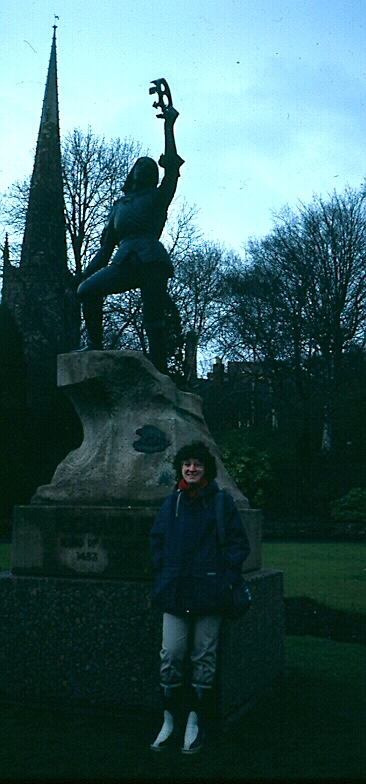
(It was the eighties, which excuses the glasses. I’m afraid there is no good excuse for the boots–though we were there in March and it was pretty damp and muddy everywhere.) So it has been a long time–OK, 23 years–since I was there, and I’m very excited about this trip. Last time I was there as a prospective history major with a lingering obsession for Richard III:


This time my interests are a bit different–and my time is much shorter. I’ll be in Oxford for three days and then in London for just about a week, which is not nearly enough time but will have to do. In Oxford I’m staying in a little hotel right across from Peter Wimsey’s college. The last time I was in Oxford I had never read Jude the Obscure; I wonder if the city will look more depressing this time. In and around London, I’m going back to Hampton Court, and to the Tower (both are having Henry VIII exhibits, as if they knew I was coming, though actually I probably have The Tudors to thank for this), of course, and to the Dickens Museum and the Carlyle House and the British Museum and the National Portrait Gallery and …

I will probably find it hard to leave the internet alone entirely, but I don’t expect to be posting anything here. When I get back, it will be time to start Villette!

Cry Me a River

I’ve been thinking about the movies that make me cry. OK, it could be a long list, as I’m the sort who likes to live vicariously through the plots of whatever she watches (what’s the point of watching if you are still aware you are sitting in your living room? it’s all about escape, right?). It amazes me how some moments never lose their poignancy for me. Yesterday, for instance, my daughter and I were watching West Side Story. I never make it much past the mock wedding, even though neither the (synched) singing nor the acting is altogether convincing:

The gorgeous Kiri / Jose version of “One Hand, One Heart” shows off the score better, but to me there’s something about Natalie Wood’s wide-eyed innocent beauty that I find heart-wrenching every time.

The ravishing Zeffirelli feature film of La Traviata is another one. I tear up about starting about here…

…and don’t recover until the end. The first time I saw it in the theatre, I could barely stand up when it was over. (Of course, Joan Sutherland is the only one who could really sing the whole part.)

Also on my list: Melanie’s death in Gone with the Wind, Beth’s death in any version of Little Women, most of the Zeffirelli Romeo and Juliet (I gather purists don’t love this version, but once again I’m a sucker for youth and beauty), and the last hour of Wit, in which the visiting mentor’s gentle reading of The Runaway Bunny should undo even most cool and detached observer.

I think the ability to cry at movies may be a prerequisite for becoming a Victorianist, actually. We all know Oscar Wilde’s sneer that it would take a heart of stone to read the death of Little Nell without laughing. Well, I cry when Jo dies in Bleak House, and there are parts of In Memoriam that I slip past in class because I don’t want to risk reading them aloud. (I also wept my way through the final chapters of Captain Corelli’s Mandolin and, more recently, A Thousand Splendid Suns.)

OK, ‘fess up: I can’t be the only sentimental fool out there. What movies (or books, if you prefer) always make you cry?