Stress!

You know that house I was getting in order, just a little while back? Well, right now it feels pretty wobbly, not for any one big reason but just from the combination of lots of little things that, cumulatively, are making me feel stressed out and distracted. I leave on Monday for my trip to the UK, for instance. In lots of ways I am really looking forward to this: a chance to meet up with friends and colleagues, to see and learn things, to be in London again and in Birmingham for the first time. But much as I enjoy being other places, I’m a terrible traveler when it comes to getting to other places (particularly by air, though I also abhor car travel). In addition to the flying itself, there’s the fun of airport security, in which you have your option of ways to have your privacy invaded, and a great deal of hurrying up in order to wait. I usually distract myself as best I can from thinking about the unpleasantness to come by keeping busy with planning, and in this case there’s plenty of that to do, along with finishing my conference presentation. But that is the source of its own kind of stress, as after all this time working out what I wanted to include and in what order and what degree of detail, I’m feeling dissatisfied with what I’ve got. I also did a practice run of the current version today and ran almost 10 minutes over what I believe to be my allotted time. I wanted to do a more informal talk, but it’s so hard to make sure you stay on point (and hit every specific point you want to) if you don’t script things pretty carefully!

I’ve been developing my Prezi in tandem with working out my speaking notes, and though I remain enthusiastic about Prezi as a concept and a conceptual tool, there too I am feeling dissatisfied: the current version doesn’t really use the special features of Prezi in a very creative way, and I’ve been wondering if I should have just saved a lot of time and done some straightforward PowerPoint slides — which I might end up preparing anyway as a back-up because I am paranoid that something (what? I don’t know!) will go wrong using Prezi (a firewall keeping me from getting to the site? an incompatibility between the design of my presentation and the projector I use? I don’t know! I enjoy technology but I don’t altogether trust it, at least not when I know people will be watching me use it!). It is not entirely calming to reflect that every conference paper I have presented in the past has been quite sparsely attended and has been the focus of far more concern to me than to anyone in the audience. The disproportion between my anxious preparation and the usual underwhelming but friendly reception in a way adds to my stress, because I feel I must be doing something wrong. I particularly recall two papers I sweated bullets over, both of which I thought dealt with quite controversial material in a somewhat provocative way. Oh, the questions I braced myself for! The micro-edits I put on them trying to anticipate and shape responses from hostile, or just better-informed, listeners! And in both cases there were maybe 9 or 10 people there besides the panelists, and no challenging questions at all. A relief? In a way, but also a let-down. One possible (and comforting) interpretation of this past experience is that I prepared such good papers they were (to quote from the cute new ‘Welcome to Dalhousie‘ song) “hater-proof.” But maybe the opposite was true and nobody wanted to be mean to me. I don’t think a paper about blogging and knowledge dissemination will be controversial, but I do want to have thought about the issues I raise well enough that I can answer questions about them, give appropriate references or clarifications, and address any skepticism I encounter…

So there’s that. And there’s the prospect of being on my own in London, which is at once exhilarating and a bit scary — it’s so big, and there’s so much to do and see, and I have so little time, too. I don’t feel so overwhelmed by New York because I’ve been there so many times (one perk of going to graduate school “up-state”), but I’ve been to London only twice and always with others. It will be nice not having to negotiate plans or meals, or just the pace of things, and I reassure myself that if I get lost, well, at least I (more or less) speak the language.

But I get back only a couple of days before my classes begin, and literally the day before my kids start back at school, so there’s a lot to try to be on top of before I leave. I’ve done one round of shopping for school supplies (I swear, I won’t be surprised if pretty soon they ask us to provide toilet paper for our kids) but am still waiting for a reply from the other school about what is needed. Then Dalhousie just announced some changes to their parking system which will make a difficult system a lot worse (unless I’m one of the lucky ones who “wins” a permit for a lot newly designated for reserved spots only — at more than double what I paid for my permit last year). So that’s stressful, as I contemplate scenarios that involve 45-minute walks with the kids through typical Maritime fall or winter weather (pouring cold rain, sideways wind, ice pellets) carrying all the gear we need for our days, and no easy way to get around if there’s some kind of problem that requires picking them up early — not to mention getting to routine after-school activities and appointments. Oh, and a hurricane is threatening to arrive the day I’m supposed to be flying out, which in a best case scenario means it will be a bumpy trip.

Sorry for venting. I’ll calm down eventually. Tomorrow I have some practical things to see to, and then I’ll do another round of tidying-up revisions on my speaking notes, and then on Friday I’ll have one more go at the Prezi, just to be sure that at least it includes all the illustrative bits I want, and to keep improving the transitions to avoid making my audience sea-sick. (My efforts towards this last point account for the increasing linearity of the prezi: big turns and lateral movement seem to be the most disorienting.) And tonight, I’m meeting two of my favourite former students, just for a coffee and a chat — that is definitely something to look forward to. Maybe I’ll even do some serious reading again soon: I’ve been too distracted for much besides yet more early Spensers.

Update: Better now. I really enjoyed chatting with my students (can I still call them this, even though they have both graduated – twice – from Dal?). Interestingly, we all talked at length and with much animation about the books we’ve been reading lately. This is interesting to me because I have noticed that at social functions with my professorial colleagues, we almost always end up talking about which TV shows we are watching. Maybe to English professors, book talk is too much like shop talk? But it’s also my colleagues who always say they have “no time to read.” I’ve taken another look at the prezi and it at least seems usable, though I do still want to tweak it (and cut the talk down). So I feel better about that, if not entirely satisfied. And now a glass of wine and maybe a dose of Our Mutual Friend, and that should keep the other anxieties at bay until tomorrow.
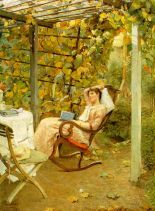
Summertime doldrums, or, I hate the idle pleasures of these days…

Bluhm PergolaWell, OK, that puts it a bit strongly — but I find I don’t flourish in the summer, despite being happy (who could not be?) to have some warmth and sunshine. I find the relative formlessness of the days difficult: I do better with more of a routine, including a routine that gets me out of the house and into my office on a regular schedule. I have an office space at home, but for years now my “real” workplace has been on campus, and though I use my home office for lots of things, from marking to blogging, still, there’s something psychologically useful to me about being “at work” rather than at home. That includes the absence of domestic distractions: being at work in a predictable way really helps me feel less torn when I am at home between wanting to appreciate being with my family and give my children the time and attention they deserve, and trying to get work-related chores and projects cleared away.
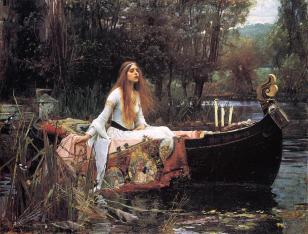
I realize that I am fortunate that the nature of academic work makes it possible to be home a lot during summer vacation, and my children are finally old enough to occupy themselves a fair amount, but I still don’t find it easy to concentrate, and the feeling of time drifting away amidst what we like to call (in honour of Mr Casaubon) “desultory vivacity” becomes nerve-wracking to me after a while. We also find that the city empties out during the summer as people head to their cottages. Neither of us was raised with the whole cottage phenomenon, and we aren’t interested in pursuing it now. We invested in a home in a very quiet and pretty part of town partly to obviate the need to rush away as soon as the weather turns nice, and we find one property quite enough to take care of (not to mention, to pay for). For various reasons, our family is also not particularly portable, so mooching off our friends at their cottages is not a live option. And so summers also feel quite isolated. Heck, even the internet is quieter in the summer!  I need to make a deliberate effort, in these circumstances not to prove a villain and get all restless and snarly. Waterhouse Shalott

To make sure I am in fact staying on top of my to-do list for work, I’m trying to focus on tasks that are more or less mechanical, like re-organizing my class syllabi and setting up Blackboard sites. I’m making progress here: two of my three fall syllabi are basically ready. All three fall Blackboard sites are in progress, though there’s a fair amount of housekeeping to do on them, because I’ve changed reading lists and am also revising assignment sequences since they were last used. I hate Blackboard. Everything about it is unbearably slow and clunky to manipulate. I also have the perhaps foolish idea that the course sites should be attractive, and should in some way reflect the themes and readings for each course, so that students feel that they are in a space that is an extension of our class time. I’m not computer-savvy enough to mean anything that elaborate by this, but I do choose colour schemes and custom icons and graphics to suit. For the Victorian ‘woman question’ seminar, for instance, I made a banner for the heading that is all different paintings of the Lady of Shalott, and at some point in the term we will reflect on the various representations in the context of our discussions of things like Victorian women as artists, problems of women entering the public sphere, idealizations of sick or dead women, and so on. I suppose I could just do the whole thing in a strictly utilitarian way and save myself time and grief (you don’t want to know how annoying it was getting that d–n banner made and then inserted–a process not helped at all by the painful sloth that comes over my otherwise zippy ASUS netbook when I’m inside the Blackboard interface).  I wonder if the students either notice or care how we set these things up. In any case, the tedious pointing and clicking of adding files, assignments, calendar entries (that’s the worst!) and links to things like the university’s academic integrity site as well as relevant web resources all has to get done by September, and it’s not the kind of work that gets thrown off too much by invitations to play MarioKart, demands for lunch, or doing taxi service to or from play dates or camps.

blogger-logoThe other work project I’m puttering away at is my presentation for the conference in Birmingham, which suddenly does not seem far off at all! I leave in just over a month. I’ve been learning Prezi, because what I’d seen of it (e.g. here) made it look just right for the kind of wide-ranging, open-ended talk that seems appropriate: the panel is on “knowledge dissemination in Canada,” and I was invited to talk about my experience as a blogger. I intend a short preamble to the more autobiographical / anecdotal part that will address some principled reasons for academics to think about and maybe even try blogging — the state of academic publishing, debates about open access vs. ‘gated’ scholarship, the potential value of academic expertise in the public domain — and also a bit about academic literary criticism and its relation to the wider book culture. But I’m not going to be trying to prove one particular point or argue for one particular value or approach, so the linearity of PowerPoint doesn’t suit. I did use PowerPoint the last time I spoke on these issues, to my departmental colloquium back in 2007, so I do have some graphics I may be able to recycle! But Prezi is an intriguingly different beast and if I can get the hang of it, I think it will work well for mapping relationships between all these different but interwoven threads. Also, it’s fun to play with–which I’m pretty sure nobody has ever said about PowerPoint. And it comes with a warning that it may cause motion sickness in your audience if not handled with care. Now tell me you aren’t longing to try it! Imagine the effect some uncontrolled zooming might have on a batch of unsuspecting first-year students…
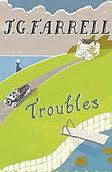
troublesI’m reading, too–right now, Troubles, by J. G. Farrell, which won the “lost” Booker a while back. I am loving it: it is brilliantly, mordantly, funny, with a current of uneasy violence running through its main storyline that is perfectly suited to the novel’s historical context, the Irish “troubles.” It’s yet another book (like Old Filth or Major Pettigrew’s Last Stand) featuring a retired servant of the empire — though in this case Major Archer is retired from active service but still a young man — yet it does not give me the same uneasy feeling that I’ve been through these moves before. We’ll see if I still feel that way at the end of the book. When day is done and I can’t even putter any more, I am watching Downton Abbey. This does seem familiar (wasn’t it called ‘Upstairs, Downstairs’ the last time?), but it is also very well done. I’ve just finished watching the Emma Thompson / Kenneth Branagh adaptation of Oliva Manning’s The Fortunes of War, which was excellent: I was most impressed that the series kept the oddly understated quality of the novels, which for some viewers might have made it unbearably slow in its pacing, which it is (slow,  not unbearable). While I watch these, I work on my bookshelf sampler, which I now believe I will actually finish by the end of the summer! I have just a bit more gilt for the book bindings and one final garland and then it’s time to mount and frame it.
My summer doesn’t sound so idle when I lay it all out like this! Add in that I’ve done some serious housecleaning (including, just this morning, taking everything out of the fridge, cleaning all the shelves and drawers, and putting everything back in all nice and orderly) and enjoyed such genuine summery activities as strolls in our beautiful Public Gardens, not to mention plenty of quality time with the kids doing other activities, and I feel quite pleased with the balance of work and play after all. Yet I will still welcome September, with its bouquet of freshly sharpened pencils* and the return to what feels–to someone who has, one way or another, been in school for nearly 40 years–like normal life.

*Sorry: I couldn’t find a clip with that actual line in it! But it’s near this point in the movie, I’m sure.

Catching Up: Bookish Miscellany, with a Special Note on Loins

I haven’t done a lot of focused reading in the past week or so–I blame (but very much welcomed!) my visiting parents, for diverting me with conversation. I also blame my daughter, who celebrated her 10th birthday on the weekend–an occasion involving much festivity but also, in advance, much planning, bustling, and shopping. Not that we did anything particularly fancy for it (not like last year’s bouncy castle, which really was quite a big deal). This year we had a “pajama day” party, with pillows and “stuffies” and movies, all very cozy. Of course, it would turn out to be the one beautiful sunny day in about a month! But everyone seemed to enjoy curling up to watch, and then we had games (‘freeze dance’ is a ritual favorite with this crowd) and pizza and ice cream sundaes with all the peanut-free toppings I could think of (Maddie’s very allergic).

I have been gathering books to read, though, and puttering through some of them, especially various books (fiction and non-fiction) about Richard III, as I think through what my essay will be about. I haven’t kept up with Ricardian novels since about 1985, and it turns out there have been quite a few, so I’ve been searching them out at the library and taking a look. At this point I’m not inclined to pay much attention to these “new” ones in my essay because they seem, well, awful. I suppose they aren’t, really. What they are is pedestrian and unconvincing. That said, I’ve been wondering: are the old books I cherish, including the two I just reread (The Broken Sword and The White Boar) really any better, or do I just read them through sentimental eyes? I think they are better. For one thing, by and large they avoid tedious attempts to make the characters sound medieval by having them speak in stilted, artificially antique dialogue–like this, from the page that happens to be open in front of me: “Ay, young Richard has proved a good student of arms. I do hear he wields a fierce sword.” You do hear that, do you? 15th-century speakers would have sounded perfectly idiomatic to themselves: I think that (for any but the most ingenious and talented writers) the smartest choice is to make them sound perfectly idiomatic to us, and to let the strangeness of their world-view come through in some other way. An old-fashioned oath or two is fine, and certainly allusions to period details of clothing, food, ritual, whatever. But stay away from ” ‘Tis unnatural in the eyes of God what they are doing” or “Certes, ’tis hard to explain.” Rather than creating an air of authenticity, this kind of labored stuff distances us–or me, at least–from the characters whose immediacy is crucial to our imaginative engagement with the novel. And for crying out loud, leave their loins out of it: across just a few pages of my current example, Anne Easter Smith’s A Rose for the Crown, we get “his exposed loins telling the tale,” “Kate’s loins all but melted into her shaky knees,” and “she experienced the familiar flutter in her heart and stomach that affected her loins.” Our heroine Kate has yet to get passionate with Richard of Gloucester, but I have a familiar flutter of my own that says loins will once more be involved, though maybe this time they’ll keep quiet and stay above the knees. I am hopeful that Jean Plaidy’s The Reluctant Queen will be better. I read and reread Plaidy’s novels as a teenager and have often regretted having discarded most of my collection over the course of many moves. This particular one is unknown to me, though: it is a late one, early 1990s, I think. (One of the unexpected convergences of my thesis research was discovering that the reason Agnes Strickland’s 1840s series Lives of the Queens of England seemed so familiar to me was that Strickland was one of Plaidy’s main sources.) I also dug up Sandra Worth’s The King’s Daughter and took Philippa Gregory’s The White Queen as I roamed the library, as both are at least peripherally about Richard and the Princes in the Tower.

One book I did get through, because I was writing it up for the summer reading feature we’re preparing at Open Letters and I couldn’t resist refreshing my memory, is Pauline Gedge’s The Eagle and the Raven. This is another old favorite, and again it raises the question of how far sentiment affects my judgment. I think I could find passages in The Eagle and the Raven that are as banal and cliched as any in A Rose for the Crown–but overall, I really do think it is fiction of a different order, richer, more challenging, more imaginatively rich. I can’t be quite sure, though, because about half way through it I developed an unnerving tendency to start weeping over every loss or betrayal in the plot, which means over most of the second part of the book. I can certainly be this kind of emotional reader (I’m a Victorianist, remember–I always cry at the end of A Tale of Two Cities too), but I wondered if it was really the tragic failures of the ancient Britons in their struggle against the Roman Empire that made me cry this time: I was full of memories, because of my parents’ visit, and emotionally stirred from reflecting on Maddie’s first completed decade, and The Eagle and the Raven is one of the books that made a great impression on me in my younger years, so that reading it was never just about the book but always about some volatile combination of who I was, who I am now, where I am now (literally and figuratively), and so on. How could I possibly assess its literary quality in these circumstances? And, I suppose, why would I really want to? I loved rereading it, so much that I think I may soon reread Gedge’s first novel, Child of the Morning, about Hatshepsut, Egypt’s only woman pharaoh–another old-time favorite.

Among the other books I have collected for my TBR pile recently is Testament of a Generation, the collected journalism of Vera Brittain and Winifred Holtby: I ordered “a lovely copy” through Abebooks (actually, from Silver Tree Books in Malvern, in the UK), and it finally arrived once the postal dispute was concluded (I won’t say “settled,” since it wasn’t, not properly). I’m more interested in reading this than in reading any more about Brittain and Holtby just yet, but I’ve also got Testament of Experience waiting. My mother and I had a nice browse at the Jade *W* downtown, too, and while she took home about 5 more books about Virginia Woolf to add to her impressive collection as well as their copy of Ursula Nordstrom’s Dear Genius (which I really hope she enjoys–I rather urged it on her!), I took Rebecca West’s The Fountain Overflows and This Real Night from their well-hidden Virago section.

First up for some sustained attention, though–which will have to be tomorrow–is Somerset Maugham’s Cakes and Ale for the Slaves of Golconda. It is worrisome to me that I read this barely a month ago (mistakenly thinking that was our deadline) and can barely recall it now!  But I’m sure it will all come back to me, especially since I see I made some helpful little notes in the back of my copy.

And that’s a start on getting back to blogging. I was actually starting to feel quite fretful about not having written anything here for so long, not because I felt guilty but because I felt sort of pent up, even with nothing in particular to write about.


Reading Around: Spinoza, Dickens, and … Ruxton?

Apparently Spinoza’s philosophical “stock” is rising:

Another scientist who was passionately Spinozist (going so far as to write him a gushing poem) was Albert Einstein. In Spinoza’s conception of nature, he recognised intuitions matching his own, concerning the elusive unified field theory. Einstein also relied on Spinoza to get him out of trouble when queried by a rabbi as to whether or not he believed in God, averring that he believed in “Spinoza’s God.”

This introduces yet another reason to consider shares in Spinoza: the heightened public interest in the raucous debates between science and religion. Spinoza’s identification of God with nature, though as subtle as that Lord whom Einstein once invoked, makes an invaluable contribution to this issue—precisely because it’s subtle. As does his attempt to establish morality on the purely secular grounds of the scientific study of human nature.

Any other tips? The rising value of Spinozas indicates that postmodernism, which plays fast and loose with rationality, might be heading for a bear market. I’d advise short-selling Heideggers.

This is good news for  my Ph.D. student writing on George Eliot and philosophy, who, on hearing the news, observed that she has been betting on Spinoza for years and is looking forward to the pay-off in the new “post-post-modern world.”

Colleen at Bookphilia has been reading and writing about Martin Chuzzlewit, one of the array of Dickens novels I have yet to read. In her final post she comes at the novel by way of Shakespeare and Dostoevsky

But, Dickens, what are you doing!? You set Tom up as the novel’s moral centre and align him as closely as possible with a literary mode of living and literary typology, but then destabilize such associations via Tom’s declaration that “There is a higher justice than poetical justice” (see previous post). But then, Chaz, you make the novel’s conclusion as literary and meta-literary as can be, not only by revealing old Martin to have been actively attempting to author the paths and outcomes of almost every other character’s actions, but also by making it very difficult for readers familiar with Measure for Measure to not make comparisons between the novel and the play. Given how frequently, in every novel of his I’ve read, Dickens references Shakespeare either directly or obliquely, I can’t believe that 1) Dickens didn’t know precisely what he was doing with Martin Chuzzlewit, and 2) that he trusted his contemporary audience to be as familiar with the Bard as he was. (I had considered offering to write a book on Shakespeare and Dickens but, alas, it’s already been done. Of course it has.) . . .

Martin Chuzzlewit seems to be a novel about the fiction we all indulge in about being able to completely control our own lives, as well as the lives of others when we see fit – when, in the long run, it’s in the hands of something higher that necessarily remains mysterious. That Dickens is careful not to spend much time implying that this higher thing is God (for godliness in his novels seems always to manifest only through one’s actions on earth, especially in The Old Curiosity Shop, but here as well) suggests to me a strangely quiet and gently resigned existential angst. Having read a number of Dickens novels in the past couple of years, and having noticed how much Shakespearean Comedy seems to influence him, I’m pleased to note that overall, even as he pays homage to the Bard, Dickens never completely succumbs to the very tidy conclusions the form allows. The discomfort Shakespeare reveals in the Duke’s surveillance and absolute control is redistributed into something more human and humane in Dickens – the discomfort that comes with acknowledging the essential incompleteness of all happy endings.

I am properly humbled: Colleen, you see, is ‘by training’ an Early Modernist, and here she’s not only reading more Victorian literature than I am (I haven’t read a 19th-century novel in nearly 6 months, unless you count La Vendee, which I am reluctant to) but rocking it completely. But I have begun Our Mutual Friend, so I may make up some ground eventually.

And speaking of 19th-century novels, Amateur Reader has a new favorite–well, as he qualifies himself, “a favorite in a quite narrow sense”:

Life in the Far West is a postmodern* Western first published as a serial in Blackwood’s Edinburgh Magazine in 1848.  The novel describes the life of an American fur trapper La Bonté, his partner Killbuck, and a number of other real and unreal mountain men and Western adventurers.  Ruxton, himself an English mountain man with literary pretensions, in a classic postmodern gesture declared that the book was “no fiction,” italics his, I guess, which is correct if I add one little amending phrase, “except for the parts that are fictional.” . . .

What is a current equivalent to Blackwood’s Magazine?  The New Yorker, perhaps.  I don’t want to say that everyone read Ruxton, but that would not be so far from the truth.  Charles Dickens, George Eliot, Charlotte Brontë, and so on would all have at least looked at Ruxton’s pieces, and the subject matter is so exotic and interesting that I do not doubt many of these writers read some or all Ruxton.   I find this amusing.

You would!

Weekend Miscellany: Linking About

Weekends are a pretty miscellanous time for me. I don’t usually even try to do much concentrated reading, though occasionally I surprise myself and burn through a book when circumstances conspire, for once, in my favor (or the book does not require particularly hard concentration). But in between errands and cooking and laundry and family activities and a lot of what (thanks to Mr Casaubon) my husband and I call “desultory vivacity,” I browse around online and see what’s on offer. Here are a few things that caught my eye, or that I went back to read again, this weekend:

In the Guardian, Rachel Cusk writes about D. H. Lawrence. I read Lady Chatterley’s Lover once but that and a couple of short stories (‘The Odor of Chrysanthemums,” for instance) are the total of my Lawrence experience. The section on Lawrence in Booth’s The Company We Keep is about the only thing I’ve read that made me consider changing that. Cusk’s piece is interesting, but comments like this always puzzle and frustrate me, and undermine my trust in the critical faculties of the writer:

The Victorian novel routinely used individual characters as emblems of wider social and geographical realities, to the extent that its concept of character often strikes the modern reader as stylised and lacking in reality. Dickens, Eliot, Gaskell: despite their interest in social change, regionalism, community, the position of women, these great English novelists have nothing in common with Lawrence at all. In The Rainbow Lawrence does more than part company with Victorian modes of narration – he destroys them by completely inverting the literary and actual function of “man” as a representative of “mankind”.

Dickens, Eliot, and Gaskell actually have relatively little in common with each other at all, and generalizations about “Victorian modes of narration” should be much rarer than they are. It strikes me that writing about Lawrence tends to make people hyperbolic (“reading him remains a subversive, transformative, life-altering act”).

In the New York Times Book Review, Nancy Kline reviews Rosalind Brackenbury’s Becoming George Sand, which I recently downloaded from NetGalley. I read the first instalment of the contemporary story and wasn’t very engaged, so I haven’t pressed on into the George Sand bit. Kline doesn’t convince me that I should; indeed, leading off the discussion by saying that if the book “does nothing more than send us back to the source, it will have done its work” really damns and blasts the novel with faint praise, doesn’t it? Because surely sending us to a different novelist is not at all the “work” of the current novelist. On the other hand, Sand is another novelist I haven’t actually read, despite having read about her quite a bit. As Kline remarks, “Her admirers included Balzac, Turgenev, Dostoevsky, Margaret Fuller, Walt Whitman, Elizabeth Barrett Browning, George Eliot and Charlotte Brontë. The last three thought her the greatest French stylist of her time.” That’s a fan club worth having! But, on the other other hand, George Eliot also greatly admired Sir Charles Grandison and Henry Esmond (which I have read).

At The Millions, Lydia Kiesling takes her turn convincing us that Lolita,”with its veritable panoply of horrors,” is nonetheless “the most bracing and perfect work of art I know.” Lolita has always seemed to me the kind of “great” literary work that really forces us to confront the problem, not of the good or bad book, but of the good or bad reader. Our standard of tolerance surely must be set by the good reader, the one who gets it that we are not supposed to (that we must not) share Humbert Humbert’s values. But we seem to be living in a moment–or maybe it is always such a moment?–in which unreliability, irony, or narrative distance are easily misunderstood or just rejected: I’m thinking, for example, of the recent decision to ban the Dire Straits song “Money for Nothing” from Canadian radio, or of the “cleaned-up” edition of Huckleberry Finn. Good thing nobody reads Victorian poetry, or someone would probably come after Browning pretty soon.

At The Second Pass, John Williams followed his round-up of women critics on women writers with an interview about the VIDA statistics with Jennifer Szalai, former book review editor at Harper’s; if you didn’t see it already, I think it adds some useful perspective to the discussion (a wide-ranging round-up of which can be found here):

The statistics approach the issue from two angles: reviews written by gender, and the books being reviewed by gender. How separate or entangled are those issues to you? What do you consider unique elements of each?

I suspect the issues are connected in some way, though I’m not sure whether it’s as straightforward as claiming that the dearth of reviewed books by women derives directly from the dearth of reviews written by women. In fact, Ruth Franklin at The New Republic concluded that “the magazines are reviewing female authors in something close to the proportion of books by women published each year.” She then wonders whether the numbers have anything to do with how “we define ‘best’ and ‘most important’ in a field as subjective as literature, which, after all, is deeply of influenced by the cultural norms in any given age.” She raises the possibility that the dismal proportion of books published by women has to do with unconscious biases, but then she doesn’t go so far to provide a confirmation one way or the other — an approach that, to my mind, is less evasive than it is honest. With a work as complicated as a book, whose creation and reception is dependent on so many factors, I’d find it hard to believe anyone who claimed they could pinpoint exactly why so few women were published. We should also keep in mind that Ruth’s sample excluded those “books that were unlikely to be reviewed — self-help, cooking, art” — which also happen to be books that are often written by women.

This connects to the question of which books are considered “important” enough to review. I do think there are a whole host of cultural norms that come into play — among them the bizarre obsession with “the Great American Novel,” as well as a condescension toward certain subjects like motherhood and a young woman’s coming of age — but then it’s hard to see how this contributes to the gender imbalance among reviewers (though I can see how it might very well derive from it).

At American Fiction Notes, Mark Athitakis reviews The Late American Novel, a collection of essays about the future of books and reading:

The majority of the essays are structured by the writer’s taking notice of the alarms—e-books, tablets, an ever-destabilizing economy for writers, readers’ decreased attention spans, the novelist’s loss of centricity in the culture—and then choosing to ignore them. We’re wired for story; story will never die; writing is worthy labor; there will always be readers who appreciate it; and hey, didn’t Choose Your Own Adventure books prove the physical book can play with form well before the iPad? The arguments’ shape, along with their homily-like brevity, reminded me of a line from Roger Lambert, the bitter, pervy divinity-school teacher at the heart of John Updike‘s Roger’s Version: “Raise the doubts, then do the reassurances. People have no idea what they’re hearing, they just want a certain kind of verbal music. The major, the minor, and back to the major, then Bless you and keep you, and out the door to the luncheon party.”

This weekend I’ve also finished up The Lonely Passion of Judith Hearne, but I won’t be writing it up until after my book club meets this week. And I’ve just begun Shirley Hazzard’s The Transit of Venus, which is this month’s pick for the Slaves of Golconda group. Anyone who’s interested is welcome to read along and contribute to the discussion. So far I am liking the novel a lot. I find aspects of Hazzard’s prose perplexing (what’s with the words that are just not there, at the end of sentences, for instance?) but it’s difficult in a more inviting way than Christina Stead’s ranting cadences (The Man Who Loved Children has been retired, for now–just not a mental space I could be in).

March Reading Plans

International Women’s Day seems like a fitting occasion to declare that I have had enough of the intensely masculine atmosphere of police procedurals for a while. I have now read 5 of the Martin Beck books and while I think they are very good of their kind, it is still not the kind that best suits my own personal taste and I’m ready to read something different. I don’t even want to finish the attempt at a properly nuanced commentary on the role and depiction of women in them that I started to write just now and then deleted! There’s plenty to be said about it, I’m sure, and I’m not calling the books sexist. I just want to take my mental life somewhere else for a while–which means I’m also not keen on reading more Henning Mankell just yet either. Reading Danielle’s nice post at A Work in Progress about her own March reading plans made me think about what I have to look forward to or might choose to focus on for the rest of this month. One of the great luxuries of being on sabbatical, after all, is exactly that choice!

I think it’s going to be a pretty intense month for women writers–which is not unusual for me, of course. In fact, prompted by the flap about the VIDA statistics, I did a quick tally of the contemporary books I’ve written up on Novel Readings and came up with around 72% women authors. (This may in itself be one tiny piece of anecdotal evidence for the difference it might make having more women involved in editorial roles at the major periodicals: if their own reading skewed at all towards women writers, that would inevitably shift the sense of what books deserve attention.) Like Danielle, I’m reading Shirley Hazzard’s The Transit of Venus for the Slaves of Golconda reading group. I’m also determined to finish Margaret Kennedy’s Together and Apart. I’m going to reread Anne Brontë’s The Tenant of Wildfell Hall and also, maybe, Agnes Grey, as I’m hoping to write something about AB for Open Letters Monthly. First, though, I’ve just begun Christina Stead’s The Man Who Loved Children, because after all the detective novels with their mostly pedestrian prose I really wanted to dive into something where the writing really mattered–and the first two chapters have already convinced me that an extraordinary (if not altogether pleasant) reading experience lies ahead. Here’s her description, for instance, of Henny Pollit’s family home:

She had the calm of frequentation; she belonged to this house and it to her. Though she was a prisoner in it, she possessed it. She and it were her marriage. She was indwelling in every board and stone of it: every fold in the curtains had a meaning (perhaps they were so folded to hide a darn or stain); every room was a phial of revelation to be poured out some feverish night in the secret laboratories of her decisions, full of living cancers of insult, leprosies of disillusion, abscesses of grudge, gangrene of nevermore, quintan fevers of divorce, and all the proliferating miseries, the running sores and thick scabs, for which (and not for its heavenly joys) the flesh of marriage is so heavily veiled and conventually interned.

The passage starts out calmly enough, but that riff on marriage as a diseased body wrapped in the veils of domesticity lacerates the imagination. I’ve also already had to look two words up in the dictionary: “desquamating” and “crepitations.” (I’m sure you all already knew just what these mean.)

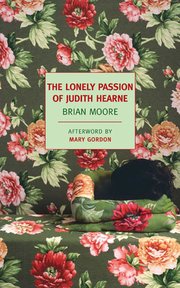
The other two books I’m planning to get through are Trollope’s La Vendée, which one of my PhD students is writing a chapter on (I’m about three chapters into that one, and as she and I were discussing today, it reads more like Scott–though not, perhaps, Scott at his best!–than like Trollope) and, for my other reading group, Brian Moore’s The Lonely Passion of Judith Hearne. I haven’t started that one yet, but I will say that the NYRB Classics edition has a gorgeous cover:

It sounds like a great month, actually. If I do get through all of these, I’ll be pretty proud of myself! But if I don’t, that’s OK too, because there’s always April…

So what about you? Anything on your TBR pile that you are especially looking forward to?

A Look Ahead

I’m not quite ready to do my annual year-end post as the year isn’t over and there’s more novel reading to be done! But I have been unwrapping all kinds of goodies which I will be reading and reviewing in 2011. A few years ago we decided that opening all the Christmas presents in one frenzied morning meant the individual presents were not fully appreciated and the let-down from the anticipation was unduly severe. So we started a brand new tradition (it’s important to launch these every so often!) of opening one present a day starting from the first day the kids are off school. I must say, I highly recommend this system! Everyone has something new to read or wear or watch or play with every day–and two, on Christmas day, plus stockings. It does mean, though, that I don’t yet know quite all the new books I’ve got (I can see some more distinctly book-shaped parcels still under the tree). So far, here’s my haul:

Miss Pettigrew Lives for a Day. I opened this one a bit early, as its card (accidentally?) said ‘Happy Birthday’–which was in March. I wrote about it already, here. I enjoyed it so much I thought I’d take another look at the film adaptation; I’ve rewatched about the first hour and I find myself often wondering why they didn’t stick closer to the book.

Hilary Mantel, Fludd. I was so impressed with Wolf Hall that I immediately began working through Mantel’s back catalogue, including A Place of Greater Safety, Beyond Black, and The Giant O’Brien. One of these will certainly feature on my ‘best reads of 2010’ list, but you’ll have to check back to see which one! Fludd looks enticing.

Kate Atkinson, Started Early, Took My Dog. I’ve started this one already. Atkinson is a great storyteller whose Jackson Brodie novels stretch, or evade, genre categories such as ‘detective fiction’ or ‘crime fiction.’ They are strongly character-driven, and they have a persistent interest in the ways people get tangled up in their own pasts, and their own erratic impulses.

Helen Simonson, Major Pettigrew’s Last Stand. Seriously, how likely is it that there would be two books featuring characters named ‘Pettigrew’ on my list? This one looks like just the kind of book I’ll enjoy. I wish the publishers didn’t feel the need to fill several entire pages at the beginning with endorsements from every conceivable source, though: it makes them look anxious! And the selection is so ‘something for everybody,’ from O magazine to the New York Times. I guess it’s perverse to find this kind of effusion offputting. Certainly it won’t actually put me off the book!

Christina Stead, The Man Who Loved Children. I first read about this in Elizabeth Hardwick’s A View of My Own, and since then I seem to have noticed a number of allusions to it elsewhere, all of which–but Hardwick’s essay especially–piqued my interest.

Zadie Smith, Changing My Mind. I thought White Teeth was OK–really good in parts, strained or excessive in others–and I disliked On Beauty intensely. On the other hand, I often really enjoy Zadie Smith’s essays, including one she wrote some time ago on Middlemarch, so I’m looking forward to reading this collection.

Good Reading for All

I seem to have little to say for myself right now. I blame the end of term for the mental clutter it creates (there’s physical clutter, too, of course, but that’s more easily dealt with). Luckily, there are lots of other people writing interesting things about books.

For instance, the December issue of Open Letters Monthly is up! As usual, its essays and reviews range widely in both subject and style, which means there’s something for everyone. For instance, if you are in the mood for something darkly disturbing, check out Colleen Shea’s review of Yoko Ogawa’s Hotel Iris, which raises questions (in the context of the glut of press coverage of a horrifying recent murder trial) about aestheticizing violence against women. For the political junkies, there are pieces on both of the big “W”s:  Greg Waldmann casts a cold eye on George W. Bush’s Decision Points, while Steve Donoghue has a somewhat chilly response to Ron Chernow’s new biography of George Washington. Alice Brittan offers a compelling analysis of Nadine Gordimer’s collected short fiction, while Ingrid Norton completes her ‘Year with Short Novels’ with a look at Charles Portis’s True Grit. Andrew Flynn is not impressed with Charles Hill’s Grand Strategies, but Morten Hoi Jensen appreciates finding the human side of Saul Bellow in his collected letters. All this plus Stephen King, Halo, Stephen Sondheim, perfume, and more…

The book world is awash in year-end features (I guess nobody publishes anything worth reading in December?). The Millions is running its annual ‘Year in Reading’ series, with contributions so far from John Banville and Lionel Shriver, among others.  At The Little Professor, Miriam Burstein has her own unique take on the ‘Year in Books (including Brontes and vampires’:

Most appalling religious novel: Mme. Brendlah, Tales of a Jewess.

Best modern antidote to Tales of a Jewess: Lillian Nattel, The Singing Fire.

Religious novel above and beyond the call of duty: Martin Shee, Oldcourt.

Religious NOVEL most ADDICTED to CAPS for EMPHASIS: Robert Wood Kyle, The Martyr of Prusa, or the First and Last Prayer; A Tale of the Early Christians.

Has anyone seen the plot?: The Vicar of Iver: A Tale, which, despite the subtitle, had no storyline whatsoever. (read the whole list here!)

At Wuthering Expectations it has been just one interesting thing after another, as usual. Try these posts on Newman, for starters, and then these on Henry Esmond (no, AR, I don’t think it’s teachable–at least, I would never try! I read it for my PhD comps and then never again. “Conceptual purity” indeed!).

At Tales from the Reading Room, litlove recently offered a crime round-up, which may give some of us more ideas for our TBR lists (as if they needed to get any longer, right?).

At stevereads, there’s something for the intellectuals in the crowd as Steve continues his great series Penguins on Parade with Michael Psellus’s Fourteen Byzantine Rulers–but if you scroll down to the next post, you’ll find something a little less cerebral, too…

Stefanie at So Many Books has gone from May Sarton’s The Small Room to e. e. cummings’s The Enormous Room, which is quite a transition.

At The Second Pass, John Williams has “finally taken the plunge into Freedom“; his response to the first 187 pages is here, with, of course, more installments to follow.

That’s hardly all, but that’s all I have time to round up for now.

In other news, my copy of Skippy Dies has just arrived and has lured me away from the Lydia Davis translation of Madame Bovary. Eventually, I will be writing about these books and more–many more, once I get through the papers and exams and arrive in the free, clear air of my sabbatical next term.

Recent Reading: In Brief

OK, I got the review in to those taskmasters at OLM and now I can risk doing a little fresh blogging–though at this point I’m just going to play catch-up. I feel as if I’m in another of those reading slumps, which inevitably lead to blogging slumps unless I’m very disciplined: it’s not much fun to write up books you don’t like, or think are OK, and it’s even harder to face giving the full treatment to a book that has been very widely acclaimed that you are luke-warm about. The latter, in this particular case, is Marilynne Robinson’s Pulitzer Prize-winning Gilead, and though I concede that the prose is beautiful and the consciousness of the narrator beautifully rendered, there seemed to be a mushiness at its intellectual centre that I couldn’t blame on John Ames. I had a sneaking suspicion, as I read through its limpid sentences and its celebratory passages about life, interspersed with evasive passages about mysteries and the dissatisfactions of demands for proof, that it was highly acclaimed precisely because of those feel-good evasions so elegantly packaged. It’s all very affirmative and small-town nice. I know I’m not doing the novel justice: this isn’t all it has to offer. Also, I know I am influenced by interviews I’ve read and seen with Robinson, which make it impossible for me to hear any delicate irony separating her nice old man’s perspective from her own. Despite some of the blurbs insisting it is not just a book for believers, I think it is, though for the currently trendy New-Agey ones whose religion is not defined by doctrine or scripture but by personal experiences and vague spiritual ideas about God. I did relish many individual lines (for instance, “Any human face is a claim on you, because you can’t help but understand the singularity of it, the courage and loneliness of it”).

I finished Sue Grafton’s ‘U’ is for Undertow, which was OK except for the whole TMI thing I wrote about before. I’ve been trying to read The Girl who Played with Fire but I’m completely stalled in it. Do you think all the millions of people who are buying these are actually reading them all the way through? Maybe they skip along to find out what happened and don’t trouble themselves too much about how plodding the prose and plotting are. But I think my copy will go sit on the shelf now. I’d rather read the new Elizabeth George mystery, which I just got from the library–not because I really want to know about the case but because I want to catch up with Inspector Lynley and the gang. I did enjoy the first story in The Penguin Book of Crime Stories Volume II, ed. Peter Robinson, which is Reginald Hill’s “The Dog Game.”

As I only have This Body of Death from the library for another week, I’ll finish that up next. Then I think I’ll see how far I can get in Scott’s The Antiquary, which I’ve pledged to read as part of the Scottish Literature Challenge sponsored by Wuthering Expectations. And that reminds me: something else I’ve been reading recently, with pleasure and interest, are the posts at WE about my anthology The Victorian Art of Fiction. As I’d hoped and expected (unwutheringly), fresh eyes see things differently, and the posts and comments have been excellent so far.

Kathryn Hughes on The Mill on the Floss

At the Guardian, Kathryn Hughes (author of this excellent biography of George Eliot) writes about the autobiographical resonance of The Mill on the Floss:

Unusually for such an intensely autobiographical novel, The Mill on the Floss was not Eliot’s first work of fiction, but her third. Shortly before it came out she explained to a friend that my “mind works with most freedom and the keenest sense of poetry in my remotest past”, and her first two novels had indeed truffled her own prehistory. Scenes of Clerical Life (1858) was drawn from stories circulating around her childhood community about a series of mild scandals that had taken place several decades earlier. Adam Bede (1859) was based on the young adulthood of her father, her uncle and her uncle’s wife. It was as if Eliot had been working through what she called the “many strata” of collective memory before she was ready, finally, to confront her own past. . . . (read the rest here)

As Hughes notes, “[l]iterary theorists tend not to approve of reading novels as if they were fictionalised autobiography,” though I don’t know any critical accounts of The Mill on the Floss that overlook the kinds of parallels Hughes draws attention to in her account. It’s not that they don’t exist–it’s just that ultimately, they aren’t that critically interesting, as I think Hughes’s own piece shows. Once you’ve done the mix-and-match exercise (“[Robert] Evans, like Tulliver, was a fond father, who doted on “his little wench”, born when he was already middle aged,”  “the Dodson aunts derive much of their grotesque energy from Eliot’s close observations of her own mother’s sisters, the Pearsons,” and so forth) you still won’t have said much about the novel’s internal energies and motivations.