My tremendous writings — not!

I got a spam comment here today that made me laugh:

Hey, you used to write great, but the last several posts have been kinda boring… I miss your tremendous writings. Past several posts are just a little out of track! come on!

Usually the spammers use honey rather than vinegar in their attempts to get us to click through and buy a little of what they are selling; this crew probably thinks that if they rile us up, we’ll come after them–and then they’ll have us! But it also made me laugh because it’s a little close to the mark: posting has been slow around here, though I do hope that what has gone up is not terribly “out of track.” It’s not that I’m not reading. I finished two Spenser novels over the weekend, for instance, part of my look back at the earlier ones in the series. Mortal Stakes seems to me particularly good, because it sets up and then challenges the moral terms on which Spenser pursues his code (which, as he notes, does not work in this instance). Looking for Rachel Wallace is interesting in different ways: again, it features Spenser coming up against some of his limitations, but in this case they are ideological more than ethical: Rachel Wallace is a “radical” feminist Spenser is hired to, but fails to, protect, an while he has to make up for his initial insistence on overriding her decisions in service of his chivalric standards (which leads her to fire him, leaving her to be kidnapped), she also has to confront her own inability to defend herself. Both are zippy reading and good, stylish examples of their kind. But I chose them to read because they fit well into the interstices of my other weekend projects, and so writing them up in detail was beside the point.

The other books I’m reading will almost certainly get their own proper posts, but I have to finish them first! One is Our Mutual Friend, which I am rereading after a gap of more than 20 years. It’s great. It’s also long! And I’ve been interrupting it with other things, including Alex Ross’s The Rest is Noise, which I am puttering along at times when concentrating on Dickens is not realistic. The Rest is Noise is fascinating, but I can’t altogether get past the frustration of its not being a hypertext edition with music samples. (There’s a companion blog, but coordinating reading with being online and listening has not proved practicable.) Reading about music without listening to it is like reading about food without eating any — or substitute your choice of sensory activities that are best experienced directly! Still, it’s making me curious about music I never wanted to listen to before, and it’s lucid, lively, and full of great anecdotes. Finally, Vera Brittain’s The Dark Tide just arrived via “document delivery” (in my day, we called it “interlibrary loan”) and the lending library has given me only until September 7th, so I thought I’d best get right to that. No point imagining a seminar for 2012-13 on the Somerville novelists if I haven’t actually tested the charm of the idea against the reality of their novels, after all, and South Riding is not a very big sample.

So. I’ll have more tremendous writings up again soon, I promise.

Against Generalizing: A Cautionary Tale

I’m often puzzled and annoyed by comments about “the Victorian novel” that purport to make a general – typically dismissive – claim applicable to all novels from the 19th century, often in order to praise “modern” fiction for being more experimental, various, risk-taking, or whatever. Sure, there’s plenty of pedestrian expository story-telling in 19th-century novels, just as there is in a certain class of fiction today, but put a paragraph of, say, Vanity Fair next to a paragraph of Wuthering Heights next to a paragraph of Mary Barton, all published in 847-48 (or pick your own examples if you prefer) and you will find your comfortable assumptions about Victorian “realism” – and just about anything else – grinding to a halt. Generalizations serve their purposes, but often these purposes are somewhat suspect, tendentious, or simply utilitarian.

I am thinking about this issue because I am currently reading two books from almost exactly the same historical moment: one was originally published in 1934, the other in 1936. In case I needed this lesson, they are teaching me to be every bit as wary about even the most tentative generalizations about “novels of the 1930s.” Here’s a characteristic excerpt from each:

I.

‘But it’s not like any kind of life!’ she cried out, in a kind of helplessness and distressed reluctance. ‘Not like any that comes your way, I’m sure.’

‘How d’you know what comes my way?’

Not that kind of waking anyway and getting on a bus, and mornings with Anna; not bed-sitting-rooms and studios of that sort; not that drifting about for inexpensive meals; not always the cheapest seats in movies; not that kind of conversation, those catch phrases; not those parties and that particular sort of dressing, drinking, dancing . . . . Not the book taken up, the book laid down, aghast, because of the traffic’s sadness, which was time, lamenting and pouring away down all the streets for ever; because of the lives passing up and down outside with steps and voices of futile purpose and forlorn commotion: draining out my life, out of the window, in their echoing wake, leaving me dry, stranded, sterile, bound solitary to the room’s minute respectability, the gas-fire, the cigarette, the awaited bell, the gramophone’s idiot companionship, the unyielding arm-chair, the narrow bed, the hot-water bottles  I must fill, the sleep I must sleep . . .

II.

Livia wrote the recommendation for banishment in very strong terms. It was composed in Augustus’s own literary style; which was easy to imitate because it always sacrificed elegance to clarity – for example, by a determined repetition of the same word, where it occurred often in a passage, instead of hunting about for a synonym or periphrasis (which is the common literary practice). And he had a tendency to over-prepositionalize his verbs. She did not show the letter to Augustus but sent it direct to the Senate, who immediately voted a decree of perpetual banishment. Livia had listed Julia’s crimes in such detail and had credited Augustus with such calm expressions of detestation for them that she made it impossible for him ever afterwards to change his mind and ask the Senate to cancel their decision. She did a good piece of business on the side, too, by singling out for special mention as Julia’s partners in adultery three or four men whom it was to her interest to ruin. Among them was an uncle of mine, a son of Antony . . . I believe that the charge of conspiracy was groundless, but as the only surviving son of Antony, by his wife, Fulvia – Augustus had put Antyllus, the eldest, to death immediately after his father’s suicide, and the other two, Ptolemy and Alexander, his sons by Cleopatra, had died young – and as an ex-Consul and the husband of Marcellus’s sister, whom Agrippa had divorced, he seemed dangerous.

I’m sure you recognize, or can guess at, the second: it’s from Robert Graves’s acclaimed historical novel I, Claudius. The first is from Rosamond Lehmann’s rather more obscure The Weather in the Streets. What a contrast between the pedantic literalness of Graves’s chronicle-like narrative (which has its own cumulative charm, but which feels not that much like a novel) and Lehmann’s idiosyncratically drifting voice. More reasons to proceed with caution: Virginia Woolf’s The Waves was published in 1931, Winifred Holtby’s South Riding in 1936.

Cassuto On Blogs: “I have nothing against them, but I don’t read them, either.”

The quotation is from a comment by Leonard Cassuto in a recent Guardian “live chat” on academic publishing. Here it is in full (he’s responding to an inquiry from Melonie Fullick about “how academic blogging might fit in with a kind of publishing ‘portfolio'”):

Another thing about blogging: lots of people with certain reading habits don’t read blogs. I have nothing against them, but I don’t read them, either. This is as much a function of available time as anything else. By restricting myself to published writing (whether digital or print), I am in effect ascribing value to the gatekeeping function of editors. I don’t do this because I’m a snob, but rather because there are only so many hours in a day.

Especially in the context of a discussion explicitly intended to address how academic publishing is changing in the digital age, this remark strikes me as both disingenuous and disappointingly narrow-minded. To begin with, he does have something against blogs: he does not consider them “published” (huh?), and they haven’t been seen by an editor, and thus he doesn’t consider them worth reading. At all. The first objection is incoherent, especially as he later goes on to say that blogs lack prestige because of “the absence of intermediaries between writing and publication”–in other words, they are published, but without (to use his vocabulary) gatekeepers. He doesn’t read them because they are self-published. The second objection is understandable from a pragmatic point of view: there is a lot of writing out there, on and off the web, and as he says, “there are only so many hours a day.” It’s not as hard as all that, though, to do a little filtering yourself, and to me it bespeaks an astonishing lack of intellectual curiosity not to look around to see which blogs might be of professional and/or personal interest and value.  (It turns out he is able to name at least two bloggers with “street cred,” Brad DeLong and Michael Bérubé–which dates his info a bit, as Bérubé has, at least temporarily, stopped blogging–so he knows where he might start looking for others, or he does if he understands the function of the “blogroll.”)

There’s also some lurking hypocrisy here: the Guardian feature opens with a link to a “blog post” by Cassuto himself, at the Chronicle of Higher Education. Now, I don’t know the mechanics of publishing in the CHE. Perhaps there’s a careful gatekeeping process there, determining which pieces deserve to appear under that illustrious banner, or perhaps there’s at least an editor who mediates between Cassuto’s unfiltered thoughts and his posts–which he calls “columns.” (I hope so, else by his own logic, why should we read them?) Perhaps the gatekeeping process begins and ends with the invitation to write for the Chronicle, which gives you a general stamp of approval. In that case I’m sure Cassuto scrupulously edits his posts columns himself, after writing them and before posting publishing them: he’s an experienced professional writer, after all, and well-qualified to do so. If so, it might occur to him that there are others who can do so as well and get good results, even without the Chronicle‘s sheltering umbrella of authority.

Here’s the exchange that followed (in the original thread, of course, it’s interspersed with the rest of the ongoing discussion):

RM: I know this is common (I have many colleagues who say the same thing), but this attitude implies, even assumes, “blogs” as a category have nothing in them worth competing for that time with other forms of writing/publishing–which is odd, since we would never trust in such wide generalizations about “magazines” or “books” or “articles”–the content should matter, not the form. It’s an odd, and inherently conservative, form of complacency, I think.

LC: You’re missing my point about teh [sic] value of the gatekeeping function. In general, I like to invest my time in writing that an editor has seen first.

RM: I agree that editors can provide a valuable service, and that it is helpful given the array of reading options out there to let someone else provide a filter, but in 20 years as an academic I’ve also read plenty of poor stuff that somehow passed through that gate! But my main point is just that people should be wary of generalizing about (or making decisions about) blogs if they don’t read any. Kathleen Fitzpatrick’s Planned Obsolescence has some really good discussion of the ways peer review (as one kind of gatekeeping) can hold back innovation and new ways of thinking.

LC: I don’t want to overwork this, but part of my point has to do with the credibility of blogs in the larger world of publishing, which is what we’re talking about. Some blogs (Brad DeLong’s and Michael Berube’s come to mind) have huge street cred that has been built up not only through years of steady and high-quality output, but also (and this is significant to me) by the work that these prolific and influential scholars do outside of their blogs: in other words, lots of people read the blog because they already respect the writer’s scholarship. Of course there are good and bad blogs, just as there is good and bad refereed scholarship and good and bad articles in the TLS, but the relative lack of prestige of blogs as an outlet has at least partly to do with the absence of intermediaries between writing and publication. You might think that prestige deficit a bad thing and I might disagree, but it’s a fact that bloggers need to consider as part of their decision to devote their time and energy in that direction.

So again we have a veil of pragmatism thrown over an argument for accepting (even reinforcing) the status quo–pragmatism, at least, from a careerist perspective (see digiwonk‘s comment on that post column). Yes, it’s true: there is a “prestige deficit.” But I would have expected a discussion about ways the digital age is changing academic publishing to at least evaluate, if not actually challenge, that normative thinking. Once you acknowledge the imperfections of the gatekeeping system (“of course … there is good and bad refereed scholarship” [emphasis added]), you should be open to more imaginative ways of conceptualizing the processes or forms of scholarly discussion and knowledge dissemination. Based on Cassuto’s own admission, the presence of “intermediaries between writing and publication” is no guarantee of quality in communicating the results of specialized research. We might also consider whether there are other goals in academic publishing (particularly related to work in progress or collaboration) or other values (such as open access) that are better served by non-traditional forms including blogging. Nobody that I know of is trying to argue that blogging in general, or even particular highly scholarly blogs, should replace traditional publications. But surely it’s time people stopped saying “I don’t read blogs” as if there’s nothing questionable or retrograde about that.  At the very least, if you don’t read any of them, there’s absolutely no way you can know what their value is, which means you aren’t really qualified to speak about the place they should have in academic publishing–only to pass along the news (which is no news to bloggers) that most academics are prejudiced against them.

Cassuto is actually inconsistent about all this, though. In the comments I’ve quoted so far, he sounds resolutely against the professional utility of blogging–again, narrowly construing ‘utility’ to mean ‘useful in building a professional resume.’ Upthread, however, he makes what I thought was a very encouraging statement about avoiding preemptive assumptions based on the form of someone’s writing:

For me personally, I now judge everything case by case. if I were reviewing the work of a job candidate who writes a blog, I’d want to see if it were a good, substantial blog, and evaluate accordingly. But there are plenty of people in my discipline who would simply say that blogging is not scholarship, however broadly conceived.

Here, then, he differentiates himself from  his stodgy colleagues. Here’s my pleased reply to that earlier remark:

It is good to see you say you would actually *read* the blog to evaluate it. This seems crucial: those who simply dismiss blogging as “not [being] scholarship, however broadly conceived,” at least in my experience are usually people who don’t read blogs and make assumptions about their content and their value (and their potential role in scholarship and scholarly communication) based on what they think they know about the form of blogging.

Later on, he sets himself up as the champion of a “new world of possibilities.” A participant in the discussion proposed that it would be good if graduate programs encouraged

digital writing as part of a research portfolio. Academia will still push for “traditional” publishing outlets[;] however blogging, video and other media formats help students collect, archive and curate knowledge – which helps with research and publishing goals.

“Yes, it would,” Cassuto says:

I’ve been writing about this in my own columns in hortatory tones. But most of my peers don’t know how to teach “digital humanities.” I’ve just started to take my own advice and encourage it, but there’s an entrenched population who has to be educated about the new world of possibilities.

Perhaps it’s not really an inconsistency but rather a slippage between the broader category of “digital writing” in the first comment and Cassuto’s use of the term “digital humanities,” which (to me, at least) means something rather different. Though there are digital humanists who blog, there are many bloggers (myself included) with no particular affiliation to digital humanities as an area of specialization. At any rate, his comments specifically about blogging do not suggest he is quite as different from his “entrenched” colleagues as he believes. Blogging is a part of that “new world”; the way to be educated about it is to actually read some blogs. He has some catching up to do. One place to start, if only for its historical interest, might be here (on the internet, 2005 is pretty ancient history!).

Like Cassuto (who, to be fair, is rather taking the fall here for the many other people who have said similar things to me about their “reading habits”), I don’t want to overwork this, particularly as I understand the main purpose of the Guardian chat was to give advice on how to be a successful academic, and all practising academics know that the safest strategy is to do the most familiar (and prestigious) things.  But even so, there are no guarantees, and I do find it discouraging that, a few years after the MLA issued its own recommendations on rethinking how we approach academic publishing for tenure and promotion (PDF) (see also Stephen Greenblatt’s 2002 letter) , the conversation here unfolds in a way that ultimately reinforces not just traditional but constraining and conservative ideas about how to “get ahead.” Despite gestures towards “portfolios” and nontraditional forms of scholarly writing (both of which the MLA encourages), the emphasis is on placing articles in journals and book manuscripts with publishers–the more prestigious, the better. Even in these forms, priority is given to print over online or electronic forms. From one press rep: “most authors and academics have a preference or taste for printed books”; Andrew Winnard of Cambridge UP also  comments that:

Digital developments continue apace but print has a suprising [sic] resilience. In terms of academic career progression in the humanities, there is still, it seems, nothing that quite replaces a physical book when presenting evidence to one’s Head of Department. Compared to 300 pages in a weighty binding and an attractive cover, a ‘click’ struggles to compete.

Again, they all seem to be strangely deferential to people’s habits, which I can see if your business is marketing, but not so much if your interest is (as Aimee says at the Chronicle) “to disseminate good ideas and advance our collective understanding of the world.” (The recurrent assumption that form determines the value of content–or its prestige, if that’s any different–is increasingly bizarre to me. How many of these folks go get the print journal if they can download the PDF of the article they want? Why should this be different for another source just because it’s book length?) Blogging is approved of as a “marketing tool,” with a couple of arguments floated about the way it proves interest in (and perhaps facility for) communicating with wider audiences. When/if a blog has any “street cred,” it’s because of its author’s previous success in traditional forms of scholarship and publishing–which  creates something like an ‘argument from authority’–these must be good blogs (because “of course” there are both good and bad blogs) because they are written by people whose other work was good. And so now they don’t need editors to come between us and them! Hooray! We can read them happily–even though they’re online!–not because they are good in themselves (though they may well be) but because they come trailing the clouds of their authors’ reputations–never mind what problems there might be with the system of peer review on which conventional academic publishing (and thus prestige, and reputation) depends. No need to go looking for the little people. They’re out there, though, and in fact one great thing about blogging is that while the attention is often hierarchical, the form is not–and the results can be surprising. Even lowly graduate students can sometimes use it to clamber out of obscurity! There are more kinds of prestige, perhaps, than are dreamt of in our conventional philosophy.

In some of the recent discussions among bloggers about hostility towards academic blogging (some good links are helpfully rounded up here), some raised the point that to some (non-blogging) academics, blogs are seen as self-aggrandizing. I should be clear that I don’t defend blogging in these discussions because I think of my own blog as exemplary as an “academic” or scholarly blog. It would be a mistake, that is, to look here and draw general conclusions about whether blogging “counts” as a kind of academic publication. My particular style of blog makes that issue harder to puzzle through than blogs like, say, Timothy Morton‘s that are more (if not exclusively) oriented around specialized research interests and projects. Though I do find writing my blog helpful as I think through ideas for my academic work, I don’t use it primarily as an outlet for that academic work. Instead, particularly in the past year or so, I have been using it to different ends (see here). I don’t think those ends are irrelevant to my work as a teacher and scholar, but I think my interest in redefining that work–getting away from specialization, writing more for a broader audience, and so on–is somewhat different. Somewhat–not entirely! Given the traditional parameters of academic publishing, I could not practice (or share with readers) the kind of writing I want to do without an outlet of this kind. From that perspective, then, my blog is exemplary of the kinds of things that are shut out by the preoccupation with prestige and gatekeeping reflected in Cassuto’s comments. I have my own recent experience with the consequences of my decision to “devote [my] time and energy in that direction.” So I agree that bloggers need to be realistic about the place of blogging in their overall professional development, including about the widespread assumption “that blogging is not scholarship, however broadly conceived.” But I think it does both bloggers and the profession a disservice to let “realism” be an excuse for leaving people’s (or our own) habits and prejudices unchallenged.

And with that, I’ll edit and proofread this post, hit ‘publish,’ and welcome (as always) your comments.
Summer Reading Plans

It’s that time, once again: we have signed up (Maddie and I, but also Owen this year) for the Summer Reading Club at our local public library.  We’ve done this before, in 2009 and 2010. This is a great way to encourage kids to read over the summer: I just wish the summer camps we often enroll one or both kids in would also encourage reading by allowing some quiet time during their usually packed days! I know their main goal is to keep kids active, but reading is an activity too. However, there are evenings and weekends, and also not as many weeks of camp this year as in the past (for Owen especially–he’s getting a bit old for the available options). So we’ll just make sure some of that time is spent in the company of books! One way I encourage the kids to persist  is by pledging to match them, which means this year I am supposed to get through (cough cough) 30 books in the next 8 weeks. For some people (I’m looking at you, Steve Donoghue!) that’s nothing, but … Mind you, they don’t all have to be long or serious books, and I believe re-reads are acceptable, at least occasionally. Last summer I read some YA fiction, which was helpful! Maybe it’s time I read Philip Pullman.

Anyway, I have lots of ideas, some of them ones that I see were on my mind this time last year: Colm Toibin’s Brooklyn, William Volmann’s Europe Central, War and Peace. Maybe (following Woody Allen’s lead) I can speed read that one: it’s about Russia, right? I’m glad to see I did get through some of the other ones there, including Bad Blood, The Children’s Book, and The Giant, O’Brien. I mentioned in my last post that I’m looking forward to Testament of a Generation, which I began today–the pieces are short and the voices are emphatic and impassioned, making it a good choice for a sunny holiday. I am keen to try the Maisie Dobbs mysteries; I actually just bought the e-book of the first one from Kobo (they tempted me with their special offers!) so that may be up next. And I’m interested in the Elly Griffiths series, of which I also have the first, and Annie has convinced me to try Helene Tursten. That should set me up for mystery reading!

I have read a couple of the short stories in the big Elizabeth Bowen collection I took out of the library soon after reading The Heat of the Day; I’d like to read more, and also The House in Paris and The Death of the Heart. Rosamond Lehmann’s  The Weather in the Streets is sitting right next to the Bowen volumes on my shelf here, and nearby are the two Rebecca Wests I picked up last week. That looks like a great cluster. Also nearby is Penelope Lively’s City of the Mind, which perhaps I will save to read on the plane to London in late August.  And then there’s Old Filth not far away, and also Laila Lalami’s Secret Son still waiting from my Boston book-buying binge. You see why I think I should put off getting State of Wonder? No matter how good it is, I’m sure it isn’t really more worth reading this summer than all these ones I already have.

Somewhat less enticing are the rest of the Richard III novels I’ve got stacked on my desk, which I need to at least look at before I feel I can get my essay quite underway. I’m not sure if it’s kosher to count them towards my summer total if I kind of skim them…but I’m just not sure, either, if I will care to read them patiently. They look like easy enough reading, but to some extent that’s my objection (the Philippa Gregory novel in particular looks like it’s written for simple-minded people, with the short sentences, short paragraphs, short chapters, and laboriously simplistic first-person narration–is this why she’s so popular, do you suppose? because she gives her readers no work to do? or do I underestimate her books?).

Probably it makes more sense to talk about reading ideas then reading plans. Who wants to plan out their reading in some rigid way? Sure, it’s nice to cross things off your list, but it’s also nice to follow where things lead, from one book to another, from one interest to another. My sabbatical is over (more about that in another post) and pretty soon, once again, reading purely by choice will be a luxury. Even now, with fall classes looming and thesis chapters still appearing with regularity in my inbox, there are plenty of things I have to read. We’ll just have to see, then, where my summer reading takes me.

If you are looking for ideas for your own summer reading (which seems unlikely, since anyone reading this is probably, like me, quite overwhelmed with possibilities already–but just in case!) you might enjoy browsing through the two-part  summer reading feature I ‘curated’ and contributed to for the new issue of Open Letters Monthly (which itself is a good reading option, I think). The members of the team pitched in to suggest books we love that we think are good for taking along to the cottage or enjoying on the back porch. I found it fascinating, and often surprising, which books people decided on. I think the two I find most tempting are I, Claudius (how have I not read that already?) and Patrick Leigh Fermor’s A Time of Gifts. Here are the links to the feature, in case you want to take a look: Part I, Part II.

It’s All in the Frame: Reasons For Writing

I’ve been brooding (and pacing, and swearing, and procrastinating) about starting a new essay project, and what I find myself most stymied by is how to frame it. This is a problem I don’t have with blogging, which is perhaps why I find this such a liberating form. Here, having read something is reason enough to write something about it, and all that’s at stake is my own thoughts about it. I don’t have to attach my comments to anything or make them relevant or prove that they are somehow current or significant to anyone but me. They don’t need to be contributing to an ongoing debate or solving a critical problem. I don’t have to be engaging with someone else, or acknowledging everyone else, who has written on the same topic. Any or all of this kind stuff may emerge as I write, but the writing needs no further occasion for itself.

I think it is possible to write this way in any venue if you either are or believe yourself to be sufficiently wise and important that people ought to take an interest in your thoughts just because they come from you. But the rest of us usually need some sort of justification for writing–which is, after all, an implicit claim on other people’s attention. At least, that’s very much how I am feeling right now.

In academic writing about literature, there are a few fairly standard ways to build a frame around your specific analysis. All of them turn on the idea that you have something new to say. Probably most common nowadays is to claim a new insight into an ongoing interpretive argument: a revision, refinement, or refutation of some element of an established critical debate. This might be text-specific or have a broader reach, but you construct the frame by outlining the existing contributions and then explaining where you come in: ‘In the ongoing debates about Jane Eyre‘s implication in British imperialism, inadequate attention has been paid to the source of Jane’s drawing paper. Closer attention to the history of the production and importation of artists’ sketch pads shows that in the very art work often assumed to express Jane’s defiant Romantic individualism, Jane is dependent on a resource deeply embedded in an exploitative economic system’–most of you know the drill. A variation on this is the application of a particular theoretical model or idea to a particular text or body of texts: ‘Reading Jane Eyre through the lens of Levinas, we discover that…’ There’s also the ‘newly discovered’ frame: a text or author is unfamiliar and requires placing within appropriate theoretical, critical, and/or historical contexts. And so on. Both the preparatory and the rhetorical moves are well established. You do the reading and thinking and research that leads to the formulation of your idea. You do more  research, to be sure that your idea is novel and so that you can set up your account of what people have said so far in relevant discussions. Your introduction lays out the debate and sets up your new contribution, and then you write it out in detail, engaging as you go along with the other people in the critical conversation you are now part of. One of the hardest parts is defining just which conversation that is, so that you don’t end up trying to include, say, everything anyone has ever said about Jane Eyre since it was published! Lots of things about this kind of writing, in fact, are difficult. But as academics, we learn how it is done–usually by the implicit example of the other criticism we read (though some people are fortunate enough to get explicit instruction).

I’ve been trying to get a sense of the range of possibilities for framing writing about literature in non-academic contexts. The most obvious form is the basic ‘review of a new release.’ The occasion for the writing is the novelty of the book itself. Within that there is certainly room for different strategies, from contextualizing the book within the author’s oeuvre or within its genre to just giving a plot summary and a few remarks on style or form. For books that are not new, things are a bit more complicated. A book may get renewed attention because of an occasion or event–the author’s death, for example, or its anniversary, or perhaps an invocation of the book by another book or author (the way, say, novels about Henry James give us a reason to talk about Henry James’s novels). A film or TV adaptation is likely to prompt a flurry of attention to “the original.” A scandal is an attention-getter: if a book is banned by a school library, for instance. Hot-button issues like (to cite a recent example) debates about whether Young Adult fiction is too dark and dreary these days can also prompt lots of discussion of back-list or even out of print titles. Fads like vampire novels or Scandinavian crime fiction give us an excuse to write again about Dracula or the Martin Beck books. These all strike me as journalistic reasons: in all of these cases, books become (or are made into) news.

Then there’s book writing of the “personal journey” or “what it meant for me” variety–a combination of autobiography and literary essay or commentary. There seem to have been a lot of examples of this recently, from Elif Batuman’s The Possessed to Rebecca Mead’s “Middlemarch and Me” or William Deresiewicz’s A Jane Austen Education: How Six Novels Taught Me About Love, Friendship, and the Things that Really Matter (this one I haven’t read yet, so I may be making unfair assumptions about it, but I did read the excerpt at the Chronicle). This is literature in the service of self-knowledge. That’s fine, but it assumes a fairly extensive interest on our part in the autobiographical subjects. That seems reasonable if they are people of substance and significance, and they know it, and they aren’t afraid to assert it: we’re back, again, at a certain kind of self-confidence, even egotism, something inherent in all writing–again, a claim on other people’s attention–but more pronounced in this form. This form makes the books new by making them personal. (I’m not a huge fan of this approach, because I feel that too often the books get subordinated to, well, personal stuff. My own attempt at something in this vein is the essay I wrote on rereading Gone with the Wind, though I don’t think personal revelation was ultimately the main issue there, as I tried to use my own reading experience as a way to think hard about the novel itself.)

It seems to me to be harder to find book writing outside of blogs that simply, without special excuse or occasion, focuses on a particular book or author. One example I’m familiar with is Zadie Smith’s essay on George Eliot, originally published in The Guardian and now included in her book Changing My Mind. I can’t get at the Guardian version any more, but assuming she didn’t revise the beginning substantially, this essay has no journalistic or personal hook: she just starts talking about Middlemarch. But then, she’s Zadie Smith, so the novelty here is that she in particular is talking about Middlemarch: she is the news, her attention itself the frame needed to create an occasion for the piece. The pieces I wrote for Open Letters Monthly on Trollope, Felix Holt, and Vanity Fair are also examples of essays without occasion or special justification. Felix Holt was easiest in some ways because it’s Eliot’s least (or second-least) popular novel, so there’s some novelty just in focusing on it instead of Middlemarch. I motivated the Trollope piece (in my mind, at least) by figuring that he doesn’t have anything like the general popularity of Jane Austen so it was safe to imagine an audience that needed some kind of general introduction; focusing on The Warden (which I love, but which is hardly either his best or his best known novel) gave it a little helpful specificity. And I also felt reasonably sure Vanity Fair is not widely read these days, so again there’s some intrinsic novelty in trying to talk about it to a general audience. It surprises me a little, though, looking back, that I wrote all of these pieces with as little anxiety as I did about their place or reason. It didn’t even occur to me, for instance, to try to frame the Vanity Fair piece by talking about either the BBC adaptation or the weird Reese Witherspoon film (which Amardeep Singh appreciated much more than I did).

Do you think book writing needs to be framed in some way that makes the book new or relevant? Can you think of other strategies (ones you like? ones you dislike?) for writing about books, besides the ones I’ve thought of? Can you think of other examples of recent (mainstream, published [in print or online]) writing about books outside of the journalistic frameworks I’ve described? Do you worry about framing your writing? There has to be a reason to write something, doesn’t there? But can the reason be, ultimately, the book itself? Must it come from somewhere else?

‘Life would be insufficient’: Sampling Bowen’s Essays

I couldn’t find Bowen’s “Notes on Writing a Novel” online so I went to the actual library to get it (funny how rare this has become!). It turns out to be kind of rambling and not particularly illuminating, at least for my thinking about The Heat of the Day, but I have been having fun browsing the volume I found it in, The Mulberry Tree: Writings of Elizabeth Bowen (selected and edited by Hermione Lee). After the careful convolutions of the prose in The Heat of the Day, it’s interesting how direct and frank her critical writing is (including about her own work). This confirms, of course, that her fictional style is deliberate, purposeful. Here are some samples:

From “Out of a Book,” about the influence of childhood reading:

Readers of my kind were the heady ones, the sensationalists–recognizing one another at sight we were banded together inside a climate of our own. Landscapes or insides of houses or streets or gardens, outings or even fatigue duties all took the cast of the book we were circulating at the time; and the reading made of us an electric ring. Books were story or story-poetry books: we were unaware that there could be any others.

Some of the heady group remained wonderfully proof against education: having never graduated these are the disreputable grownups who snap up shiny magazines and garner and carry home from libraries fiction that the critics ignore. They read as we all once read–because they must: without fiction, either life would be insufficient or the winds from the north would blow too cold. They read as we all read when we were twelve; but unfortunately the magic has been adulterated; the dependence has become ignominious–it becomes an enormity, inside the full-sized body, to read without the brain. Now the stories they seek go on being children’s stories, only with sex added to the formula; and somehow the addition queers everything. These readers, all the same, are the great malleable bulk, the majority, the greater public–hence best-sellers, with their partly artful, partly unconscious play on a magic that has gone stale. The only above-board grown-up children’s stories are detective stories.

From her ‘Afterword’ to Woolf’s Orlando:

We, in our twenties during the ’20s, were not only the author’s most zealous readers, but, in the matter of reputation, most zealous guardians. Her aesthetic became a faith; we were believers. . . . We regarded [Orlando] as a setback. Now, thirty-two years later, I wonder why this should have been so. . . .

Most of us had not met Virginia Woolf; nor did we (which may seem strange) aspire to. She did not wish to be met. Her remoteness completed our picture of her, in so far as we formed a picture at all. . . . We visualized her less as a woman at work than as a light widening as it brightened. When I say, ‘She was a name to us,’ remember (or if you cannot remember, try to imagine) what a name can be, surrounded by nothing but the air of heaven. Seldom can living artist have been so–literally–idealized.

Malevolent autumn of ’28–it taunted us with the picture of the lady given to friends, to the point of fondness, and jokes, to within danger of whimsicality. . . . What we loathed was literary frivolity. So this was what Virginia Woolf could be given over to, if for an instant we took our eye off her–which, to do us justice, we seldom did? . . .

That Orlando was beautiful nobody doubted: what we now see is that it is important–and why.

It was important to the writer. She was the better, one feels certain, for writing it; in particular, for doing so when she did. More irresponsible than the rest of her work in fiction, it has the advantage of being less considered and more unwary. This book corresponds with a wildness in her, which might have remained unknown of–unless one knew her. This was a rebellion on the part of Virginia Woolf against the solemnity threatening to hem her in. Orlando is, among other things, rumbustious; it is one of the most high-spirited books I know. . . .

I have a theory–unsupported by anything she said to me, or so far as I know, to anyone–that Virginia Woolf’s writing of Orlando was a prelude to, and in some way rendered possible, her subsequent writing of The Waves, 1931. Outwardly, no two works of fiction could be more different; yet, did the fantasy serve to shatter some rigid, deadening, claustrophobic mould of so-called ‘actuality’ which had been surrounding her? In To the Lighthouse (coming before Orlando), she had reached one kind of perfection. This she could not surpass; therefore, past it she could not proceed. In Orlando, delicacy gives way to bravura, to rhetoric. It was a breaking-point and a breathing space at the same time, this fantasy. She returned to the novel, to The Waves, with–at least temporarily–a more defiant attitude to the novel’s ‘musts.’

Finally (for now, at least!), from the thought-provoking comparison of Victorian and Edwardian fiction that leads off her review of Ivy Compton-Burnett’s Elders and Betters:

The great Victorian novelists did not complete their task, their survey of the English psychological scene. One by one they died; their century ended, a decade or two before its nominal close. then–as after one of those pauses in conversation when either exhaustion or danger is felt to be in the air–the subject was changed.

There came, with the early 1900s, a perceptible lightening, if a decrease in innocence: the Edwardian novelists were more frivolous, more pathetic. their dread of dowdiness and longwindedness was marked; content to pursue nothing to its logical finish, they reassured their readers while amusing them, and restored at least the fiction of a beau monde. They were on the side of fashion: to shine, for their characters, was the thing. Competent, nervous, and in their time daring, they redecorated the English literary haunted house. Their art was an effort to hush things up. Curiously enough, in view of that, almost all the novels I was forbidden to read as a child were contemporary, which was to say, Edwardian. They were said to be too ‘grown-up.’ (To the infinitely more frightening Victorians, no ban attached whatsoever: a possible exception was Jane Eyre.) When, therefore, I did, as I could hardly fail to, read those Edwardian novels, I chiefly got the impression of being left out of something enjoyable. Here was life no longer in terms of power, as I as a child had seen it, but in terms of illusion for its own sake, of successful performance, of display.

Even aside from the foolish pleasure I always get from the word “rumbustious” (I think A. S. Byatt uses it to describe George Eliot somewhere, which I love for the sheer surprise of that!) there’s a lot here that makes me want to jump into conversation with her. This is the same effect that, say, Elizabeth Hardwick’s criticism has: not that I’m persuaded to her view of things, but that her view is well-informed, specific, and a little unexpected, so I want to know more about it, maybe argue about it (is it true that the Victorians’ primary “task,” in their fiction, is ” a survey of emotion as an aggressive force, an account of the battle for power that goes on in every unit of English middle-class life”?).

Terry Castle, The Professor

Here’s a passage from Terry Castle’s “The Professor”–what genre  is it? essay? novella? screed?–that displays most of the qualities that made me dislike it so much:

So what to say about the Dear Lady herself, now that more than three decades have elapsed? True: one feels a bit like Sir Walter Scott putting the question so sententiously. One imagines a title: Dumped: Or, ‘Tis Thirty Years Since. Also true: that the matter evokes contradictory feelings in me. Having now described the fiasco with the Professor at length [she’s not kidding–the piece goes on for almost 200 pages], I confess, I feel on the one hand a bit embarrassed by its sheer triteness: my own sitting-duckness, my seducer’s casebook callousness. As I expected, revisiting Ye Olde Journals has indeed been lowering–not least because they tell such a dreary old-hat tale. Who hasn’t clawed at one’s pillow in anguish at a lover’s faithlessness? Had one jumped off a cliff that long-ago winter–Sappho of Lesbos-style–one would simply have ratified it: one’s lack of originality; one’s tedious by-the-bookness.

What don’t I like? First, the Capital Letters. This is a trick Castle uses frequently in this volume when she wants to use terms she knows are trite and so decides to code as ironic: “Core Emotional Truth Time,” Still Too Much Going On,” “Trial of Taste,” “The Worst Song Ever Written,” “Wild and Fun and Oh-So Grown-Up.” It’s self-mockery, sure, but also a parade of intellectual superiority (“don’t worry, I know better than this“). Then the pronoun: why, in such an intimate tale, switch to the pompous “one” when the subject is clearly, as in every essay here, Castle herself? Again, it’s self-mockery, but the sententiousness is not any less because of the off-hand and unjustifiably condescending reference to Scott. (Scott’s version of Dumped would have been far less obsessively whiny and self-absorbed: think how foolish Our Hero Edward Waverley looks as he mopes about after Flora MacIvor!) Then the faux-apologies for the triteness of the tale told–faux, because she takes 200 pages to tell her side of the story, and while the visceral energy of the piece is undeniable, she’s right that it’s not, or is not made into, something extraordinary: there’s no broader implication, no lesson learned (for her or for us), no strong attribution of cause and effect between the miserable affair and her understanding of relationships or her development as a person or an intellectual. “Ye Olde Journals”? OK, we get it: you are keen to distance yourself from the woman you were when you wrote them. There’s no need to be so arch about it. And the Sappho allusion is the pretentious cherry on this dreary sundae of self-pity and vengefulness. Though I’m not nearly as interested in Terry Castle as I would have to be to find these nearly 200 pages truly compelling, I would at least have preferred that she write them with less effortful self-conscious posturing and more sincerity. Perhaps it’s the Victorianist in me confronting the 18th-century satirist in her, but there’s no sense that she got anything intellectually or morally out of either the experience or the narration of it. Fair enough, but then it’s hard to see what we can get out of reading this, except sordid voyeuristic excitement.

I liked the first essay in the collection much better: that’s the one I quoted from before, that includes her thoughts on Vera Brittain. I was mildly to moderately engaged by the other ones, though “Desperately Seeking Susan” also struck me as self-absorbed and unpleasantly voyeuristic–I was left with the feeling that Castle is kind of a difficult person to know, and certainly a dangerous person to cross or disappoint. I really enjoyed parts of “Travels with My Mother,” but in the end I couldn’t forgive Castle her overt condescension–again, being self-conscious about it does not undo it. She’s just so pleased with herself for being able to like Georgia O’Keeffe in spite of herself:

But something odd is happening. The paintings, when I get to them, are not, I notice, as huge and blowsy as I was expecting. Several in fact are quite small. Not Vermeer small, but definitely smallish. And one or two, I have to admit, are pleasing, especially the pre-New Mexico ones from the 1910s and ’20s. Hmmm. Addled connoisseur-brain starts gently powering up again, trying to process the unanticipated subtleties of the situation. Okay, they’re all still flowers, but aren’t some of them at least as good as ones by those American Modernists you like so much? You know: Marsden Hartley, Arthur Dove, Charles Demuth? If you didn’t know they were hers, wouldn’t you be impressed? Aren’t you being hard on her–as is your perverted wont–because she’s a woman? I keep looking for more of the expected monstrosities–lewd river basins, vaginal canyons–but have only intermittent success. A few throbbing pink and yellow horrors float in and out of view in the distance, of course, but the worst offenders in the O’Keeffe Anatomical Fixation Department don’t seem to be here…

And she’s so pleasantly surprised to learn that her mother (who does crafts–the horror!) shares her enthusiasm for Agnes Martin, the “anti-O’Keeffe” who serves as her “ultimate Connoisseur’s Good Taste Vaccine”: “Yea, though I walk through the Valley of Southwestern Style, I will fear no evil.”

To my surprise … [my mother] is an Agnes Martin aficionada. . . . My snob-self is frankly stunned at this unexpected display of maternal hip: it’s as if Wally and Charlie, my dachshunds, were suddenly to begin discussing Hans-Georg Gadamer.

The flourishes of knowingness, the display of recondite expertise, the distancing irony, the snide self-mockery supplementing but never supplanting the self-absorption: the impression I get from this volume is that these qualities are not stages in Terry Castle’s life but define her personality. Judging from the effusive blurbage on the book, for people who like this sort of thing, this is really the sort of thing they like, but that turns out not to include me.

*headdesk*

As previously mentioned, I have begun a little project of catching up on recent (defined as ‘since I last really paid attention’) work in Victorian studies. In aid of this, I have browsed the TOC from a couple of the major academic journals in the field and downloaded a bunch of essays and book reviews (so far, about 75), which I am reading through to get a feel for what people have been doing, what I should know more about, books I should look up for further reading, and so on. I decided to go back about 5 years: it’s not as if I haven’t looked at any criticism published since 2006, but much of my searching has been quite targetted, whereas now I am just looking, not looking for anything in particular. It’s not a particularly inspiring task. I’ve looked at probably 30 or 40 files so far, and not one of them has given me any sense of urgency–nothing, so far, has made me think that I need to reconsider what I usually do in the classroom, for instance. But I’ve listed a few books already that I’d like to take a look, or another look, at, and I’ve filed some essays away where they will be accessible for more specialized work–research or graduate teaching. I have discovered that my iPad is really a wonderful tool for this kind of work. I’ve got the PDFs all tucked into the GoodReader app, which lets me easily highlight and annotate them, and then as I finish looking at each one I tap it away into the appropriate folder so I can find it again when I want to. Yes, I can do these things on my desktop with Adobe Pro, but how much more comfortable to do this in a more accomodating posture than sitting bolt upright staring straight ahead! And my right wrist is grateful to have a break from mousing around. I’ve still got the files saved into folders on the desktop if I want them, but I’m loving this system. It makes me think I might even get into a habit of reviewing recent criticism! Imagine.

Anyway, the real point of this post is not to rehearse my boring work routines for you but to publicly humiliate myself, in the hope that it will motivate me to do better from now on at actually following up on the notes I take. One of the reviews I read today was really the first one I enjoyed reading just for its own qualities, as well as for its subject, and I happily highlighted several passages in it, including this one:

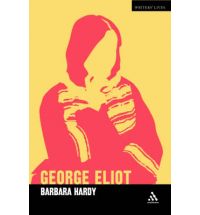
Negative hermeneutics has never been Hardy’s mode, and her determination to take seriously what Eliot said said, without suspicion and cynicism as a premise of the reading, is one thing that might make this anti-biography suspect to modern critics. But that determination becomes a form of negative capability that is one of the most moving and satisfying aspects of the book. For Hardy, Eliot wrote as if she meant what she said and she said what she meant. In critical circles, this is an astonishingly fresh argument these days. (100)

It’s a review by George Levine of Barbara Hardy’s George Eliot: A Critic’s Biography, a book I have but have not sat down and read attentively, though I have long been an admirer of Hardy, as is probably anyone who has studied George Eliot. As I filed the review away in my ‘George Eliot’ folder, I had a dim flash of recollection: didn’t I write something about Barbara Hardy as my critical model right here on Novel  Readings at some point? Sure enough, I did. Here’s the old post, in its entirety. Please note that I wrote it almost three years ago to the day.

April 8, 2008

Being Barbara Hardy

As a proud new member of NAVSA (better late than never!), I have just received a copy of the latest issue of Victorian Studies. Of the many interesting features in this issue (Volume 50 No. 1), I particularly enjoyed George Levine’s review of Barbara Hardy’s George Eliot: A Critic’s Biography, a book I own but haven’t yet read. One of my clearest recollections of my early days as a graduate student is being asked by one of my new faculty mentors to name a critic whose work on George Eliot I admired. “Barbara Hardy,” I promptly replied. The response was a tolerant smile and nod, and a bit of sage advice: “Of course, you can’t be Barbara Hardy any more.” True enough–unless, naturally, you actually are Barbara Hardy. Her steadiness in being herself is at the heart of Levine’s admiration of this new book:

Negative hermeneutics has never been Hardy’s mode, and her determination to take seriously what Eliot said said, without suspicion and cynicism as a premise of the reading, is one thing that might make this anti-biography suspect to modern critics. But that determination becomes a form of negative capability that is one of the most moving and satisfying aspects of the book. For Hardy, Eliot wrote as if she meant what she said and she said what she meant. In critical circles, this is an astonishingly fresh argument these days. (100)

I’ve put it at the top of my “t0 read” pile.

*headdesk*

Here’s a new resolution. I will not only read the book but I will write about it here when I have done so. And not any three years from now, either.

Rebecca Mead, “George Eliot and Me”

If Rebecca Mead’s “George Eliot and Me” * didn’t take up eight pages (eight pages!) in the New Yorker‘s anniversary issue, I would just let it go by without comment. But the New Yorker is prime literary real estate, and eight pages is a lot. It seems a fair assumption that Mead’s essay should be  significant in some way–that it should represent outstanding work of its kind. When, after reading it through three times, I still couldn’t find the payoff–well, that does seem to call for some discussion.

It’s not that “George Eliot and Me” is a terrible piece or anything–Mead is no Brenda Maddox (though she reports attending a talk by Maddox at which–surprise!–Maddox recounts the Curious Incident of the Honeymoon Defenestration). Then again, I notice Mead does think it’s important to tell us how plain Eliot was (however did I manage to write a whole essay on Eliot without feeling any need to bring this up?!) She also shares Maddox’s ageism, describing a female scholar she meets as “a tall woman, no longer young but still striking.” But? (This whole encounter is oddly described, actually: Mead introduces this scholar as a “notable exception” to a “maxim” she has just quoted, from Adam Bede: ‘The way in which I have come to the conclusion that human nature is loveable [sic]–the way I have learned something of its deep pathos, its sublime mysteries–has been by living a great deal among people more or less commonplace and vulgar.” I can’t tell if Mead means that this woman, though commonplace and vulgar, is an exception to the conclusion that human nature is lovable [if so, what a snidely gratuitous dig this is!] or, because she is not commonplace and vulgar, an exception to the idea that you can’t find lovable human nature in more glamorous guise.)

Anyway, as I was saying, it’s not a terrible piece. It’s nice to hear from someone who has loved Middlemarch a long time and feels she has learned from it. I felt a certain kinship with Mead on these grounds, especially at the beginning of the essay: “The first time I read George Eliot’s “Middlemarch” [I guess using quotation marks for novels rather than italics is New Yorker house style?] I was seventeen years old, and was preparing to take the entrance examination for Oxford University.” “Hey, me too!” I thought–except that I was eighteen and backpacking across Europe. So, not quite the same, but still, like Mead, I first read the novel early in my progress towards adulthood. Also, like Mead’s, my identifications and interpretations have changed over the years, not just because my own experience challenged my earlier assumptions and values, but because I learned to read the book better. Mead, too: on her early readings, she says, she “relished the satire” but “missed, more or less completely, the irony in the portrayal of Dorothea.” It’s an easy mistake; I made it too, once upon a time. And Mead and I share admiration for the novel’s moral wisdom, though I don’t think I’ve ever made Mead’s larger, and apparently continuing, mistake that “everything I might need to know about marriage, about love, about life itself, was encompassed in the novel’s eight hundred and fifty pages.” That’s a lot to ask of any novel–and it reduces the novel (as most of Mead’s comments d0) to a fairly literal set of lessons and examples that can be copied out epigrammatically.

Thinking it over, in fact, that attitude that the novel operates primarily at this level–as ‘philosophy teaching by examples,’ rather than as a richly organized aesthetic artefact–is what seems to me the essay’s greatest and most disappointing weakness. Nothing Mead says about Middlemarch is wrong, but none of it is going to surprise or even interest people who have thought much about Eliot or Middlemarch already, and none of it gives any sense of Eliot as an artist or a thinker: all we get, by and large, are one-sentence quotations used to illustrate points of character, theme or moral lesson. In the online “Ask the Author” chat that the New Yorker hosted, Mead mentions Zadie Smith’s essay, so she knows that there are richer ways to talk about Middlemarch.There are certainly richer ways to talk about The Mill on the Floss, which Mead mentions only to imply that it is “verbose,” which she then uses as an excuse to mention the (appalling) phenomenon of “a volume called ‘The Mill on the Floss: in Half the Time,’ an abridgement for those unable to countenance a six-hundred-page book.” I don’t think she means to endorse this absurdity, but juxtaposed against her “verbose” comment, it rather comes across that way. I see she didn’t get past her earlier lack of interest in Romola, either, here simply called Eliot’s “often tedious excursion into Renaissance Florence.” Sure, Romola is hard going and probably not a great novel. But you have eight pages in the New Yorker to talk about George Eliot! There’s so much more to be said about George Eliot’s novels, if you’re willing to work at it a little, to get outside your own head, and to explore not just her “maxims” (remember her cautions about people who live by them, after all–that’s one of the tedious philosophical bits that is probably left out of the truncated version of The Mill on the Floss) but her ideas and her craft. How did Mead figure out the irony at Dorothea’s expense, for instance, if not through the electric combination of Eliot’s intrusive narrator and her shifting point of view?

But perhaps in complaining about the superficiality of the literary discussion in the essay I’m making a category mistake . Maybe the main point of “George Eliot and Me” is not to talk about George Eliot, at least not in depth, but about the effect of her work on Mead’s own life and personal development. “I have gone back to ‘Middlemarch’ every five years or so,” she tells us, and her “emotional response” has evolved each time. She has learned to understand why Will’s “youthful energies and Byronic hairdressing” would have appealed “to his middle-aged creator,” for instance. (Oops, that’s actually another Maddox-like moment: Eliot the acknowledged cradle-snatcher, fantasizing about a sexy youngster!) Mead has also used Middlemarch to test prospective partners: when one tells her he “admired the climactic scene of Will and Dorothea…clutching each other’s hands, at last, as a thunderstorm rages,” she knows “things would never have worked between us.” Poor guy: done in by the pathetic fallacy! Eventually Mead married someone who “prized ‘Middlemarch’ as much as [she] did.” There’s some genuine human interest in these anecdotes, at least for a fellow Middlemarch lover who (true story) began a long tradition of reading aloud to her own husband by bringing Middlemarch along on their honeymoon. (We gave up on this tradition round about the time Frankenstein got thrown across the room for its terrible prose…but that’s another story. Maybe I should pitch it to the New Yorker.) But there’s still not a lot of substance here for someone hoping to find those precious eight pages used to advance public appreciation for one of the greatest novelists in the English tradition. I’d have to be really interested in Mead–rather than George Eliot–to be happy to read so much about her. Or, alternatively, she’d have to use her personal experience of reading Middlemarch to take us to some place more universally revelatory or insightful.

That’s not what happens in “George Eliot and Me,” though. It doesn’t articulate and illustrate the genius of George Eliot, and neither does it use its autobiographical form to build to some personal revelation or to a larger intellectual debate about, say, whether it is a good thing or not to derive one’s moral lessons from literature (now that’s a very Victorian conversation!)–or how one might do so in a rich and complex enough way that the literary texture of the source is not sandpapered out in favor of bland platitudes. (Where is the moral challenge of George Eliot’s “celebration of the unremarkable” in Mead’s commentary? The village dance which concludes the essay oddly summons up the most conservative aspects of Eliot’s rural nostalgia–as if the happy peasants of Raveloe had nothing to answer for in Silas Marner’s long isolation, or Arthur Donnithorne’s birthday dance weren’t undermined by Hetty’s seduction and abandonment.) Instead, we wander off with Mead as she tries to track down the source of a quotation often attributed to George Eliot: “It is never too late to be what you might have been.” It is, indeed, surprising that despite the tenacity of the attribution, this line cannot be traced to any of Eliot’s works. Mead asks a lot of experts about it, including Rosemary Ashton and Rosemarie Bodenheimer (both of whom have written wonderfully about Eliot’s life and writing). Not only do they say they can’t find a source for it, they also, quite rightly, note that it doesn’t seem to fit with Eliot’s explicit moral philosophy, which makes rather a big deal about the way our choices have an indelible effect on our characters and futures. Mead even interviews the author of a self-help book who used the quotation as her title: “I was depressed for a few days, and then I remembered the quote.” Eventually Mead resigns herself: she can’t find a source for the quotation or conclusively prove Eliot never said it. “Like Lydgate,” she says, “I had aspired to make a link in the chain of discovery, and had failed.” Along with some interspersed biographical material, this quest plot takes up nearly three of the eight pages. It might have been worth the space if the investigation was “linked” to something significant. (Lydgate, after all, is hoping to find “the primitive tissue” of life.) I wonder, for instance, why this is quite such a popular quotation, why it seems to satisfy so many people as something George Eliot said. Does it bring her within a safer community of women–reassuring, nurturing–and make her more conventionally feminine than is easily done if we quote from Mead’s least-favorite of her novels, Romola? “Children may be strangled, but deeds never” doesn’t go very well on a greeting card. Or how about this, from Felix Holt: “It is not true that love makes all things easy: it makes us choose what is difficult.” Try selling that on a wall plaque.

It feels churlish, in a way, to be so critical of an essay that speaks so sincerely of its author’s admiration for one of my own favorite books. It’s a good thing to tell more people how great Middlemarch is. Mead and I both think that Austen is more popular because she’s easier on (and for) her readers. As Mead says, Eliot “surpassed her precursor” (but why does she go on to say that the reader “marvels at Jane Austen’s cleverness, but is astonished by George  Eliot’s intelligence”? Why “astonished”? I’m impressed–humbled–challenged–provoked by it, but not at all astonished). But the essay is a disappointment. It’s long (“verbose,” even), cluttered, and solipsistic, as if the greatest interest of George Eliot’s life and work really is that they have played a big part in Rebecca Mead’s life and work. At a time when it’s common to hear online writing decried for its lack of editorial oversight, rigor, and credibility, to see eight pages in one of the most prestigious magazines in the literary world used for something no better than this gives the lie to the claim that these supposed features of Old Media produce the best results. It’s not terrible–parts of it are even pretty good–but it’s certainly not great, and given its very prominent placement, it surely should be.

*The essay is called “George Eliot and Me” on the magazine cover, but “Middlemarch and Me” inside the magazine.