Weekend Miscellany

At the Guardian, Jane Smiley writes about Trollope’s The Kellys and the O’Kelly’s:

The Kellys and the O’Kellys was not a commercial success. It was published – perhaps unluckily – in the same year as Thackeray’s Vanity Fair, Dickens’s Dombey and Son and Gaskell’s Mary Barton, all addressing the issue of what was wrong with life. The Kellys and the O’Kellys evoked much that was right. It must have seemed bland. It failed, selling 140 copies and earning Trollope no money. Although it was written in a wholly different tone from his first novel, The Macdermots of Ballycloran, its author gained no points for exhibiting his versatility. Both novels, scholars now feel, suffered commercially from being about Ireland – the famine was raging, and the English reading public did not want to think about it. It was destined to be a sleeper – a thoughtful, subtle novel published in an anxious year.

But one of England’s greatest novelists had laid out his tools for all to see – the grace of his writing, the worldliness of his vision, the variety of his characters and scenes, the expansiveness of his geography. The story itself is the important thing, not the satiric tone, as in Thackeray, the social criticism, as in Gaskell, or the stylistic exuberance, as in Dickens. He delivered the whole package, but it was a modestly wrapped package and got lost. (read the rest here)

I have written before about how well I think Smiley talks about Trollope.

At the TLS, critic and novelist David Lodge writes with both pathos and humour about his hearing loss:

You might think that of all the professions a novelist is least affected by hearing loss and, up to a point, that is true. We compose books in silence, consumed in silence by solitary readers.

However, deafness restricts and thins out the supply of new ideas and experience on which the novelist depends to create his fictions. That former nun’s life story might have been priceless “material” and I regret its loss. I miss opportunities to eavesdrop on humanly revealing conversations on buses and in shops and to keep up with new idioms, coinages and catch-phrases that give flavour and authenticity to dialogue in a novel of contemporary life. (read the rest here)

Hmm: “it’s a cast-iron excuse for declining to serve on committees”? That might offset a lot of the disadvantages…

In the Globe and Mail‘s book section, Cynthia MacDonald reviews Emma Donoghue’s latest, a neo-Victorian novel focusing on the 1864 Codrington divorce case:

It’s amazing to think that 150 years ago, the British Empire was ruled by an actual married woman. As Emma Donoghue reminds us in her marvellous new novel, wives in the Victorian era were usually classed with “criminals, lunatics and children”: devoid of legal identity, stripped of property, limited in their opportunities for paid work.

By way of illustration, she has chosen a thoroughly riveting courtroom drama. The Sealed Letter is a fictionalized version of the Codrington divorce case, which had le tout London squirming in its pantaloons over several months in 1864. Juicy, vicious, elegant and thoughtful, the book is a valuable addition to Donoghue’s growing corpus of fine historical novels (including Life Mask and Slammerkin). (read the rest here)

I wasn’t that taken with Slammerkin when I read it about a year ago (as George Eliot remarked a long time ago, historical fiction is a particularly demanding genre, though the risks are often underestimated). But I’ll probably give this one a try, just to keep up-to-date on my neo-Victorian options.

Finally, the little comment-spat I’ve been involved in at The Reading Experience has led me back to this earlier post by Dan Green:

After eighty years of experimenting with the study of literature as an academic subject, those carrying it out (myself included) have made a complete hash of it. Literature itself is held in contempt not just by the majority of ordinary people but by those professing to teach it. “Literature Professor” has become a near-synonym of “lunatic.” That literary study would come to such an end was probably inevitable, since the primary imperative of academe–to create “new” knowledge–is finally inimical to something so difficult to dress up in fashionable critical clothes as serious works of fiction or poetry. Once it was perceived that “aesthetic complexity” was a spent force (at least as the means for producing new monographs and journal articles), approaches to literature that essentially abandoned its consideration as an art form were practically certain to follow.

Nearly three years later, a conversation touching on many similar points is unfolding in a comments thread at The Valve even as Ronan MacDonald is announcing the death of the critic. Well, give us credit, at least, for not going gentle into that good night! Indeed, critics appear to have co-opted the story of their impending demise as yet another subcategory of metacriticism.

Weekend Miscellany: Road Murder, The Neuroscience Delusion, HBO at The Valve

A few things of interest I’ve found while browsing around:

At the Guardian site, Kate Summerscale on the literary legacy of the infamous Road Hill murders:

Even after the confession and conviction of the killer in 1865, the case was attended with doubts and unease. Wilkie Collins’ The Moonstone – described by TS Eliot as the first and the best detective novel – was suffused with the events at Road Hill. “It is a very curious story,” observed Dickens when the book was published in 1868, “wild and yet domestic.”

Collins diluted the horror – instead of a child-murder, there was a jewel theft; instead of bloodstains, splashes of paint – but he fashioned from it a template for detective fiction. A shrewd investigator strives to expose the secrets of the inhabitants of an English country house. His task is to distinguish the innocent from the guilty, real clues from red herrings. His methods are indirect, his reasoning inspired, and a highly improbable suspect turns out to have committed the crime. The novel borrowed many of the specifics of the Road Hill story: a sullied and missing nightdress; a laundry book that proves its loss; an inept local police officer; and a renowned detective summoned to the countryside from London. (read the rest here)

Also at the Guardian, Ian Rankin reviews Summerscale’s book on the case’s chief investigator, Inspector Whicher. Actually, he doesn’t so much review it as recapitulate its central story; there’s only one word in the piece that really constitutes any kind of comment on the book itself–fortunately for Summerscale, it’s “engrossing.”

At the TLS, Raymond Tallis is unimpressed with “The Neuroscience Delusion”:

At first sight, the displacement of Theory, with its social constructivism and linguistic idealism, by talk of something as solid as “the brain” of the writer and “the brain” of the reader may seem like progress. In fact, it is a case of plus ça change, plus c’est la même chose. The switch from Theory to “biologism” leaves something essential unchanged: the habit of the uncritical application of very general ideas to works of literature, whose distinctive features, deliberate intentions and calculated virtues are consequently lost. Overstanding is still on the menu.

Much of his discussion is focused on A. S. Byatt’s work on John Donne:

…by adopting a neurophysiological approach, Byatt loses a rather large number of important distinctions: between reading one poem by John Donne and another; between successive readings of a particular poem; between reading Donne and other Metaphysical poets; between reading the Metaphysicals and reading William Carlos Williams; between reading great literature and trash; between reading and a vast number of other activities – such as getting cross over missing toilet paper. That is an impressive number of distinctions for a literary critic to lose. But that is the price of overstanding. (read the rest here)

Finally, over at The Valve, the guys have been talking (again) about The Sopranos, Deadwood, and The Wire. I wonder: are these really the ‘three most talked about HBO series‘? Wouldn’t that depend on who you’re talking to? For instance, perhaps women viewers talk more about other shows–ones that aren’t characterized by “boobs, cussing, and spectacular violence“? Sex and the City comes to mind, for instance. (OK, in its own way it has two of those three elements…)

Middlemarch in the 21st Century?

(cross-posted to The Valve)

I’ve been going through a book of essays called Middlemarch in the 21st Century. It’s an interesting enough collection, with contributions by a lot of the big names in current George Eliot scholarship. It is also at least as much about criticism in the 21st century as about Middlemarch. Of course, it is self-consciously so (in these metacritical days, how could it not be?); the editor is intelligently expressive on the intevitable interplay between text and (our) context:

The essays in this volume attach Middlemarch to the twenty-first century by way of their aesthetic, ethical, and social concerns, but each reading also dwells within the confines of the pages of the novel and its communities. We move constantly between the early and later nineteenth century and to the start of the twenty-first century, respecting the differences without allowing them to become obstacles in our way. (4)

That’s all fine, and so are the essays I’ve read, though to be sure I find some of them more engaging than others. What I’ve been thinking as I read, though, is that really none of them really presents a version of Middlemarch for the 21st century: that is, none of them addresses ways Middlemarch (or, for that matter, any other past literary work) might have special relevance in the 21st century beyond those interpretive contexts selected by the contributors–none of which contexts, in turn, seems pointedly or necessarily fixed in the 21st century (except by accident of critical history, e.g. “this year, we’re doing materiality,” or “Lacanian readings are so 1990s”). I think it’s accurate to say that typically we take our “aesthetic, ethical, and social concerns” to our texts and see how they answer back. Is there a way to “attach” them to our century starting, as it were, from the other direction? How might Middlemarch, for instance, “read” the 21st century? What “aesthetic, ethical, and social concerns” might it bring to us? What would such a criticism look like? What (or who) would it be for?

I tried my hand at something of the sort for a panel called (coincidentally) “George Eliot in the 21st Century” at ACCUTE a couple of years ago. My presentation was called “George Eliot: Moralist for the 21st Century”; its major contention (stripped of nuance) was that her secularized morality offers a philosophical perspective of great potential benefit to our times, and that its presentation in compelling fictional form could help her stand as “the friendly face of unbelief.” Now, on the one hand, I realize there is something reductive about such an approach. At the same time, we know that George Eliot herself conceived of her work as fundamentally ethical, which means (as I argued in my paper) that she offered it as (in part) an answer to the basic question of moral philosophy, namely “how ought I to live?” Many (though certainly not all) of the academic approaches now in vogue have little in common with this project. At this moment, (well, not at this moment, as clearly I am procrastinating by writing this instead) I am working on a proposal for a conference paper about Ahdaf Soueif’s In the Eye of the Sun; Soueif has been called “Egypt’s George Eliot,” and In the Eye of the Sun takes the “squirrel’s heartbeat” passage as its epigraph (and refers to Middlemarch at many other points as well). Although I am still in the early stages of thinking through the relationship between the two novels, my feeling is that part of what Soueif does is bring the ethos of Middlemarch forward into a very different historical and cultural context, almost as if to ask, herself, “Can Middlemarch help us with this?” (The other part of what she does, I think, works in the other direction, testing that ethos against these new contexts; that Soueif uses a radically different form of novel suggests that, in some respects, “it won’t do, you known, it won’t do.”)

Thoughts? Do I exaggerate the difference between taking our concerns to the text and bringing the text’s concerns to us? Do I underestimate the risks or wrongs of the approach I took in my earlier paper? Or, in the spirit of the “public academic workbench,” if you’ve read In the Eye of the Sun, any ideas about the direction I’m taking in the new one? (Or about whether working on an Egyptian novelist writing in a post-colonial context necessitates using post-colonial theory? Just wondering…)

Critical Questions: James Wood, How Fiction Works

woodThe dust jacket describes How Fiction Works as Wood’s “first full-length book of criticism.” Anyone led by this blurb to expect sustained analysis supported by extensive research and illustration will be disappointed, as in fact How Fiction Works turns out to be essentially a ‘commonplace book,’ a collection of critical observations and insights of varying degrees of originality and sophistication, developed with varying degrees of care and detail. Wood acknowledges having set deliberate limits on his project, likening it in his introduction to Forster’s Aspects of the Novel, proposing to offer practical “writer’s anwers” to “a critic’s questions,” and admitting (though with no tone of apology) that he used only “the books at hand in [his] study.”

To some extent I agree with other reviewers who consider it only fair to evaluate the book Wood wrote, rather than regretting he didn’t write another one. Yet even within the parameters Wood sets, I think there are grounds for wishing he, with his exceptional gifts and qualifications as both reader and critic, had not sold himself (or us) short in fulfilling them. Further, beginning with the invocation of Forster but going well beyond it, the book has pretensions to grandeur: for instance, also in his introduction Wood remarks that Barthes and Shklovsky “come to conclusions about the novel that seem to me interesting but wrong-headed, and this book conducts a sustained argument with them” (2). With gestures such as this, Wood claims an elevated stature for his critical contribution that is undermined by its casual construction and over-confident approach to scholarship. Though How Fiction Works provides many further proofs of Wood’s critical gifts and considerable erudition, I think it also proves that even the best practical critic flounders when working only with what he has already to hand or in mind.

Right off the bat I was irritated by the book’s structure. Wood has said that he felt liberated by using the numbered “paragraphs” or sections, but allowing yourself to skip from thought to thought in this way means letting yourself off the hook too often. Frequently in the margins of my students’ work I write “And so? Finish the thought!” One effect of crafting, first paragraphs, and then longer pieces as sustained wholes is that in working out the overall movement of your ideas and building in appropriately specific transitions, you confront both the logic and the further implications of your claims: the form pressures you to think better. Numbered bits, however, relieve that pressure: you can just stop with one topic and start the next, and as long as they are more or less related, you can claim to be producing a unified whole, even if you are only papering over gaps.

wood-10In How Fiction Works, the breaks often seem unnecessary: a new number sets off what is really just the next sentence in the idea already unfolding. Most of the time, however, they are substitutes for careful transitions. They allow a certain stream-of-consciousness effect to creep in: that last bit reminds me of this exception to a general principle, or of a writer who also does that, or of another favourite excerpt, or of a time I went to a concert with my wife. Well, OK, I guess, and no doubt it would have been much more difficult to do a coherent chapter offering a theory of, say, fictional character, realism, or morality and the novel. And I suppose it’s true that non-academic readers don’t want the kind of detail and complexity such a full account of these topics would require. Even so, the numbered bits felt lazy to me. The footnotes too had an aimlessness about them. Some of them covered ideas or examples that seemed no less important to their chapter than most of the bits allowed their own numbered section (note 53 on p. 150, to give one example) while others appeared entirely unnecessary to the book (note 40 on p. 121, or note 41 on p. 124, for instance).

The TLS reviewer objects to Wood’s “grace notes”: “It is sometimes hard to distinguish a gasp of admiration for another’s skill from the contented sigh when the books in one’s study satisfy one’s own theories.” I shared this reaction, not least because “how fine that is” (139) is an expression of taste, not criticism. But Wood is a compelling reader of details, even passages. It’s when he makes broader assertions that he leaves himself more open to objections. For one thing, he has some governing assumptions about what fiction is for that he treats as universal rather than historically or theoretically specific. In his chapter on “Sympathy and Complexity,” for instance, as a footnote to his remarks on fiction as a means of extending our sympathies (the occasion for one of his shockingly few references to George Eliot!), he adds this:

We don’t read in order to benefit in this way from fiction. We read fiction because it pleases us, moves us, is beautiful, and so on,–because it is alive and we are alive. (129)

Well, maybe, but not everybody, and not all the time: for instance, most of the Victorian critics I have been editing for my Broadview anthology would not have recognized this highly aestheticized motive for novel reading. Is it fair, or even sensible, to say that they were simply wrong? Or to ignore how the formal developments of the Victorian novel furthered ends not adequately respected by Wood’s post-Jamesian formulations? His is in many respects a teleological account of the history of the novel. “Progress!” he exclaims after a quotation from Proust: “In Fielding and Defoe, even in the much richer Cervantes, revelation of this altering kind occurs at the level of plot” (125). But were Fielding and Defoe trying to do what Proust did and failing? How much better we might understand them if we allow them what James calls their “donnee. “It is subtlety that matters,” he declares in his chapter on character; “subtlety of analysis, of inquiry, of concern, of felt pressure”: “I learn more about the consciousness of the soldier in Chekhov’s The Kiss than I do about the consciousness of Becky Sharpe [sic] in Vanity Fair.”
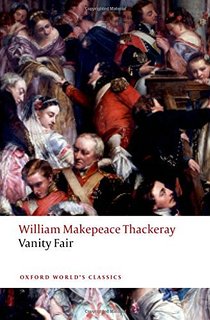
vanityfairoupBut Becky Sharp’s consciousness is surely not the point of Vanity Fair; indeed, I argue in my own lectures that too close a focus on Becky risks diverting us from Thackeray’s grand gesture of holding the mirror up to ourselves, so that the novel becomes an opportunity for us to reflect on our own morality and mortality. “Was she guilty or not?” the narrator asks–and, remarkably, will not tell us, because ultimately she is not the point but the occasion, the device. Thackeray is not a failed Chekhov any more than Dickens is a failed Flaubert. To Wood, “the history of the novel can be told as the development of free indirect style” (58), but that history is partial and often distorting. (About the operations of free indirect discourse and the importance of knowing who ‘owns’ which words, on the other hand, Wood is typically astute. Here’s one place where examples from Middlemarch would have served him well, though at the risk of undermining his generalizations. Consider this passage from Chapter 1, for instance:

And how should Dorothea not marry? — a girl so handsome and with such prospects? Nothing could hinder it but her love of extremes, and her insistence on regulating life according to notions which might cause a wary man to hesitate before he made her an offer, or even might lead her at last to refuse all offers. A young lady of some birth and fortune, who knelt suddenly down on a brick floor by the side of a sick laborer and prayed fervidly as if she thought herself living in the time of the Apostles — who had strange whims of fasting like a Papist, and of sitting up at night to read old theological books! Such a wife might awaken you some fine morning with a new scheme for the application of her income which would interfere with political economy and the keeping of saddle-horses: a man would naturally think twice before he risked himself in such fellowship. Women were expected to have weak opinions; but the great safeguard of society and of domestic life was, that opinions were not acted on. Sane people did what their neighbors did, so that if any lunatics were at large, one might know and avoid them.

Think how much is lost on a reader who improperly identifies the source of that word “naturally”–or the last two sentences altogether!)

Wood is good on the telling detail as well and the quality he calls “thisness”: “any detail that draws abstraction towards itself and seems to kill that abstraction with a puff of palpability” (54). But again, when he moves into prescription, he becomes less persuasive, as when he objects to the “layer of gratuitous detail” in 19th-century realist fiction. Again, the challenge is in defining “gratuitous” (as, clearly, Wood himself is well aware), but he can’t propose any principle except, perhaps, his idea that “insignificant” details avoid irrelevance if they are “significantly insignificant” (68). After recounting an incident in which he and his wife had “invented entirely different readings” of a violinist’s frown at a concert, he claims that a “good novelist would have let that frown alone, and would have let our revealing comments alone, too: no need to smother this little scene in explanation” (72). Again, well, maybe. I can imagine at least one “good novelist” who might have done great things with their “different readings” of that little moment, perhaps even using their “revealing comments” as a chance to reveal even more about perception and reality as well as human relationships (“these things are a parable…”). Doesn’t it depend on what your novel is about and on the formal methods you are using to realize those goals?
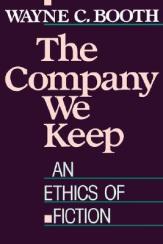
boothcompanyI’d like to return before I close to the “Sympathy and Complexity” chapter, because this is a topic close to my heart, one on which I have spent a lot of my own critical energy recently, and one I expected Wood to handle particularly well. “Perfunctory” is the best word I can think of to describe it. I’ve mentioned already his dehistoricizing assumption that “we” don’t read in order to receive moral benefits. I doubt this is true in practice, and I also question the separation he implies between moral and aesthetic readings. Here is a case in which even a little research outside “the books at hand in [his] own study” would have immeasurably enriched his discussion: Booth’s The Company We Keep, for instance, would have helped him complicate exactly that separation. And the conversation about how fiction might do “what [Bernard] Williams wanted moral philosophy to do” (135) has many participants besides Williams (Martha Nussbaum comes promptly to mind!). Further, not all novels avoid providing “philosophical answers” (here, he replicates Nussbam’s error in generalizing about “the novel,” but as a professional novel reader, he should know better). Here the hybrid character of How Fiction Works proves a genuine weakness, I think. This chapter is not a full, responsible, or authoritative inquiry into its subject. Of course, it does not pretend to be (remember, the book promises only “a writer’s answers” to “a critic’s questions”). But then how should we evaluate it? Doesn’t Wood do even his non-specialist audience a disservice by taking up complicated subjects on which there already exists a rich body of scholarship and offering his own fairly casual observations with the confidence of real expertise? What a much greater contribution it would be to distill that complex material and present it accessibly! To grab what’s at hand and say just what comes to mind bespeaks an enviable but also problematic degree of confidence. And while the non-expert reader is in no position to object, the expert reader is easily deflected with the excuse that she is not the intended audience…

After I read How Fiction Works I re-read some of my collection of Wood’s essays, including his reviews of Never Let Me Go, Saturday, and Brick Lane. This is really wonderful stuff, as I have remarked before; I admire it wholeheartedly for its critical acuity, its literary elegance, and its moral seriousness. But considering How Fiction Works strictly as one among many books about books (and Wood is wrong, or perhaps disingenuous, when he says “there are surprisingly few books” of this kind about fiction [1]), I think there are many better choices available. I continue to recommend David Lodge’s The Art of Fiction, for instance, which takes up many of the same topics as Wood, though under a less grandiose umbrella of prescriptive claims. I think it’s an exciting development that Wood has landed a job in Harvard’s English Department. In taking this now unconventional route from journalism to the academy, he is following in the footsteps of many eminent Victorian critics (David Masson, for instance). But considering how bitterly difficult it is for those following the established professional route to land any academic job at all, it’s frustrating to think that he may not be held to anything like the same standard of rigour as many critics far less lauded and applauded. Here’s hoping that he has more books in him as good as The Broken Estate.

The Dead (Critics, That Is)

Dan Green alerts us to William Deresiewicz’s essay “Professing Literature in 2008” in The Nation, in which the author draws some dire conclusions about the profession of English literature from the evidence of this year’s MLA job listings:

This year’s Job List confirms the picture of a profession suffering from an epochal loss of confidence. It’s not just the fear you can smell in the postings. It’s the fact that no major theoretical school has emerged in the eighteen years since Judith Butler’s Gender Trouble revolutionized gender studies. As Harvard professor Louis Menand said three years ago, our graduate students are writing the same dissertations, with the same tools, as they were in 1990. Nor has any major new star–a Butler, an Edward Said, a Harold Bloom–emerged since then to provide intellectual leadership, or even a sense of intellectual adventure. The job market’s long-term depression has deepened the mood. Most professors I know discourage even their best students from going to graduate school; one actually refuses to talk to them about it. This is a profession that is losing its will to live.

Twenty years after Professing Literature, the “conflicts” still exist, but given the larger context in which they’re taking place, they scarcely matter anymore. The real story of academic literary criticism today is that the profession is, however slowly, dying.

I’ve also just finished reading Ronan McDonald’s The Death of the Critic–hmm, suddenly I don’t feel so well! Both authors present their material in what strikes me as an unfortunately tendentious way. Deresiewicz, for instance, in arguing that the “profession’s intellectual agenda is being set by teenagers,” apparently does not entertain the possibility that departments might be genuinely embracing the priorities he sees reflected in the latest wave of job ads, rather than cravenly appeasing their undergraduates. McDonald similarly attributes most changes in critical practice to everything but the conviction that the method in question might have intrinsic merit, as when, discussing the establishment of English “as a university discipline” in the early 20th century, he says that the critics of the time “sought to imbue [English] with some procedural and disciplinary muscle” (89). No doubt showing that English could have “procedural and disciplinary muscle” was crucial to proving its academic credibility, but McDonald repeatedly implies the primacy of self-interest over scholarly commitment–a move which in turn bespeaks a hermeneutics of suspicion on his part to match any he might point to in ‘cultural studies.’ Both of these writers, in other words, seem to consider their colleagues and peers singularly unprincipled and opportunistic–or (a bit more generously, as they might prefer to be interpreted) they see them as particularly susceptible to fads because they lack foundational commitments (Deresiewicz) or have tried too hard for too long to appear what they are not, namely scientists (McDonald).

Still, both Deresiewicz and McDonald are describing features of this profession (historically and currently) recognizable to anyone working within it, even if we might quarrel over how they are characterized or explained. That priorities in teaching and scholarship have changed often, sometimes dramatically, is not news; neither is it a revelation that English as a discipline seems particularly prone to self-doubt, internal convulsions, and obsessive self-scrutiny and meta-criticism. Is it on its death-bed, though? In my own department we are going through yet another round of curriculum reform–the third or fourth since I was hired just over a decade ago. I have come to see we aren’t actually moving towards any final goal but that each such round is part of an ongoing, probably never-ending process driven by many things, from our own changing research interests and strengths to the ever-mutating condition of the ‘canon’ of material and methods we feel responsible for presenting and the fluctuating needs and interests of an evolving student population. How far is this instability a symptom of disease, and how far is it a healthy process, warding off stagnation and sustaining our connection with a wider (and itself endlessly evolving) life outside the academy? To be honest, at different times I have felt both ways about it myself, depending on just what’s on the table and how closely I am involved! Overall, though, surely it does not make sense to expect talk about literature to be the same now as it was 10, 20, or 50 years ago. Neither Deresiewicz nor McDonald provides particularly convincing evidence for the conclusion that criticism (as either a practice or a profession) is in a far worse state right now that at other times, and the pressure they both apparently feel towards polemical generalization means they obscure all kinds of qualifications and nuances as well as many potential signs of life.

That said, there are certainly some features of McDonald’s argument with which I do find myself in sympathy, or which ring changes on themes that have preoccupied me for some time. Key among these is his interest in closing, or at least bridging, the gap between “the academic critic and a wider public audience” (ix). Though every history of criticism notes the same phenomenon and agrees with McDonald that it dates more or less from the early 20th century, with the professionalization of literary study and the bifurcation between criticism and literary journalism / reviewing, I think McDonald’s specific diagnosis is distinct: he blames critics’ abandonment of evaluation for the alienation of the wider public:

The question in which the reading public would have taken a primary interest – ‘Is this book / artwork worth my attention and time? Is it of any merit?’ – was not one that exercised the cultural theoretician. (23)

“If criticism forsakes evaluation, it also loses its connections with a wider public” (134): this loss and its roots in the history of criticism are the book’s major focus, though McDonald also considers other phenemona that have contributed to the diminished relevance of academic critics, particularly the democratization (or relativization) of criticism, or attitudes towards critical expertise, enabled by new media such as blogs or Amazon-style customer reviews. His focus on evaluation is reiterated in his prescriptive closing section, which calls for a renewed aestheticism and concludes,

Perhaps the critic is not dead, but simply sidelined and slumbering. The first step in reviving him or her is to bring the idea of artistic merit back to the heart of academic criticism. ‘Judgement’ is the first meaning of kritos. If criticism is to be valued, if it is to reach a wide public, it needs to be evaluative. (149)

There seem to be some internal inconsistencies in McDonald’s analysis of criticism’s decline in public significance. His chief grievance with the movements he groups together as ‘cultural studies’ is that they treat literature instrumentally, as a means to other (usually political) ends. On his own account, though, most major critical movements have done some version of this, from promoting or sustaining civil society to “fill[ing] the breach left in religion’s absence” (69), and in fact the whole idea of ‘evaluation’ always has to be grounded in a set of extrinsic standards which (again on McDonald’s own account) have almost never been strictly aesthetic (if such a thing is even possible). Though McDonald believes that emphasizing aestheticism will bring about a “rapprochement between academic and non-academic criticism,” and thus, apparently, between critics and general readers, aesthetic evaluation is surely as problematic as any other kind. Further, McDonald actually praises Virginia Woolf precisely for “enrich[ing] aesthetic formalism with political and gender consciousness” (86)–so Paterian obsession with the immediacy of the aesthetic encounter is presumably not his ideal. So what is it, exactly, that he means to invoke with his mantra of ‘evaluation’? He objects to the levelling effects of considering every cultural artefact equally worthy of critical attention (“To be concerned with everything is, ultimately, to be concerned with nothing” [127]), but he resists the notion of an unchanging canon (“Who would not welcome the rediscovery of unjustly forgotten women writers, or the efforts to hear the voices of the marginalized and disempowered . . . ?” [21]; “the criteria for admission [to the ‘canon’] needed to be renovated . . . ‘quality’ is not an eternal and unchanging facility, but rather one that mutates along with the cultural evolution of a society” [23]). Once you’ve acknowledged the ‘problematics’ of literary judgment, how then are you supposed to answer what he proposes is the common reader’s key question (“Is this book … worth my attention and my time?”)? For what it’s worth, I think most academic critics would in fact be quite happy to answer that question about any book, but first we would all want to develop the question further (along the lines I laid out here, for instance).

Still, I share McDonald’s concern about the isolation of academic expertise from today’s reading culture more generally. I was struck particularly by his note that “Vintage are launching a new series of classical novels to rival Penguin, but they have decided to use journalists and novelists, not academics, to write the ‘Introductions'” (25). If true, this certainly marks a change and a lost opportunity for scholars interested in demonstrating the interest and value of their work to a wider readership. (Journalists and creative writers certainly dominate the book review section of Canada’s “national” newspaper, The Globe and Mail.) I think, too, that he is right to be looking at questions of judgment and how they are understood and articulated as one of the flashpoints for misunderstanding or resentment between academics and other readers. I just don’t see how his prescription to be more evaluative is an adequate response, unless (at the minimum) it is accompanied by a commitment to showing why the question “Is it of any merit?” requires substantial complication before a worthwhile answer is possible. The responsibility here is not all ours: ideally, readers would want, not to be dictated to, but to be engaged in debate worthy of the books they are considering. Imagine a reader who takes this position, for example:

[Great thinkers can] rouse, excite, and elevate our whole natures—set us thinking, and therefore enable us to escape from the fetters of ancient prejudice and worn-out platitude, or make us perceive beauty in external nature, or set before us new ideals of life, to which we should otherwise have been indifferent. But we have to co-operate in the result, if it is to be of any real value. We are not passive buckets to be pumped into . . . mere receptacles for ready-made ideas, but fellow-creatures capable of being roused into independent activity.

Such a reader wants, not to be told whether a book has “any merit” (McDonald’s formulation), but to collaborate in forming a judgment–and accepts responsibility for his or her own “independent activity.” Now there’s a hope to get even the most moribund critic up off her sickbed! (The quotation, by the way, is from Leslie Stephen’s 1881 essay “The Moral Element in Literature.”)

One final note: McDonald points to James Wood as an example of a new wave in critical possibilities, “an avowed evaluative critic of the novel” who has “moved not from academia to journalism . . . but rather from journalism to the university” (147). (In my text, he notes that this is not “the usual root” [sic]–one of many egregious editing errors in the volume, including missing words and faulty punctuation.) Wood is certainly an interesting example of someone who approaches criticism as a serious public task requiring both insight and erudition, judgment and learning. Is the highest standard of criticism, though, to be someone with strong opinions and the erudition to explain them well? Is Wood’s evaluation of novels really what makes his criticism important, or is it his ability to analyze literary particularities while taking into account (as McDonald argues Woolf does) the situatedness of the work in history and life? I would say the latter; even Wood has trouble articulating his standards (such as his foundational assumption that everything valuable in the modern novel begins with Flaubert) without their seeming like prejudices that ultimately add little to our ability to understand and appreciate other kinds (as the exceptions he often admits to in How Fiction Works seems to confirm–oops, for instance, but then there’s Dickens!).

Update: I just noticed John Mullan weighing in (favorably) on McDonald in the TLS here: “there has been something comical about the eagerness of academics to scorn the notion that some books are better than others…” Honestly, (setting aside objections to the incessant pretense that all ‘academics’ speak with one voice), surely these smart, literate people know that “better” is a meaningless measure unless we can explain better at what? You just can’t take the next step in the conversation without refining the question (and simply revising it to “better written” will not do). Shouldn’t readers and critics alike have to scrutinize, articulate, and defend the grounds of their evaluations? And isn’t the conversation itself, as much as (maybe even more than) the conclusion what will be exciting, revealing, instructive? Finally, is it so terrible to take time for something that is interesting or important, even if on some measures you might conclude it is not the best, even of its kind?

Why I Teach Literature” (with some thoughts about James Wood appended)

Not long ago there was a ‘meme’ going around on the question “Why Do I Teach Literature?” (Joseph Kugelmass’s comments on this topic at The Valve include links to further contributors). Reading around in my files today (where I am in search of an organizing pattern for future research–but that’s another post for another day) I came across this passage and it struck me as nicely encapsulating both the central problem of teaching literature (that it is, paradoxically, always about feeling as well as knowing) and its greatest lure:

Critics, before and after Northrop Frye, have distinguished between literature and experience and literature and knowledge. The distinction, though plausible in some theoretical contexts, blurs nearly every day, in nearly every classroom. I am content that it blurs. Unlike physicists, who teach not nature but physics, we teach both literature (how it feels, how it thinks, to have read a literary work) and the rules and facts about reading literature. As Gertrude Stein once said to an obtuse interviewer: “But after all you must enjoy my writing and if you enjoy it you understand it. If you did not enjoy it, why do you make a fuss about it?” That is why I finally became a teacher of literature, to live in the vicinity of that joy.

This is from Ihab Hassan’s essay “Confessions of a Reluctant Critic or, The Resistance to Literature” (New Literary History 24, 1993). Other critics have also written eloquently about the experience of following that lure of joy into a professional life that does not–perhaps cannot–reinforce or reward it, and may even work actively against it. John McGowan, for instance, in his book Democracy’s Children (2002), notes,

[T]here remains a tension between the experience of reading literature and the paths followed in studying. . . . To give one’s allegiance to the academic forms through which literature is discussed and taught is to withdraw (at least partly) allegiance to literature itself” (65).

25 Years after Hassan’s remarks, I think it remains true that it is in the classroom rather than in their scholarship that many academic literary critics feel and communicate their love of their subject. One of the reasons I shifted research directions altogether a few years ago (significantly, after achieving the professional security of tenure) was that I wanted my research activities to give me, or be driven by, the same kind of intellectual and affective immediacy I find in teaching, and I couldn’t see how that would happen if, among other things, much of my work continued to be on second-rate material, no matter how historically revealing it was–or how useful for generating publishable, if niche, material of my own. To a large extent I succeeded, and as an unanticipated bonus, I think I became a better teacher because of the synergy that developed between my class preparation and my other work. It’s interesting, actually, that it seems to be widely taken for granted (or is it?) that undergraduate teaching and scholarly research leading to publication are very different kinds of things, and overwhelmingly the professional priority is with the latter–even though (or, perhaps, because) its tendency is to drive all joy away!

Follow-Up (to be developed later): Also as part of sorting through my files, I’ve been re-reading some of the James Wood essays I’ve gathered up, and (aside from being overwhelmed with envy at his erudition, elegant style, and intelligent craftsmanship as an essayist), I’m struck by how much closer they are to the kind of criticism we–or at least I–do in the classroom than anything that ordinarily passes for academic or professional criticism (and here I think it’s important to distinguish, as mainstream writers often don’t, between criticism and reviewing). It’s not that I think I’m as smart, articulate, or insightful as Wood,or as well-read either, though I hope I have my good moments! My point is really about the genre of criticism he works in, which seems to me to lie somewhere in between the poles of academic scholarship (which he clearly knows about, but relies on more implicitly than explicitly most of the time) and popular book reviews (which would rarely seek the kind of broad perspective or level of sophisticated analysis he deploys). I’ve ordered How Fiction works from The Book Depository, along with The Irresponsible Self, and I’ve got The Broken Estate from the library. I sense a Wood-fest coming on, perhaps as a way to draw together some of the scattered elements of my recent browsing and brooding about the function of criticism at the present time. Conveniently, as a motivator, there’s a conference panel on Victorian criticism for which I’m hoping to submit an abstract. One of the questions in the CFP is about what the relationships envisaged by the Victorians between “different forms of cultural production and the work of the critic” might tell us “about how criticism was imagined during the Victorian era, and what they might tell us about the more professionalized forms of criticism practiced today.” If this isn’t an opportunity (and a challenge) for me to make something of my work on the Broadview anthology along with the ‘work’ I’ve been doing on this blog, I don’t know what is! Whether anyone would want to hear it is, of course, another matter altogether.

The Function of Criticism, in Brief

I just came across this quotation in my notebook and was struck, again, by how well it suits my own sense of the central purpose, or best possible outcome, of criticism:

The goal is not to pack into our traveling bag only the best that has been thought and said but to find forms of critical talk that will improve the range or depth or precision of our appreciations.

This formulation seems to me at once stringent and flexible. (It’s from Wayne Booth’s The Company We Keep.)

Novel Readings in the Guardian

Thanks to Nigel Beale for his kind reference to Novel Readings as “stimulating” in his recent post in the Guardian‘s book blog. When he was working up the piece, Nigel asked me whether I had any thoughts about “why academic writing is so abstruse,” remarking among other things that academics “don’t have to appeal to the average intelligent reader” and that they avoid making aesthetic value judgments. Nigel quoted me accurately, but being an academic, of course I answered a bit lengthily, so in case anyone’s interested, here’s my full response to his inquiry:

I suppose the first thing to be said, as neutrally as possible, is that every area of specialized inquiry develops and requires specialized language (or jargon) that can seem opaque or abstruse from outside that specialization. In that respect, academic literary criticism is like other kinds of writing aimed primarily at other specialists. (The audience for academic criticism is not, generally, students, but other academic critics.) And of course literary criticism has become intensely specialized, in its academic versions, because of the demands of professionalization. There’s a great deal of pressure to publish (in academic, peer-refereed journals), which means finding things to say that have not been said before, which of course can and does push forward the frontiers of knowledge, put new ideas and texts and theories into circulation, etc., but which also means micro-specialization or niche scholarship, and increasing levels of self-conscious commentary or metacriticism. Whether these developments are good, bad, or simply inevitable, is of course much debated (including in some other posts on this blog), but within this context, it’s clear that as an academic, the audience you are trying to be ‘interesting’ to is not usually the broader public or the ‘average intelligent reader.’

I think you are right, in general, that aesthetic judgment is not currently seen as a central (maybe even an appropriate) aim of academic criticism. We are too aware of the shifting nature of such judgments, for one thing, and of the many reasons besides aesthetic ones for finding a text worth studying. If asked whether a book is good, an academic is likely to reply ‘good at what?’ or ‘good in relation to what?’ or ‘good for what?’ It may be that this insistence on refining the question, or examining its implicit assumptions, is part of what makes academic criticism less appealing to the ‘average intelligent reader,’ if what they are after is actually a recommendation (if so, there are lots of Top 10 lists around they can go to for that). But many non-academic readers would in fact like to think in more careful ways about their reading. Here’s where academic expertise presented in an accessible manner comes in, or could or should…but it’s not clear how such work would be rewarded professionally, and so we come back around to my first point.

There has been a pretty extensive comment thread following Nigel’s post already. Related posts on this blog appear under the labels ‘literary criticism‘ and ‘writing for readers.’

What’s in a Poem?

There’s a fascinating and detailed analysis of Keats’s “To Autumn” by Tom Paulin in The Guardian:

Opening a school anthology, I find this note to Keats’s ode “To Autumn”: “The magnificent ode is justly famous, and is often regarded as the most perfect of Keats’s poems. Its structure is quite complex, but after a couple of readings it will not be difficult to see that the first verse describes the ‘positive’ side of autumn – the side that looks back to summer and brings it to fruition, while the third verse describes the ‘negative’ side – a suggestion of chilliness, a series of thin sounds, and the sadness of approaching winter. The middle verse balances these two with four glimpses of a figure representing both the spirit of autumn and a farm-worker engaged in a series of typical autumnal activities.”

This describes, clearly and sensitively, how the poem has been read since its publication in 1820, but in recent years a group of historical critics has offered a more complicated, political reading of Keats. He was passionately interested in politics, and it would be surprising if that interest didn’t shape his writing. As a radical, who read and contributed to John and Leigh Hunt’s famous weekly journal, The Examiner, he would have seen not so much a “farm-worker”, as a member of the rural poor, a gleaner, who has scraped up the grains of corn left after the farm labourers had gathered in the harvest. Gleaning was made illegal in 1818, so by personifying autumn as a gleaner he is characterising the season as a proud and dignified young woman. (read the rest here)

The piece is an advance taste of Paulin’s forthcoming book, The Secret Life of Poems. It’s a compelling reading, at least to someone who’s not a Keats expert; I particularly enjoyed its balance of attention to fine textual details and historical and intertextual contexts. But I can see someone reacting quite differently, along the lines of the discussion that broke out recently in the comments to this post at The Valve. A sample exchange:

LB: That is to say, let’s imagine two critics who write the same excellent account of the formal, stylistic, and thematic features of Blake’s “The Tyger.” Then let’s imagine that while critic 1 stops there, critic 2 builds on that account and shows in clear, well-supported terms how these features connection to biography, cultural history, economics, etc. In that case, critic 2 has clearly added something that critic 1 cannot offer.

DG: Perhaps, if you’re more interested in biography, cultural history, and ecomonics than in art. I’m not, so the critic who provides such an account does nothing for me.

It seems a tailor-made example, actually. Paulin reads Keats’s Ode as critic 2 would. But is his therefore a better analysis than a fleshed-out version of the one in the ‘school anthology’ would be? The school anthology has described the poem an ordinary (i.e. non-specialized) reader would be familiar with; Paulin argues that this simpler account is inadequate, even wrong on some counts, and supports his more ‘complicated’ reading with a lot of specific evidence. Both readings address what is “actually there” in the poem (a phrase all who teach poetry to undergraduates are familiar with)–that is, both infer the meaning of the poem from the words on the page–but Paulin is less literal and inquires further afield in search of its meaning. I think that the result is a richer appreciation of Keats’s art. What do you think: is it fair, or reasonable, or problematic, to consider that you can “understand the poem perfectly well” without knowing any of the additional material or ideas Paulin brings to bear on it? Do you just understand it differently, or do you understand a different version of it? Also, how far does this dispute over the limits of “the poem itself” encapsulate the difference between academic and non-academic approaches to interpretation? And how far do readings of this sort, that set out to correct ordinary readings as simplistic or inadequate contribute, to the dislike ordinary readers sometimes express towards academics?

Philosophy and Literature Again

Further to an earlier post on David Masson’s British Novelists, here’s another bit I came across today in my proofreading that I can add to my file of Victorian observations on the relationship between philosophy and literature. This one is from an 1848 review of Jane Eyre that appeared in the Christian Remembrancer (hence its ultimately tendentious conclusion):

With [novelists] it rests to determine, each for himself and according to the measure of his gifts, whether so powerful an instrument of moving men, as fiction is, shall be used to move them for good or evil. Are the poetic and artistic faculties given to man purely for his amusement? Are they alone of all his powers not subject in their exercise to the legislative or judicial conscience? Curiously enough, we believe no moral philosopher has yet given a complete scientific answer to this question. A philosophical account of that part of man’s essence which is neither moral nor intellectual, but lies midway between the two, both in itself and in its relation to the moral and intellectual parts, would we believe still be an addition to the Moral Science. . . . [T]he position that the poetic and artistic faculties are subject to conscience, is a truism in theory which seems to be metamorphosed into a paradox in practice. We suppose, for instance, that Mrs Marcet considered herself to be uttering an acknowledged truth in saying that Goldsmith’s ‘Deserted Village,’ being poetry, is none the worse for being bad political economy. Yet if this is so, neither is Don Juan, being also poetry, the worse for being bad religion. Goldsmith intended, or at least he foresaw that the effect of his poem would be, to raise certain sentiments and impressions relative to certain social questions; and if those sentiments were morbid and those impressions wrong, his poem is as plainly vicious as the most rigorous scientific treatise, embodying the same fallacies, would have been. This may seem an exaggerated instance. It is an experimentum crucis, certainly–but where is the line of demarcation to be drawn? . . . We do not mean to say that the writer of fiction is called upon to play the part of the preacher or the theologian. Far from it. What he is called upon to do is to hold up a clear and faithful mirror to human nature–a mirror in which it shall see its good as good, its evil as evil. His pages must give back the true reflection of a world of which morality is the law, and into which Christianity has entered.

Some good questions, along with a number of assumptions few critics today would entertain about literary merit or morality–though I enjoy the idea that morbidity is somehow an objectively measurable (and obviously undesirable) quality.