New to me, is what I mean, and then a couple of old friends: this week in my classes I have just finished teaching Dorothy B. Hughes’s The Expendable Man for the first time in Mystery & Detective Fiction, and on Wednesday we start P. D. James’s An Unsuitable Job for a Woman, while as of tomorrow it’s all Middlemarch all the time until the end of term in the Victorian Women Writers Seminar.
I enjoyed working up The Expendable Man for class and then talking it through with my students. I used it to raise many of the same questions that usually come up when we’re working through Devil in a Blue Dress: about the whiteness of “classic” crime fiction, for one thing, and the genealogy of African-American crime novels, and about the ways race complicates common themes in the genre, from ideas about the role of the police to the relationship between the specific crime and its solution (or not) and larger contexts of racial and social justice. Mosley’s novel is very different in style and tone, though, as well as in its specific historical contexts, so this time instead of talking about World War II or the history of policing in Los Angeles I sketched out a basic timeline of the civil rights movement (the novel presumably takes place around the time of its publication, so the early 1960s) as well as the fight for reproductive rights, with some attention to what it was like at this time in Phoenix specifically, where the novel mostly takes place.
It is quickly evident with Hughes’s novel that the murder that needs solving is in some ways less important than the systemic problems glaringly exposed through Hugh Densmore’s vulnerability, not even so much as a suspect but just as a black man in a relentlessly racist society. Ultimately, though, as we discussed, to say that the novel is “about” the crime of racism does not really tell us much about it in particular: you still need to dig in and think about what it is exactly that Hughes has to show or to say. What is the effect, for example, of giving us a protagonist who is so irreproachable? (I read one scholarly article about the novel that—oversimplifying the argument, of course—felt she had flattened out his humanity to serve her political purposes, making him too ideal or too safe.) What do we think about Ellen, the woman who is initially an incidental romantic interest but becomes an important ally? And what about Iris / Bonnie Lee, who enters Hugh’s life like an inadvertent femme fatale (or does she know what she is doing?) only to become a murder victim herself? When I posted about the novel after my first reading of it last year, I noted that I was bothered by what seemed to me its vilification of abortion providers. I felt basically the same during my rereads of it as I prepared for class discussion, but I was curious what the students thought and I’m not sure we reached any firm conclusions about whether we were supposed to consider Iris in any way a victim of a systemic problem similar to (if, in this scenario, less important than) the one that puts Hugh’s life at risk.
Overall, I think the book worked well for the course. I did note to my students, as I was putting it alongside novels like A Rage in Harlem, Blanche on the Lam, and Devil in a Blue Dress, that it was perhaps odd—and had given me pause—to assign a book about race and crime that is written by a white woman. As I said when reflecting on that in my earlier post, the Afterword in the NYRB edition is by Walter Mosley: he seems fine with what he calls Hughes’s “gamble,” and his admiration for the book certainly suggests that he thinks the gamble paid off. I don’t know if I needed to cite Mosley in defense of my choice, but I also didn’t think I should just ignore the issue, so I did highlight his comments. My feeling is that the book itself justified its own inclusion on the syllabus, both by its quality as a novel and by the quality of the discussions it prompted.
I haven’t taught An Unsuitable Job for a Woman in the mystery survey class for a while—possibly, since 2018, which is the most recent set of lecture notes I have saved for it. I have assigned it a couple of times since then in the seminar I also teach on Women and Detective Fiction, most recently in Fall 2022. It is an odd book in many ways but I really like it: I consider it as much a novel of ideas as a crime novel, and I think of it as pushing back against the tendency in most of the other novels we’ve read this term, especially The Maltese Falcon, to treat love as an inadequate motive for action. I like the way mixing up the reading list a bit every time I offer the course makes different conversations happen. (I admit I am relieved, however, that I get a break from this course next year, as I have been teaching it so often that sometimes it’s a struggle to keep it fresh even so. Except The Moonstone. I don’t think I could ever get tired of teaching The Moonstone! It’s sad to think that I am eventually—in the foreseeable future, now—going to retire and then I will never get to teach The Moonstone again.)
I have gone on a pretty long time already and haven’t said anything about the other novels I have been or will be teaching this week. I’ll have to post again once we’ve actually started Middlemarch. I have such a good group of students in the Victorian Women Writers Seminar: a bit quieter than some groups I’ve had, maybe, but always really astute and interesting in their comments and willing to engage with whatever questions I or their classmates bring up. So I’m optimistic that this is going to be a really satisfying month reading through this great novel with them. It’s not the slowest pace I’ve ever set for reading Middlemarch, but I think it’s pretty reasonable: we’re doing just the first 10 chapters for Wednesday, for example. I reread them on the weekend—what a treat. And speaking of new conversations, I’m not sure I’ve ever put it next to North and South before, or in the same course as Villette, and I can already tell that these juxtapositions are making slightly different things stand out.
WordPress is being weird about inserting images tonight so I’m going to post this without any, just so it doesn’t malinger unpublished. If I can I will perk it up with some pictures tomorrow!
 Another car would have come along, a family car for which she had said she was waiting, or even another man, a white man. Most travelers, like most men, were intrinsically decent. The end result for Iris would have been the same, cruelly the same. But he needn’t have been involved. He was the wrong man to have played Samaritan, and he’d known it, known it there on the road and in every irreversible moment since.
 There are many interesting aspects of the investigation that unfolds as Hugh (with painful inevitability) ends up the prime suspect in Iris’s death. I haven’t spent enough time with the novel at this point to be sure what to make of all of them, but one thing I’ll want to think more about is Ellen’s role, which doesn’t fit any of the usual restrictive hard-boiled parts for women to play. It seems tied to the novel’s attention to class, which, as Mosley notes in his Afterword to the NYRB edition, does not protect Hugh the way he hopes it will: his education and career path, his family’s money and social standing—none of it insulates him from hatred or suspicion. But Ellen’s money and connections are sources of strength, as is her prompt and unequivocal commitment to being on Hugh’s side. If Iris can be seen as a version of the damsel-in-distress turned femme fatale (intentionally or not), Ellen is an ally and partner for Hugh, one who refuses to sit on the sidelines while an injustice is perpetrated. There are other details worth considering about who helps Hugh and who doesn’t, too, including the white lawyer whose motives are primarily political, rather than principled.
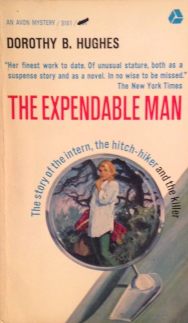 The thing that does make me hesitate is the oddity (arguably) of assigning a novel that is fundamentally about race, and that is told from the point of view of a Black man—but which is written by a white woman. “A white woman writing of a young black man’s problems with the law was a certain kind of gamble,” Mosley comments in his Afterword—but Mosley himself doesn’t seem to consider it problematic, moving immediately on to remark Hughes’s general interest in writing “from perspectives far from her own.” It is clear from the afterword that Mosley greatly admires Hughes in general and The Expendable Man in particular. What kind of representation is more important, in a class like mine that tries to show the range of uses to which the forms of detective fiction have been put since its emergence as a distinct form? It seems as if Mosley would consider it most important to address “the darker reality” (as he puts it) that lies behind more “glittering versions of American life.” Presumably he thinks the gamble paid off for Hughes because the result was a very good novel.
 Though I don’t dispute Hogeland’s interpretation, I did notice that she seems aware she’s working a bit hard to make the case. She attributes the challenge to Hughes’s subtlety: for instance,
 Novel Readings