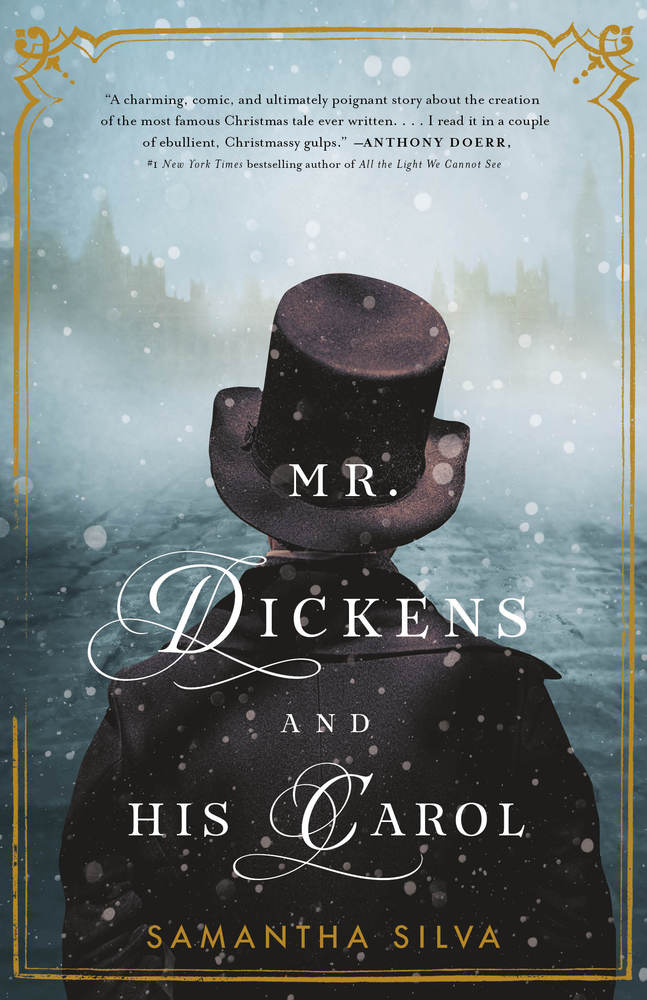
 Dickens’s A Christmas Carol was first published on this day in 1843, so it seems like an apt time to say a little about Samantha Silva’s homage to that holiday classic, Mr. Dickens and His Carol. I actually read Silva’s novel with the intent to review it more formally, but two different plans for that fell through. Frankly, I was relieved both times, because I didn’t–don’t–have that much to say about the novel! It’s inoffensive. It’s moderately diverting. It’s a nice idea. You should reread A Christmas Carol instead.
The thing is, they called Dickens “The Inimitable” for a reason. Love him or hate him, he’s a writer who absolutely revels in what words can do, and who takes risks and leaps with them, who frolics and freaks out with them, who tries every trick he can think of to make us laugh and tremble and cry with them. His is an aesthetic of excess, of extravagance, both structurally and emotionally, and I know plenty of readers who get impatient with it, or worse. I myself am actually a late convert–and there’s still plenty of Dickens I haven’t read–but I’ve come to cherish him for just that sense that he’s absolutely throwing himself into his writing, giving it, and thus giving us, everything he’s got. As I wrote a few years ago, when David Copperfield saved me from a reading slump, “his books radiate delight in words and stories and imagination.” It can be intoxicating.
 Nothing about Mr. Dickens and His Carol is intoxicating. It’s a perfectly fine story in which the writing of A Christmas Carol itself becomes the means of saving both Dickens and Christmas. Inevitably, Silva’s writing is pedestrian by comparison with her predecessor’s. When at long last the redemptive tale is written and then read aloud to the rapturous delight of Dickens’s audience,
Dickens bowed, long and low. His heart was thundering inside him, too, louder than all the clapping, which seemed not to subside at all. He needed the moment. It was as if he’d come to the crest of a great mountain peak and, though panting and spent, could see all the world. And how vivid a view. Even the Turkish carpet under his feet was every color imaginable, an alchemy of alum, copper, and chrome mied with madder root, indigo, poppy, and sage. What magic there was all around him. Words were inadequate, but all he had. He didn’t know where they came from or why, but it was how we told one another what the world was and might be. Who we were, and might become. It was the only magic he had. Everything else was faith.
Fair enough. But here’s an example of the real magic he had:
Oh! But he was a tight-fisted hand at the grindstone, Scrooge! a squeezing, wrenching, grasping, scraping, clutching, covetous old sinner! Hard and sharp as flint, from which no steel had ever struck out generous fire; secret, and self-contained, and solitary as an oyster. The cold within him froze his old features, nipped his pointed nose, shrivelled his cheek, stiffened his gait; made his eyes red, his thin lips blue; and spoke out shrewdly in his grating voice. A frosty rime was on his head, and on his eyebrows, and on his wiry chin. He carried his own low temperatures always about with him; he iced his office in the dog-days; and didn’t thaw it one degree at Christmas.
External heat and cold had little influence on Scrooge. No warmth could warm, nor wintry weather chill him. No wind that blew was bitterer than he, no falling snow was more intent upon its purposes, no pelting rain less open to entreaty. . . .
I could go on–Dickens certainly does (“and on and on and on,” I imagine the nay-sayers muttering)–but I’m sure you already see the difference. One writer is competently telling a story; the other is having a grand old time. “I know that of late I’ve pitied myself a poor man,” says Silva’s Dickens to his long-suffering wife Catherine,
–poor in love, in riches, in prospects. But I’ve learned, in these days of your absence . . . that whatever I suffered was a poverty of my own vision.
“I will honour Christmas in my heart,” exclaims Dickens’s redeemed miser,
and try to keep it all the year. I will live in the Past, the Present, and the Future. The spirits of all Three shall strive within me. I will not shut out the lessons that they teach. Oh, tell me I may sponge away the writing on this stone!
And then discovering he does indeed have a precious second chance, he is “checked in his transports by the churches ringing out the lustiest peals he had every heard”:
Clash, clang, hammer, ding, dong, bell. Bell, dong, ding, hammer, clang, clash! Oh, glorious, glorious!
Running to his window, he opened it, and put out his head. No fog, no mist; clear, bright, jovial, stirring, cold; cold, piping for the blood to dance to; Golden sunlight; Heavenly sky; sweet fresh air; merry bells. Oh, glorious. Glorious!
Only one of the two novels feels like a revelation.
 It is of course not fair to insist that someone writing about Dickens should try to write like Dickens. The results would probably be pretty awful, actually, so Silva was almost certainly wise just to write her own novel in her own way. I don’t think it’s unreasonable, though, to expect that a novel so heavily invested in another writer’s work will engage with it in some transformative way: even if that endeavor too is likely to fail (or at any rate I don’t know of many great examples, and I can think of some really dreadful ones) at least the attempt will be more interesting–and I just didn’t find Mr. Dickens and His Carol particularly interesting. There are aspects I would have tried to make more sense of for a more formal review, such as how consistent it is to make the story of Dickens’s Christmas redemption turn as much on the commercial success of his new book as on any spiritual revelation–but I don’t think much would really have come of that exercise.
On its own terms, though (and I honestly don’t mean to be damning it with faint praise) Mr. Dickens and His Carol is readable and kind of charming, and it has stretches of prose that, if not truly Dickensian, are still wonderfully tactile and evocative:
The night was an embroidery of stars on a taffeta sky so blue it bled all the black away. No more drab-colored December fringed with fog. The even of Christmas week burst into the world, clear and dry, the streets one continuous blaze of ornament and show. . . . Shops sat in their best trim under bright gaslights turned all the way up, with evergreen plumage four stories high, like a great forest canopy. There were great pyramids of currants and raisins; brown russet apples and golden bobs, Ribston Pippins and huge winter pears; towers of jams, jellies, and bonbons; solid walls of sardines, potted meats, bottled pickles, drummed figs. . . . Over grappling horses’ hooves, roaring drivers, and chaffering dealers, rose the harmonies of an oboe, French horn, and flute, warbling a pastoral Christmas tune.
All of London seemed set upon suffering gladly a sprinkle of brotherly this and that, but cheer most of all.
And the novel is sometimes even touching, as Dickens struggles through his writing slump and emerges–thanks to some visitations of his own and some hard-won insights into his own life–renewed and filled with the spirit of Christmas: “He turned his face to the star-kissed winter sky, from which tiny, glittering snowflakes began to fall. He couldn’t have been happier had he been transported to Paradise.” Silva says in her Author’s Note that “the book is, most of all, a fan letter”–and the sincerity of her appreciation for Dickens and his brilliant little Christmas ornament of a book is palpable and more than a little heartwarming.
 We had our last day of classes yesterday. Owing to a very peculiar scheduling plan devised (of course) by a committee, although yesterday was actually a Tuesday, it was designated an “extra Monday” to make up for “losing” a day of Monday classes to Thanksgiving (so much for the concept of a day off — must everything be weighed and measured?). Anyway, that meant two days of Monday classes in a row to bring us to the end of term. As I am not giving final exams in my courses, I now have a lull in immediately pressing teaching-related activities until the final essays come in, the first batch on Friday, the second on Sunday. Then I have to dig in and get through them all, and then do all the final record keeping so that I can compute and submit final grades.
 Though the cessation of classes doesn’t mean there’s not anything else to do at work (just for instance, today I put some time in organizing the Brightspace site and readings for one of next term’s courses), I usually take advantage of any break in the schedule at this time of year to get some holiday shopping done, especially for things I want to mail out west to my family. I was especially motivated to get as much done as I could today because so far (unlike my family out west, in a rare reversal!) we have no snow to deal with yet. Sadly, that can’t last, and everything gets harder once the roads and sidewalks are wintry. So once I’d taken care of some business at the office, out I went, and had a pretty nice time puttering around at the mall and in the rather more interesting shops at the
  Years ago, when our children were very little, we decided we were not going to lie to them about the existence of Santa Claus. Though as I recall we did debate it a little, in the end it was not a difficult decision, and it is not one we have ever regretted. As far as possible, we always try to be honest with our children and didn’t like the idea of one day disillusioning them–not just about Santa, but about us (“Yes, Mommy and Daddy lied to you repeatedly, because we thought it was cute!”). Of course we understand that people who pretend Santa Claus is real do so in the cheerful spirit of fun, fantasy, and fairy tales, and overall it’s probably a harmless kind of thing, but we also have a general aversion to unreality when it comes to explaining how things work in the world. No astrology, no alchemy, no holistic medicine or faith healing, no supernatural beings, no Santa Claus.


 Years ago, when our children were very little, we decided we were not going to lie to them about the existence of Santa Claus. Though as I recall we did debate it a little, in the end it was not a difficult decision, and it is not one we have ever regretted. As far as possible, we always try to be honest with our children and didn’t like the idea of one day disillusioning them–not just about Santa, but about us (“Yes, Mommy and Daddy lied to you repeatedly, because we thought it was cute!”). Of course we understand that people who pretend Santa Claus is real do so in the cheerful spirit of fun, fantasy, and fairy tales, and overall it’s probably a harmless kind of thing, but we also have a general aversion to unreality when it comes to explaining how things work in the world. No astrology, no alchemy, no holistic medicine or faith healing, no supernatural beings, no Santa Claus.
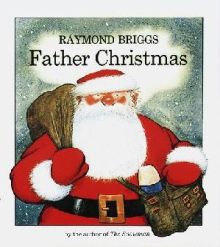 Raymond Briggs, Father Christmas. I just love this charming curmudgeonly Santa. Who doesn’t sympathize with the dreariness of having to plod off to work on a cold day? And whose spirits wouldn’t be restored by a little wine and cookies at mid-shift? Inevitably, at some point in the next little while, one of us is sure to look out the window and exclaim “Bloomin’ snow!” But at the end of the day, it’s all about making merry with the people (or, if you’re Father Christmas, the pets) you love.

 Another beloved Christmas book from my past is Ezra Jack Keats’s gorgeously gold and sepia-tinted edition of The Little Drummer Boy. This one too still lives in Vancouver, but I just discovered that it’s still in print, so may be next year it will be the traditional Advent book for my children. Par-rum-pum-pum-pum!
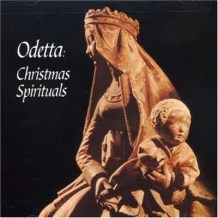
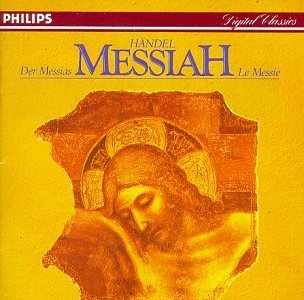
 Music is still essential to all holiday festivities, as far as I’m concerned. We got out our current stash of Christmas CDs this week. A lot of my old favourites are in the collection, along with ones that evoke holiday memories for my husband (
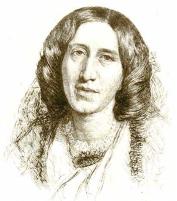 I think, too, of George Eliot’s attitude, expressed implicitly and explicitly in so much of her fiction–that, as she wrote in a letter in 1874, “the idea of God, so far as it has been a high spiritual influence, is the ideal of a goodness entirely human.” I feel the same about the “Christmas” spirit: it’s really just the human capacity for love, charity, forgiveness, and generosity (not to mention reverence, sacrifice, and inspiration) that’s being celebrated, with nothing supernatural about it. The feelings evoked by carols such as ‘Silent Night,’ ‘It Came Upon a Midnight Clear,’ or ‘I Heard the Bells on Christmas Day’ (to mention just a few of my personal favourites) are really no different from the feelings evoked for me by any beautiful music, and the fundamental ideals of peace on earth and goodwill to men do not in fact require (and may even be hindered by) the specific myths of Christianity. And yet that tradition (as George Eliot acknowledges) for centuries provided a key framework for the development of these ideals (if not their perfect realization–indeed, quite the contrary, as history shows). And so I’m quite comfortable with the secularization of Christmas, which seems to me consistent with the goal of recognizing in ourselves–claiming for ourselves–those qualities most important to making the world a better place. It’s not God who blesses Tiny Tim, after all, it’s Scrooge! Why tie ourselves to the Christian calendar, then? Well, just as Christian traditions were superimposed on pagan and other rituals, so too our modern values and ideas are incorporating old ways and turning them to our own purposes. And the music really is beautiful–so I sing along, rejoicing.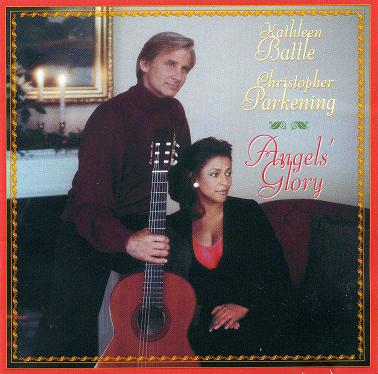
 Novel Readings
