“I was Mrs. Hawkins”: Muriel Spark, A Far Cry From Kensington

farcryMy local book club met last night to discuss Muriel Spark’s A Far Cry From Kensington. We always try to follow some kind of thread from one book to the next; after reading two novels by Elizabeth Taylor we were thinking about other mid-20th century women novelists and while Muriel Spark seemed like an obvious choice, The Prime of Miss Jean Brodie seemed a little too obvious, plus some of the group had read it before. (I hadn’t, but was finally prompted to by this discussion.) We chose A Far Cry From Kensington a bit randomly from among her other novels — I think the Amazon description of it as including “shady literary doings and a deadly enemy; anonymous letters, blackmail, and suicide” may have been decisive, because, after all, how tempting does that make it sound?!

So. Well. Hmm. I guess I could start by noting that I didn’t do terribly well with The Prime of Miss Jean Brodie — it’s not that I didn’t like it or find it interesting, but as I reported at the time, I struggled to make sense of it. The comments I got on that post helped me see how I might do better, but they didn’t do much to prepare me for A Far Cry From Kensington, which I found even more baffling — formally baffling, because it seemed to jump around from genre to genre and tone to tone; thematically baffling, because I couldn’t understand why it included the different elements it included; and baffling to me as a reader because in spite of all the things about it that bemused me, I didn’t hate it, and in fact I kind of liked it. Despite my confusion, I didn’t resent the book the way, say, Mrs. Hawkins, in the novel, resents Hector Bartlett’s The Eternal Quest, a study of the Romantic-Humanist Position.” I may not really get Muriel Spark’s fictional method or mission, but she’s so obviously artful about whatever it is she’s doing that I feel confident she is not the novelistic equivalent of a pisseur de copie…which is the epithet Mrs. Hawkins so fatefully hisses at the insufferable Hector.

Mrs. Hawkins — large, observant, acerbic, insomniac — is the best thing about A Far Cry From Kensington. I was actually going to write my whole post about the advice she hands out so confidently (and bafflingly! why does she give us so much advice?), but while googling around for insight into the novel, I came across this piece by Maud Newton, which is not only good about Mrs. Hawkins’s advice but smarter about the whole novel than I can be. So I will quote only this one bit of it:

It is my advice to any woman getting married to start, not as you mean to go on, but worse, tougher, than you mean to go on. Then you can relax and it comes as a pleasant surprise.

Even Mrs. Hawkins doesn’t know why she can’t help calling Hector a pisseur de copie (“a hack writer of journalistic copy,” she helpfully explains) but she can’t stop doing it and won’t retract it, either. She’s really quite virulent on the topic of Hector’s terrible writing:

Pisseur de copie! Hector Bartlett, it seemed to me, vomited literary matter, he urinated and sweated, he excreted it . . . His writings writhed and ached with twists and turns and tergiversations, inept words, fanciful repetitions, far-fetched verbosity and long, Latin-based words.

Little does she know that drawing this line in the rhetorical sand will cost her not one but two jobs in publishing, which the novel endlessly reminds us are both hotly desired and terribly recompensed.  Spark is acidly funny about the cliquishness of the publishing world, in which a word in the right place from the right celebrity author means more than any amount of dedication to literature. “Ah yes, in fact, books,” says one of Mrs. Hawkins’s employers:

Yes, many of our staff here are in fact fairly interested in books. One of our senior colleagues in fact was saying at a meeting only the other day that he thought he might perhaps have a shot at getting back to his first love — books.

Hector has the backing of a famous novelist, Emma Loy, who exercises her influence against Mrs. Hawkins (only, years later, to end up herself a victim of Hector’s malice, as Mrs. Hawkins placidly relates). Hector’s vengeful plotting against Mrs. Hawkins goes far beyond getting her fired, though, and realizing the extent of his insidious scheming is both amusing and, again, baffling. Spark lays her clues out so ingeniously that it’s easy to miss “that glint of a thin trail, like something a snail leaves in its slow path” even though, unlike Mrs. Hawkins, we know we’re looking for it.

Right up to the ‘reveal,’ in fact, the novel seems more random than plotted itself — which may, of course, be part of Spark’s art. And then I was surprised, rather than satisfied, by the conclusion, which draws together elements as disparate as a hysterical, ultimately suicidal, Polish refugee and the absurd pseudo-science of radionics (“no more a subject for mockery,” Mrs. Hawkins observes, “than the claims of all our religions”). And what about the parts that seemed unrelated to that plot, like Mrs. Hawkins’s brief, violent marriage (“Now, it is my advice to anyone getting married, that they should first see the other partner when drunk”), or the unwed mother in the upstairs attic whose father proposes to Mrs. Hawkins because “it would be good for Isobel to have a mother” (“at the age of twenty-nine, I wasn’t minded to take on a girl of twenty-two as a daughter”), or “the Boys” she goes to work for who “always got up when we came into the room” (“Is that American or is it homosexual?”)? I don’t understand why these are the ingredients of the novel — and yet each, in its own way, in the reading moment, was interesting or funny or temptingly quotable.

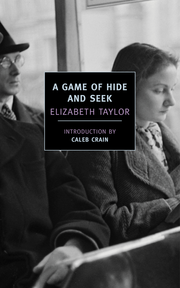
“This blurred world”: Elizabeth Taylor, A Game of Hide and Seek

Elizabeth Taylor is the first repeat author we’ve chosen in my F2F book club: for our last meeting, we read Angel, which was such a surprise hit we agreed we’d like to try more of Taylor’s novels. By “surprise hit” I mean in part that because we had no expectations, we were surprised to find ourselves so engaged with the book (which is not to say everyone loved it, but we all liked discussing it). But I also mean that we were surprised by its particulars: by how many things about it are unlike other books any of us had read. It is strange and dark and sad and comic and grim and satirical, all at once. And talk about an unlikable heroine! And yet we all found her a perversely captivating one.

taylorhideandseekSo we’ve moved on to A Game of Hide and Seek, which is the other of Taylor’s novels recently reissued by New York Review Books. We haven’t met to discuss it yet, and I’m quite curious to find out how the others responded. For me it was surprising all over again, because at first it didn’t seem very much like Angel. And yet the more I think about it, the more I realize that despite the fairly different story and structure, it does resemble Angel, not in its characters or events but in its attitude. Both novels proceed with a relentless lack of sentimentality that is all the more unexpected in A Game of Hide and Seek because it tells what might be called a love story.

A Game of Hide and Seek tracks the awkward, uneven relationship between reticent Harriet and erratic Vesey. Harriet knows she loves Vesey from early on, but for some time she is tormented by uncertainty about how he feels about her — or, indeed, whether he feels anything at all. Believing there is nothing between them, she marries Charles — older, steadier, uneasy because he knows she nurses a secret passion for Vesey, who, after being both emotionally and then physically absent while Harriet yearned for him, turns up again now that Harriet is unavailable. Harriet and Vesey flirt (though that seems too perky a word) first with each other and then with outright adultery.

I found it impossible to root for a consummation of their love: Harriet is a drip, and Vesey is a bit of a jerk. It is love, though, I suppose, that is hiding and being sought, though the novel doesn’t give a very encouraging idea of what, exactly, love is. Harriet’s early infatuation is completely inexplicable: is that perhaps the point, that love is something that trumps or eludes reason? Or perhaps, as Harriet’s friend Kitty cautions her, the problem is loving an idea instead of a person: Harriet longs for love, and she believes Vesey to be her love, while he does just enough — he is just enough — to sustain the fantasy.

It’s the idea of Vesey and Charles’s knowledge of Harriet’s longing for him that undermine Charles and Harriet’s marriage. Taylor is very good at evoking the isolation that comes with unhappy intimacy:

Beyond their familiarity and nakedness, they could now sense their true isolation and were more perfectly strange to one another than people passing in a street.

After Vesey’s re-entrance into Harriet’s life, her daughter Betsy develops her own crush on him. In an odd twist, Betsy comes to believe Vesey is actually her father, which is at once traumatizing and gratifying:

That life was so unlike Greek literature had been the worse for life, to her mind. To-night it came — on the strength of a cryptic note, a faded photograph — magnificently near to it.

Her other crush, her Greek teacher Miss Bell, urges her not to “be such a slave to [her] feelings.” Miss Bell herself eventually has to leave for a new school, and one reason is that she has made too much of a favorite of Betsy: the lesson she carries away is “never [to] grown fond of any of them.”  Is it possibly better that love be neither sought nor found?

A further facet of the novel is its suffragette backstory: Harriet’s mother and Vesey’s aunt are close friends who were once “hustled, gripped above the elbows by policemen, up the steps of a police-station.” Their heroism embarrasses more than it inspires Harriet, who shows no particular interest in the bright future they fought to win for her. Her one independent move is going off to work in a dress shop, but this is a prelude only to her marriage, not to any assertion of herself or pursuit of a more rewarding career. It’s Betsy who finds her grandmother’s adventures exciting.  I don’t know how to put this piece together with Harriet and Vesey’s strange affair. Maybe I’m not supposed to: maybe it’s just there, rather than there as part of an aesthetic or thematic unity. Some people’s mothers really were suffragettes: does it have to mean anything? Why do I always seek unifying ideas?

Yet there are teasing intertextual moments that make me think it’s not wrong to try to solve the novel’s puzzles, as when Charles sits reading Persuasion while entirely conscious that something is afoot with Harriet and Vesey:

‘What a novel to choose!’ Charles thought. ‘Only the happy in love should ever read it. It is unbearable to have expression given to our painful solitariness, to rake up the dead leaves in our hearts, when we have nothing that can follow (no heaven dawning beautifully in Union Street), except in dreams, as perhaps Jane Austen herself never had but on the page she wrote.

Persuasion is another novel of love lost and regained; A Game of Hide and Seek could certainly be read as the anti-Persuasion, in that its lovers have aged but not grown, while their past love does not seem worth either remembering or reviving — even though they both remember and try to resuscitate it. Anne and Wentworth learn to fight for the love that will enable a new, better life; Harriet and Vesey, in contrast, can barely see what would be right, much less fight for it. Not knowing where they are, or where they’re going, is liberating at first, even though at the last minute they realize they have been stumbling towards a big mistake:

He walked beside her with the rose hanging from his hand. The taste of the fog was at the back of their throats. They could see only the shape of one another and, when they spoke, so private, so safe did they feel that they neither paused nor dissembled. In this blurred world, words were more beautiful and they used them more truthfully than at other times.

 Taylor’s writing is a bit like that. Sentences can be meandering and difficult to follow, leaving you disoriented:

This morning, however, she was ruffled herself, felt that a real sequence was so broken that the punctual arrival of the milk-man, the charwoman coming in at the back door at her usual time, were small mockeries, piteous pretences, like the first meal after a beloved one’s death, not even reaffirming that the world goes on as usual, that in the midst of death we are in life.

But then ideas emerge clearly out of the fog, giving you a distinct outline of feeling or intent:

‘Nowadays,’ she thought, ‘perhaps always, happiness has to be isolated. Only when we block out all that surrounds it, can we have it perfect, as we so often have perfect grief.’ She felt that she must not grope backwards over her conscience, or forwards over her desires, but keep her contentment in this different climate while she could.

A lot seems blurry in A Game of Hide and Seek: character, motive, plot, morality, meaning. Taylor creates a climate of yearning and dissatisfaction, though, in which words seem sometimes beautiful and sometimes true.

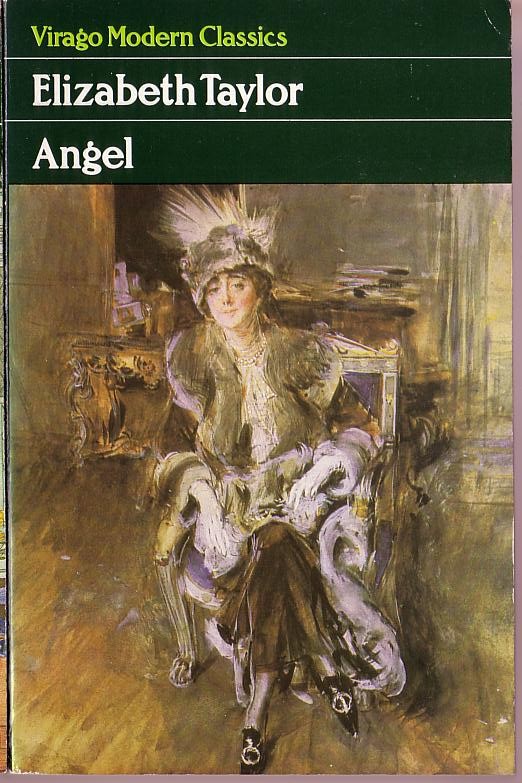
“Menaced by intimations of the truth”: Elizabeth Taylor, Angel

angelAngelica Deverell, the eponymous protagonist of Elizabeth Taylor’s Angel, will not accept the dreary reality she lives with, and so she creates a different world through her fiction, finding in it all the glamour and drama she yearns for and believes she deserves. So far, so good, right? We’ve met imaginative young girls in novels before — Jo March, Anne Shirley — who channel their repressed energy for life into story-telling, and whose hunger to express themselves matches their exuberant desire to live more fully. But Angel, it turns out, is no relation to these lovable sprites, and Elizabeth Taylor’s own novel offers none of the cheerful consolations of Little Woman or Anne of Green Gables: there’s something much darker and sadder in this account of a woman who never ceases in her insistence that her fantasies are reality but whose life never does bring her any real joy — only constant battle against unwelcome truths.

Angel, in other words, is a book that surprised me. I thought I knew the kind of thing I was getting into when I started it, and I was instantly on Angel’s side, too, when on the very first page she confronts her dubious teacher about an essay poor Miss Dawson can not believe Angel has written: “Who does she think wrote it if I didn’t? Who does she think could?” But things went awry for me after that, as Angel turns out to be anything but sympathetic — and yet there’s something compelling and maybe even tragic about the completeness with which she insists on living her own version of her life, never backing down even when faced with the cruelest facts. Refusing reality is hardly the route to moral heroism, and at no point does Angel transcend her own egotism, while at no point does Taylor soften her or elevate her to make our work easier.

Her publisher manages, as we must, to see her straight on: “He realised the hunger she had suffered, the deprivations of her wilful, ranging imagination.” Early in her career she tells him the truth of her early life but concludes, “None of what I told you seems true to me and I know that one day I shall stop believing it.”

Unreality is also the hallmark of her novels, which are critically disdained:

The very passages of which she had been most proud, had been printed as if they were richly humorous; her dialogue, her syntax, her view of life, her descriptions of society were all seen to be part of some new and quite delicious joke. No one had wept, it seemed, when reading the funeral scene–unless it was with laughter.

Yet laughable as the books are, they are (for a time, at least) bestsellers:

The more the critics laughed, the longer were the queues for her novels at the libraries; the power of her romanticism captivated simple people; her preposterous situations delighted the sophisticated; her burning indignation when some passing fury turned her aside from her plot into denunciations and irrelevancies, swayed some readers into solemn agreement and others into paroxysms of laughter.

Taylor is clearly a sophisticated novelist, not one aiming at simple people, so the most surprising aspect of Angel is the total absence of satire at Angel’s expense: she paints her character’s portrait with the same unexpected ruthlessness as Angel’s eventual husband Esmé literally paints it:

 The portrait lacked exuberance and he had painted her in her darkest clothes against a banal background; the empty window behind her, the bare wall, emphasized the suggestion of loneliness. . . . at the time people thought the portrait dreary and tactless and wondered why Esmé had not the wit to modify the arch of her nose, the eccentricity of her clothes and correct her slight astigmatism, and if she would not disguise her own pallor, he, on canvas, might have done so.

His unsentimental realism is the complete opposite of Angel’s denial of reality, which remains perfect even as she becomes increasingly freakish in her aging eccentricity:

To herself, she was still the greatest novelist of her day, and not the first in history to receive less homage than was her due. No one bought her books, and only the middle-aged or elderly had ever read them: she did not know that she was now a legend of which the young had only vaguely heard; risque, their grandparents, in quaint fashion, said her novels were.

Somehow, Taylor manages to bring no judgment down on Angel for refusing to live in the world. It would have been easy to enhance the pathos of Angel’s final moments by granting her an epiphany, a moment of painful self-awareness, but all she feels is fatigue, and relief when she realizes her long struggle is over: “it was not to be gone through again; after all she was at home, in her own bed, with her own life behind her.” In choosing fantasy she has not, after all, taken the easy way.

Magical Thinking: Truman Capote, Breakfast at Tiffany’s

tiffanyBreakfast at Tiffany’ s is the January read for my Halifax book group: we’re meeting next Saturday at Pipa to talk it over and celebrate the new year.

I more or less enjoyed reading Breakfast at Tiffany’s: more because the prose is so elegant, less because I found Holly Golightly tedious. She seems to me one of a type, though a particularly fey and charming example of it: it’s a type I think of as the intellectual man’s idea of a temptress, and other examples include Sue in Jude the Obscure and Julia in Brideshead Revisited. I believe I accused these two of representing “pseudo-philosophical eroticized flightiness.” Holly lacks their intellectual pretentiousness and shows no sign of haphazard piety, but she raises the same question for me as the other two: what’s so attractive about her? Is it that she’s so unstable her sexuality is not threatening? Is it that her intelligence is randomly dispersed rather than ambitious? Is it that for all her allure she seems fundamentally vulnerable?

Actually, even as I write I’m thinking of more ways Holly is different from my other examples. She is more endearing (at least to me), because for all her elaborate artifice, she seems warmhearted. Though she uses the men in her life to serve her selfish ends, she also enjoys giving pleasure, and she’s loyal . And she says some wise things, including “Anyone who ever gives you confidence, you owe them a lot.” And — and here’s where I think much of her charm probably does lie, for every reader — she’s a wistful dreamer, someone who, like all of us, is just wishing for a way to live her life that feels safe and happy, and maybe even a little bit dignified:

What I’ve found does the most good is just to get into a taxi and go to Tiffany’s. It calms me down right away, the quietness and the proud look of it; nothing very bad could happen to you there, not with those kind men in their nice suits, and that lovely smell of silver and alligator wallets. If I could find a real-life place that made me feel like Tiffany’s, then I’d buy some furniture and give the cat a name.

Do we all have a place that works its magic on us the way Tiffany’s calms and cheers Holly? I bet in this crowd a lot of us feel that way in a bookstore. I’ve been feeling kind of fretful lately, but this afternoon I treated myself to a browse and a coffee at Chapters, and though it’s not even my favourite bookstore to visit, I sure felt better after an hour or so roaming the shelves. While I was in there, I was wondering about one of the sources of my fretfulness–the surge of writerly confidence I felt after I got back from Boston last year, or rather the way that surge seems to have ebbed away. I spent a lot of my time in Boston in bookstores, and with other people who thrive on reading and writing and talking about books. I’m not looking for excuses to buy more books, really! But it occurred to me today that just spending my time in that way might have affected me at some subterranean level by affirming priorities, and even an identity, somewhat different from my day-to-day reality. My relationship with the wider book world is much more furtive in my ordinary life: I often (if irrationally) feel kind of guilty when I buy books, or when I steal away from work and family to browse them at my leisure; my bookish contacts and conversations are nearly all virtual; I have to fit in my non-academic reading and writing in between my “real” work tasks; my home office where I do my blogging and non-academic writing is even in the basement! I think there’s a way in which being in an actual bookstore summons up a fantasy life for me the way Tiffany’s does for Holly, though the precise things we want to feel and do are hardly the same.

Jean Rhys, Wide Sargasso Sea

I am nearly as reluctant to write about Wide Sargasso Sea as I was to read it — and, yes, until last week, I had never read it, which in some circles (like, for instance, the circle of 99% of my professional colleagues) would surely have made me a winner at “Humiliation.” I knew about it, of course, but what people said to me about it never made me interested in it as a book in its own right. It was always held up, self-righteously, as a corrective to Jane Eyre: the story Charlotte Brontë didn’t tell but should have, the story that shows her and her heroine up for their racism and imperialism, that story that, as the back cover of my Penguin Modern Classics edition says, “rescues the madwoman in the attic … and brings her to life.” The pitch seemed to be that this novel was the post-colonial vitamin pill required to read Jane Eyre in good health. How delightful that sounded!

It’s not that I haven’t read my share of post-colonial responses to Jane Eyre. For some time post-colonial criticism of the novel was all the rage. Then out came an article calling for a “Post-Postcolonial Criticism,” and a bunch of scholars responded vigorously … and for all I know they’re still passing  arguments back and forth. I took a professionally responsible interest in the issues and stakes, and I do believe that it matters to explore what the novel’s emancipatory rhetoric  suppresses (or oppresses) in its turn.  In my graduate seminar on Victorian women writers I used to assemble a whole package of secondary readings just on post-colonial criticism of Jane Eyre. But after a while I kind of got tired of it all, because the arguments seemed to be missing what (thanks to my library-school trained brother) I now think of as the “aboutness” of the novel. Certainly none of them made me want to go read Wide Sargasso Sea. If anything, the scholarly infighting made me more weary of the whole concept.

So I came to Wide Sargasso Sea, after all these years, with some reluctance, but also with relief: since my book club had chosen it, I was finally compelled to put aside my petulant resistance and look at Jane Eyre from the other side. I wish I could say that actually reading Wide Sargasso Sea was in some way decisive for me: that it either confirmed all my worst fears by being ham-fistedly ideological and reductive, or won me over by being good enough on its own terms that I got excited about the dialogue it creates with its predecessor. Instead, I didn’t get worked up about it either way. It was more nuanced and oblique than I expected about its relationship to Jane Eyre. If anything, I expected more direct overlap, but not only is the story Rhys creates of the Bertha-Rochester marriage quite different in its specifics from Brontë’s, but the Thornfield section was surprisingly brief. I suppose the logic was that we know how Bertha ends up and so the interest lies in how she gets there — still, I thought there’d be more. Rhys doesn’t do anything with the parallels between Bertha and Jane, for instance, that give Bronte’s novel so much of its own revolutionary energy. Was it that she didn’t want to admit that Brontë had already made Bertha something more complicated than Rochester’s (and, by association, Jane’s) victim? The introduction to my edition is eloquent about Rhys’s mission to “make amends for the sins of omission committed by the Victorian writer, and by that era’s literature and history in general,” but Rhys keeps the Victorian novel peripheral and doesn’t seem to be engaging with it at a very profound level.

I found myself wondering, though, if that dissatisfaction wasn’t partly the result of all the propaganda about Wide Sargasso Sea as a revision of Jane Eyre and a corrective to it (the kind of thing I’ve already quoted from the cover and introduction to the novel). Rhys isn’t necessarily answerable for the reductive constructions put on her own book, after all. If you grant Wide Sargasso Sea more literary independence from the outset, looking at it as a response to Jane Eyre, yes, but still its own novel, freely inventive, then my objection that it leaves too much of its original reference out is beside the point. My biggest irritation has always been that there’s a tendency to talk about Rhys’s novel as if it tells the true story of Brontë’s character, when of course there is no such character outside Jane Eyre and there is no reason to doubt the facts about her as Rochester relays them to us. (There are other grounds to object to the story he tells, but I don’t think there’s any suggestion in the novel that he’s outright unreliable about the history of their marriage.) But Rhys makes enough changes to those facts that it seems as if she doesn’t intend to treat the same characters anyway: rather than telling the other side of the same story, she’s inspired by Jane Eyre to tell a different story, one that reflects on Jane Eyre but doesn’t correct it, doesn’t (as that ontologically odd locution of “rescues” implies) set the record straight, somehow, about  Bertha Mason.

If I push Wide Sargasso Sea further away from Jane Eyre in this way, then the question is less how it does or doesn’t engage with Brontë’s novel and more how good a novel it is on its own terms. I’m not sure I can answer that question very well, because while I was reading it I was so preoccupied with Jane Eyre. I’ve reread portions of it, but I have nothing like an intimate knowledge of it. My impressions at this point are not especially favorable. I didn’t find the prose compelling: it often seemed labored, portentous, too insistent on its own profundity. Rhys is fond of ending a paragraph or chapter or section with a heavily meaningful line: “I was young then. A short youth mine was.” “I felt bolder, happier, more free. But not so safe.”  “There was a full moon but I saw nobody, nothing but shadows.” “Once I would have gone back quietly to watch her asleep on the sofa . . . But not any longer. Not any more.” When we’re not getting ka-thumps like that, we’re getting overripe stuff like “She had left me thirsty and all my life would be thirst and longing for what I had lost before I found it.” There is a dream-like vagueness to a lot of the scenes, and perhaps that is deliberate, but in our discussion it seemed most of us were frustrated at gaps or confusions, and though most of us agreed that there are sections that are very evocative of the setting or that capture a moody restlessness well suited to the storyline, overall we didn’t — and, not to avoid speaking for myself, I didn’t — find the novel very good overall.

And now I’ll duck, in anticipation of the incoming corrections, if not to Jane Eyre, then to my own imperfect reading of this book which is, whatever I thought of it, now inextricably linked to Brontë’s. Have at!

“Your novelistic language annoys us”: George Sand, Indiana

My intrepid book club, which followed up Madame Bovary with Julian Barnes’s Flaubert’s Parrot, decided that our next step would be something by George Sand. We settled on Indiana because it was the most readily available (there’s a nice Oxford World’s Classics edition, with a “new” [1994] translation and an introduction by eminent literary scholar Naomi Schor). We thought this would be an interesting choice because Sand is more or less the anti-Flaubert: sentimental where he is relentlessly not, idealist where he is realist, not much esteemed (or at least read) today–note, again, the date of that “new” translation. His name is a byword for literary seriousness: he is the Father of the Modern Novel. And George Sand is … something else.

Before reading Indiana I knew George Sand mostly from Elizabeth Barrett Browning’s sonnets about her, which I routinely assign in my seminar on the Victorian ‘woman question.’ “Thou large-brained woman and large-hearted man,” begins “To George Sand: A Desire”:

Self-called George Sand! whose soul, amid the lions
Of thy tumultuous senses, moans defiance
And answers roar for roar, as spirits can…

The sonnets celebrate the power of Sand’s voice and her defiance of convention, particularly her attempt to transcend the limits of her sex. “To George Sand: A Recognition” ends with a vision of her spirit finally set free of such limits:

Beat purer, heart, and higher,
Till God unsex thee on the heavenly shore
Where unincarnate spirits purely aspire

Yet even as the poem seems to reach in those lines towards an idealized androgyny, it also insists that her attempts to deny her “woman’s nature” are vain:

                                      that revolted cry
Is sobbed in by a woman’s voice forlorn,
Thy woman’s hair, my sister, all unshorn
Floats back dishevelled strength in agony,
Disproving thy man’s name…

Together, the sonnets are a moving tribute from one woman writer to another and a fascinating example of the complexity of working out the role of ‘woman writer’ at a time when gendered expectations shaped and limited women’s literary ambitions in so many ways.

Indiana is the only novel of Sand’s I’ve read, so I am in no position to generalize. However, based on this one example at least, EBB’s hyperbole suits her subject. Tumultuous senses, moaning defiance, aspiring spirits, revolted cries: this is the stuff of which Indiana is made. And I admit, though I chafed at Flaubert’s implacable objectivity, the rushing emotionalism of Indiana was even harder for me to take. I know enough to recognize that it belongs, self-consciously, to a tradition that includes its own most conspicuous intertextual reference, Paul et Virginie (which I read years ago for a graduate seminar), and which is not the tradition of either historical or social realism. And I learned from Schor’s boosterish introduction that there are terms for reading Indiana better than I was able to:

no analysis…of Sand’s work can proceed without taking account of her … idealistic aesthetics, without rethinking idealism, idealism being understood here both as the heightening of an essential characteristic (the pretty and the beautiful, but also the ugly and the stupid), and the promotion of a higher good (freedom, equality, spiritual love).

Schor suggests that the opening of the novel is a kind of feint in the direction of Balzacian realism but that the novel moves towards idealism and, more particularly, towards allegory: “each protagonist incarnates an abstraction”–and she has plenty of suggestions about how to read the allegory. With hindsight, I see that it makes sense to read the novel in this way, as a philosophical exercise as much as an aesthetic one. It does read that way, in fact, with both narrator and characters prone to long disquisitions and high-falutin’ pronouncements.

Now, any fan of Middlemarch is in no position to object to philosophical fiction or long disquisitions. And anyone who has complained that Flaubert is all head and no heart probably shouldn’t turn around and complain about a novel that oozes heartfelt emotion from every painfully sincere sentenceBut here I go: Indiana is pretty dreadful. (Alternatively, I did a dreadful job reading Indiana.) The construction was so clumsy I swear sometimes I could actually hear the plot creaking; the elements of that plot range from bizarre to absurd; the paragraphs just go on and on and on; and the characterizations are at once laboured and strangely insubstantial.

If Indiana is meant to be read as an allegory, of course, then complex characterization would be out of place–but that impulse towards realism in the opening of the novel persists throughout, so that while at times people sort of fall into place and what seems to matter is the pattern they make, at others the book gives off every impression of at least trying to be significantly believable. Trying…and failing. My most frequent marginalia is The Exclamation Mark of Disbelief, as in, I can’t believe what just happened, or I can’t believe someone just said that! The love scenes are tedious to the extreme, and a lot of the rest is (inadvertantly, I’m pretty sure) weirdly hilarious. At one point Indiana tests her lover’s faithfulness by giving him what she claims is a clump of her hair, except that it’s actually someone else’s–why does Indiana have a stash of someone else’s hair in a box in her room?  He fails to recognize it as the hair of Indiana’s maid, whom he seduced and then abandoned. “Don’t you recognize that hair, then?” Indiana demands;

Have you never admired it, never caressed it? Has the damp night air made it lose all its fragrance? Haven’t you one thought, one tear, for the girl who use to wear this ring?

Just possibly, the hair has lost its fragrance because its original owner has been dead for some time. But such practical details aside, who makes up a scene like this and gives it to us to read? A trial by hair? The lover is a manipulative jerk, but at this point I sympathized when he “shuddered from head to foot and fell to the floor in a faint.” I think it was his organ of plausibility that shorted out there. (There’s a  great deal of fainting in the novel, just by the way, by men and women alike. It’s because they really, really feel everything, very, very deeply. All that emotion makes it hard to stand up.)

The novel culminates in a a suicide pact which brings Indiana and her faithful swain (not the manipulative jerk, but the pathetic one who has mooned around in the background for the entire novel) literally to the brink. Once there (after a four-month sea voyage, which you’d think might give them time for second thoughts, but no…) they talk for about THREE HOURS and then [SPOILER ALERT! IF ANYONE IS ACTUALLY PLANNING TO READ INDIANA AND WOULD LIKE TO BE SURPRISED, STOP HERE!]  finally jump, much to my great delight. I thought they were never going to get around to it! Except that, quite inexplicably, they didn’t, and they turn up a few pages later living in contented isolation having somehow (!!!) MISSED THE CLIFF IN THE DARK. Or something–even the would-be jumpers aren’t entirely sure what happened. Maybe they got dizzy and “mistook the direction of the path,” or maybe an angel saved them. Whatever.

Like poor Emma, Indiana got her romantic ideas from novels and imagines that love is all you need–provided it’s true love, perfect love, romantic love. “A day will come when my life will be completely changed,” she gushes; “it will be a day when I shall be loved and I shall give my whole heart to the man who gives me his.” While she waits for love, she is literally dying for lack of it: “An unknown sickness was consuming her youth. . . . her silent broken heart was still seeking a young, generous heart to bring it back to life.” At least in Madame Bovary the author knows his character’s fantasies are just that, but Sand throws herself, or at least her novel, wholeheartedly behind Indiana’s dream, even though it makes her vulnerable to the wiles of the manipulative jerk and completely ineffectual at everything else in her life. Sand is also fine, apparently, with the real true love being a fraternal figure to Indiana who eventually admits to having coveted her since she was about seven. But don’t worry: he “didn’t commit the crime of hurrying on by a single day the peaceful course of [her] childhood.” Whew! He would just “bathe [her] little feet in the pure water of this lake,” watch her sleeping, and “lift up [her] fine, silky hair, and kiss it lovingly.” That’s OK, then.

I thought (because it says so on the cover blurb) that Indiana was going to be “a powerful plea for change in the inequitable French marriage laws of the time.” It’s true that Indiana’s husband is a jealous, controlling jerk, that their marriage has nothing to do with love, and that when he discovers in her journals and letters the truth about her (unconsummated) affair with the other jerk, he “grabbed her by the hair, threw her down, and kicked her on the forehead with the heel of his boot.” It’s not hard to put together a plea for change based on the ingredients of the novel–but I had a hard time reading it as being primarily about that. Indiana doesn’t really spend much time realistically trying to get out of her marriage, and periodically she defends her husband and seems willing to conform to expectations. After the kicking-in-the-head scene, the narrator tells us that the husband is “certainly not a bad-natured man” but has just acted rashly out of “the feeling of the moment.” Indiana is intermittently eloquent about her legal subordination:

The law of the land has made you my master. You can tie up my body, bind my hands, control my actions. You have the right of the stronger, and society confirms you in it. But over my will, Monsieur, you have no power. God alone can bend and subdue it. So look for a law, a dungeon, an instrument of torture that gives you a hold over me! It’s as if you wanted to touch the air and grasp space.

But it didn’t seem to me that political liberty is what she really wants. She’s pining for her dream of love, and resents marriage primarily as an obstacle to that imagined fulfillment, not as a contradiction to some more fundamental right. She comes across as someone in the grip of an adolescent delusion who is too ignorant and selfish to focus on anything except her own immediate impulses. Her political speechifying is opportunistic and incidental (to her–it is thematically tied to the novel’s critique of slavery and political oppression, so less peripheral at that level).

Sand seems to be appealing to a Rousseauian ideal of a state of nature in which such impulses can flourish uninhibited (the moral we are offered, at the end of the novel, is “respect [society’s] laws if they protect you; value its judgments if they are fair to you. But if some day it slanders and spurns you, have enough pride to be able to do without it”). But I’m afraid I didn’t want Indiana to flourish. She had no sense of duty, no sense of loyalty, no self-awareness–in short, she was no Maggie Tulliver. If Madame Bovary made me yearn for the balance of intellect and emotion, philosophy and art, that is Middlemarch, this tedious novel about a girl’s passionate and self-indulgent quest for the perfect love and the resulting clash between her and Society made me appreciate all the more the moral complexity (not to mention the artistry and humor) of The Mill on the Floss.

You know what other book it made me appreciate? Madame Bovary. Huh.

Middlemarch for Book Clubs: Update

I have started building the ‘Middlemarch for Book Clubs’ site I boldly promised to create in response to the whole ‘Middlemarch kills book clubs’ story that got so much linkage a week or so ago. Here is a list of the pages and subpages I’ve set up so far. Let me know if you think they look sensible, and also if (based on your experience either as a reader or as a member of a book club) you think I should include something else or go in a different direction altogether. As part of my preparation, I’ve been looking around at other online book club guides, and Amateur Reader is right that the Faulkner site for Oprah’s Book Club is pretty nice. (The ‘How to Read Faulkner’ section is actually fairly similar in spirit and even in some specifics to the ‘top 10 tips’ I posted before, some of which, of course, will show up on the new site.) My own instinct is that the tone of such a site will be at least as important as the content, and then after that what matters most is the organization: after all, it’ s not hard to find information on all of these topics on your own if you go looking. So my goal is not to create original content so much as an atmosphere that’s inviting and a structure that’s useful. That’s a project that plays to my strengths, at least based on my recent course evaluations: apparently I am both conspicuously enthusiastic and unusually well organized.

Middlemarch for Book Clubs: A Preliminary Outline

Welcome

Getting Started

Tips for Success

Choosing an Edition

George Eliot

Life

Ideas

Contexts

Politics

Religion

The ‘Woman Question’

Discussion Questions

The Big Picture

One Book at a Time

Forum

Links

Electronic Editions of Middlemarch

Other Writing by George Eliot

Writing About George Eliot and Middlemarch

Other Related Resources


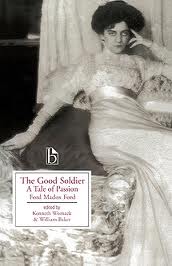
Ford Madox Ford, The Good Soldier

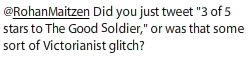
My local book group met today to discuss The Good Soldier. I finished reading it a few days ago and marked off this small accomplishment on GoodReads, where along with checking off the “read” box, we are given the opportunity to rate the book–which I did. Because my GoodReads account is linked to my Twitter account, my rating duly appeared in my tweetstream. Soon after, I received this tweet:

I got a real kick out of that message, because it got at exactly the problem I’d been having (and am still having) with my own response to the novel. Even though I recognized The Good Soldier as an extremely artful, intricately designed, psychologically probing book full of all kinds of juicy details ripe for interpretive picking, I really didn’t like it. Because the novel is so conspicuously a well-crafted aesthetic artifact, what accounts for my distaste for it? Perhaps this is one of those times when I have to say to a novel, “Honestly, it’s not you: it’s me.” But what is it about me that ruined this relationship? I think my ‘tweep’ may be right: it’s a Victorianist glitch.

The Good Soldier tells the tangled story of Edward Ashburnham (the “good soldier” of the title) and his wife Leonora, and of the narrator, John Dowell, and his wife Florence. It is, John tells us at the outset, “the saddest story [he’s] ever heard,” and from a certain perspective–not just his–it is sad indeed. There’s betrayal and adultery and bitterness and self-abnegation and manipulation, religious repression and moral confusion, malevolence and ineptitude–oh, and not one, not two, but three suicides. By the final stages of the novel everybody who isn’t dead yet pretty much hates everybody else, though how you would know what is love and what is hate in this group isn’t entirely clear. Dowell tells the story retrospectively, after all the misery has unfolded, and after his own gullibility and naïvete have been thoroughly exposed and demolished. (How Dowell could not have known the things he claims not to have known is a perplexing and important question: is he altogether an innocent betrayed? did he see but refuse to accept the truth? how reliable, in other words, is he, and how much is his version of events self-serving? How does he know, also, as much as he claims to know about the thoughts and motives of the other characters? How can he be at once both so ignorant and so knowing?)

I read The Good Soldier with the morbid fascination that seems called for by the novel itself: it invites prurient curiosity (first, what’s so sad about this story? and then, how bad are these people? and, how bad will things get for them?) and rewards it with sordid revelations; it layers and meanders and revisits meanings so that our attention must be scrupulous and sustained, but it holds us at a distance by, paradoxically, immersing us so completely in one voice, one point of view, that we know our efforts can always be subverted by yet another twist or revelation. The reading experience is compelling but also claustrophobic: by the end of the novel, I just wanted to get out of it, to open a window and let in some air. I was intensely tired out (and I’m sure I was supposed to be tired out) by the psychological tortuousness of the story and its narration–but I was also intensely tired of the whole damn bunch of them and their self-absorbed, privileged, neurotic lives.

The Good Soldier reminded me of The Golden Bowl, which had a similar effect on me except that it went on for much, much longer. Ford, as it happens, wrote a critical study of Henry James, and is pretty clearly working with ideas about the novel that are very influenced by James’s preoccupation with consciousness. I wrote a bit about my problems with the “Jamesian consciousness” in an essay on George Eliot, James, and the moral-philosophical criticism of Martha Nussbaum. I believe the words “elitist” and “exclusionary” may have come up! These are not quite the same qualities I felt in The Good Soldier, and a conspicuous difference in form between The Golden Bowl and The Good Soldier is Ford’s use of first-person narration. Ford’s prose is also much easier to follow than James’s. But there’s that same preoccupation with limited individual perceptions as if, scrutinized closely enough, given enough room to display all their twists and turns and uncertainties and evasions, those perceptions are all that matters. But–and here, I think, is that “Victorianist glitch”–it isn’t, at least not for me. All these people care about is themselves. There are indications of how those selves are connected to a wider social and political world: Leonora Ashburnham’s religion, for instance (she’s a Catholic) is a balefully determining influence on her values and thus on her warped and self-destructive marriage. Dowell and his wife are Americans; that matters too. But the implications of these broader contexts are endlessly personal, and the characters have no interest in its being otherwise. I just couldn’t care at all about them and their toxic mix of neuroses. I wanted to knock their heads together and tell them to go get jobs or do something useful, and along the way to stop using and abusing each other and everybody else they ran into. “Close thy Byron,” I wanted to yell at them; “open thy Goethe!” Yes, that’s right: I wanted to quote Carlyle at them and remind them that the way to healthy living is work:

Produce!  Produce!  Were it but the pitifullest infinitesimal fraction of a Product, produce it in God’s name!  ‘Tis the utmost thou hast in thee; out with it then.  Up, up!  Whatsoever thy hand findeth to do, do it with thy whole might.  Work while it is called To-day, for the Night cometh wherein no man can work.

Sartor Resartus is sometimes read as a transitional text: stop being Romantic, and get busy being  Victorian! I think it works just as well as a diagnosis of what I sometimes feel reading around in Modernist texts, and certainly of what I felt reading The Good Soldier. My Responsible Professional Self knows that this is an absurd conclusion about Modernism in general and possibly about The Good Soldier in particular, but whatever Self made me chose Victorian literature as “my” field thinks there’s something to it. Call it a “glitch” if you like, and make as good a case as you want for the brilliance of The Good Soldier (and I am sure there is an excellent case to be made), but in the house of fiction, this is just not my room.

Book Club: Paula McLain, The Paris Wife

My local book club met this morning for brunch and our discussion of Paula McLain’s ‘The Paris Wife. The brunch (at Pipa’s) was delicious. The book was …. well, dreadful is probably too strong a word, but generally deprecated as bland, lifeless, and devoid of both art and ideas. Some of the group felt it was wholly insincere as well, a marketing ploy meant to catch readers who (like us) think a personal perspective on the whole 1920s Paris literary scene sounds pretty interesting.

And in fact that whole scene is interesting, and so almost in spite of itself the novel is too, because Pound and Hemingway and Gertrude Stein and Scott and Zelda and Paris and bullfights are all interesting. What we all found so disappointing is how little the author did with this material. There’s no reflection in the novel, no engagement with the literary passion and experimentation these writers represent–there’s certainly no stylistic flair or experimentation on McLain’s part, no sense of an idea behind the book beyond putting in everything the author had found in her sources. Hadley’s voice is so pedestrian that after a while I thought I could understand why any writer would eventually divorce her: who would want to listen to her? There’s so little substance to her character, too (could this have been true of her in real life?)–she has no focus, no ambition, no sense of purpose, and no insight into the strange and intellectually demanding world of the writers around her. But Hemingway too is flattened out so that his overbearing, charismatic personality (for which he is at least as famous as for his writing) has to be taken on faith, as it can’t be discerned from the narration. The only break from Hadley’s “and then, and then, and then” recounting of people and events is the occasional small section from Hemingway’s point of view, but these seem so disconnected from Hadley’s commentary that some of us suspected they were added in belatedly, perhaps at the suggestion of an editor thinking they would add a desirable whiff of literariness.

These judgments sound harsh, and in fairness I should add that everyone agreed a novel from this point of view was a potentially rich concept, that some scenes were effective, or at least believable, and that the author had obviously done a lot of homework. That’s really not much to say on the novel’s behalf, but it’s all we could come up with. Oh, and we thought it would make a pretty good movie, because, again, the milieu and characters have intrinsic interest, the setting could be better conveyed on screen than it was in the novel, and there’s nothing of formal significance to be lost in the translation from one medium to another (unlike, say, Wolf Hall, where capturing the novel’s unique treatment of point of view seems like it would be a genuine challenge for a director and a real loss if it were simply ignored).

In keeping with our plan to follow a link from one book to the next–but also because we are feeling soured on new releases festooned with hype–we have chosen Ford Madox Ford’s The Good Soldier for our next book.

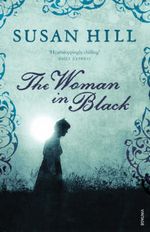
Book Club: Susan Hill, The Woman in Black

I have been curious to read The Woman in Black for some time. I’m not sure exactly why, except that the title made me curious (did it have anything to do with The Woman in White?) and I had heard that it was a really good example of a ghost story. I finally picked it up when I was in London in the summer, and I proposed it for my local book group for our October selection, figuring if there is a time for ghost stories, round about Hallowe’en is it! We met to discuss it this week, on an appropriately dark and drizzly night.

Though overall the book was not a big hit, we had quite an interesting discussion about why we liked what we did like about it, and about the aspects of it we found disappointing. Most of us thought it was a pretty good read, though our appreciation did rather depend on our tolerance for its deliberately old-fashioned style: though it is neither actually Victorian nor neo-Victorian, it sounds Victorian, in that its tone is formal, its pacing deliberate, and its descriptions long and detailed. I particularly liked the evocative landscapes, which I thought Hill used effectively to create an atmosphere of mingled beauty and menace:

As we drove briskly across the absolutely flat countryside, I saw scarely a tree, but the hedgerows were dark and twiggy and low, and the earth that had been ploughed was at first a rich mole-brown, in straight furrows. But, gradually, soil gave way to rough grass and I began to see dykes and ditches filled with water, and then we were approaching the marshes themselves. They lay silent, still and shining under the November sky, and they seemed to stretch in every direction, as far as I can see, and to merge without a break into the waters of the estuary, and the line of the horizon.

My head reeled at the sheer and startling beauty, the wide, bare openness of it. The sense of space, the vastness of the sky above and on either side made my heart race. I would have travelled a thousand miles to see this. I had never imagined such a place.

Though I didn’t find the story nearly as eerie or scary as I expected, I thought it did have some really shivery moments–the best ones, for me, being the ones with the quietest effects, like this one:

I think I must have fallen asleep only a few moments after putting the lamp out and slept quite deeply too, for when I awoke – or was awakened – very suddenly, I felt somewhat stunned, uncertain, for a second or two, where I was and why. I saw that it was quite dark but once my eyes were fully focused I saw the moonlight coming in through the windows, for I had left the rather heavy, thick-looking curtains undrawn and the window slightly ajar. The moon fell upon the embroidered counterpane and on the dark wood of wardrobe and chest and mirror with a cold but rather beautiful light, and I thought that I would get out of bed and look at the marshes and the estuary from the window.

At first, all seemed very quiet, very still, and I wondered why I had awoken. Then, with a missed heart-beat, I realized that Spider was up and standing at the door. Every hair on her body was on end, her ears were pricked, her tail erect, the whole of her tense, as if ready to spring. And she was emitting a soft, low growl from deep in her throat. I sat up paralysed, frozen in bed, conscious only of the dog and of the prickling of my own skin and of what suddenly seemed a different kind of silence, ominous and dreadful. And then, from somewhere within the depths of the house – but somewhere not very far from the room in which I was – I heard a noise.

I liked the dog especially, and I was quite upset when … well, you’ll have to find out for yourself how the dog fares.

But if in these ways the book is well written, in others it really disappointed. One thing that bothered me was the heavy-handed foreshadowing, which seemed like an unnecessary and artificial way to create suspense. Another was the imbalance between the parts: the set-up is long and not really very interesting (and full of that heavy-handed foreshadowing), then the ghost story, which is told as a reminiscence, kind of staggers along, with fits and starts of ghostly business rather than the gradual development of irresistible eeriness. And then there’s a dénouement which is clearly meant to be the climax of the horror but which struck us all, I think, as too sudden and unmotivated: why would the ghost do that? What did Arthur Kipps ever do to her?

And that brings me to our main objection, which was that the ghost story itself was not very good. The haunting may be well described, but it isn’t well motivated: its specific cause is fairly predictable, if not from the outset, than from the earliest hints, and the ghost’s malevolence seemed disproportionate and random. Why should everyone suffer for such a particular tragedy, and a tragedy for which nobody is really strongly to blame? We brainstormed a bunch of alternative twists that we thought would have built the plot up into something more original and surprising, and one that would have made more of the characters more involved–Arthur Kipps especially. There should have been more information in the documents, more cruelty in the history, and some specific unfinished business that brought the ghost back to Eel Marsh House. The book seemed more special effects than anything else–there’s no compelling aboutness to it–which is probably why we agreed that while it’s not a great book, it will probably make a pretty decent film (and indeed, the trailer looks good, for people who like that sort of thing, though judging from what it shows, the screenwriters have added a lot of new elements).

If you are looking for a ghostly read yourself, I’d recommend Elizabeth Gaskell’s The Old Nurse’s Story instead. Or, of course, The Turn of the Screw. Or The Little Stranger. I actually left our group discussion feeling less satisfied with The Woman in Black than when I arrived, and I don’t really understand why it has the ‘contemporary classic’ standing it does.