The Conference Convention

campusI’m back from Louisville, where Dan Green, David Winters, and I presented a panel of papers on criticism in the internet age at the 44th annual Louisville Conference on Literature and Culture since 1900. The panel itself was something of an anticlimax (more on that in a bit), but it was a genuine pleasure to meet both Dan and David in person and share stories and ideas about blogging, criticism, and working online. Another highlight was hearing Mat Johnson read from and discuss his latest novel Loving Day, and I also really enjoyed chatting with the amiable Woolf scholars I sat with at the conference dinner.

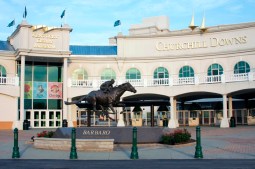
I built some slack into my travel schedule as I was quite anxious about being delayed by winter storms, if not here, then in one of the other wintry airports I had to pass through coming or going (Ottawa, Chicago, Montreal): miraculously, even the record-breaking snowfall in Ottawa that hit just as I was passing through did not hold up my flights, so I arrived a day before the conference began and had a little time to play tourist (on my own dime, don’t worry). I passed up the Louisville Slugger Museum in favor of the Frazier Museum, as I’m not a baseball fan and I like to get a sense of the local history; then, when that turned out not to be a particularly time-consuming expedition (it’s not the biggest or most fascinating museum in the world), I headed to the Kentucky Derby Museum where I paid tribute to the spirit of Dick Francis. After a lot of diligent conference-going, I took a bit more time near the end of my stay to walk in Waterfront Park, including trekking across the Big Four Bridge to the Indiana side and back. It’s probably a prettier park when it greens up, and the river itself seemed kind of a muddy mess, but (after a bitter cold start to my visit) it was 21 C that day and a treat to be outside coatless in the sunshine.
derbyEven taking these good things into account, though, I left Louisville feeling more than ever that, as a profession, we need to rethink how we do things. One of the main incentives for me to participate in this panel was that I have recently been given emphatic notice that I haven’t been going to the number of conferences expected of someone in my position. A significant number of academics apparently consider frequent conference-going a key measure of scholarly productivity and knowledge ‘dissemination.’ Frankly, I thought this was bollocks when it first came up as a criticism of my record, and my experience in Louisville only confirmed me in that view. Here’s why: Under pressure to show I am doing the “right” things professionally, I traveled a long distance at great expense (a significant amount borne by me personally, as the funding available did not cover nearly the full cost) to present a 20 minute paper to an audience of 8 people. All around me, hundreds of other academics were there doing the same, sometimes to even smaller audiences (the smallest I saw was 3 people plus the panelists, the largest, excluding keynotes, was about 16 — for a panel on Joyce — and one of the keynotes itself had an audience of maybe 15). Though there’s no doubt that some of the attendees were genuinely engaged with the papers they heard, most of them will take little concrete away besides a vague sense of the argument. One questioner at a panel I attended prefaced his remarks (as usual, questions were usually of the discursive rather than inquisitive variety) by saying that he’d heard a paper at another conference by someone whose name he couldn’t remember making an argument he dimly recalled had been somewhat similar to the one he’d just heard: though I’m sure there are some exceptions, that impressionistic result seems to me pretty typical, at least of a conference as diffuse as this one.

MLA-logoThe small audiences and inchoate overall experience is in part a function of the kind of conference this was: papers were collected under a very large umbrella, and (I suspect) accepted somewhat indiscriminately, perhaps with the admirable goal of being inclusive. But when there are 10 or more concurrent sessions in every time slot, there’s little chance of robust numbers at any given panel, and even less chance of a sizable cohort of conference-goers having much of a common experience and thus much deep, shared conversation. My experience of ACCUTE (not to mention the MLA) has been very similar: I’m not faulting the Louisville organizers in particular. Even the BAVS conference that I went to in 2011, though considerably more focused and thus more productively collegial, was fairly dispersed. At BAVS, though, I felt my own contribution got more attention and thus generated more valuable discussion for all concerned: remember, the purpose of these events is not supposed to be accumulating lines on one’s c.v. but having a face-to-face intellectual experience that matters so much it’s worth the time and money and environmental impact of all this gadding about.

twitterlogoOnce upon a time going to conferences really was our best option for letting a wider audience know what we are working on, for getting feedback on work in progress, and for networking with colleagues in our field. But while I think it is possible for a conference experience to be genuinely valuable, particularly if the conference has a narrower focus and a different format (a friend of mine speaks very highly, for instance, of the Shakespeare Association‘s annual meetings), we really do have other options today for many of the functions conferences used uniquely to serve. Just for instance, Novel Readings may be very small potatoes as blogs go, but I still reach more people with every post here than I have ever spoken to at a conference (sometimes more than all of my conference audiences combined), and the comments are every bit as engaged and engaging as any in-person sessions, and often more because they arise from a written text (not, as with most conference papers, a written text read aloud, with all the attendant disadvantages). Here I can link to things I’m talking about, creating a tangible network of related material, and my writing can be referred and linked to in turn. As I have often observed, my blog is not a particularly “academic” blog (setting aside for the moment the question of when reading, or writing about reading, counts as research) — but the form of a blog is perfectly suited to sharing just the kind of thing usually presented as a conference paper and getting feedback and suggestions for furthering “the larger project” (if I had a dime for every time I heard that phrase in Louisville, I think it would have covered the rest of my hotel bill!). Twitter is great for networking — admittedly, there’s a learning curve, but compared to the dreary 24 hours (literally) I spent traveling to and from Louisville, the time it takes to populate a useful Twitter feed and learn how to use a hashtag is nothing. And these are just the most obvious alternatives to flying half way across the continent to sit in a dingy room telling a few hardy souls (some of whom, it must be said, are actually editing their own papers or checking Facebook rather than listening intently to you) about your insight into Woolf’s aesthetics.
southridingI think I personally would have found the Louisville conference more intellectually stimulating if I were a modern literature scholar myself: I had a harder time even than usual latching on to the papers’ arguments because they were typically quite specialized contributions to scholarly inquiries I know little about. I went mostly to Woolf panels because at least there I knew the primary sources a bit! (I was interested to note that there were no papers, much less panels, on Winifred Holtby or Vera Brittain at all; there was one paper on Sayers, but I saw no sign of Rebecca West or Rosamond Lehmann or Mollie Panter-Downes or Elizabeth Taylor or Olivia Manning or any of those I think of as the ‘Virago’ set. Eliot, Pound, Woolf, Joyce, a bit of Lawrence and Forster — this was a pretty canonical outing. You 20thC people can tell me if that’s typical or just Louisville.)

I’m not sorry I went: it was an adventure, it was a change of scenery (which I really needed), I spoke with a number of really interesting people and made a couple of new friends. But why anyone would insist I should do this kind of thing more often, while shrugging off the other ways I share my writing, network with other academics, and facilitate not just my own but other people’s ‘knowledge mobilization’ completely escapes me. Just because that’s how the profession has operated for a long time, or just because it is the kind of scholarly activity some academics are used to and perhaps even enjoy, simply does not mean it is the best use of my time or the university’s resources. We need to be open-minded about other options that serve the same purposes, often more efficiently and effectively. In this, as in scholarly publishing, it seems to me that the familiar form is too often valued over the real function of the work itself.

This Week in ‘Not My Sabbatical Any More’

eggMy sabbatical actually ended officially on June 30. I marked the transition with my week’s vacation in Vancouver, and returned to Halifax ready to get back to “regular” work. It’s summer, of course, which means I’m still not teaching, but there’s definitely been a shift in my attitude, attention, and priorities.

For one thing, the fall term is no longer a distant possibility: now it’s a looming reality! So I’ve started drafting syllabi and organizing Blackboard sites. The former is always fun (because it’s both creative and optimistic), while the latter usually has me cursing within the first 15 minutes. I’m incorporating a blog into my graduate seminar, too, and so I’m setting up a WordPress site for that class as well. (Yes, Blackboard now has “blog” options, but one of the points of blogs is that they are not inside boxes. Even though I’m keeping the site private — at least to start with — working in WordPress at least feels more like actual blogging, and one of my goals is to help my students get more comfortable with the possibility of writing where other people can see them. Usually even writing where other students can see them causes a bit of anxiety at first.)

As preparation for the new teaching term, I’ve also been doing some housekeeping: sorting through my file cabinets, recycling redundant or outdated course materials in old teaching folders and properly sorting and filing what remains; archiving hard copies of grade sheets and course evaluations; and generally trying to put things in order. I keep things reasonably organized anyway (at least judging from the stacks of papers and folders visible on some of my colleagues’ floors and bookshelves — though presumably their “system” works for them) but it was a bit surprising to realize how much miscellaneous paper I still had around to deal with.

Another motivation for getting my paperwork sorted is that after much wavering and soul-searching I decided that after 20 years at Dalhousie it was time to put in my application for promotion to Professor. I earned tenure and promotion to Associate Professor back in 2000. It’s actually up to me entirely whether I ever seek another promotion, but it’s tacitly expected that we are all working with that ambition in mind. I’ve been puzzling about how much, if at all, to talk about this here. I think it’s best that I stay away from specifics, both of the case I’m making and of how the application seems to be going, at least until it’s all over. It’s a long, rigorous, and carefully orchestrated process involving every administrative level of the two universities where I am a faculty member (Dalhousie and the University of King’s College — please don’t ask me to explain the relationship, or the complexities of my joint appointment!) as well as external reviewers from at least four other universities. I won’t know the final outcome of my application, one way or the other, until next May, though I suppose I’ll have had some strong hints in the meantime. It will feel strange to keep fairly quiet about something that is going to preoccupy me mentally for months, but I think that talking about the specifics in public might come across as unprofessional, especially to those scrutinizing my file who aren’t accustomed to the relative openness of social media.

cassatI will say, though, just generally, that I am citing Novel Readings as part of my case, and that I am including it in my research dossier alongside my more conventional scholarship. (My teaching and service contributions are the other two major components of the application.) Where or how to “count” blogging in tenure and promotion cases has been much discussed online of course, and I reread a lot of articles and blog posts — including some of my own — on this topic before making up my mind about how I wanted to present Novel Readings. I was ultimately guided, of course, by departmental and faculty regulations. One of the most important tasks for me this month has been writing up a cover letter and research statement to explain and justify not just the blogging component of my file but also the other online writing I’ve been doing. This has been pretty challenging, mostly because there is so much I want to say but I have limited space to say it in. The other rhetorical challenge is to be assertive without sounding defensive, even though I would be a fool not to expect some skeptical responses. I think (hope) I have found the right tone as well as the right key points to make. I guess I’ll find out!

The other parts of the application are demanding in much more mundane ways. I had to compile a folder of every one of my course outlines, for example, which is one sure way to discover that your filing has not been 100% scrupulous over the years. I need to include a list of every class I’ve ever taught and its actual enrollment, and a table of all my numerical scores on course evaluations next to the departmental mean — I am very fortunate that our office administrator, who is helping me with all this, is fabulously competent, efficient, and also very kindhearted, which means almost more than anything else when you’re doing something that inevitably makes you feel exposed and vulnerable. (“It’s like taking your clothes off in public,” I said to her plaintively the other day, “and at my age, too!”)

I was warned that putting this file together was a big job, and it definitely is: it’s most of what I have been doing, really, since the beginning of July. It has been surprisingly interesting in some ways: even gathering my old course outlines has prompted some reflections on what has changed and what has stayed the same in my pedagogy since 1995. Still, I’m glad that my part of it is almost over: I should be able to turn everything in next week, and then, for me, it’s all about the waiting. And it’s also back to the teaching prep, and on with the writing — I’ve got three book reviews on my to-do list in the short term, plus a guest post for another blog, and I have some essay ideas that I’d like to solidify, before term begins and before the momentum I’d built up during my sabbatical fades away entirely.

Some Afterthoughts on Academic Blogging

escher12Some follow-up comments on academic blogging, prompted by comments on my previous post here and on Twitter. My main take-away at this point is that there are a number of further refinements that matter to any attempt at generalizing. Here are the ones I’ve been thinking about the most so far:

1. Disciplinarity makes a difference. I was thinking and writing about blogging in “literary studies,” which is what Holbo’s early posts focus on as well as where my own main interests and attention are. I don’t know as much about other fields, but some people suggested that blogging may have gained more ground as a recognized academic activity in other fields (such as history) than it has in English — or perhaps that English, precisely because it is such a vast and scattered “field” to begin with, is less likely to cohere around common conversations (or new models). As Nicholas commented, “the breadth of specialization is just too scattered, much as the whole notion of literature is itself diffuse”; that diversity can be seen as one of the field’s great strengths, but it also guarantees a degree of chaos that makes reform elusive. Nicholas proposes that blogging has taken greater hold in some of the sciences; Robert suggests that “philosophy (and to that I would add economics, sociology, and anthropology) has a thriving world of blogs.” I’m interested in just what “thriving” means. From some perspectives, English has a world of blogs too, if you look at individual blogs (including group blogs), but in terms of the place blogging has in the way the discipline understands and organizes itself professionally, my impression is that in the larger context of academic literary studies, blogging remains a fringe activity.

I have also been thinking that blogging in literary studies may be more likely than blogging in other fields to merge with other forms of non-academic writing — because our main objects of study and analysis are the subject of a lot of commentary by a wider bookish culture (from the NYRB to the vast array of book blogs that have no academic connections or aspirations). The impulse that led some literary academics into blogging may now have led them (or may now be leading others) into writing for sites like Public Books or the Los Angeles Review of Books instead of sustaining individual blogs.

2. Jobs and the job market make a difference. A lot of the most exciting bloggers I followe(ed) — including a number of my Valve colleagues — were graduate students when they started blogging. The energy that went into this new enterprise was tied up with hopes about how the profession might change as they entered it, but, as Aaron Bady ruefully commented on Twitter, “While we were hoping the profession would grow to include blogs, the world decided to shrink the profession.” Questions about whether blogging is (or could be) valuable to academic scholarship in principle need to be carved off from questions about whether blogging is (or was) a good option for those aspiring to enter the profession. I don’t think the two questions are unrelated: whether writing a blog makes it easier or harder for someone to become a full-time academic is bound up in how the profession works — what it values, what it rewards. I have written about some of the pragmatic questions before. In my last post (and a number of my other posts on blogging) I address mostly the principled ones: is blogging something we need as a profession (or, because I know that those securely within the academy are not by any means the sum of those in literary studies, as a community of scholars)? what can it do for us, what has it done for us, where has that energy gone? I have always acknowledged that I am fortunate to be able to persist in my own experiments in non-traditional publishing — to be an academic in my own way — because I have the security of tenure. I have also noted that people in my position need to be advocates for those who take the same risks without the same protections. It’s a big world, though, and attitudes change slowly. It would be wrong not to recognize that however strong a case might be made for academic blogging in theory, in practice some great scholar-bloggers may have lost faith in it because they realized that it was not helping (and may even have been hurting) their professional prospects. (I don’t think it has helped mine, but again, it’s up to me to decide how much I care, else what’s tenure for?) So I would add … 

3. Hope makes a difference. Starting an academic blog, as was pointed out to me by someone off-line, is a pretty optimistic gesture, not just about your work but about your career. Sustaining it takes more than just persistence (not to mention time that could, always, be used for other things). It also takes faith — faith in the value of your work, in your voice, and in your vision of the academy.

4. National frameworks make a difference. A few people pointed out that in the U.K., there seems to be pretty strong interest in blogging, partly because of the new emphasis on “impact” in evaluating research. This is clearly an equivocal blessing, as we discussed on Twitter. Requiring everyone to blog hardly seems right: it’s not a form that suits every one, or every project, and expectations are far too likely to be additive (blog as well as maintaining a stellar record of conventional publications!). Assessing impact is also a tricky business. It would be awful to be judged on the basis of “hits”: we all know that the internet rewards bad behavior, sensationalism, extreme positions, and adorable kitten pictures! We would never ask how many times a peer-reviewed book had been checked out of the library before giving it credit for a tenure or promotion application — and yet when I have asked here about how I might make the case for blogging as part of such an application, I’ve been encouraged to stress exactly such quantitative metrics. I’d be interested to know what my British friends have experienced when they’ve included blogs as part of their scholarly profile. The absence of peer-review is often the first objection raised to counting blogs as academic publications: are we any closer to establishing alternative measures of quality?

The Case for “Intelligent, Bloggy Bookchat By Scholars”: How’s It Looking?

JVCOn Thursday I participated in a Twitter Q&A with the members of Karen Bourrier‘s University of Calgary graduate seminar on Victorian women writers. The students had been assigned my JVC essay on academic blogging (anticipated in my 2011 BAVS presentation, which you can see the Prezi for here, if you aren’t one of those people who get sea-sick from Prezis!). The group showed up very well prepared with questions for me, and the half hour went by in a flash, with me thinking and typing as fast as I could. (Here’s the Storify, if you’re interested.)

In preparation for the session, I did some rereading, not just of my essay but of some of my old meta-blogging posts (many of which are listed under the “On Academia” tab here, or in the “blogging” category). I also looked back a bit further, to John Holbo’s founding post for The Valve, where I was a contributor from 2008 to 201o. I’ve actually reread this essay, “Form Follows the Function of the Little Magazine,” fairly often over the years, but I hadn’t previously gone back further from it to the Crooked Timber posts it links to on “Academic blogging and literary studies.” The second one of these especially, “Lit Studies Blogging Part II: Better breathing through blogging,” strongly anticipates the Valve essay, while The Valve itself is obviously what Holbo meant when he said “After this post I swear I am going to settle down to just doing the sort of thing I have in mind, rather than talking about how nice it would be to do it. Proof in pudding.”

I’m always swearing off meta-blogging (and meta-criticism more generally). And yet just when I think I’m out, something pulls me back in! This time the trigger is one of the questions I was asked during the Twitter session: whether my thoughts about academic blogging had changed since my essay was published. Also, rereading Holbo’s posts, now a decade old, I found it hard not to wonder: what happened? how did it turn out? Does Holbo’s call for improving the condition of scholarly publishing in the literary humanities by “rub[bing] its sorry limbs vigorously with … conversations” seem outdated now? or misguided? or utopian? Holbo advocated “intelligent, bloggy bookchat by scholars. . . . That isn’t scholarship,” he acknowledged, “but – in a world with too much scholarship – it may be an indispensable complement to scholarship.” Has that hope for the beneficent effects of blogging fizzled out, or has it been (even to a minor extent) realized? Was Holbo wrong in his premise that academic literary studies were in need of any such thing? Or was he right, but there has proved to be too much inertia in the larger system to which academic scholarship and publication belong (especially, systems of institutional credentialing and validation) for the pro-blogging arguments to make much of a difference?

My immediate answer to the question on Twitter was that my thoughts about blogging have not changed but my attitude has. To explain in more than the 140 characters I could use there, I remain convinced that blogging is (or can be) a good thing in all the ways Holbo talked about, and in some ways he didn’t (my own blogging, for instance, has never been “academic” in quite the ways he emphasizes, such as hunting out and promoting the best academic scholarship, but I stand by its value as a form of criticism). Overall, more academics are probably blogging now than in 2005, though I really don’t have any sense of the big picture and certainly no data to back up this impression. But I haven’t seen much change in the way things operate generally in the academy, and if anything, the number of bloggers actively promoting a significant shift in the way we understand scholarship and publishing seems to have declined. In my own immediate circles, I don’t see any signs that anyone is interested in actually doing any blogging of the kind Holbo described (some do now write blogs that address academic issues or serve professional associations, both good things but different), and I never hear anyone mention reading any academic blogs either (again, with the exception for blogs about academia, rather than “bookchat” blogs of the kind in question). I have no reason to believe most of my colleagues ever read my blog: if they do, they never mention it to me! (That might be different if Novel Readings were more academic and less bookish. I’m never a good example for my own arguments about all this!)

What it looks like to me, more or less (and again, my perspective is inevitably limited, so I’d be interested to hear how others perceive the situation) is that not much has changed since 2005. People who were into blogging then are often still into it (several of my former Valve colleagues, for instance, continue to maintain their personal blogs, though The Valve has been closed for renovation since 2012). But they seem less likely to make claims for, or express hope for, the form as something that can and should change how the profession of literary studies works.  I think blogging as such is no longer likely to be held against you as an academic — but it’s also not going to work for you, particularly at any of the key professional moments (hiring, tenure, promotion), when you’ll still need a defensible record of conventional publishing.

I still see the situation of literary studies pretty much as I did then, which is much the way Holbo describes it in his posts. There’s more published scholarship than we can ever hope to process in a meaningful way, and the reasons for that have more to do with professional imperatives than with any need to churn out so much so fast for the intellectual benefit of so few.   “How many members of the MLA?” asked Holbo in 2005;

30,000? That a nation can support a standing army of literary critics is a wondrous fact, and quite explicable with reference to the volume of freshman papers, etc. that must be marked. The number is inexplicable with reference to any critical project. Yes, we need new scholarship (don’t bother me with more false dichotomies, please.) The point is: no one has a clear (or even unclear) sense of what work in the humanities presently needs approximately 30,000 hands to complete. I don’t mean we should therefore hang our heads in shame, although being a member of a standing army of literary critics must be a semi-comic fate, at least on occasion. But the utter lack of any justification for 30,000 literary critics assiduously beavering away explicating, interpreting, erecting new frameworks, interrogating the boundaries, etc., has consequences. Notably, when a book or article is up for publication and the hurdle is set, ‘if it has real scholarly value’, we discover this condition is just not as intelligible as we would like, conditions being what they are. It isn’t true that literary scholars value the output of 30,000 other literary scholars. They just don’t, and that is quite sensible of them, really.

That seems fair enough, although I also think we  all value the output of a select subgroup of that 30,000, as well as of the larger ends we believe the whole enterprise serves — which is why Holbo was not, and I am not, calling for an end to it all, the way Mark Bauerlein seems to. But the sheer chaotic vastness of it all still occasionally provokes despair.

And, dedicated as I am to preserving the forest, I do often recoil from individual trees — and the less time I spend reading properly “academic” criticism, the harder it is for me to tolerate it when I dip back in. I recognize, however, that other people genuinely relish both reading and writing it, which is more than fine with me, because that’s how (to stick with the arborial metaphor!) the trees I do appreciate are able to take root and flourish. It continues to mystify me, though, that so many academics seem so content to keep planting trees in those woods knowing that hardly anybody will hear their hard-won knowledge or insight when it falls into its safely peer-reviewed place. Even people who have no professional reason to play it safe any more seem oddly uninterested in, or even resistant to, getting the word out about their research in other ways (I say this because I have proposed it to some of them!) — and I get no sense that this has changed in the past decade. Is it anxiety or snobbery that makes it seem preferable to them to hold out for acceptance by a journal or press that will deposit their work safely where almost nobody will read it, rather than to tell other people about it directly through the magic of WordPress? Surely at some point you have enough credibility just to speak for yourself, and you should do that if your actual goal is to increase the overall sum of understanding in the world. Mind you, then you’d also have to try your hand at self-promotion, something else that, as Melonie Fullick has observed, runs against deep-seated academic prejudices.
I always find myself going back to Jo Van Every’s comments about validation vs. communication. The display case in our department lounge, our faculty-wide book launch, the list of recent books by members of NAVSA — these all seem to me monuments to the triumph of validation in academic priorities, because by and large these books and articles (representing so much ardent labor!) are reasonably responded to as Lawrence White (quoted by Holbo) responded to the “current project” of John McWhorter, “some modest essay modestly proposing modest new perspectives on some modest problem in linguistics”:

At this point I say to myself, “Yes, we should all be working hard & earning those paychecks, & I’m sure Professor McWhorter does fine work in his field, & I have no doubts as to his fine intentions, but what are the odds that this essay will make any difference to anything?”

“We have to learn to live,” Holbo observes, “with dignity, with the effluent of institutionalized logorrhea.” That ardent labor is not in vain, and there is dignity in pursuing our scholarly interests rigorously and in achieving our professional goals. (What fate isn’t “semi-comic,” anyway, seen in the right light?) Still, I would add that we ought to learn to let go of the quantitative imperatives that structure our professional processes, as well as to break away from the rigid prestige economy that clearly still governs our publishing priorities. But these changes seem a little less likely to me now than they did in 2007, when I gave my first presentation to my colleagues on blogging — or than they did in 2011 when I made my case at BAVS, or in 2012 when my essay was published.

I’d love to know what other academic bloggers think — especially (but definitely not exclusively) any other former Valve-ers who might be out there. Were we wrong about the problem, or about blogging as a potential solution? What difference, if any, do you think academic blogging has made to academic writing, or publishing, or conversations? Has its moment passed without its potential ever being realized — which is what I rather fear?

Where Blogging Leads: A Bit More About How Things Add Up

When I read this post by Eric Grollman at Conditionally Accepted a little while back, it got me thinking about the various opportunities that have arisen for me since I started blogging in 2007. Whether these “extracurricular activities” (Grollman’s term — though he too puts it in scare-quotes) count in some strict professional way is not really the point, or at least not the whole point. Some day I may well make the case that they should count; increasingly the vocabulary seems to be available to explain how and why (outreach, knowledge mobilization or dissemination, public scholarship, whatever). In the meantime, what struck me reading Grollman’s post is that I may have underestimated the impact of blogging on my own activities. Grollman notes that he “received ten speaking/writing requests in 10 months, primarily because I write publicly about my experiences in academia.” That’s a lot, in a hurry! My timeline is a bit slower, and most of the specifics differ (as you’d expect, given our different fields), but one thing we have in common — and I know other bloggers who’ve remarked this too — is that by dint of being among the first and few academics in our circles to venture onto public platforms, that experience itself becomes something people want to hear from us about. (I always feel a bit odd about that, because my own blog is not exactly an “academic” blog — which is something I usually address, if not in the presentation itself, then in the Q&A. But the general issues around blogging for and by academics are things I have thought and written a lot about, nonetheless.)

Here’s my quick tally of things I have done more or less directly because of this blog:

Presentations, workshops, and interviews:

  • In 2007 (when I was just a newbie myself!) I gave a presentation on academic blogging in my department’s colloquium series.
  • In 2008, I was an invited guest speaker in a class on ‘Writing in the Digital Age’; I spoke about academic blogging and online writing more generally.
  • In 2009, I was interviewed about George Eliot by Nigel Beale, for his website The Bibliofile (now The Literary Tourist). (Gah! That picture!)
  • Also in 2009, while at ACCUTE to present a paper on Ahdaf Soueif (one that grew out of some blog posts about her novels), I led an informal workshop on academic blogging.
  • In 2011, I was invited to participate in a panel on “Knowledge Dissemination in Canada” at the British Association of Victorian Studies; that presentation became a paper in the Journal of Victorian Culture.
  • In 2012, I gave a presentation on academic blogging at our Faculty’s research retreat.
  • In 2012-13 and 2013-14 I spoke in our graduate students’ professionalization seminar about blogging (and Twitter). I expect (though I guess I don’t know for sure!) that I’ll be asked back again in 2014-15.
  • In 2013 I was interviewed for an article in the Globe and Mail about Richard III. (I don’t think the interview I did about Jane Austen had anything to do with blogging: as I recall, that was an occasion when the reporter just called the department and got handed off to me).
  • Later this month I will participate in a Twitter Q&A about Middlemarch hosted by the Atlantic‘s #1book140— I was invited to do this because of Middlemarch for Book Clubs, but that site is itself the result (you guessed it) of a blog post.

Writing:

  • In 2008, I was invited to become a regular contributor to the group blog The Valve.
  • In 2009, I was invited to contribute to Open Letters Monthly, and in 2010 I moved my blog there and signed my soul over to them became an editor there too.
  • In 2011, I was invited to contribute a short piece to John Williams’s blog The Second Pass (currently on hiatus as he now has a great gig working for the New York Times!)
  • Also in 2011, I was invited to write an essay on the Martin Beck books for the Los Angeles Review of Books (the immediate prompt for this was on Twitter, but the original impetus was – again — a blog post). Encouraged by this experience I have since pitched and published two more essays with them.
  • This year I was invited to contribute to the British Library’s Discovering Literature site, on the basis of my ‘public’ writing more generally — especially at OLM — but since everything that happens there is fruit of the Novel Readings tree, I count that too!

There have been many other more diffuse effects as well, of course, including courses developed from reading interests initially pursued here “only” out of curiosity and course assignments such as student blogs, wikis, and pecha kuchas that I would never have thought of if it weren’t for the time I spend online. And there are all the intangible intellectual benefits I referred to the last time I wrote about what this whole experiment adds up to. This tally overlaps with the list of specific publications on my c.v. (the ones that “don’t add up to anything,” you remember) but it’s a somewhat different angle on the whole question — I think it shows that in some ways my role as an academic has changed along with my work habits and publication platforms.

Summer Plans: Adding Things Up

Finally, the winter term is well and truly concluded (our annual May Marks Meeting was yesterday). As my last few posts show, I wallowed in aimless reading for a while after classes ended (aimless in the sense of “not in service of anything else,” not pointless or useless: it was certainly a very interesting run of books!), and then this past week my parents have been visiting, so I’ve been spending less time on social media and more time being sociable in person. (I had written “actually being sociable” but then realized how much that would misrepresent how I feel about my time online and the relationships I’ve formed here, which are just as “actual” to me as any of my “F2F” ones!)

And now it’s time for another end of term ritual, which is sorting out what I hope to accomplish in the next couple of months, while the fall term is still remote enough not to demand any attention beyond monitoring my waiting lists. I have mixed feelings as I look back at last year’s post about this. I did get the Middlemarch for Book Clubs site completed, but I haven’t really figured out how to get the word out about it. I’ve made some tentative efforts on my own, and I had some dim but disappointed hopes about possible synergies with the Middlemarch readalong at The Toastbut the biggest boost has certainly come courtesy of the generous mention of it by the Atlantic’1book140 Twitter book clubThis month I’ve also been invited to participate in a Twitter “party,” so if you’re on Twitter, feel free to join in! I’ll post a notice here when I know the details. I may make some changes to the site this summer based on my observation of what actual book clubs talk about when they talk about Middlemarch, though I remain determined that the site will reflect the kind of conversations I like best and want to promote, not the more solipsistic kind that still seem to be typical of the guides included with new releases.

This time last year I also had aspirations to get a lot done on my phantom book project: “the final, most ambitious but at this point most amorphous plan is to think about where I’m going with the various George Eliot essays I’ve written over the past few years: do they, could they, add up to something larger, perhaps some kind of cross-over book project?” That question of what my “various” publications add up to has been fraught to me since a dispiriting interview last year at work about my prospects for promotion. Now, I knew perfectly well that if I chose to apply, mine would be (will be) a tricky case, and I wasn’t at all sure that I was in a position to make a strong application, which is why I set up the meeting in the first place. (Getting promoted to full professor is not a high priority for me anyway: if it were, I would be doing different kinds of things with my time, for just this reason!) But as my list of non-traditional publications and projects grew, it seemed like it was worth having a chat about how my c.v. looked to someone who would have to make a supporting case if I did apply … and the response (to put it mildly) was dismissive: “All this [with a wave of the hand towards the Open Letters and LA Review of Books essays] doesn’t really add up to anything.” There are ways and ways to deliver negative judgments, of course, and that one could have been made in a less deflating way. It might have been worth considering the possibility that they do add up to something (knowledge dissemination, anyone?), if not the usual thing. Still, that was a good preview of the challenges I would face if I chose to pursue promotion without a c.v. that looks more like what academics expect. If there were a book there, however — even a different kind of book … well, academics really like books.

Now, the book I aspire to write is not an academic book. And the reason I want to write it is not that it might help me get promoted. But the observation that my work wasn’t adding up to much is the kind of thing that mattered anyway because it made me think about what I hoped “all this” would add up to, or, indeed, whether I thought it already did add up to something. A body of work is a cumulative something, isn’t it? So there’s that, which isn’t nothing. And yet it isn’t a whole lot, compared to some (as bodies of work go, mine is petite, we might say!) and it’s not as if I’ve established myself in the non-academic world in some marked way. Indeed, the challenge of making yourself known in the broader book world is pretty overwhelming!

It would be nice if I was learning from the process, though, as if the small steps I have taken so far were building up to some kind of greater insight, if not some separate and larger-scale accomplishment. Who am I, as a critic? What can I do? That’s the kind of question that my book project will help me answer, for myself if for no one else. I did not get as far on it last summer as I hoped, but I did do some ground-clearing work, including a survey of everything I’d written so far on George Eliot and a stop-overthinking-it post on why I like George Eliot “so very much.” I got caught up in smaller writing projects over the fall and spring, but one of those was my review of Rebecca Mead’s My Life in Middlemarch, so that kept me thinking about how to write about George Eliot for a broad audience. I have also started several files and documents to help me conceptualize the project. It helps me to believe it will all actually come to something that last summer I began talking informally with an agent interested in helping me get it done; this summer I am determined to ward off the distraction and temptation of other reviews and essays (for instance, I was really thinking about pitching a Robert B. Parker piece to the LA Review of Books to follow on from last year’s Dick Francis essay! that would be so fun to do!) and start turning the brainstorming into actual readable writing.

In the last couple of weeks, and especially the last couple of days, I have just begun doing this…and here’s an interesting thing I’ve noticed. I have already looked up several old blog posts of mine to draw on ideas or references in them that bear on the critical framework I am trying to set up. Yes, the ones explicitly on George Eliot are among them, but so too are some of the ones I’ve written about principles of criticism more generally (such as, just today, this one on Ronan McDonald’s The Death of the Critic,). Will this material end up in the final version of whatever it is that I’m writing? I don’t know. But it was encouraging to realize that my previous work (unofficial and informal as it may seem in some contexts) was relevant and helpful: ideas I’ve been working out here, both explicitly and implicitly, are shaping the way I am now thinking and writing. The critical voice I’ve been practicing, too, here and at OLM and LARB, is the one I want to write the book in — not the much dryer, drearier tone of even my most recent academic papers. This scattered work may not add up to a single thing that’s tangible or measurable, then, but it may do that eventually, and in the meantime what it adds up to is, quite simply, the intellectual sum of all of its parts. Looked at that way, it seems like quite a lot.

Weekend Miscellany: Good Reading and Common Pursuits

gaudyAlex in Leeds has started on a new relationship . . . with Peter Wimsey. We all know where this leads – to Gaudy Night, which means punting fantasies and a new appreciation for academic robes of the same size. It has actually been years since I’ve read any of the early Wimsey novels, because I like him so much better once Harriet gets involved. Steve wrote up The Unpleasantness at the Bellona Club recently too, but despite these encouraging posts I’m still not very tempted. Maybe I will reread The Nine Tailors soon, if only to make up for having recently given Edmund Wilson the benefit of the doubt on the larger issues.

Tom has started on the Palliser series at Wuthering Expectations and as usual he’s mixing it up, including pressing on the popular idea that Trollope is a “comfort” read:

It has taken me a while, but I am beginning to think of Trollope as a great satirist, mild compared to Jonathan Swift or Evelyn Waugh, but at times as fierce as his mentor William Thackeray.  Or Jane Austen, another writer with fangs and claws who is most frequently read for comfort, available by means of ignoring substantial portions of her writing.

 At The Little Professor, Miriam Burstein reviews Derby Day, a neo-Victorian novel I’d never heard of which is not “Dickensian” (for once) but “Thackerayan,” quite literally in that it reworks Vanity Fair:

this is a novel in which there is room both for Amelia and for Becky Sharp, in which the way of duty yields its successes but so, too, does the way of pure self-interest.

 At Tales from the Reading Room, litlove offers a persuasively positive report on Curtis Sittenfeld’s Sisterland:

In this brilliant portrait of uneasy motherhood, Sittenfeld never lets us forget that anxiety and vigilance go hand in hand, and that each magnifies and reinforces the other, a cultural curse on those who are responsible for the young.

 Sarah Emsley can’t wait any longer to get the anniversary celebrations for Mansfield Park underway:

I think the key to understanding Mansfield Park is that it’s a tragedy, rather than a comedy. I mentioned a couple of weeks ago that not many people choose it as a favourite from among Austen’s novels. (Natasha Duquette, who’s writing a guest post on part of Chapter 27 – in which Fanny “had all the heroism of principle” – is an exception. Is there anyone else out there whose favourite Austen novel is Mansfield Park? I would love to hear from you!)

JamaicaInnAt Slaves of Golconda you can read the collected posts on Daphne du Maurier’s Jamaica Inn, which inspired the most unanimity I’ve seen among readers for a while. I think the reason is the magical balance du Maurier finds between what we now often divide artificially into “literary” and “genre” fiction. The novel is a corker of a read (or at least I thought so – at least one GoodReads reviewer declared it “so so so so so boring,” and another called it a “rancid mess,” so really, what do I know?! YMMV!) but it has more than plot to offer. A lot of our interest went to the heroine, Mary Yellan, who is, as Teresa says in her post, “the kind of heroine many women want to see in novels.”

At A Commonplace Blog, D. G. Myers responds to comments on his earlier post “Academe Quits Me.” His key point there, which I think he’s right has been misinterpreted by some of his respondents, is that “where there is no common body of knowledge, no common disciplinary conceptions, there is nothing that is indispensable.” This is not a lament for the demise of a stable canon, as he explains more fully in the follow-up post, but an observation about one of the practical consequences of the way in which our ‘discipline’ has expanded and thus, inevitably, fragmented or dispersed. We do so many (interesting, worthwhile, intellectually challenging) things that it’s become nearly impossible to point to which ones are fundamental. In some ways this is very exciting (like our world, we are large and contain multitudes!), but in other ways, I think he’s right that (especially when resources are scarce) it has made us strangely vulnerable. As he says, “there is no shimmering and comprehensive surface of knowledge in which any gaps might appear” and as a result any particular area of expertise may be perceived as dispensable.

These comments resonated with me because in my own department, we have suffered (and seem poised to suffer further) losses to our full-time complement, and one of the grounds on which we can supposedly petition for replacements (if only there were some prospect of making any appointments) is ‘program integrity’ – but even internally we can’t agree on what that means any more. It may be that we are dealing with the messiness of a transition from one way of organizing our “common pursuit,” around ideas of coverage (literary historical, generic, regional), to another that thinks more about reading strategies, skills, and contexts — from what to read to how to read. We do a lot of both kinds of things in my department now, but the program (the requirements for the major, for instance) has for a long time been organized around the coverage model (ideas of what to cover have, of course, changed and expanded a great deal in recent decades). I’m not sure this is the right way to describe what’s going on, but I found his posts thought-provoking precisely because they articulated something of the confusion I’ve been feeling over our curriculum and have prompted me to keep thinking about how exactly we might — in principle or strategically — redefine that common pursuit.

This Week in My Classes: Processes and Products

Bookworm's Table (Hirst)The second full week of term has gone by already: it’s amazing how time seems to accelerate when things get busier. In both my classes we have moved from throat-clearing and context-setting to richer discussions about our readings: in The 19th-Century Novel from Austen to Dickens, we’ve wrapped up our work on Persuasion, and in Mystery and Detective Fiction we’ve got only one more class on The Moonstone. Starting the term with these two novels eases the transition from summer’s languors to fall’s stresses because both are so delightful. At least, I think so — and it seems as if a lot of students are enjoying them as well. Discussion in the Mystery class has been particularly good so far this term, especially considering it’s a big class (capped at 90), which can sometimes be inhibiting. I hope they keep putting their hands up!

academicselfOne thing I’ve been thinking about as our work gets underway, and as I contemplate my own non-teaching ambitions for this term, is trying to make the process as meaningful and rewarding as possible, shifting some emphasis away from the product — which for students is often the course credit or the grade, and for me is the finished piece of writing. I’ve been reading Donald Hall’s The Academic Self: An Owner’s Manual (thanks to @MsEMentor for the recommendation!) and while I have some doubts about whether I want to be an ‘academic self’ of the kind he describes (more about that, perhaps, in another post), I have been struck by the wisdom of his emphasis on this process / product distinction, partly because I have found myself caught up in just the kind of results-oriented moping he describes (if not for exactly the same causes):
We all know (or should know by now) that we may complete professional tasks to the best of our abilities, “play by all of the rules,” so to speak, even overachieve and push ourselves to extremes, and still be denied the book contract we have been working for, the position we have applied for, or the raise that we feel we deserve. If we tie our sense of professional payoff only to a desired reception of the end product of a process, then we are setting ourselves up for disappointment, perhaps even a state of bitterness or burnout.

As he discusses, there are lots of reasons, some of them good ones, to be fixated on achieving particular goals, but “we simply do not have to have a specific reaction to the products of our processes for those processes to have been worthwhile.”

I think there is actually a close relationship here between my students’ situation, as they strive for grades and credits, and my own difficulty dissociating the worth of my work from the reactions or results it gets. After all, I spent a great deal of my own life as a student, and in many ways academics carry forward the mental habit of waiting for affirmation from other people’s evaluation. How different, too, is the hiring process, the tenure process, or the promotion process from being graded? Or, for that matter, the grant application process or the article submission process? Well, OK, of course there are differences, including the presumption that for most of these professional matters we are being evaluated by our peers, and the not-insignificant point that our success in some of them (hiring in particular) really shouldn’t be understood as measures of our merit so much as of our great good fortune. But these things all feel a lot like handing in an essay used to, and I’m someone who once locked herself in a bathroom in Buchanan Tower to weep over an A- from a professor whose approval I really wanted — which is to say, I’m someone who (like a lot of academics) has a hard time believing in my own judgments of my work, and a hard time separating judgments of my work from judgments of me personally. I am making progress on this front, I’m glad to say, but I still find myself waiting anxiously for external validation when, for instance, something of mine is published online. There’s still that part of me that is waiting for my grade, for the internet equivalent of an ‘A,’ whatever exactly that is.Grade A Plus result vector icon. School red mark handwriting A plus in circle

I know, I know: there are so many things wrong with this, and I don’t just mean that it’s kind of pathetic in a grown woman more than two decades along in her professional career (though that is certainly true). Having become self-conscious about it, I do at least now work consciously against it, and one way I do this is simply by rereading my own work, which (I am learning to assert, on my own behalf!) I think is pretty good! Why shouldn’t I be able to tell or say that, after all, considering it’s actually a big part of my job to evaluate writing? But the other thing I want to do is give more weight to, or feel more positive about, the process of doing the work. As Hall says,

I cannot know if the words that I am writing at this moment will ever appear in any form of print other than that which comes out of my computer. . . . But I can decide that this act of creation, this thinking through of ideas as they move from conscious and subconscious thought through my fingers and onto the screen is enough to satisfy and sustain me, even if the unfortunate were to occur.

He isn’t advocating that “we dispense with highly concrete goals” (as he points out, that would be “to court disaster” professionally, as well as to shirk other dimensions of our research and writing lives by not aiming to get our thoughts “disseminated”). But he’s right that “those processes . . . . must be more explicitly valued, must be recognized as professional ‘goods’ in and of themselves.”

To bring this discussion back to my teaching, I have realized that some of the greatest frustrations I’ve run into as a teacher have come from student priorities and behaviors that are results-oriented without due attention to the intrinsic value of the processes we go through (as well as to the benefits that careful attention to process can bring to achieving desired results). A simple example: papers that are clearly (or on the student’s own admission) started and finished the night before the deadline — I’m sure many other professors have had those dispiriting conversations that begin “I’m going to work on my essay tonight” and you cringe, knowing that means they won’t have time to rethink or revise, just as they very nearly have run out of time to consult. The essay-writing process matters less to that student than getting the credit for the finished essay. Or there are students who don’t finish the readings until they are studying for the final exam, or who never read them at all (I’ve had students note on their evaluations, almost as a point of pride, which books they never did actually read) — they too are circumventing the process (which is where a lot of the real learning can take place) and focusing only on the final product. I’m trying, increasingly, to disrupt these habits by building incentives to good process into the course requirements (reading journals, paper proposals, short tests). I’m also taking more time to discuss the relationship between our processes in class and the overall goals of the course, in terms of learning and practicing skills as well as in terms of getting good grades. Yes, students should aspire to earn good grades, and I should enable and support those aspirations. But the learning doesn’t take place at the moment I return the essay or exam: it takes place while we’re doing everything else, and especially while they are doing everything else. They should try to take a lot of satisfaction from those processes — from their own “thinking through of ideas.” Then even if they don’t get the grade they hoped for, they’ll be able to dry their eyes and come out of the bathroom a little bit sooner and a lot more confident.

“The value of appreciation” — Harrison Solow, Felicity & Barbara Pym

I missed Barbara Pym Reading Week by just a bit. I have been keen to read more Pym and serendipitously picked up a couple of Pym’s novels at a book sale just in time for it (The Sweet Dove Died and A Few Green Leaves). And I ordered Harrison Solow’s Felicity & Barbara Pym, which arrived on schedule. Then other things got in the way and I missed it.

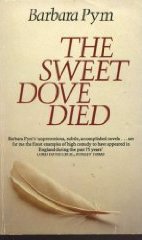
sweet doveI did read The Sweet Dove Died a week or so later, though. It’s a slight little book, yet it wasn’t an easy read for me: I kept picking it up and putting it down and letting myself be diverted to other books. It’s true I’d been on a steady diet of Dick Francis novels and so perhaps my reading senses (they’re like spidey senses only less tingly) were not attuned to Pym’s dry tone and small scale. I was eventually drawn into the pathos (or is it bathos?) of Leonora’s lost loves, and of course I abhorred the loathsome Ned … but I felt as if the larger significance of the subtle nuances were escaping me.

I was afraid that my relative inexperience and lack of success with Pym (I didn’t love Jane and Prudence either, when I read it last year) set me up badly for Felicity & Barbara Pym. It turns out, though, that the opposite was true, as Solow’s charming and slyly provocative book is (in part) a tutorial for someone not altogether unlike me. Not quite or even very much like me, I hope, as the recipient of the letters that compose the novel is a self-absorbed undergraduate who gets a little snippy at blows to her self-esteem. Actually, that last bit sounds kind of familiar … Anyway (as Felicity might say), she’s registered for a seminar on Barbara Pym and Mallory Cooper (whose side of the correspondence is all we see) is called in to provide some advance tutoring.

Felicity initially isn’t much better at appreciating Pym than I was, and Mallory is quick to call her (alright, us) on it:

Your notes aren’t bad. You have touched on a few themes that Pym’s biographers, editors, and critics analyse repeatedly: Silly men. Mousy women. Tea. Religion. Quotations. These are worthy of mention. The fact that you still think nothing happens is not. It merely shows that you do not respond to what does happen in the novel, for whatever reason — innocence, feminism, scepticism, youth, cynicism, thoughtlessness, expectation, or too rapid and therefore too shallow reading of the novel — too light, perhaps, a perception of the economy of expression Miss Pym employs.

OK, OK: I am appropriately shamed and humbled.

solow

Over the rest of the correspondence Mallory — cranky, erudite, witty, persistent — does her best to improve Felicity’s perception, working with her on nuances of dress and class, on historical contexts, on literary relationships (the riff on Religio Medici is particularly memorable), on silly men and, crucially, on the real significance of mousy women:

At best, the cultivation of mousiness is to participate in a distinctive moral past. At worst, it may indeed be a camouflage, brought about by war, under the protective covering of which the wish to inhabit one’s own cosmos peacably can be fulfilled.

“And now,” she continues, “– on to Tea” — and the excursus on tea is a wondrous thing indeed.

The Pym neophyte will benefit enormously from all of this: I have been moved not only to a greater appreciation of The Sweet Dove Died (“There is even an entire Pym novel devoted to the downfall of elegance, beauty, and taste, personified in the character of the colossally self-preoccupied Leonora”) but to a wish to reread Jane and Prudence and to acquire as soon as possible Excellent Women and Less Than Angels (at a minimum).

But the sneaky thing about Felicity & Barbara Pym is that Pym herself (as Solow acknowledges in her Preface) is not exactly the real subject of the book: instead, she’s a device for allowing Mallory — or  Solow — to critique academic approaches to literature she thinks are limited and limiting. Pym’s lack of academic currency (and really, how likely is it that anyone would offer or take an entire seminar on her novels?) makes her useful for this project: “she is such an antithesis to the prevailing attitude.”

It’s a project that could, like Pym, seem “outmoded.” Mallory speaks with nostalgia of a time when universities “were sacred to the pursuit of education, whereas now, for the most part, they are desultorily engaged in the dispensing of narrow expertise.” Her position is not exactly anti-theory: there’s even a theory primer of sorts near the end, which, though brisk and tendentious, is not inaccurate and includes the full URL of a real website at Brock University for “some rather more practical assistance,” perhaps even enlightenment. I might sum it up as a “pre-theory” position: Mallory feels that the literary conversation, particularly but not exclusively in the academy, needs to start with what Solow calls “the context of the civilisation of literature itself” — not just the big picture but the really big picture. “We do not read, after all, as a species,” Solow says in her Preface,

in order that we may deconstruct and dissect. People buy books and borrow books from libraries because they like them. They read, re-read, recommend, learn from, incorporate values from, live by, study, and take to bed at night, books they like; books they appreciate; books they find meaningful.  Appreciation is not perhaps what the university requests of its students today. But it is what writers … deserve.

As Felicity’s tutor, Mallory keeps broadening, rather than narrowing, the field of inquiry, the scope of questions. The ultimate goal, though, is not to ignore the range of theory, interpretation, and scholarship available but to arrive at it equipped with as rich an “appreciation” as possible, so that you can figure out its worth for your reading (and writing) with some independence. “I hope you will not ignore all of these critics,” exhorts Mallory, “for, among the labyrinths of nonsense, there is great, great worth. But that is for you to discover . . . ”

Excellent Women

To some extent I sympathize  with Mallory’s skepticism and impatience with the “labyrinths of nonsense,” and I certainly embrace the idea of appreciation, which is something I often pitch to my own classes as our goal (as opposed to, say, “liking”). The kind of appreciation Mallory endorses is also, crucially, not an anti-intellectual kind. There’s even a paragraph in the book that is eerily like a speech I have given more than once:

I want you to feel — and feel deeply about literature. But I also want you to know why and how these emotions are engendered by the writer, the text (apart from the writer), the words (apart from the text) as well as the relationship between the reader and all of the above. I also want you to be able to take that emotion out of any equation when it is necessary to do so. Otherwise, we could all take courses in “My Favourite Books” and spend endless and idle time in groups resembling your friend’s therapy session “sharing” our feelings about why we just love Gone with the Wind and how cool Harry Potter is. Not that there is anything wrong with that, intrinsically. But it’s not what we do in academic literary studies. If that’s what you want to do, join a book club.

Yet there are aspects of Mallory’s approach, and even more of her tone, that seemed a bit 1990s-culture-wars-ish to me, and I wondered how important it was that Felicity & Barbara Pym is epistolary fiction, rather than a straightforward first-person treatise or polemic: is Mallory herself being ironized even as she’s the vehicle for Felicity’s (re)education? Is her rather prim tone and affected manner a way of placing her at a safe distance? Are we meant to embrace her nostalgia, or to see her as embodying another among the list of theoretical approaches, one that purports to speak for the universal value of literature but that, in doing so, reveals its own limitations? (The book is actually, Solow says, “both fiction and non-fiction”; there are clear biographical parallels, but it’s also clear that we aren’t meant to assume a direct identification of author with speaker.)

Felicity & Barbara Pym, then, provokes as well as amuses. It had lots of connections, sometimes unexpected, to my own adventures in re-thinking literary criticism (speaking of “why we just love Gone with the Wind!). I would recommend Jane Smiley’s 13 Ways of Looking at the Novel over Francine Prose’s Reading Like A Writer, and I didn’t much care for Elif Batuman’s The Possessed, but these are hardly irreconcilable differences to have with a book  so lively and ingenious.

Full disclosure: Harrison Solow and I follow each other on Twitter and have had more than one friendly exchange. I first learned about Felicity & Barbara Pym as a result of this contact — and I’m glad I did.

Blogging: Accept No Substitutes!

Lady (Waterhouse)Some time ago (two years, to be precise — where does the time go?!), I wrote a testy post about some things Leonard Cassuto said about blogging in an online discussion about academic publishing. One of my chief complaints was that he threw “a veil of pragmatism” over “an argument for accepting (even reinforcing) the status quo”:
Yes, it’s true: there is a “prestige deficit.” But I would have expected a discussion about ways the digital age is changing academic publishing to at least evaluate, if not actually challenge, that normative thinking. . . . We might also consider whether there are other goals in academic publishing (particularly related to work in progress or collaboration) or other values (such as open access) that are better served by non-traditional forms including blogging.

“Nobody that I know of,” I went on to say, “is trying to argue that blogging in general, or even particular highly scholarly blogs, should replace traditional publications.” As far as I’m concerned, the question should always be what forms of publication best serve the multiple goals and interests that motivate us to write and publish in the first place. These are diverse, and so too, I think should be our styles and outlets.

Plus ça change… The debate about what place, if any, blogging has in academic publishing not only continues but continues to stress the is over the ought.  A post this weekend at ‘dagblog’ explained the way things are:

You can’t blog your way to a tenure-track professorship. You simply can’t. Even a gig at IHE orThe Chronicle for Higher Education is not enough. That doesn’t mean blogging is not professionally useful to you. It means you need to be clear about what it’s useful for.

Blogging and other social media serve academics by bringing you to other people’s attention and building your professional network. It works largely as publicity for your other work, and it widens your potential audience while strengthening your connections. . . .

 What blogging never does is substitute for other academic writing. It doesn’t get counted as scholarship. It does not serve as an employment credential. (If you wish to argue that it should, I can’t help you. I’m interested in describing what is, not what ought to be…)

I don’t altogether disagree with this as a statement of how things are. In fact, I made similar points in my own post “Should Graduate Students Blog?“:

it would be naive to ignore that blogging (for some good and some bad reasons) is not yet widely recognized as a legitimate form of academic publishing and that the case for it as productive academic work at all remains a difficult one to make. Graduate students aspiring to tenure-track positions hardly need to be told that for most hiring committees, the crucial measure of their competitiveness as candidates will be the number of conventional peer-reviewed scholarly publications on their c.v.–and the more prestigious the venue, the better.

I also said, however, that

blogging is increasingly acknowledged as having a place in the overall ecology of academic scholarship. Graduate students who choose to blog should by now be able to make a thoughtful and well-supported case for the value of that effort as part of their overall scholarly portfolio.

Notice that I do not say that it “substitutes” for other academic writing but that it has a place alongside what we have for some time (but not for-absolutely-ever) seen as the only legitimate (that is, countable for hiring / tenure / promotion) forms of academic writing.

I strongly believe this, and I have some local evidence that such a view is taking hold: the recently developed Tenure & Promotion guidelines in my own Faculty of Arts and Social Sciences include, under the heading “Indicators of Academic Research and Scholarship” (and right after “peer-reviewed publications or performances)”,  “Other forms of publication or public performance, peer-reviewed or otherwise, in venues such as blogs, policy publications, public concerts, etc.” I don’t know if acknowledging that this is a pretty significant change sounds like the kind of “blog triumphalism” dismissed as passé in the dagblog comments thread — but it certainly seems significant to me.

But this is still focusing on the is, rather than the ought. Is acknowledging blogging as a valuable supplement to other kinds of academic writing and publishing as far as we ought to go? As Ted Underwood notes in his comment at dagblog, “blog is a baggy category.” So too, I’d add, is “academic writing,” which comes in many flavors even within any given discipline. Of most interest to me is, of course, my own discipline, in which the bulk of academic writing falls into the extremely baggy category “literary criticism.”

After reading the dagblog article on the weekend, I tweeted, “If your job is criticism and you write criticism on your blog, why doesn’t that “substitute” for academic writing?” In response, Miriam Burstein asked, “Is it really equivalent, though? I think of much blogged crit as being, at best, like a highly-polished 1st draft…Something that may take 3-5 days is a “long” composition time for a blog, as opposed to 2-3 mos. for an article.” I agree that these two kinds of publication are not the same thing. As far as that goes, if by “substitution” we mean “replacing with something that’s exactly the same,” then OK, we’re done.  But I would also say, as I replied to Miriam on Twitter, that a blog post is not the same as a blog, which over time is more than the sum of its individual parts. It’s blogging, not (usually) writing one blog post, that I would argue could be defended as an academic contribution. I would certainly support Miriam’s blog on these grounds! (Notice my careful qualifiers here: I’m sure we can all imagine and may even have seen a blog post that is every bit as substantial and lasting as a conventionally published article, as well as a blog that for whatever reasons is simply not a convincing part of an academic’s portfolio.)

I would say too that the differences between blog posts and academic articles are not all to the disadvantage of the former. And I would say that for literary critics, at least in some ways or some cases, the difference in kind is not as great as all that — not as great as it might be in other fields. It depends, for one thing, on what kind of literary criticism we’re talking about. In the dagblog post,  the author suggests that

the distinction [between blogging and scholarship] doesn’t pose a problem to science bloggers, or to most social scientists or historians, where the difference between a journal article and a blog essay is usually self-evident. But it can be tricky for people who work in literature or cultural studies, who can be tempted to blur the distinction between writing scholarship about new media and doing other writing on new media platforms.

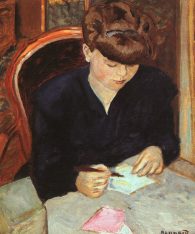
That makes us literary types sound kind of clueless! (I admit, however, there’s some justice in that comment, as I have more than once explained to my own colleagues that no, writing literary criticism online does not mean I’m doing “digital humanities.”) I’d actually like to suggest, though, that, setting aside that kind of confusion between content and form, “the difference between a journal article and a blog essay”  is not entirely self-evident when we’re talking about literary criticism, and that’s precisely because literary criticism is not a science or a social science. Our preoccupation with publishing in peer-reviewed academic journals reflects some anxiety on our part about that: it’s a kind of scientism that has been beneficial in making some aspects of literary scholarship more rigorous and accountable, more historically attentive, and more theoretically sophisticated, but that has also shaped our profession and our professional lives in occasionally disheartening ways. To be taken seriously, we know we have to look serious, which means avoiding at all costs what was scathingly described (by a peer reviewer of my one and only — and of course unsuccessful — SSHRC application) as “the whiff of belles-lettres.” Bonnard The Letter

There are kinds of literary research and scholarship that have a lot in common with history and the social sciences, or that are so well insulated with theoretical implications that no such unsavory whiff could possibly be detected. But a lot of what literary academics do is not so much produce new knowledge as pursue new understandings of, or ways of understanding, literary texts. Careful close readings lie at the heart of many more elaborate scholarly projects. It is certainly possible to do this kind (or this part) of criticism in an open, accessible way, without the specialized language and complex apparatus of argumentation and citation that differentiate academic from non-academic versions of it. Academic training can be hugely beneficial for this enterprise, but such training need not be conspicuous to be effective. We are experts at reading literature in interesting ways and articulating those readings — that’s what we do. What difference does it really make where we do it? Why should we value it, or consider it “professional writing,” only if we do it in a style and form that severely limits the audience for it and the conversation we can have about it?

Where is the self-evident line, then, between the interpretations of novels we find in academic essays and the interpretations of novels we can find on blogs — besides (again) some specialized vocabulary and a lot more footnotes? In both cases we can and should look closely at the quality (the intelligence, the care, the subtlety, the persuasiveness) of the interpretation, but I would argue that there is a fundamental similarity in the activity represented that — while (to reiterate) it does not mean the final products are exactly the same — is at least as important as any differences. It really is the same kind of thing, just done under different circumstances, for different audiences. 

The author of the dagblog post adds in the comments a statement that seems to shift from description to prescription: “blogs are really not good vehicles for academic or professional writing.” Well, again there’s the bagginess problem that makes any such big generalizations about blogs imperfect. But besides that, what I object to is the implication that academic writing really can’t be done in other forms or venues, or that it’s the form or venue, not the content or purpose, that defines “academic or professional writing.” That may be true pragmatically, and in some disciplines it may be necessarily true (I’ll let scholars in those fields hash this out), but at least for literary folks, I think a case can be made that, as literary criticism is our profession, any time we engage in it we are doing professional writing. The desire to draw a firm line between what we do in academic journals and what we do elsewhere seems to me more reflective of our desire to defend ‘professing English’ as a profession than with any really principled or inevitable difference between the two. And, again, the results of that effort have not been altogether salutary, for criticism or for our profession.

jameswoodHere’s another way to think about the academic / non-academic divide. James Wood has done (as far as I’m aware) no conventional academic publishing (including How Fiction Works, which, however interesting and thought-provoking, is not really scholarly). However, he holds an academic appointment: he is the Professor of the Practice of Literary Criticism in Harvard’s English Department. Sure, it’s Harvard and he’s James Wood — but can’t we take away from this high-profile blurring of the boundaries between the academic and the non-academic critical worlds some support for other critics, at least as qualified as Wood, to practise criticism in other ways and other places than scholarly journals? And if we can make that concession, why not accept blogs as one perfectly good place for some of that work? Aren’t there even advantages to making the academy more porous, to engaging more personally and, yes, casually, with the rest of the world? It’s not as if academics are the only ones interested in literature, after all. In Canada we have been hearing a lot about ‘knowledge mobilization‘: if some of the value of conventional peer-reviewed publications is precisely their stability, the value of blogs could be said to be their mobility, their flexibility, and, in their own way, their accountability — because after all, there they are, open for anyone to read and argue with. Their basic model is coduction – again, not a scientific model, but one supremely well suited to the ongoing process that is criticism.

I understand the pragmatic issues, but if we think there is both intellectual and professional value in changing the norms of our profession, we have to keep making the argument, not shrugging our shoulders and reiterating the status quo. As I said in a further back-and-forth with Cassuto, this is a job for “senior, ‘established,’ faculty” above all:

we are the ones in a position to encourage alternative models of productivity and scholarship, and if blogging is valuable to me in the ways I described, there would be real hypocrisy in my case if I didn’t consider it valuable work for people at earlier stages of their careers and work to recognize it as such when they do it.

 I don’t know how much my own advocacy affected my faculty’s new T&P guidelines: I wasn’t on the committee and made no direct submission to it. But I have given three presentations at Dalhousie on blogging and academic publishing, including at a faculty research retreat, and I’ve been including my blog on my c.v. and a statement on blogging in my annual report for six years now. So I’m doing my best to walk the walk.

What matters to me most, though, is that I continue to practice literary criticism, including on my blog. That’s what I trained for, after all. I’ve made conventional academic contributions to my field, and that specialized work informs all the other writing I do. Blogging, though, is where I have the most fun with that expertise, and make it the most freely available. My scholarly articles and books are, I hope, good of their kind — but they are no substitute for Novel Readings!

Update: a shortened version of this post ran on the LSE Impact blog.