 Once again, you wouldn’t know it from this blog but I have been reading a lot! Quite a bit of it, though, has been for writing projects — including both reviews I know will be published elsewhere and essays I hope will find good homes. It’s not so much that I don’t want to “scoop” myself; it’s that I have some concerns about repeating myself, particularly if I say something here that I then wish I could put the exact same way somewhere else. Would it matter if I did? Probably not if it was just a phrase here and there, but it is still an inhibiting factor. If there’s just a bit of overlap, surely nobody would care, but it’s something that I do try to keep in mind.
Anyway, I can at least report on some of what I’ve been reading, and why, and (more minimally) with what results. Last week, for instance, I read Gillian Best’s The Last Wave, which is coming out from House of Anansi in August. My review will be in the fall issue of Canadian Notes and Queries (my review of Lesley Krueger’s Mad Richard is in the current issue). Spoiler: I really liked this novel a lot! It’s not formally adventurous, but it is a smart, well-written, and touching story about families and ambition and identity.
 Today I finished reading Sarah Perry’s The Essex Serpent, which I will be writing up for the July issue of Open Letters Monthly. My initial impression is that it didn’t quite live up to my expectations, or to the hype, but I thought it had a lot of good ingredients — both stylistically and thematically — so my task over the next few days is to articulate what I think they added up to. Sometimes during this process my estimation of a book rises: it can take a little time to discover or understand the kind of whole the parts make. This was certainly my experience with Sarah Moss’s Signs for Lost Children, which I wrote about for Numero Cinq: I grew more interested as I thought more about it (and its ‘prequel,’ Bodies of Light).
I just reread Daphne Marlatt’s Ana Historic, a book that meant a great deal to me years ago when I was an undergraduate just discovering some of the questions it explores about women and history. Today some of the ideas Marlatt plays with seem much more commonplace than they did then, and there are other ways in which the book struck me as very much a product of its time (it was originally published in 1988), but it is still sharp and provocative and intensely evocative of B.C. I wrote a little bit about it at the very end of my monograph on 19th-century historical writing (1998), but I have never written about it since, and I would like to, with a bit of a personal angle about my own “awakening” as someone interested in feminism and historiography: this is one of the summer projects I have set myself, just because I want to do it.
Another rereading project is the complete Lymond Chronicles, which I have arranged to write about for the TLS on the occasion of the new editions being released this fall. I am both very excited and rather nervous about this project. For one thing, it is very odd reading books I have loved so passionately for so long with pencil in hand — one of my ambitions is not to let the reviewer get in the way of the lover too much, not to let the critic crush or even crowd out the fan. Of course, I also don’t want to just gush! I don’t have a lot of space, considering there are six long books in which a lot happens, so one of my biggest challenges will be choosing, from all the things I could say, which few things I will say. Although I do feel somewhat daunted at the prospect, I am absolutely loving having an excuse to reread the books.
 Finally, last night, for no reason besides personal interest, I started reading Susan Bordo’s The Destruction of Hillary Clinton. I’m about two-thirds through and actually finding it a bit of a disappointment. It’s certainly lucid and, on its own terms, persuasive, but those terms are basically “here’s what the 2016 election looked like to a Hillary supporter.” Though of course I did not follow the election as closely as Bordo and also don’t have the background she does in following U.S. politics or Hillary’s career, what she describes is pretty much how it looked to me too; though the book goes over a lot of ground, it doesn’t seem to me to offer any particular revelations or any deep analysis. I think that’s deliberate (sometimes there’s more detail in footnotes, for instance, as if the aim was to keep the main narrative brisk and easy to go along with, which it is). It’s political commentary, which is fine, of course: I’m not really sure what else I expected.
I have been rereading Dunnett in the intervals I would usually be reading “just” for myself, to make sure I get through them in time and also because it’s such a treat! I do have a lot of books around that I want to get to, though. My book club will be meeting in a couple of weeks to discuss Shirley Jackson’s We Have Always Lived In the Castle, for one. I brought N. K. Jemisin’s The Hundred Thousand Kingdoms back from the library yesterday on a whim: fantasy has never been my genre, but I was wondering if I might have learned something from watching Buffy about playing by different rules. And there’s my Vancouver book haul, most of which is still unread. Good thing it’s summer!
 I’m trying to move on from
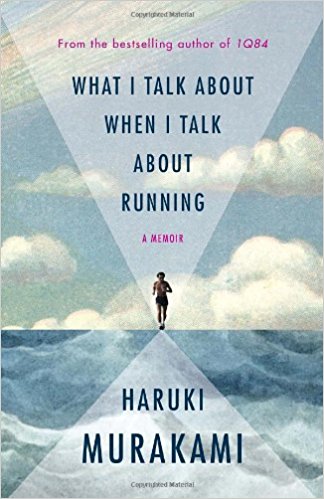 It turns out I wasn’t entirely wrong to have avoided Haruki Murakami’s
  In a similar way, he talks about both his running and his writing without flourish or posturing. There’s no false modesty, but also no braggadocio. Further, though he does talk a lot about training and personal bests, he never seems competitive against anyone but himself. He certainly has a different relationship to running than I do, an interest in pushing himself and seeing (literally but also metaphorically) how far he can go as a runner, but he does it because it suits him: for him, it’s a way of expressing himself, not proving anything. In fact, sometimes what he seeks and finds in running is humility: when he feels he has been “criticized unjustly,” for example, he runs “for a little longer than usual”:
 When he talks about writing more directly, he often emphasizes how difficult it is:
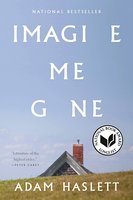 Adam Haslett’s Imagine Me Gone is painful, even tragic, and yet it is also just funny and acerbic enough to keep it (or its readers) from becoming unbearably sad. In fact, I thought there was something oddly bracing about it. That’s partly because I thought it was so well done, artistically and formally, but it’s also because the novel balances its devastating portrayal of depression and anxiety with its persistent faith in basic human kindness and, especially, family love. Haslett doesn’t oversimplify the challenge of severe mental illness — not just for the people living with it, but for the people living with them, whose lives are also inevitably changed by its presence. He also doesn’t romanticize it, or offer the faux consolation of silver linings: nobody is redeemed by it, it doesn’t bring anybody transcendence or special wisdom. It just is–for everyone involved.
 Michael’s illness cannot be willed away, stared down with stoicism, or held at bay by distractions or the pretense of normalcy — though even as he brings out the error, indeed the danger, of approaching it this way, Haslett is also very critical of medicalized approaches that consist largely of throwing more and more pills Michael’s way.
 Another thought-provoking aspect of Imagine Me Gone was the kinship Michael identifies between the family history of mental illness that so shapes his own individual story and the blight of slavery as foundational to America’s history. Michael is preoccupied with reparations, which for him represent a political and moral necessity that is impossible for him to separate entirely from his own tormenting belief that he is to blame for his father’s suicide. How can you right the wrongs of the past? How can you endure and survive your inheritance of suffering?
 I had a minor epiphany this morning: I should try to approach writing in the same spirit I approach running.
 My version of “otherwise” has
 I have also appreciated the way reviewing has expanded my reading, particularly when the books are suggested by other editors rather than hand-picked by me to suit my own known tastes and sensibilities. I would point, for example, to the increase in Canadian titles I have read since taking on some commissions for Quill & Quire and, more recently, Canadian Notes and Queries, though the best example of a writer I would probably never have discovered on my own but loved would be
 I am back from my trip to Vancouver, where in spite of the rain (even, in some ways, because of it) I had a lovely time visiting with family and friends and drinking in the always inspiring sight of the mountains rising above the city and the sea. It was a a welcome interlude between the end of a challenging term and the beginning of a summer of reflection and writing.
 I did get some travel reading done. I’m nervous on planes, so light or fast-paced books are good as my concentration isn’t always great. En route to Vancouver, I found Miranda Neville’s The Amorous Education of Celia Seaton an excellent diversion, and on the way home I alternated between Georgette Heyer’s Black Sheep (reliably amusing) and Adam Sternbergh’s The Blinds, which I’m reviewing for Quill & Quire. I plucked several promising titles off my mother’s well-stocked shelves, but the only one I read cover to cover was
  Though I didn’t manage a lot of good reading while I was away, I did bring back a nice stack of books to read here at home. One ritual my mother and I have on my visits is an expedition to
  Including The Blinds, then, which had been mailed to Vancouver so I could get started on it sooner rather than later, I came home with 8 more books than I left with. And yet wouldn’t you know it: the book I most want to read next turned out to be waiting for me when I got back to Halifax. It’s Marina Benjamin’s The Middlepause: On Life After Youth, a 50th birthday gift which seems like just the right book to help me think about where my own life is now and what I want to make of it next. That is likely, then, to be the next book I write about here.
 I haven’t disappeared or given up blogging! It’s just that as soon as my final grades went in, I had to buckle down and finish two reviews that have been haunting me — not because I didn’t want to write them, but because though I have had the books for some time and had even started reading them, it just hadn’t been possible for me to get the hard work of writing thoughtfully about them done. The result was that even though neither of them was technically late, I felt guilty for weeks! But one went in last week and the other today, and while I now have to wait and find out what the editors think, including what revisions they want, I’m out from under that shadow and ready to contemplate the rest of my summer.
 However! Rain is perfectly good weather for taking stock and making plans, and that’s the stage I’m at now. I actually feel as if I need some dedicated time for that, because I’m not really sure right now what my top priorities are. I spent a lot of the last two summers doing work related to
  Some of that was due to my specific teaching assignments this year. My fall term courses were both ones I have taught before and really enjoy. Since I first designed my version of Close Reading, I have tried to infuse its more technical aspects with both critical and moral purpose, and the result is that it generates some of the most interesting discussions and assignments I get. It was also balm to my soul to spend five weeks on Middlemarch for this class: that is not enough time, of course–what would be?–but still feels comparatively luxurious (when I teach Middlemarch in my standard 19th-century fiction class, we get three weeks). Finishing with The Remains of the Day is always marvelous, but Ishiguro’s novel felt
  One thing I realized as the term went by is that the big questions that, in my mind, really motivated the course–questions about the difference between “pulp” or “genre” fiction and “literary” fiction, for instance–were not of great interest (at least, as far as I could tell) to most of the students: they did not seem to be invested in either the distinction or arguments against it. My guess is that most of them had never thought much about genre categories or literary prestige before; certainly I got no sign that they believed themselves to be victims of or participants in any kind of “culture war” by virtue of having been assigned Elmore Leonard and Loretta Chase instead of Shakespeare and Jane Austen. It’s possible that some of them are now more interested in how and why we might draw these kinds of lines, but it was at once disorienting and refreshing to realize that they were not nearly as exercised about them as people often are in the media or in the world of literary criticism and book reviewing. In the end it was just another thing I was trying to teach them about.
 Novel Readings