 The moment when the dashing, exceedingly well-dressed, but annoyingly remote Earl of Worth declares “The game is up!” is the moment I finally understood fully that the reason I hadn’t liked him much throughout the rest of the novel is that he’s both the romantic lead and a detective hero–part Regency rake and part Sherlock Holmes.
I had realized before that point (which is very near the end of the novel) that a mystery plot–or at any rate a “someone’s up to no good” plot–was unfolding alongside the romance plot, and that Worth had an instrumental part in it. It’s also not that subtle who he suspects and why: I haven’t read any of Heyer’s actual mysteries, but I hope they are more, well, mysterious! But here it’s the central relationship between the hero and the heroine, Lord Worth’s ward Judith Taverner, that is the real impetus for the novel, not clever clues, red herrings, or other detective devices.
The problem is that a detective plot does by its nature require a fair amount of withholding, both from the reader and from other characters, and the potential problems of this approach to a romantic hero are compounded in Regency Buck by Worth’s individual character. From the beginning of the novel, he is arrogant and controlling, and one of the first things he does early in his acquaintance with Judith is kiss her, against all rules of propriety and, much more important, completely against her will:
Miss Taverner’s hands clenched into two admirable fists, but she controlled an unladylike impulse, and kept them in her lap. She was both shaken and enraged by the kiss, and hardly knew where to look.
Considering that one of the pivotal scenes later in is one in which she is sexually harassed and at risk of much worse from another man who is depicted as very much the villain of that moment, it’s uncomfortable, to say the least, that the eventual hero himself doesn’t show much more respect for her. Then there’s this little speech of his:
‘Do not look daggers at me: I am wholly impervious to displays of that kind. Your tantrums may do very well at home, but they arouse in me nothing more than a desire to beat you soundly. And that, Miss Taverner, if ever I do marry you, is precisely what I shall do.’
If he clearly renounced this intention later on, maybe we could write it off as an unfortunate fit of temper on his part, but not only is he cool (as always) when he says it, but given the opportunity to apologize, instead he doubles down — and this is once they are in fact engaged:
‘I am as disagreeable as you are,’ [Miss Taverner says]. ‘You would like to beat me. You told me you would once, and I believe you meant it!’
‘If I only said it once I am astonished at my own forbearance. I have wanted to beat you at least a dozen times, and came very near doing it once … But I still think you adorable.’
Judith is not in fact particularly “adorable”: she’s feisty even for a Heyer heroine, strong-willed and independent. She’s an excellent driver, preferring to hold the reins herself (clearly symbolic!). She even takes snuff! But because Worth keeps her in the dark about what is really unfolding around her, she is put in a position of relative weakness. He even exploits her vulnerability, “allowing” her to be carried off by the villain as part of Worth’s great scheme for making the case against him.
 There are definitely charming aspects of their relationship. Their verbal sparring is often fun, though I didn’t often find it flat out funny, which was a disappointment: usually Heyer makes me laugh more. Overall, in fact, I’d say Regency Buck is one of the darker Heyers I’ve read, with more anger, violence, and threat, including, again, the overt sexual threats against Judith. It also had more, or at least more conspicuous, “period” detail in the form of both literary allusions and references to or parts played by actual people, including Byron, “Monk” Lewis, and the famous dandy Beau Brummell:
The exigencies of his toilet occupied several hours; he had been known to spend as many as two on the nice arrangement of his clothes, to which, however, he gave not another thought once he had left his dressing-room. Unlike most of the dandies he was never seen to cast an anxious glance at a mirror, to adjust his cravat, nor to smooth wrinkles from his coat. When he left his room he was, and knew himself to be, a finished work of art, perfect in every detail from his beautifully laundered linen to his highly polished boots.
We even meet the Prince Regent himself, who is in some sense the eponymous hero of all “Regency” romances. He is a bit in decline by the time of the novel, but “there were still some traces to be found of the Prince Florizel who had captivated the world thirty-odd years before.”
 But to get back to Lord Worth, he is in some ways a typical alpha hero. I was hoping his desire to dominate would be blown away by the end of the novel, but Judith is no Mary Challoner. For the reasons I’ve given, I didn’t find him a very satisfactory romance character, and I don’t think Regency Buck is likely to become a favorite of mine. But Worth is a pretty good detective, at least if you like the Sherlock Holmes “I’m much smarter than you and have everything well in hand” kind. The scene in which he finally confronts the villain is a classic “reveal” scene: Worth goes back over everything that has happened and explains what he knew or suspected and how he found it all out. As I said, the case is not particularly subtle, but Judith at least is wholly taken aback by his revelations, and then reassured by his Holmes-like promise that “there will be no scandal.” I just wish that he’d also promised there would be no beatings.
 In both of my classes this week we are focusing on young women making mistakes. It’s interesting for me (and I hope also for the students who are in both classes) to compare the very different ways their novels approach their rather different errors.
 Dorothea Brooke’s errors are easier to spot, because George Eliot gives us not just Dorothea’s perspective but that of everyone around her and, most important, of the narrator. It mystifies every person in the novel that Dorothea chooses to marry Mr. Casaubon: they all believe that it’s a terrible mistake. We understand why she marries him, though, because we know all about her, meaning not just her desire to lead a spiritually significant life but also her impetuous nature and her tendency to interpret things according to her own desires. Of course, that last bit is at once her greatest failing and the one thing we all have in common with her, as the narrator will take pains to teach us. We are given more information in Middlemarch, but we are also kept at more of an emotional distance–both formal choices that serve the novel’s larger purposes.
 “To understand the stories of the seven lost students who are the subjects of this book,” Tanya Talaga begins her devastating, angry, and thought-provoking book Seven Fallen Feathers: Racism, Death, and Hard Truths in a Northern City,
 Seven Fallen Feathers left me with a lot to think about. Some of my lingering questions are historical or sociological; more reading, presumably, is the next step there. On a more personal level, the book prompted me to reflect uncomfortably on my own education in the B.C. public schools in the 1970s and early 1980s. If you’d asked me then, I would probably have said that we did pay attention to Indigenous history. Mostly, as far as I recall, this took the form of visiting museums with exhibits that included First Nations art, clothing, and tools — the kind of things always on display at the
  In retrospect, I still think some of this early experience was
 The 2016 U. S. election has given some books I regularly teach new resonance–and not in a good way. In March 2016,
  I’ve been thinking that another novel for our times is


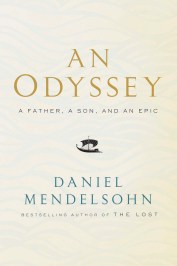
 Theirs is not an easy relationship, and the more I learned about it the more the idea of bringing it into the classroom struck me as brave, on both sides but especially–perhaps because I too am a teacher–on Mendelsohn’s. He tells the students in advance that his father will be sitting in, “so his presence on the first day of class wouldn’t be a distraction.” Jay has promised, however, that he’s just going to observe, not participate: “I’m just gonna sit there and listen.” Mendelsohn never explicitly says as much, but it’s easy to imagine that, to him, this seemed a bit like payback: this would be his class, his room, his rules, his authority. On the very first day, however, his father puts his hand up and makes both his presence and his rather contrarian opinions felt: “‘Hero’? I don’t think he’s a hero at all,” he says about Odysseus, and from then on he is a regular contributor who not only engages vigorously with the Odyssey but changes the whole classroom dynamic, because Jay’s parental claims can sideline Mendelsohn’s professional role.
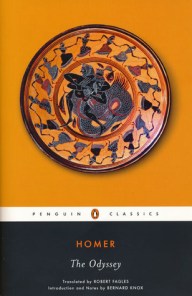 I wondered as I read if I enjoyed An Odyssey partly because I have never read the Odyssey, so in contrast to my reading of My Life in Middlemarch, in my reading of Mendelsohn’s book I was in a student-like position myself.* I have always enjoyed hearing passionate experts, and Mendelsohn’s love for his subject makes the discussions of the Odyssey positively hum with energy. I worried that my own ignorance would be an impediment to my pleasure, but while I might have enjoyed the book even more if I had read Homer, it’s possible that the opposite is true: the book is clearly written with people like me in mind, and I don’t know if someone familiar with the Odyssey would find much of interest in the analysis, or perhaps would take issue with some of the interpretations. I thought at first the book might inspire me to read Homer for myself at long last–but in the end both the quotations and Mendelsohn’s commentary made me think I might not like it very much, or be very good at it. The idea of its “ring composition,” for instance, is compelling in theory, but must be quite baffling, even frustrating, in practice, at first. (The irony is not lost on me that I am saying this and yet in just a couple of weeks I will be waxing eloquent to my own students about the web-like narrative structure of Middlemarch!) Perhaps, like Jay, I need to sit in on a seminar, both for motivation and for elucidation.
 The first couple of weeks of the new term are always deceptive: you anticipate them with so much anxiety after the slower pace of summer work, but then for a while, though the logistics are a bit hectic and there are more day-to-day deadlines, it doesn’t seem that bad. But then the first significant assignments come in, and you have to keep up the day-to-day stuff on top of marking them, and there are more meetings, and they both take time and generate things to do, and the next thing you know you are barely keeping track of it all. And that’s about where I am now!
 Still, I always like the energy both demanded and generated by the actual classroom time; regular readers will know how often I complain about summer doldrums, too, brought on by too vacant a schedule and too few opportunities for interaction and engagement with other people. As more and more of my colleagues head into retirement, I do sometimes fantasize about what that phase will be like for me, and how soon I might be able to enter into it. (Not that soon, since I’ve just turned 50!) I think when the time does come I will have to be careful that it isn’t like an endless summer, without any structure. For now what I have to do is make sure I can maintain my energy and enthusiasm — by, for instance, trying to bring less work home with me than I once had to, and making time as best I can for the reading and writing that I want to do.
 This is not to say that I’ve tired of enthusing over Donne’s “Death, be not proud,” even in the context of trying to teach scansion, and I am absolutely looking forward to teaching both Middlemarch and The Remains of the Day again. As the great Samuel Johnson said, “When a woman is tired of Middlemarch, she is tired of life!” OK,
  We’re one week into the fall term and I’m starting to feel that I’ve got my sea legs back. Every new term seems a bit herky-jerky at first, but before long it smooths out, or at least becomes routine again.
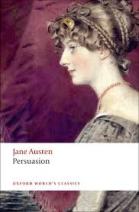 In 19th-Century Fiction, we’re reading Persuasion. For a long time I have identified Persuasion as my favorite Austen novel, but this time through, my allegiance is wavering: more than usual when reading it I am frustrated by Anne Elliot’s not speaking, when all it would take to bring about the consummation so devoutly to be wished is a few clear words at the right moment. I know, I know: her reticence and self-control are admirable, and just going for what you want makes you Louisa Musgrove, a literally fallen woman who clearly signals the dangers of undisciplined desire. When Anne finally does say something (“she speaks!” say my marginal notes at one point) it is also always significant: a breakthrough of feeling, an assertion of principle, a lesson in values. Still, one key to the novel’s happy ending is that she finds her voice, or figures out how to use it to win for herself the kind of happiness someone of her high character can accept: not simple pleasure or self-gratification, but a marriage of true minds.
 On the very first page of Celeste Ng’s
  Novel Readings