But now I understand there are no ordinary lives–that every death is the end of a single event in time’s history: an event so improbable it represents a miracle, and irreplaceable in every particular. So here I am, counting out the particulars of my father-in-law’s life, and trying to preserve them in ink–it’s precious that he drank weak Yorkshire tea in footed mugs printed with blue flowers, and artificially sweetened with tables he called ‘depth charges’ as he jettisoned them in, laughing at his own joke. It’s precious that he disliked dogs, but could calm a feral cat; precious that he kept sugar-free mints in his pocket, and would thumb them free from the tube and into his mouth without looking; precious that each summer he grew rather tough green beans and froze them to be eaten at Christmas, and had a weakness for ice cream, but could never tolerate broccoli . . . all of this remarkable only because it can never be repeated or retrieved.
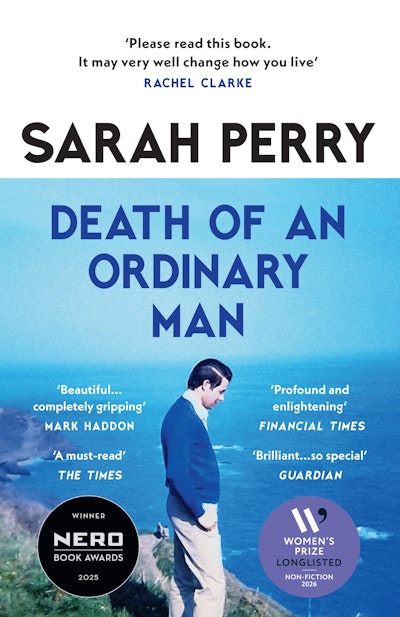
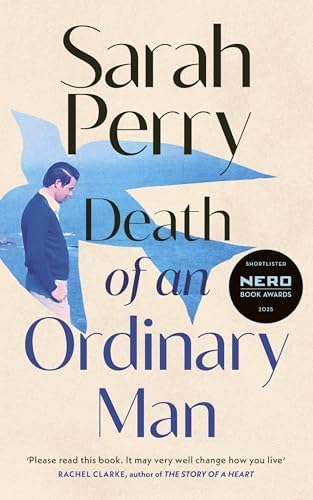
Sarah Perry’s Death of an Ordinary Man is simple in its premise, unsparing in its execution, and almost unbearably poignant in its tenderness. In it, Perry recounts–in meticulous detail–her much-loved father-in-law David’s death from oesophageal cancer. From diagnosis to death, it took a scant nine days; in that short space, she and her husband Robert and especially, of course, David himself went together through one of the most commonplace human experiences. That in general we know so little about it–that we avoid thinking about it, until forced to, and so are rarely ready for it–is one of the reasons Perry wrote this book. “It isn’t wisdom I have,” she says near the end, “it’s only experience; and experience of only one death.” Nonetheless,
I am still standing by the gate, and I keep it open, because there are things I want to tell you. I want to tell you that even a good and easeful death may have its indignities and pains, but to know this–to have seen it–is to fear death less, not more.
Above all she wants to share the realization she came to, as she traveled with David along his road to death and then was left behind, that “dying is a part of living, and like living it has its events, both difficult and marvellous.” She doesn’t expect her account to make living less fearful, but to “bring the act of dying into the scope of living,” just one more part of what we all, one way or another, go through, of our events and struggles.
She is conscious even as David is dying that she is attending him not just with love and patience and grief but with the eye of a writer, “with the assessing acquisitive eye of a magpie.” It is to her credit, or a credit to her intelligence and craft, that the result feels authentic and immediate, not artificial or mannered. That she quotes poetry and philosophers seemed unsurprising precisely because she is a writer, and thus also a reader and a thinker, about meaning and about life. Her Gothic novel Melmoth is, I thought, a genuine novel of ideas; her novel Enlightenment, which she has just finished when David begins to die, is about science and philosophy and our place in the universe. All of us who live our lives in part through others’ words find that those words come to us in our own most intense moments (as I found, and still find, that thinking of Owen brings lines of poetry, long familiar, now hauntingly so, echoing in my mind).
Most of the book, though, is not literary, or philosophical, in any conspicuous way. (The absence of that kind of conspicuous literariness is itself exceptionally careful, artful: I don’t mean that the book is at all haphazard.) It is, mostly, very literal: Perry seems to have realized that there is enough power in the simple facts of David’s death–his physical decline, unthinkably rapid; his shifts in mood; his brief returns to energy and lucidity; his graceful submission (Perry’s word)–that just to describe them will also be enough.
That said, the other task of the book is to tell us about David’s life. Some of this is done neatly, efficiently, in the first short section of the book–aptly called “Life.” But Part Two, “Death,” fills in more details, partly through the simple device of Perry noting what she sees when she looks around David’s home–photos, slippers, dishes, his favourite magazine (the Antiques Gazette), his stamp collection, all the paraphernalia of an ordinary life. Something Death of an Ordinary Man captures with great vividness is the sudden diminution of these things when the person whose life they seemed to constitute steps away from them. How quickly they become just clutter, even as they also serve as tangible reminders and connections. David’s illness progresses so quickly that he has no way of knowing, in the moment, that he is putting his slippers on for the last time, drinking his last tea, sleeping for the last time in his own bed.
There’s a lot of medical detail in the book, not the specialist kind the doctors and nurses know, but the kind family members learn perforce when they become caregivers: artificial saliva, commodes, “WendyLett sheets,” which are “fitted with handles and woven in a particular way which allowed us to move David without hurting his body, or ours.” All of this is gripping reading in a way I wouldn’t have expected. There aren’t villains or heroes in the story, but a visiting doctor fills Perry with anger at what she perceives as unfeeling briskness, while the night nurse who comes so they can sleep brings them, and David, calm ease; an oncologist friend offers honesty that comes as a different kind of relief.
I realize that little about this may sound uplifting, and I can imagine people who have gone through the illness and death of a loved one might not at all want to read Perry’s account, though I can also imagine that for some there might be (as there has been for me with some things I have read about depression and suicide) some–what? not consolation, but companionship, in any recognition it offers, and that strange pleasure in finding that someone has found words to express what we perhaps have struggled to ourselves. The TLS review praises the book for being “unsentimental”: I am a fan of sentiment, and I am not sure that Death of an Ordinary Man isn’t a bit sentimental. There is immense pathos in it, at any rate, and raw grief. There is some comedy, too, and anger, and frank admissions of failures of empathy and possible errors of judgment.
Above all, and perhaps this is the most important and surprising thing about Death of an Ordinary Man, even though it is focused on how David died, it gives a really rich sense of him as a man who lived. Death is universal, but there will never be another life exactly like his, or another man exactly like him. That, as Perry observes, is anything but ordinary.
 Novel Readings
Thank you for your wonderful review. I am thinking of my youngest brother—11 years younger than I—who is dying.
I tried to comment but it wouldn’t let me. So here’s my comment: I am reminded of the last stanza of W.D. Snodgrass’s Old Apple Trees, particularly the last few lines:
Nothing like any one of us will be seen again, forever. Each of us held some noble shape in mind. It seemed better that we kept alive.
>
LikeLike
‘Companionship’… that’s a lovely way to put it. I read this book too, and I agree with your thoughts about it. Especially the part of it portraying ‘a really rich sense of him as a man who lived.’
Thank you for sharing, especially since you read it with grief in your heart about Owen.
LikeLike
Wow, this was a great read on top of being a very insightful review. thank you!
LikeLike