Now that I had barely anything left, I could sit in peace on the bench and watch the stars dancing against the black firmament. I had got as far from myself as it is possible for a human being to get, and I realized that this state couldn’t last if I wanted to stay alive. I sometimes thought I would never fully understand what had come over me in the Alm. But I realized that everything I had thought and done until then, or almost everything, had been nothing but a poor imitation. I had copied the thoughts and actions of other people . . . There was nothing, after all, to distract me and occupy my mind, no books, no conversation, no music, nothing. Since my childhood I had forgotten how to see things with my own eyes, and I had forgotten that the world had once been young, untouched, and very beautiful and terrible. I couldn’t find my way back there, since I was no longer a child and no longer capable of experiencing things as a child, but loneliness led me, in moments free of memory and consciousness, to see the great brilliance of life again.
Marlen Haushofer’s strange, haunting novel The Wall is without a doubt one of the best books I’ve read in a long time. It is such an unlikely book to be so good: I think that’s part of its power, that its premise doesn’t seem very promising, that it is such an odd mixture of elements. It’s May Sarton’s Plant Dreaming Deep if that reflective meditation on solitude were also speculative fiction, existential meditation, and wilderness adventure. It should never work! And yet I found it completely gripping, consistently thought-provoking, and deeply moving.
It is most gripping when you take it most literally: what if one day there was an invisible wall separating you from everything and everybody else, and as far as you can tell, nobody else has survived whatever the wall is a manifestation of? For the narrator, the inexplicability of the situation quickly becomes less important than what to do about it, how to survive, how to take care of the small family of animals that will be her only companions. Her sense of responsibility for them is what really motivates her to keep struggling along, and the love she feels for them—the cow Bella, the dog Lynx, the cat and her kittens—is beautiful and also terrible, as it makes any losses incredibly painful.
The reason The Wall will stay with me, though, is not because Haushofer does such a good job chronicling the gruelling practicalities of growing potatoes and scything grass and killing deer and cleaning floors but because the narrator’s plight so insistently raises, for her and for us, questions about why she should do any of this and not just give up, not just burrow under the wall to what she is sure will be an immediate end—questions that extend to why any of us persist in living at all. The narrator’s extraordinary loneliness is not, perhaps, really that extraordinary: we are all fundamentally alone, isolated, cut off in invisible ways from even those closest to us. Sure, we form relationships and surround ourselves with distractions, but Matthew Arnold wasn’t wrong when he described us as being “in the sea of life enisled.” What is all this effort for, then? What, if anything, makes it worthwhile?
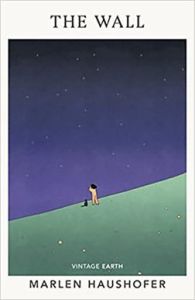 In her extreme solitude, with no prospect of ever reconnecting with another human being, the narrator faces the world with no insulation between herself and everything else, from the vastness of the landscape to the equal vastness of these existential questions. Sometimes, of course, she is too worn out from the digging and scything and hiking and chopping and hunting to think about them, or about much of anything, but at other times she thinks back on her life before (or is it outside?) the wall, on “the woman I once was” and on the people she once knew:
I now knew what had been wrong, and how I could have done it better. I was very wise, but my wisdom had come too late, and even if I’d been born wise I couldn’t have done anything in a world that was foolish. I thought about the dead, and I was very sorry for them, not because they were dead, but because they had all found so little joy in life. I thought about all the people I had known, and I enjoyed thinking about them; they would be mine until the day I died. I would have to clear a safe place for them in my new life if I was to live in peace.
She is awed and moved by the beauty of nature, including the night sky that used to frighten her:
If I narrowed my eyes to slits I could see the infinite abysses opening up between the constellations. Huge black hollows behind dense star clusters . . . I had never really known it before, locked in stone houses behind blinds and curtains. The night wasn’t dark at all. It was beautiful, and I started to love it. Even when it rained and a layer of clouds covered the sky, I knew that the stars were there, red, green, yellow and blue.
Similarly, she realizes that in her old life she never really saw the other living things around her because she was moving too fast:
A running person can’t look around. In my previous life, my journey took me past a place where an old lady used to feed pigeons. I’ve always liked animals, and all my goodwill went out to those pigeons, now long petrified, and yet I can’t describe a single one of them. I don’t even know what color their eyes and their beaks were. I simply don’t know, and I think that says enough about how I used to move through the city.
 It’s no paradise she is living in now, and all this time to think is a curse as well as a blessing, bringing bitter grief as well as epiphanies. Who even is she, anyway, with nobody else to be present for? In one particularly striking scene she sees her own reflection and wonders what her face is for now, if she even needs it any more. Her narrative, which she calls a “report,” is her one act of resistance against her own erasure: perhaps, when she is gone, it at least will persist.
Near the end of the novel, there is an episode of such grim and gratuitous brutality that it makes the eerie death zone outside the wall seem peaceful by comparison. I think I’m glad Haushofer does not explain this part to us anymore than she explains the wall; the novel would lose something if it relied more on plot. (I’m also glad there’s no clever framing device to cheapen it: we don’t know how we come to be able to read this report.) To look for meaning its violence might also be to make the mistake the narrator notes is typical of humans, in their “megalomania,” assuming significance where there is just accident: “things happen.” At the same time, she sees humans’ capacity to think and to choose as itself significant. “Maybe,” she considers,
people are more deserving of pity because they have just enough intelligence to resist the natural course of things. It has made them wicked and desperate, and not very lovable. All the same, life could have been lived differently. There is no impulse more rational than love. It makes life more bearable for the lover and the loved one. We should have recognized in time that this was our only chance, our only hope for a better life. For an endless army of the dead, mankind’s only chance has vanished forever. I keep thinking about that. I can’t understand why we had to take the wrong path. I only know it’s too late.
Is it too late, for her, or for us? We don’t know the end of her story, which does not conclude but simply stops, when she runs out of paper. Our story isn’t over yet. It’s not looking too good for us—but if Ian McEwan can find grounds for optimism, I’m not giving up hope for us yet.
 Novel Readings
I think I would find this very difficult to read. I read a dystopian novel not so long ago where the only human who is thriving in the rising waters is one who has physically adapted while everyone else has just kept on fleeing to higher ground, of which there is less and less each day. I found it profoundly depressing.
LikeLike
I would say that, unexpectedly, this novel is more exhilarating than depressing as it is not really dystopian. The narrator finds a lot of strength and beauty in her isolation, and comfort in the company of the animals and in her work to grow crops and keep a home for all of them. That said, the overall scenario is grim, I suppose – but for me, feeling that it was a metaphor more than a dystopia affected that.
LikeLike
I read this during the first Covid lockdown so it felt even more eerie. Am so glad you’re discovering Marlen Haushofer. She’s become one of my favourite writers. Uncanny vision and precision of expression.
LikeLike
Is there another work of hers that you recommend? “Uncanny” is a good word, even though on the surface the style of this novel seemed very prosaic.
LikeLike
The novella Killing Stella has just come out in translation (was hoping to acquire it for our own publishing house, but alas, it was not to be). The Loft has also been translated but might be a bit harder to find. I’ve translated a couple of her short stories but haven’t published them anywhere yet.
LikeLike
Here’s my review of The Loft, have written a fair bit about Marlen on my blog:
LikeLike
I see The Loft is available from Blackwells in the UK – but for a price! The novella is in stock locally but it’s expensive for 80 pages – tempting, though!
LikeLike
Beautiful review Rohan. I read this several years ago and loved it. I recently read somewhere (not sure where) that Marlen Haushofer suffered from severe depression throughout her life and that The Wall can be seen as the wall that depression and other mental health issues can erect between a person and the rest of the functioning world. I will read it again very soon with that in mind.
LikeLike
That really makes sense. I also felt like it was a good expression of many aspects of grief.
LikeLiked by 1 person
Yesterday someone told me they didn’t believe in closure. This was apropos the immanent death of an elderly parent, in a conversation about people looking for conclusions, for closure. I never write toward closure. What could it realistically look like, in a novel or a life? Death, for sure, but only for the one who has died. Happily ever after? While I was reading your review I wondered how the book could possibly end in a convincing way. It seems Haushofer discovered the only way to do it.
LikeLike
This is one I’ve failed to read for years, but I have taken a step closer – I now have a (German-language) copy at home, ready to try 🙂
LikeLike
I apologize for posting on this post about something you wrote in a different, much older post, however that post would not accept my comment and you seem to be an expert on something I am struggling with. I am a high school teacher unexpectedly tasked with teaching a Detective Fiction course with very little direction. So far, we have read The Murders in the Rue Morgue, several Sherlock Holmes stories, The Murder of Roger Ackroyd, several Hammett stories and watched The Maltese Falcon but I would love to do a short unit (only 3 weeks left in the semester) on more modern, female-authored detective stories. We have discussed the role of women in each time period and it would be great to bring it closer to the present. Could you recommend a short story or two that would showcase the modern female detective and/or role of women in modern crime fiction? We don’t have time for a whole novel. THANK YOU!
LikeLike
Hi, Becky,
I don’t read a lot of contemporary short stories in this genre: I generally pick from whatever’s in the reader I’m using any given year, and I can’t really think of a story that does quite what you are asking for. To get a lot of this work done I usually use Sara Paretsky’s Indemnity Only, which is not a very long novel – I wonder if it would be a good choice? It is more focused on women in hard-boiled detective fiction. I really like her short story “Dealer’s Choice” but I’m not sure it fits your bill exactly. Sorry I can’t be more help.
LikeLike