 Engine 721 doesn’t take it personally. She is made of wood and metal, and her temperament is stoic. Besides, she recognizes something kindred in Mado Pelletier’s iron conviction and unstoppable momentum. The bomber believes the world men have made is terrible, and so it is. Nor can the train deny that there is a certain beauty in the idea of burning, since she runs on flame herself.
That lunch bucket is an explosion waiting to happen. Its unstable elements sing out their longing so loudly, the train can hear them like a battle cry. All the force of combustion that makes the express the fastest vehicle on earth, this device has harnessed for instant havoc. It can take every part of an object, and every cell in the human body, and fire them in different directions.
So, for now, on we go.
Engine 721 doesn’t take it personally. She is made of wood and metal, and her temperament is stoic. Besides, she recognizes something kindred in Mado Pelletier’s iron conviction and unstoppable momentum. The bomber believes the world men have made is terrible, and so it is. Nor can the train deny that there is a certain beauty in the idea of burning, since she runs on flame herself.
That lunch bucket is an explosion waiting to happen. Its unstable elements sing out their longing so loudly, the train can hear them like a battle cry. All the force of combustion that makes the express the fastest vehicle on earth, this device has harnessed for instant havoc. It can take every part of an object, and every cell in the human body, and fire them in different directions.
So, for now, on we go.
WARNING: GREAT BIG SPOILERS

Since the railway disaster Emma Donoghue recreates in
The Paris Express is a documented historical event, I think a spoiler alert is not really called for. That said, I did
not already know what actually happened, and I suspect Donoghue is counting on our not knowing, which is what kind of spoiled the novel for me. If you knew that THE BOMB DOES NOT GO OFF and NOBODY ON THE TRAIN DIES, the sense of impending doom that she does such a good job of building up would reveal itself immediately as shameless manipulation, which it turns out it is.
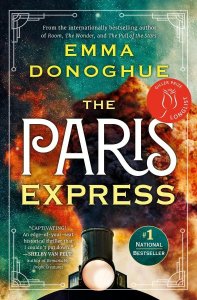
The Paris Express is not a bad novel. Donoghue is too adept for that. Given how it ends, though, I don’t really see the point of it. It’s just people on a train. She does a good job imagining them all for us (and if you like this sort of thing, there’s a long note at the end telling you who is real and which bits are made up). I got pretty invested in some of them, especially in the young anarchist who spends the whole trip clutching her homemade bomb, hoping there will be a big enough wig on the train to make detonating it the kind of political statement she aspires to. As the train raced along from stop to stop and the passengers met and mingled and shared quiet moments and lustful interludes and ate lunch and gave birth, there seemed to be a lot of potential ways their interactions could pay off. But even without climactic revelations or epiphanies (maybe assisting in a delivery would change Mado’s mind about blowing everyone up, for instance), there was power in the dramatic irony, this motley assemblage of different people all unknowingly hurtling towards disaster.
BUT THEY ALL WALK AWAY FROM IT. Geez. I mean, that’s nice for them (and rough for the one person who does actually die in the accident), but what that leaves us with is a whole bunch of people on a train. A series of character sketches, vignettes. It’s so deflating!

Also, she personifies the train. It makes some sense: apparently trains, like ships, are “she” to those who make them go. I like the idea that the train is a symbol: destructive technology, human ingenuity pushing too hard against the natural world, something like that. But the minute you say “You wonder how a train can read her passengers’ minds?” you’ve lost me. Keep it a metaphor, don’t over-literalize it, don’t tell me “she savours their memories and jokes, their doubts and rages, the way a worm tastes the earth.” Let us think for ourselves why a train might be antipathetic to something else that matters; let us experience the passengers’ humanity as something in tension with it.
I’ve read quite a few of Donoghue’s novels. I thought
The Wonder (which I reviewed for the TLS) was really good, and
Haven (which I reviewed for
Canadian Notes and Queries) was too.
I think she’s a good enough novelist that I wish she would write fewer novels—something I realize
I have said before. Obviously, it’s not nothing, to be able to write so many fine-to-good novels! She’s clearly very commercially successful, too.
I bought
The Paris Express myself, notice, gambling that even if it wasn’t great, it would still be fine, which it is. I don’t get why it has been nominated for the Giller Prize, though. My feeling about prize-winning books is that they should aspire to greatness.
 Novel Readings
I appreciate that you included a spoiler, even though it would have been fair to not do so, as I don’t know how it turned out historically either. And even though I don’t plan to read this exactly, I’ve said that before about Donoghue’s recent novels and ended up reading the odd one. She used to be one of my MustReadEverything authors (I “discovered” her with Hood and then read back, even her debut little bio about Michael Field) but, around The Wonder, that changed for me. My expectations of a Giller nominee are similar to yours, but I can imagine the discussion about accessibility and sale-a-bility and the value of a good story that would have led to its being listed; I was surprised to see it advance to the shortlist though.
LikeLike
I feel the same way, I loved Room and Slammerkin, thought The Wonder was quite good, but since then, there are just too many books! I can’t really take her seriously anymore.
LikeLike