TWO YEARS AND TEN MONTHS LATER:
No time at all. No Time.
THREE YEARS AFTER:
And by now I’ve stopped making these notes.
– Denise Riley, Time Lived, Without Its Flow
Content warning: depression and suicide.
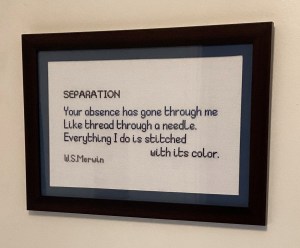 Owen died three years ago today. I wrote about his death a lot in the first year: I felt a strong urge to write about it. I needed to gather up my pain and shock and confusion and shape them into something that made some kind of sense—to bring the chaotic, unbearable feelings under some kind of control. (“In words, like weeds, I’ll wrap me o’er,” Tennyson says on In Memoriam, a poem I have returned to over and over since that first day.) I also wanted to reach out to my community of friends and readers, who showed me so much kindness, and still do. I also see now that this writing was a way of holding on to Owen by showing what I could of who he was and what he meant to me, what his loss meant. There’s a lot I don’t remember very clearly about the first few months after his death, but I do remember the way sentences would rise up in my mind and nudge at me until I used them—and the way lines of poetry would surface (as they still do), haunting me until I figured out where to put them, whether in my journal or in a sampler or in a post.
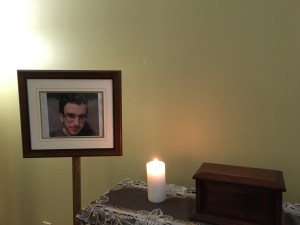 I also remember how angry it made me, in what I now know to call the “acute” phase of grief, to be told “it takes time.” Time for what? What could possibly change, with any amount of time? “My son is in a box!” I raged at the nice woman on the other end of the help line I called, before I had the right kind of person to talk to. “What difference is time going to make to that?” Seeking my own way to understand that, however I felt, time was going to keep passing, I thought about Woolf’s idea of To the Lighthouse as two blocks joined by a corridor:
One way I suppose I could think about where I am right now is precisely in a corridor between two blocks, one of them my previous life, which included Owen, and the other my future life, which will go on without him.
I have thought about that model a lot, as time has passed—time in which I have learned that both things are true, that it does take time, and that the passage of time doesn’t change how much it hurts that Owen’s life ended the way it did (or that Owen’s life itself was, to him, so painful that he ended it the way he did). When people said, kindly, helpfully, “it takes time,” I resented the implication that I would one day stop grieving, even though the prospect of feeling the way I did indefinitely was also terrible. What I think they actually meant, or should have meant, is rather that over time you learn to live with those feelings: that they do not destroy you. The grief does not end—how could it? It does not get any less—why would it? A. S. Byatt said of the death of her young son that she was haunted by the thought “He is dead . . . that will go on and on till the end of time.” People say, she said in an interview, that “after a time, you get to want to celebrate somebody’s life. All I can say is no, you don’t. It’s just terrible. It stays like that.”
The model of grief that makes sense to me now is that, as time passes, you build new layers around it: it is a lasting part of you, a big part, but it is not all of you any more. So I’m not sure that a corridor was the right metaphor. I like these lines from Julia Copus’s poem “The Grievers” a lot:
What we can’t absorb we carry in us,
a lumpish residue. It’s truly a wonder
we manage to move at all; let alone
as freely as this, with the ease at times
of our old and lighter selves.
Her emphasis on the heaviness of grief matches my own experience of it as weighty, hard to carry. I still carry it with me, but I do also sometimes move now with ease, with lightness. I am doing much better. I am stronger. I have worked hard at this: therapy is hard. The work is not done, but I am better at it too.
 Like Riley, whose meditations on grief have been interwoven with my own since almost the beginning, after three years I have nearly stopped writing about it, at least publicly. As I realized long ago, there is a terrible sameness to grief: it is repetitive, including for me. I don’t talk about it much any more either, and sometimes that’s tough, because it means I’m not always honest. How are you? Oh, fine. I’m fine. For other people, time has passed; they have moved on, and probably it seems as if I have too. I have, of course, in a way, because time does pass – for me, just not for Owen. “The dead slip away,” Riley says, “as we realize we have unwillingly left them behind in their timelessness.”
It’s a grey, foggy day here today; the lines that are pressing on my mind on this sad anniversary are Tennyson’s again, the starkest lines in In Memoriam:
He is not here; but far away
The noise of life begins again,
And ghastly thro’ the drizzling rain,
On the bald street breaks the blank day.
He is not here: after three years, what else is there really to say? But it has helped me, as always, to put some of what I’ve been feeling and thinking into words.
 She was surprised to find it more or less possible, most of the time, to follow her meal plan: it seemed that perhaps the battle was over, the endgame complete. She had followed the rules all the way to the end, until it was possible to go no further. She had met the experts’ standards until her heart and liver and kidneys failed in quantifiable and quantified ways, until other experts told her that it was time to stop and now, surely, there must be a period of grade, a little mercy.
 That instant, the memory of a long-lost word rises up in her, cut in half, and she tries to grab hold of it. She had learned that, in times past, there had been a word, a Hanja word . . . by which people had referred to the half-light just after the sun sets and just before it rises. A word that means having to call out in a loud voice, as the person approaching from a distance is too far away to be recognized, to ask who they are . . . This eternally incomplete, eternally unwhole word stirs deep within her, never reaching her throat.
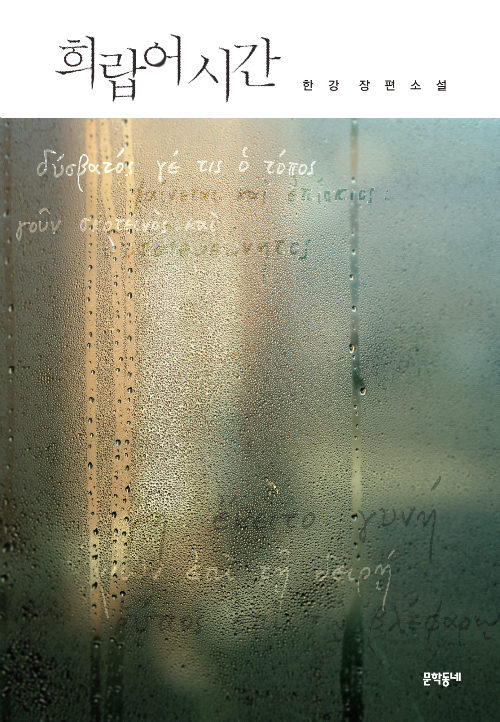 And yet overall I was captivated by Greek Lessons, not so much by its particulars as by the melancholy space it created. Ordinarily I prefer some forward momentum in a novel (both cause and effect of my specializing in the 19th-century novel for so long!). What Greek Lessons offers instead, or this is how it felt to me, is a kind of time out, from that fictional drive and also from the busy world that these days overwhelms us with “content” and noise. In the intimacy of the portrayal of these two people, both of whom are retreating from the world partly by choice but mostly from the cruelty of their circumstances, there is some recognition of how hard it is to be ourselves, to be authentic, to see each other. The quiet sparseness of Han Kang’s writing could be seen as an antidote to the pressure to perform who we are and to insist on making space for ourselves out there. (Pressured by her therapist to break her silence, the woman thinks, “she still did not wish to take up more space.”)
 November wasn’t a bad reading month, considering how busy things were at work—and considering that “work” also means reading a fair amount, this time around including most of both Lady Audley’s Secret and Tess of the d’Urbervilles for 19thC Fiction and an array of short fiction and poetry for my intro class. (I have not managed to get back into a routine of posting about my teaching, but I would like to, so we’ll see what happens next term.)
 I felt the need for something cheering in the wake of The Election and landed on Connie Willis’s To Say Nothing of the Dog: it was a great choice, genuinely comic and warm-hearted but also endlessly clever. I had a lot of LOL moments over its characterizations of the Victorian period, and it is chock full of literary allusions, many of which I’m sure I didn’t catch. A lot of them are to Agatha Christie and Dorothy L. Sayers: who know that Gaudy Night would be one of its main running references. I liked it enough that I’ve put The Doomsday Book on my Christmas wish list, even though I don’t ordinarily gravitate towards this genre.
 Novel Readings