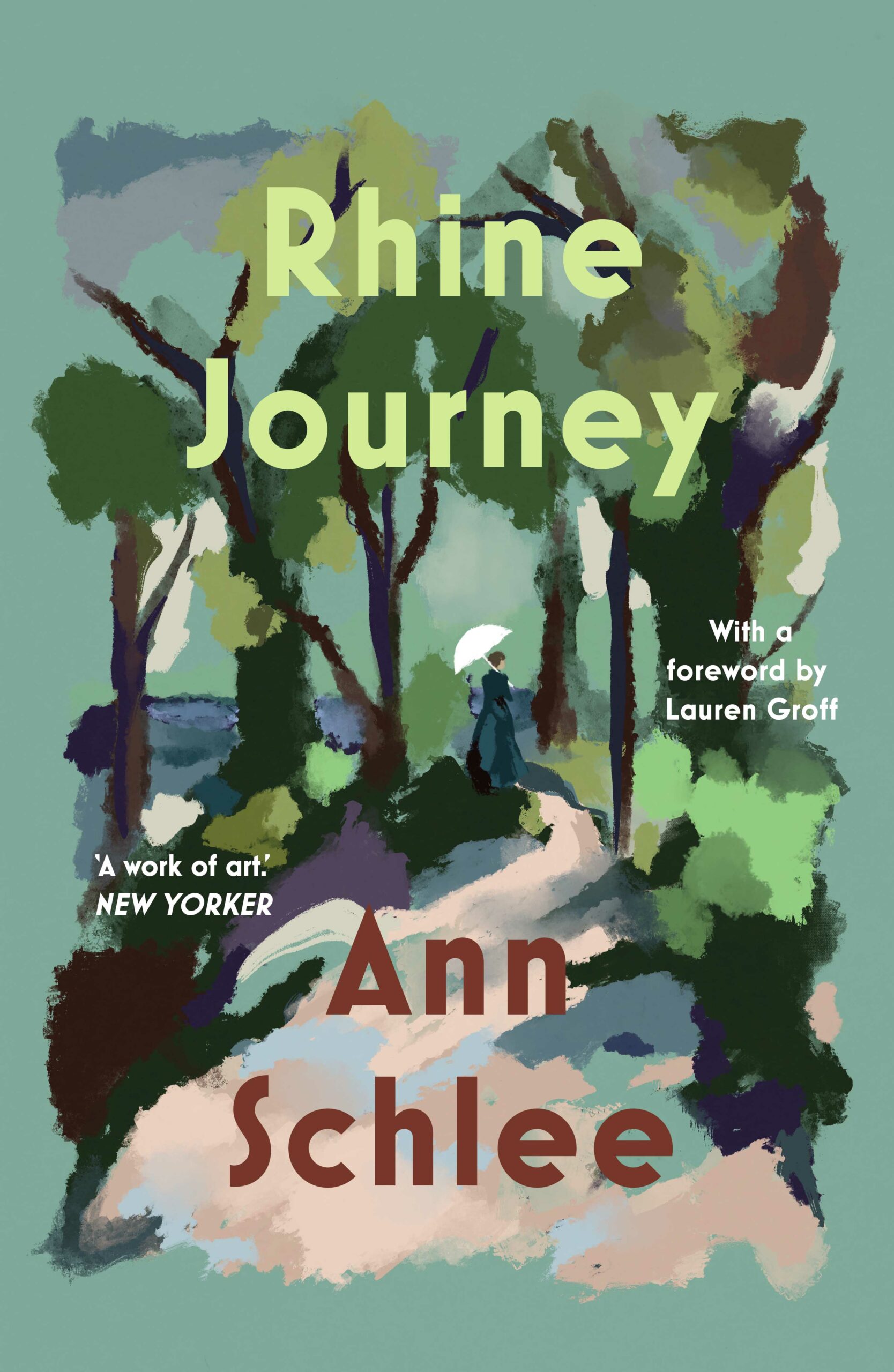
“Things That Were Herself”: Ann Schlee, Rhine Journey

She seemed to see herself moving about its unknown rooms, small bare white rooms through which the sun fell at an angle. Here she set a plant on a deep sill. There she hung the sampler she had worked for her mother as a child: her own possessions. All her adult life she had lived in houses built of deep accretions of other people’s lives. She had moved among them cautiously. But here, she herself might extend to the very walls and they would reflect back upon her, her plant, her sampler, things that were herself.

Ann Schlee’s Rhine Journey was almost too exactly the kind of novel I like. It is Lolly Willowes with a dash of Villette, or perhaps the other way around. Its protagonist, Charlotte Morrison, is stifled, repressed, mournful, and—somewhere deep inside—angry. She has no agency, or dare not claim any; she has money but doesn’t dare use it to turn herself into the main character in her own life. Her desires, like Lucy Snowe’s, manifest themselves in dreamlike fantasies shot through with both menace and eroticism; also like Lucy Snowe, she (and therefore we) can sometimes find it hard to be certain where the line is between her imaginings, conscious or not, and her reality. And like Lolly Willowes, she does finally break out of the role being assigned to her, though not in quite such a dramatic way.

Rhine Journey is a wonderfully tense and atmospheric book. Very little actually happens, and what does is largely within Charlotte’s mind, as Schlee hews very closely to her point of view—one effect of which is to make the reader chafe againstits restraints and constraints almost as much as Charlotte herself does. A sample, from a point in the novel when Charlotte has rebelled against the constant expectation that she will put others’ needs before her own, not by arguing or protesting but by taking to her bed, and then, when everyone else has finally gone away, by daring to leave it:

It would be hot in the streets. A triangle of hard blue sky came and went as the curtain blew. Idly as she lay a thin film of sweat formed between her skin and the nightdress. There was borne in upon her the luxury of being alone. And with it as the hour of eleven came and went the desire to be more entirely alone. To be out among the intensifying sounds of the city. To walk in streets that formed no pattern for her, taking a turning here or there at random, as recklessly as if at any moment she should walk off the edge of the world. To see no face that could made demand of her. The beautiful blankness of faces of whom one asks nothing not even recognition. This was what she wanted.

In the glen, a little short of Strasserhoff, it was cool. The earth smelt damp and sweet. The rushing stream sounded. Through the trees she heard the crushing of twigs and undergrowth, rapid, impatient footsteps, fleeing ahead? pursuing?

No, she cried to herself. No She must not lie here a moment longer.

It’s deft, isn’t it, the way we slip out of bed with her into that shady glen, with its hint of threat, only to realize we haven’t left yet after all?
I don’t think the novel’s plot is as important as its mood: it’s that feeling, that yearning, that insistence, so hard to acknowledge, that this cannot be all there is, that it’s not bearable to live life on these terms—this is what drives us, and Charlotte, along to the novel’s crisis, which is in a way a repudiation of Charlotte’s self-absorption. She has misunderstood: she has interpreted something as personal that was political. I found it interesting that this realization is what it takes to liberate her. Contemplating the man who has (by an accident of resemblance) been an erotic fixation for her since the first page of the novel, she suddenly sees him as someone “outside her imagination” and thus “nothing to her.” It is exhilarating: she feels “free of a great burden,” as if suddenly, or finally, she too can step outside her own mind and do something, not selfish but for herself:

She could have run towards the lighted garden so eager was she about some purpose that she had scarcely defined to herself. And all the time—so oddly the mind veers—she pictured to herself those whitened cottage rooms where she might quietly extend herself, and moving from room to room, meet and recognize herself in forms unaltered by the pressures of others upon her.

These are familiar themes and Charlotte’s is in many ways a familiar arc for readers of both 19th and 20th-century fiction, but it is all so meticulously and intensely and intelligently told that it kept me completely engaged.

My Top 10 of the 21stC (So Far)

I really enjoyed listening to Trevor and Paul discuss their “top 10 books of the 21st century so far” on their (always enjoyable!) podcast, and so I thought I’d have a go at making my own list. I agree with them that the fun of this kind of exercise is in the conversations it prompts, with other readers, but also with ourselves. There is something clarifying about the process: it can’t possibly lead to a definitive list of the “best” books by some universally reliable standard (their two lists certainly illustrate this, as there is little overlap between them!) but it is one way to discover things about yourself as a reader, first by forcing yourself to make tough  choices and then by confronting you with other people’s choices.

I certainly had a vigorous conversation (if only in my own head) with Trevor and Paul about their choices, some of which I have found unreadable (ahem, Ducks, Newburyport – but also Austerlitz, as unlike Trevor I don’t usually like “wandering” books), some of which I also thought hard about in making my own list (The Road), and some of which I am more interested in reading than before, because they spoke so eloquently about them (Flights2666). They both read so widely: I have been seeking out more translated books already but one thing I definitely said to myself as I looked over my own longlist was that I needed to do even more of that.

This fun list-making project also had its sobering side: how many of us thinking about “the best books of the 21st century” will actually know much about the books that come out in the second half of the century, after all – or even the second quarter of it? We certainly won’t be around to see what the readers of the 22nd century think of our choices, fascinating as it would be to see which of them turn out to have any staying power. Perhaps our lists will look as comically misguided as the lists of bestseller lists from the 19th century, which are full of now-forgotten names. Maybe our idiosyncratic but deeply felt preferences will be starting points for the recovery projects of the future, the next generation of Virago and Persephone and NYRB Classics and Recovered Books!

So, without further ado, here’s my own list, my personal favorites of the 21st century so far. Compiling it was not a straightforward process: many of my “best of the year” titles, for example, were written well before the 21st century, so I couldn’t just pluck them for this purpose. I also didn’t start blogging until 2007, so it’s possible I have overlooked a book I read and loved but just didn’t think of while doing this, because I don’t have a record of it. Unlike Paul and Trevor, I have not ranked my titles: they are in chronological order. I know which one I would put at the top if I absolutely had to – but it’s my blog and my list so you can’t make me. 😁 I have written about almost every one of these books here or elsewhere, so I have included the links for you to follow if you want to know more about them. (How have I never written about Fingersmith?!)

Helen DeWitt, The Last Samurai (2001)

Ian McEwan, Atonement (2001)

Carol Shields, Unless (2002)

Sarah Waters, Fingersmith (2002)

Colm Tóibín, The Master (2004)

Daniel Mendelsohn, The Lost (2006)

Hilary Mantel, Wolf Hall Trilogy (2009-2020)

Molly Peacock, The Paper Garden (2010)

George Saunders, Lincoln in the Bardo (2017)

Denise Riley, Time Lived, Without Its Flow (2019)

So, what do you think? Are any of these on your ‘best of the 21st C so far’ list? Are you aghast or just puzzled at any of them? Are any of them ones you’ve been curious about and now feel – as I do about Flights – that maybe it’s time to give them a try?

“The Sum of the Stories”: Maylis de Kerangal, Painting Time

In the clamor, Paula begins to paint, condenses the sum of the stories and the images into a single gesture, a movement sweeping as a lasso and precise as an arrow, since her painting contains at the moment something quite other than itself, gathers up the grazed knees of a five-year-old girl, the danger, an island in the far reaches of the Pacific, the sound of an egg hatching, the vanity of a king, a Portuguese sailor who bites into a rat, the rippling hair of a movie star, a writer gone fishing, the mass of time, and beneath embroidered swaddling clothes, a royal baby asleep, as if in a mythical nest, at the bottom of a shell.

Maylis de Kerangal’s Painting Time focuses on the personal and artistic development of Paula Karst, who when the novel opens is just beginning her studies at the Institut de Peinture in Brussels. She and her classmates are learning a very specific kind of painting: decorative painting or trompe-l’œil, the art of making one surface look like another, usually wood or marble or, as Paula chooses for her graduation piece, tortoiseshell. One of the recurring topics is whether this work is really painting, really art: is copying or recreating really, itself, creative? Or is it just highly skilled trickery? The goal of their painting is for the artistry to be indiscernible: is that all that really distinguishes it from painting that you know is painting? Doesn’t all art at least begin with copying, and isn’t copying also about preserving and sharing imagery that otherwise many people would never see for themselves?

These questions, both theoretical and philosophical, lurk but don’t dominate the novel. After graduation Paula and her friends deploy their training everywhere a deceptive surface is wanted, from hotel lobbies to movie sets. I didn’t feel that the story of Paula’s movement from one job to another had much momentum or interest: I didn’t have a strong sense that she was growing or changing as a person or an artist, though we are sometimes told that she is. The often highly technical descriptions of her work were more interesting, and I wondered if maybe that effect was deliberate on de Kerangal’s part, as the novel also seems quite engaged with ideas about the broad sweep of history as signaled by art history, with the artefacts and images ultimately outlasting their creators.

From this point of view, Paula is just one more painter, a point that is particularly emphasized by the final section in which she is hired to help complete a reproduction of the caves at Lascaux. To do this work, and indeed any of the painting she undertakes across the novel, Paula has to submerge herself in other times and places, in materials and processes, a kind of subordination of the self. Maybe this is how the novel asks us to think about decorative painting: instead of the insistent idiosyncrasy of works by the ‘great masters,’ which endlessly and beautifully and vexingly foreground their styles and their selves—their individual preoccupations—Paula and the other graduates of the Institut de Peinture disappear into the wood grain, the marbling, the cracks in the faux stucco. This erasure of the self makes an odd underlay for a book that is structured as a Bildungsroman or a Kunstlerroman, implicitly challenging the way those familiar fictional models drive our sense of what gives a life meaning, or what constitutes greatness or success in art.

An interesting book, then—but not, for me, a very engrossing one. Still, I enjoyed sections like this, which appeal to my longstanding fascination with ‘neepery’:

They’ve learned to glaze, to score, to soften, to stipple, to moiré, to lighten, to create a little iridescence with a polecat-hair round brush or an eyelet in the glaze with the brush handle, to draw short veins, to speckle, to wield the palette knife, the squirrel-hair two-headed marbling brush and the pitch pine brush, the large and the small spalter, the flat brush, the billiard cloth, and the burlap; they’ve learned to recognize Cassel earth and Conté, light cadmium yellow and cadmium orange; they’ve painted these same Renaissance ceiling angles with pudgy little cherubs, these same raspberry crushed silk draperies plunging from the cornices of Regency giltwood beds, these same Carrera columns, these same Roman mosaic friezes, same granite Nefertitis, and this apprenticeship has transformed them together, has shifted their language, marked their bodies, fed their imaginations, stirred their memories.

I also really enjoyed the sections about the discovery of the Lascaux caves: “For three days,” Paula tells us of the boys who first happened upon it, “they explored the cave, three days in which they toiled at extending the known world—extending known space and time—our great work.” Ah, the humanities.

Painting Time is translated from the French by Jessica Moore.