Ah, those days . . . for many years afterwards their happiness haunted me. Sometimes, listening to music, I drift back and nothing has changed. The long end of summer. Day after day of warm weather, voices calling as night came on and lighted windows pricked the darkness and, at day-break, the murmur of corn and the warm smell of hayfields ripe for harvest. And being young.
If I’d stayed there, would I always have been happy? No, I suppose not. People move away, grow older, die, and the bright belief that there will be another marvelous thing around each corner fades. It is now or never; we must snatch at happiness as it flies.
I had heard A Month in the Country referred to so often, with such admiration, that I avoided it, rather cynically, for years, doubting it could live up to the hype. Now I wish I hadn’t: it is perfectly lovely—although if you haven’t read it, please don’t interpret that as meaning it is lightweight “feel good” fiction. It isn’t even bucolic, despite the title, and despite Carr’s wonderful evocations of the country landscape that envelops Tom Birkin when he goes to the village of Oxgodby to restore the obscured medieval mural in its otherwise unremarkable church:
The rain and ceased and dew glittered on the graveyard grass, gossamer drifted down air-currents, a pair of blackbirds picked around after insects, a thrush was singing where I could see him in one of the ash trees. And beyond lay the pasture I had crossed on my way from the station . . . then more fields rising towards a dark rim of hills.
It’s a tiny novel, a novella really, and one thing that makes it so remarkable is how much is in it even as so much is deftly left out. It is, as Tom says of the view from his window, “immensely satisfying.” We get just enough detail, about, for instance, the horrors Tom experienced during the war, or his grief about his broken marriage, to feel how deeply wounded he is, and yet we know this only from glancing references or occasional confidences, never from extended exposition. Tom doesn’t want to dwell on these painful things, but we understand that they are always with him, no matter how little he says about them, and because what he does say is so devastating. Carr also doesn’t offer us, or Tom, a month in the country as the simple cure for what ails him. This is no Eat, Pray, Love: in this book, trauma is trauma and stays that way, even as its sufferers discover that, though unrecovered, they still have the capacity for love and joy.
 Throughout the novel there is a neat but never pat association between the restoration of the mural and Tom’s reconnection with a world full of life and colour—and along the way we get to follow Tom’s growing excitement about the painting itself, which he comes to believe is a true masterpiece:
It was breathtaking. (Anyway, it took my breath.) A tremendous waterfall of colour, the blues of the apex falling, then seething into a turbulence of red, like all truly great works of art, hammering you with its whole before beguiling you with its parts.
You can tell, although the point is never forced on us, that the restoration process is at once literal—described with rich technical detail, inviting us to marvel at the human capacity for creation and the way art touches and enlivens us across time and difference—and metaphorical, with the painter’s dedication to his task, in the full expectation that it will not last, that it will be lost to obscurity, standing in for our own commitment to our lives, which also will not last, which will also be obscured by the relentless passage of time. Faced with that prospect, we can either throw ourselves into it, as the artist does, giving it the very best we have, or retreat, succumb, despair. But spelling it out like this spoils it a bit, just as Tom knows that if he tries too hard to perfect the details of the uncovered painting he risks ruining it.
Tom is tempted to idealize his time in the country, but he recognizes and resists the lure of nostalgia, even for lost love, and this is the smartest thing about the novel: it at once celebrates and refuses the dream of what might have been. The promise of that idyllic interlude could never be sustained, or regained:
We can ask and ask but we can’t have again what once seemed ours for ever—the way things looked, that church alone in the fields, a bed on a belfry floor, a remembered voice, the touch of a hand, a loved face. They’ve gone and you can only wait for the pain to pass.
“All this happened so long ago,” Tom says at the end of the novel, “and I neve returned.” There is deep sadness at the irrevocability of his loss, but in leaving he also preserved the memory (“it stays as I left it”), which will never lose the beauty of its unfulfilled promise.
 Novel Readings
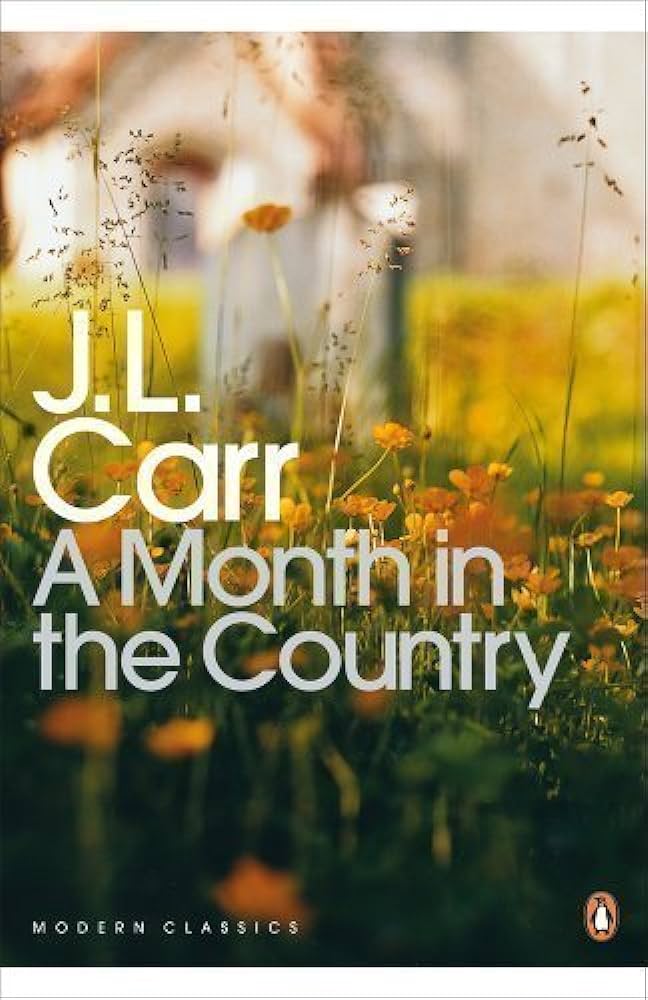
What a lovely review for a cool night after a simmering day in the country. No medieval churches though. I’ve been reading Richardson’s All the Colour in the World, and A Month in the Country seems a perfect next up. Those blues of the apex falling, that seething red. I ordered the edition at the top of the review, for the sultry orange on the cover, and the Holroyd introduction. Thank you for bringing it to my attention.
LikeLiked by 1 person
I finished the book over six weeks ago and have not yet been able to put it away on a bookshelf. Just looking at the cover brings me back to Tom’s world.
LikeLiked by 1 person
Very nice description of a book that I found a little slippery.
LikeLike
A lovely review of a beautiful, deeply felt book. I love what you say about the way Tom recognises but resists the lure of nostalgia. It’s hard to think of another book that captures the fleeting nature of time so effectively – as your opening quote highlights, the importance of snatching at happiness before it evaporates.
LikeLiked by 1 person
I’ll have to look for a copy of this one; thanks for bringing it to my attention.
LikeLike
This has been on my radar a long time as well…it’s clearly time to put it at the front of the queue!
LikeLike
Highly recommend!
LikeLike
I’ve finally read it and it did not disappoint! Have you come across any other of Carr’s works?
LikeLike
There aren’t many perfect books but I believe this one is. Every word counts.
LikeLiked by 2 people
I loved this novel so much and have been reading reviews of it all over the internet since I finished it in September! This was such a thoughtful examination of how the book avoids idealizing a moment in time. Thank you.
(And I also read Cassandra at the Wedding in 2024!)
LikeLike