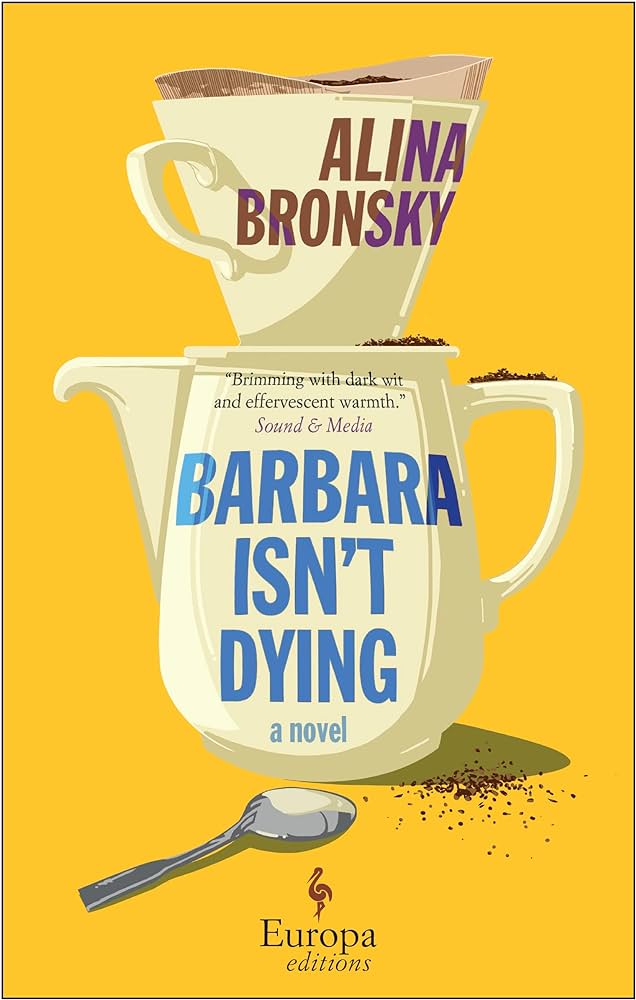
 April hasn’t been a bad month for reading, overall. I’ve already written up Dorothy B. Hughes’s The Expendable Man, and it certainly stands out as the best of the bunch – but Alina Bronsky’s Barbara Isn’t Dying is a very close second, and if I were ranking based purely on pleasure, it would be tops.
Barbara Isn’t Dying (translated from the German by Tim Mohr) is wry, funny, and poignant. It follows the struggles of dour Walter Schmidt, who wakes up one morning to find that his wife Barbara is ill and unable to do the cooking and cleaning and laundry and everything else she does that until then Walter has taken for granted. Walter, who begins the novel not even knowing how to make coffee, has to figure out how to get by, which he does partly through his own stubborn persistence and partly because he just keeps asking how to do things and people answer, from the young woman in the nearby bakery to the Facebook followers of a famous cooking show Walter happens upon. (His Facebook experiences are pretty hilarious: he has no idea at all how the site works or who these people are replying to the posts he makes under Barbara’s name.) As the novel goes on, Walter doesn’t just learn to cook but also learns to be a better person, a better husband, and a better father, a predictable arc, perhaps, but Bronsky isn’t heavy-handed about it, and Walter never becomes a very lovable guy. (For one thing, there are a few too many times when he tries hard to remember if he ever hit Barbara in the past – he’s pretty sure he didn’t, but the question itself is unsettling.) We also learn more about what Barbara had to deal with in their marriage before her illness, and we watch Walter make his rather lumbering way towards repentance and repair. Some of it will be too late, but not all of it, and that matters.
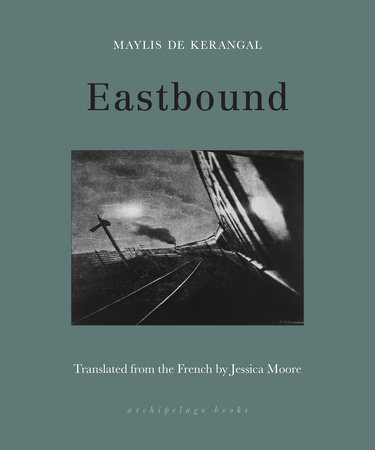 I read Maylis De Kerangal’s Eastbound in one sitting, not just because it’s short but because it’s very suspenseful and I really wanted to find out what happened! I ended up thinking that the novel’s success in this respect worked against the quality of my reading of it, because I didn’t linger over the aspects of the novel that make it more than just a thriller. The story is very simple: a young Russian soldier on a train to Siberia decides to go AWOL and is helped in his attempted escape by another passenger, a young French woman. Will he succeed, or will he be discovered and pay the price? Anxious to know, I paid less attention than I should have to the descriptions of the landscape scrolling past them – though I did appreciate them, I didn’t really think about them, and a reread of the novel would probably show me more metaphorical and historical layers to the characters’ journey. Some other time, maybe, as I had to return my copy to the library! But even my brisk reading showed me why Trevor and Paul were so enthusiastic about the book.
My other reading has been more desultory. I enjoyed Richard Osman’s The Last Devil to Die, a lot more than the first one in the series which I read a year or so ago. I also enjoyed Adrien McKinty’s In the Morning I’ll be Gone, which I read as part of my ongoing scouting for possibilities for my mystery class – I wouldn’t assign it, but it was a gripping read. I read Steph Cha’s Your House Must Fall for the same reason and also would not assign it, although that’s as much because it does not really have the form of a mystery (I’m specifically ‘shopping’ for police procedurals) as because I found it – despite the compelling social and historical contexts it deals with – a fairly plodding read. I DNF’d Qiu Xiaolong’s Hold Your Breath, China for similar reasons. I am definitely taking advantage of living walking distance to the public library: it is great being able to wander in and pick up a few things to sample. (I also now live within walking distance of Bookmark, where it is also very tempting to wander in and pick up a few things – such as Barbara Isn’t Dying!)
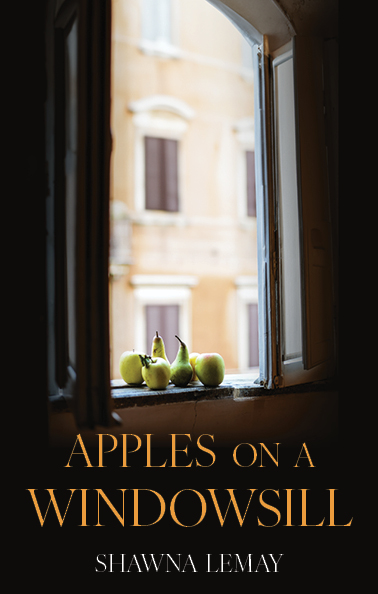 My current reading is Shawna Lemay’s Apples on a Windowsill, which is (more or less) about still lifes as a genre, but which roams across a range of topics in a thoughtful and often beautifully meditative way. A sample:
Why is it that this moment of transcendence induced by a still life, this seeing through to the other side, this opening or loophole where we drop into the sheer mystery of being, is so interesting to me? I think it’s because it also contains the promise of the moment after. A still life stops time, is out of time, occasionally offering the viewer that rupture/rapture. It is also suspenseful. The question hovers: what happens next? And it gives us an interval to dream new possibilities. It affects us, and it affects how we walk through this world, into the loophole, beyond the threshold, our eyes open, awake.
This genre – what is it, exactly? personal essay? pensées? – isn’t always, or even usually, my thing, but I have had an interest in still lifes myself for a while, not an expert interest but just a curiosity, a desire to look more closely at them. I particularly like ones with glassware, like this one by Pieter Claesz:
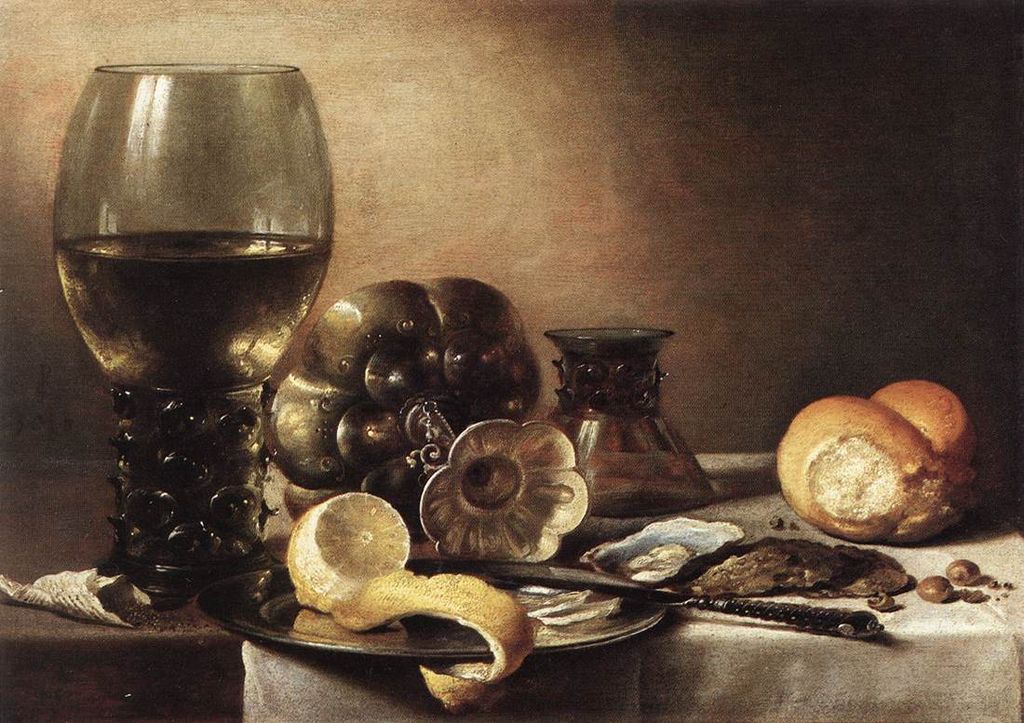
I find that wine glass mesmerizing. I also follow Lemay on Instagram and had enjoyed and been intrigued by her posts of still lifes she composed and photographed. I am appreciating the book’s commitment to finding beauty in every day objects, and to encouraging us to find everything, from quotidian objects to our own faces, worth looking at. The chapter I just read, “An Ugly Woman,” includes discussion of selfies, that much-maligned genre, which Lemay says she finds “potentially beautiful and ridiculous and fun and ultimately sublime attempts to capture your own soul when others have perhaps failed. We’re not movie stars,” she goes on, “but we exist right now at this exact moment and one day we won’t.” Why not record that moment, then? And she is eloquent about “people who are not airbrushed, who have wrinkles, and other tics and quirks.” “What would happen,” she asks, “if we were all able to imagine our wrinkled selves as fucking cool looking?” What indeed?
 Novel Readings
The only one of these I’ve tried is ‘Eastbound’, and yes, it does fly by!
LikeLiked by 1 person
Oooh, Barbara Isn’t Dying sounds excellent; I will get myself a copy, stat. I’m already booked to read the Hughes novel on my flight down east next month…
LikeLike
I think Hughes will make the time fly by! (Pun sort of intended.) 🙂
LikeLiked by 1 person
Rohan, thank you for this! Not sure how it escaped my notice until now 🙂 I really appreciate the mention!
LikeLike