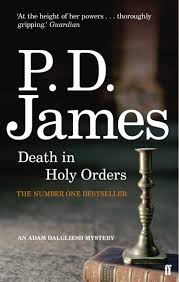
 That’s not actually the title of any of P. D. James’s novels, of course: it’s the basic plot of Death in Holy Orders, which I just finished rereading for the first time in a decade or more. Coincidentally, when I picked it more or less randomly out to revisit, I had also just reread Trollope’s The Warden, and so I had rigidly self-righteous Archdeacons on the brain even before James’s Archdeacon Crampton met his bloody end–then James herself made the Trollope connection explicit by having one of her characters read aloud from Barchester Towers with the deliberate intent of “discomforting the Archdeacon.”
The passage he reads is from the novel’s first chapter, in which the gentle and unworldly Bishop (known to us from The Warden as Mr. Harding’s great friend) is on his deathbed. “Nothing could be easier,” Trollope’s narrator assures us, “than the old man’s passage from this world to the next.” Things are more complicated, however, for his ambitious son, Archdeacon Grantly:
By no means easy were the emotions of him who sat there watching. He knew it must be now or never. He was already over fifty, and there was little chance that his friends who were now leaving office would soon return to it. No probable British prime minister but he who was now in, he who was so soon to be out, would think of making a bishop of Dr. Grantly. Thus he thought long and sadly, in deep silence, and then gazed at that still living face, and then at last dared to ask himself whether he really longed for his father’s death.
The effort was a salutary one, and the question was answered in a moment. The proud, wishful, worldly man sank on his knees by the bedside and, taking the bishop’s hand within his own, prayed eagerly that his sins might be forgiven him.
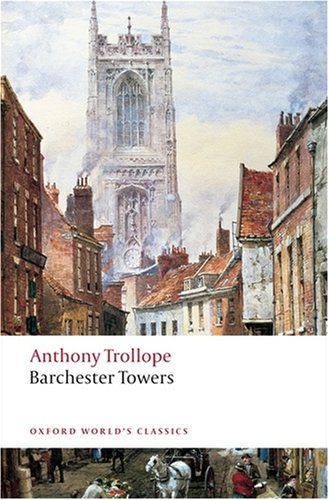 It is, as the provocateur who reads it aloud remarks, “one of the most impressive chapters Trollope ever wrote,” full of pathos, moral tension, and psychological insight. Our disgust at the Archdeacon’s selfishness is quickly countered by his own rueful self-knowledge and sincere penitence–and by Trollope’s explicit rebuttal of those who think he was “wicked to grieve for the loss of episcopal power, wicked to have coveted it, nay, wicked even to have thought about it, in the way and at the moments he had done so.” Ambition is natural in any profession, Trollope notes, and we “can hardly hope to raise the character of the pastor by denying to him the right to entertain the aspirations of a man.”
He rose with even greater vehemence to Archdeacon Grantly’s defense at the end of The Warden, a defense not against imagined external critics but against his own authorial choices:
We fear that he is represented in these pages as being worse than he is; but we have had to do with his foibles, and not with his virtues. We have seen only the weak side of the man, and have lacked the opportunity of bringing him forward on his strong ground. . . . On the whole, the Archdeacon of Barchester is a man doing more good than harm,—a man to be furthered and supported, though perhaps also to be controlled; and it is matter of regret to us that the course of our narrative has required that we should see more of his weakness than his strength.
Trollope typically resists absolutes of either virtue or vice–and that is one reason murder of the particularly calculated and brutal kind that takes place in Death in Holy Orders is so unimaginable in his world. Its cruelty and its finality obliterate ethical ambiguity; such an act disallows the nuance that is Trollope’s moral stock-in-trade.
 That said, James and Trollope do have a lot in common. James herself points to Austen, Eliot, and Trollope, rather than the Gothic or sensation novelists, as her chief fictional influences, and you see it in her patient, probing characterization as well as her meticulous attention to setting. Reading Death in Holy Orders so soon after The Warden I was struck by their shared interest in the Anglican Church as an institution defined both by its corporate identity and by the characters of the individual men who embody it, with their ideals and their faith but also their ambition, greed, and vanity. Both novels also depict the Church as an institution in which continuity and tradition are under constant pressure from changes without and within, and in which the laudable aim of preserving what is good can too easily be twisted into a justification for tolerating what is bad.
In both books, too, it is the self-righteous Archdeacon who epitomizes many of the worst tendencies of the priesthood they belong to, including self-righteousness, arrogance, and a preoccupation with worldly practicalities. While Trollope, as shown, wraps Archdeacon Grantly in the protective padding of his own humane understanding, James and her characters show no such forgiveness towards Archdeacon Crampton, who is universally hated. This is a formal necessity in a murder mystery, to be sure: more than one person must have a sufficient motive to be a plausible suspect, or where’s the puzzle? But it’s the specifics that are thematically revealing–and that turn out, in James’s case, to be a bit disturbing.
If Crampton, like Dr. Grantly, were “a fitting impersonation of the church militant here on earth,” a rigid defender of the status quo, the dislike both Archdeacons provoke could be neatly interpreted (as I think it can be, in Trollope’s case) as a call for the Church to reform, to live up to its professed spiritual ideals rather than insisting indignantly on its worldly authority and privilege. Instead, however, it turns out that one of the main reasons Crampton is disliked is that he was overzealous (as the other characters see it) in prosecuting a priest, Father John, accused of sexually molesting young boys. “The offences had been more a question of inappropriate fondling and caresses than of serious sexual abuse,” reflects Father Martin, another of the priests at the Seminary where Father John now resides, and the punishment might have been light if Crampton hadn’t “busied himself in finding additional evidence,” as a result of which Father John ended up serving time in jail. Father Martin considers Crampton’s pursuit of Father John “inexplicable”: “there was something irrational about the whole business.”
Everyone at the Seminary is sympathetic towards Father John, who seems as kind and unworldly as Trollope’s aged Bishop. If their tolerance were shown as priests closing ranks to protect one of their own, or the Church more generally, from damaging exposure, that would be one thing: then, again, a critical inference could be drawn–especially if solving the murder required them eventually to confront and regret their defense of a convicted pedophile, however otherwise likable he might be. Alternatively, I suppose, Father John’s case could have been used as an explicit model of sin, penance, and forgiveness: he has done his time, and if he were remorseful it could be worth exploring how or whether he was entitled to regain his standing in the Church. Unfortunately, though, the novel overall offers nothing to counter Father Martin’s perspective that Father John has been hard done by: that he has been punished with undue severity for a little harmless “fondling” of choir boys. It’s not just his fellow priests but also Emma Lavenham, English professor and emergent love interest for Commander Dalgliesh, who treats him with indulgent kindness; Dalgliesh himself, James’s moral avatar, expresses more concern about Father John’s trial and imprisonment (“which must,” he reflects, “have been an appallingly traumatic experience”) than he does about the priest’s young victims, whose trauma goes unacknowledged by anyone. Apparently it’s not that the Church needs to be held accountable for enabling and sheltering Father John but that his accusers, the Archdeacon among them, by making much ado about almost nothing, should be ashamed for blighting a good man’s life.
Death in Holy Orders does not ultimately turn on Father John’s history with the Archdeacon; his backstory is not central to the murder investigation but simply adds another (supposedly) unpleasant dimension to what we know about the murder victim. I suppose that could be an argument for not paying too much attention to it, except that the more I think about it, the more creepy that makes its treatment. It’s hard not to conclude that James herself considers accusations of that sort incidental–a lot of unnecessary and damaging fuss in a world, and a Church, with bigger problems. Surely, though, her reforming Archdeacon deserved at least as vigorous a defense as Trollope’s: that James allows Crampton to die cruelly and unmourned puts James out of step with the literary lineage she claimed.
 Last week and this week, actually. That’s not quite all I’ve been doing since classes wrapped up on April 10: there has been a spate of committee work, and also (one of the less pleasant features of this time of term) some academic integrity hearings, which take up a fair amount of time. Then on the home front, Maddie was in her high school’s production of The Drowsy Chaperone, which had its four-performance run April 19-21, so in addition to ferrying her to and from rehearsals and doing what I could to mitigate the stress on her schedule in other ways, I’ve also been to two performances–which, on the bright side, was the most fun I’ve had in ages. (In case you know the musical, she played Mrs. Tottendale, with great comic flair. The whole cast was great, actually, as was the production, especially the costumes.)
 I’ve been too busy and distracted to settle in for any intense reading, though I did join a few Twitter friends in reading The Warden last weekend. Then I had to take all the books off my mystery bookcase (we needed to move it out of the way temporarily, to do a household project) and in the process of sorting them I was reminded how long it has been since I read most of my P. D. James collection. I’ve put An Unsuitable Job for a Woman back on the reading list for Mystery & Detective Fiction in the fall, so it seemed like a good time to revisit one or two. As a result, I’m happily rereading Death in Holy Orders, which turns out to follow very well on The Warden as it has a number of explicit references in it to Barchester Towers. James herself said she saw the 19th-century novelists as her predecessors more than the Golden Age mystery writers, and in a book like this, that genealogy is clear. There are plenty of murderous moments in Trollope but his world is (mostly) too genial a place, his morality too committed to shades of grey, to allow for outright irremediable violence. (There are exceptions, of course). Like Trollope, James is very good at depicting institutions, with all their intricate politics and emotional dynamics. She’s also exceptionally good at setting, something I emphasize when we discuss Unsuitable Job (where the beauty of Cambridge makes a poignant contrast to the horrors of the novel’s central crime). After reading several hastier or lazier stylists in this genre recently, I am appreciating the leisurely pace of her descriptions, along with the meticulous depth of her characterizations. I don’t like all of her novels equally, but when she is good, she’s very very good.
 I am glad, therefore, that one of the tips I got on Twitter (initially from
 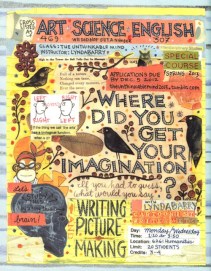 Still, my curiosity was piqued, so I decided to stop trying to figure the book out (which is a hard habit for an academic and literary critic to break!) and just browse around in it for a while to see what it might have to say to me. It turns out it did speak to me: both to the part of me that wants to, but is afraid to, put pencil to paper and draw something, but also, and perhaps more significantly, to the part of me that writes stuff. This is because Syllabus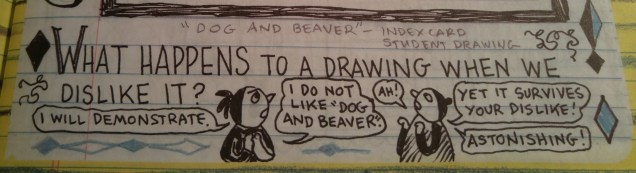
 One particular bit from Syllabus that I know I will keep thinking about is the one I chose as my epigraph for this post, about abandoning activities we are bad at. I’ve often thought that one of the best things about advancing through life, and particularly through one’s education, is the freedom you gain to abandon things you dislike and/or aren’t good at. As I’ve often said to my own children, one of the best things about university is that you can finally choose your courses to play to your interests and strengths. It’s not that I don’t think we can get good (or at least better) at things: I wouldn’t be a teacher if I believed that! I believe in program requirements, too, because that’s how we discover what else we might be good at, or want to be good at, or just put a lot of effort into. (


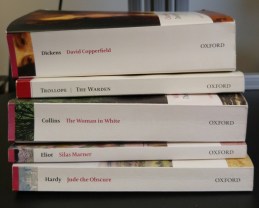 As if things in this term’s classes aren’t busy enough (and about to get busier, as next week I get in both sets of term papers and give the final exam for Pulp Fiction) but book orders for next fall were also due. It’s not a set-in-stone deadline, and quite reasonably a lot of my colleagues put it off until the summer, but I’ve actually been playing around with possible book lists for my Dickens to Hardy class since Austen to Dickens wrapped up last term, so I figured I could at least get that one settled.
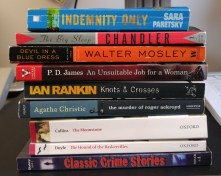 In the end I also submitted my book order for Mystery and Detective Fiction today. If I’d waited I might have made more changes to what has become my ‘standard’ book list for the course, but though I have been considering some more recent Canadian books for inclusion, I wasn’t completely convinced either of them would work well in class (
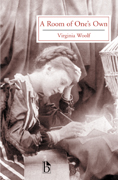 Those are my only two courses for the fall and then I’ve got a half-year sabbatical next winter, so that’s it: my book orders for next year are done! For the first time in a long time I’m not teaching a first-year class in 2018-19. I’m glad, not because I don’t enjoy teaching introductory classes but because I want to think carefully about which one I’ll teach next, and especially about whether I’ll put in for Pulp Fiction again. We recently revised
  Novel Readings