“But which?” Jo Walton, My Real Children

MyRealChildren_Jo-WaltonWhich were her real children? Poor Doug and dear Helen and brilliant George and troubled Cathy? Or sensible Flora and wonderful Jinny and talented Philip? Was Sammy or Rhodri her favorite grandchild? Only one set of them could possibly be real, but which? She loved them all, and there was no real difference in the quality of her love for them.

Is there a name for the genre of novel that tells one person’s story from birth to death? Bildungsroman isn’t right, as the point in this case is not development towards a place in the world but rather passing through the world, through the ages of life, from start to finish. Any Human Heart would be an example, and so would A God in Ruins (tricks aside), or Moon Tiger. I suppose ‘biographical novel’ would do, but that sounds dull so I’m going to call them “soup to nuts” novels and then claim My Real Children for the list  — though Walton’s trick here is to double it up, giving us not one but two stories of the same person’s life. In a way it’s Life After Life Lite, and it’s hard not to wonder if Walton was influenced in any way by Atkinson’s success. Perhaps she was just annoyed by it, as My Real Children did not, as far as I can tell, get anything like the attention, but then, both the premise and the execution of Walton’s novel are less showy than Atkinson’s.

My Real Children might also be called a “fork in the road” novel: its deceptively simple premise is that its protagonist, Patricia, is confronted with a dramatic “now or never” choice, a proposal, and her decision shapes everything about her subsequent life. But the novel opens with the elderly Patricia “very confused” in her nursing home, unable to remember which life — the “yes” life or the “no” life — she actually lived, and the rest of the book takes us in alternating chapters through both possibilities. That in itself gives Walton plenty of interesting things to do, not the least of which is working out how Patricia’s character is itself affected by the events of her life, either as “Tricia,” who marries Mark, or as “Pat,” who does not. What is fundamental to someone’s identity and what is susceptible to experience? How does someone’s individual personality express itself under different circumstances? How, to look at it from our point of view, can we see double and yet accept the Patricia of the novel’s opening and closing as the same woman we’ve followed along two such different paths? Walton does this with both ingenuity and some subtlety, I thought: arriving back at the nursing home, there’s no awkwardness, no dislocation, as the histories merge.

Both stories are also persistently interesting, though there’s not much artful about Walton’s narration: it’s one-thing-after-another storytelling, without flourishes (the governing premise aside, obviously). Both lives have their share of joy and sorrow, but the highs and lows are related with the same flat affect throughout, so that (for me, anyway) scenes that might have been moving or uplifting were not, or not very. Since the novel sounded the same all the time, I also sometimes forgot which story I was in at the moment and had to ferret around for the last time Patricia was named — and sometimes, even then, to consciously remind myself what that name meant about which story I was following. The sense of a life (or lives) unfolding, though, has its own momentum and, eventually, inevitably, its own poignancy.

There is one other dimension to My Real Children: in both cases, the backdrop to Patricia’s (or Tricia’s or Pat’s) life is not quite 20th-century history as it actually played out but an alternative version — one in which, for instance, John F. Kennedy is killed by a bomb, or the stand-off over Cuba leads to nuclear bombs falling on Miami and Kiev. I didn’t try very hard to keep track of how these variations played out in each case, but at the end of the novel Patricia helpfully sums them up:

Trish’s world was so much better than Pat’s.  Trish’s world was peaceful. Eastern and Western Europe had open frontiers. There had been no nuclear bombs dropped after Hiroshima, no clusters of thyroid cancer. There had been very little terrorism. The world had become quietly socialist, quietly less racist, less homophobic. In Pat’s world it had all gone the other way.

Are these world-historical differences in any way the result of her choices, as her different personal lives are the consequences of her answer to Mark’s marriage proposal? Why is the “better” world the one in which she accepts that early proposal? Is there any necessary connection, she wonders, between her own loss (it’s a terrible marriage) and the world’s gain? She alludes to the “butterfly effect“: I didn’t notice any hints along the way that  we were supposed to make causal connections of that sort, but that might be because I was focusing primarily on the personal elements of the story. This section at the end made me think I might have underestimated the novel I was reading. I found the alternative history aspect mostly just a distraction: I couldn’t see (still can’t really see) why the novel couldn’t have played out its two possible versions of events right here in the real world. Dorian pointed out on Twitter that it wouldn’t really make sense to do that — that’s the unbearable lightness of being, after all. And yet there’s nothing stopping a novelist from playing with possibility in that way, and Walton could have left it open-ended which version, if either, was the “truth” of Patricia’s life.

As it is, though, we’re left with a metaphysical puzzle and also a moral puzzle, both without an answer:

She had made a choice already, one choice that counted among the myriad choices of her life. She had made it not knowing where it led. Could she make* it again, knowing?

The only constant, it turns out, is love: “Whichever way she chose she’d break her heart to lose her children. All of them were her real children.” I liked that, and I was also touched by the evocation of old age that frames the novel, and by the idea of confusion that just might, in its own way, be knowledge.


*My edition actually says “Could she made it again, knowing?” So did the hardcover edition I could ‘look inside’ on Amazon. It’s a mistake, I’m sure, so I’ve made what I think is the proper correction.
“An Act of Reconstruction”: Carol Shields, Swann

swann

The faces of the actors have been subtly transformed. They are seen joined in a ceremonial act of reconstruction, perhaps even an act of creation. There need be no suggestion that any of them will become less selfish in the future, less cranky, less consumed with thoughts of tenure and academic glory, but each of them has, for the moment at least, transcended personal concerns.

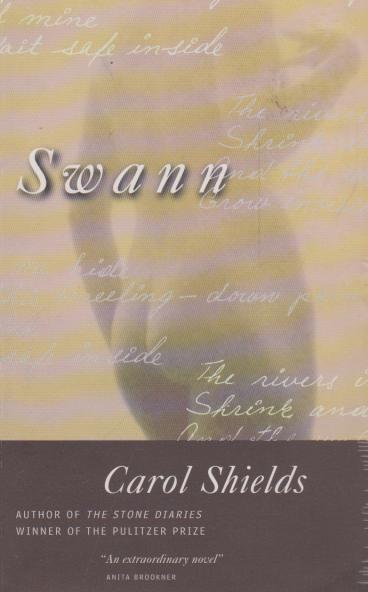
Carol Shields’ Swann is a very clever book — too clever for me, in the end, because as it went on it became more and more clearly a conceptual set-up, the people in it more evidently pieces in a game. I like novels to have ideas. I think I probably criticize more novels here for lacking intellectual depth than for sacrificing character or feelings to abstractions. But the novels I like best (including Shields’ Unless) balance head and heart: they are both thoughtful and, at some level, sincere about their characters’ humanity. There are certainly touches of that sincerity in Swann, especially in the section about town librarian Rose Hindmarsh:

She cannot possibly be the one who set in motion the chain of events that led to Mary Swann’s death since she has never been capable of setting anything in motion. Never mind her work in the town office, in the library, and in the museum — she has always known, not sensed, but known, that she is deficient in power. So many have insisted on her deficiency, beginning with her dimly remembered soldier father who failed to come back home to Nadeau to take his place as her parent, and her grandmother who told her, moving leathery gums stretched with spittle, that she had the worst posture ever seen in a young girl, and her mother who said looks weren’t everything …. and the seditious blood that is pouring out of her day after day after day, making her weaker and weaker so that she can hardly think — all this has interfered with her life and made her deficient in her own eyes, and it is this that mercifully guards her against self-recrimination, from believing she is someone who might possibly have played a part in the death of the poet Mary Swann. Rose is a person powerless to stir love and so she must also be powerless in her ability to hurt and destroy.

For me, Rose’s deficiencies show Shields’ strength: she’s great at hitting that fine line between pathos and poignancy, creating sympathy without overloading us with sentiment. In Unless, she controls these elements with her acerbic first-person narrator. In Swann, though, I felt that she subordinated these emotional layers to the point she wanted to make.

So what is that point? I think (to put it bluntly and thus, inevitably, reductively) it’s that criticism is inimical to art. Swann opens with Sarah Maloney, a feminist professor (at 28, already somehow the author of a bestselling book based on her Ph.D. thesis — yup, that happens all the time!) now building her reputation as an expert on an obscure rural Canadian poet whose work she “discovered” in a classic act of feminist literary recuperation. She narrates one section; Morton Jimroy, who’s writing Swann’s biography, narrates the next; our sad friend Rose, who rather exaggerates how well she knew Mary Swann personally, gets a section; and then Frederic Cruzzi, who published Swann’s slim oeuvre. The final section brings them all together (about this part, more in a minute!).

All of the individual parts have their charms. Even Jimroy, who’s a self-absorbed twit, is occasionally endearing, especially in his meditations on the imperfect glories of biography:

The disjointed paragraphs he is writing are pushing toward that epic wholeness that is a human life, gold socketed into gold. True, it will never be perfect. There are gaps, as in every life, accidents of silence and misinterpretation and the frantic scrollwork of artifice, but also a seductive randomness that confers truth. And mystery, too, of course. Impenetrable mystery.

His phrase “impenetrable mystery” is a hint, it turns out, at the futility of everyone’s attempt (or pretense) to really know Mary Swann. The more they think they know about her, or claim to know about her, the more elusive she turns out to be. Sarah wonders how a woman who seems in every other way to have been unbearably ordinary could have produced extraordinary verse; Jimroy struggles to grasp what her life was like and how it might connect to or illuminate her poems; Rose builds her minimal acquaintance into a story of intimacy that she knows is illusory; Frederic Cruzzi knows almost nothing about Swann herself but is the only one who knows the poems on which everyone else’s interest hangs are themselves already half-truths salvaged from ruined manuscripts. As they try to create a full picture, the scraps of evidence one by one disappear, leaving them less and less certainty. Though there is a story about where all the evidence went, the literal explanation is clearly much less important, thematically, than the symbolic one: their subject evaporates, leaving only their theories of her, which reflect who they are, not who she was.

And they aren’t that great, really: they are indeed selfish, cranky, consumed with thoughts of tenure and academic glory. Their better selves emerge only when they put those unworthy motives aside and turn, purified, to “reconstructions” of Swann’s vanished work. Swann struck me as very much a book of the 80s, and surely “reconstruction” is offered as the better alternative to “deconstruction,” or (since none of the characters is, strictly speaking, a poststructuralist) to theory. Swann is, in part, academic satire á la David Lodge: the culminating sequence at the “Swann Symposium” would fit right into any of his early novels, in flavor if not so much in form. In this section Shields makes the whole academic enterprise look both silly and futile: what do the meanings spun out in deliberately elliptical fragments have to do with the meaning of the lines of poetry we read, or with Mary Swann’s own obscure, tragic life? Her short verses are a flimsy foundation for the edifice constructed on them.

Shields’ satire isn’t blistering: there are some acknowledgements that without the attention of scholars and biographers, many great poets — especially women poets — would have stayed unknown. She also makes each of her characters more than just a caricature, so that it is possible, at least provisionally, to sympathize with their quests to find out more, and to define their own lives through someone else’s. The final section, though, inexplicably presented as a script, strips away much of the nuance and turns the characters’ interconnected stories into an odd and, for me, uncomfortably arch farce. This was the point at which Shields lost me — both the strange formal decision, which I found both distracting and sort of lazy, and the turn to comic maneuvering.

As I finished reading Swann, I found myself thinking of A. S. Byatt’s Possession, which deals with a lot of the same thematic elements. It has been quite a long time since I read Possession, so I may be misremembering, but in my recollection, while it does bring out the comic aspect of scholarly obsession, it also cherishes it, even indulges it, matching its satire with a love story — and I don’t mean (just) the historical love story that’s uncovered but the romance of knowledge itself. The scholars’ quest, there, is balanced by the humanity of their subjects, which is given the kind of scope Mary Swann never gets in Swann. I would have liked the last part of Shields’ novel to be hers — for Shields to use her novelist’s licence to solve her “ineffable mystery,” maybe even to allow for the possibility of something more — something that’s not ridiculous — between the creation and the critic, the subject and the scholar.

“A Place Like This”: Steve Burrows, A Siege of Bitterns

bitterns

“It’s this area, you see, the birds and the people, we’re all intertwined, caught up in one another’s history. We could never let it perish, a place like this.”

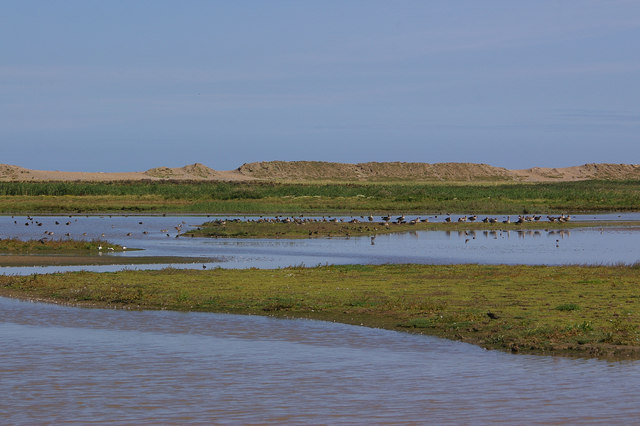
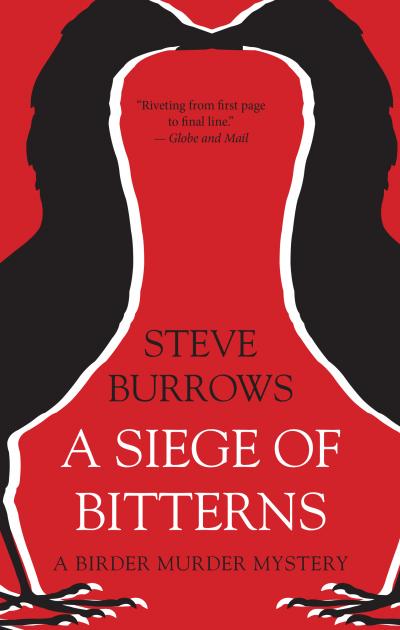
Despite my wariness of new (or just new-to-me) mysteries, I took a chance on Steve Burrows’ A Siege of Bitterns because when I peered at it in Bookmark, I was immediately caught up in the opening pages. It’s not that Burrows leaps right into any suspenseful action — quite the opposite, in fact, though obedient to the rules of the genre he doesn’t take very long to get to a corpse. What I liked was the description of the Norfolk marshland:

At its widest point, the marsh stretched almost a quarter of a mile across the north Norfolk coastline. Here, the river that had flowed like a silver ribbon through the rolling farmlands to the west finally came to rest, spilling its contents across the flat terrain, smoothing out the uneven contours, seeping silently into every corner….

At the margins of land and water, the marsh belonged to neither, and it carried the disquieting wildness of all forsaken things. Onshore winds rattled the dry reeds like hollow bones. The peaty tang of decaying vegetation and wet earth hung in the air. An hour earlier, the watery surface of the wetland had shimmered like polished copper; a fluid mirror for the last rays of the setting sun. But now, the gathering gloom had transformed the marsh into a dark, featureless emptiness.

That’s really good scene-setting: it’s full of specific details addressing all the senses, and it’s elegantly but not floridly written. The scene is full of both beauty and menace, the images suffused with unease but with no heavy-handed ka-thumps of threat or suspense. Here, I thought, is a place I’d like to go — both the marshes and the fictional world this author has created.

cleymarshes

And overall I was not disappointed in A Siege of Bitterns. It is well-written throughout, particularly its descriptions of the landscape, which are consistently both evocative and precise:

Jejeune looked out at the night sky, mesmerized. If he had to give up everything about this part of the world, it would be the skies he would hold onto until the last; the endless, blue, forever skies of the days, and these nights, vast and clear and soft with stars spangled across them as far as the eye could see. The day’s thin tracery of white clouds had been peeled away by the evening’s breezes, and above him now was a spectacular velvety black tapestry shot through with glittering points of light.

The marshes are not just the backdrop to the novel’s crimes: Burrows does a good job at integrating the crimes — the people involved, their motives — with the setting so that we feel that the violence has arisen, in some sense, from the place itself and requires  an understanding of and appreciation for the landscape to solve it. It’s a useful device to have a lead detective who is new to the area, so that our knowledge can grow along with his, even as our interest in it is piqued by seeing it through his birder’s eyes. The birding, too, is not just an accessory, a novel but ultimately unnecessary bit of characterization. It does contribute to our sense of the kind of man Jejeune is — a “watcher,” as he himself thinks at one point, but also someone curious, questing, patient, and moved by flashes of beauty. But it’s part of the case, too, which makes sense in the context of the marshes where, as we’re reminded several times, there’s a particularly high density and variety of birds and thus a correspondingly high number of birders, resident and itinerant.

I really enjoyed the birding material in A Siege of Bitterns. It played right into my general fondness for “neepery” of all kind, for one thing, but Burrows also conveys its specific appeal very well — again, there’s a useful device in the form of Jejeuene’s partner, Lindy, a non-birder, who thus gives the many birders they encounter an excuse to proselytize. I read most of the novel sitting on our back deck, and I admit that I became increasingly aware of the birds around me: there are lots of them around at this time of year, but I can’t identify most of them better than “sea gull” or “blue jay.” I’m pretty sure I saw a humming bird this morning, and sometimes I definitely hear woodpeckers. But which kinds exactly? This site could presumably help me figure it out …

The only element of the novel that I wasn’t really convinced by was Inspector Jejeune himself. On Twitter last night Liz commented that, reading the novel, she “felt like I was coming into a series in progress.” Now that I’ve finished the book, I know what she means: I wondered if the many hints dropped in the first half about things that happened before the story’s own timeline would be resolved, but we never really do get a clear account, either of Jejeune’s family situation or of the case that has turned him into “media darling.” Perhaps this reflects the awkwardness of starting up a new series when some really fine ones in the same style have been running for so long (P. D. James’s Dalgliesh series launched in 1962, for instance, and Peter Robinson’s Inspector Banks novels in 1987). It seems preferable to me to let your character build over time, but maybe relative newcomers feel the pressure to create a kind of instant depth. It didn’t work all that well for me, at any rate: we have to take a fair amount about Jejeune’s brilliance on faith, and sometimes Burrows seemed a bit too insistent on what he’d clearly chosen as Jejeune’s trademark qualities. The secondary characters too felt a bit forced.

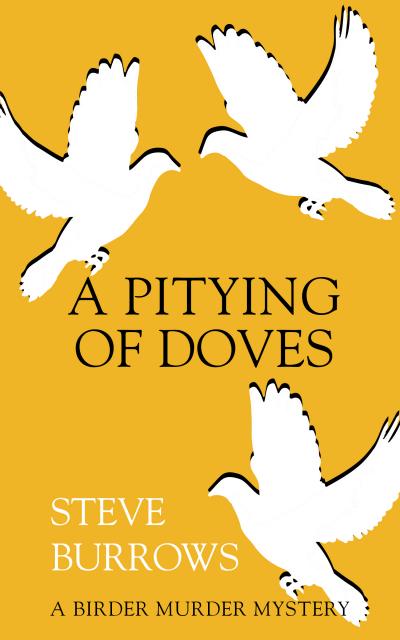
dovesThe plot is good, though, and the writing is good, and the concept is original — though I wonder how long you can sustain birding as a genuine theme, without its lapsing into a gimmick. I liked A Siege of Bitterns enough to want to read A Pitying of Doves, the next in the series. If that goes as well as the first one, I might press on to A Cast of Falcons. And who knows — I might even see if I can figure out just what birds are in my own backyard.

At least as a footnote, I do have to say that there is a very shocking error on page 67 of  A Siege of Bitterns! Dundurn Press should be pretty pleased about this series, but they should also be sure to fix that as soon as they can.