This Week in My Classes: My Waverley Intervention

My sincere thanks to everyone who weighed in, here or on Twitter, with advice about handling the classroom slump brought on by Waverley. Here’s an update on what I decided to do.

highlanderFirst of all, I did decide to do something different, rather than just pressing on with my usual strategies. I had to admit to myself — and I admitted this morning to my class — that if year after year a critical mass of students just isn’t getting engaged by the novel, at least to some extent this is a failure on my part — a pedagogical failure. Dropping Waverley from my reading list was also a failure: some students in Waverley-free years have told me how happy they were to have missed it, but missing out on it was not a win for them any more than it was one for me. As I told my class this morning, it’s a novel that deserves its place on our syllabus, one that is well worth reading for our curriculum, whatever anyone’s personal response to it. But the failure isn’t all mine. To use the analogy I suggested to my class, if you’re stumped by a difficult calculus problem, you don’t blame the problem: you work it as hard as you can, get more help if you need it, and try to bring your skills up to the level you need to solve it.

I decided to approach the class, then, as a problem-solving opportunity: we all, collectively, needed to think about what was going on and what our own role could be in addressing it. I said frankly where I thought I had been going wrong: struggle is part of learning new things, and they needed to be free to talk about their difficulties without my getting all judgmental. I told them that I thought I needed to back off a bit, and listen, so that they could trust me to work with them. But so that we didn’t fall into an unproductive gripe session, I suggested they approach Waverley in the spirit of couples therapy: avoid “you” statements in favour of “I” statements, to stimulate not blame but agency. “Waverley is boring” doesn’t help: you can’t change Waverley, after all! “I am finding Waverley boring / frustrating / confusing” is more constructive because there may be something you (or I, as the teacher) can do differently.

All of this preamble took only a  few minutes at the start of class. Then I went to work on getting out of their way. I’d made up a handout with three simple questions:

  1. How is Waverley going for me? What do I like about it? What specific challenges does it pose?
  2. Given the specific ways I’m finding Waverley challenging, here are some ideas for things I could try to make it go better:
  3. Given the specific ways I’m finding Waverley challenging, here are some ideas for what Dr. Maitzen could do to help:

I gave them about 10 minutes to respond honestly to these questions — the handout was explicitly not to be submitted or evaluated. Then on the other side of the handout they each had one of five different passages I’d picked out, and they got into small groups with the other students who had the same passage. They had two tasks in their groups: first, to talk freely about how they’d answered their questions, then to read their passage aloud and discuss it, considering it in light of their general comments about reading Waverley as well as in the context of the issues we’d been working on in our previous classes. I left the room entirely for the first five minutes of the group work, literally getting out of their way so they would be uninhibited in their discussion.

The room erupted into noise behind me as I went out, and the conversation seemed energetic for the whole period. While they talked over their passages, I went around offering my help and inviting comments on the question about what I could do to help with their reading of the novel. I got some very specific requests: the most frequent was to go over the political / historical factions again, clarifying who was on what side. A couple of people thought a handout listing characters and their affiliations (and their various names) would be great, so I think I’ll do some version of that. Another suggestion was for some straightforward plot summary: because a number of them are really struggling through Scott’s prose, they lose track of what’s actually happening. Plot summary is not usually high on my priorities for class time, but I can see how confusion about the novel’s events would inhibit class participation! So I’ll do that too, though I’m going to think about ways to make it interactive.

As for things that they could do, a couple of students said that reading the passages out loud helped their comprehension, so that might be something they’ll try on their own (we talked about the audiobook option, though sadly there doesn’t seem to be a really good one available). I showed them the e-text available through the University of Adelaide, which might help anyone struggling with the small print of our Oxford edition. I think others realized that looking more words up in their dictionary will help, and I continued to urge them all to get started trying to write about the novel. It was clear that not everyone had the same issues, and not everyone even had any problems with it — I hope the students who were already getting along fine don’t feel the class was wasted: I think we will all benefit if our remaining two sessions go better.

However it goes on Wednesday and Friday, I won’t regret having tried to change the dynamic that was developing. Lecturing more is one way to get through a slump like this, but it isn’t the best way, since (as I often remind them) the objective of an English class is for them to be better readers themselves: the process of reading and discussion is not just important, but in some ways it’s the whole point.

This Week in My Classes: In which I return to Waverley after many years.

waverleyIn class this week one of my students asked me when I last taught Waverley. “2006-7,” I promptly replied — I knew this because I had gone back to my old files to see what notes and handouts I had in reserve.* It used to be a fixture on my syllabus for The 19thC Novel from Austen to Dickens — but it was also, without fail, the least popular book on the syllabus. While I don’t typically let such considerations steer me in choosing assigned texts (a literary education is about challenging and extending our existing taste and skills as readers, after all), it did get to be a drag coaxing and cheerleading and exhorting the students to get any kind of discussion going. Sure, Scott is probably the most popular and influential author of the early 19th century: all of our other novelists read him (mostly, with passionate affection) and learned from him. And sure, Waverley itself is heaps of fun if you can get into the spirit of things, and if you can get past the garrulous, curmudgeonly, oversharing, occasionally pedantic, highly self-conscious narrator … and sure, there’s all kinds of metafictional proto-post-modernist fun to be had with that narrator, too, if, again, you can get into it. But when at least 75% of the students really can’t get into it, then their boredom and resentment infects the classroom atmosphere, and not necessarily just for the two or so weeks spent on Waverley itself. So I stopped assigning it, and have been teaching Austen to Dickens with no Scott at all since then, except for “The Two Drovers” in a recent summer session of the course.

But I’ve missed Waverley: unpopular as it was, and its intrinsic merits aside, it provided an infinitely valuable touchstone for interesting features of our other novels. As I was already tilting this year’s incarnation of the course towards the Bildungsroman by including both Jane Eyre and David Copperfield, I knew I was going to miss it even more. So it’s back  — and, judging by the last two class meetings, so is the stupified resentment it inspires. Not, by any means, among all the students — but even those who are writing smartly in their reading journals seem uncharacteristically reticent in class, and I have numerous indications that a lot of students are falling behind in their reading as well as in their appreciation of the novel. And so I’m back wondering, as I was in 2006-7, what I could be doing differently to make things go better, or whether it’s just not worth the effort.

My basic approach is a ramped-up version of what I do with every assigned novel, which is to present the novel as enthusiastically as I can, front-loading our time on it with a lecture or two clearing up historical information and setting up some interpretive frameworks which then, in theory, enable everyone to read on and consider how the particulars of the novel fit into those broader patterns. There is a bit more context to be established here than usual, but as Scott himself says,

I beg pardon, once and for all, of those readers who take up novels merely for amusement, for plaguing them so long with old-fashioned politics, and Whig and Tory, and Hanoverians and Jacobites. The truth is, I cannot promise them that this story shall be intelligible, not to say probably, without it.

If that was true in 1814 (or 1805), it’s even more so today, when there’s barely any chance at all that those terms will mean anything, even to a History major. But once you see what the stakes are, it seems to me that it’s not impossibly difficult to follow the story! It takes patience for a modern reader to settle into the prosy narration, but it’s great stuff once you do, and there’s as much “action, laffs, and romance” as in any Captain Underpants novel!  So once we’re launched on the more discussion-based classes, I start from my stock of open-ended questions (“What kind of a fellow is Waverley?’) and then draw us along into analysis of the answers (“What’s the value of such a ‘wavering’ hero in a novel about civil conflict?’) — focusing, along the way, on particularly fun or revealing scenes. An early episode in Waverley that’s good to discuss, for instance (in theory) is the banquet at Tully-Veolan that ends in a drunken brawl at Luckie Macleary’s inn. In addition to being a great comic scene and one that illustrates Waverley’s uncanny (and symbolic!) habit of falling down in times of crisis, it shows the living importance and potentially violent results of the broad political conflicts we’ve gone over: the fight begins with “a toast which seemed . . . to have a peculiar and uncivil reference to the government that [Waverley] served.”

bustofscottAgain, this is all standard classroom procedure — lecture mixed with discussion prompted by questions designed to build interpretations out of observations. But it just doesn’t go well with Waverley, though there are always a few stalwart souls who put their hands up (thank you!). I’m always a bit puzzled by the conspicuous collapse: the novel doesn’t strike me as that opaque, especially once we’ve done our warm-up sessions. On the assumption that incomprehension is a problem, though, my first response is usually to step up what I think of as the ‘modeling’ component of class — that is, walking the students through those key episodes and showing them what’s in there to notice, enjoy, and work with. Then I try backing off again — but still with lackluster results. Is it me, I wonder? Perhaps I come on too strong: if they are feeling bemused or bored, then my enthusiasm, rather than ‘selling’ them on the novel, may just alienate them from both it and me. Also, sometimes I catch myself hectoring them: this week, for example, I gave them a heads-up that we’d be discussing three particular incidents, and when hardly anyone seemed prepared to do that, well, I did take them to task! But that backfires too, I bet: rather than feeling challenged to do better, they probably just feel defensive.

I really want them to rise to the challenge of this novel. I really don’t think it’s an impossible task. But for many of themI think it does require letting go of the expectation that class reading will be immediately accessible and ‘relatable.’ It’s a class , after all: you’re supposed to learn from it — cue the speech about this not being a book club! Last class I urged them to get started writing about it, if they hadn’t already: they’ve got study questions they can use as prompts for their journals, plus the questions we’ve been working on in class. Active engagement of that kind is a good way to learn, and Waverley is a genuinely interesting novel to write about even if you aren’t finding it a treat to read. But I’m stumped about what else to do, and about what attitude to take in class. I should probably just go on as usual and try not to make a big deal out of the slump we’re experiencing — but that’s easier said than done.

Any tips? Teachers, how do you handle it when you think you’re losing your students and, as a result, they’re missing out? Students, what tactic is most effective, in your experience, at motivating you to get on board with something you don’t find immediately compelling?

*2006-7! That means it was in the era Before Blogging, which is why I have never blogged before about the pleasures and perils of teaching Waverley.

Putting the Record Straight: Muriel Spark, Curriculum Vitae

Curriculum Vitae SparkWhen I’d finished puzzling over A Far Cry From Kensington, I decided I’d had enough Muriel Spark for now. There are just so many other books I really want to read, after all. But then I remembered that I’d picked up a copy of her autobiography, Curriculum Vitae, from the public library’s discard sale (it’s shocking, really, what great stuff I’ve found there!), so I used the last of my Spark momentum to give it a try — and I ended up reading it straight through with much enjoyment. The first lines alone are entirely winning:

I am a hoarder of two things: documents and trusted friends. The former outweigh the latter in quantity, but the latter outdo the former in quality.

Predictably, for Spark, there’s a sting lurking there: she’s writing because “so strange and erroneous accounts of parts of my life have been written since I became well known, that I felt it time to put the record straight.” That is, people who are not friends to be trusted have spread misinformation, and she is countering their version with her own, which contains “nothing that cannot be supported by documentary evidence or by eyewitnesses.” The book is, then, a kind of “gotcha!” But it doesn’t seem nasty so much as pointed: be careful what you say about me! And why not, after all? As she says, “Lies are like fleas hopping from here to there, sucking the blood of the intellect.”

The first part of Curriculum Vitae is a series of episodic pieces about Spark’s experiences growing up in Edinburgh in the twenties and thirties. It includes bits on buying bread and making tea, on shopping for “commodities,” and on neighbors, friends, and family. Though in some respects she had a hard childhood, she reflects on it with resolute satisfaction:

Sometimes I compare my early infancy with that of my friends whose very early lives were in the hands of nannies, and who were surrounded by servants and privilege. Those pre-school lives seem nothing like so abundant as mine was, nothing like so crammed with people and amazing information. I was not set aside from adult social life, nor cosied-up in a nursery, and taken for nice regular walks far from the madding crowd. I was witness to the whole passing scene. Perhaps no other life could ever be as rich as that first life, when, five years old, prepared and briefed to my full capacity, I was ready for school.

Her years at school were “the most formative years of my life, and in many ways the most fortunate for a future writer.” It was at Gillespie’s High School for Girls that she met Miss Christina Kay, who “bore within her the seeds of the future Miss Jean Brodie.” “She entered my imagination immediately,” Spark says of Miss Kay, and she offers her own as well as classmates’ recollections of this “exhilarating and impressive” woman.

After school Muriel worked in various secretarial positions, and then in 1937 she married Sydney Oswald Spark: “I was attracted to a man who brought me flowers when I had flu. (From my experience of life I believe my personal motto should be ‘Beware of men bearing flowers’).” They lived in Rhodesia, where he had a teaching job. “It was in Africa,” Spark says, “that I learned to cope with life”:

It was there that I learned to keep in mind — in the front of my mind — the essentials of our human destiny, our responsibilities, and to put in a peripheral place the personal sorrows, frights and horrors that came my way. I knew my troubles to be temporary if I decided so.

They weren’t easy years. She found the colonial apparatus and attitudes in Rhodesia bizarre and isolating. Her marriage fell apart due to her husband’s “severe nervous disorder,” and in 1939 she filed for divorce. In 1944 she moved back to England, where she went to work “in the dark field of Black Propaganda or Psychological Warfare,” helping to create misinformation campaigns to undermine German morale. Many of her experiences from this time ended up, she observes, in some of her later fiction, but it isn’t until after the war that her life comes to be shaped around her literary ambitions.

sparkwritingFirst she worked on a journal called Argentor, “the official quarterly journal of the National Jewellers’ Association.” Then she stepped in as editor of the Poetry Review — and it’s here, in recounting the eccentric personalities, egos, and feuds of the poetry world, that you sense her really settling in to put the record straight. She’s got a particular genius for quoting writers to their own disadvantage, like Robert Armstrong, “a physically and morally twisted, small, dark fellow, a veritable nightmare” who takes umbrage at her decision not to name him on the journal’s front cover. “I had been working hard for the opportunity to put the Society and yourself on the map,” he self-aggrandizingly complains; “I had also put in some groundwork with influential friends so I am puzzled and assume something must have arisen to sidetrack your promise.” “This was a mere taste of things to come,” Spark says, almost gleefully, before quoting her sharp reply and then noting, “I never in future put this man’s name on the front cover.” She was eventually dismissed from her position: “I was delighted to get out of that scene of strife and of that mortal sin of art, pomposity.”
The last part of Curriculum Vitae takes us through Spark’s various jobs and writing projects up to the completion and success of her first novel, The Comforters. Since then, Spark reports,

I have passed the years occupied with ever more work, many travels and adventures. Friends, famous and obscure, abound in my life-story. That will be the subject of another volume.

As far as I can tell, she never wrote that other volume. Too bad, because that I’d like to read! There’s a sense, at the end of Curriculum Vitae, that she’s really just getting started on the good stuff.

This Week in My Classes: Processes and Products

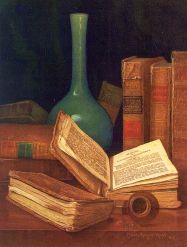
Bookworm's Table (Hirst)The second full week of term has gone by already: it’s amazing how time seems to accelerate when things get busier. In both my classes we have moved from throat-clearing and context-setting to richer discussions about our readings: in The 19th-Century Novel from Austen to Dickens, we’ve wrapped up our work on Persuasion, and in Mystery and Detective Fiction we’ve got only one more class on The Moonstone. Starting the term with these two novels eases the transition from summer’s languors to fall’s stresses because both are so delightful. At least, I think so — and it seems as if a lot of students are enjoying them as well. Discussion in the Mystery class has been particularly good so far this term, especially considering it’s a big class (capped at 90), which can sometimes be inhibiting. I hope they keep putting their hands up!

academicselfOne thing I’ve been thinking about as our work gets underway, and as I contemplate my own non-teaching ambitions for this term, is trying to make the process as meaningful and rewarding as possible, shifting some emphasis away from the product — which for students is often the course credit or the grade, and for me is the finished piece of writing. I’ve been reading Donald Hall’s The Academic Self: An Owner’s Manual (thanks to @MsEMentor for the recommendation!) and while I have some doubts about whether I want to be an ‘academic self’ of the kind he describes (more about that, perhaps, in another post), I have been struck by the wisdom of his emphasis on this process / product distinction, partly because I have found myself caught up in just the kind of results-oriented moping he describes (if not for exactly the same causes):
We all know (or should know by now) that we may complete professional tasks to the best of our abilities, “play by all of the rules,” so to speak, even overachieve and push ourselves to extremes, and still be denied the book contract we have been working for, the position we have applied for, or the raise that we feel we deserve. If we tie our sense of professional payoff only to a desired reception of the end product of a process, then we are setting ourselves up for disappointment, perhaps even a state of bitterness or burnout.

As he discusses, there are lots of reasons, some of them good ones, to be fixated on achieving particular goals, but “we simply do not have to have a specific reaction to the products of our processes for those processes to have been worthwhile.”

I think there is actually a close relationship here between my students’ situation, as they strive for grades and credits, and my own difficulty dissociating the worth of my work from the reactions or results it gets. After all, I spent a great deal of my own life as a student, and in many ways academics carry forward the mental habit of waiting for affirmation from other people’s evaluation. How different, too, is the hiring process, the tenure process, or the promotion process from being graded? Or, for that matter, the grant application process or the article submission process? Well, OK, of course there are differences, including the presumption that for most of these professional matters we are being evaluated by our peers, and the not-insignificant point that our success in some of them (hiring in particular) really shouldn’t be understood as measures of our merit so much as of our great good fortune. But these things all feel a lot like handing in an essay used to, and I’m someone who once locked herself in a bathroom in Buchanan Tower to weep over an A- from a professor whose approval I really wanted — which is to say, I’m someone who (like a lot of academics) has a hard time believing in my own judgments of my work, and a hard time separating judgments of my work from judgments of me personally. I am making progress on this front, I’m glad to say, but I still find myself waiting anxiously for external validation when, for instance, something of mine is published online. There’s still that part of me that is waiting for my grade, for the internet equivalent of an ‘A,’ whatever exactly that is.Grade A Plus result vector icon. School red mark handwriting A plus in circle

I know, I know: there are so many things wrong with this, and I don’t just mean that it’s kind of pathetic in a grown woman more than two decades along in her professional career (though that is certainly true). Having become self-conscious about it, I do at least now work consciously against it, and one way I do this is simply by rereading my own work, which (I am learning to assert, on my own behalf!) I think is pretty good! Why shouldn’t I be able to tell or say that, after all, considering it’s actually a big part of my job to evaluate writing? But the other thing I want to do is give more weight to, or feel more positive about, the process of doing the work. As Hall says,

I cannot know if the words that I am writing at this moment will ever appear in any form of print other than that which comes out of my computer. . . . But I can decide that this act of creation, this thinking through of ideas as they move from conscious and subconscious thought through my fingers and onto the screen is enough to satisfy and sustain me, even if the unfortunate were to occur.

He isn’t advocating that “we dispense with highly concrete goals” (as he points out, that would be “to court disaster” professionally, as well as to shirk other dimensions of our research and writing lives by not aiming to get our thoughts “disseminated”). But he’s right that “those processes . . . . must be more explicitly valued, must be recognized as professional ‘goods’ in and of themselves.”

To bring this discussion back to my teaching, I have realized that some of the greatest frustrations I’ve run into as a teacher have come from student priorities and behaviors that are results-oriented without due attention to the intrinsic value of the processes we go through (as well as to the benefits that careful attention to process can bring to achieving desired results). A simple example: papers that are clearly (or on the student’s own admission) started and finished the night before the deadline — I’m sure many other professors have had those dispiriting conversations that begin “I’m going to work on my essay tonight” and you cringe, knowing that means they won’t have time to rethink or revise, just as they very nearly have run out of time to consult. The essay-writing process matters less to that student than getting the credit for the finished essay. Or there are students who don’t finish the readings until they are studying for the final exam, or who never read them at all (I’ve had students note on their evaluations, almost as a point of pride, which books they never did actually read) — they too are circumventing the process (which is where a lot of the real learning can take place) and focusing only on the final product. I’m trying, increasingly, to disrupt these habits by building incentives to good process into the course requirements (reading journals, paper proposals, short tests). I’m also taking more time to discuss the relationship between our processes in class and the overall goals of the course, in terms of learning and practicing skills as well as in terms of getting good grades. Yes, students should aspire to earn good grades, and I should enable and support those aspirations. But the learning doesn’t take place at the moment I return the essay or exam: it takes place while we’re doing everything else, and especially while they are doing everything else. They should try to take a lot of satisfaction from those processes — from their own “thinking through of ideas.” Then even if they don’t get the grade they hoped for, they’ll be able to dry their eyes and come out of the bathroom a little bit sooner and a lot more confident.

“I was Mrs. Hawkins”: Muriel Spark, A Far Cry From Kensington

farcryMy local book club met last night to discuss Muriel Spark’s A Far Cry From Kensington. We always try to follow some kind of thread from one book to the next; after reading two novels by Elizabeth Taylor we were thinking about other mid-20th century women novelists and while Muriel Spark seemed like an obvious choice, The Prime of Miss Jean Brodie seemed a little too obvious, plus some of the group had read it before. (I hadn’t, but was finally prompted to by this discussion.) We chose A Far Cry From Kensington a bit randomly from among her other novels — I think the Amazon description of it as including “shady literary doings and a deadly enemy; anonymous letters, blackmail, and suicide” may have been decisive, because, after all, how tempting does that make it sound?!

So. Well. Hmm. I guess I could start by noting that I didn’t do terribly well with The Prime of Miss Jean Brodie — it’s not that I didn’t like it or find it interesting, but as I reported at the time, I struggled to make sense of it. The comments I got on that post helped me see how I might do better, but they didn’t do much to prepare me for A Far Cry From Kensington, which I found even more baffling — formally baffling, because it seemed to jump around from genre to genre and tone to tone; thematically baffling, because I couldn’t understand why it included the different elements it included; and baffling to me as a reader because in spite of all the things about it that bemused me, I didn’t hate it, and in fact I kind of liked it. Despite my confusion, I didn’t resent the book the way, say, Mrs. Hawkins, in the novel, resents Hector Bartlett’s The Eternal Quest, a study of the Romantic-Humanist Position.” I may not really get Muriel Spark’s fictional method or mission, but she’s so obviously artful about whatever it is she’s doing that I feel confident she is not the novelistic equivalent of a pisseur de copie…which is the epithet Mrs. Hawkins so fatefully hisses at the insufferable Hector.

Mrs. Hawkins — large, observant, acerbic, insomniac — is the best thing about A Far Cry From Kensington. I was actually going to write my whole post about the advice she hands out so confidently (and bafflingly! why does she give us so much advice?), but while googling around for insight into the novel, I came across this piece by Maud Newton, which is not only good about Mrs. Hawkins’s advice but smarter about the whole novel than I can be. So I will quote only this one bit of it:

It is my advice to any woman getting married to start, not as you mean to go on, but worse, tougher, than you mean to go on. Then you can relax and it comes as a pleasant surprise.

Even Mrs. Hawkins doesn’t know why she can’t help calling Hector a pisseur de copie (“a hack writer of journalistic copy,” she helpfully explains) but she can’t stop doing it and won’t retract it, either. She’s really quite virulent on the topic of Hector’s terrible writing:

Pisseur de copie! Hector Bartlett, it seemed to me, vomited literary matter, he urinated and sweated, he excreted it . . . His writings writhed and ached with twists and turns and tergiversations, inept words, fanciful repetitions, far-fetched verbosity and long, Latin-based words.

Little does she know that drawing this line in the rhetorical sand will cost her not one but two jobs in publishing, which the novel endlessly reminds us are both hotly desired and terribly recompensed.  Spark is acidly funny about the cliquishness of the publishing world, in which a word in the right place from the right celebrity author means more than any amount of dedication to literature. “Ah yes, in fact, books,” says one of Mrs. Hawkins’s employers:

Yes, many of our staff here are in fact fairly interested in books. One of our senior colleagues in fact was saying at a meeting only the other day that he thought he might perhaps have a shot at getting back to his first love — books.

Hector has the backing of a famous novelist, Emma Loy, who exercises her influence against Mrs. Hawkins (only, years later, to end up herself a victim of Hector’s malice, as Mrs. Hawkins placidly relates). Hector’s vengeful plotting against Mrs. Hawkins goes far beyond getting her fired, though, and realizing the extent of his insidious scheming is both amusing and, again, baffling. Spark lays her clues out so ingeniously that it’s easy to miss “that glint of a thin trail, like something a snail leaves in its slow path” even though, unlike Mrs. Hawkins, we know we’re looking for it.

Right up to the ‘reveal,’ in fact, the novel seems more random than plotted itself — which may, of course, be part of Spark’s art. And then I was surprised, rather than satisfied, by the conclusion, which draws together elements as disparate as a hysterical, ultimately suicidal, Polish refugee and the absurd pseudo-science of radionics (“no more a subject for mockery,” Mrs. Hawkins observes, “than the claims of all our religions”). And what about the parts that seemed unrelated to that plot, like Mrs. Hawkins’s brief, violent marriage (“Now, it is my advice to anyone getting married, that they should first see the other partner when drunk”), or the unwed mother in the upstairs attic whose father proposes to Mrs. Hawkins because “it would be good for Isobel to have a mother” (“at the age of twenty-nine, I wasn’t minded to take on a girl of twenty-two as a daughter”), or “the Boys” she goes to work for who “always got up when we came into the room” (“Is that American or is it homosexual?”)? I don’t understand why these are the ingredients of the novel — and yet each, in its own way, in the reading moment, was interesting or funny or temptingly quotable.

This Week In My Classes: The Seventh Season Begins

I began writing posts about my teaching plans and experiences because I thought it might contribute to demystifying our profession — and perhaps counteract, just a little bit, the way it is sometimes demonized (or ridiculed).  I discovered after that first year that there were real benefits in this for me, and, not incidentally (if less directly) for my students, and so I’ve kept it up ever since (you can browse through the archive of posts here, if you’re interested). At this point, I’ve talked about pretty much all the courses in my regular teaching rotation at least once, but while there’s some repetition, I do vary the reading lists from time to time. And I’ve also strayed occasionally from straight-up reporting to broader reflections  on different aspects of pedagogy or extended reflections on our readings, so for me at least that keeps the exercise interesting.

The-Big-SleepHeading into my seventh season of this series, I have no specific ambitions or plans for it beyond keeping it up and seeing what arises from week to week. One of this term’s classes will already be quite familiar to regular visitors here as I have taught it literally every year I’ve been doing these posts, and that’s Mystery and Detective Fiction. I change it up a bit each time, and this year’s innovation is — finally! — switching to The Big Sleep from The Maltese Falcon. I’ve been thinking about this since at least 2009, when I read it and complained that I found it tiresome: “sexist, homophobic, convoluted.” Rereading this summer, I didn’t love it but I certainly appreciated it more (but yes, it is convoluted, and I’m also still pretty sure it is sexist, though I’ll invite debate about that in class when we get there). The only other tweak is that I’ve cut most of the short fiction: students often remark in their evaluation that there’s a lot of reading in the course, and this allows me to stretch out our time for some of the novels a bit more without losing anything that makes me particularly sad. Today we talked about “The Murders in the Rue Morgue,” and Friday we begin discussions of The Moonstone. Yes, I always reread it — though at this point I do sometimes skim selectively. I almost never get caught out on a detail I’ve forgotten!

copperfield

My other class this term is The British Novel from Austen to Dickens. I’ve taught this class pretty regularly in recent years but I haven’t assigned Waverley since before I started blogging. I stopped assigning it because the students were so petulant about it in their evaluations — most of them, I should say, as there were always a few who really got it and loved it. We’ll see how it goes this year:  it may well provide fodder for a post or two. The other big change is bringing in David Copperfield as my Dickens option: in previous incarnations of this class I have done Hard TimesGreat ExpectationsA Tale of Two Cities, or A Christmas Carol. It’s our only really loose baggy monster, and it does come right in the middle of term, but I’ve tried to allow enough time for it in the schedule that it won’t kill us all — or kill everyone’s enthusiasm for the class. I’m sure they’ll love it. How could they not? Right? Please? Right now we’re working our way through Persuasion and as far as I can tell they’re keeping up and appreciating it.

“The Rough Rocky Depths”: May Sarton’s Journal of a Solitude

journalsolitudePlant Dreaming Deep has brought me many friends,” says May Sarton early in Journal of a Solitude, “…but I have begun to realize that, without my intention, that book gives a false view.” She worried that she had given an overly idealistic picture of her life alone in her restored New Hampshire farmhouse, which she describes in Plant Dreaming Deep with such joyous lyricism: “the anguish of my life here — its rages — is hardly mentioned.” She wrote Journal of a Solitude as a counterweight:

Now I hope to break through into the rough rocky depths, to the matrix itself. There is violence there and anger never resolved. . . . I go up to Heaven and down to Hell in an hour, and keep alive only by imposing upon myself inexorable routines.

She kept this journal for a year and recorded both those heights and those depths.

I’m definitely among those who were won over by Plant Dreaming Deep. As I said in the comments on my post on it, though, I didn’t find it idealizing: in the post itself I wrote, “Sarton’s story here is not of uninhibited bliss: there’s guilt and anxiety, as already mentioned, but also fear, hard work, and constant demands on her self-reliance.” Still, Journal of a Solitude did seem darker and more fretful. Days may begin well but often end in tears; friends are welcome but their departure is a relief; traveling is less invigorating than exhausting: “I armed myself in patience and before I finally got back here, I needed it.” Her solitary home is a refuge from the pressures of the external world, but often provides insufficient distractions or buffers against inner turmoil:

I woke in tears this morning. I wonder whether it is possible at nearly sixty to change oneself radically. Can I learn to control resentment and hostility, the ambivalence, born somewhere far below the conscious level? If I cannot, I shall lose the person I love. There is nothing to be done but go ahead with life moment by moment and hour by hour — put out birdseed, tidy the rooms, try to create order and peace around me even if I canot achieve it inside me.

But while there are tears and rages and fits of intense, frustrated depression, her emotional life is not one deep trough. Her garden especially brings her pleasure, and here, as in Plant Dreaming Deep, she writes about it, and the flowers it yields, with pungent vividness:

 A gray day . . . but, strangely enough, a gray day makes the bunches of daffodils in the house have a particular radiance, a kind of white light. From my bed this morning I could look through at a bunch in the big room, in that old Dutch blue-and-white drug jar, and they glowed. I went out before seven in my pajamas, because it looked like rain, and picked a sampler of twenty-five different varieties. It was worth getting up early, because the first thing I saw was a scarlet tanager a few feet away on a lilac bush–stupendous sight! There is no scarlet so vivid, no black so black.

 You almost want to finish her paragraph with “ah–bright wings!

While I didn’t really find Journal of a Solitude that different or that much darker than Plant Dreaming Deep, I did find it more episodic and fragmented, perhaps because the earlier journal tells the story of her finding, fixing, and learning to live in her New Hampshire home, while this one does not have as clear a narrative arc. It does turn out to be about a particular turning point in her life — or at least it covers what turns out to be a turning point, namely her decision to move away from the farmhouse and into a house on the Maine coast. This is a development that occurs fairly far along, however, an opportunity that seems to arise more or less out of the blue, so it’s not as if it is written as a farewell to Nelson.

Life rarely has the coherence of fiction, however, and journals especially — written, as they are, in the moment — can hardly be expected to anticipate or be structured around patterns that will emerge only in the future. That’s a luxury for memoir or biography. Simply as a record of Sarton’s experiences and responses to them, Journal of a Solitude had plenty to interest me. For instance, it’s during this year that she first meets Carolyn Heilbrun, whose essay on Sarton I refer to in my post on Plant Dreaming Deep. I enjoyed seeing the relationship from the other side. With her letter of introduction, Heilbrun sends Sarton some reprints of her articles. “I dived into one on Bloomsbury at once,” says Sarton, who “knew Virginia Woolf slightly.” I can’t resist quoting extensively from her remarks on Woolf, not least because they end up at what is still a familiar place:

What a relief to find an essay that neither sneers at nor disparages Virginia Woolf! The sheer vital energy of the Woolfs always astonishes me when I stop to consider what they accomplished on any given day. Fragile she may have been, living on the edge of psychic disturbance, but think what she managed to do nonetheless — not only the novels (every one a break-through in form), but all those essays and reviews, all the work of the Hogarth Press, not only reading mss. and editing, but, at least at the start, packing the books to go out! And besides all that, they lived such an intense social life. (When I went there for tea, they were always going out for dinner and often to a party later on.) The gaity and fun of it all, the huge sense of life!  . . .

It is painful that such genius should evoke such mean-spirited response at present. Is genius so common that we can afford to brush it aside? What does it matter whether she is major or minor, whether she imitated Joyce (I believe she did not), whether her genius was a limited one, limited by class? What remains true is that one cannot pick up a single one of her books and read a page without feeling more alive. If art is not to be life-enhancing, what is it to be? Half the world is feminine — why is there resentment at a female-oriented art? . . . Women certainly learn a lot from books oriented towards the masculine world. Why is not the reverse also true?

 These comments resonate in the journal itself partly because Sarton struggles very hard during this period with her own status as a writer. The entry immediately following records her devastated response to “an annihilating review in the Sunday Times,” which continues to pain her in her low moments:

What a lonely business it is . . . from the long hours of uncertainty, anxiety, and terrible effort while writing such a long book, to the wild hopes (for it looked like a possible best seller, and the Digest has it for their condensed books) and the inevitable disaster at the end. I have had many good reviews and cannot really complain about that. What I have not had is the respect due what is now a considerable opus. I am way outside somewhere in the wilderness. And it has been a long time of being in the wilderness. But I would be crazy if I didn’t believe that I deserved better, and that eventually it will come out right. The alternative is suicide and I’m not about to indulge in that fantasy of revenge.

But she can be turned aside even from these dark thoughts by a glimpse of the sky: “Somehow the great clouds made the day all right, a gift of splendor as they sailed over our heads.”

Summer 2013 Reading Recap

My first classes of 2013-14 meet tomorrow morning: between that and the expectation that temperatures will drop into the single digits tonight, it’s clearly time to admit that summer is over — and along with it, Maddie and my annual summer reading project. (She exceeded her goal this year, so good for her!) Because blog traffic, like all things, slows down around here in the warm weather, I thought I’d do another quick review.

Orphan-Masters-Son-with-Pulitzer-BurstIt wasn’t as good a reading summer as last year, though to be fair, it’s hard to beat a season that includes Madame Bovary The Once and Future Kingand Bring Up the Bodies along with my personal highlight, The Paper Garden. A late entry turned out to be this year’s winner: I was entirely moved and impressed by Adam Johnson’s grim, funny, poignant novel of North Korea, The Orphan Master’s Son. The summer’s other notable highlight was a long overdue rereading of David Copperfield – it’s absurd, really, how much there is to savor, laugh at, and cry at in that one book. Rose Tremain’s Restoration was another notable experience.  Like Hilary Mantel’s Cromwell novels, it approaches history very personally, and (though quite different in tone and style)  it is also similarly ingenious about making individual character convincingly embody the spirit of an age. Finally, May Sarton’s Plant Dreaming Deep was just wonderful. (I’ve just begun its dark twin, Journal of  a Solitude and am finding it equally engrossing, if less uplifting.)

straightSome of the summer’s other good reading came in clusters. The biggest of these, of course, was the Dick Francis cluster: I reread all 40 of his (solo) thrillers as I worked on my essay for the Los Angeles Review of Books. But there was also the Barbara Pym cluster, which included not just The Sweet Dove DiedJane and Prudence, and Excellent Women, but also Harrison Solow’s smart and lively Felicity and Barbara Pym. There was the Georgette Heyer cluster (I’ve finally figured out how to read her! Everyone was right – she’s delightful!): ArabellaSprig MuslinBlack Sheepand Cotillion — the last two of which I particularly enjoyed. And there was the Tana French cluster: In the WoodsThe Likeness, and Faithful Place (which for my money is the best of these three – I haven’t read Broken Harbor yet). (I wrote a little about each of these at GoodReads but didn’t review them here in detail.)

Two other books I particularly enjoyed were Mrs. Palfrey at the Claremont, which is, so far, my favorite Elizabeth Taylor novel: it’s an odd but very effective blend of poignancy and acidity (but I read it while on vacation, so again, no post here!) and Anne Morrow Lindbergh’s Gift from the Sea — which I know I will reread in turbulent times, despite my faint unease at its self-helpishness.

mrspalfreyI shouldn’t forget the books I reviewed in Open Letters. Kate Atkinson’s Life After Life was both good and bad, smart and limited — in my review I tried to do justice to its strengths while being as clear as I could about what I felt were its shortcomings. I’m particularly proud of that review, actually; I think it’s one of the best I’ve done. Deirdre David’s biography of Olivia Manning, in its turn, was consistently both smart and interesting — like its subject! (But not in any way as ornery!) And that reminds me that I read another excellent literary biography, Susan Kress’s Feminist in a Tenured Position: I’ll be reviewing this as I prepare for next term’s seminar on ‘Women and Detective Fiction’ (even though I won’t be able to assign Death in a Tenured Position this time around).

The only real disappointments were The Woman Upstairs (which, to be fair, I didn’t exactly think was a poor novel – I just disliked it) and The Sixteen Pleasures.

Going through this list, it seems like a decent summer’s reading after all, even if last year’s was better. When the reading’s not as good, neither is the writing, though: I felt a comparative lack of critical exhilaration as well as energy, as indicated by the number of books here I didn’t blog about at all. I was pretty energetic about some other summer projects, though, notably my Middlemarch for Book Clubs website, which went live in June. Now if I could only figure out the most effective way to publicize it … but that’s for another post, along with more thoughts about projects for the fall and beyond.

middlemarchsite

“Better than the truth”: The Orphan Master’s Son

Orphan-Masters-Son-with-Pulitzer-Burst

It is a true story of love and sorrow, of faith and endurance . . . Sadly, there is tragedy. Yet there is redemption, too! And taekwondo!

What would it be like to live in a world where it is better not to know what happened to someone you love — where lies becomes the truth and truth lies, where props and costumes are interchangeable with the elements of real life? How do you find a way to make your life worth living when you don’t even know for sure who you are? What story do you tell about that life, or about yourself, when what you need is not a story “anyone could really believe” but “a story they can use”?

This is the grim, terrifying, funny, surreal world of Adam Johnson’s The Orphan Master’s Son, which is the best book I’ve read all summer. (It may be the best book I’ve read all year.) That the world Johnson conjures up so memorably is not a fictional dystopia but, as far as his research and his imagination can determine, the actual world of the Democratic People’s Republic of Korea makes his novel only more painful and affecting. In the author interview included with the novel, Johnson notes that “most of the shocking aspects in my book are sourced from the real world,” but, he adds

I felt I actually had to tone down much of the real darkness of North Korea, as in the kwan li so gulags, the reports of which were so harrowing — forced abortions, amputations, communal executions — that I invented the blood harvesting as a less savage stand-in.

Yet many of these details are in The Orphan Master’s Son, if only in passing, and it’s hard to contemplate what a darker version might read like, never mind be like:

When I first arrived at Division 42, the preferred method of reforming corrupted citizens was the lobotomy. . . All you needed was a twenty-centimeter nail. You’d lay the subject out on a table and sit on his chest. . . . Careful not to puncture anything, you’d run the nail in along the top of the eyeball, maneuvering it until you felt the bone at the back of the socket. Then with your palm, you gave the head of the nail a good thump. After punching through the orbital, the nail moved freely through the brain. Then it was simple: insert fully, shimmy to the left, shimmy to the right, repeat with other eye. . .

We were told there were whole lobotomy collectives where former subversives now knew nothing but good-natured labor for the benefit of all. But the truth proved far different. I went with Sarge once . . . to interrogate a guard at one of these collectives, and we discovered no model labor farm. The actions of all were blunted and stammering. The laborers would rake the same patch of ground countless times and witlessly fill in holes they’d just dug. They cared not whether they were clothed or naked and relieved themselves at will.

Part of the brilliance of the novel, I think, is that Johnson neither lays out these horrors in prosaic exposition — more explanation would not make more sense of them, after all, and might only smother their human impact — nor overwhelms us  with the scale of the national trauma that is his underlying subject. The novel is full of individual trauma, both directly represented and indirectly indicated, and the layers of meaning Johnson builds up prompt us to scale up their ruinous experience without losing ourselves in abstractions. Eventually it’s clear that the protagonist, the orphan Jun Do, is (as his name suggests) a kind of John Doe, an everyman, who stands in for all the lost individuality of his countrymen; his dreams, his love, his desperation, and his courage are the distilled essence of the humanity of a population forced into lives of near-total artifice and repression. But Johnson makes him too much himself to be reduced to an allegorical figure or for his story to be read only in such formulaic terms.

The first part of the novel proceeds chronologically, taking us along on Jun Do’s journey from the orphanage to Prison 33 and, less literally, from an unquestioning servant of the state to a man who “hated his small, backward homeland, a land of mysteries and ghosts and mistaken identities.”  The second part begins with the arrival at Division 42 for interrogation of a man known as Commander Ga; we gradually reconstruct the events that brought him there.

What is the truth of this man’s identity? Earlier in the novel, Jun Do told a story about his life that caused him to be mistaken for Commander Ga. Like all stories in this unsettling world, this one is as true as its effects make it, as authoritative as those who believe in and act on it. When people can disappear and then simply be replaced, no identity is authentic or lasting — you become who you are said to be. “Where we are from,” explains an older comrade to Jun Do,

stories are factual. If a farmer is declared a music virtuoso by the state, everyone had better start calling him maestro. And secretly, he’d be wise to start practicing the piano. For us, the story is more important than the person. If a man and his story are in conflict, it is the man who must change.

“If they say you’re an orphan, then you’re an orphan,” Jun Do explains in his turn, to a puzzled American handler during an unlikely visit to Texas that is among the sadder and more surreal sequences in the novel:

If they tell you to go down a hole, well, you’re suddenly a guy who goes down holes. If they tell you to hurt people, then it begins. . . if they tell him to go to Texas to tell a story, suddenly he’s nobody but that.

In this world, once “the Dear Leader has declared you the real Commander Ga,” you are Commander Ga . . . until someone declares it otherwise. After all, what matters is not that the story be either true or believable, but that it be useful. The result is not always destructive:

“People find your movies inspiring,” he said.

“Do they?”

“I find them inspiring. And your acting shows people that good can come from suffering, that it can be noble. That’s better than the truth.”

“Which is?”

“That there’s no point to it. It’s just a thing that sometimes has to be done and even if thirty thousand suffer with you, you suffer alone.”

Though the first part of the novel is gripping reading, with flawless control over tone and pacing, I found Johnson’s technical accomplishment most impressive in the second part. As we shuttle between the narrative of the otherwise unnamed Interrogator, the continuing story of Commander Ga, and the official version of events (told as if installments of the ‘Best North Korean Story’) the novel never loses its coherence or its momentum. Indeed, during the final sections, as the pieces fall into place and the Casablanca allusions take on their full relevance, I found the suspense entirely nerve-wracking. Johnson is as masterful at different voices — and as fluent in multiple genres — as David Mitchell, but reading Cloud Atlas the display of writerly ingenuity distanced me from the novel, whereas reading The Orphan Master’s Son I just felt pulled deeper and deeper in. He’s especially artful with the sanitized banality of the official communiqués: while these initially seem like comic interludes, they become increasingly sinister because we realize they will overpower the other stories (the true stories, the human stories) they subsume. The ebullient doublespeak is particularly revolting because we know what it denies — for instance, that there are no “retired” people at the “resort” of Wonsan:

“Please,” she said. “Give me the joy of seeing my mother at the premiere.”

Citizens, citizens. Ours is a culture that respects the elderly, that grants them their need of rest and solitude in the final years. After a life of labor, haven’t they earned some remote quietude? Can’t the greatest nation on earth spare a little silence for the aged? . . . But we throw up our hands. Who can deny Sun Moon? Ever the exception, so pure of emotion is she.

“She’ll be sitting in the front row,” the Dear Leader told her. “I guarantee.”

Citizens, if the Dear Leader says it, that settles it. Nothing could prevent Sun Moon’s mother from attending that movie premiere now. Only an utterly unforeseeable occurrence — a train mishap, possibly, or regional flooding — could stand in the way of this joyous reunion. Nothing short of a diphtheria quarantine or a military sneak attack could keep Sun Moon’s dreams from coming true!

It’s not just that we know the train mishap or military sneak attack need not actually happen to be the excuse for  Sun Moon’s mother never reappearing: it’s that everyone knows it, and there’s no recourse against the abusively cheerful tissue of lies. Johnson tells us that “much of the propaganda, especially the funnier lines, I pulled straight from the pages of Pyongyang’s Rodong Sinmun Workers’ Party newspaper.” When the line between satire and realism disappears, we don’t know whether to laugh or cry. How can intolerable suffering be made so absurd?

It isn’t really absurd, of course. The juxtaposition of stories and voices allows us to realize the many dimensions of pain and grief, and how people’s suffering is exacerbated by its denial and by the state’s relentless revisionism. Our laughter is initially at the transparent and self-serving dishonesty of the state communiqués: their buffoonery defies belief. By the end, though, those jaunty narratives filled me with unsettling rage: that they have the last word seems the ultimate violation of the people whose lives they have made a mockery of. That it’s true, though fictional, is the most appalling thing of all.

The Interrogator’s library of confessions is one form of resistance within the novel to these offenses against human dignity. In creating his “citizen biographies” he believes he is preserving something otherwise lost, and certainly not present in the Central Records office, as he realizes when he looks at his parents’ files:

the files were filled with dates and stamps and grainy images and informant quotes and reports from housing blocks, factory committees, district panels, volunteer details, and Party boards. Yet there was no real information in them, no sense of who these two old people were, what brought them from Manpo to be line workers for life at the Testament to the Greatness of Machines factory.

 But even his meticulously bound confessions, which contain “an entire life, with all its subtleties and motivations,” are worth less than intimacy, a concept that is initially hard for him to understand:

Intimacy? What is that?”

“It’s when two people share everything, when there are no secrets between them.”

I had to laugh. “No secrets?” I asked him. “It’s not possible. We spend weeks extracting entire biographies from subjects, and always when we hook them up to the autopilot, they blurt out some crucial detail we’d missed. So getting every secret out of someone, sorry, it’s just not possible.”

“No,” Ga said. “She gives you her secrets. And you give her yours.”

At the end, the Interrogator has “finally been intimate,” and in that voluntary sharing of what he knows to be true he finds the most precious freedom of all: the freedom to be himself. That in his world this epiphany is no prelude to a happy ending is the ultimate and grimly predictable catastrophe of The Orphan Master’s Son. The only hint of grace is that in his final suffering, though he does not know the real identity of the man he’s with, at least he is not alone. That’s not much, but perhaps it’s better than the truth.