The Stage Swarmed with Maggies: Helen Edmundson’s The Mill on the Floss

Last night I attended the Dalhousie Theatre production of The Mill on the Floss that I mentioned here: I was invited to give a short talk to the “Patrons” on opening night. As I explained to the attendees, I wasn’t there as an expert on Helen Edmundson’s adaptation, though I had read through most of it in preparation for the night. So, rather than pretending to explain things about the play, I tried to set up what I take to be some of the central problems of the novel so that we could all have them in mind as we watched — not to see if Edmundson “got it right” or anything as reductive as that, but to see what she did with the material, how she reworked or rethought it for a different form.

As I worked on my notes (and it isn’t easy deciding what you’ll use your precious 20 minutes on, when you love a novel as I love The Mill on the Floss), it was form that I kept thinking about. So many things about The Mill on the Floss make it seem such an unlikely choice for the theatre. There’s the ending, for one thing, but of course there are ways of evoking large-scale natural phenomena on stage: nobody expects torrents of actual water to sweep the scenery away. But what about the narrator? Though she does plot and dialogue with the best of them, so much of the wit and wisdom of George Eliot resides in her masterful exposition. What is The Mill on the Floss without my favourite chapter, “A Variety of Protestantism Unknown to Bossuet” (which contains not one line of dialogue, not one step forward for the plot) or without the great meditation on “the shifting relation between passion and duty” and the moral failure of the “man of maxims”? How will we understand Maggie’s dilemmas, her “labour of choice,” without the reminder that our striving for something better might lead us astray “if our affections had not a trick of twining round those old inferior things — if the loves and sanctities of our life had no deep immovable roots in memory”?

The narrator of The Mill on the Floss is someone special, to be sure, and the novel is inconceivable without her.  But the play is its own thing; it has its own structure and logic. It offers no substitute for the historical and philosophical commentary (for instance, it doesn’t, as far as I noticed, give any of the narrator’s best lines to characters, the way the famous opening line of Pride and Prejudice becomes Elizabeth Bennet’s line in the BBC adaptation). It does draw a lot of its dialogue directly from the novel, and noticing how much of the script is right out of the novel is a good reminder of just how great George Eliot is at voices (her characters, as I’ve talked about here before, have wonderful specificity: there’s no mistaking any one of them for any other one). It was particularly delightful seeing the Dodson sisters completely embodied (go, Mrs Glegg!). In a more general way, seeing not just familiar people but familiar objects (such as Mrs Tulliver’s tea pot) appear in front of me, in tangible form, was both disorienting and quite moving. For all the vividness and intensity of the novel, my engagement with it is often quite abstract, so that even its tragedies over time lose their visceral clutch. Though watching a play is not, for me, ever as immersive or total as watching a film can be (it’s just harder to lose the awareness that this is acting — which is not a criticism, just a difference in the experience), seeing the physical objects right there, hearing people actually say the words, makes the novel’s truths that much more real. And while we joked a bit in the introductory session about how the play is the Twitter version of the 500-page novel, its minimalism also made some aspects of the story particularly, affectingly, stark, especially Maggie’s suffering and isolation as an unconventional girl. She seemed so beleaguered, throughout the play: I wanted to jump out of my seat and go be on her side!

The most interesting feature of the adaptation is its use of multiple Maggies. It’s not that surprising a gimmick to have different actresses play Maggie as a child, a teenager, and then a woman. But Edmundson goes further: rather than replacing each other in chronological order, the Maggies coexist — not literally, in the action of the plot, but on the stage. This device allows Edmundson to dramatize the moral and emotional conflicts that Maggie faces as she grows up. Young Maggie retains her passionate impetuosity and her painful devotion to Tom; ascetic Maggie struggles between the yearning of her conscience towards an idealized right and the fellowship offered by Philip; grown-up Maggie responds to Stephen in spite of herself. The multiple Maggies literally push and pull each other according to their own loves and loyalties. What ending could possibly be right for any of them, never mind for all three of them? When the ending finally came, one of them lay with Tom, while the other two were flung aside. Again, the physicality of their bodies made the tragedy George Eliot imagined for us more real, even as their overtly symbolic roles neatly laid out the thematic lines of the conflict.

Overall, then, it was a thoroughly stimulating evening. The cast all played their parts with commitment, and they did an impressive job with what I imagine is a pretty challenging script. The three Maggies in particular were busy all the time. By the time the final trial by water came, I felt that everyone in the theatre was thoroughly engaged, and then shocked by the concluding catastrophe. (“It’s so sad! I feel like crying!” said my immediate neighbour.) My only disappointment was that we only got to give them all one round of applause: I thought they deserved at least one more curtain call, if only to let us catch our breath and remember that life goes on and “nature repairs her ravages.”

Jean Rhys, Wide Sargasso Sea

I am nearly as reluctant to write about Wide Sargasso Sea as I was to read it — and, yes, until last week, I had never read it, which in some circles (like, for instance, the circle of 99% of my professional colleagues) would surely have made me a winner at “Humiliation.” I knew about it, of course, but what people said to me about it never made me interested in it as a book in its own right. It was always held up, self-righteously, as a corrective to Jane Eyre: the story Charlotte Brontë didn’t tell but should have, the story that shows her and her heroine up for their racism and imperialism, that story that, as the back cover of my Penguin Modern Classics edition says, “rescues the madwoman in the attic … and brings her to life.” The pitch seemed to be that this novel was the post-colonial vitamin pill required to read Jane Eyre in good health. How delightful that sounded!

It’s not that I haven’t read my share of post-colonial responses to Jane Eyre. For some time post-colonial criticism of the novel was all the rage. Then out came an article calling for a “Post-Postcolonial Criticism,” and a bunch of scholars responded vigorously … and for all I know they’re still passing  arguments back and forth. I took a professionally responsible interest in the issues and stakes, and I do believe that it matters to explore what the novel’s emancipatory rhetoric  suppresses (or oppresses) in its turn.  In my graduate seminar on Victorian women writers I used to assemble a whole package of secondary readings just on post-colonial criticism of Jane Eyre. But after a while I kind of got tired of it all, because the arguments seemed to be missing what (thanks to my library-school trained brother) I now think of as the “aboutness” of the novel. Certainly none of them made me want to go read Wide Sargasso Sea. If anything, the scholarly infighting made me more weary of the whole concept.

So I came to Wide Sargasso Sea, after all these years, with some reluctance, but also with relief: since my book club had chosen it, I was finally compelled to put aside my petulant resistance and look at Jane Eyre from the other side. I wish I could say that actually reading Wide Sargasso Sea was in some way decisive for me: that it either confirmed all my worst fears by being ham-fistedly ideological and reductive, or won me over by being good enough on its own terms that I got excited about the dialogue it creates with its predecessor. Instead, I didn’t get worked up about it either way. It was more nuanced and oblique than I expected about its relationship to Jane Eyre. If anything, I expected more direct overlap, but not only is the story Rhys creates of the Bertha-Rochester marriage quite different in its specifics from Brontë’s, but the Thornfield section was surprisingly brief. I suppose the logic was that we know how Bertha ends up and so the interest lies in how she gets there — still, I thought there’d be more. Rhys doesn’t do anything with the parallels between Bertha and Jane, for instance, that give Bronte’s novel so much of its own revolutionary energy. Was it that she didn’t want to admit that Brontë had already made Bertha something more complicated than Rochester’s (and, by association, Jane’s) victim? The introduction to my edition is eloquent about Rhys’s mission to “make amends for the sins of omission committed by the Victorian writer, and by that era’s literature and history in general,” but Rhys keeps the Victorian novel peripheral and doesn’t seem to be engaging with it at a very profound level.

I found myself wondering, though, if that dissatisfaction wasn’t partly the result of all the propaganda about Wide Sargasso Sea as a revision of Jane Eyre and a corrective to it (the kind of thing I’ve already quoted from the cover and introduction to the novel). Rhys isn’t necessarily answerable for the reductive constructions put on her own book, after all. If you grant Wide Sargasso Sea more literary independence from the outset, looking at it as a response to Jane Eyre, yes, but still its own novel, freely inventive, then my objection that it leaves too much of its original reference out is beside the point. My biggest irritation has always been that there’s a tendency to talk about Rhys’s novel as if it tells the true story of Brontë’s character, when of course there is no such character outside Jane Eyre and there is no reason to doubt the facts about her as Rochester relays them to us. (There are other grounds to object to the story he tells, but I don’t think there’s any suggestion in the novel that he’s outright unreliable about the history of their marriage.) But Rhys makes enough changes to those facts that it seems as if she doesn’t intend to treat the same characters anyway: rather than telling the other side of the same story, she’s inspired by Jane Eyre to tell a different story, one that reflects on Jane Eyre but doesn’t correct it, doesn’t (as that ontologically odd locution of “rescues” implies) set the record straight, somehow, about  Bertha Mason.

If I push Wide Sargasso Sea further away from Jane Eyre in this way, then the question is less how it does or doesn’t engage with Brontë’s novel and more how good a novel it is on its own terms. I’m not sure I can answer that question very well, because while I was reading it I was so preoccupied with Jane Eyre. I’ve reread portions of it, but I have nothing like an intimate knowledge of it. My impressions at this point are not especially favorable. I didn’t find the prose compelling: it often seemed labored, portentous, too insistent on its own profundity. Rhys is fond of ending a paragraph or chapter or section with a heavily meaningful line: “I was young then. A short youth mine was.” “I felt bolder, happier, more free. But not so safe.”  “There was a full moon but I saw nobody, nothing but shadows.” “Once I would have gone back quietly to watch her asleep on the sofa . . . But not any longer. Not any more.” When we’re not getting ka-thumps like that, we’re getting overripe stuff like “She had left me thirsty and all my life would be thirst and longing for what I had lost before I found it.” There is a dream-like vagueness to a lot of the scenes, and perhaps that is deliberate, but in our discussion it seemed most of us were frustrated at gaps or confusions, and though most of us agreed that there are sections that are very evocative of the setting or that capture a moody restlessness well suited to the storyline, overall we didn’t — and, not to avoid speaking for myself, I didn’t — find the novel very good overall.

And now I’ll duck, in anticipation of the incoming corrections, if not to Jane Eyre, then to my own imperfect reading of this book which is, whatever I thought of it, now inextricably linked to Brontë’s. Have at!

This Week In My Classes: Where Did It Go?

It really does not feel as if it has been a whole week since my student’s thesis defense — where does the time go? This sense that the days are racing past is probably a function of how busy this time of term is: it’s one thing after another after another, and it will stay that way until exams. In some ways, this is how I like it (remember how mopish I get during the summer?). But it has been frustrating for me for the past couple of weeks that I haven’t been able to focus on much reading or writing outside of work. I did finish Crewe Train, and then this week I finished Wide Sargasso Sea–but I can’t seem to work up anything I want to say about it yet. My book group meets tomorrow to discuss it, so I’m going to reread some parts of it between now and then, and I’m sure the conversation with everyone else will get my reading brain working again…and then my blogging will perk up again too! Things have been so sluggish around here I thought I was going to have to do a meme of some kind just to pick up the pace–something like this one. Maybe I’ll do it anyway this weekend, just for fun. Nobody ever tags me for memes! Maybe I don’t seem like a meme-doing kind of blogger. At any rate, much as I’ve been enjoying all the book blogging goodness from all the folks on my Reader feed, I was starting to get depressed that I wasn’t adding anything to it.

Not that I’m not reading for class, of course. On Wednesday we started Sara Paretsky’s Indemnity Only in Mystery and Detective Fiction. I enjoy working through this book with the class, though I sometimes imagine (or am I imagining?) a faint simmering of resistance to its overt feminism. Every year there are a few students who remark that V.I. goes “too far” talking back to the men she finds belittling — they seem to think she doesn’t need to make such a big deal about it. I usually bring up the context of “tough talk,” which is a convention of hard-boiled detective fiction: in a way, she’s just carrying on that tradition, except her relationship to authority figures is affected by her sex in a way that Sam Spade’s isn’t. I also put the novel in a bit of historical context (it was first published in 1982). But in the end, I think we just have to deal with V.I.’s political assertiveness as part of her character and part of the agenda of the novel. Overall, I think the novel doesn’t so much preach a particular feminist agenda as it tries to model it. In case anyone’s interested, a couple of years ago I wrote at greater length about Paretsky at Open Letters.

In Introduction to Literature we’re in our short fiction unit. Today’s story was Alice Walker’s wonderful “Everyday Use.” They seemed pretty interested in it. For Monday, we’re reading Raymond Carver’s “A Small Good Thing,” which I love. I’m having them work on finding what we’re calling “exemplary passages” for discussion. I find it’s a good exercise because in order to decide on a passage that really repays close attention, they have to figure out what they think is really important to say about the story as a whole. Then they can take their ideas about its themes and problems and patterns and focus on how specific details of the language convey and illustrate those themes. Back and forth between general and particular: that’s the basic process of literary analysis, right? The other reason we’re taking this approach, though, is that in the era of control-C control-V plagiarism I really can’t risk assigning a straight “interpret this story” essay — there needs to be some kind of twist. Sadly, I’ve already sent my first plagiarism case of the term on to the appropriate authorities.

In the Somerville Seminar, they have been working on their collaborative wikis and independent reading projects this week. I see a lot of material starting to go up on the wiki site, which is reassuring! And the first student Pecha Kuchas are Monday. I’m looking forward to them. I’m trying to plan ahead to make the technological side of it as simple as possible because we need to fit five into each class session. If things go smoothly, that should leave us about 15 minutes for some Q&A after each round. I hope they have some fun putting them together. I know some of them are chafing at the restrictions of the format, but the more I’ve conferred with people about them, the more pleased I am that they are having to think about the slides less as a projected version of what they are going to say themselves and more as a different dimension of the story they want to tell.

In between classes I’m marking midterms for the mystery class. I’m also preparing a short talk I’m giving for the Dalhousie Theater Department to introduce their production of Helen Edmundson’s The Mill on the Floss. Can you imagine a stage version of The Mill on the Floss? I couldn’t either, but I’ve been looking through the script and it’s fascinating. I’m speaking as an expert on the novel and novelist, not the play, but of course I wanted my remarks to be pertinent to what we’re going to see. File under “Things that make me feel old”: the brilliant, charismatic director, also an award-winning teacher, was a student in one of the first classes I taught at Dalhousie!

Catching Up

When I said I was posting my review of Crewe Train a bit early because I had another big deadline coming up, in a way I misspoke. It wasn’t exactly my own deadline, although I was involved in it: a Ph.D. student I have been supervising defended her thesis on Friday, so my part of the event (reviewing the thesis and preparing questions for the exam), though time-consuming, was not nearly as important as hers! I’m happy to report that the defense was very successful and, aside from some odds and ends of paperwork and the submission of the very final copy, she and I are both done. I am very pleased for her: she should be proud of her hard work and its results. However ambivalent I may be about recommending graduate school as an option, there’s no question that the graduate students I have worked with over the years are some of the best and smartest people I know, and once they have made the commitment to do these degrees, I do my level best to be helpful and supportive.

In some ways, though, I have to admit that in recent years graduate supervision has been harder for me to do. The advice I have to give students based on what I know to be the standards and conventions within the discipline and profession is often not congruent with my own doubts about those standards and conventions, and my aversion to reading some kinds of academic criticism has only worsened as I spend less time doing it myself, making it tricky to coach students to write it! For these reasons, among others, I have been cautiously scaling back my role in our graduate program. As of yesterday, though, that contribution includes supervision of four completed Ph.D. theses and 16 completed M.A. theses. We had a celebratory dinner at Estia for the candidate and all six members of the examining committee. A small point, or maybe it isn’t so small: we couldn’t help but notice that from the external examiner on down, we were all women.

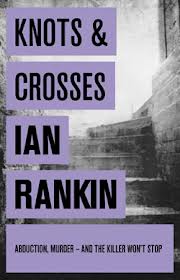
Preparing for Friday’s defense took up a lot of my time and energy last week, but there was routine class business to get done as well. I managed to return a set of papers in my first-year class, which was really worth the extra push so that they weren’t hanging over me this weekend. My conscience needs a break! In Mystery & Detective Fiction we were working through Ian Rankin’s Knots and Crosses. I know he doesn’t consider it his best, and in many ways it is also atypical, but it teaches awfully well because it is so deliberately literary–not to mention terse. Still, I’ve been wondering if next year I might take a chance on one of the longer ones and cut something else from the reading list. It’s such a challenge in that class finding the right balance between providing variety and overwhelming the students with too many different books. My own view has usually been that most of the books we read aren’t really complex enough to require a lot of classroom hours, so just taking longer on them would be counterproductive: we’d go more slowly, yes, but also feel that less was happening, that we were discovering less. The books are not particularly long or difficult reads, either, and I figure they can sub in easily enough for whatever leisure reading students might otherwise be doing! It’s hardly punishment to “have” to read The Murder of Roger Ackroyd or Indemnity Only, right? But students do often remark that there are a lot of books to keep track of. I might cut An Unsuitable Job for a Woman (even thought it’s a personal favorite) and put in Fleshmarket Close or The Naming of the Dead. Actually, since these are both in the 400-page range, I’d probably have to cut something else too. Well, something to think about. In the meantime, they write a mid-term on Monday which will be my next marking chore.

In the Somerville Novelists seminar, we have moved into the collaborative projects phase, and I’ll admit, I’m a bit worried. I had a sinking feeling last week that though we had been doing very well with our discussions of the individual novels–better and better, in fact, as the weeks went on–I had not done a good enough job keeping the larger frameworks of the course in view, or preparing the students to feel confident with the meta-level questions I’ve been hoping we’d address. I did some intervention once I realized that they were still thinking mostly in terms of local or close reading issues, and as I see the draft material starting to appear for their wiki projects, I think it worked. I also felt that they were tense and uncomfortable approaching their independent and collaborative projects despite the careful and detailed instructions and rubrics I’d given them. My intention was to make sure they had enough information about basic structures and expectations to think creatively and even have some fun working within them. What I’ve been feeling is that they still find them unpleasantly open-ended. I decided that I had to stop responding to this discomfort with yet more specifics. I tried to demystify the Pecha Kucha assignment by preparing one of my own–it worked better than intended, because if anything, I think they were underwhelmed by my efforts!* And now I want to keep out of their way a bit. We have one more group session, to discuss some secondary materials most of which we read before, as we were starting up the course: I’m really hoping that now they will feel ready to engage critically with this criticism, bringing their own sense of the material and its (and their) priorities to what these scholars have said and done about it. And then we don’t convene again until the first of their presentations: I’ll be available for consultations, and I hope they’ll take advantage of that, but otherwise it’s over to them.

In book news, I did manage to putter through Sue Grafton’s latest, ‘V’ is for Vengeance. I didn’t have much to say about it, but what I did say is here. I’ve been reading with interest the other posts on Crewe Train and resolving to make The Towers of Trebizond my next Rose Macaulay read, and I’ve started Wide Sargasso Sea for my local book group, which meets next Saturday. I have been feeling frustrated that nothing I’ve read recently has been really transporting, and when I’m done with Rhys I think I might either buckle down and get a lot more of Black Lamb and Grey Falcon read or start on Elizabeth Bowen’s The Death of the Heart, which has been beckoning to me from my TBR shelf–along with Anna Karenina, Alan Hollinghurst’s The Line of Beauty and Colm Toibin’s The Master. All of these look very tempting…but I worry that the last weeks of term are exactly the wrong time to commit to a book that really deserves my full attention.

*Speaking of those efforts, here are the slides. You’ll have to imagine the commentary that went with them! For this assignment we’re allowed two exceptions to the “1/1/5” rule, to demonstrate literary style.

Honourable Estatehttp://www.scribd.com/embeds/113685859/content?start_page=1&view_mode=slideshow&access_key=key-eo8lez5993z3yxtnrcc

“Why did not anything do?” Rose Macaulay, Crewe Train

Crewe Train is the first novel by Rose Macaulay I’ve read. I can’t decide if it makes me want to read another! It was easy to read: the prose is brisk, the tone is lightly satirical, the characters and incidents are quirky but mostly engaging. It has something of the flat quality I’ve noticed in other non-modernist novels I’ve read from the twenties and thirties: everything’s just narrated in order, one thing after another, artlessly. Yet of course there is an art to this too: it’s just not an art that makes itself felt.

Crewe Train tells the story of Denham Dobie, the daughter of a widowed English clergyman who can’t stand chatter and sociability and so tries to find a place to live where he can avoid people who “insist on conversing with you.” Unfortunately for him, the English “cannot stay at home” and his quest for perfect peace is ruined by cheerful, well-meaning, annoying people who “insisted on making friends with him and his grave, square-faced, brown-legged girl.” They end up in Andorra: “enquiring about it, he ascertained that it was very difficult of access, being snowbound from November to May, and mountainous all the year round, and that the approach to it was by mule.” Promising as that sounds, Mr. Dobie nonetheless is still unable to cut himself off from life, and ends up remarried and drawn back into society in spite of himself. The irresistible pull of relationships with other people turns out to be a central idea of the novel.

Denham takes after her father in her dislike of “that strange love of human intercourse, of making talk.” She finds other people mostly just puzzling and troublesome in their demands and expectations: “when she saw anyone whom she knew approaching, she plunged aside off the path and lurked hidden until they were passed by.”

Mr. Dobie dies and Denham is taken back to London by her mother’s family, the Greshams. And so the stage is set for the fish-out-of-water comedy that makes up the bulk of the novel. Denham is a perfect device for Macaulay to poke fun at the conventions and morés of high society. She can’t see the point of all the rules–what to wear, what to say, where to sit, when to stand, how to pass one’s time. Since, of course, most of these really are perfectly arbitrary rules, it’s not that hard to satirize the mindless compliance of the Greshams and their friends–but once you get the idea, it’s also not really that interesting or sophisticated a critique. Here’s Denham newly arrived in London, for instance:

London. The problem was, why did so many people live in it? Millions and millions of people, swarming all over the streets, as thick as flies over a dead goat, as buzzing and as busy. Why? Did they all agree with Uncle Peter that nothing was like London and that they must, therefore, be in London, this unique spot? Did they all have to be here? Had they been adopted by relations and brought here, or did they do something here which they couldn’t do elsewhere? . . .

And then the streets. Thousands and thousands of omnibuses, taxis, vans and cars, all roaring down the streets together, like an army going into battle, mowing down with angry trumpetings all human life that crossed their path. Were they all necessary? Was human life in London so cheap? Denham, after the first, had no personal anxieties on this head, for she felt competent to evade the assaults of these monsters; neither had she much pity for the victims, for they could probably well be spared, and certainly the population needed thinning; but it seemed a curious way of doing it.

Funny, right, especially that deft little jab at the end? And the theme is funny in all of its variations, even as its underlying point is serious and well-taken:

With these Greshams life was like walking on a tight-rope. The things you mustn’t do, mustn’t wear. You must, for instance, spend a great deal of money on silk stockings, when, for much less, you could have got artificial silk or Lisle thread. Why?  Did not these meaner fabrics equally clothe the leg? Why had people agreed that one material was the right wear and that others did not do? Why did not anything do?

The same with gloves, with shoes, with frocks, with garments underneath frocks. In all these things people had set up a standard, and if you did not conform to it you were not right, you were left. . . You had, somehow or other, to conform to a ritual, to be like the people you knew.

It’s not only expensive living up to these standards, but it is also a lot of trouble, and if there’s one thing Denham hates, it’s going to any trouble. She dreams “of a life in which one took practically no trouble at all. One would be alone; one would have no standards; there would be a warm climate and few clothes, and all food off the same plate, if a plate at all. And no conversation.” Awash  in the trivial chatter and clutter of London society, Denham goes along to get along, but it’s all folly, as far as she’s concerned.

The novel follows Denham to marriage (to Arnold Chapel, a writer) and then a pregnancy that (happily, from her perspective) ends in a miscarriage — imagine how much trouble motherhood would be! Despite these gestures towards normalcy, she still craves escape, and she finds what she thinks is the perfect alternative to the Greshams’ lifestyle in an ill-kept Cornish cottage complete with a smuggler’s passage to the sea and a cave she sets up as her parlor. Then, when her privacy in this not-so-bucolic retreat is destroyed by a news story about her eccentric choices, she heads off on a bicycle tour, believing that in constant motion she can free herself from the constraints of society.

No such luck, however. Just as her father was drawn into a second marriage by “madness of the blood” and Denham herself also into marriage by her own passionate response to Arnold’s kisses, so once again it’s passion that thwarts Denham’s plans as she has an affair with a fisherman and becomes pregnant again. Her return home feels something like a failure, as she’s clearly capitulating, of necessity, to the trivialities and domesticities she has always hated. For all that human relationships are troublesome and social conventions pointless, life outside them is an impossibility, a fantasy. “Love,” reflects Denham, “was the great taming emotion”:

Oh, life itself was the trap, and love the piece of toasted cheese that baited it, and, the bait once taken, there was no escape.

It’s a potentially poignant moment, but I felt disoriented at the end of the novel about how Macaulay really meant to steer us. So society is silly and superficial–but Denham’s life and thoughts hardly offer us an exhilarating alternative. She’s no untamed genius, no blooming wildflower ruined by her new unnatural environment, no free spirit caught and tragically tamed. She’s dull, sluggish, literal, unimaginative, anti-intellectual, and, in her own dogged way, entirely selfish. She can’t see any motive for doing anything other than for personal pleasure or satisfaction. She holds up no positive value except individual freedom–and not freedom of a high order (political freedom, freedom of the mind, freedom from oppression, freedom to create or worship or love) but just freedom to do what you feel like doing and nothing else. She thinks books are pointless, plays are “tedious stuff,” children are a nuisance. At times I thought perhaps it was Denham who was being satirized (“What a trade it was, increasing the number of books in a world already stocked with them! As bad as parents, who increased the number of people”). I suppose there’s no reason why the scoffing couldn’t go in both directions. Society: can’t live with it, can’t live without it! But the novel would have been more compelling to me–it would have seemed like more than an eccentrically amusing story–if there had been a clearer sense of what the costs are of the two options. I guess I like my social comedy to have a stronger undercurrent of moral seriousness. Vanity Fair, this isn’t.

Crewe Train is this moth’s reading for the Slaves of Golconda reading group. I’m posting here a bit early because I have another big deadline at the end of the week; I’ll cross-post it over there on November 17th. I’m looking forward to seeing what the other readers thought of the book!

This Week In My Classes: So Much To Do! Also, a New OLM!

It’s the time of term when I really just have to focus on doing one thing at a time: if I contemplate the big picture, it’s overwhelming. The truth is, everything does not in fact need to get done in a hurry or come due at once, but the constant appearance of more items on the ‘to do’ list creates that impression–and thus generates panic–if I’m not careful. Requests for reference letters are streaming in, for instance, and just fielding the inquiries and receiving and collating the documents and forms is a lot of virtual paper-pushing, but the deadlines are in fact spread out between now and January or later, so I have to be careful not to put these nice finite tasks ahead of more amorphous ones that are actually more urgent, if less defined. I do have one extraordinary event coming up next week, a Ph.D. defense (I’m the supervisor): it is not optimum to do these in the middle of term, but that’s how it’s happened, so by next Friday I need to review a 450-page thesis. Given just how important an event this is for the student and our graduate program, more routine business may have to get set aside–marking, for example. Nobody will suffer anything worse than a little suspense if the papers and responses currently awaiting my evaluation take a bit longer than usual to come back.

Routine business goes on, though, in all three of my courses. In Introduction to Literature, we’ve started our short fiction unit, which wraps up the basic ‘introduction to genres’ I’ve been focusing on this term. Next term we revisit all the genres but, as I said to my class today, from a position of strength! We won’t be beginners any more, so we will read longer texts as well as texts in thematic clusters that provoke different kinds of conversations than the ones we’ve been having. My expectations will go up, and they will have a larger role in presenting and analyzing the readings, including, I think, more collaborative group work. I’m really pleased with the good will and hard work I’m seeing from the students in this class so far. I know that they are feeling a lot of pressure at this point in the term too, but they’re hanging in there, and, I hope, feeling that at least in my class they are clear about what the expectations are and supported in meeting them.

In Mystery and Detective Fiction, we’re reading The Terrorists. It really is a superbly interesting and provocative book. Today’s focus was on the plural form of the title, and how the presentation of the different acts of violence and coercion in the novel challenge us to think about innocence and guilt, about motives and justifications, about not “whodunit” but about why. The two convicted murderers in the novel are both people for whom we feel a great deal of sympathy, while their victims hardly seem to deserve the protection of the state. Next class, when everyone has finished the whole book, we’re going to discuss our standard questions about the conclusion — is justice served? on whose terms? what does the novel present to us as a ‘just’ outcome, and how closely does that track what the law declares to be right or wrong? — and then I’m going to open up the discussion further to look back across our earlier readings and start trying to do some more comparative and synthesizing analysis, because whether they write the final exam or do the optional paper, they are going to have to reach a bit more than we’ve been doing on our assignments so far.

In The Somerville Novelists we are moving into the controlled chaos zone of planning the collaborative wiki project. It is a delicate balancing act for me. I need to avoid dictating exactly what I think will work and how I think they should do it (something I know some of them would prefer) but at the same time provide enough guidance and insight that they can make the best use of their time and resources. They’ve been doing some planning on their own, but we met as a class today and I think that it was just in time in some ways, because I realized that there was a risk of their thinking being a bit too narrow, a bit too zoomed in on the particular texts they’re working on, so that the larger framing issues the course aims to address were not part of the conversations they were having and thus not part of the plans they were making–issues like canonicity, for instance, or relationships between gender and genre. I had a chance to make this point today, I hope in a constructive way, and we will return to the discussion and to the planning process on Wednesday. I need to step back soon and let them build their wiki sections, but it’s really important that they not rush to formalizing the structure of their projects before we’ve worked out the conceptual issues better. In order to maintain the momentum of today’s conversation, I’m postponing Wednesday’s planned session on “Pecha Kucha,” which is actually a bit of a relief: I have been working industriously on my sample presentation and would have been ready for Wednesday, but I’ll be better rehearsed on Friday.

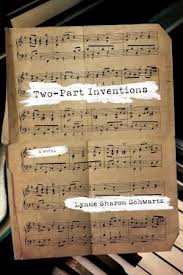
In other news, in case you missed the Twitter and Facebook announcements, there’s a beautiful new issue of Open Letters Monthly up, including what will almost certainly be my final OLM contribution for 2012: my review of Lynne Sharon Schwartz’s new novel Two-Part Inventions. I was so sorry not to be more enthusiastic about it, as her novel Disturbances in the Field is one of my all-time favorites. I wrote about it briefly here, and I wrote at length here also about my great admiration for Leaving Brooklyn. During the editing process, one of my co-editors asked if my review was an implicit response to the recent brou-ha-ha about critics being “too nice.” It certainly was not–at any rate, I did not set out to be not nice, and I hope the review does not come across as anything but what I believe it to be, which is honest and thoughtful. In his “Critic’s Manifesto,” Daniel Mendelsohn proposed that “The intelligent negative review … does its own kind of honor to artists: serious artists, in my experience, want only to be reviewed intelligently, rather than showered with vacuous raves—not least, because serious artists learn from serious reviews.” I agree that taking a work seriously is a way of honoring it and its author, and in this case (as with my review of Jeffrey Eugenides’s The Marriage Plot) I tried to write an “intelligent negative review.” It’s not the kind of reviewing that gets a lot of attention: it’s no good at all as link-bait, compared to the outrageous pan or the “vacuous rave”–but it’s hard work and I think does more service to readers and writers than either of the more extreme alternatives.

Margaret Kennedy, The Outlaws on Parnassus

Preparing for reading The Constant Nymph in my Somerville Novelists seminar, I was intrigued to learn that in her Times obituary Margaret Kennedy was accorded little significance as a novelist while her book on the novel, The Outlaws on Parnassus, was considered her greatest literary contribution. I promptly ordered it from interlibrary loan, and it arrived just in time for me to take a look at it before we wrap up our discussions on Friday.

First published in 1958, The Outlaws on Parnassus harks back to works like E. M. Forster’s Aspects of the Novel rather than anticipating the more theoretical wave of criticism to come. It’s an idiosyncratic book, including  taxonomies of forms and styles along with reflections on the role of the novel and of the critic. Kennedy begins from the point that the novel is a “late arrival” and thus does not have a clear, established place among the other older arts. The relatively low and ill-defined status of the novel is one factor, she proposes, for the dearth of serious criticism of the novel; the other is the perceived redundancy of such criticism given the apparent ease of both reading and writing novels: “The other arts strike the average man as being much more mysterious and as making more strenuous demands upon him.” Novelists, too, she thinks, are uneasy about where they fit and what their work is worth.

I enjoyed her analysis of the fundamental problem confronting the would-be critic:

It is a great misfortune for any human activity if the Greeks, as was seldom the case, had no word for it. The chances are that it will stagger through the ages shackled by ambiguities, since it never got itself thoroughly defined at the start. The most useful words in which to discuss it are missing, and there is no original debate to which any dispute can be referred.

In a discussion of the drama, for instance, it is always possible to ask what Aristotle meant by irony, pathos, the unities, and the protagonists. Since he never deliberated upon the novel we do not know what meaning he would have attached to a plot or a story save in relation to tragic drama. If he did not define these things, who can? Who should?

Who should, indeed? The Outlaws of Parnassus is, of course, Kennedy’s own contribution to defining “these things” plot, story, narrative voice all get some attention, with examples drawn from Homer to Austen to Scott to Tolstoy to Joyce. Kennedy’s approach is pluralistic: she focuses on what different strategies enable, or on when and why various trends emerged, rather than declaring any of them preferable. A sample from her chapter “The Language of Thought”:

Scott, when he wrote this passage [from Waverley], would not have maintained that it was an accurate transcription of thought. He had taken some trouble to convey the state of mind. The soliloquy is addressed to the victim, which is obviously right. We are told that the dying man’s whisper rang continually, like a knell: “Ah, Squire! Why did you leave us?” The paternal fields have been identified as a boyhood memory for both of them, and a picture conjured up of a cottage and bereaved friends: “old Job Houghton and his dame” to whom the penitent has promised to be kind if he ever gets home. In 1814 no novelist would have thought it necessary or possible to do more. Few would have done as much.

By 1914 it was felt to be necessary, and possibilities were therefore explored. Writers using an orchestra of minds to tell their story for them were obliged to consider, not only the exact language of the mind, but the variety of language, as used by different minds. A technical device developed which has sometimes been called “interior monologue.” It is a soliloquy purporting to be bounded entirely by the thinker’s character, idiom, vocabulary and range of expression.

As a device it bristles with problems. . . .

After discussion of, among other things, Molly Bloom’s “reverie at the end of Ulysses,” Kennedy returns to Scott to note that when most fully possessed with a character, as she thinks he was with Jeanie Deans, exceeds “the conventions of his age” and “indicates those small, subtle changes of style and vocabulary,dictated by mood, which are the essence of the whole business; he indicates them with a certainty for which many a writer in this century, grinding out interior monologue, might envy him.” That’s the kind of moment that made The Outlaws on Parnassus winning for me–it’s not that Scott is good only insofar as he anticipates later fictional priorities, but that he’s not to be underestimated because these were not routinely his priorities.

Kennedy gets kind of snarky when she gets to the more self-conscious era of the modern novel, especially when talking about novelists who focused making the novel “professional” or “serious.” About James, Moore, and Conrad, she notes,

All three were tremendously interested in the theory of the novel; they believed that a writer ought to be able to determine in advance what a good novel should be, instead of writing one, as their forbears had done, in the hope that it would turn out to be good.

Things only got worse as novelists decided that their watchword, their measure of good, serious art, should be “integrity”: “The fact that bad artists can have it too was not so generally recognized.” Shes impatient with attempts to distinguish on this basis between potboilers and real novels, or between art and non-art, an effort she sees as a diversion from the critic’s real task, which is “to distinguish between bad art and good art, and, above all, to help us to understand why good art is good.” Attempts to delimit the field of art a priori, on the basis of intentions, are fundamentally mistaken; as she says with admirable understatement, “It is not by a yard-stick of intentions that we can measure the distance between East Lynne and Middlemarch.”

However, the twentieth century saw the rise of “dogma” about “the only possible and permissible way” of writing novels. She looks at “naturalism,” for instance, which she sees as having given novelists new tools and ways “to say some things which had not been said before” (a good thing) but which, taken as dogma, could also lead novelists into error: “at length it became clear that there is no intrinsic magic in the formula . . . a formula can beget nothing on the imagination.” The alternative to the dogma of naturalism or realism is what she calls “the novel of egocentric perception.” Here her touchstone text is Woolf’s essay “Modern Fiction,” which she quotes at length, including the “gig lamps symmetrically arranged” bit. Rather than insisting on scrupulous fidelity to external details, the novelist wedded to this dogma “bases all on the writer’s own feeling . . . [and] shuns the external.” This too is an enabling dogma in the right hands (“by its first advocates [the Bloomsbury Group] it was regarded as a formula for the rare, the gifted, the chosen few”). But as with realism, egocentrism — however excellent in theory –could be only as good  in practice as the individual novelist:

Amongst novelists the good news spread that they need no longer provide plot, comedy, tragedy, love interest, nor catastrophe in order to get top marks. Many adopted the new method who had never got nearer to Bloomsbury than Clapham Junction. They did not see why they should not be as rare and gifted and chosen as anybody else.

The failures of “writers who should never have attempted the method” incited a backlash and “the dogma collapsed so suddenly that those who had put their shirts on it had no resource save to declare furiously that the whole art of the novel must be, in such cases, defunct.” Yet Kennedy believes that “frontier land between the novel and poetry” which “the novel of egocentric perception” had explored was worth the risks and rejoices that such experimentation had made it possible for novelists such as Elizabeth Bowen and Eudora Welty to have “a large public.” Pluralistic, as I said, a point that is reinforced by her chapter “The Choice” which surveys formal options available to novelists (with examples from Richardson, Fielding, Homer, Bennett, and Bowen) and concludes:

In making a possible list for the attic these questions can be put: Why was the form chosen? Did it suit the material? Did the author appear to understand it? Had he the gifts required by those who use it? Is any departure from it deliberate, an experiment, or merely an indication that he did not perceive its limitations? Upon the answers will depend the sheer readability of the book in thirty years’ time. Whether, even it is readable, it will be read, is another matter. That depends upon content. He need not sign his own death-warrant in advance. If he does so sign it, however striking the content, to the attic he will go.

One way this commentary seems relevant to the reading I’ve been doing for my Somerville seminar is precisely that point about choosing the form to suit the material: one of the most useful critical pieces I’ve read is an essay on Winifred Holtby and Woolf (previously discussed here) that points out that by the time Holtby wrote her novels, there were clear stylistic and formal alternatives to the social realism she chose.

There’s much more of interest in this little volume, including a chapter on didacticism in fiction (charmingly titled, “Anyway, I think so!”), another on ethics, another  on “Faking” (including a bit on famous writers who produce a “Reputational Novel,” one written only “because he thinks that his reputation demands another addition to literature”). But I’ll take my last excerpts here from her concluding chapter on “The Goosefeather Bed,” in which Kennedy takes up arms against “the appearance of a new critical term: the serious novelist.” In this chapter she laments the tendency of critics to set aside “the labour of identifying and defining the good” in favour of guaranteeing a writer’s seriousness, defined largely in opposition to his commercialism. “Seriousness” used to be a meaningful term, she says, but now is little more than a good conduct prize, indicating “a miserable decline in critical standards.” In fact, Kennedy argues, there ought to be no such distinction between types of novels, all of whom “share the great goosefeather bed of General Fiction.” What seems to bother her most, again, seems to be the idea that you can or should discriminate between kinds of novels or novelists, rather than between good and bad novels. She urges as broadminded a concept of fiction as possible, on the grounds that it is ultimately the freedom from rules, constraints, and categories that

enabled novelists in the past to write as they pleased, under a label which might be inadequate but which never quenched those who had no mind to be quenched. It never fettered or silenced the giants who won for the novel a whom on Parnassus, and to whom it owes liberty and dignity.