This Week in My Classes: Fun with Fiction

In Close Reading we have finished our poetry unit (yay, say the students–no more scansion!) and been working on short stories. The basic idea is the same: our focus is on paying attention to the various ‘technical’ elements in them, to see how they work to support the effects and ideas of the stories overall. The process of picking out individual elements often feels somewhat artificial, but there’s also a useful discipline in it. Often, we work backwards from a general impression, of a character or scene, for instance, to figuring out how we got that impression. So far we’ve talked about point of view, narration, characterization, and setting. Because one of the guiding principles of the course is that it provides portable knowledge and skills, I’m having some fun bringing in illustrative examples from all kinds of books in addition to our officially ‘assigned’ reading. Here are some of the excerpts we considered as examples of different approaches to characterization:

Dorothea knew many passages of Pascal’s Pensées and of Jeremy Taylor by heart; and to her the destinies of mankind, seen by the light of Christianity, made the solicitudes of feminine fashion appear an occupation for Bedlam. She could not reconcile the anxieties of a spiritual life involving eternal consequences, with a keen interest in gimp and artificial protrusions of drapery. Her mind was theoretic, and yearned by its nature after some lofty conception of the world which might frankly include the parish of Tipton and her own rule of conduct there; she was enamoured of intensity and greatness, and rash in embracing whatever seemed to her to have those aspects; likely to seek martyrdom, to make retractions, and then to incur martyrdom after all in a quarter where she had not sought it.

He belonged to that class of men – vaguely unprepossessing, often bald, short, fat, clever – who were unaccountably attractive to women. Or he believed he was, and thinking seemed to make it so. And it helped that some women believed he was a genius in need of rescue. But the Michael Beard of this time was a man of narrowed mental condition, anhedonic, monothematic, stricken.

Macon wore a formal summer suit, his traveling suit—much more logical for traveling than jeans, he always said. Jeans had those hard, stiff seams and those rivets. Sarah wore a strapless terry beach dress. They might have been returning from two entirely different trips. Sarah had a tan but Macon didn’t. He was a tall, pale, gray-eyed man, with straight fair hair cut close to his head, and his skin was that thin kind that easily burns. He’d kept away from the sun during the middle part of every day.

 He had a great relish for feminine beauty; he was addicted to observing and analyzing it; and as regards this young lady’s face he made several observations. It was not at all insipid, but it was not exactly expressive; and though it was eminently delicate, Winterbourne mentally accused it – very forgivingly – of a want of finish. He thought it very possible that Master Randolph’s sister was a coquette; he was sure she had a spirit of her own; but in her bright, sweet, superficial little visage there was no mockery, no irony.

Dear Joan,

 I do hope I know you well enough to say this.

 I think you ought to forget about your leg. I believe that it is something psychological, psychosomatic, and it is very hard on Charles. It is bringing both him and you into ridicule and spoiling your lives.

 Do make a big try. Won’t you! Forget about your bodily aches and pains. Life is a wonderful thing, Joan. I have discovered this great fact in my work with the Dying.

 Your sincere friend,

   Eliza (Peabody)

We were talking about the role of description or exposition, speech (including thought) and action, external points of view, and what I called ‘accessories’–all the things on or around a character that help communicate who they are, from literal accessories to homes or occupations or hobbies or what books they are reading in a scene. I quoted David Lodge’s remark, from The Art of Fiction, that “all description in fiction is highly selective; its basic rhetorical technique is synecdoche, the part standing in for the whole”: that seems to me a helpful principle to keep in mind. It was interesting how much information we could glean from these small pieces, especially as nobody in the class had actually read any of the novels I took them from. I think (I hope!) they could see the point of the exercise, which was to help us realize how we know what we (think we) know when we’re reading along. Working on fiction in this way you always have to resist their tendency to get caught up in the plot, so using examples out of context, which might seem perverse in other contexts, is actually helpful in this particular course.

In Victorian Fiction we are nearly done with Great Expectations–already! One of the things I like to think about with this novel is the development of young Pip into the Pip who is morally capable of narrating the novel. One of the most moving chapters in the novel for me is Chapter 44, in which Pip first confronts Miss Havisham and Estella with his new knowledge of the real identity of his benefactor. He hasn’t yet moved all the way from confusion to compassion, but already he is working to make something right out of the wrongs he–and they–have done in pursuing their false ideas, and to restore some sense of love and forgiveness to their devastated lives. “You will get me out of your thoughts in a week,” says Estella as Pip, overcome with grief and horror, begs her not to throw herself away on the malignant Bentley Drummle. Pip’s response moves not only us, but also, against all expectation, Miss Havisham:

`Out of my thoughts! You are part of my existence, part of myself. You have been in every line I have ever read, since I first came here, the rough common boy whose poor heart you wounded even then. You have been in every prospect I have ever seen since — on the river, on the sails of the ships, on the marshes, in the clouds, in the light, in the darkness, in the wind, in the woods, in the sea, in the streets. You have been the embodiment of every graceful fancy that my mind has ever become acquainted with. The stones of which the strongest London buildings are made, are not more real, or more impossible to be displaced by your hands, than your presence and influence have been to me, there and everywhere, and will be. Estella, to the last hour of my life, you cannot choose but remain part of my character, part of the little good in me, part of the evil. But, in this separation I associate you only with the good, and I will faithfully hold you to that always, for you must have done me far more good than harm, let me feel now what sharp distress I may. O God bless you, God forgive you!’

In what of unhappiness I got these broken words out of myself, I don’t know. The rhapsody welled up within me, like blood from an inward wound, and gushed out. I held her hand to my lips some lingering moments, and so I left her. But ever afterwards, I remembered — and soon afterwards with stronger reason — that while Estella looked at me merely with incredulous wonder, the spectral figure of Miss Havisham, her hand still covering her heart, seemed all resolved into a ghastly stare of pity and remorse.

That ability to touch someone’s heart is fundamental to Dickens’s fiction, isn’t it? This moment makes an interesting comparison to the climactic encounter between Dorothea and Rosamond in Middlemarch, which also turns on an encounter with someone else’s ‘center of self’ and on the morally inspirational effect of generosity…and yet the scenes are arrived at so differently and belong in other ways to such different worlds.

“On the Duties of Professors”: Research vs. Scholarship

A friend and colleague who read and sympathized with my previous post passed along to me an essay by the late C. Q. Drummond, a long-time member of the Department of English at the University of Alberta. The essay is called “On the Duties of Professors,” and it addresses many of the same issues as my post, particularly the competition for attention, resources, and rewards between research and teaching. As competitions go, all academics know, this is a distinctly unequal one these days: officially, university policies may stress the equal importance of both duties, but inadequacy or irresponsibility in teaching will never hold back someone’s tenure or promotion if they have a “strong” publication record, and while the administrative infrastructure for research is large and powerful, topping out at the Vice Presidential level, if the two factors are really equally important, where, Drummond rightly asks, is the “Vice President (Teaching)”? (Here at Dalhousie, our office of Research Services has 22 staff, including a VP and an Associate VP. Our Center for Learning and Teaching has 10, with a Director and Associate Director at the top.) Not that Drummond wants to see an expansion of teaching-related bureaucracy–though I quite like his idea for how a VP (Teaching) would go about his or her business: this VP “would move through all the Faculties, visiting classes, hearing lectures, attending seminars, drinking coffee, joining oral examinations, talking into the night.” Through qualitative engagement with teachers and students, this VP would become “another source of evidence, besides tabulated student assessments, for who teaches well and who poorly.”

Drummond’s remarks are directed specifically at his own situation: at the time of writing (around 1984), he had recently been “penalize[d] for insufficient publication during a year in which [his Faculty] received extraordinary evidence of his merit as a teacher.” There’s a polemical thrust to them, as a result, but Drummond uses the occasion to place his own professional experience into its larger context: the increasing dominance of precisely the kind of quantitative measures of research “output” about which I was complaining yesterday. Actually, there is one difference that signals the 30-year gap between us: I didn’t notice any mention of research grants in his piece. I expect he would have objected still more strenuously to measuring scholarly success by level of external funding. He directs his criticism at “forced publication,” and at the reductive equation of publication with research or scholarship:

The Salaries and Promotions Committee certainly does not ask for wisdom; it does not ask for erudition or for scholarship; it does not ask for learning, or even for research; it asks for output, something to be measured or counted. . . . What good does such output do anyone? If research in an Arts Faculty means humane learning, then we all hope our teachers are as much involved in research as they possibly can be. We want them to know better and better what they are talking about, so that they will have, and will continue to have, something intelligent and important to profess to their students. But if research means output or publication, as it so often does today, how do the students profit? And how does the scholarly world profit from the forced production of ephemera? Most professors in Arts Faculties would be better off reading more and publishing less, and their students would be better off too, and so would the world of scholarship.

The very term “research” is, he argues, part of the problem.  He quotes George Whalley, who argued in an essay of his own that “research” suggests a goal-oriented activity, work carried out in pursuit of something in particular. “The functions of research,” Whalley writes, “are specialized and limited; … the word research is not a suitable term for referring to the central initiative and purpose of sustained inquiry in “the humanities” . . . “The humanities” is what “humanists” do; not only what they study, but how they study, and why . . . .”

Drawing on the Handbook published by the CAUT (invoked by his Dean in response to Drummond’s appeal of the Committee’s decision), Drummond himself brings in the vocabulary of knowledge “dissemination” which is once again very current in discussions of our aims:

Research should result in teaching, and might result in publication, teaching and publication being the most important means of dissemination of knowledge. We may teach those near at hand in our lectures, discussions, tutorials, apprenticeships, and supervised practical training, or we may teach those distant through our published papers, articles, essays, and books. But in either case we will have to have found out and shown something worth lecturing about, discussing, or writing down. And where will we have our greatest effect in disseminating what we have found out and know? . . . Dissemination has to do with sowing seed; what we hope when we disseminate is that the seed will take root and grow. . . . So much of the seed one sows in publication falls by the wayside and is devoured by birds, or falls on stony ground, or among thorns and yields no fruit. What the good teacher sows in his class or tutorial is far more likely to find the good ground, spring up, increase, and itself bring forth.

 He reiterates at intervals throughout the piece that he is not opposed to either research or publication, only to a mechanistic understanding of both, especially when it “drives out teaching”–which almost inevitably follows: institutional systems of measurement and incentives are set up not “to encourage the combination of knowing and teaching,” but to “encourage the production of printed pages,” and “because we live in a world in which time itself is scarce, the time taken for one must be taken from the other.” Again, it’s not that he wishes teaching, in its turn, to drive out research–teaching depends on research, broadly understood as inquiry.

It’s not, in my turn, that I wish to drive out either research or publication, both of which are essential (as Drummond too acknowledges) to learning, teaching, and knowledge dissemination. What bothers me is the  incessant identification of “productive” scholarly activity with a narrow model of  output, a cloistered, specialized, self-referential kind of publishing supported, ideally, by as large an external grant as possible. It’s a shame that the faux-scientific model Drummond objects to is now so firmly entrenched–so deeply entangled in the values, practices, and especially the finances of our universities–that it seems unimaginable that we could ever undo it. Some might argue that we have won more by it than we have lost–that without playing the game that way, we would have forfeited any place in the contemporary academy. Others might reply that, yes, we are playing the game, but on terms by which we can only, ultimately, lose: however vast our research output, will we ever win either the public or the institutional respect enjoyed by the sciences? Hasn’t our preoccupation with research actually isolated us and cost us public support? And in our effort to insist on the goal-oriented practicality of our fields, we may have flagged in our defense of their intrinsic value. Again, it’s not that I think we should not do research, or publish what it teaches us–but it’s a shame that the system is so rigged in favor of hurrying it along and rushing it into print–not to mention aiming it at a specific (and very narrow) audience. “I know for a fact,” Drummond observes, “that policies of forced publication never brought into being–nor could ever have brought into being–those critical books that have been to me most valuable.” That’s certainly true of my reading as well. The narrow concept of research and the pressure to publish also, when made the primary measures of professional success, marginalize undergraduate teaching. (The emphasis in grantsmanship on teaching and funding graduate students, or “HQP” [Highly Qualifed Personnel] is another whole area of trouble.) Finally, it seems to me paradoxically retrograde to be urging or following a model that measures productivity by grant size or output of peer-reviewed publications at a time when the entire landscape of scholarly communication is changing. We can circulate our ideas, enhance our and others’ understanding, pursue our inquiries and disseminate our knowledge in more, and often cheaper, ways than ever before. As long as we are all using our time in service of the university’s central mission–the advancement of knowledge, including through teaching–by the means best suited to the problems we think are most important and interesting to pursue, aren’t we doing our duty as professors?

But as the Associate Vice President who spoke to my Faculty on Thursday said repeatedly, there aren’t “metrics” for those other ways of doing (or discussing) research or measuring its impact: they do not yield data that can be counted, measured, and easily compared across departments, faculties, and campuses. Apparently, that means we have to set them aside–or, at any rate, that the VP (Research) will do so, when reporting to us on our “performance.”

The essay I discuss here is in the volume In Defence of Adam: Essays on Bunyan, Milton, and Others by C. Q. Drummond, edited by John Baxter and Gordon Harvey (Edgeways Books, 2004).

This Week at Work: Reflections on Our Research Culture

DALHOUSIE-UNIVERSITYYesterday I received a reminder from the Mellon Foundation about a follow-up survey they are doing of people who did Ph.D.s supported by Mellon Fellowships.  I remember how exciting it was when I learned I had won one of these fellowships, which was both generous and prestigious. I had mixed success with my actual Ph.D. applications–indeed, I was rejected by many more schools than accepted me–and I’ve often thought that the crucial factor in my winning the Mellon was the interview. I was (am?) more charming in person than on paper–it’s something about my sense of humor, I think, which apparently doesn’t carry over much into my writing!

In any case, winning a Mellon Fellowship made me a more attractive target for the schools that had offered me places: I ended up with the luxury of comparing complete five-year funding packages from a couple of excellent schools, and the even greater luxury of comparing these North American alternatives to using a Commonwealth Scholarship to go to the UK. In the end, I chose Cornell, starting in 1990 and finishing in 1995 with job offer in hand–job offers, in fact: while my job market success was also mixed and I got a lot of rejections, when I got close, I did pretty well (speaking of rejection, though, I’ll never forget the message telling me I was not offered the job I wanted most of all, which hit me like an emotional bomb when I read it in the dank basement computer lab where, in those olden days, I had to go to check my email–would it have been so hard to give me a phone call so I could have absorbed the blow in private?). Anyway, I chose Dalhousie, and (though I have made a few attempts over the years to move on) here I still am today.

Dal_MarionMcCain_BuildingThe Mellon survey focused primarily on career paths and job satisfaction. Most of it was pretty easy stuff (how many peer-reviewed articles did you publish before tenure? what kind of pre-tenure mentoring did you get? were there explicit expectations about the kind or quantity of publications you’d need for tenure?), but towards the end there were some more open-ended ones, and the very final one proved a real poser: If you had to do it all over again, they asked, would you do the same? Same degree, same school? Same degree, different school? Different degree? Or no Ph.D. at all?

Maybe this would not have been such a stumper of a question if they’d asked it on a different day, but yesterday was kind of a tough day for me at work. It’s not that I was busier than usual or overwhelmed with new tasks or dealing with confrontational students upset with their grades, or dead-ended on a writing project or behind in my class preparation. Rather, it was a day (one of many recent days) in which different priorities clashed in the department and I ended up feeling that more and more, we are steering by (or allowing ourselves to be steered by) the wrong values. There are a lot of moving parts behind the motions we have voted on recently, but the net effect is that a majority of the department has carried through an agenda by which we will reduce class offerings at all levels and increase class sizes at the undergraduate level, in order to bring our nominal teaching load down and thus clear more time for research during the academic term.

macke woman readingI emphasize that last clause because we have dedicated research time already (the spring and summer terms, when we do not regularly teach undergraduate classes, as well as our sabbaticals); the argument was being made for the importance of making more time for research while teaching, and thus the new plan deliberately favors reducing our contact hours and prep time. We’ll remain individually responsible for the same number of students, so any time savings won’t come from reducing our grading. Now, I find marking assignments as tedious as the next prof. What I don’t find tedious or want less of is face time with my students. My hours in the classroom are almost the only hours during which I have no doubts about my answer to the Mellon Foundation’s question. It’s true that class prep can be relentless, and in the middle of my heavier teaching term, I’m too busy with it–too overwhelmed by it, in combination with the marking–to do anything ambitious regarding other research or writing projects. Not nothing at all, but nothing much. But class prep can also be  intellectually stimulating, and often is itself research, or feeds into ongoing research interests: I didn’t like the presumed opposition between teaching and research that dominated the arguments for the latest motion.

The problem is that this pitting of two of our essential tasks against each other is in large part a consequence of the pervasive research culture promulgated especially by administrators who talk about “productivity” and “output” in terms of grant dollars pursued and won, and of quantity (rather than quality and significance) of (conventionally peer-reviewed) publications. Tomorrow, for instance, we are invited to a “presentation” on “trends in FASS [Faculty of Arts and Social Sciences] research performance.” Let’s just say I will be pleasantly surprised if the emphasis is not squarely on those kinds of quantifiable measures. Everyone I’ve spoken to about it fully anticipates that the event has been set up as an occasion to chastise us for our failure to measure up, both to other faculties on campus and perhaps also to comparable faculties at other universities.

But the conversation we should be having is about the adequacy of the measures, about the damage they do and the absurdities they create. We should be talking about whether it’s really a good use of time for a humanities scholar to spend weeks, months even, on a grant proposal for a program with a success rate of below 25%; we should be talking about the culture of greed and hypocrisy and cynicism that has been created by the pressure to ask for more and more money whether you need it or not, because big grants bring prestige (and support graduate students–and that’s another can of worms right there); about the flawed logic of trying to get grants because the university relies on its share of them to cover ‘indirect costs.’ We should be resisting the pressure to increase our research productivity according to such ill-fitting measures, and we should especially resist chipping away at our curriculum and at our undergraduate students’ educational experience because we want to look like the kind of “productive researchers” the university seems exclusively to recognize and reward. I don’t measure my “performance” as a scholar exclusively on my output of specialized peer-reviewed publications, or on my success at competing for external funding, and I don’t think my university should either. Here too, there are a lot of moving parts, and the funding challenges universities faced are not something I take lightly (or understand completely, given their intricacies). But that doesn’t change the oddity of trying to twist and bend humanistic inquiry into something that looks like scientific research, and of treating us as failures precisely because we don’t do expensive projects.

woman-writing-1934Let me be clear: I don’t think there’s no point in our doing our research. I don’t think it’s a waste of time; I do think that there are both intellectual and social pay-offs from our efforts to understand the world better by way of understanding its literature. But I do think we produce enough of it already. I don’t think Mark Bauerlein makes a particularly fair or coherent argument about its excesses, but I also don’t think we need to “protect” more time to produce more of it faster. I actually think we should slow down and produce less of it, especially in conventional forms. How much “output” is enough? It’s not the quantity that should matter. How much research time is enough? If we let go of the artificial urgency fueled by the kind of presentation I’m looking forward to tomorrow, I think we’d find we already have enough time.
Now, to be fair, we haven’t exactly decimated our program, and we still have plenty of classes on the small side. But the pressure is undoubtedly upward. Big classes are routine elsewhere, I’m told, and a lower teaching load for full-time faculty is also the norm at other “research institutions.” But is this a good thing? Is this the way we want our resources distributed? Well, judging by yesterday’s voting, the answer for a lot of us is ‘yes.’   I understand why, but I feel that we’re in pursuit of a model of success or excellence that I just don’t believe in anymore. Sometimes sitting with my colleagues I feel like a nonbeliever in church! And it’s a church in which two things are sacrosant: our research, and our graduate program–in the interests of which we have made all of the recent changes to our overall curriculum.

And this is why the Mellon survey question was so hard to answer. How can I be sorry that I’ve been able to pursue this career, which in many ways suits me so well? How can I regret that I can dedicate my time to things I not only think are really important, but love? In what other job can you be paid to spend hours and hours a week concentrating on literature, and working with bright, eager students to nurture their love of reading and their interest in the kinds of questions it opens up? But the other values of the profession have troubled me from the start of my Ph.D. work, and the systems of incentives and rewards, and of prestige and reputation too, skew very far in one direction. How can I not feel I’m out of step and perhaps unsuited for the career I chose when I can’t commit myself wholeheartedly to two of its central pursuits?

If I had the choice, would I do the same again? Today, I’m not sure. But ask me again  after my small group discussion of Great Expectations on Friday. I bet my answer then will be “of course!”

To Robert Graves: Thank You For All That!

There’s one way in which Robert Graves is important to me that has nothing to do with Goodbye to All That or any of the other significant contributions he made to literary history, and that’s his role in turning me from a history major into an English major–and thus steering me down the whole professional road I have since followed. I told most of this story once before, in a post I wrote appreciating the important teachers in my life. I had always been a passionate reader but a skeptic about the idea of literary criticism (anyone can read, right? so what is there to study?). History, on the other hand, was about something measurable. But things changed, ultimately in my view of history and the degree to which it too is literary, but first in my attitude towards literary criticism:

one day we had read a poem I really liked (it was Robert Graves’s “The Cool Web“) and I finally put my hand up and ventured some replies to his questions about Graves’s language and how particular words fit the central ideas of the poem. He seemed pleased! My answers were good! I knew what he was talking about! Things started to fall into place. He wasn’t making things up, because I could see them there too, in the poem, and thinking about how the details of form and language built up the whole piece made the poem better, more pleasurable, more exciting to read. It was like something coming into focus, something I (as someone who had always loved to read both fiction and poetry) had always seen, but had never really looked at.

I began contributing more often to class discussion (though I never became particularly voluble as a student–despite being, um, chatty in real life, I always felt both shy and nervous about speaking up), and more significantly I became absorbed by the process of literary analysis and interpretation. My first-year experience motivated me to enter the 2nd-year English pre-Honours program U.B.C. then offered, and in a little twist of fate, the sight poem I was given for my oral exam in it was “The Cool Web.” I felt almost like I was cheating because I knew the poem so well! The exam went well (don’t worry, there was more on it that “The Cool Web,” so it’s not like I coasted completely!) and the next year I started my combined Honours program in English and History, a combination of interests that sustained me through an Honours thesis on Carlyle’s The French Revolution and Middlemarch as ‘novels’ and ‘histories,’ then a Ph.D. thesis on gender and genre in Victorian historical writing…and on to the emphasis I still put on historical contexts and historiographical interests in the texts I teach. (From my fall course evaluations: “Too much history for an English class.” Huh.) I didn’t much like the Graves I met in his autobiography, and I don’t know much about the man himself beyond that, but I will always be glad I happened upon him in that form at that moment. “Who can tell what may be the effects of writing?” George Eliot asks in Middlemarch–and it is amazing, really, to reflect on the difference one poem made in my life.

“The Cool Web” was the poem I chose for today’s Close Reading tutorials, where we are preparing for an annotation assignment due next week. I still find it a wonderfully stimulating (and teachable) poem:  complex and artful enough to be interesting, direct enough to be accessible, and surprisingly moving.

The Cool Web

Children are dumb to say how hot the day is,
How hot the scent is of the summer rose
How dreadful the black wastes of evening sky
How dreadful the tall soldiers drumming by.

But we have speech, to chill the angry day,
And speech to dull the rose’s cruel scent.
We spell away the overhanging night,
We spell away the soldiers and the fright.

There’s a cool web of language winds us in,
Retreat from too much joy or too much fear:
We grow sea-green at last and coldly die
In brininess and volubility.

But if we let our tongues lose self-possession,
Throwing off language and its watery clasp
Before our death, instead of when death comes,
Facing the wide glare of the children’s day,
Facing the rose, the dark sky, and the drums,
We shall go mad, no doubt, and die that way.

This Week in My Classes: Contact Hours

One of my goals for this term was to increase the amount of direct contact between me and my students. One step towards that goal was my (re)introduction of seminar groups into my 3rd-year “lecture” class on the Victorian novel. It’s not a straight lecture class: hostile media reports to the contrary, I know no professors who literally only lecture, and in English, some degree of back-and-forth with the class is, I’m confident, 100% the norm in every class. English is not a fact-finding discipline at heart, after all: though we need to teach vocabulary, provide contexts, and model interpretation, the overall goal is students who can think and write their own way through the course material. My Victorian novels classes are probably pretty typical, in that sometimes I do hold forth for most of the 50 minute session, especially when introducing new material, but most often I gather ideas from the class and return them reorganized, or challenge them, or complicate them, or offer illustrative examples for them. The classes are capped at 40 and are usually full (this term, Barchester Towers seems to have scared a few away during the last bit of the add-drop period, and we are down to 34, which is an atypically small group). In a class that size you can get quite a bit of student involvement, but it’s still not possible to hear from everyone or to give everyone’s ideas a lot of sustained attention. And the more I talk specifically to a student, the more I find that student engages and learns. So I’ve broken them up into two groups, one meeting basically every Friday while the other had a dedicated reading hour (Friday afternoons–yes, I’m positive they will all use that hour to go to the library, definitely!).

We had our first small group session last Friday, and I was extremely encouraged about the plan: it went great! Although it was clear that many of them were not falling in love with Barchester Towers (the word ‘dry’ was used!!), the discussion was very lively and did not require a lot of intervention from me to keep it going. It was great to hear what they were thinking about and responding to, and to have a chance to steer them from observation to analysis in a more immediate way. Some students were particularly keen on the Stanhopes–one said that they had “saved” the novel for her by livening it up just as she was worrying that it would be all dull clergymen all the time (I’m paraphrasing loosely, but that seemed to be the gist of it). I am so fond of Mr Harding and the Archdeacon that I admit I hadn’t been focusing that intently on the Stanhopes (except the Signora, of course) but it’s quite right that they bring a degree of informality into the book, as well as a careless cosmopolitanism that does break up the intense provincialism of the other characters. That very looseness of theirs enables some key developments in the plot (for instance, it’s the Signora’s interference, improper as it is from some perspectives, that finally gets Eleanor and Arabin together), so that was a great place to take the discussion. The general topic I had settled on as the focus of the session was the women of Barchester Towers, as in the first lecture meetings our focus was primarily on the men and their ‘parties.’ Eleanor was not a great favorite! I guess she is rather dull at first. I hope by the time she boxes Mr Slope’s ears, they were giving her more credit.

So that’s one way I am changing things up. I’m doing something quite different in my Close Reading class that turns out to be another way of increasing direct contact, although that isn’t exactly how I’d thought of it–and that’s regular homework. We have tutorial groups already in Close Reading, as it is a skills-oriented course and supposed to include plenty of hands-on, collaborative, and consultative time. Because of that hands-on emphasis and my previous experience when reading assignments are light that students rather blow off class preparation (sure, you can breeze through a sonnet while waiting for the classroom to open and be ready to go, right? wrong! especially, though not exclusively, when it’s a Donne sonnet!)–because of those features of the class, and because for the first time I’m using an actual textbook that includes question sets and practice exercises, I thought it made sense to assign specific things to get done before each class, usually fairly simple questions that apply the current topic (say, meter and scansion, or figurative language, or poetic structure) to select texts. I actually called it ‘homework’ in the syllabus and have been feeling kind of self-conscious about that; I even acknowledged to the class that I know that terminology sounds a bit high schoolish. But I also stressed that all the homework does is make tangible what would be my expectation anyway, namely that they would actually work on the material before class, and practice applying what they have learned.

The thing is, I have graded four sets now, and to my surprise (I expected to find it tedious) I quite like the experience of it, precisely because it does put me in contact with the students so often and in such a non-threatening way (well, non-threatening to me, at least). The homework sets are not “worth” a lot each (2%), and as long as they are responsibly completed, I’m giving them full marks: it’s not about deducting points for scanning it wrong or calling something “anaphora” when it’s not. The point is I can see their work, see how they are doing, what they get and what they don’t, and give them prompt feedback. I can also see who’s doing the work and who’s not, and as the evidence about this accumulates, I’ll use it to nudge the slackers, because I bet there will be a strong correlation between doing the weekly work for the class and doing well in the class! It’s not like I haven’t given regular small assignments of one kind or another in a lot of classes. Often they are in the form of discussion questions and reading responses, or in-class writing starts, or reading journals (which is what these homework assignments will become when we have finished our time with the textbook). It’s just that these exercises feel very straightforward, both in their relationship to the course objectives and in terms of my interaction with them: they are about practising, for them, and about coaching, for me. I hope that getting that kind of personal feedback, even on such a small scale, will help them feel connected to me and to the work we are doing: as they see that I do go over their homework and use it to prompt them towards better work, I hope they won’t see it as “busywork” but as a meaningful, if minute, interaction between us.

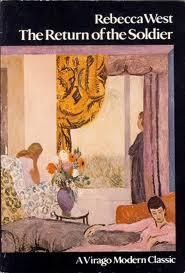
Rebecca West, The Return of the Soldier

This strange, beautiful, overwrought little novel surprised and disturbed me. Its story is  simple: a soldier, Chris Baldry, returns from the front a victim of shell-shock that has cost him fifteen years worth of memory. The news is broken to his wife, Kitty, and his cousin, Jenny, by Margaret Grey, who as Margaret Allington was once in love with (and loved by) Chris. In his damaged mind, their affair is immediate and ongoing, while his marriage is unknown, his wife a stranger. As the novel progresses we realize, with Jenny (our narrator), that the fifteen years lost to his memory were, to him, years already lost in another way: lost to the love he had to give up, lost to the effort to maintain his family business and the family home, Baldry Court. Kitty and Jenny have never understood that the life they shared with him–perfect, elegant, insulated against ugliness–was for him a death of the soul. His return from the war, ill and lost and confused, is a return to Margaret and an opportunity to find himself again through her; their reunion is painfully touching, the more so because we see and feel it only from the literal and emotional distance of Jenny’s perspective.

Jenny’s point of view is the most disconcerting aspect of The Return of the Soldier. At first I was troubled by uncertainty about far we were supposed to go along with her, which is a question that matters because she’s really dreadful: not just judgmental, but nastily so. Here’s her initial description of Margaret, for instance, just arrived to break the news of Chris’s illness:

The bones of her cheap stays clicked as she moved. Well, she was not so bad. Her body was long and round and shapely and with a noble squareness of the shoulders; her fair hair curled diffidently about a good brow; her grey eyes, though they were remote, as if anything worth looking at in her life had kept a long way off, were full of tenderness; and though she was slender there was something about her of the wholesome endearing heaviness of the draught-ox or the big trusted dog. Yet she was bad enough. She was repulsively furred with neglect and poverty, as even a good glove that has dropped behind a bed in a hotel and has lain undisturbed for a day or two is repulsive when the chambermaid retrieves it from the dust and fluff.

But Jenny can already sense something significant, can at least credit Margaret with an impulse towards “candour and gentleness.” As the story goes on, though her language remains permeated with the same hateful condescension, Jenny–in spite of herself–also acknowledges repeatedly that Margaret has, that Margaret is, something valuable and beautiful. It’s Jenny’s problem, not Margaret’s, that Jenny can’t reconcile this knowledge with her own repugnance towards Margaret. Jealousy is  part of it, as Jenny clearly (thought this is never overtly admitted) loves Chris herself. It’s not only personal animosity, though: Jenny and Kitty practice a creepy kind of aestheticism literalized through the way they tend to Baldry Court, where everything must “be made delicate and decorated into felicity.” How can Margaret, with her coarse hands and cheap clothes, even dare to enter? “Surely she must see … that no one accustomed to live here could help wincing at such external dinginess as hers.”

The novel overall is a profound chastisement of Jenny for her cruelty, her judgments, her mistaken priorities, even for her love, which is cloying and limiting in comparison to the luminous generosity of Margaret’s. It’s Jenny and Kitty–especially Kitty (eventually seen by Jenny as “the falsest thing on earth”)–that have destroyed Chris, as much as the war has; it is his life with them, especially his marriage, which he wants to forget as much as anything he has seen in the trenches. They don’t even know him well enough to cure him: it’s Margaret who does, and the bitter irony of the novel is that the cure will in fact destroy him–again. Worse yet, for Margaret, is that one inevitably consequence of his return to reality will be her banishment, her loss now replacing his. A further extension of this irony is that his return to sanity will send him back (healthy, once again) to war: once he returns to them with his memory restored, he must return as a soldier.

The moral and emotional stakes are high, and West makes the most of them. In fact, at times I thought she made too much of them: the writing is (like Baldry Court) highly decorated, rich with adjectives and imagery and detail. Not knowing anything of West’s writing except some bits of her criticism, I was surprised by the thickness of the style: its insistently showy but languid artistry. I didn’t dislike it: it’s compelling, and as I became more interested in Jenny as a narrator, I thought it mostly reflected her consciousness, her self-consciously aesthetic sensibility. But then there’s this bit, as Jenny observes Margaret watching over Chris while he sleeps:

…it was the loveliest attitude in the world. It means that the woman has gathered the soul of the man into her soul and is keeping it warm in love and peace so that his body can rest quiet for a little time. That is a great thing for a woman to do. I know there are things at least as great for those women whose independent spirits can ride fearlessly and with interest outside the home park of their personal relationships, but independence is not the occupation of most of us. What we desire is greatness such as this which had given sleep to the beloved.

It is Jenny speaking, of course, but the moment is infused with such intensity, and the comments reflect so much of what is held out as noble, even heroic, about Margaret overall (that she loves so generously, that she gives so much of herself and expects nothing in return, that she is sanctified in her devotion to others) that I can’t attach them only to Jenny’s already problematic point of view. In fact, I think this is meant to be an epiphany of sorts for Jenny: an acknowledgement of where she and Kitty have fallen short in their love, and perhaps by extension fallen short as women. Kitty’s icy beauty (not to mention the entire relationship she has in fact had with Chris–her husband, after all) is completely devalued by comparison with Margaret’s hovering nurturance. This scene, for me, was a low point. The novel’s conclusion, on the other hand, with its commitment to “the wine of the truth” which we “must drink or not be fully human,” was a high point. If Chris’s marriage to Kitty has been in some fundamental ways a lie, it’s no better to repress the marriage itself and go on living another lie. In imagining that they could protect him, Jenny and Margaret have “forgotten that it is the first concern of love to safeguard the dignity of the beloved.” And so we arrive at the saddest moment of all, as Chris walks back towards the house, “not loose limbed like a boy, as he had done that very afternoon, but with the soldier’s hard tread upon the heel.” “He’s cured!” whispers Kitty. As the soldier returns, it is easier to mourn than to celebrate.

Goodbye to Robert Graves, Goodbye to All That

I finished Robert Graves’s autobiography Goodbye to All That tonight. When I wrote about it on the weekend, I was wondering if he would shift gears and begin reflecting on the experiences he recounts. The short answer to that is no. There are dribs and drabs of commentary that, if extended, would have added the kind of layered response I was looking for. For instance, Graves is asked at one point by a local Rector to speak at a War Memorial service:

He suggested that I should read war-poems. But instead of Rupert Brooke on the glorious dead, I read some of the more painful poems by Sassoon and Wilfred Owen about men dying from gas-poisoning, and about buttocks of corpses bulging from the mud. I also suggested that the men who died…were not particularly virtuous or particularly wicked, but just average soldiers, and that the survivors should thank God they were alive, and do their best to avoid wars in the future.

That’s very nearly it, as far as addressing the significance of the war or what he personally carried away from it. Perhaps he has written more about it somewhere else. He wrote poems about it: perhaps he felt that, in them, he had said what he wanted. The thing is, I finished Goodbye to All That with no desire to find out or read more. I just came away from the book not liking him very much–and what that should have to do with anything, I don’t altogether know, but even acknowledging that any autobiography involves the creation of a persona that should not be naively identified with the subject etc. etc., still, this is what he wrote to represent himself, and to me, he comes across as a bit of a jerk. Here’s his example of taking “a stern line,” for example (from the Epilogue, technically, so written later than the rest of the book, but still…). During WWII, while serving as an Air Raid Warden, he is called for a medical examination,

and the policeman brought me a third-class railway-warrant together with an order to appear before a medical board at Exeter. As an officer on the pensioned list, I refused to travel except first class, a privilege to which my rank entitled me. He and I might find ourselves in the same compartment, and it would never do for us two to mix socially.

Now, I wonder if he’s being ironic at his own expense here, but questions of rank actually come up quite often in the book, right from the early part when he notes that having “paid so heavily for the fourteen years of my gentleman’s education” he felt “entitled, now and then, to get some sort of return.” In any case, taking a stern line on traveling first class compares badly to the kinds of things Vera Brittain takes a stern line on following her own war experiences. I didn’t much like his discussions of his time teaching in Egypt either, for the same reason: his attitude about both the job and his students is arrogant and dismissive. He quotes, apparently in full, three “diploma essays” from students at the Higher Training College in Cairo where he served as an examiner. It’s true they are mostly ludicrous (on The Character of Lady Macbeth: “The impression on the reader becomes very great and feels with anger”) but the writers are laboring in a second or even third language, after all. Graves’s dry conclusion: “I decided to resign.” He would. Of his assignment to teach literature at Cairo University, he remarks, that the students “professed themselves anxious to master Shakespeare, Wordsworth, and Byron in that time. I had no desire to teach Wordsworth and Byron to anyone, and wished to protect Shakespeare from them.” But then he disdains them for considering it “beneath their dignity to admit the existence of ballads in Egypt” because of their class prejudice against the fellaheen.

I commented on the matter-of-fact tone and the unthinking forward movement of the narrative in my previous post, and in the comments, Mike quoted this passage from Graves’s essay “P. S. to Goodbye to  All That“:

I have more or less deliberately mixed in all the ingredients that I know are mixed into popular books. For instance, while I was writing, I reminded myself that people like reading about food and drink, so I searched my memory for the meals that had significance in my life and put them down. And they like reading about murders, so I was careful not to leave out any of the six or seven that I could tell about. Ghosts, of course. There must, in every book of this sort, be at least one ghost story with a possible explanation, and one without any explanation, except that it was a ghost…But the best bet of all is battles, and I had been in two quite good ones–the first conveniently enough a failure, though set off by extreme heroism, the second a success, though a little clouded by irresolution.

I replied that this sounded discouragingly cynical, but once we got out of the war sections, it seemed more and more accurate to me. Graves’s stories of life in the trenches are intrinsically compelling just for being so far from ordinary life, and the bluntness of his style preserves them from any sentimentality and himself from any pretense of heroism. But after that the book is just a chronicle of what happens and who he meets, with particular care taken to drop names and anecdotes: a few pages on visiting with Hardy, notes on his relationship with Sassoon (which had the effect of making me want to reread Pat Barker’s Regeneration trilogy rather than anything more directly by or about Graves), stories about meeting T. E. Lawrence  (yes, of Arabia). He gets married, and his wife Nancy actually sounds pretty interesting (she’s a committed feminist who refuses to take his surname, just for instance), but we don’t get to know much about her or about why their marriage came apart. They have children but he spends little time with them. They putter around Oxford, open a shop, go out of business, go to Egypt–and the book stops.

The most thought-provoking thing in the book, ultimately, may be this little bit about genre not far from the end:

I made several attempts during these years to rid myself of the poison of war memories by finishing my novel, but had to abandon it – ashamed at having distorted my material with a plot, and yet not sure enough of myself to turn it back into undisguised history, as here.

Brittain too first tried to write about the war in fiction. Both clearly concluded that their way forward was not exactly through “undisguised history” but through memoir, letting themselves into the story and telling it as they experienced it personally. Only Graves doesn’t really bring himself into it: what he thought and felt about it, how it affected him, what he thinks it meant–none of that is in this book. For me, that made it a real disappointment, a much lesser book than it could have been. Is it unfair to think that’s a reflection on Graves? As always, I’m prepared to believe it might reflect on me, bringing the wrong expectations or models to the book he decided to write.

We Are All Mr. Harding

Substitute, say, “education or technology” for “politics or religion,” and doesn’t this sound familiar?

“New men are carrying out new measures and are carting away the useless rubbish of past centuries!” What cruel words these had been; and how often are they now used with all the heartless cruelty of a Slope! A man is sufficiently condemned if it can only be shown that either in politics or religion he does not belong to some new school established within the last score of years. He may then regard himself as rubbish and expect to be carted away. A man is nothing now unless he has within him a full appreciation of the new era, an era in which it would seem that neither honesty nor truth is very desirable, but in which success is the only touchstone of merit. We must laugh at everything that is established. Let the joke be ever so bad, ever so untrue to the real principles of joking; nevertheless we must laugh — or else beware the cart. We must talk, think, and live up to the spirit of the times, and write up to it too, if that cacoethes be upon us, or else we are nought. New men and new measures, long credit and few scruples, great success or wonderful ruin, such are now the tastes of Englishmen who know how to live. Alas, alas! Under such circumstances Mr. Harding could not but feel that he was an Englishman who did not know how to live. This new doctrine of Mr. Slope and the rubbish cart, new at least at Barchester, sadly disturbed his equanimity.

That’s a little snippet from Chapter XIII of Barchester Towers. Poor Mr. Harding: he just wants to be left alone to enjoy his quiet life and be a generally good person. Is that too much to ask? And yet in true Trollopian fashion, the answer is not as easy as we’d like, as Mr. Harding himself is sadly aware:

Had he in truth so lived as to be now in his old age justly reckoned as rubbish fit only to be hidden away in some huge dust-hole? The school of men to whom he professes to belong, the Grantlys, the Gwynnes, and the old high set of Oxford divines, are afflicted with no such self-accusations as these which troubled Mr. Harding. They, as a rule, are as satisfied with the wisdom and propriety of their own conduct as can be any Mr. Slope, or any Dr. Proudie, with his own. But unfortunately for himself Mr. Harding had little of this self-reliance. When he heard himself designated as rubbish by the Slopes of the world, he had no other resource than to make inquiry within his own bosom as to the truth of the designation. Alas, alas! The evidence seemed generally to go against him.

Just because the old ways are comfortable does not mean they are right–and worse yet, just because Mr. Slope is the agent of change does not mean change is altogether wrong. If only! When Barchester Towers is not being extremely funny, it’s often being surprisingly wise. Sometimes it’s both at once.

This Week in My Classes: Poems and Prelates

And we’re underway! It’s still a bit chaotic (cue rant about Pet Peeve #47, the long class add-drop period, which sends students the message that they can join a 12-week course 2 weeks in and expect not to be behind) but most of the students seem to have made it back from the break (PP #53, why don’t they just come back for the first day of term?) and even if they haven’t, it seems reasonable to start acting as if they have, including holding them accountable for catching up to us. Though this makes me sound cranky, I’m actually feeling pretty perky today, mostly because I enjoy being back in the classroom and I’m pretty keen about the material we’re working on in both of my classes.

In Close Reading, we’re working through some basic elements of poetic analysis: last week, we talked about diction; today, I reviewed major types of figurative language; and Wednesday and Friday we’ll focus on scansion. In theory, this is review for most students, but in practice, especially since we have muddied diluted diversified our core curriculum and program requirements so much, there’s no guarantee they will have spent time on it. And if they have, there’s no guarantee, of course, that they will have retained, much less mastered, it. So I really do focus on the basics. The immediate goal is to grasp what the elements are–to be able to recognize and name them. But this in itself is not much of an objective, and especially because this is an upper-level course, I try hard to emphasize that the real goal is to be able to talk better about poetry, to be able to recognize what’s going on in a poem when we read it, to be as precise as we can about its effects. In the handout I prepared for them, I quoted this excerpt from a good book called Poetic Designs:

No one reads the rules for the game of … hockey for pleasure; yet no one can possibly understand the game without knowing the meaning of ‘icing the puck’ or ‘offside.’  Without this understanding, the game is a meaningless blur.  Only with it does the game begin to ‘make sense.’  But prosody, like the rules of hockey, is not simply a body of information that one learns and then ‘applies.’  The truly informed fan sees the offside happen before the whistle blows, experiences it in the stir of action.  In poetry as in sport, the observer’s eyes—and ears—must be educated to this same point of instinctive understanding.

Yes, I had some hope that the hockey analogy would appeal to a room full of Canadian 20-somethings! But the same principle applies to, say, quilting: if you know what the norms and standards and challenges are, you can appreciate “the achieve of, the mastery of the thing” when you see it, not just at an analytic level, but “in the stir of action.” If you don’t know much about it, you might like it just fine, and you might have a strong personal response to it, but you couldn’t appreciate it in the same way you could if you had that “instinctive understanding” that combines knowledge and excitement, insight and affect. One of our first readings was Frost’s “Design,” for instance. It’s a deceptively simple poem; it adds to my appreciation of its deceptive simplicity that I see how regular the first line is–that sing-song rhythm leads us along as if into a harmless nursery rhyme–and then find my poetic innocence betrayed by the irregularities that follow. I’m not a hard-core poetry expert, and I sometimes think that helps in this particular class: we’re not going after the most obscure or complex levels of analysis, just practicing how to develop and support our reading. We’re trying to understand how we know what we think we know about our readings, as well as why they have the effects and meanings they do.

In 19th-Century Fiction, today was our first day on Barchester Towers. I took pretty much the whole time myself, with some introductory framing comments about Trollope and his aesthetic, and then an explanation of the basic hierarchy and social significance of the Church of England in the mid-Victorian period. About Trollope, I noted the ways his rather literal novels resist ideas about what is literary, being neither difficult nor particularly poetic. He was never really the go-to novelist for the fancier kinds of literary theory, not yielding as well to symbolic, psychoanalytic, or deconstructive approaches. But he has proved amenable particularly to ethical criticism (as with Ruth ap Roberts’s nicely titled The Moral Trollope). I talked about his interest in institutions, not just the church in the Barsetshire novels but the law and government in the Palliser series, and about his exploration of the interaction between institutions–which have their own abstract logic and their larger missions and priorities–and the individuals who actually constitute those institutions. That’s the point at which some explanation of the Church of England becomes essential, from the general, such as the extent to which it is always already a political institution (not to mention a social and educational one), to the particular–such as what it means for the position of Warden to be ‘in the Bishop’s gift’ or why the impending change of government matters so much to the novel’s very opening question, who will be the new Bishop of Barchester? I always feel a bit bad when I talk so much, but then, it’s pretty hard to navigate intelligently in Barchester Towers without knowing something about these matters. Once you get the idea, you can be “in the stir of action” as you read it. Next time we will get into the novel itself, and into class discussion, starting (as you always must and should, in Trollope) with people: we’ll talk about Archdeacon Grantly, Mr Slope, and Mr Harding to start with, I think, sorting out what they stand for and what the larger implications are of the antagonisms among them.

I really hope that the students are finding Barchester Towers amusing. How could they not? There’s the brilliant comedy of Mrs Proudie’s reception, for instance, at which Signora Neroni’s sofa strips the Bishop’s haughtily arrogant wife of her finery, and there’s the constant entertainment of Trollope’s narrator, who really comes into his own here, after warming up so charmingly with The Warden: “And now, had I the pen of a mighty poet, would I sing in epic verse the noble wrath of the archdeacon.” Good heavens!

Reading Robert Graves, Goodbye to All That

I’m about half way through Robert Graves’s autobiography Goodbye to All That. My interest in reading it was sparked by Testament of Youth: Brittain points to Graves’s book both as an inspiration for her own memoir of the war and as a kind of counter-example to it, as she wanted her book to tell a very different story about the war, the one she thought was (to some extent inevitably) overshadowed by battlefield accounts.

So far, Goodbye to All That definitely is a very different book, as much because of Graves’s different tone and personality as because of the difference in their experiences. I’ve been trying to figure out just what makes it sound so different from Testament of Youth. One factor, I think, is that in the early parts, Graves has quite a wry and engaging sense of humor. For all that I found Brittain’s voice compelling, I don’t recall ever finding her funny, and in fact the extent to which she takes herself seriously is probably the least attractive thing about her books–though I also, perhaps paradoxically, respect her intellectual seriousness very much. Graves writes with more ease, somehow: he sounds very confident and direct, and the narrative has a lot of forward momentum. There’s not much reflection on broader contexts or issues (again, so far), which helps things move along briskly–but it’s odd to find that we are now well into the war (and deep into the trenches) and Graves really hasn’t said anything about the war as a larger event–about why it was being fought and how he felt about that, about its effect on his generation or society more generally, about any of the things Brittain (who often writes with a retrospective cast) sees as motivating her story. Testament of Youth is very much a reflective book about the effects of the war on a generation. Goodbye to All That just carries us along with Graves, who doesn’t give the impression that he himself thought deeply about the war at all before or during it, and who isn’t infusing his account of it with whatever he might have come to think about it later. As a result, the war seems doubly meaningless, both in itself and as the subject of his book, and there’s a way in which that seems appropriate given how chaotic, haphazard, and insane it seems to have been to those fighting it.

Here’s a little bit from the description of his first major action, near Bethune in 1915:

No orders could come through because the shell in the signals dugout at battalion headquarters had cut communication not only between companies and battalion, but between battalion and division. The officers in the front trench had to decide on immediate action; so two companies of the Middlesex, instead of waiting for the intense bombardment which would follow the advertised forty minutes of gas [much of which had spread back into the British lines], charged at once and got as far as the German wire – which our artillery had not yet cut. So far it had been treated only with shrapnel, which had no effect on it; the barbed-wire needed high-explosive, and plenty of it. The Germans shot the Middlesex men down. One platoon is said to have found a gap and gotten into the German trench. But there were no survivors of the platoon to confirm this. The Argyll and Sutherland Highlanders went over, also, on the Middlesex left; but two companies, instead of charging at once, rushed back out of the gas-filled assault trench to the support line, and attacked from there. It will be recalled that the trench system had been pushed forward nearer the enemy in preparation for the battle. These companies were therefore attacking from the old front line, but the barbed-wire entanglements protecting it had not been removed, so that the Highlanders got caught and machine-gunned between their own assault and support lines. The other two companies were equally unsuccessful.

The account of their work that night bringing in the wounded and dead is as harrowing as you’d expect. “The Germans behaved generously,” Graves remarks, not firing on them “though we kept on until it was nearly dawn.” He reports that the Argyll and Sutherland Highlanders “had seven hundred casualties, including fourteen officers killed out of the sixteen who went over; the Middlesex, five hundred and fifty casualties, including eleven officers killed.” The tone is similarly matter-of-fact throughout, sometimes with a degree of detachment that is disconcerting: “I found no excitement in patrolling, no horror in the continual experience of death.” Will he eventually say something about the emotional and psychological experience of the scenes he depicts with such precision? One night he goes out on patrol in No Man’s Land; while crawling through the mud and barbed wire, he recalls, “I snatched my fingers in horror from where I had planted them on the slimy body of an old corpse.” How do you just move on from this, as he does? Literally, of course, he had to, but he’s moving through a landscape in which craters are inhabited by “the corpses of men who had been wounded and crept in there to die. Some were skeletons, picked clean by the rats.” I’m very curious to see if or how he moves from description to reflection.