Assignment Sequences: 19th-Century Fiction

I have one week left of my sabbatical. That in itself is probably a good subject for its own post: the time is coming for a full reckoning of what I did and didn’t get done in the last six months. But it’s also probably the reason that I have just had my first teaching dream in months! Teaching isn’t actually the first routine chore I’ll be getting back to: I have a meeting to attend next week, technically the day before my sabbatical ends (I’m too good a department citizen to be a stickler about that…), which I have to prepare for by beginning my review of one of the tenure and promotion cases I’ll be involved in over the next few months. But teaching is always the part of my job that I puzzle over the most–as testified to by the amount of time I spend fretting over things like reading lists for the mystery and detective fiction class. With that issue settled for this round, it’s time to turn my attention to my courses in 19th-century fiction. For these, it’s not so much the reading lists that are difficult to decide on: though I do mix them up regularly, the courses are meant to offer something like a ‘greatest hits’ list, and once the most obvious choices are covered, there’s not a lot of room to play around. No, for these classes it’s the assignment sequences that I worry about, partly because I do assign a lot of reading and it’s hard for me to decide how much writing it is reasonable to ask the students to do, particularly as the writing won’t be very good if they have barely had time to finish the novel(s) they are writing about.

I used to do what I think is a pretty standard sequence of one short (3-5 page) paper and one longer (5-7 page) paper, followed by a final short-answer and essay exam. I’ve also done two short papers and then an option of a long paper or an exam. Usually I don’t ask them to do research, or else the research component is deliberately very small–again, I ask them to do a lot of reading and it’s hard enough, IMHO, to come to grips with the complexities of the novels without adding in secondary readings you aren’t really in a position to evaluate if your understanding of the novels is still very preliminary. Even though I usually try to make the essay topics fairly flexible, on the theory that people write best on topics they are genuinely interested in, a lot of the writing always turns out to be quite clearly perfunctory or just plain careless. Some years ago, I read about an assignment that required students to send each other letters early in their work on a novel and then answer them when they were finished–the idea was that students would pick out something that caught their interest and their partner would follow through and explain its significance later on. Not only does this allow the students to find their own angle on the reading, but it makes the audience for their writing clearer and sets them up as a community working together to build their understanding of a range of critical cruxes and problems. I really like the assumptions and expectations of this process, and I developed a version of it for the 19th-century novel classes that ran, I think, quite successfully for a few years. We do a sample letter first, with everyone answering one of a handful of sample questions set by me. Students bring anonymous copies of these first letters to class and we circulate them and discuss them in small groups and then as a whole class, identifying particularly successful strategies as well, of course, as problems–and not just with the letters, but with my sample questions as well. Then over the next three novels they do a letter exchange for each one, each time with a different partner. For the final novel, they have the option of writing a longer, more conventional critical essay with a research component or writing the final exam, which includes answering a question from me about the novel.

I am strongly tempted to do this letter exchange sequence again for both of the 19th-century fiction courses in 2011-12. Because they generate their own topics and write to each other, and because I encourage them to raise issues from their questions in class and to draw on lectures and discussions as they think their way to their responses, it can really raise the overall level of engagement. It also means they are thinking creatively and critically about every novel but often along somewhat unpredictable lines (you can’t predict what their partners will ask about!), and it gets me, too, out of some of the ruts it’s easy to fall into with novels you think you have figured out. The letters are required to be very short (two pages), so they also have to work on focusing what may be a kind of wide-open question and on not wasting words as they answer it. Though I emphasize that a good answer has to be pointed (in other words, they do still need to have a thesis), the letter format prompts (and I encourage) a somewhat more colloquial, personal tone, too. One reason student writing can be so wooden or awkward is that they try to write the way they imagine we do, or they imagine we want them to, and in the process not only do they lose any confidence in their own voice but they end up with tortured constructions and using a vocabulary they are not comfortable with, just to try to sound ‘academic.’ A lot of them relax and become much clearer and more articulate when they have met face to face with their partner (as I insist they do) and then write knowing their job is to tell this particular person something about a topic they care about. (They are still expected to follow standard rules of spelling and grammar!) I have seen some great results.

But…having said all that, I am also reluctant to do this assignment sequence again. The last couple of times I’ve done it, it has been logistically extremely difficult, for one thing. For whatever reason, a lot more students created problems by not submitting their questions to their partners on time, leaving the other student stranded without an essay topic. In response, I made the rules more and more explicit and worked out contingency plans and penalties and so on–but handling these complications becomes very time-consuming, and chasing people with threats and recriminations about their not meeting their part of the bargain is unpleasant. With forty students involved, there are lots of ways things can screw up technically–students send each other attachments that don’t work, or they don’t use the Blackboard tools that make sure the addresses at least are consistent and reliable, or they ignore instructions about document format and end up with incompatibility issues. They miss required face-to-face sessions. They skip the practice letter (which is not worth a lot of marks but, as I stress, is worth a great deal in terms of preparing them for success in the ‘real’ assignments). They misunderstand the requirements–so that my explanations have gotten longer and longer, tediously so. They want lots of specific guidance on how informal or how specific or how many quotations … the first few times I did these assignments, everyone seemed much more confident about working within the general guidelines, but I’ve felt more and more pressure to try to spell everything out (the tyranny of the rubric!) and to anticipate every quirk or . There have always been some whose questions were terribly disappointing (showing clearly, for instance, that the student had read at most the back cover of the book)–again, my explanations of the requirements have gotten longer, and I give more and more examples and discuss good and bad strategies for formulating productive questions, but the last couple of times there just seemed to be an awful lot of students stuck with unusable questions, and even if the provision is there to mark down the students who provided them, I’m still stuck rescuing their partners. In brief (too late for that, I know!), instead of making the writing (and marking) more fun, in many ways the letter exchanges seemed to make everything more stressful. I still saw some excellent, original, smart work, but the students who accomplished it would have done as well on more conventional assignments, I expect, and the overall hassle would have been less.

So I’m not sure what to do. My goals are: to have the students write regularly, preferably at least once about every novel–though not necessarily in equal detail each time, and exam answers would count; to have the students see their writing assignments as closely connected to our work together in the classroom (too often it seems as if papers turn students’ attention elsewhere, as if they don’t realize that they can and should use lectures and discussions to develop their ideas and as models for the kinds of argumentation and evidence appropriate to the assignment); to have students see each other, not just me, as a resource and as participants in the work of learning; to avoid as much as possible writing that is done only because they had to do it–to have the students feel ‘ownership’ (ugh, I know, but it does matter) of their intellectual work, to feel that it really matters to them somehow; and to do all this within reasonable limits, so that they can give real, sustained attention to their assignments and I can evaluate them with clear eyes and a full heart (!) rather than frustration and annoyance at hasty, thoughtless work. Some combination of informal and formal writing seems optimum (in another recent version of these classes, for instance, we did regular ‘free writing’ in class, which cumulatively was worth about 10% of their grade and was meant to jump-start discussion as well as provide seed material for longer assignments). I like giving an option of a final paper or the final exam–which really helps reduce the ‘writing because I have to but can’t give it my full attention’ problem that arises for so many students at the end of term. Students who choose a final paper are likely to be quite highly motivated for it.

There are students out there, I know. What kinds of assignment sequences do you like? What is the best way, in your own experience, for you to keep your attention on the class readings? What kind of writing gives you the most satisfaction? If any of you happen to have been in one of the classes with the letter exchanges, any thoughts or suggestions about their success? And for the other teachers out there, any suggestions? Resources that have helped you?  I got the letter assignment from Art Young’s book on teaching writing across the curriculum (PDF here–see p. 26 and following).  I attended a workshop once on teaching writing where the main ‘lesson’ was ‘don’t assign any writing you don’t want to read when they turn it in’–that always seemed like easier advice to give than to take! But maybe there’s a way to do that, if I could just figure it out.

Youthful Obsessions: Ricardian Edition

As I mentioned in my last post, I’ve begun an essay project that involves, among other things, looking back at some of my old Ricardian novels. I wrote another post about them once before, mostly wondering what they would be like to revisit after all these years (more years, now, since it has been nearly three years already since that post–egad!). So far, in addition to reading around in a fair number of relevant non-fiction works, I’ve also reread The Daughter of Time and Marian Palmer’s The White Boar, and now I’m about half way through Rhoda Edwards’s The Broken Sword (which was published as Some Touch of Pity in the UK).  I admit, I was braced for the worst, but really, neither of these old favourites strikes me as embarrassing (unlike Gone with the Wind). Both resolutely avoid any of that annoying “Olde Englishe” stuff that inevitably makes historical fiction seem less, rather than more, authentic–there are traces of faux-medieval idiom in The White Boar, though only in the dialogue, but in general both books are written in very straightforward, literate prose. The characterization in The White Boar is particularly good, with Richard himself important primarily insofar as he inspires the loyalty of the co-protagonists. Neither novel has any strong historical theory behind it (I find this is true of almost all mainstream [if that’s the right word] historical fiction–it’s the rare novelist, like, say, A. S. Byatt or Hilary Mantel, who conjures up a past age as part of a novel of ideas) but both tell a good human story. Both also (like all the others, as I recall) have to touch on key moments that are part of the scanty and very problematic historical record of this period. One of the more interesting things about all this is to watch the novelists work to devise a narrative that makes sense of, say, the various surviving documents, as well as the episodes such as Hastings’s precipitous execution or Richard’s claiming of the crown for himself. Precisely because the record is not complete, there’s lots of room for creative elaboration, and even where the facts are quite specifically known, actions are not self-explanatory–and here, at the level of motive and character, is where the novelists all go to work.

Naturally, I’m rereading these novels with that line about “women writers, for whom the rehabilitation of the reputation of a long-dead king holds a strange and unexplained fascination” echoing in my head: the original sentence is from Charles Ross’s biography, which appears to be the ‘standard’ one at this point, but I’ve found it quoted twice already by other (male) historians–once, oddly, without attribution. I expect to have a thing or two to say about that ‘inexplicable fascination’ in my essay. From a strictly personal point of view, of course, there’s nothing inexplicable at all about it to me, as I shared it! I’ve been wondering why, though. I suppose for any adolescent there’s something appealing about taking up a cause and perceiving yourself to be part of some kind of fight against injustice. But historical injustice? That’s pretty nerdy, I know. My trajectory is logical enough, though: I was a bookworm and a history buff, and before I discovered the Ricardian cause I had already thrown myself into the sad story of the wrongfully imprisoned and executed Mary, Queen of Scots–another fixation that is half intellectual, half visceral or sentimental. I had also been preoccupied with Lady Jane Grey, going so far as to write a play (in 4th grade) about her pathetic (and undeserved!) fate. These cases lacked the contentiousness of the debates over Richard’s guilt or innocence, though–and though both Mary and Jane have been the subjects of novels, they don’t come trailing quite the clouds of exculpatory fiction that Richard enjoys (that I’m aware of, anyway). Novels like The White Boar filled me with passionate advocacy, quite taking over my imagination and convincing me beyond any reasonable doubt that this was a man who needed both love and saving. I’ve been thinking that this is the point at which historiography and eroticism meet, and even merge, in pretty much all of the Ricardian novels:  is that (admittedly odd) combination what makes the male historians so uncomfortable, do you suppose? As you can imagine, this is one of the strands I think my essay will explore.

Did you have youthful reading obsessions? Have you kept them up or gone back to them? What do you think drew you to them?

Gender, Genre, and Victorian Historical Writing

That’s the title of my book. Catchy, isn’t it? But the reason it’s the title of a post here is that I have been revving up another essay project and realizing that many of the same issues I address in the book are going to be central. I’ve been looking back at some of my old historical fiction about Richard III (long story short: read The Daughter of Time in 6th grade, became dedicated Ricardian, joined Richard III Society, did several school projects on the topic, and collected quite an array of Ricardian fiction–which, just by the way, is still a flourishing genre). I didn’t really know what I would find when I went back to this material, which was part of the appeal: as I learned from working on my Gone with the Wind essay, rereading after many years means you bring a lot of different ideas to things. In this case what is immediately standing out for me is how embroiled the materials are in issues of genre, and how much those issues are (as they pretty much always are) gendered. Here’s just one example, from a fairly well respected late 20th-century biography of Richard (by Charles Ross, a real historian, which as you’ll see, is important):

There developed about this time [late 19thC] an unfortunate divide between the specialist and the popular views of Richard, which is almost the same as saying between the amateur and the professional. Markham was the philosophical progenitive ancestor of Richard’s modern defenders. His offspring have included an Oxford professor of English law, a headmaster of Eton, several peers of the realm and a number of historical novelists and writers of detective stories. Apart from some with serous pretensions to be writing history, notably the late Paul Murray Kendall (himself an American professor of English literature), the writers of fiction are the most prominent, among them Philip Lindsay, whose zeal for Richard matched that of Markham himself, Josephine Tey, whose best-selling Daughter of Time (1951) concerning the fate of the princes was described by that fount of historical authority, the Daily Mail, as ‘a serious contribution to historical knowledge,’ Rosemary Hawley Jarman, author of Speak No Treason [it’s actually We Speak No Treason–I have it], and a number of others, nearly all women writers, for whom the rehabilitation of the reputation of a long-dead king holds a strange and unexplained fascination. . .

It’s true that every one of the many Ricardian novels I have is by a woman writer, but the sheer gratuitousness of that line about their “strange and unexplained fascination”with their subject is perversely delightful–it sets my critical faculties humming. I also love the way that dig at the Daily Mail is also a swipe at Tey’s claim to have contributed anything of historiographical significance.

One of the early pro-Richard sources often cited is Caroline Halsted’s 1844 work Richard III as Duke of Gloucester and King of England. Here’s Ross’s comment:

As a child of the Romantic age she wrote in affecting, indeed melting prose. But there was also some whalebone behind the outer garment of sensibility. Her work contains 82 appendices covering 128 pages drawn from record sources, including the important manuscript known as Harleian 433.

Biography Paul Murray Kendall (himself, as Ross notes, a mere English professor) is not particular impressed by this archival work, however:

Though Miss Halsted did some valuable digging in Harleian MS. 433, the registry of King Richard’s grants and writs, and printed a number of the principal entries as well as other important source materials, her work is conceived rather in the vein of the Victorian gift-book, and to this rude age is almost unreadable.

That’s OK. “Miss Halsted” knew she wasn’t really invited to the party anyway, so like so many of her female contemporaries, she set her work apart from that of the “general” historians, deftly turning their research failures into her apologia:

After many and lengthened discussions from writers of acknowledged ability, the boundaries of the historical and the poetical in the received popular version of the history of Richard the Third remains as indefinite as ever. If the author of the present work had imagined that the course pursued by the zealous inquirers to whom she has alluded was that by which the truth might be discovered, she would have deemed her interference to be in the highest degree presumptuous. If the questions in dispute were to be determined, or could possibly be determined, by acute reasoning or profound philosophical inquiry, she would have shrunk from attempting to exhibit powers to the possession of which she is well aware she cannot pretend; but, it appearing to her that mere argument and discussion were unsatisfactory modes of attempting to determine a doubtful question in history, and that the humble seeker of authorities might in a case like this do better service than the most brilliant or philosophical of speculators, she resolved on collecting from every available source all existing authentic notices, however trivial, of the defamed prince and monarch. Many of them were found in MSS., many were gathered from recent publications bearing on the events of this period, … and many were so widely scattered, or were deposited in places so unlikely to afford materials for such a purpose, that it is by no means astonishing that they have occasionally escaped the notice of general historians.

. . . [S]trong in the power of the evidences she has analysed, and in the belief that no prejudice can withstand the truth when fairly and simply displayed, she indulges the hope that, her unwearied research having fortified her with facts, and her own views being supported by those who rank high in literary fame, she may be shielded from the charge either of defective judgment or of presumption in her bold undertaking.

As I observed in my earlier work, 19th-century women historians “faced, even more than other nineteenth-century women writers, problems of self-presentation and self-authorization:”

How should they write? What voice should they use? What relationship to their readers should they cultivate? What kinds of stories should they tell? Could they fulfill their obligations as historians without violating expectations of them as women? And what exactly were their obligations as (women) historians anyway?

One of the first enabling strategies I identify is a “rhetoric of differentiation and subordination,” a kind of “don’t bother about little me, I’m just puttering away here in your shadow, not trying to encroach on your territory” attitude–even as, of course, just as Halsted does, they proceed quite merrily to encroach: “These gestures allow the women writers at once to distance themselves from ‘historians’ and to appropriate their authority.” Acknowledging that her work might be seen as presumptious, Halsted preemptively, and surely disingenuously, defends herself while pressing on with her scholarly project just the same.

This is going to be fun.


Reality Check: ‘The applicant’s publication record is spotty’

To those of you who are also my  Twitter friends, I apologize: I said I was finished with this issue and moving on, but it turns out it is still going around in my head and needs a bit more sorting out–not because I feel aggrieved (that, I’m basically over), but because I think it is symptomatic in ways that are worth further disucssion.

My immediate situation is this: I was invited to participate in a panel  on ‘knowledge dissemination in Victorian Studies in Canada’ at the upcoming British Association of Victorian Studies conference. Specifically, I was asked to present a paper about my experience as a blogger and how it connects to broader issues about research, writing, and ‘knowledge dissemination.’ I was also invited to propose a workshop for graduate students on academic blogging (or, as I like to think of it, blogging as an academic). Naturally, I think this is all good. For one thing, it is encouraging to find that my blogging seems interesting and significant enough to other academics for them to want to hear more about it. Also, it seems like evidence that this activity of mine, which is not by any conventional definition “scholarship,” can nonetheless open a door for me into an event like this–at least to the organizers, that I have been blogging was a reason to include me in this gathering of scholars, not a strike against me. The panel was duly accepted by the conference organizers, and I spent some substantial time last month putting together the materials required to apply for funding to cover travel expenses and the conference registration (which in this case is quite a substantial sum, as it includes on-campus accommodation as well as a registration fee). Times are hard and budgets are tight, but participation in conferences is a recognized professional activity, the kind of thing we are supposed to do, to share our ideas and learn about other people’s. I do it rarely, because my experience is often disappointing, but BAVS is just the kind of conference that promises to be really worthwhile. Our attendance at international conferences also does a little to raise the profile of our home institutions–though in this particular context, I think it’s worth pointing out that my blog, where my name and institutional affiliation are clearly displayed, also does this. (I think it’s safe to say that many people who read my blog had never heard of Dalhousie University before they came here–though perhaps I underestimate the successes of our PR team in getting the word out. I’d actually be interested to know from readers if I’m right about this.)

Anyway, the long and the short of it is that the institution I sort of work for that I don’t regularly name here, the University of King’s College (please don’t ask me to explain the Dal-King’s relationship–nobody can do it–let’s leave it at saying that I’m a member of the “Joint Faculty”) promptly coughed up the money I asked them for. Since they are a small institution and in particularly challenging financial circumstances right now, their commitment to supporting faculty research and conference travel is particularly appreciated. Thanks, King’s! But they have a cap on these grants, and just getting to the UK is very expensive these days, even though it’s a modest 5-hour direct flight from here to Heathrow. Luckily, there’s a special fund available through Dalhousie for international conference travel, specifically intended to help with the likely shortfall between a standard-sized travel grant and the real cost of even a short trip. I applied for a modest additional sum from this fund, to make up the difference between the King’s grant and what I anticipated the whole trip would cost. This application was turned down.

This is perhaps an unnecessarily long preamble, especially since the real point of this post is not to complain about this outcome–or at least, not exactly. I understand that universities do not have enough money to pay for everything, and I’m actually readier than most of my colleagues to point to conference travel as something that ought to be more rare than it is, given the multitude of ways we can communicate with each other for free, or at least for no more than the already budgeted overhead costs for internet access. I myself last attended a conference in 2009. (That doesn’t mean that there is nothing valuable about bringing a community of scholars together, though, and providing the occasion and support for focused and also serendipitous face-to-face engagement.) Given the shortage of funds, I also see that applications have to be ranked and there will be some that aren’t ranked as high as others. I do think the rationale for these decisions should be explicit and transparent,  so that we put in the best applications we can and can realistically assess our chances of success before going to the trouble of applying again. So on getting the bad news that I wasn’t getting any more money from my university towards this trip, I fired off a request for the reviewers’ assessments of the application, and here’s where I got my knickers in a bit of a twist, because the single negative comment in the two otherwise perfectly positive evaluations was, under Quality of Applicant,”The applicant’s publications record is spotty.” Given that neither reviewer objected to my budget or to anything about the conference or to my proposed participation in it (“the conference and the applicant’s contributions seem noteworthy,” remarked the same person), it doesn’t seem far-fetched to conclude that the “spotty” publication record accounts for the relatively low rating assigned the application by Reviewer #2 (of course they are anonymous, though my application wasn’t) and its mediocre overall final rating. Did that perception “cost” me the grant? I’m not sure, since I don’t know precisely where the cut-off point was for the fund/don’t fund decision, but something did, and that’s the only clue I have about what it might have been.

But here’s the thing. Yes, absolutely, my publication record over the last 5 years (which is what they asked about) is “spotty” if by that you mean that I haven’t published a peer-reviewed academic article since 2007. My anthology of Victorian writing on the novel did come out in 2009: I’m not sure where editorial projects rate on the whole academic prestige scale, but I can tell you it was a pretty big undertaking and included a fair amount of original scholarship, particularly of the “reading things from old periodicals and figuring out if they are somehow significant, based on research into secondary materials about Victorian theories of the novel” kind. During that 5-year period, though, I have also published 5 essays and 4 book reviews in Open Letters Monthly. Actually, those are all since October 2009–so in the past 18 months or so, I have been more active as a published writer than during any previous time in my life. Because the application asked us to highlight publications especially relevant to the proposed conference, I listed my essay on Ahdaf Soueif as well as my review of Brenda Maddox’s George Eliot in Love and my pieces on Felix Holt and Vanity Fair (remember, the panel is on ‘knowledge dissemination in Victorian Studies’).  Though the blog is discussed in the description of my paper I submitted for the panel (included in the application file), I did not attempt to declare it a “publication” on the application form, even though it is in fact the writing most relevant to a paper about my experience as an academic blogging in Canada. As a blogger, there’s nothing “spotty” about my record at all: I have posted 2-3 pieces (sometimes more) every week on my blog since 2007, for a grand total of 600 posts (601, counting this one!). Some of them are incidental, some of them are substantial. Some reflect original (if sometimes incomplete) thinking about scholarly problems, many of them address critical and interpretive questions. I think I could make the case that on this occasion, I have every right to identify this material as in an important sense a relevant “publication”–but I didn’t. There’s no place on the form, after all, to justify doing so, and the package overall is pretty clear about the relevance of blogging because that’s what I was invited to the conference to talk about. Maybe I made a tactical error in trying to avoid directly confronting the whole “a blog is just meaningless self-publishing” thing, but you’d think a careful reviewer might have thought a little outside the box provided and seen that in this case, that “spotty” comment was kind of missing the point.

I did, however, present my Open Letters pieces as publications, though I did not put the little asterisks next to them to indicate “peer-reviewed.” I think this is  where the “spotty” comment really comes from, and here’s where I think our reliance on (or our faith in) peer review does a disservice, not just to those of us doing other kinds of publishing, but to the principle that what matters is the quality of the work, not the system that grants it (or doesn’t grant it) an extrinsic stamp of approval. Nobody is going to actually read any publication I list on something like this, starred or not. The task of deciding whether I’m doing good work or not has been outsourced to the readers of academic journals. I’m sure I don’t have to tell an audience of bloggers that there are serious flaws with peer review (see here for lots more about it). There’s no good reason (except efficiency and habit–and I don’t underestimate the weight of these) to assume that the little asterisk means “job well done” while its absence means “not a real contribution to the academic enterprise.” Or, we shouldn’t assume that if we understand “the academic enterprise” a little more broadly than perhaps many people do. Consider the panel topic again: “knowledge dissemination.” That’s an ugly coinage, but basically doesn’t it mean getting the word out about what we know? Who says that the only important thing is getting the word out to other academics? (Indeed, who says that other academics get their information exclusively from academic sources?) In fact, though probably the humanities were not at the forefront of anybody’s mind when worrying about this, there’s been a national discussion in recent years about the importance of communicating scholarly research beyond the traditional frameworks (for example).  My review of Brenda Maddox’s book has been viewed 561 times since it went live. As academic blogger Alex Reid has reported, statistics show that 93% of humanities articles go uncited. That doesn’t mean they aren’t read, but if they were serving the purpose they are supposed to, e.g. furthering academic understanding and debate, their citation rate would surely be close to their viewing rate. I can’t know what the results were of those 561 “hits,” but it seems fair to say I disseminated something there. My essay on Gone with the Wind has been viewed more than 9700 times since it went live, and though you would have to read it to know, it offers an extensive ‘expert’ reading that is enmeshed in my work on fiction and ethics, as well as on historiography: it just presents that expertise in an accessible, jargon-free (well, nearly!) way. The Ahdaf  Soueif essay has been viewed a modest 282 times–but reading it over, I am convinced it makes an original contribution to our understanding of Soueif’s novels, and 282 is not bad if Alex Reid and his respondents are right that the average readership for a humanities article is somewhere between 2 and 7. Why would it be better if I had padded it around with footnotes and laid it to rest in the Journal of Middle Eastern Literatures? Of course, I realize it might have been rejected if I had sent it to the Journal of Middle Eastern Literatures. The whole thing would have been a much slower process, certainly: not just writing the kind of paper that can compete for space in such a publication, but waiting to see how I did. Heck, I waited 5 months for a reply to a preliminary inquiry about submitting it to another journal, one that claims to ‘welcome’ such inquiries and even to recommend them prior to our undergoing the full submission process.  By writing it on my own terms, subjecting it not to academic peer review but to the scarily rigorous review of my co-editors at OLM, and then publishing it there, I seized an important moment and, yes, disseminated my knowledge. The only way in which I think it would be preferable to be in, say, JMEL, would be that an essay there would be found and cited by other scholars working on related topics in a way that probably the Open Letters piece won’t be–it won’t show up in the MLA bibliography, right? That said, any scholar with anything on the go these days will do a range of searches including a web search, so someone writing on Soueif is surely bound to find my essay if they are doing a half-decent job of research.

I can’t help but be aware, though, that to some extent I am rationalizing my own recent choices, the way I have prioritized my time. It has turned out that for me, it is not possible to do everything. One rationale often heard for academic blogging is that it can further a ‘proper’ research and publication agenda. This has happened for me to some extent, especially in the early days of my writing about Soueif and while I was contributing at The Valve, but that’s not really how I have been using my blog for some time. Instead of writing posts about Victorian literature, or Victorian studies, I have been writing about Vera Brittain and Elizabeth Bowen and Maj Sjowall and Per Wahloo–and Salley Vickers and Jennifer Egan and Morley  Callaghan and Brian Moore. I have chosen to do this, as I have chosen to write essays and reviews for Open Letters on both Victorian and non-Victorian topics, in the full knowledge that I have only so much time for reading and writing and that these are not the kinds of reading and writing that will serve me best professionally. I know perfectly well that the kind of writing I’ve been doing doesn’t “count”;  I feel guilty and inadequate and defensive about not having been equally productive at the kind that does, and I can hardly pretend to be surprised that there are consequences to this.I have thought often about how my decision to use the security of tenure to experiment with the parameters of my work as a critic will affect my chances of any further promotion: it’s ‘research and publications’ (that is, research that leads to academic peer-reviewed publications) that will count for that, no matter how enriched my teaching is as a result of my other intellectual explorations, or how good and even well-respected my non-academic essays might become.

A couple of my “tweeps” have kindly suggested that it’s not easy being “in the vanguard” or being an innovator in a system that is as rule-bound as academia (I’m extrapolating a bit from their 140-character replies to my venting!). I think that without making exaggerated claims for the value of the writing I’ve been doing, it’s safe to see the reviewer’s response to my profile as symptomatic of something like this. The categories and labels in use are no longer sufficient; the boxes we are given to fill in do not fit what all of us are doing; the patterns we are expected to follow need to be altered. A productive, respected (if I may?) blogger presenting a paper on blogging at a panel on knowledge dissemination should not need a string of unrelated peer-reviewed publications to prove herself.

And that really is my  last word on this incident! (Well, except for any responses I might have to comments. And any follow-up tweets …. )

Reading Around: Spinoza, Dickens, and … Ruxton?

Apparently Spinoza’s philosophical “stock” is rising:

Another scientist who was passionately Spinozist (going so far as to write him a gushing poem) was Albert Einstein. In Spinoza’s conception of nature, he recognised intuitions matching his own, concerning the elusive unified field theory. Einstein also relied on Spinoza to get him out of trouble when queried by a rabbi as to whether or not he believed in God, averring that he believed in “Spinoza’s God.”

This introduces yet another reason to consider shares in Spinoza: the heightened public interest in the raucous debates between science and religion. Spinoza’s identification of God with nature, though as subtle as that Lord whom Einstein once invoked, makes an invaluable contribution to this issue—precisely because it’s subtle. As does his attempt to establish morality on the purely secular grounds of the scientific study of human nature.

Any other tips? The rising value of Spinozas indicates that postmodernism, which plays fast and loose with rationality, might be heading for a bear market. I’d advise short-selling Heideggers.

This is good news for  my Ph.D. student writing on George Eliot and philosophy, who, on hearing the news, observed that she has been betting on Spinoza for years and is looking forward to the pay-off in the new “post-post-modern world.”

Colleen at Bookphilia has been reading and writing about Martin Chuzzlewit, one of the array of Dickens novels I have yet to read. In her final post she comes at the novel by way of Shakespeare and Dostoevsky

But, Dickens, what are you doing!? You set Tom up as the novel’s moral centre and align him as closely as possible with a literary mode of living and literary typology, but then destabilize such associations via Tom’s declaration that “There is a higher justice than poetical justice” (see previous post). But then, Chaz, you make the novel’s conclusion as literary and meta-literary as can be, not only by revealing old Martin to have been actively attempting to author the paths and outcomes of almost every other character’s actions, but also by making it very difficult for readers familiar with Measure for Measure to not make comparisons between the novel and the play. Given how frequently, in every novel of his I’ve read, Dickens references Shakespeare either directly or obliquely, I can’t believe that 1) Dickens didn’t know precisely what he was doing with Martin Chuzzlewit, and 2) that he trusted his contemporary audience to be as familiar with the Bard as he was. (I had considered offering to write a book on Shakespeare and Dickens but, alas, it’s already been done. Of course it has.) . . .

Martin Chuzzlewit seems to be a novel about the fiction we all indulge in about being able to completely control our own lives, as well as the lives of others when we see fit – when, in the long run, it’s in the hands of something higher that necessarily remains mysterious. That Dickens is careful not to spend much time implying that this higher thing is God (for godliness in his novels seems always to manifest only through one’s actions on earth, especially in The Old Curiosity Shop, but here as well) suggests to me a strangely quiet and gently resigned existential angst. Having read a number of Dickens novels in the past couple of years, and having noticed how much Shakespearean Comedy seems to influence him, I’m pleased to note that overall, even as he pays homage to the Bard, Dickens never completely succumbs to the very tidy conclusions the form allows. The discomfort Shakespeare reveals in the Duke’s surveillance and absolute control is redistributed into something more human and humane in Dickens – the discomfort that comes with acknowledging the essential incompleteness of all happy endings.

I am properly humbled: Colleen, you see, is ‘by training’ an Early Modernist, and here she’s not only reading more Victorian literature than I am (I haven’t read a 19th-century novel in nearly 6 months, unless you count La Vendee, which I am reluctant to) but rocking it completely. But I have begun Our Mutual Friend, so I may make up some ground eventually.

And speaking of 19th-century novels, Amateur Reader has a new favorite–well, as he qualifies himself, “a favorite in a quite narrow sense”:

Life in the Far West is a postmodern* Western first published as a serial in Blackwood’s Edinburgh Magazine in 1848.  The novel describes the life of an American fur trapper La Bonté, his partner Killbuck, and a number of other real and unreal mountain men and Western adventurers.  Ruxton, himself an English mountain man with literary pretensions, in a classic postmodern gesture declared that the book was “no fiction,” italics his, I guess, which is correct if I add one little amending phrase, “except for the parts that are fictional.” . . .

What is a current equivalent to Blackwood’s Magazine?  The New Yorker, perhaps.  I don’t want to say that everyone read Ruxton, but that would not be so far from the truth.  Charles Dickens, George Eliot, Charlotte Brontë, and so on would all have at least looked at Ruxton’s pieces, and the subject matter is so exotic and interesting that I do not doubt many of these writers read some or all Ruxton.   I find this amusing.

You would!

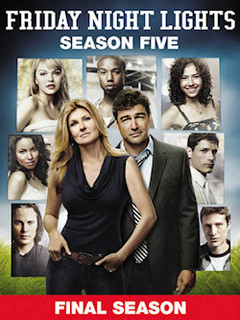
Clear Eyes, Full Hearts: Friday Night Lights

We finished watching the final season of Friday Night Lights last night. I’m surprised how bereft I feel with no more to watch! Though this is not TV with the intellectual reach of The Wire or Deadwood, it has the most heart of any TV show I can think of. I think what moved me most about its conception is that its characters are all striving to be or do better, often against considerable odds. Though they are flawed (except, arguably, for Coach Taylor), and they often fail to turn their good intentions into right actions (I’m talking about you, Tim Riggins), there is something tremendously affecting about watching them muddle through. And even when their triumphs were a little too pat (the East Dillon Lions, for instance, are surely unbelievably successful in their second-ever season), I was thrilled at every one–and I was also usually in the grips of heart-pounding anxiety until I knew how things were going to work out. It’s just great human drama, and the writers and actors (and their whole team) completely succeeded in making me care about the characters and feel “invested” (a word that recurs frequently in the DVD extras) in their decisions. The only time I felt skeptical was during the unfortunately melodramatic “murder” plot involving Landry and Tyra in Season 2. The writers were right to let that lapse out of the show’s memory, just as they were right to keep some other early elements going–a particularly nice small touch, I thought, was bringing Landry and Matt back together in the final episode for a little of the dry, friendly banter that they open the series with as Matt practices throwing the football through the old tire in his unprepossessing yard never dreaming of the immanent tragedy that will propel him into the role of QB1. They didn’t do too well with the “Julie Goes to College” plot-line (why is it that TV shows often falter so badly when they try to portray university life? a professor who holds salons, for crying out loud? and a TA who gives her paper a C- because he thinks it’s “safe” and she’s bright enough to do better–when he’s talked to her, what, twice?), but by that time I was so involved with Vince that I would have forgiven the show anything.

It’s Coach Taylor who carries the show, though, and who embodies individually the qualities the show stands up for overall: integrity, sincerity, perseverance, commitment, loyalty, aspiration. His official job is to win football games, but the series ultimately focuses on his role in building character. I had reservations occasionally about the degree of shouting involved in this: I’m always dubious that people who are yelled at will in fact be motivated to do their best. (Those of you with more experience at–and tolerance for–organized team sports can perhaps tell me if this is indeed how coaches work, and whether it is considered somehow necessary or beneficial to the players to encounter authority in this fairly absolute way.) What saved it for me was how clear it was that Coach really did have the best interests of his players at heart, and that in addition to yelling at them, he also opened his door to them at all hours of the day and night and stood up for them in every context where he could make a difference. When they screwed up, he made no secret of his displeasure but also showed them that he absolutely believed they could do better. The only one he never won over was J. D., who turned into a real little creep in Season 4–though by that time his equally creepy dad had cost Coach Taylor his job with the Panthers anyway. If he’d stayed with Coach, I’m sure he’d have turned out just fine! I think Kyle Chandler is amazing in the role: in addition to having perfect piercing eyes (he can command a scene just by looking at someone), he’s completely believable, especially during the football scenes. There’s one win in particular (I won’t specify which, so in case you haven’t watched it yet, you too can be on the edge of your seat until the final minute–which in FNL is always when a game is decided!) after which his reaction is so tangibly fired up I thought our TV might have switched to 3-D.

I don’t even like football in my real life, but watching FNL gave me new interest in and respect for the game. I think Sonya Chung is right (in her nice essay on the show at The Millions) to emphasize “the way the football action itself is used to advance plot” in the series:

You almost always know what’s going to happen during a given game: some player is going to succeed or fail, according to the character’s dramatic journey.  And yet it’s almost ridiculous how gripping it is to watch it unfold – Matt Saracen throwing interceptions and losing his QB1 spot to an upstart prick freshman in Season Three; running back Luke Cafferty (Matt Lauria) getting side-tackled hard while playing with a serious hip injury he’s kept secret throughout Season Four; geek-turned-kicker Landry Clark (Jesse Plemons) going for a 45-yard field goal in the final seconds of the final game of the season.  All of Season Four is built around an underdog uphill climb for the ragtag East Dillon Lions (with Coach Taylor at the helm, now the victim of aforementioned prick freshman’s prick father’s maneuverings to get him transferred after a local gerrymandering debacle), and of course we know where it’s going: there’s nowhere to go but up.  Still, the battle is replete with the absorbing defeats and triumphs of both game and life.  Season Four is also where we see a more explicit emergence of racial issues (featuring The Wire’s Michael B. Jordan as the East Dillon quarterback), handled like everything else on the show – as part of the fabric of everyday life.

Beyond that, even, I’d say football is really the occasion, rather than the reason, for the characters’ development, standing in for any endeavor that relies on the kind of commitment, cooperation, and hunger for success that football does here. In a different setting, it could be a youth orchestra, a ballet company, a hockey team, couldn’t it? And yet I guess it’s true that football has a specific resonance all its own in some communities, and it’s also more exciting (I suppose) to watch football practice than an orchestra rehearsal!

There are so many other things I enjoyed about the show, including the increasing complexity in the relationship between Eric and Tami Taylor, culminating in the difficult choices that end Season 5. Tami’s a great character in her own right, also brilliantly and believably played, and the story-lines related to her work as counselor and principal effectively round out our picture of the Dillon community. The style of the show was fascinating, from the loose camera work to the unscripted freedom you can sense in so many of the scenes–the producers’ openness to experiments and improvisation is one of the reasons the show seems so real and authentic, presumably. It’s the people that really mattered, though, and the way the show embraced the emotional possibilities of their lives.  I was so happy every time a door opened to reveal Matt Saracen–or, for that matter, when we got to visit his grandmother, one of the best “minor” characters in the show. It was nice to see Jason Street reappear too. The people seem so real that I kept wondering what had become of “Smash” Williams (we do finally get a glimpse of him–on TV). But I got fond of Luke and Becks too, along with Vince and Tinker and especially Jess Merriweather. I’m going to miss them all! To quote from Chung’s essay again, Friday Night Lights is “an unflinching portrait of contemporary America that is not at all clever or ironic; that is both earnest and real; that dares you to care, and to embrace the notion that heart and personal morality are at the center of everything we do.” The lack of irony, the earnestness, might strike some viewers as faults, symptoms a kind of deliberate, even self-indulgent, naivete, but to me it was a relief and a pleasure  to watch a show that served up some idealism without ignoring realism.

I’m wondering if I could develop a pedagogical style based on Coach Taylor. Do you think if I opened every lecture by saying “Let’s go have some fun!” and then yelled “What are you doing??” every time someone fumbled a question, things would go better than usual? We could do worse than to adopt “Clear Eyes, Full Hearts” as our mantra…

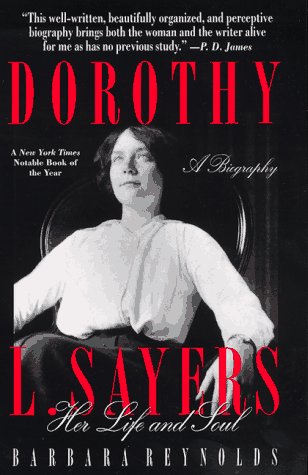
Barbara Reynolds, Dorothy L. Sayers: Her Life and Soul

I finished Barbara Reynold’s biography of Dorothy Sayers this evening feeling as if I know a lot more about both Sayers’s life and her personality. I already knew a little bit of the biographical outline–Somerville, a child “out of wedlock,” a turn to religious writing, translations of Dante–but because in my life she has always mattered because of her Peter Wimsey novels, I never really focused on anything else about her. I knew (and know better now) that she would not have wanted it that way, and yet that even in her lifetime she had to live with the frustration of other people’s preoccupation with her famous detective. She wrote to a friend that one reason she didn’t write more Wimsey novels was precisely that people kept importuning her to do it: “I have been so much put off by being badgered to do it when I was wrapped up in other things that the mere thought now gives me a kind of nausea. . . . the thought of being pushed and halloooed into the old routine fills me with distaste.” Fair enough–but except for now feeling I really ought to, and would actually quite like to, read Dante in her translation (confession: I haven’t read Dante in any translation so far), I’m still with those badgerers and halloooers.

I think one reason I can’t move forward with her is that I don’t share her religious convictions and so I can’t really enter into the mental world or the enthusiasms of her later career. In some ways Sayers is a more easily likeable person than Vera Brittain, or even than Winifred Holtby–it turns out she was rather a bon vivante, much more playful and frisky than the other two, and more tough and racy as well. But their passionate sincerity and dedication to social and political causes are easier for me to care about than Sayers’s radio plays about the life of Christ. It’s clear from the material Reynolds includes, though, that Sayers embraces a kind of practical or tough-minded Christianity, and also that she does see it as important to integrate religious with political thought and action. In one of her letters, she emphasizes that her faith is not instinctive or (she thought) irrational:

Since I cannot come through God through intuition, or through my emotions, or through my ‘inner light’ (except in the unendearing form of judgment and conviction of sin) there is only the intellect left. And that is a very different matter. . . Where the intellect is dominant it becomes the channel of all the other feelings. The ‘passionate intellect’ is really passionate. It is the only point at which ecstasy can enter. I do not know whether we can be saved by the intellect, but I do know that I can be saved by nothing else.

Reynolds goes on to say that Sayers found this “combination of intellectual light and spiritual ardour” in Dante; I would add that it seems the right way also to describe the love of Harriet and Peter, not just in the resolution of Gaudy Night but in the ecstatic passages of Busman’s Honeymoon–which I was glad Reynolds did not apologize for, as many have:

The love-scenes in Busman’s Honeymoon are exultant. The surprising, and original, thing about them, for a novel, is that they are love-scenes between a husband and a wife. Despite the deterioration of her own marriage, Dorothy L. Sayers the writer has allowed herself to visualize Hymen as a god of joy. Romantic sentiment, which she had so long distrusted, here comes triumphantly into its own.

I always thought so too.

One last quotation I liked, this time not from Sayers but about Sayers, from a letter from Professor R. D. Waller of the University of Manchester thanking Sayers for her lecture there on Dante. It had “heart,” he said, explaining further

that it was about something humanly interesting and that you were humanly interested in it . . . I don’t see why professors and lecturers shouldn’t try to give lectures like yours and so put a bit of heart into their universities . . . I think you do a good thing giving lectures like that when you can in universities . . . University people have grown shy of committing themselves to anything, especially in the presence of their colleagues, for fear of being proved wrong, or perhaps of being thought naïve for having any beliefs or enthusiasms.

“The book I wanted to write”: Dorothy Sayers on Gaudy Night

I’ve been reading (and enjoying) Barbara Reynold’s biography of Dorothy L. Sayers. Much as I enjoy some of the other Peter Wimsey novels, it’s Gaudy Night that I love, so much that I’ve had trouble staying objective and professorial in seminar discussions with students who don’t get how completely fabulous it is (see? hardly dispassionate). I very much appreciated, then, this letter from Sayers to her publisher that shows she too felt the novel was something special:

It is the only book I’ve written embodying any kind of a ‘moral’ and I do feel rather passionately about this business of the integrity of the mind–but I realise that to make a ‘detective story’ the vehicle for that kind of thing is (as Miss de Vine says of the Peter-Harriet marriage) ‘reckless to the point of insanity’. But there it is–it’s the book I wanted to write and I’ve written it–and it is now my privilege to leave you with the baby! Whether you advertise it as a love-story or as educational propaganda, or as a lunatic freak, I leave it to you. It may be highly unpopular; but though I wouldn’t claim that it was in itself a work of great literary importance, it is important to me, and I only hope it won’t be a ghastly flop!

For the other Sayers fans out there, by the way, back in the early days of Open Letters Monthly (August 2007, to be precise), Joanna Scutts wrote a very nice feature essay on Dorothy Sayers that’s well worth reading.

It’s All in the Frame: Reasons For Writing

I’ve been brooding (and pacing, and swearing, and procrastinating) about starting a new essay project, and what I find myself most stymied by is how to frame it. This is a problem I don’t have with blogging, which is perhaps why I find this such a liberating form. Here, having read something is reason enough to write something about it, and all that’s at stake is my own thoughts about it. I don’t have to attach my comments to anything or make them relevant or prove that they are somehow current or significant to anyone but me. They don’t need to be contributing to an ongoing debate or solving a critical problem. I don’t have to be engaging with someone else, or acknowledging everyone else, who has written on the same topic. Any or all of this kind stuff may emerge as I write, but the writing needs no further occasion for itself.

I think it is possible to write this way in any venue if you either are or believe yourself to be sufficiently wise and important that people ought to take an interest in your thoughts just because they come from you. But the rest of us usually need some sort of justification for writing–which is, after all, an implicit claim on other people’s attention. At least, that’s very much how I am feeling right now.

In academic writing about literature, there are a few fairly standard ways to build a frame around your specific analysis. All of them turn on the idea that you have something new to say. Probably most common nowadays is to claim a new insight into an ongoing interpretive argument: a revision, refinement, or refutation of some element of an established critical debate. This might be text-specific or have a broader reach, but you construct the frame by outlining the existing contributions and then explaining where you come in: ‘In the ongoing debates about Jane Eyre‘s implication in British imperialism, inadequate attention has been paid to the source of Jane’s drawing paper. Closer attention to the history of the production and importation of artists’ sketch pads shows that in the very art work often assumed to express Jane’s defiant Romantic individualism, Jane is dependent on a resource deeply embedded in an exploitative economic system’–most of you know the drill. A variation on this is the application of a particular theoretical model or idea to a particular text or body of texts: ‘Reading Jane Eyre through the lens of Levinas, we discover that…’ There’s also the ‘newly discovered’ frame: a text or author is unfamiliar and requires placing within appropriate theoretical, critical, and/or historical contexts. And so on. Both the preparatory and the rhetorical moves are well established. You do the reading and thinking and research that leads to the formulation of your idea. You do more  research, to be sure that your idea is novel and so that you can set up your account of what people have said so far in relevant discussions. Your introduction lays out the debate and sets up your new contribution, and then you write it out in detail, engaging as you go along with the other people in the critical conversation you are now part of. One of the hardest parts is defining just which conversation that is, so that you don’t end up trying to include, say, everything anyone has ever said about Jane Eyre since it was published! Lots of things about this kind of writing, in fact, are difficult. But as academics, we learn how it is done–usually by the implicit example of the other criticism we read (though some people are fortunate enough to get explicit instruction).

I’ve been trying to get a sense of the range of possibilities for framing writing about literature in non-academic contexts. The most obvious form is the basic ‘review of a new release.’ The occasion for the writing is the novelty of the book itself. Within that there is certainly room for different strategies, from contextualizing the book within the author’s oeuvre or within its genre to just giving a plot summary and a few remarks on style or form. For books that are not new, things are a bit more complicated. A book may get renewed attention because of an occasion or event–the author’s death, for example, or its anniversary, or perhaps an invocation of the book by another book or author (the way, say, novels about Henry James give us a reason to talk about Henry James’s novels). A film or TV adaptation is likely to prompt a flurry of attention to “the original.” A scandal is an attention-getter: if a book is banned by a school library, for instance. Hot-button issues like (to cite a recent example) debates about whether Young Adult fiction is too dark and dreary these days can also prompt lots of discussion of back-list or even out of print titles. Fads like vampire novels or Scandinavian crime fiction give us an excuse to write again about Dracula or the Martin Beck books. These all strike me as journalistic reasons: in all of these cases, books become (or are made into) news.

Then there’s book writing of the “personal journey” or “what it meant for me” variety–a combination of autobiography and literary essay or commentary. There seem to have been a lot of examples of this recently, from Elif Batuman’s The Possessed to Rebecca Mead’s “Middlemarch and Me” or William Deresiewicz’s A Jane Austen Education: How Six Novels Taught Me About Love, Friendship, and the Things that Really Matter (this one I haven’t read yet, so I may be making unfair assumptions about it, but I did read the excerpt at the Chronicle). This is literature in the service of self-knowledge. That’s fine, but it assumes a fairly extensive interest on our part in the autobiographical subjects. That seems reasonable if they are people of substance and significance, and they know it, and they aren’t afraid to assert it: we’re back, again, at a certain kind of self-confidence, even egotism, something inherent in all writing–again, a claim on other people’s attention–but more pronounced in this form. This form makes the books new by making them personal. (I’m not a huge fan of this approach, because I feel that too often the books get subordinated to, well, personal stuff. My own attempt at something in this vein is the essay I wrote on rereading Gone with the Wind, though I don’t think personal revelation was ultimately the main issue there, as I tried to use my own reading experience as a way to think hard about the novel itself.)

It seems to me to be harder to find book writing outside of blogs that simply, without special excuse or occasion, focuses on a particular book or author. One example I’m familiar with is Zadie Smith’s essay on George Eliot, originally published in The Guardian and now included in her book Changing My Mind. I can’t get at the Guardian version any more, but assuming she didn’t revise the beginning substantially, this essay has no journalistic or personal hook: she just starts talking about Middlemarch. But then, she’s Zadie Smith, so the novelty here is that she in particular is talking about Middlemarch: she is the news, her attention itself the frame needed to create an occasion for the piece. The pieces I wrote for Open Letters Monthly on Trollope, Felix Holt, and Vanity Fair are also examples of essays without occasion or special justification. Felix Holt was easiest in some ways because it’s Eliot’s least (or second-least) popular novel, so there’s some novelty just in focusing on it instead of Middlemarch. I motivated the Trollope piece (in my mind, at least) by figuring that he doesn’t have anything like the general popularity of Jane Austen so it was safe to imagine an audience that needed some kind of general introduction; focusing on The Warden (which I love, but which is hardly either his best or his best known novel) gave it a little helpful specificity. And I also felt reasonably sure Vanity Fair is not widely read these days, so again there’s some intrinsic novelty in trying to talk about it to a general audience. It surprises me a little, though, looking back, that I wrote all of these pieces with as little anxiety as I did about their place or reason. It didn’t even occur to me, for instance, to try to frame the Vanity Fair piece by talking about either the BBC adaptation or the weird Reese Witherspoon film (which Amardeep Singh appreciated much more than I did).

Do you think book writing needs to be framed in some way that makes the book new or relevant? Can you think of other strategies (ones you like? ones you dislike?) for writing about books, besides the ones I’ve thought of? Can you think of other examples of recent (mainstream, published [in print or online]) writing about books outside of the journalistic frameworks I’ve described? Do you worry about framing your writing? There has to be a reason to write something, doesn’t there? But can the reason be, ultimately, the book itself? Must it come from somewhere else?

Vera Brittain, Testament of Friendship

Whether or not the spirit of man is destined for some unknown flowering in a life hereafter, the benevolence of the good and the courage of the undefeated remain, like the creative achievements of the richly gifted, a part of the heritage of humanity for ever.

I’m not sure that I would have fully appreciated the rarity of Testament of Friendship if it weren’t for Carolyn Heilbrun’s thoughtful introduction to my edition–and in a way, that’s part of the lesson I take away from the book, namely, that there isn’t really anything extraordinary about strong, supportive, important friendships between women. Women live these (if we are lucky); we know their value. What’s unusual is to find a story of such a friendship, something for which, as Heilbrun notes it is difficult to find a literary model. “Friendship between women is seldom recounted,” she observes; “[f]rom the love of women for one another as they work and live side by side … recorders of civilization have averted their eyes.” Vera Brittain makes a similar observation in her Prologue:

From the days of Homer the friendships of men have enjoyed glory and acclamation, but the friendships of women, in spite of Ruth and Naomi, have usually been not merely unsung, but mocked, belittled and falsely interpreted.

Heilbrun sees Brittain and Holtby’s friendship as unusual because for them it meant, “as it had long meant for men, the enabling bond which not only supported risk and danger, but comprehended also the details of a public life and the complexities of pain found there.” It is true that their lives, and thus their friendship, had what have more typically been masculine aspects, but too much emphasis on this point risks reinforcing the division of norms into masculine and feminine, and Brittain’s own account shows that she and Holtby lived and worked among many women who were also publicly active, and that they looked back to a tradition of other such women. Obviously, it’s important to acknowledge that this was not the norm, that there were practical as well as ideological obstacles to women’s participation in public life–but at the same time reality has never been neatly bifurcated into male and female spheres and there’s nothing intrinsically masculine about public life, only the expectation or belief that there is.

Though Brittain, like Holtby, is an avowed and articulate feminist, Testament of Friendship is only implicitly a protest against both the narrative and the political constraints on her friend’s life story. Though Holtby was an extraordinarily busy public intellectual (just how busy, I had absolutely no idea until I read this book), Testament of Friendship is a personal tribute–and yet, having said that, it seems artificial to separate out the personal dimensions of her life or of Brittain’s recounting of it from her public ambitions and activities. A better way to put it might be that Brittain celebrates her beloved friend in her entirety, seeing a complete union of principle and character across all aspects of Holtby’s life. Unable to refuse a friend’s request for help or a listening ear, Holtby was equally unable to countenance injustice or failures of principle in the world at large. While travelling in South Africa, for instance, she recognized the parallels between prejudice and systemic discrimination on the basis of sex and on the basis of race:

At camp one night in the Transvaal, she had heard two black servants teaching each other to read from a child’s exercise book. But wherever she went, the white people whom she met talked to her pessimistically about the native question. They told her that higher education was bad for natives and gave them ideas and undermined their loyalty; that political power was unsuited to natives, since they were not ready for it; that segregation and the Colour Bar and the disenfranchisement of the black men in the Cape were necessary for the preservation of white civilization and the safety of white women and the happiness of the home.

Sometimes, as Winifred meditated on these statements, they seemed to have a familiar ring. Suddenly, one day in Pretoria, she realised why. In her mind she began to substitute the noun “women” for the noun “natives,” and found that these fiercely held, passionately declared sentiments of white South Africa coincided almost word for word with the old arguments in England against women’s enfranchisement, women’s higher education, and women’s entry into skilled employment. She even perceived–as Olive Schreiner had perceived before her–a close relationship between the two forms of subjection . . . .

Henceforth Holtby is equally tireless in her crusade against both forms of oppression.

Brittain’s admiration for Holtby–for her radiant beauty, her astonishing energy, and above all her moral integrity–energizes what might otherwise be a somewhat pedestrian recounting of Holtby’s life and career from her childhood in a small Yorkshire village to her sadly early death. We get, I think, at least as strong a sense of what Brittain thinks about her friend as about that friend herself, who is–perhaps inevitably–an idealized figure. I don’t think we ever hear of her as anything less than keen, enthusiastic, and generous. Interestingly, Brittain is not so uniformly positive about Holtby’s novels: though she refers to them often, frequently bringing out parallels between Holtby’s views and her characters, finding ways Holtby refracts her personal experience through her creative imagination, Brittain is frank about their shortcomings, seeing all the early ones as subordinate in skill and interest to South Riding. As South Riding is the only one I’ve read, I have only Brittain’s word to go on, but the others do sound a rather motley assortment. Her comments on South Riding, though, did make me want to reread that novel, which I feel I have so far under-appreciated. South Riding represented, Brittain suggests,

the reconciliation, at long last, of the artist and the social reformer who had wrestled for so many years within her personality. Thanks to the wisdom of growing maturity, she realised that for her there could be no final victory of the one over the other, so she found material for literature in those preoccupations which had hitherto dragged her away from it. In South Riding she threw down a challenge to pity, the deadly and recognised enemy of her achievement, and pity itself, captured, enthroned and crowned, became the apotheosis of her art.

The result was a story which, for all its differences of time and place, bears a close family resemblance to Ibsen’s play, An Enemy of the People. Would the clever literary critics who maintain that the political and social themes of Winifred’s novels put her outside the ranks of the artist take, I wonder, the same view of Ibsen? To mirror universal values in local or personal experience is surely a major function of art; and in this Winifred superbly succeeded.

The comment here about “clever literary critics” is a reminder that Holtby is publishing her socially-conscious fiction during the same years that, say, Virginia Woolf is writing and publishing her very different works (Holtby’s first novel, Anderby Wold, appeared in 1923; South Riding was published in 1936)–or, for that matter, Elizabeth Bowen’s early novels are appearing. Though she didn’t use this terminology, Holtby knew perfectly well she was not a Modernist. Writing to a friend about her decision to write about Woolf for a series of ‘Modern Writers on Modern Writers,’ she says,

I took my courage and curiosity in both hands and chose the writer whose art seemed most of all removed from anything I could ever attempt, and whose experience was most alien to my own. . . . I found it the most enthralling adventure–to enter, even at second-hand, that world of purely aesthetic and intellectual interests, was to me as strange an exploration as it would have been for Virginia Woolf to sit beside my mother’s pie and hear my uncles talk fat-stock prices and cub-hunting. I felt that I was learning and learning with every fibre of such brain as I have.

According to Brittain, Holtby’s work on Woolf  “enabled Winifred to state her own basic problem–the conflict between means and ends, between practical measures for bringing the good life nearer, and the creation of enduring beauty which is part of the good life itself. The [Woolf] book is one prolonged analysis of the meaning of true art and the method of its attainment.” Studying Woolf’s books helped Holtby “formulate more clearly her own philosophy of life and death,” Brittain says, and then quotes this passage from Holtby’s book describing “the flashes of insight” some of Woolf’s characters achieve:

These are the moments of revelation which compensate for the chaos, the discomfort, the toil of living. The crown of life is neither happiness nor annihilation; it is understanding. The artist’s intuitive vision; the thinker’s slow, laborious approach to truth; the knowledge that comes to the raw girl, to the unawakened woman–this is life, this is love. These are the moments in which all the disorder of life assumes a pattern; we see; we understand; and immediately the intolerable burden becomes tolerable; we stand for a moment on the slopes of that great mountain from the summit of which we can see the truth, and thus enjoy the greatest felicity of which we are capable.

This is not the ‘literary criticism’ we are now accustomed to: it has what I have heard described as the “whiff of belles lettres” about it–and in many circles (especially academic ones) that’s a smell as unwelcome as anything you might unwarily step on in the dog park. As an artist’s reflections, though, and as a commentary on the experience of reading Woolf, it has the ring of truth.  I admire Holtby’s open-minded eagerness to learn from someone unlike herself, which seems to have been one of the unifying characteristics of all of her work, and indeed of her life.

Reading this book has added to my sense that we let the Modernists win too easily–by which I mean that in the literary history I am familiar with, the important thing about the first part of the 20th-century is, singly, exclusively, Modernism: there isn’t a place in the story for any of the writers who did not take up their commitment to “purely aesthetic and intellectual interests.” Some confirmation comes from peering at our most recent description for our course on ‘British Literature of the Early 20th Century’: I see only Conrad, Joyce, Lawrence, Lewis, Wilde and Woolf on the reading list. Neither Brittain nor Holtby appears on our 20th-Century British reading list for Ph.D. students’ qualifying exams, and neither does Antonia White, Rosamond Lehmann, Elizabeth Taylor, Margaret Kennedy, Barbara Comyns–not even Rebecca West, and certainly not Dorothy Sayers.* (Actually, the most recent student to take these exams in 20thC British added Sayers’s Murder Must Advertise–it was conspicuous to me that her supervisor had not taken the Sayers seriously as anything but a token specimen of genre fiction, and the only question the novel prompted from him was a derisive one about the relevance of the cricket match. Ahem: we can do better!) It’s possible that I can’t make sense of, say, Margaret Kennedy‘s novels because they aren’t actually very good. But it seems at least as possible to me that they don’t seem very good because I don’t know why they do the things they do–I don’t understand the story to tell about them. Holtby’s cheerful determination to undertake strange explorations of unfamiliar minds is a good model for all of us.

*I’d be curious to know from those of you at other institutions: How typical is this? Also, apparently Elizabeth Bowen doesn’t rate either, even though she is a Modernist (as far as these labels hold up, of course). Is that typical?