Recent Reading Update

Blog evidence to the contrary, I have in fact been doing some reading besides that for my classes. Since The Last Samurai, there hasn’t been anything that really excited me, and between that and the usual late-term mental exhaustion, I just haven’t felt that motivated to write anything up in detail. Here’s a quick run-through of what I’ve been reading.

I did enjoy Jane Gardam’s The Queen of the Tambourine, if “enjoy” is the right word for a book that is really quite sad, as well as occasionally disturbing. It’s the story of Eliza Peabody’s journey through a mental breakdown, told all in her letters to a departed neighbor…sort of. The novel thrives on uncertainty about what is real and what are Eliza’s delusional (or compensatory) imaginings. Even as much of the story proves unreliable, Gardam manages effectively and poignantly to make Eliza’s emotions real and vivid, and to balance the pathos of her situation with comedy.

I had high hopes of Laila Lalami’s Secret Son, because I admired Hope and Other Dangerous Pursuits a lot, but I found it a somewhat disappointing read. It’s a thematically and politically interesting and carefully structured book, but the language felt stilted and often even cliched, and as a result I never became very engaged.

I have been urging Maddie to read From the Mixed-Up Files of Mrs. Basil E. Frankweiler for ages, and one night I decided I should leave her alone (she’s busy enough reading her way through the novels of Jacqueline Wilson) and revisit it myself. The story of the brother and sister hiding out in the Metropolitan Museum is still a delightful fantasy to me (the “period” rooms in the museum are my favorite parts and I love the idea of camping out there!), but this time I was less caught up in those specifics than in the sense that the book is really about a different kind of quest-as the author says in her afterword, “the greatest adventure lies not in running away but in looking inside, and the greatest discovery is not in finding out who made a statue but in finding out what makes you.”  I wonder what it means that I often feel closest to finding this out when I am “away,” including when I’m in New York.

I’ve continued my adventures in contemporary romance with some more Jennifer Crusie titles, including Welcome to Temptation and Bet Me. I found Welcome to Temptation a bit too zany, but I quite enjoyed Bet Me. I don’t mean to condescend to the genre when I say that for me, the appeal I can see is that it doesn’t demand to be taken very seriously, and indeed these titles are quite conspicuously light-hearted. Especially when the books I’m reading for work are not that at all, it’s actually nice to have something to pick up in between that makes me laugh.

Now I’m reading Mr. Golightly’s Holiday for those in-between times, along with Mollie Gloss’s Wild Life, which is this month’s selection for the Slaves of Golconda reading group. I felt bad that I didn’t get through last month’s choice, Anabel Lyon’s The Golden Mean: I just wasn’t interested in it, and it’s hard, with so many books around, to make one a priority that isn’t otherwise a priority for me. I admit I’m feeling the same about Wild Life, that it’s not a book I would otherwise be reading–and I also feel that about The Paris Wife, which my local reading group settled on for this month. I have books stacked up that I’m more interested in! But then, one of the points of belonging to a reading group is that it pushes you outside your usual reading habits, which if unchallenged can actual be limits, and may prevent the discovery of new pleasures. So I will finish these, I swear! One thing I do like about Wild Life so far is its West Coast setting: it reminds me of big trees and blue mountains, and a little bit of one of my favorite meta-historical novels, Daphne Marlatt’s Ana Historic…except that Wild Life, as I understand it, is going to take its fantasy in a different direction, one that I fear is going to involve something like Big Foot…

And in the meantime reading for work continues. This week we begin North and South in my 19th-century fiction class, which I’m looking forward to, and in Mystery and Detective Fiction we are moving on to Sara Paretsky’s Indemnity Only and then our last book of the term, Walter Mosley’s Devil in a Blue Dress, while in the Victorian ‘Woman Question’ we have just The Odd Women left. It’s amazing how fast the term goes by! Reading will actually be the least of my problems this week, as I get in 70 midterms and 20 paper proposals on Monday, followed promptly by 40 essays on Wednesday. Egad! I should really do something frivolous today, as it will be my last chance to play for a while.


In Brief: Two Takes on Reforming Graduate Education

I hope to write more about my response to each of these very different calls for reforming graduate education, but since I’m not sure when I’ll be able to, for now I’ll just quote a bit, link to them, and invite comments. I think that my response is something like this: both are right that real structural change would be good, but Nowviskie’s proposal makes me uncomfortable by going so far away from the kind of work I’m familiar with (and that drew me into graduate school and now characterizes my teaching and writing life), while Berman’s leaves me dissatisfied because it avoids issues of intellectual substance in its emphasis on time to degree, a goal to be pursued by “required courses with clear benchmarks and learning goals,” and its overall tone of business-school-like pragmatism. In both cases, I like the emphasis on new forms of knowledge dissemination and alternative forms of publishing, including Berman’s reiteration of the need to rethink the dissertation and the dominance of the monograph (like the weather, this is something people keep talking about, with no perceptible effect). Here are the two links, with excerpts:

Bethany Nowviskie, It Starts on Day One

Here’s a modest proposal for reforming higher education in the humanities and creating a generation of knowledge workers prepared not only to teach, research, and communicate in 21st-century modes, but to govern 21st-century institutions.

First, kill all the grad-level methods courses.

Kill them, that is, to clear room for something more highly evolved — or simply more fruitful — to take their place. Think: asteroids clobbering dinosaurs. Choking weeds ripped from vegetable gardens. The fuzzy little nothings and spindly cultivars in this scenario, squinting cautious eyes or uncurling new leaves into the light, are:

  • those research methodologies and corpora (often but not exclusively gathered under the banner of the “digital humanities”) that address hitherto unanswerable questions about history, the arts, and the human condition;
  • and the new-model scholarly communications platforms we can already recognize as promising replacements to our slow and moribund systems for credentialing and publishing humanities scholarship and archiving the cultural record on which it is based.

Russell Berman, Reforming Doctoral Programs: the Sooner the Better

Departments should design regular course series that expeditiously prepare students for examinations. Such organized curricular design is vital to achieve an accelerated time to degree. It is a common practice in some social sciences for entering students to face an articulated set of required courses with clear benchmarks and learning goals.1 In contrast, in some literature fields, annual course offerings vary in accordance with individual faculty predilections. Instead we should design a curriculum for student learning needs. Graduate students ought to be able to complete course work in two years. This realistic goal depends on effective management of both faculty teaching responsibilities and student course enrollment.

We need to design a wider array of capstones to doctoral programs and to move beyond the traditional dissertation. In literary studies, the nearly exclusive form of completion is the dissertation, which has come to mean, effectively, a draft of a book manuscript. We maintain this expectation, despite the crisis in academic book publishing. Let us be honest: most academic books, especially those derived from dissertations, have little distribution. . . . Technological change and the digital humanities suggest other shorter genres of scholarly writing; moreover, such genres might be able to bridge the gap between scholarship and the public, which has hurt us so badly in the current wave of budget cuts.


This Week in My Classes: The Morals and the Stories

Though everyone is looking a bit peaked around the department these days–students and faculty alike–and I’m certainly feeling the usual pressures as we move into the term’s final phase, I am also finding myself intellectually invigorated by the novels we’re working through in all of my classes. It is just such a pleasure to be spending time reading and thinking about them, even under less than optimal conditions.

In The Victorian ‘Woman Question,’ we are finishing up The Mill on the Floss. Although I love the early volumes of this novel, with their evocative (if also rather vexed) representation of childhood, and their wonderful blend of sly humor and philosophical reflection (not to mention, of course, the brilliant characterizations of Tom and Maggie and their whole mish-mash of a family life), Books VI and VII really get me excited. I know they are disproportionately short, and who wouldn’t love it if Eliot had written out the great conflict between duty and desire more fully–but then, there’s something apt, too, about the headlong rush to the ending. Though we had read only to the kiss on the arm for today, it was clear from our discussion that the students both grasp the complexity of Maggie’s situation and are interested in it: there aren’t easy answers, the way there are in Tenant of Wildfell Hall, for instance. Brontë’s narrative is complex in other ways, but that there is a right way out of Helen’s difficulties is far less difficult to grasp, just as it is easier to see where she went wrong in the first place. Her attraction to Arthur Huntingdon, while understandable, is a sign of her moral immaturity. Maggie’s attraction to Stephen Guest, on the other hand, while equally misguided in its own way, is a symptom of something much deeper and much further from her control. I was struck on this reading with how much Eliot emphasizes that Maggie and Stephen are initially motivated by unconscious forces, feeling as if “in a dream,” unable to recognize or articulate the “laws of attraction” that compel them. Their drifting down the river is hardly a deliberate act, or at least its impelling motives are hardly clear to them–which of course is much of the use Eliot is making of the metaphorical pattern of rivers and water and currents and drifting right to the end of the book. Once Maggie wakes up, though, into full consciousness, then sexual attraction ceases to be an accidental cause and becomes a force to be reckoned with, and that reckoning is the process of morality–the engagement of human reason in “the labor of choice.” Though it’s possible (I reluctantly suppose!) to find something mechanical in Maggie and Stephen’s impassioned debate, I find it very moving precisely because it represents that struggle to think through feeling to right action:

Maggie trembled. She felt that the parting could not be effected suddenly. She must rely on a slower appeal to Stephen’s better self – she must be prepared for a harder task than that of rushing away while resolution was fresh. She sat down. Stephen, watching her with that look of desperation which had come over him like a lurid light, approached slowly from the door, seated himself close beside her and grasped her hand. Her heart beat like the heart of a frightened bird; but this direct opposition helped her – she felt her determination growing stronger.

‘Remember what you felt weeks ago,’ she began, with beseeching earnestness – ‘remember what we both felt – that we owed ourselves to others, and must conquer every inclination which could make us false to that debt. We have failed to keep our resolutions – but the wrong remains the same.’

‘No, it does not remain the same,’ said Stephen. ‘We have proved that it was impossible to keep our resolutions. We have proved that the feeling which draws us towards each other is too strong to be overcome. That natural law surmounts every other, – we can’t help what it clashes with.’

‘It is not so, Stephen – I’m quite sure that is wrong. I have tried to think it again and again – but I see, if we judged in that way, there would be a warrant for all treachery and cruelty – we should justify breaking the most sacred ties that can ever be formed on earth. If the past is not to bind us, where can duty lie? We should have no law but the inclination of the moment.’

‘But there are ties that can’t be kept by mere resolution,’ said Stephen, starting up and walking about again. ‘What is outward faithfulness? Would they have thanked us for anything so hollow as constancy without love?’

Maggie did not answer immediately. She was undergoing an inward as well as an outward contest. At last she said, with a passionate assertion of her conviction as much against herself as against him,

‘That seems right – at first – but when I look further, I’m sure it is not right. Faithfulness and constancy mean something else besides doing what is easiest and pleasantest to ourselves. They mean renouncing whatever is opposed to the reliance others have in us – whatever would cause misery to those whom the course of our lives has made dependent on us. If we – if I had been better, nobler – those claims would have been so strongly present with me, I should have felt them pressing on my heart so continually, just as they do now in the moments when my conscience is awake – that the opposite feeling would never have grown in me, as it has done – it would have been quenched at once – I should have prayed for help so earnestly – I should have rushed away, as we rush from hideous danger. I feel no excuse for myself – none – I should never have failed towards Lucy and Philip as I have done, if I had not been weak and selfish and hard – able to think of their pain without a pain to myself that would have destroyed all temptation. O, what is Lucy feeling now? – She believed in me – she loved me – she was so good to me – think of her….’

One of my students remarked that when she studied The Mill on the Floss in another class, they discussed Maggie and Stephen’s relationship as a great romantic love story–thwarted, I suppose, by “society,” though she didn’t go into detail about their interpretation. I admit, I find that a puzzling take on these two, who seem so ill-suited to each other in character and taste, and also, as we see here, in values. That their passion cuts across these factors is precisely what makes it so surprising and dangerous. If only there were a great romantic option for Maggie in the novel! Instead, she’s torn between three loves (Tom, Philip, and Stephen), each with his own demand on her feelings and loyalties. Where is she to go–what is she to do? Short of leaving them all behind and starting over, there is no way forward for her, and she can’t cut them off because as she tells Philip (become, poor fellow, her “external conscience” rather than her beloved), she “desires no future that will break the ties of the past.” Given that, her final choice is as inevitable as its result.

In 19th-Century Fiction we are nearly finished with Hard Times. I was wondering about my decision to rotate it into the reading list again after a few years of Great Expectations and a special turn for Bleak House, but I’m actually finding it really compelling. The structure is taut (if every so often the sentiment is a bit flabby) and it’s such a very dark novel. We were discussing Louisa today and her descent down Mrs Sparsit’s staircase. I don’t know another novelist who could (or would!) stretch out a conceit like that across not just paragraphs but whole chapters. And throughout the novel there is such a tight integration between Dickens’s prose and his thinking, every thought infused with fancy so that as we read we live the novel’s principles. It’s not his most subtle novel, but subtlety will get you only so far, as Trollope conceded when he wrote about “Mr Popular Sentiment” in The Warden: the artist who paints for the millions must use glaring colours, and might make more difference than all his own fine shades of gray. And what subtle novelist could make me cry the way Dickens does every time I read the chapter called “The Starlight”? Before the week is out I want to bring in some excerpts from Martha Nussbaum’s Poetic Justice: it occurred to me during today’s discussion that we could think in more contemporary terms about the social effects of his literary strategies.

In Mystery and Detective Fiction it’s a Victorian kind of week too, because we’ve moved on to P. D. James’s An Unsuitable Job for a Woman. James has always been explicit about her interest in 19th-century fiction, especially Austen, Eliot, and Trollope, and I think in many ways Unsuitable Job is very much in their tradition. It is a kind of Bildungsroman, or so I will propose in Wednesday’s class, and the central conflict is between a calculating kind of utilitarianism (on the villain’s part, of course!) and Cordelia’s passionate humanitarianism: “what use is it to make the world more beautiful if the people in it can’t love one another?” she exclaims, and in that moment she is close kin to Louisa as she falls on the floor before her father, Mr. Gradgrind, proclaiming “your philosophy and your teaching will not save me.” Both make the case for the wisdom of the heart over the wisdom of the head.

In the Penny Press: My Fantasy Life

I love Steve’s series on his readings in the “Penny Press.” He engages with such gusto with all kinds of periodicals, from highbrow literary journals to lad mags to Dogfancy and National Geographic–and he’s so delighted when he finds good stuff, and so disheartened when his favorites let him down.

Reading Steve’s posts always makes me think about the magazines I read. It’s a small number: I do most of my more miscellaneous reading online, and the only print periodical I actually have a current subscription to is the New York Review of Books (some years it’s the TLS instead, but next year I think it will be the NYRB again, and/or the London Review of Books). I do pick up individual issues of magazines sometimes–but they are almost never literary, culture, or news magazines. Usually, they are quilting magazines, with the occasional foray into Canadian Living (which I did subscribe to for many years–for the recipes!) and a dip into the Running Room’s freebie whenever I pass by the store. Once in a while I pick out something else for variety: I bought Granta‘s spring feminism issue, for instance, but I’m at least as likely to bring home something like the issue of Piecework shown in the photo.

I’ve been wondering why it is that these are the choices I make from the magazine rack and not, say, Harper’s or the New Yorker (or The Walrus, for that matter). What is the lure of these publications dedicated to food, fabrics, and healthy living? These are hardly the central concerns of my days, or at least, not so much that you’d think I would want pages and pages of articles about and glossy colour photographs of them. That said, I do dabble in all of these things: by and large I’m the family chef, and I appreciate getting new menu ideas; I do a little quilting and needlework; and I’ve been a slow, intermittent, but fairlypersistent runner since my “Learn to Run” clinic several years ago. Do you suppose that I buy these magazines because I wish these activities were a bigger part of my life? Do I buy them because doing so gives me the illusion that I do more of this stuff than I actually do–is browsing their pages a way of pretending I’m the sort of person who might run a marathon some day and distributes full-sized quilts to friends and family that have all the points of their triangle patches all neatly in position?

I do think that is part of why I buy them: to bolster my sense of commitment to things that are actually (partly by choice, partly by pragmatic necessity) peripheral to my main priorities. But why would I wish I were living the life that these magazines collectively illustrate, rather than the life I do in fact live? Why is my magazine pile not all book reviews–not to mention academic journals (which I read only under duress now)? Thinking about what the magazines I like have in common, I noticed that they all emphasize two things: the individual satisfaction of tangible achievements (something rare in academic work), and a strong sense of community created by a shared passion. The Running Room magazine and the quilting ones I like are especially conspicuous for their stories of people helping each other to realize their dreams: the Running Room has tributes to clinic leaders and coaches who inspired runners to do more than they thought possible, of people who began just as members of the same running groups and became fast friends. I love the “shop hop” issues of Quilt Sampler, which feature different shops around the country (sometimes in Canada, too) with stories of how they were founded, often by a couple or a pair or group of friends who just really wanted to shape their lives around something they loved and, happily, found a community of like-minded customers and became a supportive, creative community. I think I pore over these stories because academic work is only intermittently like that: the work itself, in fact, often seems to pull us (or at least me) away from the kind of creative fulfilment and warm-heartedness the quilt shop owners seem to enjoy in their work lives. Also, on a more personal level, I’m often a bit lonely in my day-to-day life: my extended family is all far away, my local friends are as busy and stressed out as I am, if not more; a lot of my work is done in solitude, and its group aspects are far from warm-hearted and creative (committee meetings, anyone?)–it’s easy to feel isolated, and the world these magazines conjure (and this is true of Canadian Living as well) is not like that. So, they represent a kind of fantasy life for me, in a few variations, one that if I had more time and energy and guts I might be able to pursue here (I could take a quilting class, maybe–but the nearest quilting store is quite far away, and winter is coming, with its icy roads… I could take another Running Room clinic–but they are often in the evenings, and I’m just so tired and swamped…and again, winter’s coming). Also, in my fantasy life I really love to cook, and nobody in the house has food allergies or any other dietary complications…

There’s one other thing I know I buy the quilting and needlework magazines for: often, their pages are just beautiful! And though I don’t have (or make, I guess) a lot of time for quilting, I do get some done now and then, and it’s inspiring to look at the colours and patterns and spend a little time indulging in the sensual pleasures they offer: they are treats for the eye, just as the fabrics are when you’re actually quilting (when they are a tactile pleasure as well–I bet all quilters sort their stash once in a while really for no purpose than to fondle the fabrics and look at them some more).

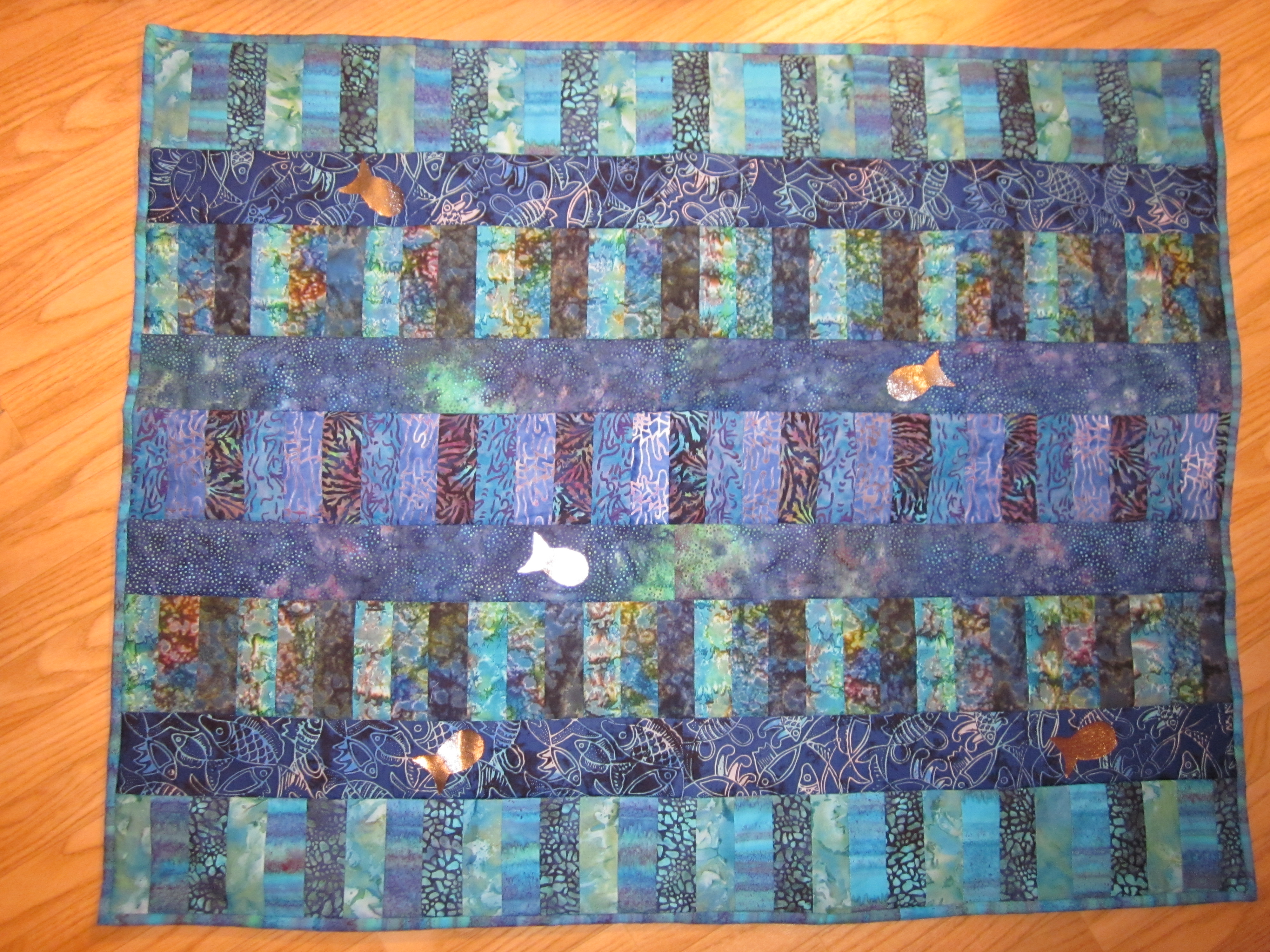
(A couple of my more recent quilting efforts: “Overall Bodie” and “Blue Ocean”)

This Week in My Classes: Pacing Problems

One of the most challenging aspects of course planning for me is pacing, particularly in my 19th-century fiction classes, where I teach a lot of pretty long books. My strategy has always been to assign specific parts to be read for each class meeting. That way I can keep expectations clear and the reading load manageable for all of us, and make sure we are on common ground for class discussions. Though this method does create some pedagogical and critical challenges (for instance, not talking about what happens later in the novel until we get there), I have found it also has surprising benefits: for instance, because we can’t rush ahead to what happens later, we really have to pay attention to what has happened so far!

Over the years I’ve stuck with this system. The only alternative I can really think of is expecting students to have read the whole book by the first class session on it–and that means they’d be reading the next book (presumably) while we’re still talking about the one before it, so how focused and ‘in the moment’ could they be? Plus realistically, they probably would not, in fact, have read the whole book by that first class, so it seems tidier to admit that and try to be literally all on the same page. Especially with novels that were published serially or in instalments, it’s not that hard to find good places to break and take stock. It can still be tricky, though, to assign enough that there’s something new to learn and discuss from each instalment, but not so much that we feel rushed, especially when there’s not that long a reading interval between one class and the next. My classes meet Mondays, Wednesdays, and Fridays. How much is too much–or too little–to expect them to read between 3:30 Monday, when we wrap up one session, and 2:30  Wednesday when we’re at it again? They do have four other classes (at least), after all.  I usually assign longer chunks between Friday and Monday–but is that fair, as it rather assumes weekends are for studying? Bigger instalments give us more to work with–if we haven’t read a lot since the last class, sometimes it feels to me as if our discussion is necessarily a bit thin or even repetitive–but if a lot of people are behind, it’s not necessarily the case that class discussions will be better if I assign more.

I used to notice this problem of balance less in these classes. My expectations overall were higher earlier in my teaching career (I’ve gone from a standard of six assigned novels in a one-term course to a norm of five–with six, there was never a feeling of having too much time to spend on any one of them!). Also, we used to meet twice a week instead of three times in upper-level ‘lecture’ classes, so with fewer classroom hours, again, there was never any feeling of lingering too long on one point or example. An order came down from above, though, that we had to have three “contact hours” a week in all our classes. In reading-intensive classes, it might actually make most sense to meet once a week for 2-3 hours. As far as I know, this is only an option for night classes, though, and that’s not an option that appeals to me at this stage of my family life. My impression is that five novels seems like plenty to my current students, especially when one of them is Vanity Fair  or Bleak House or Middlemarch, so bulking up the reading list and generally intensifying the workload doesn’t seem like a good idea. I do use some class hours for writing workshops, group discussions, and other learning activities, and that’s not only pedagogically time well spent but helps vary the pace. Sometimes I also use a lecture hours for student conferences, as it’s a time when I know that group is actually available (regular office hours are often sparsely attended, and conflicting schedules is a major reason). Even so, I sometimes look at the schedule and think “that many more classes on the same book? whatever will we talk about?”–or, “we haven’t read any further than that yet?” Those of you who also teach long novels–how do you manage them, logistically? Do you worry about finding that line between being burdensome and being boring?

I did pack the reading list for the mystery class with a couple more titles than usual this term and I like the greater variety–and I don’t think we’re rushing. The books are shorter there, and generally easier to read (except The Moonstone–but that’s just so fun!). We have three novels left to do in that class this term (after we finish The Terrorists for Wednesday, there’s An Unsuitable Job for a Woman, Indemnity Only, and Devil in a Blue Dress), whereas in the Victorian fiction class we have only 1.5 (the rest of Hard Times, and then North and South).


Mrs Tulliver’s Teraphim

One of the many things that make reading George Eliot at once so challenging and so satisfying is her resistance to simplicity–especially moral simplicity. It’s difficult to sit in judgment on her characters. For one thing, she’s usually not just one but two or three steps ahead: she’s seen and analyzed their flaws with emphatic clarity, but she’s also put them in context, explaining their histories and causes and effects and pointing out to us that we aren’t really that different ourselves. Often the characters themselves are in conflict over their failings (think Bulstrode), and when they’re not, at least they can be shaken out of them temporarily, swept into the stream of the novel’s moral current (think Rosamond, or in a different way, Hetty). But these are the more grandiose examples, the ones we know we have to struggle to understand and embrace with our moral theories. Her novels also feature pettier and often more comically imperfect characters who are more ineffectual than damaging, or whose flaws turn out, under the right circumstances, to be strengths. In The Mill on the Floss, Mrs Glegg is a good example of someone who comes through in the end, the staunch family pride that makes her annoyingly funny early on ultimately putting her on the right side in the conflict that tears the novel apart.

Then there’s her sister Bessy, Mrs Tulliver, who is easy to dismiss as foolish and weak, but to whom I have become increasingly sympathetic over the years. Mrs Tulliver is foolish and weak, but in her own way she cleaves to the same values as the novel overall: family and memory, the “twining” of our affections “round those old inferior things.” In class tomorrow we are moving through Books III and IV, in which the Tulliver family fortunes collapse, along with Mr Tulliver himself, and the relatives gather to see what’s to be done. The way the prosperous sisters patronize poor Bessy is as devastatingly revealing about them as it is crushing to her hopes that they’ll pitch in to keep some of her household goods from being put up to auction:

“O dear, O dear,” said Mrs Tulliver, “to think o’ my chany being sold in that way — and I bought it when I was married, just as you did yours, Jane and Sophy. . . . You wouldn’t like your chany to go for an old song and be broke to pieces, though yours has got no colour in it, Jane–it’s all white and fluted, and didn’t cost so much as mine. . . . “

“Well, I’ve no objection to buy some of the best things,” said Mrs Deane, rather loftily; “we can do with extra things in our house.”

“Best things!” exclaimed Mrs Glegg with severity, which had gathered intensity from her long silence. “It drives me past patience to hear you all talking o’ best things, and buying in this, that, and the other, such as silver and chany. You must bring your mind to your circumstances, Bessy, and not be thinking of silver and chany; but whether you shall get so much as a flock bed to lie on, and a blanket to cover you, and a stool to sit on. You must remember, if you get ’em, it’ll be because your friends have bought ’em for you, for you’re dependent upon them for everything; for your husband lies there helpless, and hasn’t got a penny i’ the world to call his own. And it’s for your own good I say this…”

Unable to believe she will be parted from her things, poor Mrs Tulliver brings before them “a small tray, on which she had placed her silver teapot, a specimen teacup and saucer, the castors, and sugar-tongs.” “‘I should be so loath for ’em to buy [the teapot] at the Golden Lion,'” she says, “her heart swelling and the tears coming, ‘my teapot as I bought when I was married…'”

Early in these scenes Maggie finds that her mother’s “reproaches against her father…neutralized all her pity for griefs about table-cloths and china”; the aunts and uncles are pitiless in their indifference to Bessy’s misplaced priorities. I used to find her pathetic clinging to these domestic trifles in the face of much graver difficulties just more evidence that she belonged to the “narrow, ugly, grovelling existence, which even calamity does not elevate”–the environment that surrounds Tom and Maggie, but especially Maggie, with “oppressive narrowness,” with eventually catastrophic results. She also seemed a specimen of the kind of shallow-minded, materialistic woman George Eliot’s heroines aspire not to be. But she’s not really materialistic and shallow. She doesn’t want the teapot because it’s silver: she wants it because it’s tangible evidence of her ties to her past, of the choices and commitments and loves and hopes that have made up her life and identity. She’s not really mourning the loss of her “chany” and table linens; she’s mourning her severance from her history.

I think I understand her better than I used to, and feel more tolerant of her bewildered grief, because I have “teraphim,” or “household gods,” of my own, things that I would grieve the loss of quite out of proportion to their actual value. They are things that tie me, too, to my history, as well as to memories of people in my life.  I have a teapot, for instance, that was my grandmother’s; every time I use it, or the small array of cups and saucers and plates that remain from the same set (my grandmother was hard on her dishes!) I think of her and feel more like my old self. I have a pair of Denby mugs that were gifts from my parents many years ago: one has Hampton Court on it, the other, the Tower–these, too, have become talismanic, having survived multiple moves. If I dropped one, I’d be devastated, and not just because as far as we’ve ever been able to find out, they would be impossible to replace. “Very commonplace, even ugly, that furniture of our early home might look if it were put up to auction,” remarks the narrator with typical prescience, shortly before financial calamity hits the Tullivers, but there’s no special merit in “striving after something better and better” at the expense of “the loves and sanctities of our life,” with their “deep immovable roots in memory.” Sometimes a teapot is not just a teapot.

From the Archives: Moral Tourism, Revisited

There’s a thought-provoking response at Arabic Literature (in English) to Steven Pinker’s The Better Angels of Our Nature (or, more precisely, to an excerpt from this book recently posted at the Guardian). On the general question of how fiction influences us, an interesting site to explore is OnFiction, where you will found a range of posts, articles, and academic papers on research into fiction’s psychological, social, and emotional effects. The post at ALiE raises questions specifically about whether “reading Arabic literature in translation” will make someone a better person. This made me think about my own motives for (and responses to) some of the reading I have done over the past few years, one aspect of which I explored in a 2009 post about Nadeem Aslam’s The Wasted Vigil. It would be nice if it were as simple as knowing that reading was morally improving, but as the post at ALiE makes clear, it’s important not to be complacent about this idea. On the other hand, in the same essay by Anthony Appiah from which I took the phrase “moral tourism” there are also some comments that ring true about the value of reading novels that stretch our attention and our empathy into less familiar territory:

What is necessary to read novels across gaps of space, time, and experience is the capacity to follow a narrative and conjure a world: and that, it turns out, there are people everywhere more than willing to do. . . . For we do learn something about humanity in responding to the worlds people conjure with words in the narrative framework of the novel: we learn about the extraordinary diversity of human responses to our world and the myriad points of intersection of those various responses.


I recently finished reading Nadeem Aslam’s The Wasted Vigil. It is a remarkable novel, equal parts beauty and brutality; as its parts accumulate it does an elegant job of evoking through its literary form some of its central motifs and symbols, such as the images gradually revealed, restored, or repaired from the walls of the house decorated originally to celebrate all the delights of the senses. The fallen Buddha that bleeds gold when assaulted by the Taliban’s bullets, the lingering fragrance from the perfume factory, the books nailed to the ceiling and gradually reclaimed but irreparably scarred, the canoe that becomes an unlikely symbol for a desirable but tragically impossible collaboration–the novel is full of rich but delicate details that can make you catch your breath with their unexpected eloquence about the damage, tangible and intangible, inflicted by the conflicts that generate its plot. It is a novel, too, that hums with nuance and yet somehow refuses to judge those on whom such ambiguities are lost: many of its characters themselves hold to intractable, unforgiving, unforgivable absolutes, but the novel often seems to be asking us how they could have done otherwise, with the result that the tragedy of the novel (and it is extraordinarily, lyrically tragic throughout) feels inevitable, which is the saddest thing of all. Like Bel Canto, though also very differently, The Wasted Vigil holds up against brutality an ideal of aesthetic, rather than political, commitment; in fact, at times it seems as if the greatest evil of the Taliban is less their physical violence (which many other factions in the novel are also shown to be capable of, after all) but their violence towards art and the beautiful. When we see a glimmer of hope, it comes from quiet moments of aesthetic appreciation; violence is, ultimately, vandalism.

I was moved and impressed by this novel. But I also became uneasy about it in ways that I did not feel uneasy about Bel Canto, I think because Aslam’s novel is much more directly intervening in our discourse about particular historical and political events. It is at times an exceptionally, horribly, violent novel, but my unease was not queasiness about the violence as such but rather about the kind of aesthetic experience the novel itself was offering me (including through that violence) and how my pleasure in the novel as a whole thus reflects on me as a reader. What does it mean to enjoy, or at any rate to appreciate aesthetically, a novel in which a captive soldier is literally pulled to pieces as sport, a wife is forced to amputate her husband’s hand, a young man’s eye is burned with a blow torch, a suicide bomb is detonated next to a school?

Puzzling over this question made me think more generally about the purpose of such a book and about my own purposes in seeking it out. The aesthetics-of-suffering issue is not uncommon (Holocaust literature seems the obvious example) and has certainly been analyzed and theorized–I’ve looked into this a little as part of preparation for teaching Elie Wiesel’s Night, for instance. There’s something a bit different about the recent wave of high-profile titles about the Middle East or the Arab or Islamic world, though, including Khaled Hosseini’s The Kite Runner and A Thousand Splendid Suns, Mahbod Seraji’s Rooftops of Tehran, Mohsin Hamid’s The Reluctant Fundamentalist, Yasmina Khadra’s The Swallows of Kabul and The Attack, to name a very few–and that’s not even touching on the many non-fiction titles, from memoirs to histories to political analyses.

It’s possible, of course, that what seems like a trend is actually just the result of my taking note of them as the circle of my own reading interests becomes less parochial, but my sense is that what has happened is that since 9/11, not only is the so-called “clash of civilizations” big news, but there is an interest, an appetite, among western literary audiences for stories that help them see different perspectives on current and historical events in a part of the world which, previously, they might have considered only glancingly, or with the reductive and limited insights available from following headlines and TV reports. The back cover of The Wasted Vigil quotes a reviewer suggesting as much–Peter Parker of The Sunday Times says that the novel “reminds us that fiction can do things that mere reportage can’t.”

One of the purposes of such novels, then, or at any rate one of their uses or effects, is revelation, maybe even instruction or pedagogy. That’s certainly one of the reasons I have been reading them: to the hoped-for satisfaction of a rewarding literary experience I can add the desire to learn more about these worlds that seem so other, to be in my reading life a better-informed citizen of the world and then perhaps, as a result, also to be a better-informed participant in real-world events–though I think there is also the temptation, the risk, to feel as if reading about, say, Afghanistan, is an actual substitute for trying to do anything about Afghanistan (would the money I spent on A Thousand Splendid Suns have been better spent as a donation to Canadian Women for Women in Afghanistan?). But if reading leads to understanding, especially appreciation for nuance and complexity, isn’t reading a kind of doing? Isn’t it a good thing to do? And wouldn’t the world be a better place if more people (former world leaders, even) perhaps read such novels?

And yet at the same time, fiction is not (quite) fact; anecdote, especially imagined anecdote, is not a reliable substitute for aggregate data and rigorous contextualization; impressions, however beautiful, are not analysis; and, finally, contemplation is not action, and actions must sometimes be reductive–nuance and complexity are, perhaps, luxuries permitted to those who need not make decisions. In Saturday, Ian McEwan actually makes a similar point about ambivalence, depicting it (or so I read the novel) as a luxury, even a self-indulgence, when decisive action is required; in the more theoretical realm, Geoffrey Harpham notes that “without action, ethics is condemned to dithering,” and perhaps novels feel ethically more satisfactory sometimes than real life precisely because they need not take a singular position. Ethical critics have often pointed to this “negative capability” as a strength of the novel form, but it is also a crucial aspect of its artifice.

While I was thinking these things I came across an phrase in an essay by K. Anthony Appiah that struck me as suggestive in this context. In the essay, “Cosmopolitan Reading,” Appiah is discussing Tsitsi Dangarembga’s novel Nervous Conditions; he is thinking about the question of the novel’s implied audience, “the ‘you’ addressed in the first paragraph of the novel”:

The usual answer, of course, is that the postcolonial African novel is addressed to a Western reader. Here, that is, according to the usual narrative, is a safari moment: an Africa constructed exactly for the moral tourist.

Appiah goes on to argue against reading Nervous Conditions in this way, but my interest is in the model he outlines of literature as a kind of “safari,” “constructed … for the moral tourist,” which seems at some level an apt characterization of the experience of reading something like A Thousand Splendid Suns or The Wasted Vigil (though the specific experience offered by each is, of course, quite different). I hear Appiah’s tone here as dismissive of that “moral tourist,” the reader seeking only an exotic experience, like a “safari,” rather than … I’m not sure what, actually. Is the alternative to being a “tourist” somehow “going native”? Is that any less problematic? Perhaps it is the author addressing the “Western reader” who is being faulted for offering up marketable, consumable, safe (fenced?) stories to suit the tourist’s taste. In her talk on representations of Arabs in western literature, Ahdaf Soueif points to some versions of this effect in recent novels; I’ve read some commentaries that object to the western fixation on veiling or stories of women’s oppression along similar lines. And yet … shouldn’t the story of women’s suffering be known, even if their victimization is not the whole story? Isn’t there something more substantial than “tourism,” than gawking, involved in seeking to know it? And, to come back to my opening comments on The Wasted Vigil, isn’t the aesthetic experience itself a kind of response, however inadequate, to the denial of their humanity?

[originally posted July 26, 2009]

This Week: More Classes, and a New Issue of OLM

Did I mention how busy things have been at work? It’s rare for me to go nearly a week without posting something here, but I just haven’t had the time or energy: what extra I had of either went into this month’s Open Letters, which includes my own review of Jeffrey Eugenides’s The Marriage Plot and a lot of other pieces across an impressive array of books and writers, from Rumi to Robert Musil, from Emma Goldman to Dick Cheney, from Ha Jin to Dickens to Umberto Eco. On the first of every month, all of us involved in editing, writing for, and producing Open Letters sit back and wonder for a little while that we did it again! And then we get right to work on the next issue. I found the Eugenides review quite challenging to write, partly because The Marriage Plot is one of the “it” books, the books of the moment, and comments and reviews are appearing from pretty much every source. I decided to keep my head down until I’d written mine–I didn’t even go over to the Wall Street Journal to see what our own Sam Sacks had said about it until yesterday. As I was putting the final touches on, it occurred to me that I have been pretty critical of every new book I’ve reviewed for Open Letters except Sara Paretsky’s Body Work. I guess I was pretty much OK with Claire Harman’s Jane’s Fame, too.  I do get enthusiastic about things I read! Maybe it’s just that the odds of any particular book being one I’ll be enthusiastic about are dramatically reduced when the field is limited to The Very Latest. What have I been most excited about here recently, for instance? Testament of Youth, for sure, and also The Last Samurai. One every 100 years isn’t bad! (But as those of you who follow me here know, I exaggerate my choosiness. It won’t be long now before my traditional look back at highs and lows of my reading year, and there will be many highs.)

At my day (and sometimes night and weekend) job, things continue to be busy, though I returned a set of papers last Friday and don’t get another in until this Friday, so I don’t feel quite as harried as I did–even though I am doing yet another “new” book in Mystery and Detective Fiction, The Terrorists. This is not new to me, of course, but new to my teaching, so I have no materials filed away for it. Rereading the opening chapters today, though, and drafting up some class notes, I felt really glad I had chosen it. We had good discussions of Ed McBain’s Cop Hater, and a lot of the students seemed to be enjoying it quite a bit, but there’s no getting around a couple of problems with it qua book. First, the writing really is cheesy (with some exceptional passages interspersed). I invited comment on the “literary merit” of the book, and one student said that every time she came to one of his emphatic one-sentence paragraphs she heard the Law & Order “da-DUH” scene-changer in her head–which I completely sympathize with. Those little tag lines seem so cheap and manipulative, as if we won’t feel the suspense with writing that’s any more complex. Then there’s the novel’s severe discomfort with women, who are consistently sexualized and severely limited in their roles, in ways that make Hammett’s portrayal of Brigid O’Shaughnessy seem subtle. Interesting and influential as McBain is in the history of the genre, I’ll be glad to move on to Sjöwahll and Wahlöö, who seem so much more sophisticated in just a few pages. We aren’t totally out of the woods yet with the representation of women, though: while the range of women is much greater and there are strong, independent women characters, there’s still a slightly voyeuristic quality to the way they are presented, including Beck’s love Rhea Nielsen, whose nipples are remarked frequently and whose naked body is described in much more detail than Beck’s ever is. Point of view accounts for some of this, but when Beck stares at his own body in the mirror, he doesn’t tell us anything about his pubic hair; we know the size of her breasts but not of his … anything. Not that I want to know, but it’s conspicuous which way the gaze is directed. (I wonder if I’m more aware of this now that I’ve been reading romance novels, which do direct our attention very specifically to men’s bodies.)

In 19th-Century Fiction, we have our last session on The Tenant of Wildfell Hall tomorrow and then on Friday we begin Hard Times. I have a love-hate relationship with this novel. I love that it’s shorter and thus in some ways an easier sell than most other Dickens novels; I love the clear fabular structure and the surreal tone and the elaborate artifice of the language. It’s more symbolically dense and thematically coherent than some of the bigger novels. But I hate that it is stripped so bare of the Dickensian details that make the big fat ones so delightful; I hate that it is so heavy-handedly moralistic and didactic (ironically so, given its emphasis on fancy); I hate that its fable-like style reduces the characters to quite slight and, again, artificial figures. But (yet again!) for all its oddities and its ironically mechanical feeling, it makes me cry every time I read it, and I think Louisa Gradgrind is one of Dickens’s really great creations. I absolutely thrill to the moment when she tells Tom that she would cut out the piece of her cheek where Bounderby kissed it. Cut it out with a knife! She understands the kind of man Bounderby is. Our final novel for the course is Gaskell’s North and South, and the two novels, published in close proximity, pair wonderfully for comparative discussions of industrialism, class relations, and unions–both contain chapters called “Masters and Men,” for instance, but they take really different approaches to resolving the “condition of England” problem.

In The Victorian ‘Woman Question’ we discussed “Goblin Market” last week and yesterday turned our attention to Gaskell’s short story “Lizzie Leigh.” That more or less concludes our ‘unit’ on fallen women, unless you consider Maggie Tulliver fallen, which of course will be part of our discussion of The Mill on the Floss, which we start talking about tomorrow. I’m really looking forward to that, for some of the same reasons I’m glad to get to Martin Beck in the mystery class: really good, interesting, satisfying novels are the most rewarding to pay sustained attention to, and they also usually generate the best discussions because their complexities need sorting out.

All of this week’s efforts will be fuelled by leftover Hallowe’en candy. Where have all the trick-or-treaters gone? We have maybe a dozen last night, even though the weather was as good as can be hoped for in Halifax at this time of year. (Better than it was on Sunday, when we greeted Ian Rankin with a massive wind and rain storm–he finished up his Canadian tour with a stop here, and yes, I lined up to get his autograph.)

This Week in My Classes: Mid-Term Madness!

The sheen is definitely off the new term now: we are in the thick of it, and the challenge of juggling its many demands has not been helped by (and probably contributed to) the cold-y flu-y virus I’ve been struggling with for about ten days. It was at its worst this past Friday,when in a rare moment of weakness I even let one of my morning classes go early! They looked so tired themselves, and they weren’t really rising to the bait of my discussion questions–but the bait itself was kind of limp with no fight left in it, not the fresh wiggly kind you need to … well, whatever. Probably best for us all that I stay away from fishing metaphors. Anyway, I was tired and slightly foggy at that point and suddenly just couldn’t keep the song and dance routine going. Some quiet working time in my office and some hot tea perked me up enough to get through the last class of that day, and by Monday I was more or less healthy, but it sure has felt like a slog. It’s good to feel better, but the work is still piled up, more than it would be if I hadn’t been sick last week, and that’s despite how much I did over the weekend and routinely do at night as well. This is the time of term when it’s particularly galling that all the mainstream media coverage of higher ed so often seems focused on what a bad job we are doing teaching undergraduates because we are either lazy tenured slackers or self-important research kingpins who can’t be bothered to spend time in the classroom.

So. Where are we now? Well, in Mystery and Detective Fiction we have just wrapped up our discussion of The Maltese Falcon, which I continue to find a particularly depressing novel, and tomorrow we turn to Ed McBain’s first 87th Precinct novel, Cop Hater. This is one of the books I read during my sabbatical quest to refresh the reading list for this course. When I wrote up my first impressions, I noted,

What seems really different about Cop Hater compared to earlier detective novels is its attention to the specific procedures of the police investigation, even including reproductions of gun licenses and rap sheets, but also detailed explanations of forensic measures (such as fingerprinting) and lab work. These features, along with the spread of the novel’s attention across several detectives (though Carella is clearly the main character) help us see the police as a system, as part of a bureaucratic organization operating within a network of other supporting (or, sometimes, hindering) systems. The case is not solved by the ingenuity of Poirot or the ratiocination of Dupin or Holmes but by the persistence of men who just keep looking and asking until they find something out.

This is one of the things I want to talk about tomorrow, though I think we’ll start with some attention to the setting, especially since we’ve talked quite a bit about the whole “mean streets” idea in Chandler and Hammett. Rereading the McBain, I was struck again by some of the stylistic tics I found annoying the first time, but I’m more interested in the dynamic of the squad room. I’m curious to see how the class reacts to this one. It is quite a good group: there’s a core of keen participants, and as far as I can tell most of the rest of them are reasonably engaged, with the exception of a couple of them who sit at the back and pretty obviously scrawl notes to each other and smirk. The room has tiered seating and isn’t that deep, so they are quite visible to me. Pretty soon I may actually say something to them, as it does occasionally throw me off my mental track wondering what they’re writing…

In 19th-Century Fiction (where, actually, there are also a few scribblers / whisperers and smirkers, and it’s a much smaller room, so again, it gets distracting!) we are working our way through The Tenant of Wildfell Hall. Happily for me, given how much else I’m trying to stay on top of, I just did this novel in The Victorian ‘Woman Question,’ so it’s pretty fresh in my mind, though I’m still rereading pretty much all of each instalment. It is interestingly different doing a book in a seminar and a lecture class. I don’t just lecture, of course, but even when we’re working through points together I’m steering things more than in the seminar. The participation level is definitely better with Tenant than with Vanity Fair. It helps that some of the students, too, just read the novel for my other class! But it helps even more, I think, that the novel is simply more straightforward, in some ways more familiar, and definitely shorter. I’m a big admirer of Tenant, which is a really artfully constructed novel as well as a compellingly told one. For some time I have been meaning to do another Victorian ‘Second Glance’ piece for Open Letters (which I haven’t done since I wrote on Vanity Fair in the summer of 2010) and Tenant is at the top of my list. Another one that would be fun is Ellen Wood’s East Lynne … but no time to think about that now!

And in The Victorian ‘Woman Question’ we wrapped up Aurora Leigh last week. I thought our discussions of it went well–better than I expected, frankly! They did not find its blank verse bulk nearly as off-putting as I had anticipated, and we had some good lively sessions on it. This week we’re doing more poetry: yesterday was D. G. Rossetti’s “Jenny” and Augusta Webster’s “A Castaway,” both complex and fascinating dramatic monologues focusing on ‘fallen women,’ and tomorrow and Friday it’s Goblin Market.

Behind the scenes, I marked the first set of Mystery midterms last week and this week I’m trying hard to get through the Vanity Fair papers for the novels class. On the weekend I wrote up my final evaluation of an honours thesis I’d agreed to examine for the University of Western Sydney and sent it off. The letters for the three tenure and promotion cases I was involved in have been submitted, and I don’t think there’s any major committee business looming again for a while–so that’s a relief, because there’s a Ph.D. thesis chapter languishing in my inbox that I’d like to get to before another week goes by, and it’s starting to seem possible that I will manage it!

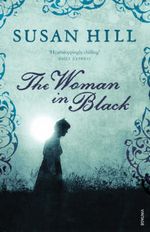
Book Club: Susan Hill, The Woman in Black

I have been curious to read The Woman in Black for some time. I’m not sure exactly why, except that the title made me curious (did it have anything to do with The Woman in White?) and I had heard that it was a really good example of a ghost story. I finally picked it up when I was in London in the summer, and I proposed it for my local book group for our October selection, figuring if there is a time for ghost stories, round about Hallowe’en is it! We met to discuss it this week, on an appropriately dark and drizzly night.

Though overall the book was not a big hit, we had quite an interesting discussion about why we liked what we did like about it, and about the aspects of it we found disappointing. Most of us thought it was a pretty good read, though our appreciation did rather depend on our tolerance for its deliberately old-fashioned style: though it is neither actually Victorian nor neo-Victorian, it sounds Victorian, in that its tone is formal, its pacing deliberate, and its descriptions long and detailed. I particularly liked the evocative landscapes, which I thought Hill used effectively to create an atmosphere of mingled beauty and menace:

As we drove briskly across the absolutely flat countryside, I saw scarely a tree, but the hedgerows were dark and twiggy and low, and the earth that had been ploughed was at first a rich mole-brown, in straight furrows. But, gradually, soil gave way to rough grass and I began to see dykes and ditches filled with water, and then we were approaching the marshes themselves. They lay silent, still and shining under the November sky, and they seemed to stretch in every direction, as far as I can see, and to merge without a break into the waters of the estuary, and the line of the horizon.

My head reeled at the sheer and startling beauty, the wide, bare openness of it. The sense of space, the vastness of the sky above and on either side made my heart race. I would have travelled a thousand miles to see this. I had never imagined such a place.

Though I didn’t find the story nearly as eerie or scary as I expected, I thought it did have some really shivery moments–the best ones, for me, being the ones with the quietest effects, like this one:

I think I must have fallen asleep only a few moments after putting the lamp out and slept quite deeply too, for when I awoke – or was awakened – very suddenly, I felt somewhat stunned, uncertain, for a second or two, where I was and why. I saw that it was quite dark but once my eyes were fully focused I saw the moonlight coming in through the windows, for I had left the rather heavy, thick-looking curtains undrawn and the window slightly ajar. The moon fell upon the embroidered counterpane and on the dark wood of wardrobe and chest and mirror with a cold but rather beautiful light, and I thought that I would get out of bed and look at the marshes and the estuary from the window.

At first, all seemed very quiet, very still, and I wondered why I had awoken. Then, with a missed heart-beat, I realized that Spider was up and standing at the door. Every hair on her body was on end, her ears were pricked, her tail erect, the whole of her tense, as if ready to spring. And she was emitting a soft, low growl from deep in her throat. I sat up paralysed, frozen in bed, conscious only of the dog and of the prickling of my own skin and of what suddenly seemed a different kind of silence, ominous and dreadful. And then, from somewhere within the depths of the house – but somewhere not very far from the room in which I was – I heard a noise.

I liked the dog especially, and I was quite upset when … well, you’ll have to find out for yourself how the dog fares.

But if in these ways the book is well written, in others it really disappointed. One thing that bothered me was the heavy-handed foreshadowing, which seemed like an unnecessary and artificial way to create suspense. Another was the imbalance between the parts: the set-up is long and not really very interesting (and full of that heavy-handed foreshadowing), then the ghost story, which is told as a reminiscence, kind of staggers along, with fits and starts of ghostly business rather than the gradual development of irresistible eeriness. And then there’s a dénouement which is clearly meant to be the climax of the horror but which struck us all, I think, as too sudden and unmotivated: why would the ghost do that? What did Arthur Kipps ever do to her?

And that brings me to our main objection, which was that the ghost story itself was not very good. The haunting may be well described, but it isn’t well motivated: its specific cause is fairly predictable, if not from the outset, than from the earliest hints, and the ghost’s malevolence seemed disproportionate and random. Why should everyone suffer for such a particular tragedy, and a tragedy for which nobody is really strongly to blame? We brainstormed a bunch of alternative twists that we thought would have built the plot up into something more original and surprising, and one that would have made more of the characters more involved–Arthur Kipps especially. There should have been more information in the documents, more cruelty in the history, and some specific unfinished business that brought the ghost back to Eel Marsh House. The book seemed more special effects than anything else–there’s no compelling aboutness to it–which is probably why we agreed that while it’s not a great book, it will probably make a pretty decent film (and indeed, the trailer looks good, for people who like that sort of thing, though judging from what it shows, the screenwriters have added a lot of new elements).

If you are looking for a ghostly read yourself, I’d recommend Elizabeth Gaskell’s The Old Nurse’s Story instead. Or, of course, The Turn of the Screw. Or The Little Stranger. I actually left our group discussion feeling less satisfied with The Woman in Black than when I arrived, and I don’t really understand why it has the ‘contemporary classic’ standing it does.