Joanna Trollope, A Village Affair

From the Novel Readings Archives. Writing about Rosy Thornton’s The Tapestry of Love got me thinking about other examples of intelligent ‘women’s fiction’ (which I would say is the thinking person’s alternative to ‘chick lit’: readable but insightful stories about women living recognizable lives, sorting through family, career, or personal issues, learning more about themselves in the process–and prompting us to reflect a little on our own lives along the way). I mentioned Anne Tyler, for instance; her unassuming books often offer unexpectedly broad (or is it deep?) insights. Joanna Trollope is another writer I think writes low-key, easily readable, but worthwhile novels. Some of her more recent ones have not really worked for me (Friday Nights, for instance), but I’m fond of several of her earlier ones. I wrote about them long ago–when I almost never got readers or commenters! So I thought I’d repost what I said then. Has anyone else had a similar experience of being surprised into taking something more seriously than they expected? Also, what writers do you turn to when you want to relax a little into your reading? Who are your trusted go-to books or authors when you want something in between, say, Virginia Woolf at one extreme and Sophie Kinsella at the other? (Sally Vickers has been mentioned already; I’ve made a note!)


When I decided to take a break from more “serious” reading with A Village Affair, I wasn’t really expecting the novel to reach towards the serious itself. I had read it before, but what I had retained was admiration for the clarity with which Trollope gives us the people she has devised: many (though not all) of her novels that I have read have struck me as achieving an enviable quality in their characters: they are enormously specific and individual and often intensely, even poignantly, believable. Here, Alice’s father-in-law, Richard, seems especially well conceived. Everything he says communicates to us who he is and how he has lived, particularly in his marriage to a woman he persists in loving but who cannot, in her turn, recognize in him someone as complex and fully human as she is. He lives this hampered life in full knowledge of its limits, neither tragic nor stoic. Alice’s discontent is the stuff of cliches; her affair seems contrived (by the author) to break up the seemingly calm surface, the routines and compromises of daily life. In fact, this is how Trollope’s plots generally work: the ordinary people, the change or revelation, the repercussions. For me, it’s the repercussions she does really well. Having set up her experiment in life, she works out plausibly how it will play out, and she does not sentimentalize–as, in this case, Alice’s “coming alive” through a new and different experience of love creates more problems than it solves.

In this case, as in another of her novels that I think is very smart, Marrying the Mistress, Trollope sets her characters up to confront what is a central dilemma in many 19th-century novels as well, namely how to resolve the conflict between, or how to decide between, duty to self and duty to others. That she is aware of her predecessors in this investigation is indicated by the quotation from Adam Bede recited (OK, improbably) by one of the characters in A Village Affair. As that quotation forcefully indicates, George Eliot placed a high value on renunciation and on accepting (as gracefully as possible) the burden of duty: resignation to less than you want, or less than you can imagine, is a constant refrain, and this with no promise of rapturous happiness. Hence the melancholic tinge at the end of Romola, for instance, or Daniel Deronda, or, for all its lightning flashes of romantic fulfilment, Middlemarch. (Of course, famously, it is her heroines who must resign or, like Maggie Tulliver, die.)

Although much has changed socially and politically since George Eliot found it unrealistic to give Romola, Maggie, or Dorothea uncompromised happy endings, the struggle between what we want for ourselves and what is expected or demanded of us by others continues to be a staple of fiction. Though Trollope’s scenario is much more contemporary, she too accepts that one’s individual desire cannot (or not easily, or not ethically) be one’s guiding principle, because of the “visible and invisible relations beyond any of which our present or prospective self is the centre” (Adam Bede). So Trollope, with admirable restraint, refuses a fairy tale ending for her protagonist, though, with a different kind of insistence that perhaps George Eliot would respect, she also pushes her out of the unsatisfactory life that was her reality before, and into what, given this context, seems like a narrative limbo, or a waiting room. This is not to say that Alice’s single life is an incomplete one, but she herself acknowledges that it is not, in fact, what she really wanted–only what she was capable of achieving.

I think this novel makes an interesting comparison to another quiet novel about a woman reconsidering her life, Anne Tyler’s Ladder of Years, which I have always admired. But Tyler, though far from offering simplistic fairy tales, offers her own version of the resignation narrative. In Ladder of Years, as in Back When We Were Grownups, it proves mistaken for the heroine to try to start a new life, however much she is, or believes she is, following the promptings of her innermost self. Again, the “visible and invisible relations” exert a powerful pressure, like the entangling webs of family and society in Middlemarch but perceived, overall, as more kindly, less petty and destructive. The plain litte room Delia takes and uses as a staging ground to reinvent her life is a room of her own, but her story is not rightly understood as being just about her own life (“was she alone,” Dorothea asks herself). In these novels Tyler’s women learn to appreciate the value of what they tried to leave, to see their own identities as having become inseparable from those of the others whose demands and complications hamper their desires. The vision seems starker in Trollope’s novel (“Aga saga” though it certainly is).

(originally posted June 15, 2007)
Rosy Thornton, The Tapestry of Love

What’s not to like about The Tapestry of Love? It’s undemanding and charming, while also being thoughtful and literate. Along with Thornton’s Hearts and Minds, it now numbers among the little cluster of books I think of as my ‘comfort reading,’ books that I reread when I want to wander mentally away from home without feeling adrift, to be distracted without being distraught or dismayed–books, too, that always bring me home again, quietly, rather than leaving me staring wistfully over the horizon. I am sure I will reread The Tapestry of Love more than once in the years to come.

Like Anne Tyler (whose Ladder of Years is a longstanding comfort read), Thornton has an astute sense of character–of what makes people distinctly themselves–but also of relationships and how they challenge (or, more rarely, reinforce) that individualism. The story of Tapestry of Love is simple enough, perhaps even clichéd: a divorced Englishwoman pursues her dream by moving to a cottage in the Cévennes and setting up her own business, including making the tapestries that provide the novel’s underlying metaphor (and, obviously, its title). Though she doesn’t go in search of romance, inevitably (by fictional, not real standards) she finds it. But its development is hampered by her own reserve, by her more flamboyant sister, and by the complications of being both grown up and divorced already, and thus under no illusions about fairy-tale endings. Filling in this simple outline are details and anecdotes–sometimes humorous, sometimes poignant–about life in this rural community, told in prose that is precise, evocative, and unsentimental.

I first heard about Rosy Thornton from the review of The Tapestry of Love at Tales from the Reading Room. Litlove speaks so well about the book that I’m going to quote her at some length rather than try to find another way to say something that wouldn’t end up being very different (it’s not lazy, it’s appreciative!):

There are two preoccupations in this delicate novel that stand out in particular. The first is the exquisite nature writing that brings France alive on every page. I don’t recommend you pick up this book if you have a deep hankering to move to the south of France because you’ll find you’ve booked a ticket before the end is reached. Catherine is an observer, a practiced witness to lives that are more vivacious than her own, and her profound attention to the consoling beauty of the world around her is completely convincing. But at the same time, this attentiveness to the natural world has another purpose, in that it emphasizes the cycle of life in which all the characters are trapped. I found this to be the most poignant of Rosy’s books so far, the one most concerned with loss and how it might not perhaps be managed, but eventually accepted, or soothed with other distractions. The cycle of family life, with its need to find partners, to raise children, to let go of the adults they become as well as the parents who raised us in their time, is the underlying trajectory of the plot. Catherine is at the time of her life when there are too many goodbyes, and to add to that, she has chosen to leave her homeland and all its familiarity behind. But Catherine is a sensible, grounded woman, a woman whose work matters to her as much as her romantic life, a woman who knows what needs to be done and will do it, even if it requires unreasonable selflessness. And she is also a hopeful woman, one who believes without needing to say it, that tomorrow will bring fresh opportunities and new chances. Her resolute strength of character and her belief in the process of renewal carry her (and the reader) through adversity and to the optimistic ending you long for her to have.

There’s also a lot of wry humour in the book, about the French bureaucratic system (which deserves to have fun poked at it), and about sibling relationships. It’s a wonderful portrait of two sisters, and it was probably this relationship I appreciated most in the novel. There’s always a great core of strength at the heart of Rosy’s novels and this comes from her celebration of love over the false friends that are need, desire, lust and romance. Unlike other genre writers, who turn love into Sturm und Drang or emotional pyrotechnics, Rosy portrays love more realistically (and therefore surprisingly), as presence, awareness, mindfulness, and also as acceptance of people exactly as they are. This makes her books less outwardly dramatic than some, but reassuringly, resolutely real and immensely comforting. The Tapestry of Love is about the gentle warp and weft of relationships, the tracing of a thousand threads of attachment into patterns that please and console. In this way it’s a novel that leaves the romance genre some way behind, and deserves a categorization all of its own.

You can see from this why I was prompted to look up Rosy Thornton for myself (and why I like Tales from the Reading Room so much, too). I was delighted to learn from Thornton’s author page that her career as a novelist grew out of her enthusiasm for Gaskell’s North and South (and I would just like to say “I hear that!” to her comment about Richard Armitage in the role of John Thornton). I haven’t read her other two novels yet, including the first one in which, she says, the influence of North and South is particularly evident, but I enjoyed Hearts and Minds very much too–also gently humorous and unassumingly astute. This is the point at which easy access to the Book Depository and its free worldwide shipping becomes dangerous…

A trivial question that lingers: There are all kinds of novels about the English abroad, yearning for sunshine, or for a society fondly imagined to be somehow more open, emotional, or authentic–like A Room with a View, to give just one more famous example. Do folks in Italy or the south of France ever dream of (and write novels about) holidays in England? I suppose if they do, it would be out of yearning for something other than the weather.

Ed McBain, Cop Hater

I took a break from the grim world of cop fiction after Faceless Killers and spent a little time with Rosy Thornton in the Cévennes (I’ll write a little about The Tapestry of Love later, I hope). What a nice interlude that was! But then I got right back on the horse with Ed McBain’s Cop Hater, which I had requested as an exam copy because it seemed a strong contender for the Mystery & Detective Fiction survey. Having read it, I think that was a pretty good call, though I can’t say I enjoyed the McBain any more than I enjoyed the Mankell. (I have also added Sjowall and Wahloo’s Roseanna to my Kobo collection and taken Mankell’s The Fifth Woman out of the library, so I’ll be improving my Mankell skills soon.) Cop Hater does seem to exemplify a certain definition and style of police procedural. McBain’s own introduction notes that his 87th Precinct novels were innovative in making the operations of a squad, rather than an individual detective, their focus; this comment made me think of the Dell Shannon series I remember my parents reading steadily many years ago (and I just this very minute, googling the name, learned that is one of the pseudonyms of novelist Elizabeth Linington). Her Luis Mendoza series premiered in 1960, so a few years after McBain published Cop Hater (1956).

I’d read only some 87th Precinct stories before; Cop Hater is my first full-length McBain. I imagine these books, too, get better as the writer becomes more sure of his territory and characters. I found this one a bit cheesy at times, with coy little writing tricks for effect, especially at the ends of chapters:

There was only one thing the investigators could bank on.

The heat.

Some of the writing is much better than this, though; McBain effectively conjures up the sights and, especially, the smells, of urban life in a heat wave:

The smell inside a tenement is the smell of life.

It is the smell of every function of life, the sweating, the cooking, the elimination, the breeding. It is all these smells, and they are wedded into one gigantic smell which hits the nostrils the moment you enter the downstairs doorway. For the smell has been inside the building for decades. It has seeped through the floorboards and permeated the walls. It clings to the banister and the linoleum-covered steps. It crouches in corners and it hovers about the naked light bulbs on each landing. The smell is always there, day and night. It is the stench of living, and it never sees the light of day, and it never sees the crisp brittleness of starlight.

McBain (not knowing, perhaps, quite how his own new subgenre should sound or would develop) sometimes seems to be aiming for a noir-ish atmosphere, and striving for the verbal panache of his hard-boiled predecessors. The results are occasionally awful: “He shook his head sadly, a man trapped in the labial folds of a society structure.” In fact, Cop Hater is most hard-boiled in its claustrophobic masculinity, in its unease with and about women (“trapped in the labial folds” indeed!), in the voyeuristic gaze it directs on all of its female characters, and especially in the femme fatale who turns out to behind the cop killings. I don’t really know what to do about Carella’s girlfriend being deaf and mute: on the one hand, there’s something fitting about that being the novel’s ideal woman, but then, she acts courageously and saves Carella’s life in the novel’s thrilling denouement, which is a refreshing change in a novel in which the women (including her) seem to spend all their time in stuffy apartments just waiting for their men to come home. As our villainess says, “What kind of life is that for a woman?” But I don’t see any room here for seeing, much less adopting, her point of view (despite her hopes, even the men on the jury don’t like her enough to save her), while in The Maltese Falcon Brigid is (arguably) not really worse than anyone else.

What seems really different about Cop Hater compared to earlier detective novels is its attention to the specific procedures of the police investigation, even including reproductions of gun licenses and rap sheets, but also detailed explanations of forensic measures (such as fingerprinting) and lab work. These features, along with the spread of the novel’s attention across several detectives (though Carella is clearly the main character) help us see the police as a system, as part of a bureaucratic organization operating within a network of other supporting (or, sometimes, hindering) systems. The case is not solved by the ingenuity of Poirot or the ratiocination of Dupin or Holmes but by the persistence of men who just keep looking and asking until they find something out.

The other thing that I found striking about Cop Hater is how completely unglamorous it is (setting aside the lacy lingerie bits). There are some quotations from McBain at the end including this one about violence in his books:

I am unflinching about the violence…If someone is getting killed, that person is getting killed and you know it, and it hurts, and it results in a torn body lying on the sidewalk. It’s not pretty…it’s horrible. But there’s a way of doing violence that’s salacious. And that’s wrong…I have never, ever, ever in my books tried to make violence appealing. I’ve made it frightening and I’ve made it ugly, but never appealing.

I respect that, and though the lead-up to violence in Cop Hater is almost always manipulatively suspenseful, the violence itself is as he describes it: blunt, horrible, not appealing. I’d like to discuss his dead bodies with my class in comparison to Roger Ackroyd’s bloodless corpse. And I think Cop Hater would make a good stop in between Hammett or Chandler and Paretsky, and not just because of the timing (right now my book list jumps pretty much right from 1930 to 1982). Perhaps it would also be a good step on the way to a later example of the police procedural–not an alternative to Rankin or Mankell, but a supplement. I think the students would probably like it: it’s short, it moves fast…but it’s also $21, which seems a lot for an edition that seems to be just a reproduction of an earlier version but on larger pages (there are oddly wide margins, especially at the top). I think there is also a page out of order: near the beginning of the book is a title page for Alice in Jeopardy, “now available in hardcover” etc., and it says “turn the page for a preview,” but next is the title page of Cop Hater. Then after Cop Hater ends (happily ever after!), we go right to a new Chapter 1, otherwise unidentified–which I assume is from Alice in Jeopardy. For $21, readers might like Simon and Schuster to make a nicer book.

And now, I need another break from the death and dirt and darkness, so I’ve started May Sarton’s The Education of Harriet Hatfield.

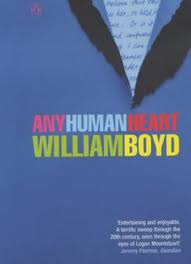
William Boyd, Any Human Heart

From the Novel Readings Archive

I haven’t watched the first instalment of the new BBC adaptation of Any Human Heart yet, but it’s waiting for me on my DVR. In the meantime, it seems like a good time to recall what I thought about the book. As you’ll see, things started out a bit rocky–but I ended up liking it a lot. I’m curious to see how (or if) the adaptation deals with the formal features of the novel, particularly the first-person narration through the diaries. I’m expecting that it doesn’t try to capture Logan’s voice but simply dramatizes his life story. That’s usually the great loss in the shift from written to visual form, no matter how good the adaptation otherwise. The BBC Middlemarch, for instance, though intelligent in many ways, is an incredibly thinned-out experience compared to the novel because (except for a brief voice-over at the end) there’s no narrator.


I almost didn’t finish reading William Boyd’s Any Human Heart. By about 200 pages in, I was tired of Logan Mountstuart, his personality, and his life. He seemed archly insouciant, pretentious, insubstantial–as did the novel’s conceit of following this unappealing person through the 20th century, punctuating his episodic memoir (the novel consists of his journals, ‘edited,’ complete with footnotes, editorial commentary, and an index) with encounters with Woolf and Joyce, Hemingway and the Duke of Windsor and Picasso. Here’s a typical diary entry:

Tuesday, 4 March We dined at Luigi’s and went on to the Cafe Royal. It was busy, full of unfamiliar faces. Spotted and spoke with Cyril [Connolly] and Jean who were with Lyman? Leland? [unidentifed]. They left shorty after. Then Adrian Daintrey[22] came in with a party in evening dress–which included Virginia Woolf[23], smoking a cigar. I let them have our table and during the general milling around that took place I introduced Freya to Woolf. ‘Are you two here alone?’ she said to Freya. ‘What a ghastly crowd. How it’s changed.’

‘We were here with Cyril Connolly, a moment ago,’ Freya said.

‘Was his black baboon with him?’ VW asked.

Freya didn’t know what she was talking about.

‘His little gollywog wife.’

I turned to Freya. ‘Now you understand Mrs Woolf’s reputation for charm.’ Back to VW. ‘You should be ashamed of yourself.’

We strode out and when we reached home had our first serious row. Freya was a little shocked at VW’s spite. I said you would never imagine the person who wrote all that lyrical breathy prose was steeped in such venom. ‘At least she writes,’ Freya said, without thinking. But it cut and so we looked around for something to fight about and duly found it. Now I’m writing this, about to go to sleep on the sofa, and I can hear Freya sobbing next door in the bedroom.

And so it goes, documenting Logan’s haphazard journey across the century. He’s a novelist, a journalist, a sort-of spy, an art dealer, a husband, a philanderer, a father. He meets Joyce in Paris, Hemingway in Spain, Frank O’Hara in New York. He is a kind of picaresque Rosencrantz (or Guildenstern, take your pick), always present, always involved, never really very important or impressive. He spends two years as a prisoner of war–in Switzerland! Somehow, that detail of his WWII escapades seems to me to capture something fundamental about how his life is conceived and presented in this novel, that he should parachute into Europe on a secret mission but to a neutral country, and end up so unheroically, and so diverted from the course of history that he doesn’t even know when the war has ended. It would be a comic incident (even Logan, mystified as he is by his internment, never seems to fear he will meet a terrible fate at the hands of the Swiss), if his return to action weren’t marked by a family tragedy. His story oscillates between such turns of good and bad fortune…and that uneven, unpredictable alternation of good and bad, happiness and grief, begins after a while to reveal itself as the underlying logic of the novel. As Logan reflects, near the end of his life,

That’s all your life amounts to in the end: the aggregate of all the good luck and the bad luck you experience. Everything is explained by that simple formula. Tot it up – look at the respective piles. There’s nothing you can do about it: nobody shares it out, allocates it to this one or that, it just happens. We must quietly suffer the laws of man’s condition, as Montaigne says.

As I realized Any Human Heart was not going to shape its protagonist’s life into something more definite, but would just keep on going with it, right to the end, I began to fall under its spell. I didn’t like Logan much more later in the novel than I had at first, and certainly he never achieved the level of moral self-reflection you might hope for if the novel were of a different kind (a Bildungsroman, for instance). The novel is a bit like David Copperfield, but without the benefit of hindsight in its narration, or of real personal growth in its action. But at the same time, the relentless forward movement of time itself has a kind of narrative to it. At one point Logan heads “to the passport office to collect [his] new passport, valid for another ten years”:

In 1965 I’ll be fifty-nine and the thought makes me feel faint. What’s happened to my life? These ten-year chunks that are doled out to you in passports are a cruel form of memento mori. How many more new passports will I have? One (1965)? Two (1975)? Such a long way off, 1975, yet your passport life seems all too brief. How long did he live? He managed to renew six passports.

I thought that was a beautiful moment; it was certainly the moment at which I began to read without impatience, with a quickened interest in following Logan’s life the rest of the way. He has no great epiphanies. He just keeps on living, one way or another, sometimes better, sometimes worse, in comfort and in poverty, in sickness and in health. He makes and loses friends and lovers; he has good ideas and bad ones, successes and failures. His most lasting relationship is with himself (he dies alone), but he has the great gift of “genuine love” for three other people, a love that brings him to another brief but beautiful insight:

As I write this I feel that draining, hollowing helplessness that genuine love for another person produces in you. It’s at these moments that we know we are going to die. Only with Freya, Stella, and Gail. Only three. Better than none.

I finished the final journal entry, which is touching but unsentimental, very happy to have persisted with the novel. I was with Logan emotionally in a way I never would have predicted from my initial response. I’m not convinced, though, that the set-up, the elaborate pretense of authenticity, was necessary. The apparatus (explanatory prefaces, footnotes, index) seems gratuitously metafictional. We can suspend our disbelief readily enough when reading a novel cast as a diary (or as letters, for that matter); we don’t need to pretend we can read it because it was prepared for publication. I suppose this framing material does enhance the novel’s emphasis on Logan as a witness to history, something he himself becomes more self-conscious about, naturally enough, later in his life when having known Hemingway, or met Woolf, or been sketched by Picasso, confers on him a kind of status, as if he’s a walking relic. But it still felt artificial to me and even, at times, detracted from my unfolding sense of commitment to the individual voice speaking through the journals.

(originally posted October 10, 2009)

“Women Catch Courage”: Carolyn Heilbrun, The Last Gift of Time

lastgiftThe greatest oddity of one’s sixties is that, if one dances for joy, one always supposes it is for the last time. Yet this supposition provides the rarest and most exquisite flavor to one’s later years. The piercing sense of “last time” adds intensity, while the possibility of “again” is never quite effaced.

It’s impossible not to be very aware, reading The Last Gift of Time: Life Beyond Sixty, that Carolyn Heilbrun committted suicide in 2003–six years, that is, after the book’s publication. As she tells us in the Preface, she had “long ago settled upon the determination to end [her] life at seventy,” but arriving at that age, which once seemed “far off, indeed unlikely ever to occur,” she surprised herself by choosing to live past it. Life, for her, became a daily decision, an empowering one because it meant she remained in control of the narrative of her own life. As someone who finds the opacity and finality of death profoundly disturbing, I am fascinated by her clarity and resolve about it.

The Last Gift of Time is a series of personal essays reflecting on Heilbrun’s experience of aging as well as on issues that took on new relevance or new dimensions as she aged. Perhaps because they are quite personal, to me they were not all equally substantial or valuable. I didn’t much like the chapter “Living with Men,” for instance, which seemed to me to overgeneralize carelessly. But I loved “The Small House,” in which Heilbrun writes about her desire for solitude, in pursuit of which she eventually buys a small house in the country. It turns out she does not love being alone quite the way she expected and she and her husband end up, paradoxically, finding “solitude together.” But she is astute about the temptation, the fantasy, of solitude, “a temptation so beguiling that it carries with it the guilt of adultery, and the promise of consummation.” Being alone and being lonely are not necessarily the same conditions–indeed, my own experience is that it is sometimes possible to feel much more lonely when not alone. I imagine many women, particularly ones with young families, feel both longing for “quality time” with themselves and guilt about that desire; men who want to get away from it all have (as Heilbrun points out) more cultural support and precedent for it. I wonder how far Heilbrun is right that the pleasure of solitude depends on its being both voluntary and temporary.

Another chapter I enjoyed is the one on e-mail, which is also really about balancing aloneness and togetherness. E-mail “reaches into our privacy without invading it,” as she remarks, and she rightly notes too that it enables new relationships to develop as well as sustaining old ones that might otherwise erode with distance. She’s writing when this technology was still relatively new for non-techies. I got my own first email account in 1990, when I moved away from Vancouver to go to Cornell, and I remember how it sustained me (as, indeed, it still does) to open my mailbox and find messages from home. As Heilbrun notes, there’s an intimacy to email that is different (not better, just different) from both face-to-face and phone conversations: “with e-mail, one moves into it without notice, and may find there messages that are not, strangely enough, appropriate for the telephone.”  Also, because they are written and not in ‘real time,’ email messages can allow us not just extra reflection but also “the practice of wit.” I imagine Heilbrun would have been even more exhilirated by blogging–and might even have been an enthusiastic Facebooker.

220px-Carolyn_Gold_HeilbrunTwo other, more literary, chapters also stood out for me. One, “Unmet Friends,” talks in general about the way writers can come, in our minds, to be our close friends, though we have ‘met’ them only through their words on the page. “Women catch courage,” Heilbrun proposes, “from the women whose lives and writings they read, and women call the bearer of that courage ‘friend.'” Heilbrun’s main example is Maxine Kumin, who, she says, “exists as a close friend only in my mind.” She talks in engaging detail about how she got to ‘know’ Kumin and what their ‘friendship’ has meant to her over the years. “Kumin,” she explains, “spanned both the refuted and the desired aspects of my life.” But she also mentions Dorothy L. Sayers (“her life and her writings spoke to me of a more expansive life, an existence devoted to aims riskier than I had previously allowed myself”)–and Virginia Woolf, who, though “a writer I have studied, taught, and written about with admiration, has never been a friend: she is entirely too much of a genius for that.” There’s also a separate chapter on a writer who became Heilbrun’s real-life friend, May Sarton. Heilbrun mentions her reading of Sarton’s 1968 memoir, Plant Dreaming Deep, “a work that quite literally caught me in its spell,” as “the beginning of our friendship;” that comment, plus her account of Sarton’s eccentric personality and vexed writing career, made me glad I had coincidentally picked up Plant Dreaming Deep at the same time I bought The Last Gift of Time.
The final chapter in The Last Gift of Time is “On Mortality.” It’s here, of course, that the knowledge of her suicide lingers most hauntingly over her words, but the chapter is neither morbid nor sentimental–she considers her death in the context, especially, of her children and grandchildren, and admits that she faces her own mortality with equanimity but cannot bear the thought of her husband’s: “Perhaps death, the nearness of it, transforms long marriages. . . . I have noticed that marriages that have endured over many decades seem to have earned, as reward, a mutual mellowness.” She has learned to stop expecting or demanding change; she quotes George Balanchine’s instruction, “Just dance the steps,” and suggests that similarly she has come to believe that in marriage too, one should worry less about larger meaning and significance and “just dance the steps.” The chapter ends with a poem that was new to me and that will linger with me, Jane Kenyon’s “Otherwise.” An excerpt:

I slept in a bed
in a room with paintings
on the walls, and
planned another day
just like this day.
But one day, I know,
it will be otherwise.

For Heilbrun, that day was October 9, 2003.

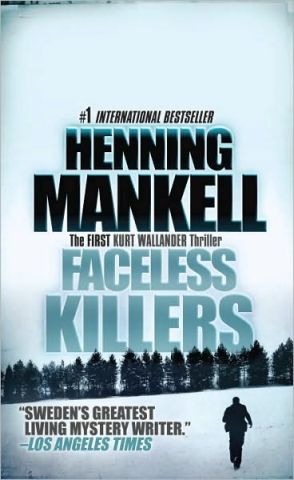
Henning Mankell, Faceless Killers

mankellMy copy of Faceless Killers is littered with snippets of praise, both for Mankell in general and for the book in particular. “Sweden’s greatest living mystery writer!” (Los Angeles Times). “An especially satisfying crime novel” (Wall Street Journal). “A thriller of the very best kind.” (The Times [London]). “Beautifully constructed plots.” (New York Post). “An excellent thriller…A terrific novel.” (The Independent [London]).

Hmm.

I’m not in a position to generalize about Mankell, or Wallander, after reading just one novel in this series. But I honestly can’t see why this book, or its author, would stimulate such enthusiasm. The style is almost unbearably plodding–not quite as dreary as the Stieg Larsson books (or the 1.5 of them I managed to wade through), but close. Maybe the fault lies with the translators, but there is no elegance, no rhythm, no color to the prose at all: it’s just one statement after another. Its starkness does seem suited, after a while, to the bleak landscape–both literal and emotional–of the novel, but that didn’t rescue it from seeming perfunctory, as writing, rather than artistic or literary: it often seemed as if Mankell was just working his way down a checklist of things to include or describe:

At 4 p.m. that afternoon Wallander discoverd that he was hungry. He hadn’t had a chance to eat lunch. After the case meeting in the morning he had spent his time organising the hunt for the murderers in Lunnarp. He found himself thinking about them in the plural.

or,

For the next three days nothing happened. Naslund came back to work and succeeded in solving the problem of the stolen car. A man and a woman went on a robbery spree and then left the car in Halmstad. On the night of the murder they had been staying in a boarding house in Bastad. The owner vouched for their alibi.

He gets the job done, but do reviewers really have such low expectations for crime fiction qua fiction that something so flat gets so much praise?

Perhaps the “very best kind” of “terrific” thriller doesn’t need great prose, just an interesting and well-constructed plot (a double-standard, of course, as if genre fiction should not be expected to be well written in every respect). How good is Faceless Killers by this measure? It’s fine, I guess. By the end the necessary information has been gathered and the pieces fitted together. Because it’s a procedural, solving the case is a matter of following along as the police do their job, which necessarily makes us more passive as readers–we have to wait for their discoveries to be delivered to us. Lots of very good crime novelists use the procedural form–as P. D. James has pointed out, nowadays it’s really the only way to write realistic mysteries, after all. A procedural can become rich and interesting if the contexts and the characters are developed enough and the police’s discoveries aren’t all strictly literal. Cases can be devised that draw both detectives and readers into new territory–social, political, intellectual, even philosophical. And the detectives themselves can be made multifaceted, and have plot lines of their own, so that the case under investigation becomes a device for personal exposure or exploration as well. James, of course, does all this brilliantly (think of A Taste for Death, for instance), as does Ian Rankin (whose last three Rebus novels in particular deserve to be called ‘condition of England’ novels), and sometimes Elizabeth George (Deception on His Mind, I think, is one of her most interesting). Faceless Killers reads like a thin version of, say, Rankin’s Fleshmarket Close. Wallander is a close cousin of Rebus (and not too distant from Peter Robinson’s Inspector Banks)–which is not to say that Wallander is derivative (if I have the chronology right, they are basically contemporaries), just that with his divorce and his drinking and his depression, he seemed formulaic, another in an already well-populated group. Over the later books in the series, perhaps, he distinguishes himself in some way besides his fondness for opera.

The crime is very violent, and described very graphically, and there are some intense action sequences in the novel. I suppose this is why some of the reviewers call it a “thriller” rather than a “mystery.” I don’t enjoy that kind of reading very much: I’d rather be drawn in intellectually than manipulated through fear and suspense. This, I recognize, is basically a matter of taste, though I think that it is worth asking if different kinds of preferred experiences might in fact be more or less valuable, or whether we ought to seek out or encourage preferences that pander to our baser nature rather than our higher! (Look, for example, at Wayne Booth’s comments on Jaws in The Company We Keep, and ask yourself “who am I being, what am I desiring, as I go along with this kind of story?”) Here I think Mankell’s dull style is actually a good thing, because though grim, his violence is not really sensational–it’s just there, and then we move on to the next thing. The case does touch on some broader issues, particularly xenophobia and tensions over immigration. Again, though, the treatment seems perfunctory: we don’t spend time among the asylum seekers in the camps, and the central crime turns out to be connected only incidentally to the racial tensions it stokes. Probably the most distinctive feature of the book, for me, was its atmosphere, a relentless cold heaviness. Things just always get worse, and then there’s more sleet and snow. Who wouldn’t want to spend hours immersed in that?

I read Faceless Killers for a couple of reasons–first, because Mankell is such a big name now that I figured I should have some first-hand experience, and then because I would like to broaden my course reading list by adding some ‘international’ authors and Scandinavian crime fiction is very hot right now. If he bumped anyone from my usual list, it would be Ian Rankin. Right now, though, Rankin wins: he’s just a better writer. The question is, should I (must I?!) read more Henning Mankell to be sure. Suppose I read one more, to see how much better he gets: any recommendations?

This Month in My Sabbatical: Not a Bad Start

I’m sort of missing the routine of my weekly teaching posts–not just writing them, but the act of taking stock that they represent. So I thought I would have a go at a similar exercise reflecting on my  progress (if that’s what it is!) through my sabbatical term. It may be even more useful, in a way, to make sure I am self-conscious about the passage of time, because my days are much less structured and my goals are in some ways more diffuse! So here goes.

Ongoing Business: Despite what non-academics often think, being on sabbatical does not mean not being at work–it means shifting the focus of your work, particularly by re-allocating the time usually spent in class prep, teaching, marking, and administration to research and writing tasks. Most of that time, that is, because there are always teaching and administrative tasks that still need to get done. For instance, this month we were asked to turn in our course descriptions for next year, which means I have already spent some time thinking about reading lists. Book orders will be due later this spring, so at this point my choices are only tentative, but I did brood about how things went with specific books or courses the last time and make some changes accordingly; I also researched and then wrote away for exam copies of some alternative texts, particularly for the Mystery and Detective Fiction class. I set up and marked a make-up exam for a student who had a family crisis right before our December final. I worked through 100 pages of a draft thesis chapter from one of my Ph.D. students and about 40 pages from another (and I attended a colloquium paper presented by yet another whose committee I am on). I wrote a lot of reference letters (and have three more I plan to finish up today or tomorrow).

Housekeeping: During teaching terms, though I stay on top of the day-to-day business pretty well, I find there’s not a lot of time to spend thinking about how I organize things, or sorting through old materials to see what needs to stay and what can go. After 15 years in this job (and 10, now, in this particular office) stuff does rather pile up. One of the first things I did in the new year, then, was to begin going through my filing cabinets: so far I have three bags of paper ready for recycling, and much less duplicate or unnecessary material taking up space. I’ve also donated (or at least put out on our “help yourselves” shelf in the department lounge) an array of unwanted books. Equally important now that we do more and more of our work electronically, though, is electronic filing, and here I have begun a big project of reorganizing my files of course materials. Long ago I decided to keep my paper notes and handouts in files by author and text, rather than course, which has worked very well for me: if I’m teaching, say, Great Expectations, I pull out the DICKENS GREAT EXPECTATIONS folder and in it I find old lecture notes, discussion questions, overheads, essay topics, etc. But my computer files have always been by course and then by year. This worked well for a few years, but now I often find myself puzzling over which year it was that I taught The Tenant of Wildfell Hall or where the latest version of the exam questions on Jude the Obscure are filed. Of course, you can simply search for key terms, but inefficiencies still emerge if you’re trying to browse your materials for a particular text or topic–plus there’s redundancy here too, as I end up with many files of lecture notes revised, expanded, or improved on over the years but still stored in multiple versions. So I’m re-sorting all this stuff into the kinds of groupings that I think will help me quickly gather what I need when I’m prepping for class and deleting outdated or duplicate files. Once the teaching ones are better organized, I’d like to do the same for my research materials. Many of these files I might copy into OneNote, which is where I now organize my new notes and draft materials.

Research: My main research project for this sabbatical is getting a version of my essay on Ahdaf Soeuif ready for submission to a peer-reviewed journal–at least, I think that’s what I want to do with it, though I admit, the revolution still unfolding in Egypt has made me feel dissatisfied, somewhat, with what I’ve been doing. More about that later, perhaps. In any case, I have finished taking my fresh set of notes on The Map of Love (on January 25th, as it happens, I was just working through a scene of intense political discussion in the novel, a debate about the future of Egypt and the possibility of change). One of the challenges of academic writing is figuring out, not just what you want to say, but when you’re ready–or allowed–to say it, given the array of contextual and critical material that already exists. When can you stop reading, in other words, and feel entitled to contribute to the discussion? There is no right way to answer this, of course, and it is easy (at least for me) to get so overwhelmed by the vastness of the existing scholarship and the difficulty of drawing lines between what’s relevant and what’s peripheral that I can’t put two words of my own together. I find what helps me most, in this situation, is to go back to my primary text, allowing whatever else I’ve been reading to buzz around in the back of my mind and help me notice things and generate questions as I go. I make detailed notes, going page by page through the novel, and along the way I usually begin to see where the main questions are for me, and how I might begin to answer them. Then I am better able to see what I don’t have to read, and to position myself in the discussion I want to be a part of. In this case, because I am starting from my analysis of In the Eye of the Sun, I wanted to stay in roughly the same territory, thinking about the relationship between Soueif’s work and the English literary tradition she repeatedly invokes. But The Map of Love is a very different book, particularly in its form, and it seems much less confident about the idea of common ground (or ‘mezza terra’) that I argued is central to the earlier novel. Towards the end of last week I started roughing out the new section of the essay.

Other Reading and Writing: I’ve done quite a bit of reading this month. I began looking at some recent books in Victorian studies, in keeping with my goal of refreshing my own expertise for both teaching and criticism in “my” field. One was Patrick Brantlinger’s Victorian Literature and Postcolonial Studies, but it ended up not being of great interest, as it recapitulates texts and debates that I had already become reasonably familiar with. He’s a good writer and it’s a good overview, to be sure. I’ve begin Rachel Ablow’s The Marriage of Minds: Reading, Sympathy, and the Victorian Marriage Plot, and I have James Eli Adams’s A History of Victorian Literature out from the library–another overview, but given how specialized critical work has become, I thought I’d start big and zoom in. But, speaking of specialized, I saw Julie Fromer’s A Necessary Luxury: Tea in Victorian England in the library while I was browsing around and couldn’t resist checking it out as well. Necessary indeed! I’ve documented most of my other reading on this blog already, including the beginnings of my Margaret Kennedy project–I’m two books in and feeling, frankly, underwhelmed, but I will persist! And if the essay that results is along the lines of “Margaret Kennedy: As Well Known as She Deserves, Actually,” well, that will be as interesting in its own way as “Margaret Kennedy: Underappreciated!” Among the other books I’ve read and written up are Graham Greene’s The Power and the Glory and Tove Jansson’s The Summer Book, for the book clubs I now participate in, and I’m now reading Henning Mankell’s Faceless Killers, not really for fun (how could it be? too grim!) but with an eye to my mystery class in the fall.  In addition to the ‘other writing’ that I have done here on Novel Readings (including a long piece on Sex and the City 2), I also wrote a review of Sara Paretsky’s Body Work for Open Letters Monthly–though this is not an academic publication, it certainly draws on the work I’ve done preparing for my courses on detective fiction.

Overall, then, though I’d like to be a bit further along in the rough draft of the Soueif essay, and though I feel I have not, actually, done as much reading as I’d like, or (with the academic reading) as much as I probably should have, I think I have made a reasonable start on accomplishing my goals for this sabbatical. A lot of time I might have spent working on other things, I spent reading and watching coverage of events in Egypt–I’m not inclined, actually, to see that as in any way irresponsible. I’ve also been going fairly regularly to the gym, where I run around the dreary concrete track, and I’ve made good progress on my cross-stitch “Bookshelf” sampler, including changing the pattern to include more of the books and authors I like best! Maybe next weekend I’ll get the binding on the quilt that has been sitting unfinished on my sewing table for months, and then I’ll really feel I’m getting things done…

Slaves of Golconda: Voting Has Begun

I was tagged to put up the shortlist for the next book choice of the Slaves of Golconda (“mining literature for pure gems”): any of you who are already participants should head on over and indicate your preference. It’s a pretty miscellaneous list: Colm Toibin’s Brooklyn, Shirley Hazzard’s The Transit of Venus, Laurence Cossé’s A Novel Bookstore, Alaa Al-Aswany’s The Yacoubian Building, and Sigrid Undset’s Kristin Lavransdatter I: The Wreath. Right now the voting is Hazzard 2, Toibin 1. I figure I’m going to read all of these eventually anyway, so whichever one we settle on for the group will be fine, and the discussion is always varied and thoughtful. Anyone interested is welcome to join, or just to read along and comment, of course. Our last two books were Tove Jansson’s The Summer Book and May Sarton’s The Small Room.

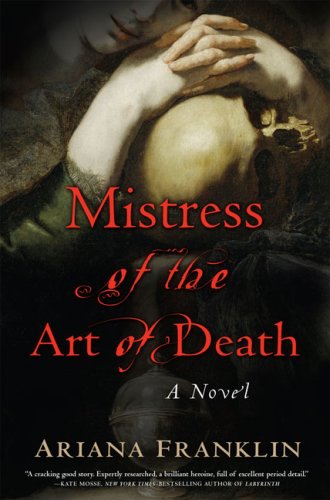
Ariana Franklin, Mistress of the Art of Death

I’m coming belatedly to this series of medieval mysteries featuring Vesuvia Adelia Rachel Ortese Aguilar–mercifully, just ‘Adelia’ most of the time–who is the eponymous ‘mistress of the art of death,’ which was launched in 2008. I’m generally wary of historical mysteries. Actually, I’m wary of most mysteries, though people often assume (because I teach courses in mystery and detective fiction) that I must read them avidly. Too many of them are too formulaic for my taste (though the issue of how we value [or label] formulaic vs. ‘original’ fiction is an issue we discuss at some length in my classes), and I’m not particularly interested in solving puzzles as I read. So when I read mysteries for pleasure, I gravitate to authors who emphasize character development and social context (P. D. James, Elizabeth George, Peter Robinson, and Ian Rankin, for instance). I’m also a faithful fan of Robert B. Parker and Dick Francis (both of whom, sadly, died recently): their books are among my most frequent re-reads, actually. I’ve followed both Sara Paretsky and Sue Grafton for many years now and will keep doing so, though Grafton with far less enthusiasm. And there are other books and authors in this genre that I love (Gaudy Night, The Daughter of Time) or find consistently interesting (Amanda Cross). But outside this group, which is pretty small considering just how vast the possibilities are, I can’t seem to get very excited, despite having sampled quite a lot of suggestions each time I’ve put out a ‘bleg‘ for teaching ideas. (Of course, books I get excited about reading for myself are not necessarily the same as books I get excited about using in my classes–Paul Auster’s City of Glass being a perfect example.)

Anyway, though I could ramble on about other mystery writers I’ve tried and liked or not liked recently (Denise Mina–liked! Inger Ash Wolf–not liked!), this post is supposed to be about Mistress of the Art of Death…which I liked. And then didn’t like. And then liked again.  I have a personal distaste for crime novels focusing on murdered children: I find it troubling to treat such grim possibilities as entertainment. So I had some difficulties initially with the set up of the crimes, which seemed sensationalistic, even manipulative. This distaste receded for much of the novel as I saw how stylishly Franklin proceeded with her historical context as well as with establishing her main characters and relationships. I’m no kind of expert on the 12th century, but in the Q&A at the end Franklin discusses her research as well as her (very endearing) nerdish enthusiasm for the many period details she mastered to write the book. I have to take her expertise on trust, but I can say that she made it all seem very convincing, and in general she dealt with it very naturally, not weighing down her narrative unduly with exposition and certainly not falling into any of the annoying faux Olde-Englishe stuff that makes a lot of historical fiction seem so artificial. She’s frank, in fact, about introducing anachronisms (including calling Cambridge ‘Cambridge’ instead of its medieval names) to make the story ‘comprehensible,’ and her dialogue especially is for the most part briskly contemporary.  She succeeds in making her chosen historical moment seem fraught with interesting tensions and possibilities, especially because of the religious and racial tensions that she uses effectively to frame the killings. And Adelia is a good character: smart, prickly, intense.

But…with all that going for it, I wish the crime had not turned out to be a medieval version of a fairly conventional psycho-killer plot: I thought towards the end  it collapsed into lurid melodrama, turning away from a compelling forensic investigation into a violent thriller in which the suspense comes not from wondering our way through clues and personalities but from waiting for the villain to take off his mask (literally!). And the revelation is a surprise, yes–but not one that particularly satisfies any story arc we’ve been following. With so much going right in the book to that point, I was surprised that it got so cheap so fast. Then there’s the romance subplot, which I found the least convincing aspect of the novel.

But…just when I thought I had the measure of the book–good start, bad finish–she brought in Henry II and made everything interesting again. So I’ll definitely search out the next one in the series. Next up, though, is Henning Mankell’s Faceless Killers–long a front-runner to replace Ian Rankin’s Knots and Crosses as my example of the ‘grim contemporary’ police procedural in my class (not because I don’t like the Rankin, but because I would like a change, and also because the ‘internationalization’ of the crime novel in English seems to me the biggest recent development in the genre). I’ve tried Mankell before and gotten stumped by the bleakness of the atmosphere and what seemed a flatness in the style (or the translation). February seems the right month to try again, doesn’t it? I mean, who expects anything cheering in February?

February at Open Letters Monthly

Thanks to the insight, creativity, and just plain hard work of editors and contributors alike, the new issue of Open Letters Monthly went live yesterday, and it’s full of the usual fine array of essays and reviews (yes, I’m patting myself on the back along with everyone else!). Here’s a sampling of what you’ll find if you click on over:

  • Anne Fernald (who blogs at Fernham and has published in Open Letters before) offers a thought-provoking reminiscence of her grandmother, an uncommon variety of the ‘common reader.’
  • Victoria Best (better known to some of you as litlove), writes a fascinating account of the troubled but somehow mutually inspiring, or at least enabling, relationship between Margeurite Duras and her young acolyte (lover? muse?) Yann Andréa.
  • My Dalhousie colleague Alice Brittan reviews Michael Cunningham’s By Nightfall and finds it good–but not quite good enough for what she believes Cunningham to be capable of.
  • Joanna Scutts’s excellent commentary on the new BBC series Downton Abbey makes me wish I’d been recording it–I’ll be watching for the reruns.
  • The indefatigable Steve Donoghue (who blogs at stevereads) launches his new series, ‘A Year with the Windsors,’ with a review of Kate Williams’s Becoming Queen Victoria. At my urging, the remainder of the series will include far more references to Walter Bagehot.
  • I pitch in with a review of Sara Paretsky’s most recent V.I. Warshawski novel, Body Work, placing it in the context of some of the issues that come up when I teach my classes on detective fiction.

There’s lots more, too, so I hope you’ll take a look. We’ve also added a couple of sidebar features this month, one linking around to a few highlights elsewhere on the web, the other showcasing some of the great material from the OLM archives, which go back almost four years. The magazine is a labor of love for everyone involved–and I never really guessed just how much labor, or how much love, before I became part of the editorial team!

By the way, if you happen to be in Washington at the AWP Conference, look for our table, chat with our charming representatives, and buy a copy of our anthology!