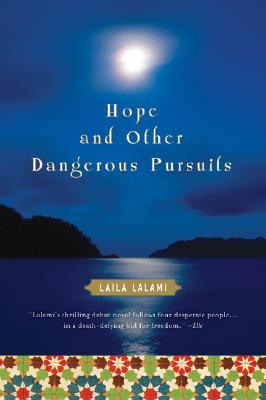
Laila Lalami, Hope and Other Dangerous Pursuits

The author of Hope and Other Dangerous Pursuits, Laila Lalami, is a long-time blogger at the site originally known as Moorish Girl. I have followed her writing there for some time and have been looking for the novel locally for a while; I was very pleased, therefore, to come across it on my recent expedition to The Strand.

It doesn’t seem entirely apt to say that I enjoyed reading Hope and Other Dangerous Pursuits. It’s elegantly written, spare but not unnecessarily elliptical, suggestive and yet surprisingly detailed for a novel that’s less than 200 pages. This artistic care (and it does, somehow, strike me as a careful book, by which I mean painstaking, not cautious) is dedicated to such a quietly harrowing account of hopes turned back and diminished, though, that pleasure seems an uncomfortably voyeuristic response.

Lalami explains on her website that the novel was inspired by stories she read about Moroccans attempting illegal crossings of the Strait of Gibraltar, hoping to begin a new life in Spain. The novel is artfully constructed, beginning with the crossing itself, introducing us to each of the four protagonists huddled with 25 other people in a 6-meter Zodiac. The pilot refuses to take them all the way to land; they are all tipped into the water and make their desperate way across the last stretch of water to the beach as best they can, only to face the unwelcoming realities that await them on shore. As we backtrack in the next part of the novel to learn how our four came to be in the boat, their watery struggle takes on retrospective symbolic significance: they have left home in the first place to avoid drowning of one kind or another. In tracing the very different lives of the four main characters up to the crossing and then picking them up again after the attempt, Lalami finds an effective formal device for conveying the variety and the human complexity of circumstances that drive people to such dangerously optimistic decisions. At the same time, in concentrating on just four stories she puts a human face on the pursuit too easily abstracted under terms like “illegal immigrants.” And though each of her stories is highly particular, both to the character she has imagined and to the social and historical context that is her focus, the hopes her people cherish–for opportunity, for freedom, for the dignity that comes with prosperity and independence–resonate because they are universal. Without belittling the families or the cultures they are choosing to leave behind, Lalami moves us to sympathize with her people because they look across the water and imagine something better. The saddest part of the novel, I thought, was its quiet concession to the elusiveness of that dream: hope is a dangerous pursuit, not just because of the risks of the pursuit itself, but because sometimes the chance you take brings you only further away from what you really wanted.

“The Story of an Eye”: Lynne Sharon Schwartz, Leaving Brooklyn

lsschwartz-210-exp-Leaving_brooklyLeaving Brooklyn is hands down my favourite reading of the summer, maybe even of the year so far. It’s also the only book I’ve read in a while that has sent me, immediately on finishing it, straight to the computer because I wanted to blog about it. Having said that, I realize that immediately after finishing a book is not necessarily the best time to write about it, as it allows no time for reflection. But Leaving Brooklyn excited the reader in me, and that’s a great feeling.

It’s an especially good feeling because I’ve been feeling a kind of mild, prickly annoyance at the whole conversation buzzing about the literary / lit-blogging / book-tweeting arena to do with men’s writing and women’s writing prompted by the fuss about Jonathan Franzen’s new novel. There was the shallow piece at the Atlantic, for instance, in which the writer realized he didn’t read books by women and set himself the noble project of “consciously trying to read at least one piece of fiction by a woman for every one I read by a man.” “This sounds stupid, I know,” he continues–yes, it does, because “fiction by a woman” is not a genre, and while it’s all very nice and inclusive to advocate reading “books outside of the reader’s direct experience as a way of understanding the world,” the very way the problem and its putative solution are framed here is impossibly reductive. Plus, of course, it’s impossible to imagine a woman reader seeking out a “piece of fiction by a man” as if that’s a coherent and potentially illuminating category–which of course proves the problem that men’s writing is more easily taken as universal, including by women–who have centuries of experience accommodating themselves, provisionally, to a more-or-less masculine point of view in order to enter into fictional worlds. I sympathize, though not entirely, with the reaction of Linda Holmes at NPR’s ‘Monkey See’ blog, who noted that the discussion would be improved by abandoning the term ‘chick lit,’ which is now far too casually flung around as if it embraces all “books that are understood to be aimed at women, written by women, and not important” (that “not important,” of course, is not Holmes’s view of books aimed at, written by, or about women). I’ve intemperately expressed my own impatience with what I take to be exemplary chick lit titles here a couple of times, and I’m not nearly as impressed with Jennifer Weiner as Holmes is, though I certainly consider Weiner’s books (including In Her Shoes) a big step up from, say, Confessions of a Shopaholic. But I do think that there’s something to the complaint that assumptions about literary significance still skew towards the masculine.

Anyway, I don’t want to set Leaving Brooklyn up as a case study in the gendering of literary standards, but it struck me so forceably as being a breathtakingly good novel that I am puzzled about why it’s not (to put it bluntly) more famous than it is. Why, just for instance, is The Catcher in the Rye a modern classic, and not this wonderfully pungent, self-reflective, intelligently emotional and erotic story? Now, to be fair, I’m not an expert on contemporary American fiction, and perhaps Leaving Brooklyn is considered precisely a modern classic. Or perhaps, as it was published only in 1989, it will grow into that status. Or perhaps it will shrink into the somewhat more marginal status hinted at by the odd qualifier in Russell Banks’s cover blurb: “The blend of lyricism and history, of memory and the imagination–all shot through with the female erotic–is wonderful,” he writes (my emphasis). Well, it is wonderful, and it is shot through with eroticism, sort of. But just as courses I teach with ‘Woman’ in the title consistently attract very few male students, how likely is it that this particular endorsement of the novel will be taken as indicating that it’s one of those books “aimed at women, written by women, and not important”?

But never mind all that, really, because the reason that whole discussion annoys me is precisely that it directs our attention to the writer and not the book. There’s a reason Charlotte Bronte and Marian Evans chose to publish under pseudonyms. Gender makes a difference, to be sure, but it’s when that difference becomes the measure that writers want to evade it.

Leaving Brooklyn is a novel that is intensely about a particular place and time: Brooklyn, obviously, in the post-war years. Street names, subway stops, card parties, news stories all evoke that era and the peculiar aura it has, especially for the protagonist, Audrey. “The air was suspended on a discrepancy,” she recalls:

something like the discrepancy between my mother’s use of the words ‘To thine own self be true’ and their true meaning. It was a presumption of state-of-nature innocence, an imaginative amnesia, and a disregard of evidence such as photographs of skeletal figures in striped pyjamas clawing at barbed wire, of mushroom clouds and skinned bodies groping in ashes.

The disjuncture between what is known and what is said is given oddly literal metaphoric form in the opposition between Audrey’s two eyes (“This is the story of an eye,” the novel enticingly, obliquely, begins, “and how it came into its own”)–one, her left, is perfect, but her right eye wanders, due (or so her mother believes) to an unspecified injury just after Audrey’s birth. So Audrey sees straight on, with perfect clarity, but also sees everything askew. She can see around corners, or so she feels; she can see through the discrepancies, the surfaces and half-truths. How is it possible–is it even desirable–to unite these perspectives? Not then, or at least not in Brooklyn, Audrey realizes. Brooklyn demands an end to wandering, as represented by the hard contact lens Audrey is prescribed to control the errant movements of her eye: “Conscientious parents pursued standardization as Calvinists performed good works,” she reflects. Difference was not to be borne but confronted.

But of course Audrey never does see as everyone else does. She learns to compensate for her lack of binary vision (just incidentally, so apparently did I, before an eye operation in my early childhood that repaired a problem with my depth perception): she navigates stairs and corridors, street crossings and subway stations, with precision and accuracy. She also learns to navigate the intangible complexities revealed by her intelligence and imagination, those qualities fed by her imperfect physical sight. She’s a reader and a thinker, sharp, unsentimental, feeling Brooklyn as a constricting force she must leave emotionally as well as literally. She can’t leave, of course, because Brooklyn is her past, part of her identity, who she was before she became who she is: “no matter how much I leave, it doesn’t leave me.”

Leaving Brooklyn is not just about leaving Brooklyn, though. It’s about, among other things, precisely that inextricable tie we have to our past and our early selves, but also about how we reconstruct that self, looking back and trying to recognize ourselves in the child we once were.  “I am confused about who I was,” she reflects:

why else would I need to tell this story about my eye? The confusion is that I seem to have grown up into someone who could not have been me as a child. Yet in the telling the girl grows to sound more and more like the woman I became. The voice overcomes her. The real girl with her layers concealing me becomes more elusive the more I tell. She has been superseded, but I am sure she existed. As I try to find her in me, I keep finding me in her.

At one point she feels the convergence of her selves:

She was me, at that moment. She already knew what I know. This is so startling to come upon that I have to stop and contemplate it. And her. Oh yes, I see myself plainly, right there, bearing the seeds of all I would come to know.

This is metafiction without pretense or flamboyance; Schwartz integrates crucial insights about the inevitable inauthenticity of memoir as a genre with the dramatic urgency of personal discovery.

It’s not accidental that this moment of identification occurs while Audrey is having sex with the Park Avenue eye doctor who prescribed the contact lens. Their affair is not, initially, revelatory to Audrey, but as its erotic possibilities unfold for her, her perception of the world around her becomes less bifurcated: her mind and her body begin to feel equally present to her, though what she sees in Brooklyn is that a woman “could choose the life of the mind or the life of the body, but she could not have both.” Though the doctor eventually expresses his somewhat pathetic (and certainly inappropriate) passion for her, he’s a catalyst for her development: he’s its occasion, not its object. The affair prompts her to see that there might be “another way to live,”

some free and unhampered way I could recover from those years before I stood waiting in the ration lines gripping my mother’s hand, before I began school and was assigned a place in the ranks.

It’s not desire that liberates her, not erotic freedom that she seeks. It’s not love, either–it’s the risk of “caving in” to the doctor’s love that scares her away, the risk of having to be true to him, or to them, rather than to herself. It’s something more like space–mental space, room to decide for herself, to identify herself. Walking through Manhattan after ending the affair, she experiments with an eye patch she has taken from the doctor’s office. But which should she cover, the good eye or the bad? She covers the left eye first, and the world becomes “a huge amorphous mass, its fine points and articulations lost in blur and darkness.” That’s not right: “I needed to find my life, not lose it.” Heading home from the subway, in Brooklyn again, she covers her right eye and “saw clearly the usual sights,” then switches it again. But that’s no real test, she thinks, as she knows the route “so well I could have walked it blindfold.” And yet as she goes along, everything around her indistinct, she is filled with “limitless buoyancy”:

It seemed I might leave the earth and sail up unimpeded, as the snow around me was sailing down, and float right over Brooklyn up to where the stars drifted. . . I didn’t want to float away, though; I was so enraptured that I wanted to remain here on earth, or maybe just a few inches above, and dance. Everything seemed perfect and right; the world, glistening and abundant, unfurled its rightness and perfection–how come I hadn’t noticed it before? Of course I would have everything I wanted, my life would be all I dreamed.

Her ecstasy is inexplicable: “it came from nothing that had happened to me today or ever, beyond circumstance, out of nowhere, a gift that wouldn’t last.” But what she feels is the spaciousness of human possibility, liberated momentarily from the specificities of history. Of course it can’t last, but at that moment she feels that her “entire past barely existed, could be rolled up into a mote in the eye and winked away.” Eventually her own life will begin, she thinks, and then “oh how freely I would float.” It’s the bad eye, the wandering eye, that sees her home that night, and with it she looks through and then past Brooklyn with the hopeful, naive, ambitious exaltation of youth. It’s an intensely personal but also profoundly commonplace experience, movingly represented in a book by a woman, about a woman, that I think deserves to be called “important.”
A Word to Canada: We are not dismayed.

Colleen of the always engaging blog Bookphilia is clearing out stock at her bookstore (side note: check out the website or, if you’re in Toronto, just show up, and you will find some great deals). In the process she came across a little gem which she sent along for my Daphne du Maurier collection. It’s called Come Wind, Come Weather; first published in Britain 1940, this collection of “true stories” is intended to “bring courage and strength” to the British in the face of impending invasion by the Germans. My copy is the Canadian edition. I haven’t read the stories yet, though their titles are perfectly enticing (“The Admiralty Regrets,” “A Nation’s Strength,” “Spitfire Megan” [that might have to be first], “Mrs. Hill and the Soldiers”…). But I have read the preface, “A Word to Canada,” which is–well, rather than describe it, I’ll just quote from it:

The book was published on the 15th of August, 1940, the famous date of threatened invasion when every man, woman, and child in the Kingdom stood waiting tense and expectant for the blow to fall. Since then we in this island have experienced the full horrors of war in the air. Many have faced death itself, others are homeless–parents without children, children without parents.

In spite of these things we are standing firm. We are not dismayed. The spirit of the British people is rising triumphant. The old lazy go-as-you-please, every-man-for-himself attitude is becoming a thing of the past, and out of this testing time of tribulation we shall arise, please God, worthy descendants of those ancestors of ours who first sailed the Seven Seas and laughed at danger.

You men and women of Canada are helping us in the European struggle. Many of your sons are with us now, showing great gallantry and courage in the face of danger, and their coming has strengthened even more, if it were possible, the link that binds our two countries together.

We believe that side by side with this war in Europe we are fighting another battle–the battle against human selfishness. We can only win the first if we are victorious in the second.

You people of Canada are fighting this battle too. We are allies in this war, just as we are allies in the war in Europe. Political differences, class struggle, financial wrangles, racial jealousies, these are all problems that must be solved before the new world can be born. Peace will not come nor unity be achieved among the nations of the world, unless we can first sow peace and unity ourselves. It is in the workshops, in the farms, in the factories, in the fields, and above all in the homes that you men and women of Canada can lay the foundation stone. You have inherited a splended past from your British and French ancestors; but you will bequeath a far greater future to your Canadian descendants, if you can hand down to them, side by side with equality and freedom, the new spirit of selflessness, cooperation, and goodwill.

There are so many odd things about this little period piece that I hardly know where to begin. For one thing, I have no idea if this call to selflessness is actually typical of the war-time rhetoric, but that’s not where I thought she was going when she started. It’s also really interesting how she places the responsibility for the Utopian future right in the domestic sphere. I’m curious to see how the “true stories” that follow reflect that idea. But certainly my favourite moment is the brilliantly understated remark “We are not dismayed.” Take that, Hitler!

Normal Programming will Resume…

I’ve just returned from my trip to New York for the launch of the Open Letters Monthly Anthology. It was a great night for everyone on the Open Letters team, I think, and once we recover from the festivities, we’ll all enter with renewed vigor into getting the September issue ready for its eager public. I also hope to be back to a more regular blogging routine. One important part of that will be getting back into the habit of more frequent but shorter posts. Starting a new teaching term will help with that, as I will suddenly be too busy with the hectic miscellany of lectures and tutorials and assignments and wiki projects to linger over other things. On the other hand, I will also look forward to blogging more once it becomes, again, more of a rarity to have time and attention for things I choose to read.

And speaking of choosing things to read, naturally a great highlight of my trip to New York was my visit to The Strand bookstore (sadly, I didn’t really have any time to browse at Housing Works, where we held our reading, but just knowing that its secret sub-basement exists will be spiritual nourishment for me). I didn’t have enough time to explore all the layers and recesses of The Strand either, but I did find a couple of titles I’ve had on my ‘most wanted’ list for a while, plus a couple of others that were just too enticing to pass up at those prices. Here’s my haul:

Laila Lalami, Hope and Other Dangerous Pursuits. I have followed Laila Lalami’s blog for some time and I’m really looking forward to reading her novel, which I hadn’t been able to find around here.

Lynne Sharon Schwartz, Leaving Brooklyn. I’ve mentioned Schwartz’s Disturbances in the Field as one of the ‘books of my life’; though sometimes when I really love a particular book I don’t necessarily even want to read others by the same author, in this case I’m keen–and I already like the first sentence: “This is the story of an eye, and how it came into its own.”

Penelope Lively, Family Album. Moon Tiger is another of those books I’ve loved for many years, though in this case I have followed up with several others by Lively–who has never disappointed me so far.

Anita Brookner, Strangers. They had a lot of titles by Brookner and I had a hard time choosing one. I’ve only read Hotel du Lac, which I really enjoyed. This is a very recent one. I admit: I chose it from the many options there partly because I liked the cover.

Shirley Hazzard, The Evening of the Holiday. I also picked up The Transit of Venus recently, so I guess I’m about to go on a very small scale Hazzard binge. So far the only one of hers I’ve read is The Great Fire. I loved the writing but didn’t love the book–this is not a common response for me. In fact, I think usually I would deny that the writing can be separated from ‘the book.’

Henry James, English Hours (introduction by Leon Edel). This was out on one of those $1 tables that line the outside of the store. The first sentences are, well, Jamesian: “There is a certain evening that I count as virtually a first impression–the end of a wet, black Sunday, twenty years ago, about the first of March. There had been an earlier vision, but it had turned to gray, like faded ink, and the occasion I speak of was a fresh beginning.” Now really: could you have resisted this book, for $1, if only to find out what the heck he is going on about in such lovely, nuanced, but oblique language?

Just as an aside, on my visit to The Strand, I happened to be wearing one of my favorite (and oldest) scarves: it’s kind of purple/green/black strips, with a bit of shimmery thread running through the weave. On my way in, the greeter (I don’t know his actual job, but he seemed to be saying ‘hello’ to everyone who came in) said “Hello. I like your scarf. It’s very distracting.” Distracting from what, I had to wonder?

These aren’t the only books I brought back with me, either. I have SD to thank for yet another two, The Art Book (which I only regret not having had in hand at MoMA, where as is actually quite predictable, I bumbled around quite a bit wondering where the actual art was hidden–though I did enjoy the Matisse exhibit) and a review copy, stories by Joe Meno. I’ve promised to write up at least one here at Novel Readings, so more about that eventually.

And at the Metropolitan Museum gift shop, there on the sale table, just as if they knew I was coming, I found this beautiful book on ‘Embroiderers, Knitters, Lacemakers, and Weavers in Art.’ I did come to regret its heft as I lugged it along while walking all the way back down through Central Park, but it promises hours of browsing pleasure, and perhaps some encouragement for the little needlework project mentioned in an earlier post–which I have begun.

But before I can finish any needlework, much less any blogging or other actual intellectual task, I have to recover from several days of poor sleep (sirens, car horns, and garbage trucks not being altogether lullabies to my small-town ears) and really early rising (note to me: it’s all very well to prefer early flights because “then you have the whole day ahead of you when you get there,” but you aren’t as young as you once were and it will cost you).

Open Letters Monthly Reading and Book Launch!

It’s almost here: the day you’ve all been waiting for!

Friday is the Open Letters Monthly Reading and Book Launch at the Housing Works Bookstore and Cafe. The line-up of readers (including Nathan Schneider, Lianne Habinek, Sam Starkweather, Jared White, Lisa Peet, Steve DonoghueJohn Cotter, and me!) reflects the  range in both styles and subjects that makes OLM such a great reading experience every month. Here’s hoping for good weather and a good turnout! I think that, for our part, we can promise you a good time.

Emsley, The Jane Austen Playgroup

I’m deep into a rather quixotic essay project and thus stalled in my other reading and writing, including blogging. But this is no loss to you, as I’m going to fill in the gap with a lovely little piece of writing by someone else. Here’s an excerpt from a charming children’s story called The Jane Austen Playgroup.

In February Laura and her mom invite us to their house for a Valentine’s party. We watch Mr. Darcy propose to Elizabeth in the Pride and Prejudice movie. Then we make valentines to give each other. My Mom says we’re wasting gold paper, the way the rich sisters Maria and Julia do in Mansfield Park. She likes it, though, when I give her a big valentine and a kiss. Zachary’s mom gives Sophie’s mom a pretty card that says, “I admire and love you, love, Mr. Darcy.” Sophie’s mom laughs and says “Thank you,” but she looks kind of sad.

Pending appropriate interest from a publisher, the story is available in full on the author’s website. The photos are placeholders until there’s a full set of artist’s illustrations, but I think they work very well.

Full disclosure: the author, Sarah Emsley, is a friend and former Ph.D. student of mine. I’d like to take some credit for this particular project but all I’ve contributed is my enthusiasm. Sarah has also written about Jane Austen for grownups, and she edited the Broadview edition of Edith Wharton’s  The Custom of the Country.

Recent Reading: Johnson, Mitchell, Sage, and Mitchell

Somehow that post title ends up sounding like a law firm! Its somewhat miscellaneous character matches my recent reading experiences well, though.

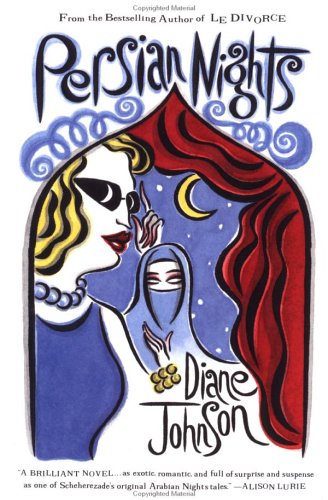
Diane Johnson’s Persian Nights is the first book on my blogging catch-up list. I picked it up on a recent trip to Doull’s because I’ve been spending a fair amount of reading time in Iran lately and also remembered having read Ahdaf Soueif’s review of Persian Nights in her collection Mezzaterra, so it just seemed like a good book for me to try. Soueif seems to have liked it better than I did: she found it ” a serious tale, a tale of altered perceptions and of moral responsibility.” I’m quite prepared to believe that she is a better reader of this book than I was, but I was disappointed precisly by the lack of seriousness and by the sideways, slightly satirical way it touched on issues of moral responsibility. The book clings closely to the point of view of Chloe Fowler, an American doctor’s wife who ends up spending alone what was meant to be ‘together’ time for them in Iran. I felt that her limitations became the novel’s limitations, that the opportunity for a complex narrative about cultural misunderstandings and crosspurposes was handled instead as a rather sour comedy of manners. I agree with Soueif that Persian Nights “is a story about the limits of change — and, finally, its impossibility,” but I would press a little on that, or add in that it is about the limits of change that are possible for someone like Chloe.

The first ‘Mitchell’ on the list is for David Mitchell: I’m reading Cloud Atlas. Notice that I say “reading”: it’s a work in progress. I was doing really well until “An Orison of Sonmi-451.” I’m not a science fiction reader, largely because I find the elaborate artifice of ‘world-making’ tedious, and while I accept intellectually that the genre at its best works as an indirect way of exploring themes or problems in our actual world (though of course I’m sure it doesn’t always, or have to, do this)–still, there’s a machinery to it that I don’t read well. Still, I persevered with Sommi 451 and eventually became adept enough at the futuristic dialect to feel a pulse of readerly excitement as it came to its (interim) conclusion. But then Mitchell hit me with “Sloosha’s Crossin’ an’ Ev’rythin’ After” and ground to a halt. Egad. It’s like reading “Caliban Upon Setebos” but for 100 pages. Still, the novel as a whole is clearly genius, and I know my expectations and reading habits are just being tested. I’m going to return to it and just read, even skim, if I have to, until I feel that pulse again, because I’m quite keen to return to all the other narratives, each of which caused a terrible hiccup of interrupted attention as I began it the first time–like grinding gears!–but each of which also had drawn me right in within a few pages. I enjoyed seeing the threads of connection gently laid down for us, too, and I’m pretty confident that the experience of following them back out of the labyrinth of stories will be quite thrilling. I just have to get past “Sloosha.”

‘Sage’ here is for Lorna Sage, whose memoir Bad Blood I’m also stalled in the middle of. I’m not sure why, except that the atmosphere of the book was depressing and I have been discovering, also, a strain of resistance in myself to memoirs as a genre.

And the second ‘Mitchell’ here is for Margaret Mitchell: I’ve just finished reading Gone with the Wind for (and I’m not making this up) the 32nd time. I know this exact number because GWTW was a favourite of mine in my misspent youth and I used to note each rereading on the inside cover (the copy I now have takes me from 23 to 32). I have many thoughts about how this book looks to me today–but I’m saving those for what I hope will become an essay for Open Letters on just that experience of rereading something in a different way, from a different time–almost, as a different person. I’m thinking of drawing (not too heavily, I hope) on Wayne Booth’s discussions of books as friends in The Company We Keep: An Ethics of Fiction. In this case, not to spoil the ending of my future essay or anything, I have to say that this friendship right now is under a lot of strain, but I think, despite myself,  its longevity may sustain it. Don’t we all, after all, have a friend (or a relative) we still love, warts and all, in spite of everything that’s wrong with them? We’ll see.

In the meantime, because clearly I don’t have enough unfinished projects on the go, I’m about to start work on this nice bookish sampler from Little House Needleworks. I’m going to try and sneak “George Eliot” in instead of “Wilder”–not that I didn’t read and love all the Little House books as a girl, but really, if it’s going to hang in my office when it’s finished, she just has to be there. There’s some nice lurking irony in this project, given how many of these writers felt about needlework! Canadian readers with a crafty tendency may want to know that I ordered my copy of the pattern from the Button & Needlework Boutique in Victoria. You Yankees are on your own.

Help Wanted: “novelists and poets published in the last sixty years”

In a comment on my ‘About’ page, Bruce Cooper makes the following request:

I have no academic qualification and, to a very large extent, have relied on the works of FR Leavis to guide my reading of poetry and fiction. The reliance has not, I believe, been without merit and I am indebted to him for my deep and ongoing enjoyment of English literature. But, sadly, I’ve had no such guidance for novelists and poets published in the last sixty years and my age (65), and the limited time I have to spend on this most cherished pursuit, press upon me to seek from those better informed a literary canon for the period as well as the names of good literary critics who might assist in finding, to some degree at least, what I’m looking for.

I’d be most grateful if you’d be willing to have a shot at this.

Bruce, I don’t consider myself to have deep expertise in recent poetry and fiction: my own primary field for teaching and research is Victorian literature. However, I do read outside that field, of course, and I also have had to get a lot smarter about more contemporary literature in order to teach our survey course in ‘British Literature After 1800.’ In that effort, I have found the Cambridge Companion series extraordinarily rich and helpful. There’s a volume on almost any subject you can think of, including, say, Contemporary Irish Poetry, Literature of World War II, Malcolm X, Modern British Women Playwrights, Twentieth-Century English Poetry, and Postmodernism.

I also spent some time with some general introductions to contemporary fiction, all of which I found clear and lively. One was the Blackwell Companion to The British and Irish Novel 1945-2000, edited by Brian Shaffer. In this volume, a range of experts address both general issues in the history and theory of the novel in this period and more than two dozen particular novelists from George Orwell to A. S. Byatt. Shaffer also has written a guide to Reading the Novel in English 1950-2000, also from Blackwell. And the essay collection Contemporary British Fiction, edited by Richard Lane, Rod Mengham, and Philip Tew, from Polity Press, also contains a lot of very interesting material.

I think it is possible to derive from these works (and from standard teaching texts such as the Norton Anthology) a pretty good sense of the ‘canon’ for this period, though just how long that list would become would depend on what, if any, limits you set. Even if you stick to “literature written in English,” setting aside work in translation, you’d have a lot to cover, taking into account works from many countries. The reading list for our Ph.D. comprehensive exams in modern British literature is several pages long, and we have separate exams for Canadian, American, and postcolonial literature–though to be sure, these lists are aimed at producing specialists, not well-informed general readers.

But let me throw this question open, as I know I have readers who are more knowledgeable than I about contemporary literature. Recommendations, anyone? How should Bruce proceed? What critical guides or voices would you recommend? Where would you look (or, for that matter, not look) for help in compiling a manageable reading list for novelists and poets published in the last sixty years?

P.S. I have thought of making a kind of regular ‘ask the professor’ feature here. I get questions all the time, from students but also from friends, family, and colleagues, from “Why do we call George Eliot ‘George Eliot’ when we don’t call Charlotte Bronte ‘Currer Bell’?” to “What would you recommend for my first attempt at reading Dickens?” or “What’s so great about Finnegan’s Wake if nobody can understand what it says?” I don’t always have a good answer, but I often know someone I can ask. Do you think that would be fun? What would you ask? What has someone asked you that you couldn’t answer? Maybe this could even be a bit of a column in Open Letters (“Open Questions”?), if there’s enough interest. (I should probably ask this general question in a more prominent place eventually, but this seemed a good time to at least air it in a preliminary way!)

August in Open Letters

The August issue of Open Letters is up and full of the usual wide range of readerly goodies. I’m especially pleased to call attention to my Valve colleague Amardeep Singh’s “The Original Wasn’t Better,” which presents arguments against the literary purist’s “fixation on ‘fidelity'” in film adaptations. I admit, I count myself among those for whom Mira Nair’s revised ending to Vanity Fair was “a step too far,” but Amardeep helps me think about my resistance to it, and about the general issues involved in adaptation, in a more complicated way. The issue also includes a complete “fitt” of Adam Golaski’s new translation of Sir Gawain and the Green Knight, Amelia Glaser on Peter Stein’s adaptation of Dostoevsky’s The Demons, Megan Kearns on veganism and ‘carnism,’ Max Ross on Alberto Manguel’s A Reader on Reading, Steve Donoghue on a new biography of Edward II, Garrett Handley on the Shakespeare authorship controversy, Ingrid Norton on Margaret Atwood’s Surfacing–and that’s not all. Come on over and see for yourself!