 I got back Monday afternoon from my long-anticipated trip to Birmingham for the British Association of Victorian Studies conference–and, of course, my stop-over in London for sightseeing and book shopping. I’m now in the midst of back-to-school preparations. Though I am feeling very glad that I did so much work for my fall courses before I left, inevitably there are still details to be finalized, and in fact it’s a good thing I didn’t quite finalize things like my syllabi, as for various reasons (such as the last-minute announcement from higher up that we are not renewing our contract with Turnitin.com for this year–ask me how good an idea I think that is…), a number of sections needed to be tweaked. So I ‘m doing that, and making plans for the actual classroom time on Friday and Monday, updating PowerPoint slides and lecture notes, and making sure I have things like sign-up sheets for presentations and attendance lists. It adds to the excitement that the printer in our main office is defunct: as Dalhousie does not provide individual faculty members with printers (or, more significant these days, with ink cartridges, which typically cost more to replace than the whole darned machine), I rely on the office printer for my course materials, reference letters, and so on, so this is pretty inconvenient. The workaround in place is our new copier, which is “networked” so that we can send documents to it straight from our offices–except that the networking is itself a work in progress, to be completed by the end of September, and my computer remains out of the loop. So there are various extra steps involved any time I want a document sharp enough to copy. I know, you’re all fascinated by this trivia about the glamorous life of the professoriate! Anyway, bit by bit the pieces are falling into place, the handouts into the folders, the notes into order, the graphics into position.
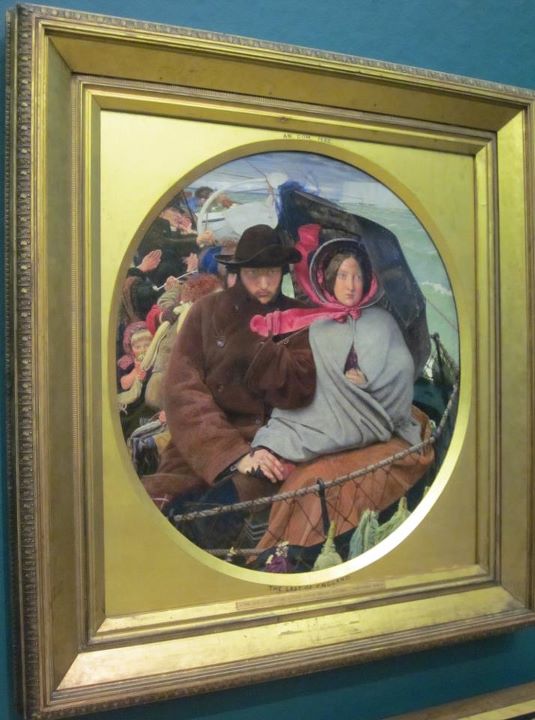
As for BAVS, I feel good about the experience. It was a big conference, with five parallel sessions running in most time slots and thus there was a lot of competition for everyone’s attention. In my own case, I find that my capacity to listen to specialized academic papers is somewhat limited at the best of times, and so I rationed out my attention a bit stingily, not attempting to attend a panel in every time slot but rather taking one break to go into downtown Birmingham to explore the Birmingham Museums and Art Gallery (which was wonderful, and topical, too, since it houses a terrific collection of Pre-Raphaelite art), and another to go across the street from the main conference site to the Barber Institute of Fine Arts (also wonderful, a real gem, as Ann promised when we met for our very pleasant dinner the night before the conference). The genre of the academic conference paper is, in my view, a somewhat problematic one. Typically, papers are highly specialized, and they are also usually very tightly crafted, polished to a high degree of rhetorical sophistication. As a result, I find it isn’t easy to engage with them, to see how to get into a conversation with (or about) them. If your own research isn’t highly proximate, it’s unlikely you know enough to get into the details, and if you’re interested anyway, you may feel kept at a distance by the effect of closure such a paper generates. I guess I wish conference papers were more like blog posts: preliminary or open-ended (or open-minded) enough that you feel invited into a conversation rather than impressed by a performance. That said, I heard some interesting papers, good things of their kind: they told me things I didn’t know or addressed questions I hadn’t thought of. A highlight for me was Colin Cruise’s plenary on ‘Arranging meanings: Pre-Raphaelite compositions and narratives,’ not only because it was intrinsically interesting and well presented, but because I had only just seen, in the BMAG, many of the paintings he focused on.
I think my own presentation went well. Our panel on ‘knowledge dissemination in Canada’ offered snapshots of three quite different projects, one the well-established Disraeli Project based at Queen’s University, presented by its director, Michel Pharand; another the Affect Project, a large-scale interdisciplinary endeavor recently launched at the University of Manitoba under the leadership of my good friend Arlene Young; and the other my adventures as an academic who blogs. We had a reasonable audience, considering the number of alternatives they had (if I’d had the choice, I too might have been at the Carlyle panel!)–around 20 people, maybe? I’m terrible at estimating these things, especially when I’m buzzed from nerves, as I always am when speaking in public. My prezi worked fine, which was a relief, after all that time spent on it, and I was even able to do a little last minute tinkering and get in a snippet from the Guardian piece that went up just that morning in response to my earlier post about Leonard Cassuto’s dismissive attitude towards blogs. There was some pretty lively discussion after. I was not surprised that the first couple of questions were, let’s say, skeptical–one of them was prefaced with a hope that it wouldn’t sound “too adversarial.” I didn’t think so, but I did think it skipped past a number of the quite careful framing statements I had made in order to present a kind of extreme worst-case scenario the logic of which, to be honest, I didn’t completely grasp. The concern seemed to be that somehow if we started doing something besides the conventional, highly structured and hierarchical and gated forms of academic publishing, we were heading down the slippery slope to having all our research funding and graduate programs cut — because (and this part of the question, or response, I do remember quite clearly) “in that case why would we need to do research or train graduate students?” As one of my main points was that the non-academic writing I’d been doing was closely integrated with, or reliant on, expertise acquired through my own specialized research, I don’t think I did, myself, offer evidence that such research was irrelevant or beside the point beyond the gates of the traditional publishing models. In fact, to the contrary, I was trying to make the point that such research has more value outside those gates than we typically believe, or at least than we typically let it. As for training graduate students, well, as readers of my blog know, I have a lot of doubts about whether we should continue to train graduate students in quite the way we have been doing for the last several decades, and it was really in service to those concerns that I emphasized my own belief that we need to make a place for (and make the case for) the value of unconventional scholarly practices including blogging in the overall landscape of recognized academic activities.
It struck me, listening to the more dubious voices in the audience, not just that they gave some signs of the defensiveness people like Alex Reid have written about, but also that they tended to talk about “the system in which we are embedded” as if we have no agency in that system. Has Foucault made cowards of us all? Who makes up the academic system, after all, if not the people who embody it? To be sure, there are all kinds of people in that system, often people with administrative or executive powers, who show no appreciation for the academic humanities. But if we really believe we can change our profession for the better, surely we should advocate for those changes, and seek to explain them in the strongest and clearest and most aggressive ways, rather than condemn ourselves–and, more pressingly, those coming after us–to persisting in a system we believe is dysfunctional. It may also be that breaking open the current rigid paradigms of academic scholarship and publishing will help us make the case for the value of our work to those administrators by showing it to be less insular, to serve a broader public. This is part of the logic behind the support structure for the new Los Angeles Review of Books, as I understand it; Tom Lutz, the founding editor, noted in his powerful essay on the state of book reviewing that academics are able to contribute to “as part of our commitment to the dissemination of knowledge that is integral to that job.” In any case, the questions were not, really, “adversarial,” but curious and eager to consider the further implications of the fairly modest proposals I specifically made, and it seemed worthwhile to have stimulated that kind of discussion. I think it’s telling that quite a number of young scholars, mostly continuing Ph.D. students, came up to me later to express their interest in what I’d said. Maintaining the status quo is not, overall, in their interests, I think, and their eagerness to think about how else things might be done was energizing.
Unusually for me, the conference felt most useful as an opportunity to have these informal exchanges, and also to meet people I knew from blogs or Twitter or the long-standing VICTORIA listserv, or from reading their scholarship, to make the personal contact that moves conversations and relationships forward — networking! It was a real pleasure putting faces to names, especially Rosemary Mitchell, whom I have ‘known’ for many years (since we both wrote essays on 19th-century needlework and historiography and decided we would be not competitors but allies) but never met in person. David Skilton was there! I was able to tell him how useful I have found his book Anthony Trollope and His Contemporaries. And I met Regenia Gagnier, whose book Subjectivities was one of the first critical books I bought when I was a student at Cornell, and Lyn Pykett, whose work on sensation fiction I rely on, and I was able to reconnect with one of my very best former students, now completing her Ph.D. in the UK (hi, Emily!). I could wish there had been a bit more time for simply mingling, as we were either in sessions, standing in the crowded atrium eating the (very good) lunches provided, or seated at tables for dinner. Perhaps if I hadn’t been too tired from traveling to go to the pub …
Next up: some self-indulgent posts about my eagerly awaited visit to the London Review Bookshop and other bookish haunts.
 Novel Readings