“This extraordinary colloquy”: Sylvia Townsend Warner, Summer Will Show

warnerI picked up Summer Will Show on my trip to Boston a couple of years ago. It caught my eye then because not long before we had run a good essay on Sylvia Townsend Warner in Open Letters. I’ve read most of the books from that trip but until now, not Summer Will Show. I think I put it off because I was expecting (its being historical fiction and all) something both dense and intense, like A Place of Greater Safety, say, or The Children’s Book (though obviously it’s much shorter — which should have been a clue). I was prompted to get to it at long last by notice that Anne Fernald was giving a talk about it at the New York Public Library.

I wanted to attend the talk even before I read Summer Will Show, because I know Anne to be someone well worth listening to (see, for instance, her essays and reviews for Open Letters). Now that I’ve read the novel, I wish even more that I could have been there, because the novel seemed so strange to me that I could tell I needed some tips, some guidance about how it works, how it makes sense on its own terms. I actually enjoy that feeling of interpretive disorientation provided the book causing it feels interestingly confusing, not just blundering or messy. Vera Brittain’s The Dark Tide, for example, or anything I’ve read by Margaret Kennedy, would fall into that first category — and I wonder if it’s not coincidental that Summer Will Show is roughly contemporary with these novels and shares with them the property of being (for want of any other literary-historical label) “not modernist.” Not that I’m any kind of expert on reading modernism, but as far as I know there isn’t a handy set of terms or frameworks for making sense of the more miscellaneous fiction from the early decades of the 20th century. I read a number of very interesting books on topics like The Feminine Middlebrow Novel for the Somerville seminar, but Warner isn’t someone who came up — though her absence from my notes doesn’t mean that she isn’t actually mentioned in those sources, just that I wasn’t interested in her in that context. So even there I got no particular help. It may be best read along with other political fiction from the time (Orwell, maybe?), but I don’t know much about that context. All I can really offer, then, are some provisional first impressions.

My strongest initial impression is that Summer Will Show (again like The Dark Tide) is not an especially good novel, but that it’s bad in interesting ways. Duly acknowledging that “but is it any good?” is a fraught question, I’ll point out as weaknesses that neither of the main characters seemed quite three-dimensional to me: both were the literary equivalents of vivid but jerky puppets going through the motions of a story designed to lead to encounters and crises that, in their turn, were designed to bring about a conclusion more intellectual and ideological than human and dramatic. The story itself is at once simple and unexpected: aristocratic Sophia Willoughby travels to Paris in 1848 after the death of her children determined to find her straying husband and get pregnant again to make up for her loss; she finds him, as she intends, but instead of staking her claim, she falls in love with his theatrical Jewish mistress, Minna Lemuel, and as a result of their relationship is drawn into revolutionary fervor and ends up literally fighting on the barricades.

Sophia is a supremely unappealing character — not just at the start (when her haughty prejudices are at their most dominant and unrepentant) but throughout. What Minna ever sees in her was one of my major stumbling blocks, while what she sees in Minna was another: their relationship comes from nothing and is never explained or described in any way that really motivates it. There’s another of the problems I had with the novel: it is jumpy and episodic, skipping over transitions where exposition would have been welcome and then becoming fulsome in contexts where great detail seemed gratuitous and digressive.

And yet the section of the novel that I found most compelling could be seen as a digression: Minna is a storyteller by profession, and our (and Sophia’s) first introduction to her is her gripping account of surviving a pogrom in her childhood:

I was just coming across the yard from the outhouse, where I had gone to carry our goats their feed, when I heard footsteps, a man running and staggering along the frozen path. The running man was my father. He had torn off his mittens as though their weight would encumber him, I saw his red hands flapping against the dusky white of the snow. His mouth was open, he fetched his breath with groaning. He fell down on the icy track, and was up again, and came running on with his face bloodied. He did not see me where I stood motionless in the dusk of the yard, but ran past me and burst open the house door and staggered in. Before he had spoken I heard my mother cry out, a wild despairing cry that yet seemed to have a note of exultation in it, as though it were recognizing and embracing some terror long foreseen. I went in after him, very slowly and quietly, as though in this sweep of terror I must move as noiselessly as possible. He was leaning over the table, his hands clenching it, and trembling. He trembled, his back heaved up and down with his struggles for breath, with every gasp he groaned with the anguish of breathing. Mixed in with his groans were words. Always the same words. “They’re coming!” he said. “They’re coming!”

The breathless rhythm of the sentences, the vivid tactile details, the repetitions, all add to the combination of urgency and predictability that makes the story so chilling: this is a catastrophe that has been long expected, even as its coming is painfully, hopelessly sudden. “No need, at this last door, to cry that the Christians were coming,” Minna says of her own frantic attempts to notify their neighbors.

Summer Will Show earned my interest precisely because the writing is, generally, that good: I was captivated and impressed by Warner’s style even as the structure of the book frustrated me and the characterization disappointed. A book this well written can’t be simply careless, it isn’t inept: the awkwardness and the didacticism both felt purposeful. But what might that purpose be? According to the publicity notice, Anne’s talk focused on the novel as an exploration of “what might make a middle-aged person change her mind and her life–the very problem at the heart of politics. . . .what it might take to transform an imperious aristocratic wife into a communist.”  In that context, I can see that Minna’s storytelling is important, not just because it sets up her individual identity, but because it draws our attention to the importance of the stories we tell about our experiences and those of others: changing your mind means changing your story, perhaps accepting someone else’s or incorporating it to create a more complex, multi-faceted narrative. I thought Sophia’s conversion from conservative to radical was too abrupt, and too idiosyncratically motivated by her passion for Minna, to be much of a model, but maybe it’s not her initial move into Minna’s life that really counts so much as her transformation at the very end of the novel, when her own experience of violent confrontation and its bloody consequences prompts a much deeper change. Certainly her speech before the firing squad is utterly and convincingly unlike anything the Sophia of the first chapters could ever say — and the Sophia who reflects with such pride on her meeting with the Duke of Wellington as the novel begins hardly seems the same person who concludes the novel reading The Communist Manifesto.

But that’s where my dissatisfaction with the novel as a novel makes trouble for me again: the ending is a bit too pat. It felt as if the elements of the novel had been manipulated to ensure we ended up there, with the specter haunting Europe, rather than discovering the need for Marx as we read. Elizabeth Gaskell is a much more politically conservative thinker than Warner, but Mary Barton explains a lot more about socialism as a response to economic conditions than Summer Will Show — and no wonder, of course, since she was observing Manchester in the 1840s just as Engels was when he wrote The Condition of the Working Class in England.

Where Blogging Leads: A Bit More About How Things Add Up

When I read this post by Eric Grollman at Conditionally Accepted a little while back, it got me thinking about the various opportunities that have arisen for me since I started blogging in 2007. Whether these “extracurricular activities” (Grollman’s term — though he too puts it in scare-quotes) count in some strict professional way is not really the point, or at least not the whole point. Some day I may well make the case that they should count; increasingly the vocabulary seems to be available to explain how and why (outreach, knowledge mobilization or dissemination, public scholarship, whatever). In the meantime, what struck me reading Grollman’s post is that I may have underestimated the impact of blogging on my own activities. Grollman notes that he “received ten speaking/writing requests in 10 months, primarily because I write publicly about my experiences in academia.” That’s a lot, in a hurry! My timeline is a bit slower, and most of the specifics differ (as you’d expect, given our different fields), but one thing we have in common — and I know other bloggers who’ve remarked this too — is that by dint of being among the first and few academics in our circles to venture onto public platforms, that experience itself becomes something people want to hear from us about. (I always feel a bit odd about that, because my own blog is not exactly an “academic” blog — which is something I usually address, if not in the presentation itself, then in the Q&A. But the general issues around blogging for and by academics are things I have thought and written a lot about, nonetheless.)

Here’s my quick tally of things I have done more or less directly because of this blog:

Presentations, workshops, and interviews:

  • In 2007 (when I was just a newbie myself!) I gave a presentation on academic blogging in my department’s colloquium series.
  • In 2008, I was an invited guest speaker in a class on ‘Writing in the Digital Age’; I spoke about academic blogging and online writing more generally.
  • In 2009, I was interviewed about George Eliot by Nigel Beale, for his website The Bibliofile (now The Literary Tourist). (Gah! That picture!)
  • Also in 2009, while at ACCUTE to present a paper on Ahdaf Soueif (one that grew out of some blog posts about her novels), I led an informal workshop on academic blogging.
  • In 2011, I was invited to participate in a panel on “Knowledge Dissemination in Canada” at the British Association of Victorian Studies; that presentation became a paper in the Journal of Victorian Culture.
  • In 2012, I gave a presentation on academic blogging at our Faculty’s research retreat.
  • In 2012-13 and 2013-14 I spoke in our graduate students’ professionalization seminar about blogging (and Twitter). I expect (though I guess I don’t know for sure!) that I’ll be asked back again in 2014-15.
  • In 2013 I was interviewed for an article in the Globe and Mail about Richard III. (I don’t think the interview I did about Jane Austen had anything to do with blogging: as I recall, that was an occasion when the reporter just called the department and got handed off to me).
  • Later this month I will participate in a Twitter Q&A about Middlemarch hosted by the Atlantic‘s #1book140— I was invited to do this because of Middlemarch for Book Clubs, but that site is itself the result (you guessed it) of a blog post.

Writing:

  • In 2008, I was invited to become a regular contributor to the group blog The Valve.
  • In 2009, I was invited to contribute to Open Letters Monthly, and in 2010 I moved my blog there and signed my soul over to them became an editor there too.
  • In 2011, I was invited to contribute a short piece to John Williams’s blog The Second Pass (currently on hiatus as he now has a great gig working for the New York Times!)
  • Also in 2011, I was invited to write an essay on the Martin Beck books for the Los Angeles Review of Books (the immediate prompt for this was on Twitter, but the original impetus was – again — a blog post). Encouraged by this experience I have since pitched and published two more essays with them.
  • This year I was invited to contribute to the British Library’s Discovering Literature site, on the basis of my ‘public’ writing more generally — especially at OLM — but since everything that happens there is fruit of the Novel Readings tree, I count that too!

There have been many other more diffuse effects as well, of course, including courses developed from reading interests initially pursued here “only” out of curiosity and course assignments such as student blogs, wikis, and pecha kuchas that I would never have thought of if it weren’t for the time I spend online. And there are all the intangible intellectual benefits I referred to the last time I wrote about what this whole experiment adds up to. This tally overlaps with the list of specific publications on my c.v. (the ones that “don’t add up to anything,” you remember) but it’s a somewhat different angle on the whole question — I think it shows that in some ways my role as an academic has changed along with my work habits and publication platforms.

Rebecca Solnit, The Faraway Nearby

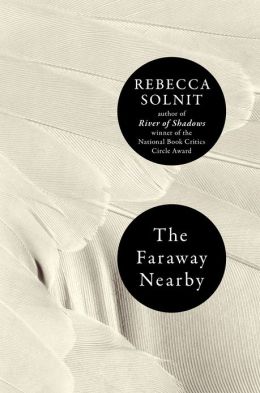
solnitI’ve been wanting to read The Faraway Nearby for myself ever since I helped edit the fine review of it that Victoria Olsen wrote for Open Letters. In her review, she describes it as “an experiment in digressive form” and also as a “book constructed as a spiral” — what could that really mean, I wondered when I first read her piece. I’m not usually attracted to books that are either particularly experimental or deliberately digressive, but Victoria’s review (itself written in an evocatively associative way) made The Faraway Nearby sound very appealing by emphasizing Solnit’s interest in the stories we tell and how they help us create or understand connections.

I went back to reread Victoria’s review after I finished The Faraway Nearby, and I have little to add to her analysis of its strengths and weaknesses, so if you want to know more about them, hop on over and read her first! I am perhaps a bit less impressed with Solnit’s actual writing than she is (and not just she but many reviewers — there are three full pages of blurbiage in my edition rhapsodizing about her “gorgeous” “graceful” “dazzling” “lush” “sumptuous” prose) — though this may be because her sentences, like the book itself, are meandering and exploratory rather than polished and purposeful, which, again, isn’t usually my thing. Reading them (and it), I wasn’t always sure where we were going, which is something I tolerate in my reading in direct proportion to my confidence in the writer’s overall control. Is Solnit always in control? I wasn’t convinced. Take this sentence, for instance: “Or rather writing is saying to the no one who may eventually be the reader those things one has no someone to whom to say them.” Is it just me or is that a mess?

But there were also lots of passages I liked a lot, such as the one about libraries I quoted from last time, and the other pages in its vicinity about reading: “a book is a heart that only beats in the chest of another” (though shouldn’t it be “beats only” instead of “only beats”?). Apricots, Iceland, Frankenstein, Arctic explorers, leprosy: as long as I could relax and just follow her where she went, I was almost always interested, even if I sometimes found myself pausing, perplexed, because I couldn’t remember the path we had traveled to arrive at our current location. In that respect the essayist she reminded me of the most was Woolf, except that in A Room of One’s Own (vivid in my reading memory right now because I just taught it) a specific argument is made emphatically at the beginning of the book and everything else is logically (though not linearly) in pursuit of it. Solnit’s governing ideas are themselves more fluid, and thus her stream-of-consciousness method ultimately diffuses rather than focuses our attention — or, at any rate, my attention. Prompted by her observations, experiences, and descriptions, my own mind often wandered off to my own life, or reading, or family, or travels, and I had to bring myself deliberately back. I don’t think Solnit would be dissatisfied with that, as if she has a thesis, it’s that stories move between us and link us, and shape our understanding, of ourselves and of others, in just that way.

Something I found myself wondering about a lot as I read The Faraway Nearby was where the authority comes from to write in this genre, whatever it is. It’s not exactly a memoir, though it might be right to call it “life writing” (I would actually have liked it if it were a more conventional autobiography, as I got very caught up in the more linear sections about her mother’s dementia and her own cancer). It’s not exactly travel writing, though sections of it are (she writes wonderfully about Iceland). It’s not philosophy, at least not in any way a professional philosopher would recognize, but its parts are woven together with writing I might call “philosophical” in the informal or colloquial use of that word: reflections on what things mean and what is important, not just for Solnit but in general.

Maybe The Faraway Nearby is a modern version of “sage” writing: it purports or aspires to offer us not just observation and personal experience but wisdom. Where does someone find the confidence — it’s really a kind of arrogance, isn’t it? — to offer general insights about life? I don’t mean that as a criticism, honest! It’s a genuine question about writing and voice and, again, authority. Here’s an example of the kind of meditative but also assertive passage that I’m thinking about:

The moment when mortality, ephemerality, uncertainty, suffering, or the possibility of change arrives can split a life in two. Facts and ideas we might have heard a thousand times assume a vivid, urgent, felt reality. We knew them then, but they matter now. They are like guests that suddenly speak up and make demands upon us; sometimes they appear as guides, sometimes they just wreck what came before or shove us out the door. We answer them, when we answer, with how we lead our lives. Sometimes what begins as bad news prompts the true path of a life, a disruptive visitor that might be thanked only later. Most of us don’t change until we have to, and crisis is often what obliges us to do so. Crises are often resolved only through a new identity and new purpose, whether it’s that of a nation or a single human being.

 The first thing I thought after I read that bit was “Chapter 42!” That’s my favorite chapter of Middlemarch; it includes Mr. Casaubon’s confrontation with the reality of his own mortality. It is “one of those rare moments of experience,” Eliot writes, “when we feel the truth of a commonplace,”

which is as different from what we call knowing it, as the vision of waters upon the earth is different from the delirious vision of the water which cannot be had to cool the burning tongue. When the commonplace ‘We must all die’ transforms itself suddenly into the acute consciousness ‘I must die — and soon,’ then death grapples us, and his fingers are cruel.

Maybe one of the reasons I did not find Solnit’s version of this idea especially compelling is that, knowing Eliot’s so well, Solnit’s proffered insight struck me as unoriginal. It’s also more abstract: it emerges from her recounting of the story of Che Guevara, but its idea is immediately diffused across other stories, while Eliot uses her appeal to our shared experience as a means of making us feel all the more intensely the mental agonies of Mr. Casaubon (which is, in turn, part of her larger agenda of training us in empathy, which is also one of Solnit’s intermittent interests). Both passages are overtly written, but Eliot’s metaphors are more concrete and surprising.

I don’t think I could necessarily make a convincing case, though, for why I read Eliot’s philosophizing as more profound or authoritative than Solnit’s. (I did have a much easier time with Solnit in this regard than I did with Cheryl Strayed, whose Tiny Beautiful Things annoyed me so much I couldn’t finish it.) Am I underestimating Solnit’s gravitas because of the comparative ease and looseness of her writing, which made it seem (mostly) artful but not truly deep? Or is there a genuine difference of quality, of substance, between her elegant reiteration of fairly commonplace ideas and Eliot’s sustained attempt to dramatize a system of ethics, a theory of history, a human place in nature? (I realize that’s not a particularly neutral way to put the question!) Solnit’s section on leprosy includes many fascinating and thought-provoking observations, but once she turns to using the disease as a metaphor, it becomes banal: “If numbness contracts the boundaries of the self, empathy expands it.” Why do I not feel the same dissatisfaction with the pier glass passage in Chapter 27? Is it just the accumulated deference and admiration of long acquaintance with its author that makes it so much more interesting to me? If I knew Solnit better — if I had been reading her longer — would I hear the same rich authority in her pronouncements?

That the passage I liked best in The Faraway Nearby is this one, not by Solnit herself but a quotation from Woolf, makes me think not:

 It is only by putting it into words that I make it whole. This wholeness means that it has lost its power to hurt me; it gives me, perhaps because by doing so I take away the pain, a great delight to put the severed parts together. Perhaps this is the strongest pleasure known to me. It is the rapture I get when in writing I seem to be discovering what belongs to what. . . . From this I reach what I might call a philosophy; at any rate it is a constant idea of mine; that behind the cotton wool is hidden a pattern; that we — I mean all human beings — are connected with this; that the whole world is a work of art; that we are parts of the work of art.

Compare this, from Solnit’s follow-up commentary: “Stories like yours and worse than yours are all around, and your suffering won’t mark you out as special, though your response to it might.” Isn’t that a letdown, even rhythmically? But it’s a lot to ask of a writer, that they withstand comparison to Eliot and Woolf.

Shhh! It’s (Still) A Library!

sp-coasterOne of my favorite souvenirs from my trip to Oxford a few years ago is a pair of coasters from the Bodleian Library that say “silence please.” I love these because they speak for me: so often I crave silence so that I can concentrate on my book. Reading, for me — at least serious reading, rapt, transcendent, lost-to-the-real-world reading, which is the best kind of all — takes concentration, and I know no greater threat to that concentration than intrusive noise. Especially since I had children, I feel as if it has been a constant struggle to find the kind of quiet conducive to that kind of reading. The polite Bodleian signage reassures me that I’m not anomalous: that others too value the silence that enables us to merge our consciousness with the words on the page.

central_02a

I was thinking about this recently because my husband and I attended a fundraising event for the new Halifax Central Library, currently under construction and expected to open its doors this fall. I am hugely excited about the new library, because I’m a huge believer in libraries as great civic spaces. A public library represents an idea that’s at the heart of democratic society: that the accumulated thinking of centuries is our greatest resource and should be freely available to everyone. A library’s specific commitment to reading as a source of both information and pleasure is a wonderful thing. Like so many families, mine made regular trips to our local library branch while I was growing up; it looks a little different now than it did, but it’s still in the same place, and walking into it on a visit home last summer I vividly recalled the feeling of liberation that came over me whenever I entered its doors as a child — there was a whole world in there, inside the covers of all those books, and my library card was my passport. I had free run of the collection: I don’t recall anyone, either parent or librarian, ever trying to steer me away from anything I was interested in because it was “too hard.” (I have struggled greatly with the emphasis in the schools here on “just right” reading — reading should be aspirational! I was incensed once while volunteering at a school book sale when a mother pulled her crying child away from a book, berating him about wanting something he couldn’t read on his own yet. “But he wants to read!” I wanted to yell at her. “Read it with him until he’s ready!”) I discovered many favorite authors in the stacks; some of my most cherished books today are library discards with the “VPL” stickers still on them. It was built after I’d moved away, but the Vancouver Central Library is a spectacular building that has long inspired me from a distance.

439565434_3f9ebc254c_z
Flickr photo by Dustin Quasar

I’m reading Rebecca Solnit’s The Faraway Nearby right now and while I have some issues with the book overall, I really appreciated what she says about libraries:

Libraries are sanctuaries from the world and command centers onto it: here in quiet rooms are the lives of Crazy Horse and Aung San Suu Kyi, the Hundred Years’ War and the Opium Wars and the Dirty War, the ideas of Simone Weil and Lao-tzu, information on building your sailboat or dissolving your marriage, fictional worlds and books to equip the reader to reenter the real world. They are, ideally, places where nothing happens and where everything that has happened is stored up to be remembered and relived, the place where the world is folded up into boxes of paper. Every book is a door that opens onto another world, which might be the magic that all those children’s books were alluding to, and a library is a Milky Way of worlds. All readers are Wu Daozi; all imaginative, engrossing books are landscapes into which readers vanish.

“Here in quiet rooms”: for her too, quiet is part of reading. The temporary hushing of everything going on around us is what lets us pass through into that other landscape and really see and think about what we find there. So why does it seem to have become such a bad thing to imagine a library governed by a polite request for “silence please”? Over and over at the fundraising presentations, speakers spoke with disdain of the old-fashioned notion of librarians shushing patrons and celebrated the library as a place for what sometimes seemed like every activity besides actually reading to yourself. “It’s not just about books anymore” seemed to be the go-to argument for why we should enthusiastically support the library’s fundraising campaign — even though (interestingly) they also emphasized that they are raising money now “for the collection.”

I should be clear that I think the social and educational functions of libraries — children’s activities, teen hangouts, workshops and meeting groups of all kinds, performances, lecture series — are also wonderful things integral to the library’s mission as a place to nurture and support its community. But after a while I started wondering where, among the atriums and coffee shops and recording studios and play areas, a person is supposed to go who wants the traditional hush of a place suited to actually reading books. I’ve been looking again at the plans and it turns out that the fourth floor does have designated areas for “quiet reading and study.” As far as I can tell, though, they are still very wide open, and I wonder how much ambient noise will travel up from below — and whether anybody will respect or enforce the suggestion that here, at least, shushing might be in order. It’s already such a noisy world everywhere else! I even recently left a local bookstore in a huff because the annoying pop music they were playing distracted me from browsing the shelves: the words to the songs came between me and the words on the page. If I had the kind of money that makes this kind of thing possible, I think that I would have offered to fund a real “reading room” somewhere in the new library building: comfortable chairs, good lighting, no wi-fi, a door that closes (quietly, without slamming!), and a sign on it courtesy of the Bodleian.

silence_please_sign_black

What do you think: am I just a curmudgeon? Do you like quiet when you read? When you use the library, do you resent or appreciate attempts to keep it a place suitable for quiet contemplation and deep concentration? If you’re a librarian, how do you deal with the competing expectations that the library serve both social and silent purposes?

“And neither was content”: George Gissing, The Odd Women

gissingI suggested Gissing’s The Odd Women to my book club as our follow-up to The Murderess: though the two novels are drastically dissimilar in style and setting, they are fairly near chronologically and, more to the point for my book club, extremely close in the problem they address: the hazards of being a “redundant” woman in a society that sees unmarried women as either aberrant or burdensome. “But I ask you, do there really have to be so many daughters?” asks Papadiamantis’s anti-heroine Hadoula — and the same question launches The Odd Women, where in the first chapter we meet Dr. Madden and his six daughters: Alice, Virginia, Gertrude, Martha, Isabel, and Monica. Dr. Madden has the best intentions for his girls, but when he dies suddenly and uninsured, they are thrown into a world for which they are woefully unprepared: “it never occured to Dr. Madden that his daughters would do well to study with a professional object.”

By the second chapter, Gissing has — with Hadoula’s ruthlessness — killed off three of the sisters. But there are still too many for the doctor’s small legacy to support, and the work the remaining ones can find is grueling and poorly compensated. Alice and Virginia look to younger, prettier Monica to fulfill what they still believe is a woman’s real destiny: “Thank heaven, she was sure to marry!” Monica, worn out from long hours in a draper’s shop, has much the same ambition for herself, though the men she meets in the ordinary course of things are hardly good economic prospects. When she makes the acquaintance of Mr. Widdowson on one of her afternoons off — “an oldish man, with grizzled whiskers and rather a stern visage,” but well-dressed, with a gold watch and other signs of prosperity — he seems like a solution to her (and her sisters’) problems.

One of Gissing’s central concerns in The Odd Women is precisely the way financial exigencies like the Maddens’ lead to moral compromise because women had so few ways to support themselves. The uncomfortable proximity of a “good marriage” to prostitution is a theme often touched on in Victorian fiction (think of the narrator in Vanity Fair, for instance, reflecting on poor Rose Crawley, who sold her heart “to become Sir Pitt Crawley’s wife”: “Mothers and daughters are making the same bargain every day in Vanity Fair”). That a woman would invest her beauty for a good financial return might shock in a novel like Lady Audley’s Secret, but it was easier to gloss over or defend when other “career” options for women (at least for middle-class women, which is where most novels focus their attention) were both rare and not obviously necessary (except for their intrinsic satisfactions, of course, but that’s rarely the point). The context is different in The Odd Women, though, and so too are the arguments. The novel directly confronts a widely-discussed statistical imbalance between men and women addressed in other works such as W. R. Greg’s essay “Why  Women Are Redundant,” and it proposes a more radical solution than Greg’s preference, emigration: independence!

oddwomen

In counterpoint to the faltering Maddens — raised to fulfill an ideal of womanhood that is repeatedly shown up as both outdated and unnatural — Gissing gives us two feminist activists, Mary Barfoot and Rhoda Nunn, who run a training program that prepares girls for office work. Both are single, and Rhoda in particular has set herself against marriage: “I maintain that the vast majority of women lead a vain and miserable life just because they do marry,” she replies when Mary proposes that marriage remains a better alternative than some more degrading ones. She disdains “the sexual instinct”: “women imagine themselves noble and glorious when they are most near the animals.” Rhoda prides herself on the stringency of her principles, though Mary cautions her that “the ideal we set up must be human.” Cue Mary’s dashing cousin Everard, who finds himself increasingly fascinated, first by Rhoda’s mind (“His concern with her was purely intellectual; she had no sensual attraction for him”) — but then with everything she represents (“Rhoda might well represent the desire of a mature man, strengthened by modern culture and with his senses fairly subordinate to reason”). As his interest in her grows into passion and a desire to see her “yield herself,” Rhoda also becomes caught up in feelings that greatly confuse her and test her commitment to living up to her surname.

It takes Gissing a while to get all his pieces on the board and into position, but the game that plays out after that is fast-moving, dramatic, and consistently surprising. Hardly anything turns out quite as you expect, from Monica’s disintegrating marriage to Widdowson (another highly suggestive surname!)  to Rhoda and Everard’s “romance” (which, trust me, deserves the scare-quotes). The plot twists that bring about the final crises are precisely those of a farce or comedy of errors, but they are anything but funny. And though there’s not one main character that is easy to like or admire wholeheartedly, even the worst characters are hard to blame for their failings, which arise from expectations ingrained in them from early on — poor Widdowson, for instance, who is driven to Othello-like rage and violence because he really believes Ruskin’s “Of Queens’ Gardens” is a good guide to women’s roles. Ironies abound: for example, that Monica’s brief exposure to Rhoda and Mary’s ideas (which at the time she disdains in favor of Widdowson’s proposal and her idea that marriage is the easy way to a comfortable life) turns out to have planted seeds that take root and grow into theories of and demands for equality once she experiences the oppressive subordination of actual marriage to him. There are no easy solutions to any of the problems Gissing highlights: though some new standard for relations between the sexes seems urgently needed, one that acknowledges women’s right to “live a life of her own” (as Monica comes to advocate), nobody in the novel seems to know what it could be, or to be ready for it. The most rapturous love scenes leave the partners discontented; desire clouds judgment; new compromises emerge that seem no more satisfactory than the old ones.

I’ve assigned The Odd Women several times, usually in the upper-level seminar I offer on “The Victorian ‘Woman Question.'” It has been a few years since I offered that class, though, and thus since I read it through. I remembered its plot very clearly, along with the ways I’ve come to read its central themes, but I had forgotten how emotionally intense it is and also how strange it feels, because it refuses to sort anything out nicely for us. Even Jude the Obscure at least gives us the cathartic satisfactions of tragedy, but the griefs of The Odd Women are more sordid. It’s possible (we debated this last night) that Rhoda’s story has elements of triumph in it, but at the very least they are equivocal. I don’t consider Gissing much of a prose stylist, but another thing we discussed last night is how specific he is, especially about money, or its lack, and the difference this makes: as one of my friends observed, The Odd Women has a lot in common with Pride and Prejudice, including this economic preoccupation and its focus on the precarity of women’s lives absent good matrimonial prospects — The Odd Women is what Pride and Prejudice would be if Mr. Bennet died before Bingley ever came to Netherfield. Suddenly Mr. Collins doesn’t look so silly, just as Mr. Widdowson looks pretty good when you’ve been standing for 18 hours at a shop counter.

Another aspect of The Odd Women that we discussed was the confusion around men’s roles as well as women’s in it. Our interest in the ways its men were sometimes “womanly” and its women “manly” led us, eventually, to choose Woolf’s Orlando as our next book. The only part of that novel I know well is the wonderful riff on the arrival of the 19th century:

The damp struck within. Men felt the chill in their hearts; the damp in their minds. In a desperate effort to snuggle their feelings into some sort of warmth one subterfuge was tried after another. Love, birth, and death were all swaddled in a variety of fine phrases. The sexes drew further and further apart. No open conversation was tolerated. Evasions and concealments were sedulously practised on both sides. And just as the ivy and the evergreen rioted in the damp earth outside, so did the same fertility show itself within. The life of the average woman was a succession of childbirths. She married at nineteen and had fifteen or eighteen children by the time she was thirty; for twins abounded. Thus the British Empire came into existence; and thus — for there is no stopping damp; it gets into the inkpot as it gets into the woodwork — sentences swelled, adjectives multiplied, lyrics became epics, and little trifles that had been essays a column long were now encyclopaedias in ten or twenty volumes.

When I read the whole novel, years ago, I think I was not ready for Woolf in general, or for it in particular. I’m looking forward to giving it another go. I’m also looking forward to working through The Odd Women again in the fall, as I’ve assigned it for the Victorian fiction class.

Summer Plans: Adding Things Up

Finally, the winter term is well and truly concluded (our annual May Marks Meeting was yesterday). As my last few posts show, I wallowed in aimless reading for a while after classes ended (aimless in the sense of “not in service of anything else,” not pointless or useless: it was certainly a very interesting run of books!), and then this past week my parents have been visiting, so I’ve been spending less time on social media and more time being sociable in person. (I had written “actually being sociable” but then realized how much that would misrepresent how I feel about my time online and the relationships I’ve formed here, which are just as “actual” to me as any of my “F2F” ones!)

And now it’s time for another end of term ritual, which is sorting out what I hope to accomplish in the next couple of months, while the fall term is still remote enough not to demand any attention beyond monitoring my waiting lists. I have mixed feelings as I look back at last year’s post about this. I did get the Middlemarch for Book Clubs site completed, but I haven’t really figured out how to get the word out about it. I’ve made some tentative efforts on my own, and I had some dim but disappointed hopes about possible synergies with the Middlemarch readalong at The Toastbut the biggest boost has certainly come courtesy of the generous mention of it by the Atlantic’1book140 Twitter book clubThis month I’ve also been invited to participate in a Twitter “party,” so if you’re on Twitter, feel free to join in! I’ll post a notice here when I know the details. I may make some changes to the site this summer based on my observation of what actual book clubs talk about when they talk about Middlemarch, though I remain determined that the site will reflect the kind of conversations I like best and want to promote, not the more solipsistic kind that still seem to be typical of the guides included with new releases.

This time last year I also had aspirations to get a lot done on my phantom book project: “the final, most ambitious but at this point most amorphous plan is to think about where I’m going with the various George Eliot essays I’ve written over the past few years: do they, could they, add up to something larger, perhaps some kind of cross-over book project?” That question of what my “various” publications add up to has been fraught to me since a dispiriting interview last year at work about my prospects for promotion. Now, I knew perfectly well that if I chose to apply, mine would be (will be) a tricky case, and I wasn’t at all sure that I was in a position to make a strong application, which is why I set up the meeting in the first place. (Getting promoted to full professor is not a high priority for me anyway: if it were, I would be doing different kinds of things with my time, for just this reason!) But as my list of non-traditional publications and projects grew, it seemed like it was worth having a chat about how my c.v. looked to someone who would have to make a supporting case if I did apply … and the response (to put it mildly) was dismissive: “All this [with a wave of the hand towards the Open Letters and LA Review of Books essays] doesn’t really add up to anything.” There are ways and ways to deliver negative judgments, of course, and that one could have been made in a less deflating way. It might have been worth considering the possibility that they do add up to something (knowledge dissemination, anyone?), if not the usual thing. Still, that was a good preview of the challenges I would face if I chose to pursue promotion without a c.v. that looks more like what academics expect. If there were a book there, however — even a different kind of book … well, academics really like books.

Now, the book I aspire to write is not an academic book. And the reason I want to write it is not that it might help me get promoted. But the observation that my work wasn’t adding up to much is the kind of thing that mattered anyway because it made me think about what I hoped “all this” would add up to, or, indeed, whether I thought it already did add up to something. A body of work is a cumulative something, isn’t it? So there’s that, which isn’t nothing. And yet it isn’t a whole lot, compared to some (as bodies of work go, mine is petite, we might say!) and it’s not as if I’ve established myself in the non-academic world in some marked way. Indeed, the challenge of making yourself known in the broader book world is pretty overwhelming!

It would be nice if I was learning from the process, though, as if the small steps I have taken so far were building up to some kind of greater insight, if not some separate and larger-scale accomplishment. Who am I, as a critic? What can I do? That’s the kind of question that my book project will help me answer, for myself if for no one else. I did not get as far on it last summer as I hoped, but I did do some ground-clearing work, including a survey of everything I’d written so far on George Eliot and a stop-overthinking-it post on why I like George Eliot “so very much.” I got caught up in smaller writing projects over the fall and spring, but one of those was my review of Rebecca Mead’s My Life in Middlemarch, so that kept me thinking about how to write about George Eliot for a broad audience. I have also started several files and documents to help me conceptualize the project. It helps me to believe it will all actually come to something that last summer I began talking informally with an agent interested in helping me get it done; this summer I am determined to ward off the distraction and temptation of other reviews and essays (for instance, I was really thinking about pitching a Robert B. Parker piece to the LA Review of Books to follow on from last year’s Dick Francis essay! that would be so fun to do!) and start turning the brainstorming into actual readable writing.

In the last couple of weeks, and especially the last couple of days, I have just begun doing this…and here’s an interesting thing I’ve noticed. I have already looked up several old blog posts of mine to draw on ideas or references in them that bear on the critical framework I am trying to set up. Yes, the ones explicitly on George Eliot are among them, but so too are some of the ones I’ve written about principles of criticism more generally (such as, just today, this one on Ronan McDonald’s The Death of the Critic,). Will this material end up in the final version of whatever it is that I’m writing? I don’t know. But it was encouraging to realize that my previous work (unofficial and informal as it may seem in some contexts) was relevant and helpful: ideas I’ve been working out here, both explicitly and implicitly, are shaping the way I am now thinking and writing. The critical voice I’ve been practicing, too, here and at OLM and LARB, is the one I want to write the book in — not the much dryer, drearier tone of even my most recent academic papers. This scattered work may not add up to a single thing that’s tangible or measurable, then, but it may do that eventually, and in the meantime what it adds up to is, quite simply, the intellectual sum of all of its parts. Looked at that way, it seems like quite a lot.

“Glassy Malignity”: Alan Hollinghurst, The Line of Beauty

hollinghurstThe Line of Beauty joins an illustrious line of novels I’ve read that I admire but am unable to like. It makes me feel better about saying this that I’ve recently been reminded of Henry James’s admission, in “The Art of Fiction,” that “nothing … will ever take the place of the good old fashion of ‘liking’ a work of art or not liking it; the more improved criticism will not abolish that primitive, that ultimate, test.” Like him, I accept that ‘liking’ is a primitive form of criticism (hence the need for appreciation, which at least begins to substitute rigor and objectivity for impressions and idiosyncrasy) but believe we can’t and shouldn’t expect to do without it. A lot of the best literary conversations, in my experience at least, begin there — though they never end there.

It is useful that I can lean a little on James here. For one thing, James’s The Golden Bowl is at the top of the list of novels I’ve read with admiration but no pleasure (along with Madame Bovary and Edward St. Aubyn’s Patrick Melrose novels — oh, and I mustn’t forget The Good Soldier — I told you it was an illustrious group!). It’s nice to know that James accepts, in principle at least, that some readers will not like his novels. Further, The Line of Beauty is a kind of explicit homage to James — or, perhaps more accurately, an invocation. Its protagonist, Nick Guest, who is repeatedly identified as an “aesthete,” is himself an admirer of the Master, a post-graduate student at work on a thesis about style in the English novel (for which James, of course, is a central case study), and eventually a collaborator in a mostly-pretend project to produce a film adaptation of James’s The Spoils of Poynton.  You can hardly turn a page of the novel, or turn around in the world of the novel, without bumping up against James somewhere.

I understand that for some readers that would be a cause for celebration, not complaint. The annoyed claustrophobia I experienced while reading The Line of Beauty vividly reminded me of the intense months I spent with The Golden Bowl as I worked on my essay critiquing Martha Nussbaum’s fixation on it in Love’s Knowledge. In particular, I recalled an essay by Robert Reilla on “Henry James and the Morality of Fiction” which sums up the adulatory smugness evident in the nickname ‘the Master’:

For the Jamesian, the work of James is really above and beyond most other fiction; it is a high palace of art which he enters with genuine reverence, by virtue of those qualities which James himself required of the ideal critic—perception at the pitch of passion, insight that is only once removed from the original creative act.  In James’s work the Jamesian perceives the quintessence of conscious art; he learns to delight in the process of total artistic consciousness presenting, or projecting, vessels of consciousness nearly as full as its own. . . For the Jamesian, only James is really satisfactory—other fiction seems fumbling and accidental, or easy and obvious, or simply gross.  The Jamesian nearly always speaks from heights; it is impossible for him not to judge by Jamesian standards, because in order to become a Jamesian he has had to ascend to these standards.

For people who like this kind of thingThe Line of Beauty is unquestionably the kind of thing they like: there’s nothing fumbling or accidental here! The Line of Beauty is as elegantly designed and impeccably stylish as a novel about selfish, greedy, superficial people could possibly be. But as Nick thinks about the gorgeous luxury magazine he has edited (named, with perfect self-referentiality, Ogee), “its splendour had a glint to it, a glassy malignity. No,” he goes on, “it was very good. It was lustrous. The lustre was perfected and intense — it was the shine of marble and polish.” It is, in other words, beautiful, but dubiously worthwhile — the magazine, that is. I am not so sure about the novel. Is it possible to lavish such well-crafted sentences on a  morally compromised world without glamorizing it? The novel is a satire on the moral and emotional hollowness brought on by the thoughtless pursuit of wealth, power, and gratification, but does its self-consciousness mean that it offers or embodies any kind of alternative? Does it achieve what the magazine — with its full-page ads from Bulgari and BMW —  does not? Asked about The Spoils of Poynton, Nick explains,

It’s about someone who loves things more than people. And who ends up with nothing, of course. I know it’s bleak, but then I think it’s probably a very bleak book, even though it’s essentially a comedy.

That is also a pretty good description of The Line of Beauty, but does its presence turn the novel into metafiction? I didn’t think that Nick was sufficiently detached from the life he lives with his wealthy friends (for all that they see him as the outsider, the aesthete) to stand as a critique or to add the missing dimension — call it love, or perhaps humanity. Its absence is felt, and sometimes poignantly conveyed, by the characters, but nothing in the novel fills that space. A vacuum remains where another novelist would have put the contrasting elements, the story that looks beyond the way we live now to the way we could, or should, live tomorrow.

A novel in that spirit, however, or with that form, might not be Jamesian enough for Hollinghurst. It might, for instance, be called Our Mutual Friend. I would  like it better — but as James also reminds us, ““the house of fiction has not one window, but a million.”

Broken Heart of Darkness: Hilary Mantel, A Change of Climate

mantelclimateA Change of Climate is an odd book. I didn’t love it, perhaps because I didn’t know quite what to make of it. It reminded me a lot of Joanna Trollope’s earlier novels — the “aga saga” ones, like A Village Affairor Marrying the Mistress. It has a small cast of intertwined characters, all more or less eccentric, all more or less needy or damaged or just muddling along. The plot is essentially a family drama, its focus on the ebb and flow of people’s feelings (love, resentment, antagonism, yearning). But the resemblance is only superficial: though Trollope’s novels are not necessarily comfortable or reassuring, Mantel’s is built around a core of trauma so devastating that Ralph and Anna, the main characters, barely name it. The particular event takes place long before the novel’s present and far from its present location. Mantel explains it (naturally) better than I ever could:

…they’ve buried their experience, which they can do because it is something that happened in Africa, a place which, to their friends in England, is in any case the realms of the inexplicable. Africa becomes a metaphor for what we do not explore; in the novel it’s no longer a solid place that one can travel to, but somewhere consigned to the subconscious.

It’s a tricky game, turning the cliché of how Africa has so often been imagined (as the Other, as the heart of darkness) against itself like that. For a while, reading the novel, I thought Mantel had, unwittingly, fallen into the trap — but even her characters are self-conscious about it. When they get home, that’s one reason they try not to talk about their experience: “if we tell them what we think has happened, we will pander to their filthy prejudices, we will seem to traduce a whole nation: savages, they will say.”

Perhaps one lesson might be that they ought not to have gone, taking their naïve will to do good, their pragmatic but inevitably ignorant and intrusive mission to help, to a country they cannot understand or belong to. Perhaps they should just have stayed home. But to see their suffering simply as a punishment for colonial presumption would be reductive. They do help, for one thing. And one of the layers of the novel is an inquiry into the value of doing good. The catastrophe comes upon them because they opened the door to it: “I decided to do a good action, and by it my life has been split open and destroyed.” Is it really better not to do what you think is good, though? “In choosing evil,” thinks Ralph, puzzling over the meaning and the implications of free will,

we collude with the principle of decay, we become mere vehicles of chaos, we become subject to the laws of a universe which tends back towards dissolution, the universe the devil owns. In choosing to do good we show we have free will, that we are God-designed creatures who stand against all such laws.

So I will be good, Ralph thought. That is all I have to do.

Yet in doing so, he lets in evil — or, as he comes to think, “malign chance.” The result is a horror, and then a hollow at the center of their moral and emotional lives. What do you do, after that? How do you live? Ralph and Anna raise a family and continue doing good, opening the door to every “sad case” that comes their way, but there’s no foundation for the new life they build, and so it is much more fragile, its misadventures more frightening, than either the village setting or the specific plot would lead you to expect. But to what end? What does it all mean? In the interview notes with Mantel at the end, she talks about A Place of Greater Safety, which was her first completed novel but wasn’t published until after she had had some success writing “contemporary novels.” She says that when it was published she saw it as a way of letting her readers know “I was something else as well: an accumulator and sifter and sorter of facts, dates and research.” I did love A Place of Greater Safety; maybe my problem is that I first came to Mantel through what she calls the “other side to my writing personality.” I enjoy well-dramatized facts, dates and research; for me, the elliptical quality of this novel was tantalizing but also somewhat disorienting.

Amateur Hour: Alan Rusbridger, Play It Again

rusbridgerI first learned about Play It Again, Alan Rusbridger’s account of his quest to learn Chopin’s great Ballade No.1, from Robert Winter’s recent review in the New York Review of BooksIt’s a convincingly positive review, which is why it sent me out to get the book, but as I worked through Play It Again I found myself thinking that Winter had oversold it. The book does contain lots to interest, entertain, and inspire anyone who has ever puttered away at a keyboard. (As I’ve written about here before, that  includes me.) But it’s also formally slapdash, with related information — such as the rich analyses of the Ballade gleaned from conversations with a slew of great pianists, including Murray Perahia, Alfred Brendel, Daniel Barenboim, and Emanuel Ax, or meditations on the value and beauty of amateurism, or on the effects of the recording era on classical music, or about the neuroscience of music and memory — scattered across a relentlessly chronological and surprisingly dull (considering Rusbridger’s job) account of his day-to-day activities.  (Rusbridger is the Editor in Chief of The Guardian. To be fair, the non-musical bits might be of greater interest to someone keen to get an insider’s view of things like the phone-hacking scandal.) Winter describes it as “a limp diary format” and rightly notes that “the parts themselves provide little structural mooring.” But later he seems to excuse it, calling it “a conceit, a stream-of-consciousness platform for exploring the challenges of remaining human in a world that moves at the speed of Twitter.” I think that’s putting it kindly, if not grandiosely: to me, the “conceit” felt more like laziness, as if Rusbridger was not willing or able to put in more than 15 minutes a day on his book any more than on the Ballade — though there’s no doubt that the book reflects his genuine passion for music and his remarkable dedication to the Quixotic project of learning a piece Perahia warns him is “one of the hardest pieces in the repertoire.”

Winter also notes that “it is the author’s journey rather than his destination that we remember”: I didn’t think the journey was very compellingly told (again, a real narrative rather than a bit-by-bit accounting would, for me, have been more satisfying), but I also think Winter’s assessment may reflect a marketing trend as much as anything, that is, the apparently widespread preference for the personal angle (see recent related discussions at Wuthering Expectations). I didn’t really mind following Rusbridger’s journey, but one reason the destination is not very memorable is that he doesn’t in fact triumph (his final performance is OK, but not by any means flawless or inspired, by his own report), and a lot of what we hear along the way is kind of dull reiteration of his difficulties with one passage or another (“The section that still falls apart a bit is the big A major / E major section” etc.). The real substance is everything he learns around the project, and I ended Play It Again thinking that there must be other books that do a better job synthesizing and narrating this kind of information and offering more insight. In fact, Rusbridger’s own list of “Further Reading” gives me a few ideas, including Charles Cooke’s Piano for Pleasure. I’m also  reminded that I’d meant to look up Charles Rosen’s Music and Sentiment, brilliantly reviewed by Greg Waldmann in Open Letters Monthly a couple of years ago. And Tom at Wuthering Expectations reminds me that Wayne Booth also wrote about his own efforts as an amateur cellist: I’ve put his book, For the Love of It: Amateuring and Its Rivals, on request at the library.

One effect Play It Again had on me (besides making me wonder if I shouldn’t do a little practising this summer) was to make me pay much more attention to the Ballade: I’ve been listening to it a lot, including while I tried to follow along the annotated score that is my favorite part of Rusbridger’s book (he includes many of the specific comments made about the piece by the pianists he interviews). I’ve always thought it was a spectacular piece, but it’s not until you imagine trying to play it, or watch someone else physically engaged in it, that you appreciate just what a daunting thing it is. There are a lot of recordings of the Ballade on YouTube but not a lot of them are videos, and I love to be able to watch the pianist’s fingers. (After a childhood of always being reminded about this, it is an ingrained habit for me to sit on the left side of any theater, even when no piano is on the program!) Here’s Vladimir Horowitz in a bravura performance.

“The truth that’s fixed in the heart”: Mark Helprin, In Sunlight and In Shadow

helprinThe only thing that’s really true, that lasts, and makes life worthwhile is the truth that’s fixed in the heart. That’s what we live and die for. It comes in epiphanies, and it comes in love, and don’t ever let frightened people turn you away from it.

In Sunlight and In Shadow is surely one of the riskiest novels I’ve read recently – riskier by far, at any rate, than Ian McEwan’s smart but pat Sweet Tooth, or even the ambitious but cumulatively disappointing Sacred GamesThe Murderess is perhaps equally defiant of expectations , though it’s at the opposite end of the emotional spectrum: where The Murderess is grim, ruthless, and cruelly ironic, In Sunlight and In Shadow is radiant, romantic, and hopelessly idealistic. In his Wall Street Journal review, Sam Sacks called it “a sublime anachronism,” and now that I’ve read it I see what he meant: even though I can’t actually think of another novel with quite the same qualities, it reads like a throwback to another era, less because of anything it actually does or says but because it embraces nostalgia so openly. Yet somehow — perhaps because it never allows us to forget the price to be paid for a life worth remembering — it avoids cheap or simplistic sentimentality. It’s a novel that invites an unfashionable critical vocabulary: it’s aspirational, ennobling, inspiring, morally serious, beautiful, heartfelt.

In Sunlight and In Shadow has a simple (though dramatic) plot that is elevated to something very special by the language in which its told. In its insistence that we pay attention to it as something crafted deliberately out of words, the novel reminded me incessantly (and unexpectedly) of Cormac McCarthy’s fiction. Again they’re at opposite ends of a spectrum: McCarthy’s language alienates and defamiliarizes, while Helprin’s illuminates and rhapsodizes; McCarthy’s approach is relentless and unforgiving, though he offers us glimmers of grace, while Helprin is lovingly attentive, though as his title indicates, he does not spare us darkness and pain. Different as they are, though, both writers make the artifice of their writing constantly apparent, and thus they make readers constantly aware of their presence, much as an intrusive narrator does in a Victorian novel. I think this is risky because it exposes their idiosyncrasies and values as writers in a way that, say, McEwan’s deceptive directness does not: in McEwan’s prose (which is of course highly stylized in its own way) every word drops so crisply into place that the result feels inevitable and somehow impersonal, as if he has magically found the right word, of all possible words. I admire McEwan’s prose very much, but at the same time there’s something cold about it. In their very different ways, both McCarthy and Helprin seem more exposed through their writing: this is who I am, they seem to say; this is what I think a novel should do; this is my vision, my vocabulary, my art . . . are you with me? The risk is that the answer may well be “no” — an answer many people have certainly made to McCarthy, and that I suspect many people would also make to this novel.

I had moments of wavering myself. For one thing, the novel definitely requires a suspension, not of disbelief, but of cynicism. You have to accept (more than accept — believe in) the coup de foudre that launches its central love story, though it is less credible than any “meet cute” from romantic comedy: “he was oblivious of everything on account of a woman who then vanished, and left him as if struck by a blow.” You have to accept the lovers, Harry and Catherine, in all their youth and beauty and sublime confidence in each other and in love. The first time we see Harry his doorman tells a young boy “Now watch this guy. Watch what he does. He can fly.” Harry has, in fact, flown through the air, during his service in the 82nd Airborne during the war. Now he only appears to be flying because the watchers can’t see him land after he jumps. But the unreality of Harry is that he does seem to be above it all in some far less literal way. He’s not perfect, but he is elevated.

Harry has come back safely, though not unharmed, from the war. In coming back he believes he has brought with him a responsibility to live the life he fought for and his comrades died for. Some of the most memorable (and least mannered) parts of the novel are those set during the war. Stirring and significant in themselves, these sections are also essential to our understanding of why, in peacetime, Harry acts as he does, setting out on a quest to defeat the mobsters who are destroying his family business:

It was possible to lose everything in an instant or over time. It was possible to be confronted by forces, natural or otherwise, that one could not overcome by virtue. Courage, greatness, honesty, all could be defeated. He had understood this on the field of battle as it was illustrated by the way death chose among the soldiers. But after such a war, in which scores of millions had died, how could anyone tolerate corruption? . . . How could such a thing, after so much sacrifice, in a country where millions of men were now hardened soldiers, be allowed?

It’s a mission that is at once understandable, admirable, and infuriatingly quixotic, but Harry knows all this about it too, and that layer of self-consciousness was, for me, crucial in insulating In Sunlight and In Shadow against naïveté. Harry has had enough of people who think “they’re wise and worldly, having been disillusioned,” people who “mock things that humanity has come to love,”

things that people like me — who have spent years watching soldiers blown apart and incinerated, cities razed, and women and children wailing — have learned to love like nothing else: tenderness, ceremony, courtesy, sacrifice, love, form, regard. . . . They don’t have the courage to embrace or even to recognize the real, the consequential, the beautiful, because in the end those are the things that lacerate and wound, and make you suffer incomparably, because, in the end, you lose them.

He left a soldier, in other words, but has come back a knight — that speech tells us that Harry deliberately and defiantly embraces a chivalric ideal. It also tells us, I think, that Helprin too is making his stand against cynics masquerading as realists: In Sunlight and in Shadow tells exactly and unapologetically the kind of story (consequential, beautiful, lacerating) that Harry’s principles evoke.

But lurking in that romantic ideal is another source of my occasional unease with the novel: it seems to share Harry’s conviction that women are special sources of grace and inspiration, especially through their physical beauty: “women,” says Harry, “are the embodiment of love and the hope of all time”;

And to say that they neither need nor deserve protection, and that it is merely a strategy of domination, would be misjudge the highest qualities of the world. This is what I learned and what I managed to bring out with me from hell.

 It’s possibly that there’s some irony in the way his “deep consideration, devotion” plays out. When he carries out an elaborate scheme to rescue Catherine from her pending engagement to the society boor who, when she was 13, laid claim to her by raping her,  it turns out she does not need his intervention. Her courage in her own sphere is time and again shown (and often announced) as equal to Harry’s in his. She has wit, intelligence, moral rectitude — and yet even though we are assured that for Harry beauty is not, strictly speaking, an external trait (“because his sight was clear, the world was filled with beautiful women, whether the world called them that or not”), her physical loveliness is stressed again and again, with a strangely elegaic kind of voyeurism:

Even had her hands not been so beautiful, had her hair not been so glorious, had her face not been of breathtaking construction, had her youth not enveloped her like a rose, had her eyes not been so lovely, even had all this been different, the way she held herself, and her readiness to see, her fairness of judgment, and her goodness of heart would have made her beautiful beyond description. She was, like many, though not everyone by any means could see it, beautiful, just beautiful, beyond description.

In fairness, Harry is described as resembling a young Clark Gable, so they are meant to be well-matched in every way, but  it’s his physical presence, not his physical perfection, and certainly not his charm, that’s most often remarked. Harry himself insists that there’s nothing demeaning or controlling in his vision: “All I want is to be with you.” Clearly Catherine is persuaded, but I retained some hesitation about whether their love story might, if treated in a different register, have foundered on these rocks. To be adored is not quite the same as to be equal, after all, and putting women back on their pedestal could be seen, not as romantic, but as retrograde. And nothing in In Sunlight and In Shadow suggested to me thought we were meant to resist Harry, in this or anything else. Forget that usefully neutral term “protagonist”: he is every bit the novel’s hero.

But that faint disquiet aside (and I’d love to hear from other readers what they thought about that aspect of the novel), I loved In Sunlight and In Shadow. Rather than rehearse the plot, I’ll give a few more short samples of Helprin’s style, which is, as I’ve said, what I think makes the novel more than the sum of its parts — more than a love story, and a war story, and a quest plot. From the war story, a glimpse of a winter landscape:

Daylight revealed a nation of crows on the snow-covered plain. Thousands were in the sky or on the ground — flying in tightening circles, breaking off to glide down, running to take off, or walking like old people trying to dance. They fell from a white sky as if they had just been created, and their spirals echoed the columns of black smoke beyond them.

 From the love story, which is inseparable from the novel’s love affair with New York:

She wandered, overwhelmed by images — by thousands of faces, each telling of deep or despairing lives; by clouds garlanding the great buildings; by the engines of the city’s commerce; the wind lifting briefly the hem of a woman’s cream-colored coat as she glided south at the edge of Madison Square; the sun in blinding flashes upon a hundred thousand windows; bridges sailing high above blue waters and whitecaps; pigeons rising in almost exact synchrony from sidewalks darkened by rain, banking in a mathematically perfect curve, wings still, their perfection the gift of the omnipresent and invisible air.

And from the formally elegant, emotionally wrenching conclusion:

Had the story come full circle in the way that stories end, they would have walked quietly, Catherine and Harry, into the rest of their life, knowing that in the end the whole world is nothing more than what you remember and what you love, things fleeting and indefensible, light and beautiful, that were not supposed to last, echoing forever — golden leaves swept across the Esplanade, wind-polished bridges standing in the winter sun, the sound of Catherine’s song.