My Mortal Enemy is an unlikely choice for my first experience of Willa Cather – it’s obscure enough that the Americanist colleague I hit up for a copy to borrow not only didn’t have it and hadn’t read it, but hadn’t even heard of it, and the only copy in our university library is a 1926 edition so old and fragile it is stored in a box because it is considered too flimsy even to restore. Apparently, then, My Mortal Enemy is not the go-to Cather text.
Because I haven’t read any other Cather, I’m not in a position to say whether that’s because it’s anomalous or in some way not up to her usual standards. The introduction to the Vintage edition I finally opted for as an e-book has a long introduction that holds it up as exemplary, particularly of her prose style, which has, says its author, ‘a relentless purity of style’ which is ‘never so pure and never so relentless as in My Mortal Enemy … the novel makes a raid on all amplitudes, all mere pleasantness, and all sloppiness.’
As I was reading it, I can’t say that I was noticing any particular purity of style, but I did feel the absence of pleasantness. The novella tells the story of Myra Henshawe, an heiress who abandons her father’s fortune to marry for love. Her elopement has taken on an almost mythical quality in her home town, where the narrator, Nellie, grows up hearing about her. When Nellie finally meets her, she feels ‘quite overpowered’ by her, and Nellie is indeed overpowered by Myra throughout the novella – she is a narrator of almost no interest herself, as far as I can tell, serving only as a device to present and contrast with Myra’s more showy and emotionally intense character. Myra lives life loud, but her sacrifice for love has not brought her happiness, and the love itself has not proved lasting: when Nellie goes to stay with Myra and her husband Oswald in New York, she eventually sees that despite their superficial displays of unity and affection, the reality is more complex and even sinister. The realization appalls Nellie in a way that would seem disproportionate if it weren’t for the status marvellous Myra and her magical marriage have had in Nellie’s youthful imagination:
This delightful room had seemed to me a place where lightheartedness and charming manners lived–housed there just as the purple curtains and the Kiva rugs and the gay water-colours were. And now everything was in ruins. The air was still and cold like the air in a refrigerating-room. What I felt was fear; I was afraid to look or speak or move. Everything about me seemed evil. When kindness has left people, even for a few moments, we become afraid of them, as if their reason had left them. When it has left a place where we have always found it, it is like shipwreck; we drop from security into something malevolent and bottomless.
When Nellie next meets Oswald and Myra, they are living in a dingy apartment-hotel where she, having fallen on unspecified hard times, has also taken up residence. Myra is an invalid tortured beyond reason by the clattering and thumping and shrieking of their unsympathetic upstairs neighbours (actually, having lived in basement apartments, I understand how crazy this can make you!). There’s nothing left of even superficial glamour in their lives, only bitterness and defeat. Is it tempered at all by the Henshawes’ love for each other? Oswald waits on Myra faithfully, even devotedly, and she responds with occasional tenderness, but seeing them now and knowing what she knows, too, Nellie cannot see this as the last phase of a great passion.
Myra’s death is clearly meant to be climactic, but I had trouble discerning the precise nature of the conflict to which it is the crisis. “Why must I die like this, alone with my mortal enemy?” cries out Myra. But I didn’t understand what she meant or why (or whether) I was supposed to rebel with her or judge her. I wasn’t enthralled by Myra’s character, and I don’t think we are meant to be: there’s nothing truly grand or heroic about it, and there’s something unpleasantly melodramatic about the way she plays her own part. She’s more interesting than anyone else in the novella, though, which I suppose is, indirectly, a critical reflection on the roles people usually play. She’s not a tragic heroine–if there’s any tragedy, I think it’s in the gap between our (or at least Nellie’s) expectation that love is worth everything else and the sordid culmination of Myra’s life story, in which her grand gesture has done nobody any good.
After finishing the novella I turned to the introduction for ideas, and its author argues that Myra’s enemy is ‘friendship and love, human relationship itself.’ He reads her angry cry as a pun that refers also to her husband, who is ‘her enemy because he is the source for her of human relationship, of that which passes without fulfillment, of mortality.’ That is, I guess, her husband is standing in for all the false hopes and promises that human relationships bring meaning, and for the inevitable collapse of that beautiful dream in the face of mortality. That sounds plausible enough when he explains it, though it seems to me to take quite a bit of reading into – perhaps, quite a bit of bringing to – the novel what isn’t obvious to someone encountering Cather’s ethos for the first time. I didn’t feel like I was reading My Mortal Enemy very well: I couldn’t seem to get oriented in it, and then it was already over. What I’m left with is an interest in reading something more expansive of Cather’s, something that gives me a better chance at understanding her for myself.
My Mortal Enemy is this month’s choice for the Slaves of Golconda reading group. More comments and discussion can be found at the Slaves blog.
One reason it is going to take me a long time to read Black Lamb and Grey Falcon is that so many of its individual sentences stop me in my tracks. I’ve been trying to figure out what it is about them that is so startling (in a good way). Here are some examples of sentences that I’ve marked in the first 50 or so pages:
She was always thrusting the blunt muzzle of her stupidity into conclaves of state, treading down intelligent debate as a beast treads down the grass at a gate into mud.
All her life her corsets had deformed and impeded her beautiful body, but they did not protect her from the assassin’s stiletto. That cut clean through to her heart. Even so her imperial rank had insulated her from emotional and intellectual achievement, but freely admitted sorrow.
But now I realize that when Alexander and Draga fell from that balcony the whole of the modern world fell with them.
It is certain that he is dying, because he is the centre of a manifestation which would not happen unless the living had been shocked out of their reserve by the presence of death.
I reflected that if a train were filled with the citizens of the Western Roman Empire in the fourth century they would have made much the same complaints.
They are standing in the rain, and they are all different and they are all the same. They greet us warmly, and in their hearts they cannot greet each other, and they dislike us a little because it is to meet us that they are standing beside their enemies in the rain.
It takes the whole of Croatian history to solve the mystery.
[The Habsburgs] were bent on procuring the dissolution of their Empire, on raping time and begetting on her the Sarajevo assassination.
What quality is it in these sentences that makes them so impressive, so exciting? They certainly aren’t poetic, if by that we mean something like mellifluous or musical or beautiful–though they are rhythmic and sometimes startlingly metaphorical. I’ve been thinking that their excitement lies in their intellectual daring: in West’s fearless reach from the particular to the historical, from the personal to the philosophical. Though they are eloquent, memorable, dramatic, I don’t admire these sentences as examples of rhetorical display–I don’t read them and wish I could write like that. Rather, they make me wish I could think like that…and then the writing, perhaps, would follow. It’s the voice of someone who has (or at least believes she has) not just the whole of European history at her disposal but the whole of human nature in her sights. ‘You can’t say that,’ they make me exclaim; ‘you can’t know that.’ But she does know it; she does say it.
It’s too late now to do anything organized about this problem this term, but as I work my way through the next-to-last assignments my students are doing I’m puzzling over why so many of them seem not to have learned much from the assignments they have already turned in and had returned. It seems a no-brainer to me that you would scrutinize a returned assignment to learn how to do better next time: that’s the point, that’s why this is called ‘education,’ that’s why I write comments and corrections on it in the first place–that’s why I hold office hours, too, so that if my written comments don’t give you enough to go on, you can follow up in person. But I’m not the only resource, and for some problems (apostrophe errors, for instance) I’m not the best one to turn to, not because I can’t explain apostrophe errors, but because you can look those up easily on your own and save our inevitably limited one-on-one time for higher order things. Obvious as it seems to me that you don’t just note the grade and file the assignment away (or recycle it), though, I’m convinced that many of them simply put finished work behind them and move on to the next task as if it is unrelated.
It’s possible that a lot of students are actually diligently following up on my comments and just making very slow progress. It’s possible, too, that a lot of the problems I see are the result of haste rather than ignorance, and that they persist because the students get no better at time management as the term goes on, and even get busier, making proofreading an even more unlikely process. And it’s also possible that many students are happy enough with the grades they are getting that they can’t be bothered to strive for better–professors, themselves relentless and incurable “A students,” have a hard time understanding complacency in the face of a C, or even a B+, but that’s our problem. Whatever the reason, though, it is frustrating to get the sense on assignment after assignment that some students are endlessly and needlessly reinventing the wheel, opening a new document and just starting in (probably late at night before the due date!) as if there’s no connection between this new task and what they’ve already done. I always urge them, as a new deadline approaches, to review their past work, but I’ve been thinking that I should actually build that into the structure of some classes as a requirement.
On Twitter the other night, when I was complaining about this issue, @rwpickard noted that he asks “for a commentary on the last paper’s grade & comments before I accept the next paper,” which sounds like a great idea. I remember that in my own first-year English class, we had to turn each essay back in after it was returned to us, making corrections or revisions on the opposite side of the page in response to the professor’s comments. (I actually have a vague memory of having required something like this in my earliest sections of English 1000 myself, back in the dark ages.) My only concern is that with relatively large classes, such measures add a potentially onerous, or at least tedious, further step for me–but on the other hand, telling someone on three papers in a row that they haven’t stated a thesis but only announced their topic is also tedious, as is endlessly circling incorrect apostrophes. I have a small first-year class next year, the smallest I’ve ever had (30 students): I think this is a good chance to try something like this, as it clearly does not go without saying (and does not happen, by and large, without the element of coercion). Still, I am a bit anxious about the additional 180 items that will need to be submitted and returned across the year (we have a departmental requirement of six essays in our first year classes).
I’d be very interested in ideas from other people about how to encourage students to follow up on the feedback they get, and particularly about strategies that are fairly easy and efficient to handle with larger groups. Even with my nice small class of 30, I will have two other classes going on at the same time, adding up to about another 100 students, and no TA support: there’s only so much paperwork I can do and keep track of. Also, in classes where writing is meant to be a supporting issue, while literary content is the chief class objective, it’s tricky to know how to balance demands that they write clearly and correctly against the other aims of an assignment.
I had an interesting chat with a colleague the other day about academic writing and publishing that shifting over, inevitably, into the changing ways we do our writing and publishing now. My colleague said, basically, that he can’t shake the feeling that there’s something particularly ephemeral about online publishing: when it’s not in front of you, after all, where is it? Or, when its original home has expired in some way–whether it has been taken down or the site is no longer maintained or updated (as is the current status of The Valve, where I did a lot of writing for a while) or the content has migrated–where is it then? With hard copies, they are always somewhere. I have offprints of my articles and reviews, for instance, as well as copies of my books. No matter how old they are (and how unlikely it is that anyone might want to pick them up and take a look) I know where they are and the medium they are in will not be outdated. Just the other night I was actually working on a piece and trying to remember something that, it occurred to me, could be easily found in my U.B. C. honours thesis c. 1990, which exists now only in a cerlox-bound copy on my shelf.
Even though I know digital content is (or at least can be) archived and stored and in many ways is actually more accessible and durable than some kinds of paper archives, I have sometimes had the same feeling as my colleague about online writing, especially blogging. I know that all my posts are still “there” and can be searched for and viewed easily enough. (I also make back-ups by way of preserving the content against unforeseen catastrophes. What if WordPress just shut down one day?!) But there’s something relentless about the way the posts scroll off the bottom of the page. That makes them seem to lose currency, even though, with book reviews at least, there’s no reason why they should. I have tried to counter that ‘out of sight, out of mind’ effect by building the blog index, which groups and lists posts in what I hope are useful ways and gives a little form to the range of topics I write about. But there’s something about not having anything tangible to show for all these years of writing. It’s one thing to pull a book off the shelf and put it in someone’s hand: here, look what I made! It’s more complicated to do that with a blog.
I thought of this recently when my faculty held its annual “Book Launch,” which (as journals and articles are also displayed) is really more of a research showcase than a book launch. There was no provision made this year for displaying digital projects, so as not one of my 2011 publications was in print, I had nothing to contribute. Well, I could have printed out copies of my book reviews and essays–but you don’t end up with something that looks quite right when you do that unless you can figure out some way to recreate banners, not to mention links. And how do you display a blog without a computer, if you did decide to insist that it deserved, literally, a place at the table?
I know that the kind of publishing I’ve been doing doesn’t really count as research by academic standards. It’s not just that I’m publishing in digital-only forms but that I’m writing for a non-academic audience, and while I do often draw on original research, I’m putting it to slightly unconventional purposes. Because I’m well aware of this and have decided to live with the professional consequences, I’m not really upset about the book launch, though I will suggest that next time they make sure to have computers set up, as I know I’m not the only one whose research is being disseminated electronically, while other people in the faculty are at work on archival or other digital projects that really deserve to be shown off even though they aren’t books. The MLA has been advising us for years now to “decenter” the monograph, after all: here’s an opportunity to think through how we can do that.
But I do feel odd–bereft, even–that I’ve done all this writing and from a certain perspective it’s invisible. It’s not any less “there” than the offprints of articles I have filed away, but why does it feel as if it is more transient, more ephemeral? Am I just still, in spite of everything, in thrall to print? Is it a sentimental thing? Do those of you who also keep blogs ever find yourself fretting that for all your hours of writing, you have created something that seems oddly insubstantial?
In both of my classes, we are now on the final book of the term. The bad news is, this means that in both of my classes, we aren’t working on Middlemarch any more. It was fun while it lasted, that daily double dose! I tried to do different things in them, especially once I’d done the basic introductory work. I also tried to work up some new material, particularly in the interests of covering some topics or plot lines that I haven’t always had time for. And for the 19th-century fiction class, I took pains to crack open some of the more neatly crafted lectures I had prepared over previous years, both to get the students more involved and to give myself more room to wander around people and ideas. For our final session I talked about forgiveness and secular grace in the novel, bringing in some of the ideas about how Eliot humanizes the religious impulse that I talked about in this long-ago post on ‘George Eliot and Prayer.’
Now we’ve moved on to Ishiguro’s The Remains of the Day in Close Reading and Jude the Obscure in 19th-century Fiction. I love The Remains of the Day, both to read and to teach. It invariably moves me to tears, but Ishiguro approaches Stevens’s tragic fallibility with impeccable delicacy as well as moral rigor. I wrote a bit at The Valve once about why I admire it so much.
On the other hand, I don’t much like Jude the Obscure. Well, that’s not exactly true. It’s also very moving, and it’s extremely provocative. It’s also depressing and not particularly well written–at the level of sentences, anyway, though on a larger scale it is pretty carefully built. I really should take up a different Hardy novel (can’t avoid him altogether as the course is called “Dickens to Hardy”), except every year when book orders come due (this year, April 1!) I feel too rushed with ongoing immediate business to scope out the alternatives. Tess of the d’Urbervilles seems an obvious choice. Maybe I’ll just order that for next year’s version–except (another disincentive to mixing things up) I’m very aware of how helpful it is to work with familiar texts, especially at the end of term when everything else is very busy, and especially in a term when I will be teaching three courses including one with all-new prep, which will be the case in the fall. A final point in favor of Jude is that it is generally very popular with the students. Tune in next week for the thrilling conclusion of ‘What’s On Order?’ In the meantime, I must get my thoughts together for Jude this afternoon. “Nobody did come, because nobody does” is pretty much my whole idea so far. Happily, the gloom will be offset by the stunningly beautiful weather. It’s supposed to go up into the mid twenties today!
Update: I just remembered that we’ve switched the terms for my classes so I need to have the Mystery books for next year decided pretty soon but I have longer to consider my options for the 19th-C Fiction class. So–any suggestions for how best to get out of my Jude the Obscure rut? I haven’t read The Mayor of Casterbridge in ages–is that a popular one with students? Does Tess teach well? I could do some Hardy re-reading in the summer.
There are lots of impersonal reasons that I’m interested in Rebecca West’s Black Lamb and Grey Falcon. Most obviously, it is a widely celebrated literary and intellectual achievement. Here’s what Steve Donoghue says in his write-up on it for his list of 20th-Century Non-Fiction Greats:
All the dark heartaches of the newborn century are shaped into the dark corridors and musty train compartments that make up West’s masterpiece – readers will come out of it knowing quite a bit about Yugoslavia (and the entirety of Eastern Europe), yes, but their hearts will have been harrowed too.
In his introduction to the Penguin Classics edition, Christopher Hitchens calls it a “signal polymathic achievement.” It’s also written by a woman who is herself fascinating, intimidating, original (take a look at this Paris Review interview and tell me you don’t come away from it captivated, impressed, and thoroughly provoked).
These are the best reasons to read Black Lamb and Grey Falcon, and these are mostly the reasons motivating me to read it now, but I’ve also had it on my TBR list for many years for more idiosyncratic personal reasons. As it happens, my family has a longstanding interest in the Balkans–not because our roots are there, but because many years ago my parents took up international folk dancing as a hobby and became particularly keen on the music and dance of eastern Europe. For many years some combination of us went every week to meetings of the Vancouver International Folk Dancers. From September to June the club met in school gymnasiums; in the summers they set up on a blacktop in Stanley Park. Another club we went to for years met at International House at U.B.C. In addition we attended dance camps, with classes led by specialists from all over. One we went to regularly was a Balkan dance camp held at Fort Worden, near Port Townsend in Washington: this event included, along with days of teaching and nightly dance parties, a fabulous outdoor finale dinner including whole pigs roasted over giant spits. At one point VIFD organized a camp in Vancouver, the “Big Bulgarian Bash” or “BBB,” which ran for several years. My father and sister belonged to the VIFD performing group that used to dance at various local folk festivals and other occasions. My family used to hold Friday night sessions in our basement for the ‘hard core’ dance enthusiasts, and also for many years my mother hosted a weekly Balkan singing group that met Sunday afternoons around our dining room table.
So I grew up with a somewhat unusual awareness of the Balkans, for an otherwise blandly Anglo-Yankee Canadian kid. We had a lot of friends and visitors who were from the Balkans, particularly from what we then still called Yugoslavia–tensions sometimes ran high between the Serbians and the Croatians, but by and large (at least as I remember it) the dance community was not a place for politics but an opportunity to learn and share enthusiasms about music and dance from all over the world, from Quebec to Israel to Louisiana to Romania.
Although I went along pretty regularly to the weekly club meetings for a while and tagged along on many trips to different camps, I wasn’t as involved at VIFD as others in my family. Friday “hard core” nights, when my parents were otherwise occupied, were perfect opportunities to tie up the phone for hours talking to my best friend (remember when there was no such thing as ‘call waiting’?), and I mostly stayed out of the way of the Sunday singing, though I liked to join in for the tea and goodies after. My father and I also took up Greek dancing as “our” thing: we joined the Philhellenic Dancers and eventually were regulars in their performing group–oh, the memories, of late nights full of smoke and retsina as we danced in restaurants in exchange for dinner and drinks. We danced at Greek Day, too, and sometimes were even flown out of town by restauranteurs who thought we’d liven up their weekend business. One day maybe, if I’m posting late at night and feeling nostalgic, I’ll tell the story of the pentozalis performance that ended with someone’s teeth in a water glass, or of the patrons who didn’t quite understand that you aren’t supposed to throw the plates at the dancers.
Anyway, this is all just background to explain why, when my sister and I planned a six-month backpacking trip in Europe for 1986, the year after my high school graduation, it was inevitable that we would head into the Balkans. In particular, we set our sights on Koprivshtitsa, Bulgaria, where that year a folklore festival was to be held that happened only once every seven years. Whatever else we did, whatever other turns we took along the way, we aimed to get to Sofia in August in time to go into the mountains to the festival. And we did get there. We left for London on March 1 and flew into Sofia from Belgrade on August 4 (on what I described in my journal as “a rickety creaking old BalkanAir plane”). Along the way we had been to England, Scotland, France, Spain, Portugal, Italy, Greece, and Yugoslavia.
I wish I could say that my record of my trip across the Balkans is full of insight. I wish that my youthful experience of singing and dancing had made me enough of an expert on the history and politics and culture of the places we visited to make me an observer or commentator even one tenth as interesting and engaged as West is in her drabbest moments. Unfortunately, my journal for that period–though it does include odds and ends of scenic description and some passing reflections on what we were seeing–is relentlessly personal, a record of my own tumultuous emotional state, with the changing landscape little more than a backdrop. In my defense, I was barely 19, and despite having read Middlemarch for the first time (between Paris and Barcelona), I had not yet learned to decenter my own experiences. Also, again in my defense, I had just been through what to me seemed like an extraordinary crisis: during our stay on Crete, I had fallen passionately in love and, believing myself to be passionately loved in return, had declared my intention to stay there forever, only to find that an impossible promise to keep. It was, actually, kind of a Middlemarch moment, in that I was ultimately moved to leave by reflecting that the situation as a whole was not my event only. It was also, though I only really figured this out very recently, a Mill on the Floss moment: to stay would have been to attempt to create a new life–very nearly a new identity–as if my life were not intimately bound up with everyone and everything I had left behind. It’s amazing to me now, really, that I thought I had a genuine choice to make, but there’s no doubt that in the moment it was all very real and overwhelming for me. I think now that the reason I was so emotionally distraught when we left Hania for Athens is that despite my insistence that I was going to be back the following summer, I knew I was saying my final goodbye to everything I thought I had found there.
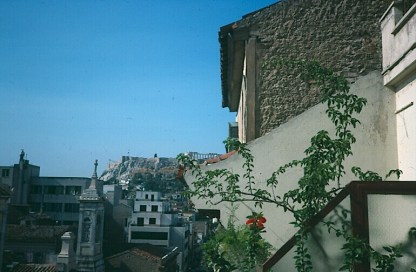
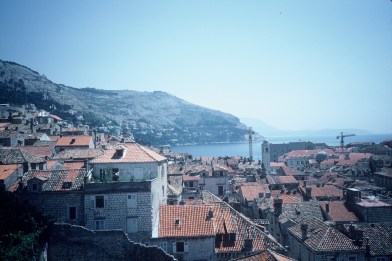
The grief I felt (and the gardenia pressed between the pages of my journal brings it back with surprising sharpness) cast a cloud over the remaining weeks of our trip. Athens, to me, was little more than a place I didn’t want to be, though even in my self-absorbed state it was thrilling to see the Acropolis from the balcony of our cheap hotel. We took the night train from Athens to Skopje, then went to Belgrade and then to Zagreb, then to the Plitvice Lakes National Park, where we tried and failed (because it rained the whole time) to take a holiday from our travels, which were wearing us both out pretty much by this point. From Zagreb again, we went to the town of Varazdin, where we had arranged to meet a Serbian friend we knew from back home (I think he must have been an exchange student, though I can’t now recall exactly) who was at that point serving in the army. Then we finally did get that holiday, by flying to Dubrovnik,where we spent a couple of wonderful lazy days in a city I remember as being, with Venice, the most beautiful city we visited.
Then it was back to Belgrade to catch our flight to Sofia, where we spent two slightly surreal days navigating as solo tourists in a city still emphatically behind the iron curtain.
We did go to the Koprivshtitsa festival, and by that time–and thanks to the distractions it offered–the cloud was lifting. I was also, oddly, though further from home in almost every respect than I had been at any other point on the tour (it doesn’t get much more foreign for European travel, perhaps, than being in rural Bulgaria) back in more familiar territory: we saw more people we knew at the festival than we had seen for almost six months. So the world I had chosen over the fantasy life I had imagined was already becoming, as it inevitably would, my reality once again.
What possible relevance can this personal history have to Rebecca West’s masterpiece? None, really, of course–except that we bring our whole selves to anything we read, and when I read the last line of her Prologue — “In a panic I said, ‘I must go back to Yugoslavia…'” — it echoed in my mind like the opening line of Rebecca, pointing me back towards a part of my own story that has never been completely resolved. I have no desire to go back to Yugoslavia, but every time I have thought about both reading West’s book and writing about it, every time I have looked at her subtitle (“A Journey Through Yugoslavia”) as the book sits by me on my desk, I have been distracted by thinking about my own journey there, which was a grey interlude between two parts of my life. I’ve sometimes thought I left something behind in Crete–not (or not just) a little piece of my heart, but my youthful romanticism. I’m not, now, the kind of person who gets swept up in the moment. Maybe I never really was, but I was then, for a little while. Then I came home, started university, and the rest is history–or, more accurately, it would have been history, if I hadn’t changed my major to English…
Still, all this reminiscing (out of place, perhaps, on this blog that’s supposed to be about literature and criticism) feels like an unfortunate extension of the solipsism that characterizes my journal entries from that part of that long-ago trip. Or, it did feel that way, until I came to this passage in Black Lamb and Grey Falcon tonight:
Art is not a plaything, but a necessity, and its essence, form, is not a decorative adjustment, but a cup into which life can be poured and lifted to the lips and be tasted. If one’s own existence has no form, if its events do not come handily to mind and disclose their significance, we feel about ourselves as if we were reading a bad book.
I don’t pretend there’s any particular art in this post, but I think she hits on why I have wanted for so long to write at least something about this part of my past. I’ve been thinking off and on about its significance for more than half my life. I don’t much like critical writing that subordinates the books to the writer. I’m not going to talk about myself when I start writing properly about Black Lamb and Grey Falcon. But I’m actually glad that this great book finally prompted me to give a little form to my own existence. If I keep working on it, maybe it won’t be such a bad book, by the end.
To close, here’s some Balkan music for you from Balkan Cabaret, a group well known to my family; the lead singer, Mary Sherhart, gave many workshops at camps and festivals, and also at my mother’s Sunday singing group. The song, “Jovano, Jovanke,” is Macedonian, and is one I heard many, many times, either being sung or being danced to.
OK, I admit it. My previous post about reading and research is also disingenuous. In a university context, research is not just “purposeful reading” or “reading in pursuit of knowledge” or “reading directed towards solving a problem or answering a question.” University-level research, research that is publishable in professional venues, research that is eligible for funding, is research that produces new knowledge. The research mission of a university is to move the frontier of knowledge, to add to the world’s sum of knowledge, to be at the cutting edge of knowledge… I know that! I’m only sort of pretending not to know it when I ask why research that serves other academic purposes, including teaching and individual intellectual development, does not earn a researcher the same support or the same professional credit.
But I’m pretending not to know it because “the pursuit of new knowledge” is not as obvious, or as easily applied, a principle as it sounds. One possible line of questioning begins with “new to whom?” The degree of hyper-specialization that characterizes the contemporary university is the result of the standard answer: new to other specialists in the field. This is obviously the right standard, isn’t it? It doesn’t advance knowledge to repeat what has been done before, to redo what has been tested. You can’t discover what is already known; you can’t have progress in a field unless you are constantly finding out something new.
This makes perfect sense, right? And yet it isn’t 100% obvious that what I’ve just said applies as well to literary research as it does to, say, research in genetics. What counts as a “discovery” in literary scholarship? Turning up a lost manuscript? OK, that’s an easy one. Explicating and contextualizing the work of a previously unknown or little-known author? Yes, good. Overturning a longstanding theoretical paradigm? Yup, I think so. Proposing a new reading of a novel based on paying attention to a detail nobody has ever paid attention to before? Well, OK. Contradicting a proposed new reading of a novel based on an alternative interpretation of a detail nobody has ever paid attention to before? Constructing a large theoretical claim based on readings of novels that pay attention to details usually disregarded? Yes, fine. Applying a theoretical framework from another discipline to a novel in order to read it in a way that it has never been read before? Yes! Of course! These are exactly the kinds of things literary scholars do (not all the things they do, but how long did you want this paragraph to get?). I wouldn’t argue that understanding texts in new ways doesn’t produce something reasonably called “knowledge.” At any rate, all of these activities affect the way we think about things. If our activity leads us and others to think in a new way, to see something in a new light, that moves some kind of frontier, surely.
But it seems to me there’s a difference that is at least worth thinking about between the importance of doing something new in genetics (or whatever) and pursuing novelty in literary studies. In some kinds of research, work that isn’t new and that doesn’t take into account every other recent discovery will be useless and irrelevant to anyone. But the drive towards novelty and hyper-specialization in literary studies is itself generating a great deal of work that is relevant only to other specialists, and even then, not so much. There is no large project or inquiry, after all, towards which incremental additions are being made; there’s just a proliferation of pieces often with little connection to each other. Even to other specialists, the work of keeping up is not only nearly impossible now, but also (and relatedly) of diminishing importance.
I’ve written about some aspects of this situation before, here in this post on Mark Bauerlein’s “The Research Bust.” I don’t think this kind of observation has to lead into an argument for the cessation of literary research, or for insisting that literary scholars return to doing only certain kinds of research that are more measurably productive of new information (for the case against literary “readings” and in favor of “a more traditionally scholarly conception of literary study”, see this post by D. G. Myers, also triggered by Bauerlein). One reason that I would support people continuing to do new readings is that we can’t be sure where inquiry will take us, and our sense of what “more traditionally scholarly” research is a priority might well be affected by ideas arising from rethinking texts we thought we already knew. If these new readings are truly driven by intellectual curiosity, by attempts to puzzle through problems, however abstract, then there’s value in them, for the researcher as well as for the audience of other people also interested. “Who can say,” as George Eliot remarks in Middlemarch, “what will be the effect of writing?” And I think we ought to have the same open-minded assumption about thinking. (If the research is not truly curiosity-driven, on the other hand, then we might remark, with Dorothea, “what could be sadder than so much ardent labour all in vain?”)
But I don’t think that the only paradigm for valuable work in literary studies should be one derived from a scientific model, as if a similar cumulative advance of information is ongoing, or one that disregards the other kinds of audiences there are for literary understanding. The reason the umpteenth interpretation of Middlemarch is important to at least some specialists is that they already know a whole lot about Middlemarch — but lots of people don’t, people who would be interested in knowing more. Our focus on novelty underestimates the value of what we already know, even though unlike old theories of the atom, old ideas about books have not lost their real-life significance; it also undervalues the skills we have at making what we know accessible to people who don’t know it yet, and reduces our audience to each other instead of trying to imagine how we could be part of the broader literary culture. The ‘cutting edge’ is actually a much less important place to be in literary studies (as well as a much more shifting territory).
This volume is subtitled “The First World War Letters of Vera Brittain and Four Friends: Roland Leighton, Edward Brittain, Victor Richardson, Geoffrey Thurlow.” The editors, Alan Bishop and Mark Bostridge, explain in their ‘Note to the Text’ that they have abridged the letters, sometimes significantly, in order to “lay bare the vivid and moving personal stories they tell, against the historical background of a cataclysm that destroyed four of the five writers.” In their ‘Introduction,’ they sum up the story the letters tell, one of “idealism, disillusionment, and personal tragedy.” Though excerpts always make me wonder whether the material omitted might have changed the story, there’s no doubt that the letters as presented here do follow just that arc. The four young men in the correspondence are all products of the British public school system which taught them the values they lived and then died for: “traditions of chivalry,” the editors explain, “the values of self-sacrifice, fair play, selfless patriotism, honour, duty.” War, in their view, was the ultimate proving ground for these qualities as well as their defense. Remnants of what can only look to us like a narrow-minded as well as naive idealism linger on throughout their letters, especially in their poignant wish to show courage in the face of incessant horror and imminent death: “I only hope I don’t fail at the critical moment,” writes Geoffrey, in what turns out to be his last letter to Vera, “as truly I am a horrible coward: wish I could do well especially for the School’s sake.” But it doesn’t take long for the realities of the trenches to disillusion them about war itself. “I used to talk of the Beauty of War,” Vera’s fiancé Roland writes to hear early in August 1915, “but it is only War in the abstract that is beautiful.”
After Roland’s death, in late December 1915, Vera’s brother Edward writes to her that Roland “considered that in War lay our one hope of salvation as a Nation, War where all the things things that do not matter are swept rudely aside and one gets down to the rock-bottom of the elementary facts of life.” Their friend Victor, the most militaristic of them (Geoffrey, in contrast, is the least militaristic, telling Vera that “he objects to War on principle”) argues at one point to Edward that “the Allies are God’s instrument by which He will remove that spirit and doctrine which is the cause of such Wars as this one.” To Vera, Victor writes that “The thing one appreciates in the life here more than anything else is the truly charming spirit of good fellowship & freedom from pettiness that prevails everywhere.” But these theoretical, wishful, or compensatory arguments are inadequate bulwarks against passages like this one:
I have been rushing around since 4 a.m. this morning superintending the building of dug-outs, drawing up plans for the draining of trenches, doing a little digging myself as a relaxation, and accidentally coming upon dead Germans while looting timber from what was once a German fire trench. This latter was captured by the French not so long ago and is pitted with shell holes each big enough to bury a horse or two in. The dug-outs have been nearly all blown in, the wire entanglements are a wreck, and in among this chaos of twisted iron and splintered timber and shapeless earth are the fleshless, blackened bones of simple men who poured out their red sweet wine of youth unknowing, for nothing more tangible than Honour or their Country’s Glory or another’s Lust [for] Power. Let him who thinks that War is a glorious thing, who loves to roll forth stirring words of exhortation, invoking Honour and Praise and Valour and Love of Country with as thoughtless and fervid a faith as inspired the priests of Baal to call on their own slumbering deity, let him but look at a little pile of sodden grey rags that cover half a skull and a shin bone and what might have been Its ribs, or at this skeleton lying on its side, resting half crouching as it fell, supported by one arm, perfect but that it is headless and with the tattered clothing still draped around it; and let him realise how grand & glorious a thing it is to have distilled all Youth and Joy and Life into a foetid heap of hideous putrescence. Who is there who has known & seen who can say that Victory is worth the death of even one of these? (Roland to Vera, 11 September 1915)
“It seems to me now,” Vera writes back soon after, “that this War is scarcely for victory at all, for even if victory comes it will be at the cost of so much else, so many greater things, that it will be scarcely worth having. No, this War will only justify itself if it puts an end to all the horror & barbarism & retrogression of War for ever.” After Roland’s belongings are returned to his family, Vera writes to Edward,
I was glad that neither you nor Victor nor anyone else who may some day go to the front was there to see. If you had been you would have been overwhelmed by the horror of war without its glory. For though he had only worn the things when living, the smell of those clothes was the smell of graveyards & the Dead. The mud of France which covered them was not ordinary mud; it had not the usual clean pure smell of earth, but it was as though it were saturated with dead bodies – dead that had been dead a long, long time. All the sepulchres and catacombs of Rome could not make me realise mortality and corruption as vividly as did the smell of those clothes.
“Dear child,” Edward writes to Vera after the news of Geoffrey’s death, “there is no more to say; we have lost almost all there was to lose and what have we gained?”
What’s so surprising and touching about their letters is not what was gained or lost, but what was somehow retained–in spite of everything, you never lose the awareness that they are just (just!) five young people making their way forward a day at a time, in the best way they can find. They have school memories and career ambitions, favorite novels and poems, families that frustrate as well as comfort them. They worry, too, about how the war might be changing them. “I don’t think,” Roland writes to Vera, “that when one can still admire sunsets one has altogether lost the personality of pre-war days. I have been looking at a bloodred bar of sky creeping down behind the snow, and wondering whether any of the men in the trenches on the opposite hill were watching it too and thinking as I was what a waste of Life it is to spend it in a ditch.” Geoffrey’s final letter (paraphrased in Testament of Youth) includes an evocative description of the trenches in the setting sun, a line of men “outlined against a pale yellow sky with dark purple clouds low down in the sky: over to the right tall trees astride a river also looking gold in the last rays of the sun and beyond the river more ruined houses from which occasionally flashed a large gun.” Though his life will so shortly be wasted, he at least has not lost his ability to appreciate that “it was all quite beautiful.”
Geoffrey’s letter ends with lines from Rupert Brooke’s sonnet “Safety” – “War knows no power safe shall be my going / Safe tho’ all safety’s lost, safe where men fall / And if these poor limbs die, safest of all.” (Vera to Edward: “I had a letter from him, within 3 days before his death, which was in all ways a farewell. . .. it made you feel that Death could not conquer a person of such fine & courageous natures.”) He had written earlier to Vera about Brooke: “Yes! I love Rupert Brooke & took him up with some of the other verses which Edward gave to me, to the trenches the last time but owing to wet, mud and squashed cake in my pack, which, the cake, seemed to permeate everything my edition is somewhat dilapidated now tho’ the dearer for that.” But much of their daily life is much more mundane than poetry, and that’s really where we realize “the pity of war.” There’s the long saga of Edward’s missing valise, for instance. Apparently claiming lost luggage wasn’t any easier in the trenches than it is with Air Canada: “I have got various papers on which to write my claim but I don’t konw when I shall have time to write it all out as it will probably take about 2 hours as it has to be done in duplicate,” he writes in some frustration to Vera, asking her to send along new shorts and sundries. Then there are his confidential remarks to Vera that he never seems to meet any “decent girls”–“Can you throw any light on the matter and do you think I shall ever meet the right one because at present I can’t conceive the possibility?” (Vera replies, “I think very probably that older women will appeal to you much more than younger ones”). These are the moments that restore these painfully young men to the normalcy that their extraordinary circumstances have stripped away, the moments that help us see them as our own sons or brothers or loved ones. “The reason why your last letter was so beautiful,” Victor writes to Edward in May 1916, “was because it was so very human. And after all to be human is better, and greater, and more beautiful than anything else.”
I admit, my earlier question “When is reading research?” was a bit disingenuous: obviously, research is purposeful reading. Of course, this definition can get batted around a bit too, depending on how you define your purpose: the pursuit of pleasure? aesthetic enrichment? familiarity with current best-sellers? Perhaps it’s better to say that, at least in a university context, research is reading in pursuit of knowledge, or reading directed towards solving a problem or answering a question or accomplishing a task. As Jo VanEvery also points out in her recent post on this topic, though, we have become preoccupied with the results of that reading, so that oddly, the process of exploration fundamental to defining a question in the first place has become devalued. And in universities we have also become preoccupied with research funding as a measure of productivity and success. If you don’t have a grant, you aren’t doing it right. Here, for instance, (with specifics expunged) is what the Assistant Dean of Research for my Faculty reported at the last Faculty meeting:
X has been awarded a —- Grant; X and Y have received a —- Grant for a conference… —- Grant applications this year are numerous and promising; X’s project on Y received a very positive mid-term review [from its funding agency].
At a recent presentation from one of our VP’s for research, at which he tracked our “success” and goals exclusively in terms of granting dollars, he made the point that money is measurable and thus is the easiest aspect of research to track and evaluate. The same is true, of course, of publications. But (as I and others pointed out to him emphatically in the Q&A that followed) that’s only true if the rubric you want to use is a pie chart or bar graph. If you really understand (as he claimed to) that research funding does not tell the whole story about research productivity, much less about the value of any given research project (especially in the arts and humanities), why continue using such inadequate tools? Perhaps there are fields of research in which research is better explained in a narrative, rather than a PowerPoint slide. Would it be too much, I wonder, to try to change our habits so that we acknowledge other dimensions of research activity–and stopped sending the incessant message that the best research is the most expensive? What about research that culminates in new classes, also? Isn’t that work valuable to the university? Isn’t that a purpose to which universities are fundamentally committed? You wouldn’t think so, by the way the term “research” is typically used on campus.
In any case, I can tell when my own reading has crossed into research of that more recognizable kind because I start to think about it in terms of obligations–things I should look up, things I need to know in order to achieve my purpose. I start to think in terms of depth and definition: more about this and this and this, but not that. Still, it’s always hard to draw the lines: there are no external rules about relevance, so you have to keep reading somewhat open-endedly as you figure out just how it is that you are going to define your project. There’s not a question “out there” waiting for me to turn my attention (and my students’ attention) to it: I have to mess around in all kinds of material until I see what I could do with it that is interesting and new. This conceptual work is, for me, among the most interesting and creative phase: there’s the whole “tempting range of relevancies called the universe,” and then there’s your part of it, but where that begins and ends, and why, is something that, in literary research at least, is rarely self-evident.
I’m in that happy stage right now with my Somerville novelists reading. I have defined a purpose for it–my fall seminar–and the reading I had been doing out of personal interest, which had included all of Brittain’s Testament volumes as well as the volume of Brittain and Holtby’s journalism, some of their fiction (as well as Margaret Kennedy’s), and some biographical materials, is now the first phase of a more deliberate investigation. I think this phase is happy for me because it involves focus but not the kind of micro-specialization that would be required to say or do anything research-like on Middlemarch now. Instead of having to read abstruse ruminations on theoretical or other kinds of topics that have less and less to do with the things that excite me about Middlemarch, reading I would be doing only out of a weary sense of professional duty (must keep up with the latest!), I’m doing reading I’m genuinely interested in–maybe because this material has simply not attracted the degree of scholarly attention Middlemarch has, it’s still possible to talk about it quite directly and with a real sense of discovery.
Here are some of the books I’ve collected so far for this research:
Letters from a Lost Generation: First World War Letters of Vera Brittain and Four Friends. Ed. Alan Bishop and Mark Bostridge (I’ll be posting a bit about this soon, as I’m over half way through – the stories are familiar from Testament of Youth but the letters in full have a remarkable immediacy and personality)
Winifred Holtby, Women and A Changing Civilization (I have a sad feeling that this 1934 book may have more relevance today than we’d like – “Wherever a civilisation deliberately courts its old memories, its secret fears and revulsions and unacknowledged magic, it destroys that candour of co-operation upon which real equality only can be based,” Holtby observes near the end – and flipping another page, I find “we must have effective and accessible knowledge of birth control.” Yes, I thought we’d had some of these fights before!)
Vera Brittain, The Women at Oxford
Vera Brittain, Lady into Woman: A History of Women from Victoria to Elizabeth II (I’m curious to see what this reads like in comparison to the many volumes of women’s historical biography I worked with for my Ph.D. thesis, later my book)
Susan Leonardi, Dangerous By Degrees: Women at Oxford and the Somerville College Novelists (as far as I know, this is the only critical work specifically dedicated to my seminar topic, and so far it is my main source for other relevant titles)
Behind the Lines: Gender and the Two World Wars. (This collection includes an essay Lynne Layton specifically on “Vera Brittain’s Testament(s)” as well as some useful-looking contextual ones.)
Jane Roland Martin, Reclaiming a Conversation: The Ideal of the Educated Woman.
This list shows the some of the frameworks that I expect will be important to talking about the core readings for the seminar in a rich and informed way: the stories of the writers; their works (our “primary” sources); the history of women at Oxford and in WWI (which means making sure I am reasonably well-prepared about general contexts); and theories and contexts on women and education, particularly university education. Each of the writers we’ll look at in detail will also raise more particular questions: with Sayers, for instance, the history of detective fiction will be of some relevance.
Doesn’t this sound like fun? That I’m excited about it makes me think it isn’t really research after all: research is work, right? Reading for pleasure isn’t work. And yet it can be, of course, and that’s the ideal of this kind of career–that it lets you do what you love, as well as you can, to make your living. That love itself can’t be the sole purpose of your reading makes sense in a professional context, but I’ve read an awful lot of scholarly writing that seems motivated by nothing more than the need to make certain moves in order to pass professional hurdles. In a previous post I quoted C. Q. Drummond saying “policies of forced publication never brought into being–nor could ever have brought into being–those critical books that have been to me most valuable.” Too much of the apparatus and discourse of research in the university seems to me to emphasize and reward everything but love of learning: it favors, as I said in that earlier post, “a narrow model of output, a cloistered, specialized, self-referential kind of publishing supported, ideally, by as large an external grant as possible.” This project so far has been supported only by me, with some help from my university library. So it won’t ever get me mentioned in the Assistant Dean’s report (just as my publications in Open Letters had no place, literally, at the display of recent books and articles put on in my Faculty)–especially if its only output is a class, not an academic article or book. I haven’t ruled out that kind of result down the road, but I haven’t defined it as a plan yet either. In the meantime, I’m going to keep calling what I’m doing “research.”
It wasn’t until I was nearly finished this outrageous and pitch-perfect satire that I realized it wasn’t really very funny. In fact (with apologies to Ford Madox Ford) I think I would even call it one of the saddest stories I’ve ever read. It’s sad partly because of the unforgiving picture it paints of contemporary American society, where everything’s for sale if you can only find the right pitch and the right market, where people only pay lip-service to ideals of equity and diversity but long for ways to subvert the pressure for genuine improvement, where women can make more by selling themselves than by doing their jobs. DeWitt has a particularly ruthless eye for banality–thinking about my surprise that this novel is by the author of The Last Samurai, it occurred to me that The Last Samurai is founded on a similarly harsh critique of people’s appetite for cheap substitutes. There it’s the “blunt attack on popular taste” exemplified by Sybilla’s insistence that Ludo realize what’s wrong with her samples of it (including a Liberace tape and a drawing by Lord Leighton). She tells him, “You will not be ready to know your father until you can see what’s wrong with these things”:
Even when you see what’s wrong you won’t really be ready. You should not know your father when you have learnt to despise the people who have made these things. Perhaps it would be all right when you have learnt to pity them, or if there is some state of grace beyond pity when you have reached that state.
The satire, the humour, of Lightning Rods (and it is often very funny, laugh-out-loud funny) seems to me to be driven by a similar feeling of utter contempt, though in this case for a different category: not for aesthetic mediocrities but for people who will believe any story that makes them accept what they already want, or helps them do what they’ve decided they need to do even if they know it’s wrong or unacceptable, or who allow a slapdash superficial glossy marketing version of morality to override their better instincts. Lightning Rods is sad because it’s right to hate that substitution of fake for real, and because there’s a lot of that going around these days.
But that’s not the sadness in the novel that really touched me. The biggest loss I was feeling, moving mentally from The Last Samurai to Lightning Rods, was the loss of the tremendous compassion that compensated there for Sybilla’s anger and disdain. If The Last Samurai were Sybilla’s novel only, it would have impressed me but I could not have loved it. Sybilla needs the redemptive companionship (in her life and in the novel) of Ludo. It’s too hard to go forward–and Sybilla is conspicuously failing to do that–stuck in an attitude of contemptuous superiority. It’s too close to despair and too alienating. You need a glimpse of some other possibility, and you need some forgiveness. Sybilla acknowledges that when she talks about the “state of grace beyond pity.” She knows it’s possible; she even feels it herself after Yamamoto’s concert. For most of Lightning Rods, I could not find any such compensation, any way out of the relentless forward march of Joe’s absurd but perfectly logical (and perfectly rationalized) success story. DeWitt is just so good: there are no cracks in the tone or point of view of the novel. That it’s a tone and point of view that we can be certain are anathema to DeWitt (it’s satire, after all) makes it all the more impressive that she can be so utterly convincing. (That’s also the great risk she takes: 273 pages in the vocabulary of spin and sales pitches and self-justification is a lot of pages. “The way I look at it is,” a characteristic passage begins..and then it follows, sentence after pitiless sentence, propelling us towards assent to the lowest estimates of what people are capable of, what they work for, what they are worth, what their aspirations should be. “The fact is”–and we’re off again.
The fact is there is no perfect job. The perfect job does not exist. People are people. Any job you go to, you’re always going to find people. And the way I look at it is, let’s say somebody steps out of line. You’ve got to keep a sense of proportion about these things.
There’s all that–and almost everybody in the novel is equally adept at it–and there’s Joe’s salesman rhetoric [“It’s important to give that new job 101%, 25 hours a day, 366 days a year. You simply can’t afford to have any distractions.]” Who really wants to spend 273 pages in this company, listening to these voices? It’s riskier, in a way, than something like “A Modest Proposal” because it is so banal. Swift’s excesses are wild, fun, dangerous–instead of boiled children, DeWitt gives us PVC tights and adjustable toilets.)
But back to the sadness. The polish of the novel is so impeccable, the premise so absurd, and the situations presented with such perfect deadpan comedy, that I couldn’t help but appreciate it, but I really wasn’t liking it at all. Then there came a little scene near the end where Joe is taken back, suddenly, to his first sales job, selling (or at least trying to sell) copies of the Encyclopedia Brittanica and the difference between what he could be selling and what he is selling confronts him and the tone of resolute optimism dies away, just for a page or so. Joe has made his fortune by accepting people “the way they are. Not how they ought to be.” This realism has made him a rich, successful man. But it’s not realism: it’s defeatism. Joe failed selling encyclopedias because “people could not make a living out of appealing to people’s better nature.” That would have been his first choice: to live in a world where that was possible, where people wanted encyclopedias rather than routinized anonymous sex (or the money it could earn them). “We live in the kind of world where people end up with their third or fourth or fifth choice because there just isn’t the money in their first choice”;
Every once in a while you get this glimpse of what the world would be like, not if everyone was perfect, but if just a few more people were just a little bit better than they are. You get this glimpse of a world where people could get by, maybe not with their first choice, but with a close second.
Joe sets to work talking himself out of the gloom this vision casts over him: “You’re making a living out of a world you didn’t make, out of people who evolved the way they happen to evolve. All you can ever do is try to increase the net sum of human happiness to the best of your ability.” It’s sad that his pep talk succeeds. It’s sad that his epiphany leads him, not to a brilliant new strategy for selling the Encyclopedia Brittanica, but to a brilliant new strategy for expanding his business into Christian ‘family values’ territory. It’s sad that this strategy works. But it’s saddest of all that he knows that what will sell is not what appeals to our better nature. There’s compassion here after all, for Joe’s knowledge (well hidden under his patter) that what he’s selling isn’t worth buying. The annoying, tireless, slick veneer of the novel is like the $1000 suit he buys to help him launch Lightning Rods: it’s an impeccably tailored garment covering up human failure, even tragedy. There’s a glimmer of that “grace beyond pity” in DeWitt’s treatment of Joe, it turns out. But is there any of it for us? How can we judge Joe if he’s only selling what we’ll buy, after all?
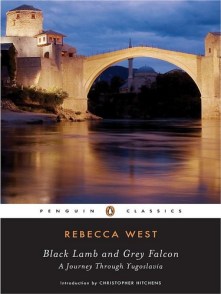 There are lots of impersonal reasons that I’m interested in Rebecca West’s Black Lamb and Grey Falcon. Most obviously, it is a widely celebrated literary and intellectual achievement. Here’s what Steve Donoghue says in his write-up on it for his list of


 Novel Readings