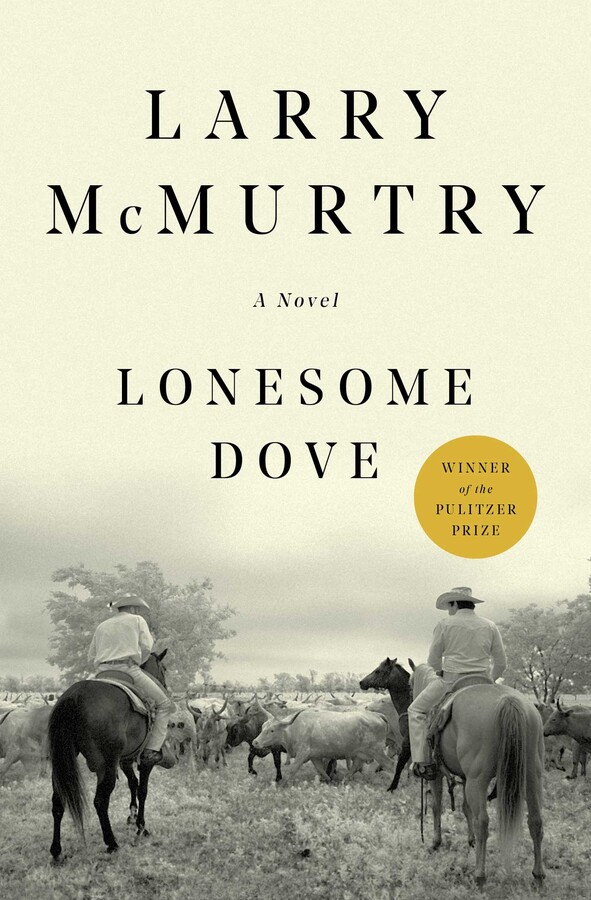
 I tried for quite a while to pick a excerpt from Lonesome Dove to serve as the epigraph for this post and also to provide its title – my usual practice for book posts. As you can see, I gave up! The problem is not that there aren’t good options: it’s that I can’t settle on a single angle or excerpt that sums up or represents the multitudes the novel contains, or that points to what I want most to say about it. It’s not a novel about summing up, is perhaps the problem: it’s a novel about adding up, a novel that just keeps giving its reader more and more and more until you can hardly remember a time when you weren’t deep in its world. It is the novelistic equivalent of surround sound! Any small sample is bound to be partial and misrepresentative.
I thoroughly enjoyed all 857 pages of Lonesome Dove. (Well, I didn’t enjoy some of the more horrific parts, especially Lorie’s time in captivity. But I was gripped by the narrative nonetheless, which is a kind of pleasure.) Lonesome Dove really is a masterful feat of storytelling. For one thing, even though the plot was constantly surprising and suspenseful as it unfolded, every incident fell into place with the kind of inevitability that (I can only assume) bespeaks careful planning. So many details in the first few chapters that seemed interesting but incidental turned out to bear fruit later on—often hundreds of pages later on. The elegance with which the many characters’ storylines weave in and out of each other was a constant delight, as was the neatness with which the main characters’ journey (literal but also figurative) came full circle at the novel’s conclusion. And the characters themselves are also delightful – not, of course, because they are all admirable, but because McMurtry has the gift of making them live on the page. From wide-eyed Newt to evil Dan Suggs, they are all distinct and memorable, Gus and Call and Lorena most of all.
 There’s a lot of Lonesome Dove: I’m not going to try to recapitulate it. I used to do more plot summary in my posts, but especially with a really “plotty” novel like this one, these days it seems a bit beside the point. If I were going to try to describe it more fully, I’d try instead to give some sense of the writing, especially the descriptions of the landscapes, or maybe the weather. There’s a lot of weather in Lonesome Dove! Or the river crossings: there are a lot of those too, many of them memorable (snakes!!).
Beyond that, I feel overwhelmed by the possibilities, so I’m just going to do a kind of speed round of topics. First of all, I think there’s a lot of interesting stuff going on in the novel about masculinity: Gus and Call are foil characters in ways that seem relevant to this theme, as is July, who keeps crying, and Newt, who needs not just a father but a father figure. Then, one way we can tell Lonesome Dove is a relatively modern example of the Western is not so much Lorena (though she is a reasonably three-dimensional version of the role she plays) as Clara, who startled me by introducing metafictional commentary into a novel that otherwise seemed strikingly unselfconscious (“the ladies’ magazines had stories and parts of novels in them, in many of which were ladies who led lives so different from hers that she felt she might as well be on another planet”). Clara’s reflection that “the menfolk that came by weren’t interesting enough to put in books” surely says something about the kind of book McMurtry is writing—just as Clara’s presence in Lonesome Dove to some extent answers her longing to find her own life represented.
 Then, what about Lonesome Dove as a Western – what story is it telling about the settlement of the American West? Again, it shows its (relative) modernity by being something of an anti-Western (like Elmore Leonard’s Valdez Is Coming). It does not romanticize its cowboys’ journey, idealize their motives, or (I don’t think) turn their individual quest into a metaphor for any broader narrative of “civilization” or nation-building. Gus and Call themselves hardly know why they are going to Montana, and by the time he gets there Call, whose decision it largely was, has lost interest in the undertaking and is just going through the motions. There’s plenty of racism in the novel, and a lot of violence between the cowboys and the “Indians”—but (anachronistically?) Gus in particular is wryly and explicitly aware that they are vulnerable to attack because they are moving into someone else’s land; towards the end he goes so far as to suggest they really should have left it all alone. The “Indians” may be antagonists, but the folks who evoke moral disgust, whose violent ends seem eminently justified, are horse thieves like the Suggs brothers. That said, Blue Duck is a cartoon villain, by far the most reductively two-dimensional character in the novel.
 Even with the nuances McMurtry introduces, too, I wonder if it is possible for a Western not to be compromised by the very story it tells. Our “heroes” in this case are complex characters, including in their relationship to the project of American expansion and settlement, but we are still on their side throughout and overall they are admirable: not perfectly virtuous, but embodying values familiar from both classic Westerns and related genres like hard-boiled detective fiction: the rugged individualist, the loner, the vigilante whose stature and moral freedom comes from his detachment from conventional or community ties. If we admire Gus and Call (and grow fond of Newt and the others) we are going along, to some extent at least, with their morally problematic roles in history.
But maybe that isn’t the right way to see it. Lonesome Dove seemed more descriptive than prescriptive, not “these are the men we should admire” but “here’s a version of what men like this could have been like.” I’m not sure about this, though, even as I’m also not sure that examples of a genre can be judged solely on their participation in its tropes. Crime fiction is always about “solving” crimes but that doesn’t mean every instance of crime fiction is complicit in the kinds of systemic injustices law enforcement can be rightly accused of propagating. Valdez Is Coming is a vigilante narrative but one in which the demands of both justice and morality can only be met by confronting and destroying evils including racism. Does Lonesome Dove resist or critique the world it is set in, in a similar way? Does it interrogate the claims of its protagonists to heroism?
 I’ve only read this long novel once so I’m not really in a position to answer. Most of the time, reading it, it seemed (as I said before) unselfconscious: it was “just” telling us this great story and not challenging us (or itself) to question its terms. I was surprised, then, when Clara (again Clara!) introduced a powerful note of skepticism, one that came so close to the end that it felt like a commentary on what we had all (author, readers, characters) been doing to that point. “And I’ll tell you another thing,” she says to Call during his stopover on his mournful way back to Lonesome Dove:
I’m sorry you and Gus McCrae ever met. All you two done was ruin one another, not to mention those close to you . . . You men and your promises: they’re just excuses to do what you plan to do anyway, which is leave. You think you’ve always done right—that’s your ugly pride, Mr. Call. But you never did right and it would be a sad woman that needed anything from you. You’re a vain coward, for all your fighting. I despised you then, for what you were, and I despise you now, for what you’re doing.
She’s angry and she’s grieving: maybe this is not meant to be a reliable judgment. Certainly it doesn’t sound like a fair description of the men I’d been reading about for 850 pages. Maybe McMurtry’s storytelling seduced me, though: maybe I was enjoying the novel too much on one level to keep my critical guard up on another. If so, there’s another Lonesome Dove I haven’t exactly read yet, right here on the same pages I already turned. Would I—could I? should I?—read it again to find out? Not in the near future, anyway, so I’d love to hear what other readers think about these questions.
 Although it is often difficult to concentrate on reading fiction right now, amidst the clamor of current events, it is also the case that current events have their usual uncanny way of making some of the novels I’m reading seem more important than ever.
 The other novel I’ve been working on for class is Valdez Is Coming. It is a pretty different reading experience in almost every way, but it too turns on questions about what’s right and what’s fair, and about when and where to draw the line in the face of an injustice. “Why do you bother?” Valdez is asked about his quest to get restitution for a widow whose fate nobody else cares about because she’s Apache and her dead husband (though shot by Valdez himself) was the victim of their unrepentant racism. “If I tell you what I think,” he replies, “it doesn’t sound right. It’s something I know.” By that time we know too why standing up to the men who mocked him, shot at him, then crucified him when he asked for justice is something he has to do. It’s about not letting them win, yes, but that outcome matters because of who they are, and who he is — and, if we’re on his side, who we want to be, and how we want the world to be. “You get one time, mister, to prove who you are” he tells his antagonist during their final showdown. Valdez (true to his genre) proves who he is through action, including a lot of violence. (I wouldn’t like this novel as much as I do if this violence were treated differently — simply as action, for instance, or drama — but Leonard imbues it with
  The past couple of weeks have felt pretty hectic to me, mostly because any time you teach a new course, or just new material, you have to build up all its materials from scratch. This term it’s Pulp Fiction that needs, well, everything! Not only do I not have any lecture notes to draw on for most of the readings (but boy, am I looking forward to our weeks on The Maltese Falcon, which I
  In 19th-Century Fiction we are nearly through Bleak House. They seem to be hanging in there! In this class too I have felt myself falling into too much lecturing, but I have been consciously working on balancing that out with some much more open-ended sessions. I feel as if lecturing in a more orderly way can be an important part of our work on a novel as long and complex as Bleak House, where a risk for newcomers to the novel is getting overwhelmed by minutiae: I try in my lecture segments to give them big grids or maps on which they can later place specific characters or incidents as they arise, or rise to prominence. I also try to plant interpretive seeds in the form of questions to be followed up on as they read further. That way, when we do approach topics through discussion, they will already have been thinking about some of them on their own — which usually seems to work!

 Valdez himself is an interesting character: though he feels no ambivalence about his specific conflict with Tanner, he is less certain about his own role in life more generally, and the relationship he develops with Tanner’s fiancée Gay (whom he kidnaps as leverage) adds more nuances. It’s to be expected, though, that the protagonist will have some depth, so what I appreciated more is the way key secondary characters also have their own motives and their distinct roles to play in the denouement, including Gay herself but also Tanner’s “segundo.” One of the best bits in the novel is wholly inessential to its plot but adds a great deal to the atmosphere and to our sense of the kind of world its characters live in. Valdez shoots one of Tanner’s men and sends him back with a message. He delivers it and then lies dying, and we spend nearly two pages with him as he reflects on Valdez, and on his own life and immanent death:
 Defining my terms, which in turn will define my boundaries, is clearly one of the first thing I have to do. It’s inevitably going to be a somewhat arbitrary exercise, and the stakes aren’t that high given that the course is one of our first-year writing requirement classes and, as the calendar description implies, its main purpose is just to begin students’ training in literary studies. It doesn’t have to be an in-depth, theoretically complex, or even particularly thorough exploration of pulp fiction, whatever that is. It differs from the first-year class I usually teach (Introduction to Prose and Fiction) only in having what we hope is a sexier hook — it promises readings that at least sound more fun than what you might get in a standard literature class. Students in recent incarnations of the course, then, might have been surprised to find themselves reading Pride & Prejudice, Jane Eyre, or Much Ado About Nothing, all of which I have seen in recent Pulp Fiction syllabi!
 I’m not actually 100% sure True Grit is “pulpy”: does it transcend its genre? I think maybe it is to the general run of Westerns what Hammett or Chandler might be to crime fiction: still definitely of its kind, but the best, or most intense, version of it. Its story is simple and its pacing is relentless, but it’s the narrator that makes it particularly interesting. Mattie bristles with paradoxical qualities: she’s prim, abstemious, and insistently righteous, even as she’s razor-sharp and ruthless. She won’t touch a drop of whisky (“I would not put a thief in my mouth to steal my brains”) but she doesn’t hesitate to pull the trigger when she finally comes face to face with her father’s killer (“I pointed the revolver at his belly and shot him down”). She doesn’t much like the sight of hangings, but when she has to, she pulls the arm off a corpse and uses the long bone to save herself from falling into a pit of rattlesnakes (“I was grateful to the poor man for being tall”). Is she hilarious or heroic? Both and more, I think, and it’s her combination of naiveté and grit that wins over her jaded allies, who don’t want her along but then won’t leave her to die. And we hear all about it in the voice of aged Mattie, who still has no patience for people who waste time on pointless talk:
 Novel Readings