 Technically, actually, it was in someone else’s class: I was invited to come and talk about social media to our Honours Capstone Seminar, which (among other things) features a range of guest speakers talking about everything from digital humanities to graduate school to (non-academic) career paths.
Like many academics who blog and/or are keen Twitter users, I have found that these activities have become a sort of secondary expertise, one that felt exciting and envelope-pushing when I still had the feisty sense that through them we might be changing the academy for the better but which I have a much more equivocal relationship to now that it’s clear that by and large, my colleagues remain mostly either uninterested or openly skeptical about their value. There are exceptions, of course, including the colleague who not only invited me to the seminar but bravely left it up to me what to say, even knowing, as I am sure she does, that there was a chance my remarks might go somewhat against the grain.
 As I told the class, I really struggled with what to say. I have given quite a few talks on the subject by now, especially on blogging: these include relatively informal sessions at faculty “research retreats” and two conference papers, one of which I expanded into a more detailed and formal publication. I have also addressed it more than once in a similar seminar we run for our graduate students, with a narrower focus on the pleasures, perils, and possible profit of blogging as a graduate student. In all of these settings, my focus has been on the relationship between blogging and academic publishing, asking questions about the purpose of scholarly publishing and then how well our typical practices meet our goals–how successfully we are able to navigate between the need for professional validation and the desire to communicate widely, for instance, and the possibility that “vigorously rubbing” scholarship with “intelligent, bloggy bookchat by scholars” (as John Holbo once memorably put it) might “get the blood of ideas moving.”
O nce upon a time I might have considered these topics equally relevant for our Honours students, many of whom (in those days) were likely heading on to graduate school. A lot has changed, though, and I no longer feel comfortable actively grooming students for an academic path that (as I said to them) now seems strewn with broken glass. (There’s more about how the dismal academic job market has affected academic blogging in these posts.) I couldn’t see the relevance, for this audience, of debating whether blogging is or is not a legitimate form of scholarly publishing or any of the “usual” professionally-inclined topics. What, then, should I talk to them about?
Well, I don’t know what I should have talked about. I think perhaps it would have been more in keeping with the general purpose of the seminar for me to talk about the value of a well-curated online presence for networking, perhaps with some comments about what I think of as best practices. Instead, though, I decided to speak (as I warned my colleague) from the heart about what, on reflection, I think social media has to offer them, which is, in brief, a way (multiple ways, really) to continue the kinds of conversations they have enjoyed as part of their English degrees. The university, I said, is not (despite what its denizens too often seem to believe) the only place you can have an intellectually stimulating life. In fact, it is not at all clear that “the life of the mind” is a reasonable way to describe the academic life anymore–even if you are lucky enough to join the vanishingly rare number of tenure-track faculty, which (and it is so hard to say this in a way that students can or will actually hear it) it is extremely unlikely you will be.
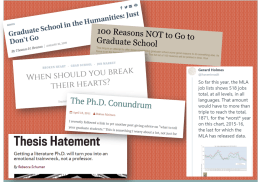 In my short talk, I did not go into more detail about the arguments pro and con about graduate school in the humanities (and I know there reasons, some of them pretty good ones, or at least not terrible ones, that other people still insist that encouraging students to head into Ph.D. programs is perfectly rational and ethical). I just highlighted some of the many articles they could read about it if they wanted, and urged them to talk to their professors if they were thinking about it. What I decided to use most of my own time for was making sure that they knew graduate school was not the only (and might be far from the best) way to keep talking about the literature they love in ways they find exhilarating. There are, I said, other places, other people, other opportunities, for people who love books, and I know that because of the time I spend on social media.
 I don’t know if they were very interested in what I had to say. If they were, they didn’t express it through a torrent of follow-up questions, that’s for sure, and I’m also pretty sure that I didn’t make a dent in anyone’s plans regarding graduate school applications. I said things I really believe in, though, which is consistent with what I would have said if I had talked about “best practices” instead, namely, be authentic. Further, and more important, as I worked up these remarks I realized that my own case for twitter and blogging is not really about their academic value anymore either. Whether the students needed or wanted to hear it or not, for me it was useful discovering that I still feel quite passionately about the positive value of reading, writing, and commenting on blog posts, and sharing ideas, tips, enthusiasms, and disagreements about reading via Twitter. Why should they care how much my life changed for the better because one day, without really knowing what I was doing or why, I pressed ‘publish’ on my first Novel Readings post? But I care, and really it has, in ways I could not possibly have predicted. So to the doubters and skeptics (if for some reason you happen to stop by), well, you do you, but I think you’re missing out. And to those of you who, like me, are out here living your best bookish life online and discovering friends and comrades along the way, cheers!
 Life is short, I’m busy, my TBR list is long and endlessly proliferating — so why would I waste my time on books that are shallow, badly written, and pander to silly, juvenile fantasies of finding Mr. Right? They’re so formulaic as to be essentially interchangeable and so numerous they are clearly also disposable. And their covers are so embarrassingly lurid!
 On Twitter, in the meantime, my tweeps joked, good-naturedly, about actually persuading me to read a romance novel someday, and they batted around titles they thought might be my “conversion” novel–so finally I took the bait and borrowed Loretta Chase’s Lord of Scoundrels, apparently known to some as one of the best romance novels of all time, from the library. Well, that was a setback.
  Thinking about why I liked Anyone But You (not loved, mind you, but liked–to the tune of 2 stars on Goodreads), I realized that it is really a prose version of a romantic comedy, a movie genre I enjoy. I actually have a collection of favorite romantic comedies I own on DVD, including Moonstruck (the best!), When Harry Met Sally, Notting Hill, You’ve Got Mail and Sleepless in Seattle. These are not high art films–but then, almost none of the films I watch are! I don’t reject these films for being “only” what they are. I appreciate how well I think they do what they set out to do, which is tell a romantic story about people I can be brought to care about, with humour and a touch of grace. They indulge happily-ever-after fantasies, yes, but with just enough realism to be engaging and just enough tongue-in-cheek self-consciousness about their own love stories (sometimes, with overt meta-commentary on it, as with the invocation of Pride and Prejudice in You’ve Got Mail or of An Affair to Remember in Sleepless in Seattle) to give a little tartness to their sweetness. As mystery novelists work within but manipulate conventions, these films follow formulas but succeed insofar as they tweak them to make them new. There’s comfort in knowing how things will turn out (again, as in mystery novels, with the reassurance of order restored). They are feel-good movies. What’s wrong with a feel-good book? Anyone But You is exactly that. In fact, it would make a nice little rom com. I can totally see Meg Ryan in it! It even has the quirky secondary characters. If it’s perfectly OK with me to enjoy Sleepless in Seattle even though I know it is not a great, profound, or innovative film–just a charming one–then why shouldn’t there be a place for charming, light-hearted romance in my reading life?
 Novel Readings