Napoleon was Defeated at Watergate…

…and George Osborne died during the civil war. Jane Austin eloped with a married man, Charle’s Dickins wrote Bleak Houses, and Maggie Tulliver doesn’t share the values of her aunts the Duncans. Night is a non-fiction novel, realism is when you decide to write realistically about reality, and unreliable narration is when you don’t believe what you are saying.

Yes, I’m grading exams.

Sigh.

Well Marked

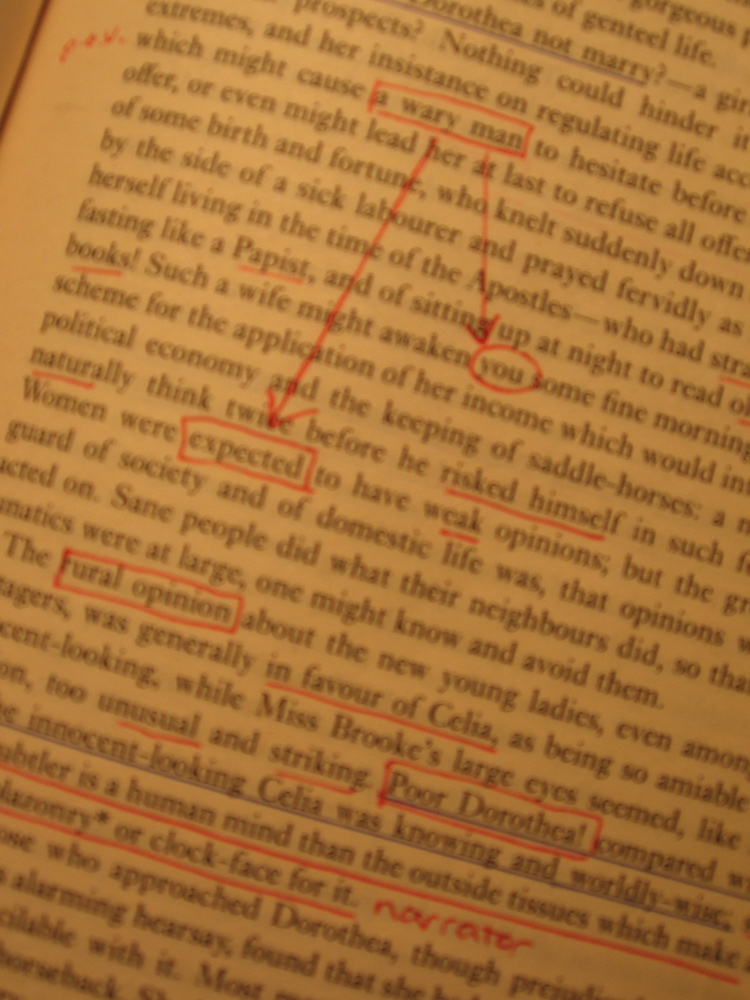
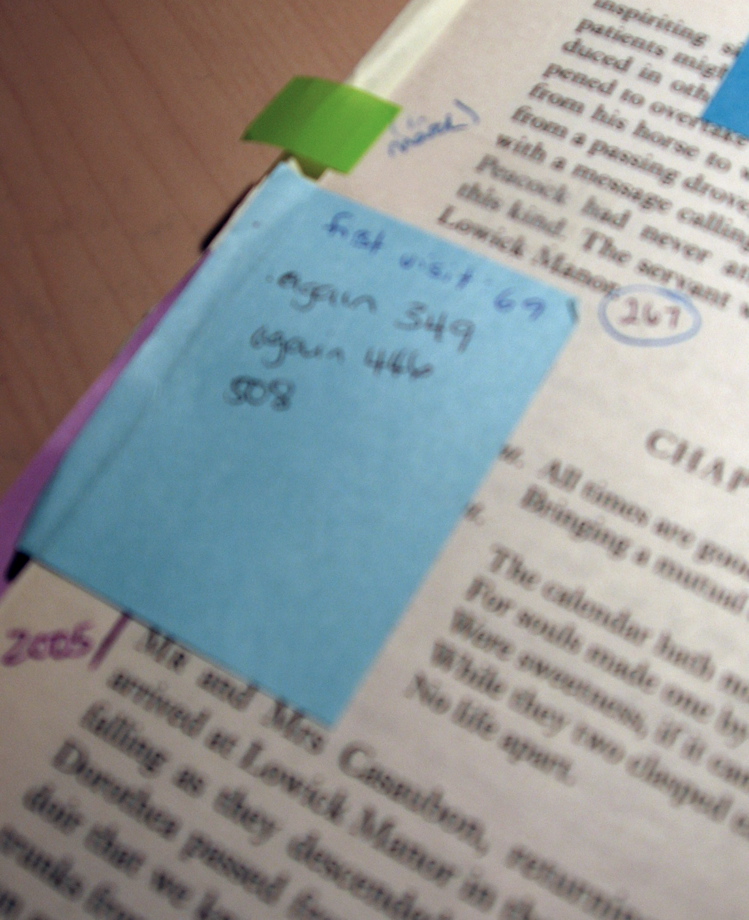
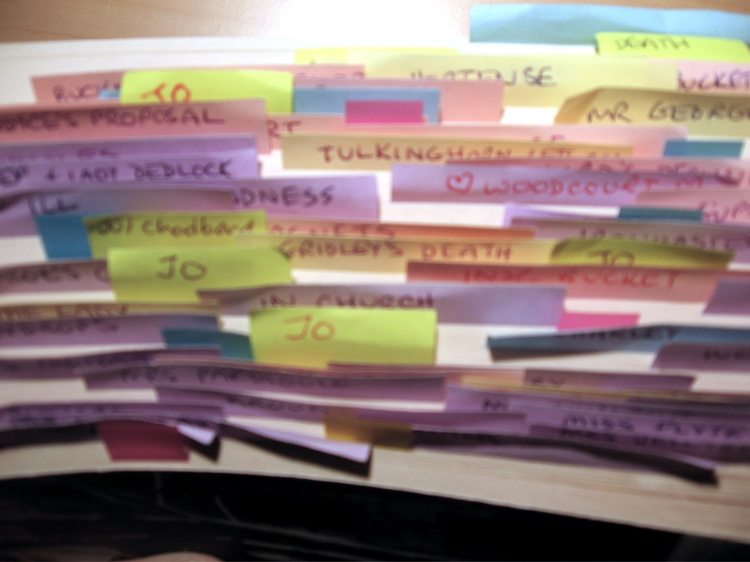
A couple of weeks ago, Nigel Beale posted some tips from Mortimer Adler on ‘How to Mark Your Books “Fruitfully and Intelligently.”‘ The recommendations sounded pretty familiar, though understandably there’s no mention of my own must-have accessory, the Post-It Note. I think anyone who teaches literature has to get over any initial reservations about making a mess on the page; a large part of what we want to convey to our students is that reading is an active process, for one thing, and writing on the text is one way to make sure you are actually engaging with it. Textual annotations can also serve as prompts and guides for lecture and discussion. As someone who mostly teaches ‘loose baggy monsters,’ I also feel that one of my primary responsibilities is just being able to find important passages to help students make their observations and analyses specific. Herewith, some samples of a well-used teaching copy of Middlemarch, marked up Maitzen style.

First, the Big Picture Post-It Index and Finder’s Guide.


Next, the Inside Cover Index to Essential Information:

Here’s a sample of a key passage annotated for teaching point of view and free indirect discourse:


And a sample of a Cross-Referencing Post-It–probably the most important kind (it’s blue because it marks the blue-green boudoir passages, of course!):


Here’s this year’s Post-It opus:


See how you can track Jo through the novel? And the hot pink tabs point to the clues to Lady Dedlock’s past. Hmmm. It starts to look a little obsessive, doesn’t it?

Score One for Our Team!

It’s easy to get discouraged when you’re teaching first-year English. A lot of people in the room don’t really want to be there and don’t see why they should care much about the course, except that they need to fufill a writing requirement. Sometimes they even tell you as much. That can make you cranky, defensive, or even a little bit sad. Still, you show up with your game face on and do the best you can to show them reasons to care. You try not to let your own commitment or enthusiasm flag. You teach as if they are all with you, because that’s the highest compliment you know how to pay them, as well as the only way to face coming to class again and again. And of course many of them are with you: they are basically well-meaning and open-minded kids, and even if they do see your class primarily as a requirement, they’ll put in the effort and see what they learn from it. Still, you’re always aware of those lurking skeptics, which is why it is especially nice to hear, from the very student whose earlier words rankled so, “I’m changing my major … to English.”

Dear Students,

Welcome back! I’m sure we’re all looking forward to a lively and intellectually stimulating term together. Here are some tips about getting off on the right foot with me. I’m guessing that they’ll work with your other professors too.

  1. Just because you can e-mail me doesn’t mean you should. Sure, there’s only one of you in particular, but overall there are a lot of you, and I can’t realistically attend to each of you individually. If you remain determined to try the personal approach, take a look at these excellent tips on how to e-mail your professors. Are you sure that you want me to know you as ‘hotpants@mymail.com’?
  2. Still on the subject of e-mail, do your homework first. You’d be surprised how much information is online about almost everything you are planning to e-mail me about…and if you were really as dedicated to taking my particular course as you claim, you’d probably have found that out already. E-mails that begin “Dear Sir” are a dead give-away.
  3. Surprise: I know the degree requirements for our programs! I helped draft them! I voted on them! That means I also know whether my course is “absolutely necessary” for you to graduate. I appreciate your apparent interest in getting into it, but let’s not start out lying to each other.
  4. If you think I’m grouchy, try this site. Or this one. Or, worst of all, this one. When I’m not jet-lagged, I’m actually pretty cheerful and accommodating. And so far, I have answered every one of your messages, usually within 24 hours. I hope that if you do take my course, you’ll be prompt and courteous too.

See you soon!

My Teachers: An Appreciation

This post is my 200th at Novel Readings, and I’d like to turn it into something of a special occasion.

A month or so ago, finding myself in “a bit of a posting slump” after wrapping up my series on “This Week in My Classes,” I asked for suggestions about things to write about. I recently received this nice suggestion by email from Tom Wood: “How about a post on a teacher/scholar whose work has had a significant influence on you?” I really liked this idea, because I still think with admiration and gratitude of several teachers whose influence, support, and guidance shaped my life in ways exceeded only by the love and direction provided by my parents. So, for this 200th post, I thought I’d take up Tom’s suggestion and celebrate them.* Now that I’m a teacher myself, I reflect often on the potential we have, in this profession, for making a difference in someone’s development. If you had a particularly memorable or influential teacher, I hope you’ll post a comment telling me about them!

It is impossible to overestimate the importance the right teacher at the right time can have on a student, though it may be impossible to foresee what will turn to be “right” ahead of time. In my own case, I think of my sixth grade teacher, Mr. James. I hadn’t wanted to be assigned to his class, as he had a reputation for being brilliant but eccentric and sort of scary–all of which he was, and indeed still is! But he was the right teacher for me after all: he saw something in my moody, bookish 12-year-old self that caught his interest enough for him to lend me extra books and encourage me to be less fearful about the differences between my own strengths and the qualities that earned other students ease and popularity with their peers. I think, too, of the indomitable Joni MacDougall, who browbeat me into being a better writer and let me, as a nerdy tenth grader, visit her History 12 class to give a presentation on Richard III (when I say “nerdy,” I mean that I was the youngest member–at least to my knowledge–of the Richard III Society of Canada). Later, when she had moved to a different school, she invited me to speak to her social studies class on the Industrial Revolution. Both teachers intimidated, bullied, and pressured me; both also, in equal measure, inspired and motivated me. Somehow, they had an idea of what I was capable of that exceeded my own, and by urging me to cultivate my own interest in reading and history, they started me along my career path well before I could have articulated anything like academic ambition for myself.

But probably the most influential moment, and the one I never saw coming, was my enrollment in D. G. Stephens’s first-year English class at UBC. I nearly missed it: I had registered for another section, but after the first class meeting I was told that I had to switch to what they called a “Z” section (I had done well on a placement test, I think). So I showed up in Dr. Stephens’s class for the next meeting (and, I distinctly remember, had to write an in-class essay on the seven deadly sins, about which everyone else had been forewarned). Prior to taking his class I had fully intended to major in history. I was a lifelong avid reader, but a complete skeptic about literary interpretation: when I thought about literary criticism at all, which was almost never, it seemed to me an exercise in second-guessing, or just plain guessing–in seeing what wasn’t there. In retrospect, I think this dismissive attitude was partly the result of growing up in a house full of devoted readers: I took reading for granted and didn’t see why or how it could be complicated.

So what happened to me in Dr. Stephens’s class? Obviously, whatever it was, it changed my mind about a lot of things. But it wasn’t because he was messianic. His teaching style is probably best described as “understated,” in fact.** I particularly remember the way he would make a comment and then scan the room, looking for responses, which were slow and hesitant in coming (his demeanor was, or I remember it as being, a bit intimidating–wryly ironic, a bit cynical). Many of his remarks were actually very funny, and I came to believe he was looking around to see if anyone got the joke. (I do that too, now: it’s a good way to see who’s paying attention.) But I don’t remember that he ever cracked a real smile himself. When he asked the class a question, I often wondered what mysterious answer he had in mind. Whatever I was thinking seemed too obvious to be right, and clearly hardly anybody else would hazard a guess. But it was frustrating not to have more discussion, and one day we had read a poem I really liked (it was Robert Graves’s “The Cool Web“) and I finally put my hand up and ventured some replies to his questions about Graves’s language and how particular words fit the central ideas of the poem. He seemed pleased! My answers were good! I knew what he was talking about! Things started to fall into place. He wasn’t making things up, because I could see them there too, in the poem, and thinking about how the details of form and language built up the whole piece made the poem better, more pleasurable, more exciting to read. It was like something coming into focus, something I (as someone who had always loved to read both fiction and poetry) had always seen, but had never really looked at.

I actually have all of my old undergraduate essays (it’s a good exercise in humility to look them over, especially during marking season). I certainly didn’t get all As in his class. What I did get was a sense of the rewards of interpretation, of lingering over details, of making a specific connection with a text. It probably helped me that Dr. Stephens was not a showy teacher, and it certainly helped me that he was a rigorous one as well as a witty one. I didn’t give up the idea of majoring in history. Instead, I became the first UBC student to do a combined Honours degree in English and History (back in the olden days, interdisciplinarity was not the norm). I had many excellent teachers in both departments, and superb mentors for my Honours thesis in James Winter and Jonathan Wisenthal. But I dedicated my thesis to Dr. Stephens, with gratitude.

*I realize that Tom’s question may have been meant to elicit more about scholarly and critical, rather than personal, influences. I’m still thinking about that dimension of influence. No question, I have learned a lot from many teachers and scholars. But is that the same as having been “influenced” by them? And have any of them actually inspired, moved, or motivated me? (If not, is that a problem or a loss?)

**My search of the UBC website for pictures or other details about Dr. Stephens to link to revealed that he won a “Master Teacher” award in 1974 and 1977 (fully a decade before I took his class), so clearly I wasn’t the only student he impressed. This raises the further question for me of whether UBC had, at that time, a deliberate policy of putting senior and well-regarded faculty in their first-year classrooms.

A Note on Course Evaluations as a Guide to Future Conduct

They don’t help (much). Here’s why…

Should I change the reading list next year?

“There were a LOT of texts. Too many, really. It was impossible to keep up with the readings.”

“It would have been interesting to add a few more books…I found the course load light enough that a few more (enjoyable) readings wouldn’t have been oppressive.”

“I loved the Moonstone–everything comes back to that.”

“I really enjoyed the Moonstone; I thought it was the most interesting and hard to figure out.”

“Great reading list except for the Moonstone. It was too long and boring.”

“I think one of my favourite books from this course is The Murder of Roger Ackroyd.”

“I thought Roger Ackroyd was unfair and not a clear example of Christie’s usual style.”

“Knots and Crosses a bit freaky.”

“Do not drop Knots and Crosses, best book I have ever read.”

“I found it more stimulating to examine actual books and stories rather than musty old course books.” [?]

I know I talk quickly, but how much of a problem is that, really?

“Her lectures were indecipherable because of how rapidly she spoke.”

“Maitzen speaks too fast. Slowing down would be helpful to take clear notes.”

“I found the lectures interesting and stimulating (I didn’t fall asleep in class once).”

“I do not think you talk too fast. I thoroughly enjoyed this class and look forward to taking classes taught by you in the future.”

“I actually liked Maitzen’s upbeat, fast-talking teaching style. It kept me from being bored and it kept me really listening.”

“She spoke too quickly at times; it was difficult to take notes in this manner.”

“I do not find she speaks too quickly. People need to take more condensed notes.”

What about the assignment structure and methods of evaluation?

“Assignments are a great way of getting us to think about the material. 75-word limit was also a good challenge.”

“I liked the way we had two assignments, and the in-class quizzes definitely were motivation to stay on track in class.”

“I think the homework assignment format should be re-evaluated.”

“The assignments were short and concise while still being challenging, which was a nice change from lengthy papers.”

“Your response to the first assignment was completely inappropriate and extreme, you wasted 2 classes and called the class ‘illiterate.'”

“I particularly appreciated the amount of time you dedicated to correcting in class the mistakes made on assignments. It genuinely helped and clarified my understanding of good writing!”

“She gives great constructive feedback on assignments and even gives us exercises that would help with our assignments.”

“Actually enjoyed quizzes, felt questions were fair.”

“For the quizzes I felt that there were too many questions on what were sometimes subtle statements made in class.”

“Increase the value of attendance.”

“Unsympathetic with the occasional absence.”

“Group work was a nice change of pace.”

“I hate group work and found those classes monotonous and unhelpful.”

And the intellectual substance?

“Maitzen posed questions that forced you to think!”

“Extremely interesting books were featured and taught in an intellectually stimulating manner.”

“Often lecture topics were repetitive or had little to do with the day’s reading.”

“Lectures were quick-paced and extremely informative. I never wanted to miss a class because so much material was covered in each lecture.”

“Feminism within the texts wasn’t over-emphasized.”

“TOO MUCH FEMINISM. This isn’t gender studies.”

So, overall how did I do?

“The teaching was mediocre.”

“One of the best profs I have had at Dal.”

“No complaints.”

“Pretty successful.”

“Sort of funny.”

“A great prof, very funny.”


“______”

“Dr. Maitzen is a superstar!”

Anything else to add?

“Thanks for keeping a blog–helps with some insight from time to time.”

I think the problem should be obvious. It’s not that the feedback isn’t welcomed or taken seriously, but if it’s not at all consistent, it’s hard to do anything in particular in response!

I should say (just for the record) that these are not the actual questions on our departmental course evaluation forms; these are the things I worry about as I look ahead to next year’s classes. I specifically asked them about the fast talking, as it has come up a few times in my evaluations before. All of the responses, though, are taken verbatim from the forms.

Updated Classics

At the TLS, Margaret Reynolds calls our attention to the relaunch of the Oxford World’s Classics editions. The article includes a survey of some available editions of Jane Eyre. A sample:

Oxford World’s Classics
Jacket Clean and striking but she’s too sulky.
Introduction By Oxford prof Sally Shuttleworth. Covers all bases and is excellent on the ending.
Text Based on first edition of 1847. Actual print a bit small.
Extra material Plenty on the text and publication of the novel.
Price £5.99. Good value.

Penguin Classics (Black)
Jacket A painting by Millais. Jane would never have worn this dress.
Introduction By novelist and critic Stevie Davies. Very good on the political context.
Text Revised edition of 1848, with some emendations. Clear print.
Extra material Chronology, notes and “Opinions of the Press”.
Price £5.99.

Vintage Classics
Jacket Clever, intriguing and spot on for the story.
Introduction No.
Text Based on the revised edition of 1848. Nice print.
Extra material Little life of Charlotte. Quote from Sarah Waters: “One of the most perfectly structured novels of all time”. Meaning?
Price £5.99. Hmm.

I’m not entirely sure that this is quite the information I need to make my selection. Let’s see: put me down for one copy of the sulky version with the introduction that “covers all bases” (I’m sure I usually miss one or two in my lectures) and one copy with the “clear print” for my aging eyes… Also, a testimonial about novel structure from the author of Fingersmith is good enough for me! The slide-show of the various covers is nice. I’d like to point out a good option that gets no mention at the TLS:

Broadview Edition
Jacket excellent– see illustration at right
Introduction by Richard Nemesvari (my near neighbour, at St. Francis Xavier University in Antigonish): thorough and interesting.
Extra material is Broadview’s specialty; in addition to the introduction and a chronology of Charlotte Bronte’s life and publications, this edition includes selected correspondence as well as contemporary pieces on governesses, girls’ education, race, and empire
Price Wow–only £4.99! ($12.95 US or Canadian)

Further information on the OUP relaunch is to be found at the OUP blog, where “Senior Commissioning Editor” (now that’s a title) Judith Luna explains,

We wanted a new look that would be fresh and contemporary and appeal to general readers and browsers who might previously have thought Oxford World’s Classics were a bit too academic for them. So we have a clean white title panel, and white back and spine, and we have chosen dramatic crops of appropriate illustrations to intrigue and entice the reader. We also wanted a sense of continuity with the old look, so we have retained a red strip at the top of the spine and back cover, and added a tantalizing detail from the cover image in a small thumbnail on the spine (older readers may remember that we used to have a similar feature on a previous incarnation of the series, but at the bottom of the spine, not the top). We also chose a new typeface for the cover, Capitolium, a modern take on classic lettering, based on classical Roman inscriptions and Renaissance calligraphy and designed by Gerard Unger. The insides of the books are unchanged, and we will continue to publish high-quality editions and translations with outstanding introductions and notes at truly affordable prices, editions that are designed to satisfy the needs not just of students, but of the lively general reader as well.

Since I’ve already ordered my fall term books, including many World’s Classics titles, I’m relieved to hear that the “insides are unchanged,” though it strikes me, given this, that they are rather encouraging (or expecting) people to judge a book by its cover. Still, I’ll be jealous if my students all have spiffy new covers on their books while I’m still wielding my battered old versions. (Hint to OUP reps: send Maitzen new desk copies…) (On the other hand, replacing all the post-its in my teaching copies would be a lot of work. There are a lot of them, because I consider it one of my primary obligations when teaching, say, Bleak House, to be able to find key passages quickly. Browsing through 900 pages muttering “I know it’s here somewhere” wastes a lot of class time.)

Reflections on Blogging My Teaching

I began my series of posts on ‘This Week in My Classes‘ back in September, in response to what I felt were inaccurate and unfair representations of what English professors are up to in their teaching. As I said then,

I don’t suppose that my own classroom is either wholly typical or exemplary, but I think it might contribute somewhat to the demystification of our profession, now that the teaching term is underway, to make it a regular feature of my blog to outline what lies in store for me and my students each week.

The resulting entries range from brief commentaries on key passages to meditations on larger critical or theoretical issues prompted by a particular reading or class discussion (on October 1, for instance, there’s some of each); from notes on pedagogical strategies or favourite discussion topics (such as ‘giant hairball’ day) to protracted afterthoughts on the central issues of a class meeting or reading (such as the didactic or instructional aspects of 19th-century courtship and marriage novels).

And so? What did I accomplish by writing all this up–and by putting it all out in public? I think there’s no way to tell if I made any difference at all to the kinds of pervasive and (in my view) pernicious attitudes towards literary academics expressed in the Footnoted posts that prompted me to do this. It seems pretty unlikely! How would these angry people even know my blog exists, after all? And even if they did come across it, the odds of conversion would surely be pretty slim for a determined anti-academic. Still, I think it was worth making the effort and putting some evidence against their version out there, just in case. Where in my posts would these people find evidence that I hate literature and spend my time on political indoctrination? (April 16: or, again with reference to this post, that I dismiss aesthetics, hold in contempt the notion of literature as “record and register of literary art,” and oppress my students with my hyperliteracy? Sigh. A classroom is large and can contain multitudes–of ideas and voices and critical approaches.)

As the weeks went by, though, I more or less stopped thinking about these lost souls. So who was I writing for? Well, as other bloggers often remark, your only certain audience is yourself, so you have to find the effort intrinsically valuable and interesting, which I almost always did. Teaching is, necessarily, something you do in a state of rapid and constant motion (and I mean not just mental but physical, as the Little Professor has recently proven). Classes follow on classes, and on meetings and graduate conferences and administrative tasks and attempts to meet proposal deadlines, in what becomes a blur of activity as the term heats up…and though a great deal of planning and preparation typically goes into each individual classroom hour, I hadn’t usually taken any time to reflect further on what just happened, or what’s about to happen. I found that taking this extra step each week not only helped me identify the purpose, or, if writing retrospectively, the result of each class, but it made each week more interesting by giving me an opportunity to make connections or articulate puzzles or just express pleasure and appreciation in ways that went beyond what I had time for in class. I pursued links between my teaching and my research projects, for example, as well as between my teaching and my other ‘non-professional’ interests and activities. I articulated ideas suggested by class discussions that otherwise would have sunk again below the surface of my distracted mind. Blogging my teaching enhanced my own experience of teaching. That in itself is a worthwhile goal.

But isn’t that a goal I could have achieved by keeping a teaching journal off-line? Well, sort of, but not altogether. For one thing, blogging (again, as other bloggers have remarked), precisely because it is a public form of writing, puts a different kind of pressure on you as a writer. Though perhaps nobody will read your posts, somebody actually might! And once you realize that, you try to write better–just in case. Maybe there are all kinds of dedicated prose stylists in the world who laboriously craft the entries in their private notebooks. But even they probably have their eye on posterity (“one day, when I’m famous, these notebooks will sell for a fortune on eBay!”). It’s true, too, that the ‘blogosphere,’ with its millions of members, includes many samples of writing done, as far as anyone can tell, with no care at all. But for me at least, the accessibility of writing in this medium (and the impossibility of ever really taking something back once it has been ‘published’ on the internet) raises the stakes, even while the relative informality of the blog post as a genre has been a welcome change from the demands of professional academic writing.

Further, I like the idea that I might write something that other readers find interesting, useful, or mentally stimulating. My teaching posts in particular seem to me likely, if chanced upon, to be welcomed by readers outside an academic setting who are, nonetheless, interested in learning more about the kinds of reading contexts and strategies I work on with my students. Looking through my posts, I think there is nearly enough in them for someone to do an ‘independent study’ of my reading lists for any of the four classes I taught this year. The frequent publication of ‘books about books‘ aimed at non-academic audiences suggests an appetite for what you might call ‘reading enhancement.’ Maybe other teachers, too, would get some ideas for how to approach some of the texts I’ve discussed, just as I have often sought ideas from posted syllabi or from the blogs of other people in my field or, more generally, my discipline. At its best, the ‘blogosphere’ is a great reservoir of information and insights made generously and collaboratively by people of all kinds; we can learn from each other and contribute to each other’s learning. This is not something that can happen off-line. (Here, of course, is the justification for blogging at all, not just for blogging about teaching.) And in the year or so that I have been blogging, I have been contacted by a few readers who have seemed genuinely appreciative of my efforts in this direction.

Finally, as a blogger, I found that carrying out this plan to do a regular series of posts on one theme added a helpful structure to my posting habits: it was a kind of productive discipline. Like all academics, after all, I’m used to working to deadlines. Often, I began my week thinking I had nothing in particular to say. But I ‘had’ to post about my classes (also like all academics, I have an over-developed sense of obligation and I’m used to generating my own necessities). And once I started writing, most of the time I quickly found I was invigorated by discovering that I did have something to say after all.

Overall, then, I’m glad I set myself this task, and reading through my posts, I’m pleased with the results. No doubt other English professors do very different things, including with the same primary materials I took on. No doubt there are some who would be alienated, rather than won over, if they happened upon this material; no doubt some who have read it have turned away impatiently (or worse), for their own theoretical, political, or other reasons. But my posts represent my classroom well, and thus I admit, they represent me well too. Yup, that’s me: the one who cries over Oliphant’s Autobiography and finds passages in Dickens poetic, who admires George Eliot’s stringent morality but worries about the way her better people seem driven to sacrifice themselves to their petty partners because ‘the responsibility of tolerance lies with those who have the wider vision,’ who watches House and Sex and the City and finds Agatha Christie clever but shallow, who goes all pedantic when homework comes in but relishes her students’ creativity and humour in devising class activities, whose children delight and torment and distract her. That’s the thing about teaching–and about blogging too. You put yourself out there, try to be your best self most of the time, have moments of irritability and moments of eloquence–and then you sit back and see if anyone was paying attention.

George Eliot in 2009?

Speaking of contemporary interest in George Eliot, here’s a question on a much smaller scale than my previous one: which George Eliot novel would you assign for a seminar on ‘Victorian Literature of Faith and Doubt’? I’m scheduled to teach such a class in Winter ’09 and though book orders won’t be due until the early fall, I always prefer to plan ahead. Plus as this will be a new class for me, it will take substantial preparation–which I can’t entirely do unless I know what I’m doing, if you see my point. Much of the reading list will be non-fiction and poetry (this will be my first chance to teach In Memoriam in several years, which will be a great treat). I expect to close out the term with Jude the Obscure; my very rough preliminary schedule suggests I have room for one more full-length novel. The Mill on the Floss, which will read particularly resonantly right after our ‘unit’ on Darwin, is my current first choice, but issues of ‘faith and doubt’ are perhaps more obviously front and center in Daniel Deronda. Or there’s Silas Marner, which would leave me room for another short work of fiction–or, with some shuffling of other readings, even for Jane Eyre, which I don’t usually teach with a religious emphasis. Or what about Scenes of Clerical Life? It’s striking that one of the period’s most profound thinkers about religion (in both its theological and its sociological aspects) actually treats the subject quite obliquely in her major works.

Suggestions?

Why I Teach Literature” (with some thoughts about James Wood appended)

Not long ago there was a ‘meme’ going around on the question “Why Do I Teach Literature?” (Joseph Kugelmass’s comments on this topic at The Valve include links to further contributors). Reading around in my files today (where I am in search of an organizing pattern for future research–but that’s another post for another day) I came across this passage and it struck me as nicely encapsulating both the central problem of teaching literature (that it is, paradoxically, always about feeling as well as knowing) and its greatest lure:

Critics, before and after Northrop Frye, have distinguished between literature and experience and literature and knowledge. The distinction, though plausible in some theoretical contexts, blurs nearly every day, in nearly every classroom. I am content that it blurs. Unlike physicists, who teach not nature but physics, we teach both literature (how it feels, how it thinks, to have read a literary work) and the rules and facts about reading literature. As Gertrude Stein once said to an obtuse interviewer: “But after all you must enjoy my writing and if you enjoy it you understand it. If you did not enjoy it, why do you make a fuss about it?” That is why I finally became a teacher of literature, to live in the vicinity of that joy.

This is from Ihab Hassan’s essay “Confessions of a Reluctant Critic or, The Resistance to Literature” (New Literary History 24, 1993). Other critics have also written eloquently about the experience of following that lure of joy into a professional life that does not–perhaps cannot–reinforce or reward it, and may even work actively against it. John McGowan, for instance, in his book Democracy’s Children (2002), notes,

[T]here remains a tension between the experience of reading literature and the paths followed in studying. . . . To give one’s allegiance to the academic forms through which literature is discussed and taught is to withdraw (at least partly) allegiance to literature itself” (65).

25 Years after Hassan’s remarks, I think it remains true that it is in the classroom rather than in their scholarship that many academic literary critics feel and communicate their love of their subject. One of the reasons I shifted research directions altogether a few years ago (significantly, after achieving the professional security of tenure) was that I wanted my research activities to give me, or be driven by, the same kind of intellectual and affective immediacy I find in teaching, and I couldn’t see how that would happen if, among other things, much of my work continued to be on second-rate material, no matter how historically revealing it was–or how useful for generating publishable, if niche, material of my own. To a large extent I succeeded, and as an unanticipated bonus, I think I became a better teacher because of the synergy that developed between my class preparation and my other work. It’s interesting, actually, that it seems to be widely taken for granted (or is it?) that undergraduate teaching and scholarly research leading to publication are very different kinds of things, and overwhelmingly the professional priority is with the latter–even though (or, perhaps, because) its tendency is to drive all joy away!

Follow-Up (to be developed later): Also as part of sorting through my files, I’ve been re-reading some of the James Wood essays I’ve gathered up, and (aside from being overwhelmed with envy at his erudition, elegant style, and intelligent craftsmanship as an essayist), I’m struck by how much closer they are to the kind of criticism we–or at least I–do in the classroom than anything that ordinarily passes for academic or professional criticism (and here I think it’s important to distinguish, as mainstream writers often don’t, between criticism and reviewing). It’s not that I think I’m as smart, articulate, or insightful as Wood,or as well-read either, though I hope I have my good moments! My point is really about the genre of criticism he works in, which seems to me to lie somewhere in between the poles of academic scholarship (which he clearly knows about, but relies on more implicitly than explicitly most of the time) and popular book reviews (which would rarely seek the kind of broad perspective or level of sophisticated analysis he deploys). I’ve ordered How Fiction works from The Book Depository, along with The Irresponsible Self, and I’ve got The Broken Estate from the library. I sense a Wood-fest coming on, perhaps as a way to draw together some of the scattered elements of my recent browsing and brooding about the function of criticism at the present time. Conveniently, as a motivator, there’s a conference panel on Victorian criticism for which I’m hoping to submit an abstract. One of the questions in the CFP is about what the relationships envisaged by the Victorians between “different forms of cultural production and the work of the critic” might tell us “about how criticism was imagined during the Victorian era, and what they might tell us about the more professionalized forms of criticism practiced today.” If this isn’t an opportunity (and a challenge) for me to make something of my work on the Broadview anthology along with the ‘work’ I’ve been doing on this blog, I don’t know what is! Whether anyone would want to hear it is, of course, another matter altogether.