 ‘And if you don’t take me,’ she said, ‘—well, when they put an end to your visits, what will you do then? Will you go on envying your sister’s life? Will you go on being a prisoner, in your own dark cell, forever?’
And I had again that dreary vision, of Mother growing querulous and aged—scolding when I read too softly or too fast. I saw myself beside her in a mud-brown dress.
This post is more or less a mea culpa for the many times I have remarked that Affinity is my least favorite Sarah Waters novel. I usually elaborate on that by noting that her very worst novel would still be better than most novelists’ best (a distinction she shares, at least in my opinion, with a pretty small cohort including, just for example, Hilary Mantel). I usually point to Fingersmith as my personal favorite, a preference that’s probably based in my interest in Victorian sensation fiction; I’ve assigned it often in a seminar on that topic and digging in on its details in the way you do when you’re working through a reading with students has only deepened my appreciation for it.
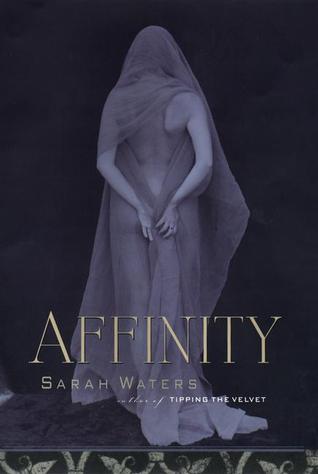
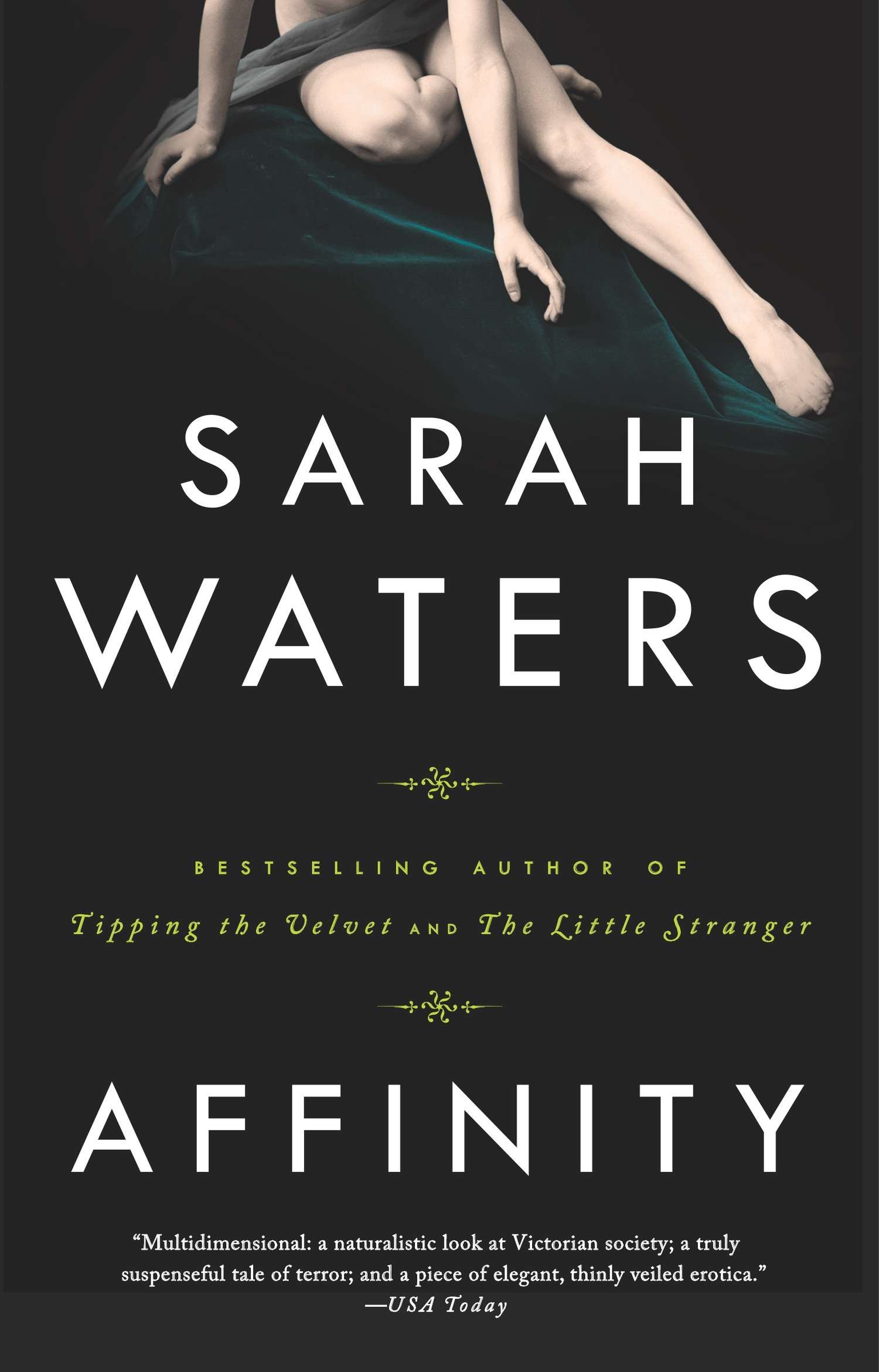 I decided to reread Affinity because I have always wondered if I’d underestimated it; because I was in the mood for something plotty but smart and (sadly) Stuart Turton’s The Devil and the Dark Water, which I just read for my book club, looked promising but turned out not to be very good; and because I recently “attended” an interview with Waters as part of the London Library Book Festival, which of course was lively and fascinating. And here’s the thing. Affinity probably remains my least favorite Sarah Waters novel—but reading it this time, I was very conscious of just what a high bar that actually is! I was gripped from the first page and absorbed from beginning to end. I was surprised by it, because I read it long enough ago that I didn’t remember the details, and I was satisfied by it because its details are so well considered. Waters has the rare knack of making her historical research feel alive on the page, and somehow her characters feel true in a way that Turton’s never did for me. I don’t know if I could point to any specific example or highlight anything in particular that she does differently, but reading Waters right after reading Turton reminded me of the bit in Henry James’s “The Art of Fiction” when he notes that, on the subject of childhood, “with M. de Goncourt I should have for the most part to say No. With George Eliot, when she painted that country, I always said Yes.” I ended up saying “no” to Turton; Waters is a writer to whom I always say “yes.”
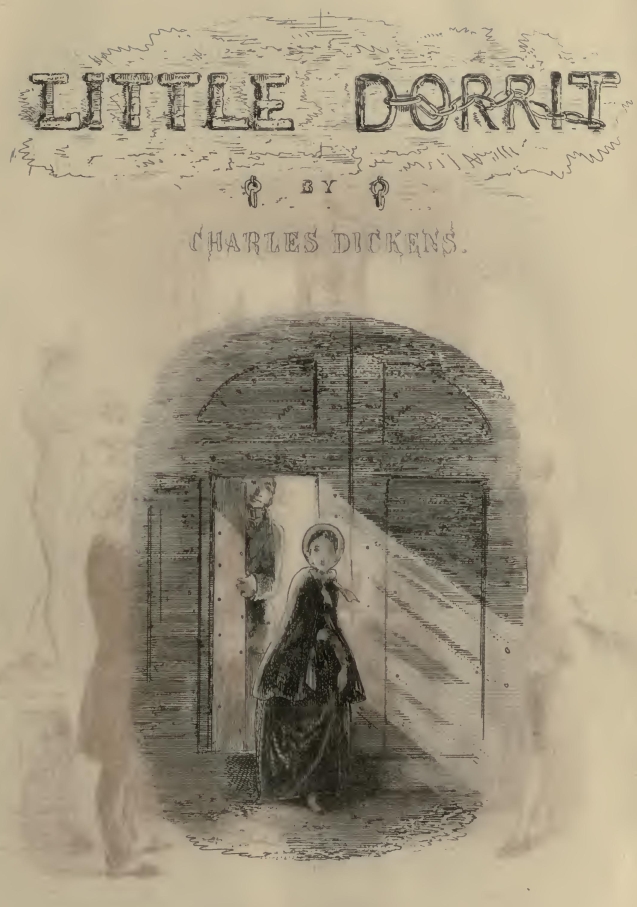 I’m not going to go into a lot of detail about the novel because one of its pleasures is how tense and twisty it is. I will say that one aspect of the novel that I especially enjoyed this time was how nicely Waters uses Little Dorrit to signal some of her own themes. Like Dickens’s novel, which Waters’ protagonist Margaret Prior reads with her mother, Affinity is set in a literal prison but is also very much about metaphorical prisons—social, psychological, and emotional. Much as Dickens does, Waters plays this idea out like a theme and variations, so that various meanings overlap and amplify each other. Margaret is free to come and go from London’s grim Millbank Prison, where she volunteers as a “Lady Visitor” offering company and comfort to the inmates, but she is unable to escape the crushing expectations and limitations of life as an unmarried woman whose interests and desires do not fit the life she is supposed to lead. When the novel’s action begins, she has already tried to commit suicide; thus life itself, to which she was unwillingly returned, is a kind of confinement, and her misery about her circumstances makes her eager to believe in the possibility of spirits that can pass back and forth over the threshold between life and death. Unable to express, much less claim, the love that might make her happy (for her sister-in-law Helen, for example), Margaret is also trapped by her loneliness. When she meets Selina Dawes, imprisoned at Millbank for fraud and assault, she gradually comes to believe that she has found the key that will set her free. Selina, in her turn, seeks liberation, from her literal cell but also from other forces the novel only gradually unveils for us.
 What can these two imprisoned women mean to each other? What place is there for them in the world? I think the main reason I still find Affinity less exciting than Fingersmith is that its answer to these questions is [vague spoiler alert] sadder. Fingersmith goes to pretty bleak places, worse even (perhaps) than the “darks” of Millgate, but something luminous and beautiful emerges at the end. I’ve always remembered Affinity as dour by comparison, and this reading confirmed that impression; its grimness is not lifted in the same way by the sense of possibility, of escape, that the conclusion of Fingersmith offers. I might tentatively say that Affinity is more Gothic while Fingersmith is more Victorian, though like many such period or genre distinctions, that one may confuse more than it illuminates! At any rate, both novels are great reads and I’m glad I gave Affinity another chance. I might reread some of Waters’ other novels this summer: how is it possible that it has already been more than a decade since The Little Stranger came out?

 This is definitely exciting stuff, as is the unusually explicit way in which Nell frames her choice between love and prosperity as a degrading and openly sexual kind of barter:
 The problem for me is that things don’t get this interesting until so far along in the novel. Up to that point, though the ground was certainly being laid, very little actually happened: the novel is almost all talk and no action. Why is that a bad thing, you might ask? Well, it isn’t, of course–not necessarily. Nell is an engaging narrator, and as Pamela Gilbert’s smart introduction to the Broadview edition convincingly argues, her unapologetic desire for Dick makes her an unusual and subversive one as well, as the contemporary reviewer I already quoted from indicates when protesting “the unmaidenly manner” in which she “dwells on her lover’s physical charms.” The relationship between Nell and Dolly is unconventionally fraught, and Dolly herself is an interesting twist as a woman who achieves villainy by her unrepentant pursuit of exactly what nice young woman are supposed to win, namely a “good” (wealthy) husband. Perhaps on a second read I would do better at appreciating these subtler effects. This time, however, I was bored by the lack of plot. A great deal more suspense and excitement might have made up for the long stretches of watery philosophizing like this:
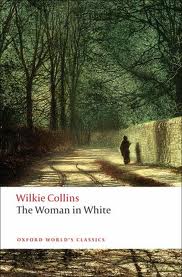 I thought Cometh Up As A Flower would be more in the Collins vein because it is cited as an example of sensation fiction. Gilbert’s introduction is good on the issue of genre. While acknowledging that the novel “is not heavily plotted” and has “little of the crime and madness characteristic” of other sensation novels, she notes that “Broughton gives us desiring heroines, women actuated by sexual desire.” She goes on to link Cometh Up As A Flower to novels of different kinds, including “the religious conversion narrative” and autobiographical fictions including Jane Eyre. I saved the introduction to read until after I’d finished the novel; thinking about it in those terms would probably have given me more patience with the first 250 pages. On the other hand, I was reading it in the first place because I’m shopping for an alternative to Braddon’s Aurora Floyd for my seminar on sensation fiction, which I’m offering again this coming winter term. (I have nothing against Aurora Floyd, but including two novels by the same author has always seemed a bit narrow.) I can see ways in which it would work very well with the other readings (The Woman in White, Lady Audley’s Secret, and East Lynne), both because there are some common themes and because it is so different in tone, style, and treatment. It’s just not as much fun as the others.
 Novel Readings