We watched this meeting with its strange weight of human dignity and goodness. I could not ever have believed that saying sorry might mean so much. None was their government. None bore responsibility. No one spoke for anyone other than themselves. Nothing said or done had any national consequence. Yet in that strange communion lay liberation. What other answer can any of us make to the terrible question of history?
19.
Thomas Ferebee’s body was lit up like a neon tube, his body is lighting up like a neon tube, his body will always light up like a neon tube as until the end of all things the suffering of the dead illuminates the living.
That’s life.
Question 7 is an odd, powerful, poignant, frustrating, beautiful, and perhaps slightly incoherent book. I say “perhaps” because although for me it was a bit too fragmented to be wholly satisfying, it seems possible, even likely, that a rereading would unify it more. It has a lot of moving parts, pun intended: many parts of it are emotionally affecting, and it is composed of a lot of different pieces so lightly connected that at times it felt like I was drifting from one to the next, or that Flanagan’s topics were drifting and only occasionally coming into direct contact with each other.
You can probably tell that I am struggling to figure out Question 7, or how to talk about it. To be honest, something I thought often as I read it is that Flanagan is only allowed to write a book like this because he has earned readers’ trust with his other writing. I don’t mean that it is not a good book: actually, I think it is a very good book. But it is very loose: Flanagan does not do the expository work of tying everything together. Insofar as Question 7 has a unifying idea or argument it’s “that’s life,” which says at once everything and nothing. And by “that’s life” Flanagan does not mean “this is the answer” but “this is the unanswerable question,” or “these are questions we can never answer—that is what it is like being alive.”
Question 7 is a meditation on the strangeness of it all. It is about the atom bomb, and its makers, and their ambition and hubris and, in some cases, their profound regret. It is about H. G. Wells, accidental instigator of one of modernity’s great catastrophes:
without H. G. Wells’s book Leo Szilard would never have conceived of a nuclear chain reaction and without conceiving of a nuclear chain reaction he would never have grown terrified and without growing terrified Leo Szilard would never have persuaded Einstein to lobby Roosevelt and without Einstein lobbying Roosevelt there would have been no Manhattan project . . .
In this grim version of If You Give A Mouse a Cookie, Flanagan continues on to Hiroshima and the bomb that killed thousands of people but also probably saved his father’s life and thus made his own possible:
without Hiroshima there is no me and these words erase themselves and me with it.
Question 7 is, I think, Flanagan puzzling out how to live in a world (the world) where these are the conditions of his own existence.
Question 7 is part memoir, part ghost story (Flanagan himself died at 21 in a kayaking accident but then was revived). It is part tribute to his father, a POW who was enslaved in a Japanese labour camp (and whose experiences lie behind Flanagan’s harrowing novel The Narrow Road to the Deep North). It is also a memorial to his mother: his account of her dying, which he says was “one of the most beautiful things I ever saw,” is itself beautiful and sad and comforting. The book is part meditation on war and part lament for the devastations of climate change. It is about—and here I risk making it sound trite, which it is not—accepting moments of grace, such as the meeting in my epigraph, between Flanagan’s father and three Japanese women, “committed to exposing Japanese war crimes,” who visit him to apologize. If that sounds like a lot, well, it is, and yet the book is not dense or even, despite these difficult topics, heavy.
I said that Question 7 doesn’t tie everything together; that is clearly intentional. In its form as well as its spirit, Flanagan’s book is a rebuttal to the idea, too prevalent, he believes, “that life is infinitely measurable,” that everything can be reduced to metrics. His title comes from a story by Chekhov that is also a rejection of the desire to oversimplify in order to achieve certainty: “Wednesday, June 17, 1881,” the story goes,
a train had to leave station A at 3 a.m. in order to reach station B at 11 p.m.; just as the train was about to depart, however, an order came that the train had to reach station B by 7 p.m. Who loves longer, a man or a woman?
This reminds me of Sissy Jupe refusing to answer her utilitarian teacher’s questions on the terms they have set:
‘Then Mr. M’Choakumchild said he would try me again. And he said, This schoolroom is an immense town, and in it there are a million of inhabitants, and only five-and-twenty are starved to death in the streets, in the course of a year. What is your remark on that proportion? And my remark was—for I couldn’t think of a better one—that I thought it must be just as hard upon those who were starved, whether the others were a million, or a million million. And that was wrong, too.’
“Who?” asks Flanagan, picking up Chekhov’s question:
You, me, a Hiroshima resident or a slave labourer? And why do we do what we do to each other?
That’s question 7.
I will be thinking about this book and its connections and juxtapositions for a long time, and we should probably all be asking ourselves question 7 and trying to get the people in power to answer it better, or differently, then so many of them are currently doing.

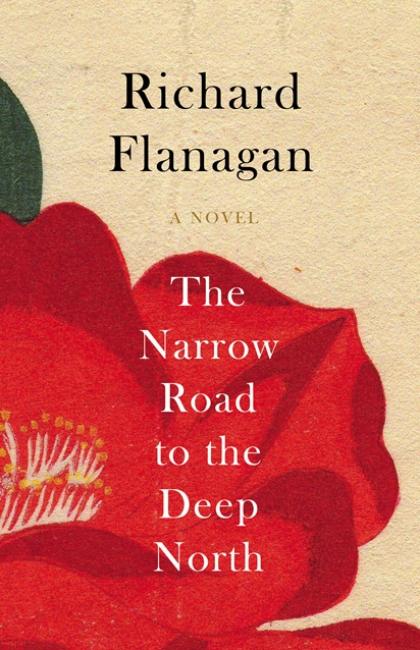 The Narrow Road to the Deep North does gesture towards the value of the private life that Dorrigo has lost faith in. But of all its many parts, the novel’s romance seemed to me the weakest: the story of star-crossed lovers doomed to separation because of a petty deception felt forced, too overt a gesture of the novelist himself, as if he thought we needed that kind of idyllic star to follow through his otherwise unrelentingly dismal narrative. I’m not sure the love story works this way in any case: there’s a suggestion at the very end of the novel that the beauty of love is a “small miracle” worth cherishing even “in the midst of the overwhelming darkness,” but is this the real truth of the novel, or is it an illusion that is beautiful but unsustainable? It isn’t love that sustains Dorrigo in the camp but his own characteristic determination to “charge the windmill”: not to turn back or be daunted by the next hard task, or the next, or the next. What good are dreams of love when you are literally wading through shit? Or, what is the point of wading through shit, unless you believe in love?
 Novel Readings