Sometimes I think that was the happiest day of my life, those hours of heat and silence and colour, alone with David high up on the moor. But then I remember that I have said that of many other days, so I cannot be sure. This I know—that it was almost perfect. Not quite, for perfection is dull: it took the serpent to make Adam and Eve appreciate their garden.
I have had the nice British Library Women Writers edition of O, The Brave Music on my shelves for four or five years. I chose it as one of my samples when the series was launching because I remembered my mother saying it had been a childhood favorite of hers, but somehow I hadn’t gotten around to reading it yet; Shawn’s enthusiastic mention of it in a recent episode was just the nudge I needed. What a treat it was! I really enjoyed it.
O, The Brave Music follows young Ruan Ashley on her bumpy road towards adulthood. We first meet her when she is seven, living in the Manse with her stern preacher father, her beautiful mother, her older sister Sylvia, and her little brother Clem (“will he walk and talk soon,” she asks her father, “like other babies?”). Ruan’s story exemplifies the trend Anita Brookner so aptly describes in Hotel du Lac, by way of her romance novelist protagonist Edith:
In my books it is the mouse-like unassuming girl who gets the hero, while the scornful temptress with whom he has had a stormy affair retreats baffled from the fray, never to return. The tortoise wins every time. This is a lie, of course . . . In real life, of course, it is the hare who wins. Every time. Look around you. And in any case it is my contention that Aesop was writing for the tortoise market. Axiomatically . . . hares have no time to read. They are too busy winning the game. The propaganda goes all the other way, but only because it is the tortoise who is in need of consolation.
Ruan’s youth is full of hardship and loss, but Smith is definitely pitching her story to the “tortoise market” as it is clear from the beginning that (though Ruan herself is not always sure of this) it is better to be smart than beautiful, to love books more than boys, to be wild and free than to be (as Sylvia basically is) conventional and safe. Ruan is the direct descendent of Jane Eyre and Maggie Tulliver (though without their passion or rage) and an avatar of her most likely readers: other bookish girls who know they don’t quite fit the mould and long to be told that they will nonetheless win the game.
 The promise of ultimate victory for Ruan is embodied in David, her playmate, companion, and beloved. I give Smith credit for dangling the possibility that he will not, in the end, be true to Ruan: that her dream will turn out not to be his. Perhaps that would have been a more interesting novel, as it would have put their long alliance into a different light, undermining Ruan’s point of view (the novel is told in her voice)—but Smith spares her, and us, that disappointment. That said, the novel’s ending is surprisingly ambiguous or ‘open,’ and while Ruan is certain that happiness will come for her, “hand in hand with David,” I was reminded of the evasive ending of Villette.
Though the plot is well enough told and I was engaged throughout finding out what happened to Ruan and her odd collection of family and friends, what I liked best about the novel was how beautifully Smith (through Ruan) describes the moor, where Ruan is always happiest:
Now it would be lying asleep, dun and sere under sullen November skies, inimical to many, but never, never to me! Soon the snow would come; here, in these sheltered dales, a mere matter of an hour’s Christmas-card prettiness, followed by days of slush and mud; but oh, how different on the moor! My heart quickened at the memory of mile upon mile of untrodden purity, white as angels’ wings on the uplands, blue-shadowed in the hollows of air like bright sharp swords that you could almost see . . . of the solemn beauty that awed you when you peeped under your blind at night; so still, so vast and pure in the light of the moon, that a lump came in your throat because so much loveliness was not to be borne.
Even in deep grief, the moor brings Ruan life:
Up there, in the pure, clean moorland air, the pattern of life showed more clearly; on a larger scale. I lifted my eyes to the hills; and I perceived how minute, how unimportant, a portion of that pattern we made, all of us, and we no longer seemed to matter greatly.
Things do matter greatly to Ruan—the tension between that uplifting, unworldly liberty and the pull of both love and responsibility marks her maturation and gives the book, which is somewhat episodic overall, some unity and and also some depth. I think today we would categorize O, The Brave Music as “YA” fiction but like other examples of ‘books for younger people’ from an earlier era, it feels more sophisticated to me than much current YA fiction (as do the Pennington books, for example, which were favorites of my childhood and which I still reread with genuine interest).
A side note: the title of Smith’s novel comes from The Rubaiyat of Omar Khayyam (“O, the brave music of a distant drum!” is the line). Many years ago one of my teachers gave me an illustrated edition of the Rubaiyat, inscribed “To Rohan, a ‘rara avis.'” In retrospect, it was perhaps an odd choice, as I was in elementary school at the time. I just thought it was fanciful and beautiful; I was used to reading things I didn’t completely understand and picking out what I liked about them. What mattered most to me about it was that I felt seen, that I felt that being bookish could actually make me stand out in a good way rather than a bad way. I was (and am) very much a tortoise too!
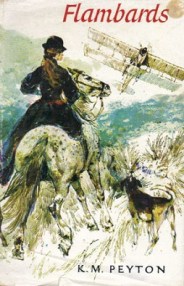 Probably my favourite “YA” novels are K. M. Peyton’s Pennington novels, which I own in library discard copies and reread often. I’m sure I read Flambards in my youth too, but I had only a hazy memory of it, except that it involved a big house and horses. I was helping find books for my daughter at the library last week and, happening upon the handsome Oxford Children’s Classics edition of it on the shelf, grabbed it up for myself–and what a treat it was! It’s such an intelligent book, bringing together a range of historical changes all effectively dramatized through the clashes of personalities and values at Flambards, the house where young orphaned Christina is taken in by her bitter, violent uncle. His desire to hang on to a fading way of life is thwarted by his fallen fortunes as well as by his having been crippled in a fall so that he can no longer ride and hunt. His older son Mark is handsome, arrogant, and determined to follow in his father’s footsteps, a goal for which he will need Christina’s fortune, but it’s the younger son William, whose strengths are intellectual and who loves, not horses, but flying machines, who wins our sympathy as well as Christina–though not before she has a sort of romance with Dick the groom, thus bringing class, also, into the whole vexed business of personal lives that can’t help but reflect the conflicts of their times.
 Novel Readings