I haven’t done a lot of focused reading in the past week or so–I blame (but very much welcomed!) my visiting parents, for diverting me with conversation. I also blame my daughter, who celebrated her 10th birthday on the weekend–an occasion involving much festivity but also, in advance, much planning, bustling, and shopping. Not that we did anything particularly fancy for it (not like last year’s bouncy castle, which really was quite a big deal). This year we had a “pajama day” party, with pillows and “stuffies” and movies, all very cozy. Of course, it would turn out to be the one beautiful sunny day in about a month! But everyone seemed to enjoy curling up to watch, and then we had games (‘freeze dance’ is a ritual favorite with this crowd) and pizza and ice cream sundaes with all the peanut-free toppings I could think of (Maddie’s very allergic).
I have been gathering books to read, though, and puttering through some of them, especially various books (fiction and non-fiction) about Richard III, as I think through what my essay will be about. I haven’t kept up with Ricardian novels since about 1985, and it turns out there have been quite a few, so I’ve been searching them out at the library and taking a look. At this point I’m not inclined to pay much attention to these “new” ones in my essay because they seem, well, awful. I suppose they aren’t, really. What they are is pedestrian and unconvincing. That said, I’ve been wondering: are the old books I cherish, including the two I just reread (The Broken Sword and The White Boar) really any better, or do I just read them through sentimental eyes? I think they are better. For one thing, by and large they avoid tedious attempts to make the characters sound medieval by having them speak in stilted, artificially antique dialogue–like this, from the page that happens to be open in front of me: “Ay, young Richard has proved a good student of arms. I do hear he wields a fierce sword.” You do hear that, do you? 15th-century speakers would have sounded perfectly idiomatic to themselves: I think that (for any but the most ingenious and talented writers) the smartest choice is to make them sound perfectly idiomatic to us, and to let the strangeness of their world-view come through in some other way. An old-fashioned oath or two is fine, and certainly allusions to period details of clothing, food, ritual, whatever. But stay away from ” ‘Tis unnatural in the eyes of God what they are doing” or “Certes, ’tis hard to explain.” Rather than creating an air of authenticity, this kind of labored stuff distances us–or me, at least–from the characters whose immediacy is crucial to our imaginative engagement with the novel. And for crying out loud, leave their loins out of it: across just a few pages of my current example, Anne Easter Smith’s A Rose for the Crown, we get “his exposed loins telling the tale,” “Kate’s loins all but melted into her shaky knees,” and “she experienced the familiar flutter in her heart and stomach that affected her loins.” Our heroine Kate has yet to get passionate with Richard of Gloucester, but I have a familiar flutter of my own that says loins will once more be involved, though maybe this time they’ll keep quiet and stay above the knees. I am hopeful that Jean Plaidy’s The Reluctant Queen will be better. I read and reread Plaidy’s novels as a teenager and have often regretted having discarded most of my collection over the course of many moves. This particular one is unknown to me, though: it is a late one, early 1990s, I think. (One of the unexpected convergences of my thesis research was discovering that the reason Agnes Strickland’s 1840s series Lives of the Queens of England seemed so familiar to me was that Strickland was one of Plaidy’s main sources.) I also dug up Sandra Worth’s The King’s Daughter and took Philippa Gregory’s The White Queen as I roamed the library, as both are at least peripherally about Richard and the Princes in the Tower.
One book I did get through, because I was writing it up for the summer reading feature we’re preparing at Open Letters and I couldn’t resist refreshing my memory, is Pauline Gedge’s The Eagle and the Raven. This is another old favorite, and again it raises the question of how far sentiment affects my judgment. I think I could find passages in The Eagle and the Raven that are as banal and cliched as any in A Rose for the Crown–but overall, I really do think it is fiction of a different order, richer, more challenging, more imaginatively rich. I can’t be quite sure, though, because about half way through it I developed an unnerving tendency to start weeping over every loss or betrayal in the plot, which means over most of the second part of the book. I can certainly be this kind of emotional reader (I’m a Victorianist, remember–I always cry at the end of A Tale of Two Cities too), but I wondered if it was really the tragic failures of the ancient Britons in their struggle against the Roman Empire that made me cry this time: I was full of memories, because of my parents’ visit, and emotionally stirred from reflecting on Maddie’s first completed decade, and The Eagle and the Raven is one of the books that made a great impression on me in my younger years, so that reading it was never just about the book but always about some volatile combination of who I was, who I am now, where I am now (literally and figuratively), and so on. How could I possibly assess its literary quality in these circumstances? And, I suppose, why would I really want to? I loved rereading it, so much that I think I may soon reread Gedge’s first novel, Child of the Morning, about Hatshepsut, Egypt’s only woman pharaoh–another old-time favorite.
Among the other books I have collected for my TBR pile recently is Testament of a Generation, the collected journalism of Vera Brittain and Winifred Holtby: I ordered “a lovely copy” through Abebooks (actually, from Silver Tree Books in Malvern, in the UK), and it finally arrived once the postal dispute was concluded (I won’t say “settled,” since it wasn’t, not properly). I’m more interested in reading this than in reading any more about Brittain and Holtby just yet, but I’ve also got Testament of Experience waiting. My mother and I had a nice browse at the Jade *W* downtown, too, and while she took home about 5 more books about Virginia Woolf to add to her impressive collection as well as their copy of Ursula Nordstrom’s Dear Genius (which I really hope she enjoys–I rather urged it on her!), I took Rebecca West’s The Fountain Overflows and This Real Night from their well-hidden Virago section.
First up for some sustained attention, though–which will have to be tomorrow–is Somerset Maugham’s Cakes and Ale for the Slaves of Golconda. It is worrisome to me that I read this barely a month ago (mistakenly thinking that was our deadline) and can barely recall it now! But I’m sure it will all come back to me, especially since I see I made some helpful little notes in the back of my copy.
And that’s a start on getting back to blogging. I was actually starting to feel quite fretful about not having written anything here for so long, not because I felt guilty but because I felt sort of pent up, even with nothing in particular to write about.
 George Eliot considered the writing of historical fiction “a task which can only be justified by the rarest concurrence of acquirement with genius,” requiring “a form of imaginative power [which] must always be among the very rarest, because it demands as much accurate and minute knowledge as creative vigour.” Novels of “the modern antique school have a ponderous, a leaden kind of fatuity,” she complained, “under which we groan.” The extraordinary difficulty of the genre is testified to by her own attempt “to reanimate the past” in Romola, the only one of her novels set back more than a couple of generations. She began writing Romola as a young woman and ended it an old one, she said herself, and having worked through the novel recently in my graduate seminar, I know that the effort it demands can make it feel as if it is having the same effect on its readers. To be sure, Romola does have its thrilling moments, and it certainly demonstrates both “accurate and minute knowledge” and “creative vigour”–just not always at the same time, or always in harmony with each other. And there’s the whole “cheese to the macaroni” moment…but I digress from my main point, which is that really good historical fiction is really hard to write, and thus really rare to read.
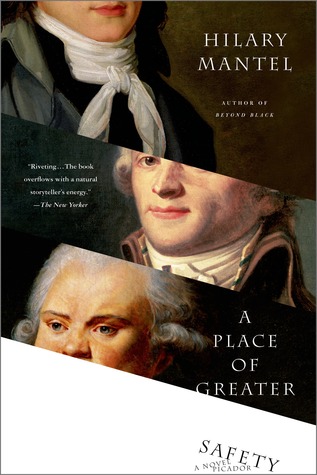
 Many of the same qualities and techniques are evident in Mantel’s earlier novel A Place of Greater Safety, particularly the lack of sentimentality and the sharpness of the writing, which is at once prolix and poignant, even uncomfortable–if, as I recently suggested, reading Ian McEwan’s prose is like getting acupuncture to your brain, I found reading A Place of Greater Safety akin to walking barefoot across a stretch of gravel towards a graveyard: you aren’t particularly enjoying the experience, but it has its own vividness and particularity, and there’s a morbid fascination in the direction you know you’re headed. (I seem to be finding my reading especially, if only metaphorically, tactile lately.) A Place of Greater Safety also, like Wolf Hall, builds momentum gradually by developing our relationship, with not just one complicated protagonist this time, but with three, the revolutionary triumverate of Georges-Jacques Danton, Camille Desmoulins, and Maximilien Robespierre. Again, there are neither heroes nor villains in this crowd, though each has his heroic, as well as his villainous, moments. (Desmoulins, beautiful, erratic, alternately effervescent and enervated, and writing, always writing, seemed to me a particularly brilliant characterization.) And just as Wolf Hall only incidentally informs its readers about the causes and contexts of the Reformation, A Place of Greater Safety eschews the potential pedagogical role of the historical novel. At the end of its 750 pages I really didn’t feel much better informed about the events or even the political and philosophical stakes of the French Revolution than I was already. Here again, Mantel adopts a slantwise approach: not altogether personal, not just the ‘human story’ of the men and women who lived it, but not abstract, theoretical, or fully contextualized either. Here’s a rare but characteristic ‘explanatory’ passage, terse and ominously proleptic:
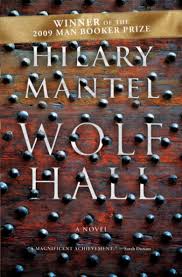 It’s tribute to Mantel’s peculiar gifts and strategies as a storyteller that she assembles an even less attractive crew here than in Wolf Hall and yet what matters is not how appealing they are but how compelling they are, and how intensely themselves, so that by the final chapter, as the Revolution devours its children, I didn’t care who they were, really, only that they were going to die, after my having known them for so long. Mantel manages their end (known from the novel’s beginning because, after all, it is history) without any of the tumbril sentimentality the inevitable Dickens comparisons on the jacket blurb might lead us to anticipate. None of the characters comes across as heroic or noble, but they have such great vitality (even Robespierre, with his tedious incorruptibility), that their deaths felt like great losses–losses, quite simply, of life, of the energy and lust for life, for words, and for action, that characterized them all. Again, a sample of her terse, epigrammatic style:
 . I knew from the book blurb, of course, what this protagonist’s career path was going to be, but somehow it wasn’t until the first few descriptions of her ‘at work’ that I felt strongly that I had already read all this–or near enough–and that for all that it sounded so promising (especially because I have heard such interesting things about Donoghue, though admittedly in the context of her other works), this novel was not going to surprise me by offering a new idea about it all, or even an especially gripping account. Mary Saunders never became a fully realized character for me; she seemed inconsistent, and once in a while said or did things that seemed like deliberate efforts to make the book more serious and thematically rich–but when you are struck with something as an effort, of course the implication is that the effort is not successful, or the whole would be better integrated, more compelling. It still seems like a very good idea to put a story like this together “from the headlines,” as it were, and I thought the fabric / clothing motif had great potential, but again, it was brought up intermittently in a way that seemed effortful rather than inevitable. Mary’s fate would have made first-person narration a bit problematic, perhaps (“as told to”?), but as the novel stands it suffers from uneven handling of point of view. Most of it, including the entire first section, is from Mary’s, but in the second part, for no apparent reason we begin to get different perspectives. The result is a diffusion of our sympathy and attention–not that Abi, for instance, doesn’t (again) have a lot of potential as a character, but why in this novel? Just because it’s interesting to get in some material about black people in 18th-century England? One final comment is that the great novel about a woman on the make in 18th C England has surely already been written (Moll Flanders): I didn’t see any evidence that Donoghue had looked to this obvious predecessor for the spirit or flavour of her own, markedly humourless version.
 Novel Readings