Once it became more solid, the emerging story and all its ramifications and possibilities lifted him out of the gloom of his failure. He grew determined that he would become more hardworking now. He took up his pen again — the pen of all his unforgettable efforts and sacred struggles. It was now, he believed, that he would do the work of his life. He was ready to begin again, to return to the old high art of fiction with ambitions now too deep and pure for any utterance.
As I finished reading yet another not-very-good novel about George Eliot (Dinitia Smith’s The Honeymoon, review forthcoming), I found myself wondering why she has been so ill-served by later novelists who obviously (judging by their choice of subject) found her very inspiring. But I suppose in some ways it’s a thankless task, deliberately to set yourself against one of the geniuses of your genre: you can’t help but invite comparison, and you have to find a way to be not just connected to your source but also brilliant on your own terms. Naturally, this got me wondering where the good examples are of what we might call “homage fiction” — and this led me to The Master, which has been ripening on my bookshelves for a few years now.
The Master is a book I have long wanted to read, but my intention to actually do so kept getting undermined by my fear that reading it would be like reading the Master himself. He’s a writer with whom I have a vexed relationship: usually when I read him I’m equal parts fascinated and repelled, impressed and impatient. I sometimes feel a bit resentful of him — of his influence on people’s thinking about the art of fiction, for instance — but I love his actual essay on “The Art of Fiction.” Even in my best Jamesian moments, I can’t muster anything like the enthusiasm for him that, say, Jessa Crispin has expressed — I find him too claustrophobic in his meticulousness — but at the same time he’s a writer I can’t resist wrestling with.
I have not so far been a great Colm Tóibín fan either. My only previous experience is Brooklyn, which I also found a bit too perfect, though not so much for any particularly Jamesian qualities as in its replication of its protagonist’s emotional suppression. There’s a fine line between representing and enacting flatness and inertia. And yet even though I was mostly unmoved by Brooklyn, I could tell that Tóibín was a writer to trust — smart, skilled, deliberate. So I hung on to The Master, as if I knew that its day would come! 
I’m glad it finally did, because I thought it was wonderful. I knew only snippets about James’s biography before, and I’m not at all familiar with his letters or other key sources, so I don’t know how far Tóibín has shaped the story in a distinctive way or how far his Henry is recognizable to people who already knew him well from other versions. But to me, Tóibín’s character was immediately convincing because he was so specific, so somehow complete, not just as a man but (more important, perhaps, in a Jamesian context) as a point of view. The Master read like a novel looking at the world from a very particular consciousness, which of course is the crucial twist James gave to the form himself — not that he was the first to do this, but he developed and concentrated the technique until its very singularity perversely crowded out some of the other things novelists valued (or were valued for). Tóibín’s novel isn’t quite as insular as its inspiration’s can be, but it seemed to me very much a novel of looking, rather than doing: it’s a novel about a man for whom the meaning of an action is more significant than the action itself.
Tóibín does a beautiful job showing how James’s novels arose from that way of being in the world. He doesn’t avoid making the literal connections between biographical events and real-life relationships and James’s plots and character — in his detailed account, for instance, of James’s cousin Minny, resurrected particularly in Isabel Archer:
he had a great mission now to make Minny walk these streets, to allow the soft Tuscan sunlight to shine on her soft face. But more than that, he sought to re-create her moral presence more finely and more dramatically than he had ever done before.
But Tóibín also evokes the creative mysteries that underlie the transformation of life into art: we feel the ideas for new stories glimmer in Henry’s mind before they take any final form, and see them as part of a broader striving to elucidate and connect both people and ideas. His Henry’s mind is always at work, observing details (“Henry noticed how beautiful his shoes were and how slender his feet”), puzzling over nuances, shaping thoughts into the elegantly complex sentences which Tóibín can hardly resist invoking in his own prose (“He dictated with his usual mixture of certainty and hesitation, stopping briefly and darting forward again, and then going to the window, as if to find the word or phrase he sought in the garden, among the shrubs or the creepers or the abundant growth of late summer, and turning back deliberately into the cool room with the right phrase in his head and the sentence which followed until the paragraph had been completed”).
 Something that moved me deeply about Tóibín’s vision is that, as he tells it, there really are costs to such an extraordinarily intellectual life. It isn’t easy to be “one of those on whom nothing is lost”: The Master is suffused with melancholy, and with a strange, contradictory longing for decisive moments that never quite arrive, for connections that are never quite achieved. Every time Henry ventures further out into the world, whether literally or emotionally, just as promptly he retreats. For him, to be fully himself is, paradoxically, to be distant from himself; his best company, it sometimes seems, is his memory, but that is an equivocal solace:
Alice was dead now, Aunt Kate was in her grave, the parents who noticed nothing also lay inert under the ground, and William was miles away in his own world, where he would stay. And there was silence now in Kensington, not a sound in the house, except the sound, like a vague cry in the distance, of his own great solitude, and his memory working like grief, the past coming to him with its arm outstretched, looking for comfort.
The Master overall is a mournful book, as if the great achievements of its protagonist came, in some sense, at the his own expense. But at the same time, Tóibín shows us a Henry who is happiest precisely at that remove from liveliness. I was struck, at the very end, by the unexpected image of young Henry wholly absorbed in David Copperfield, reading, as David himself says, “as if for life.” In some ways it’s hard to imagine a less Jamesian novel than David Copperfield: although both David and Henry find their vocation in writing fictions of their own, David — and Dickens — has a vitality I’ve never found in James. Tóibín’s Henry seems at once wistfully aware that such energetic engagement is not for him and quietly content that it should be so — that he should be, at the end of the day (at the end of his days) alone with his thoughts.

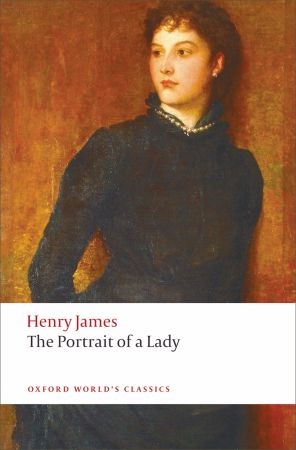
 What renders [James’s method] distinct from, say, Thackeray’s method, with which it has been compared, or from George Eliot’s, is the limitation of the favorite generalizations and analyses. If the reader will attend, he will see that these take place quite exclusively within the boundaries of the story and characters. That is to say, when the people in the book stop acting or speaking, it is to give the novelist an opportunity, not to indulge in general reflections, having applications to all sorts and conditions of men, of whom his dramatis personae are but a part, — he has no desire to share humanity with them, — but to make acute reflections upon these particular people, and to explain more thoroughly than their words and acts can the motives which lie behind. . . .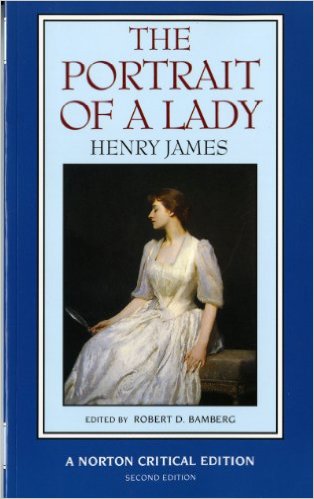
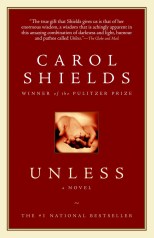 In a way, this post is also about “this week in my classes,” as it is prompted by the serendipitous convergence of my current reading around questions we’ve been discussing since we started working on Carol Shields’ Unless in my section of Intro to Lit. In our first session on the novel, I give some introductory remarks about Shields — a life and times overview, and then some suggestions about themes that interested her, especially in relation to Unless. One of the things I pointed out is that she also wrote a biography of Jane Austen; in an interview, Shields said “Jane Austen is important to me because she demonstrates how large narratives can occupy small spaces.” We come to Shields right after working through Woolf’s A Room of One’s Own, so I also bring up Woolf’s pointed remark: “This is an important book, the critic assumes, because it deals with war. This is an insignificant book because it deals with the feelings of women in a drawing room.” Both Shields and Woolf are thinking about the relationship between scale and significance, and both of them are drawing our attention to the ways assumptions about what matters — in literature, particularly, since that’s their primary context — have historically been gendered.
 Reta’s redrafting is disrupted by her editor, an officious American (of course! Unless is a Canadian novel, after all) named Arthur Springer who has even bigger plans for Thyme in Bloom, which (significantly) he proposes she retitle simply Bloom. His idea is that Alicia should fade into the background while Roman emerges as the “moral center” of the novel. This, he insists, is necessary for the novel to graduate from “popular fiction” to “quality fiction.” He also proposes that Reta retreat behind her initials: she will become R. R. Summers (“Winters” is her husband’s surname). This way her new (“quality”) book can’t possibly be associated with her, or with her earlier (“popular”) novel.
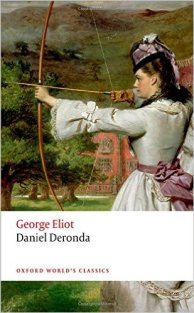 One of them is Daniel Deronda, which I’ve just finished reading with my graduate students. This novel is famously bifurcated between Gwendolen’s story (a highly personal, small-scale drama) — and Daniel’s (which starts out on a similarly domestic scale but opens out into a potentially epic, world-historical story). Is Gwendolen condemned to insignificance when she is left behind to suffer at home while Daniel goes off to (perhaps) found a nation? The literal scale of Eliot’s treatment of Gwendolen is not belittling: she gets at least half the huge novel to herself, after all. Perhaps this novel insists, formally, on an equivalence between two kinds of significance, one of which occupies a small space. Or perhaps what’s significant is Gwendolen’s discovery of her own insignificance. “Could there be a slenderer, more insignificant thread in human history,” asks the narrator,
 Neither of these novels, however, whatever their differences, feels in any way light, despite the intimacy of their core casts of characters. It’s the treatment, not the subject, that gives literary significance, isn’t it? Austen’s novels don’t feel trite even though viewed narrowly they are “just” about a handful of “ladies and gentlemen, in their elegant but confined houses” (in Charlotte Bronte’s words) — because her love stories are also stories about values and class structures and social changes with far-reaching effects. When Isabel Archer accepts Gilbert Osmond’s proposal, it feels large because James has imbued Isabel’s choices with philosophical consequence: her decision isn’t just to marry or not to marry, but about how to use her freedom, and about what to value and how to value herself. These are personal questions but also abstract ones, and so the small space of her individual life occupies a large narrative (by which I don’t mean, though I could, just a long book).
 I have been thinking that this constellation of questions (not really any answers) is relevant to the discussions about why, say, Jonathan Franzen’s novels about family and private life get treated as more significant than some other books that are about similar topics. Gender may well be part of the explanation, but it would be disingenuous to pretend we don’t know that some books by both men and women simply do more with their material than others, and that that scale — the scale of meaning, of treatment — is ultimately where literary significance lies. But this post has gone on long enough without really arriving anywhere in particular, so that’s probably as good a place to stop as any.
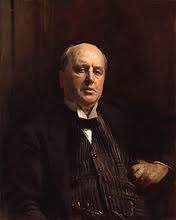 We interrupt our regular programming (specifically, a pending but dispensable installment of ‘This Week In My Classes,’ featuring more moping about how badly Woolf’s A Room of One’s Own always seems to go over with my first-year students, plus some rueful ruminations on my own inability to shut up and let the students in my graduate seminar talk more) for this important preliminary observation about rereading The Portrait of a Lady:
 So far (a mere 75 pages into this edition’s 490) the prose of Portrait itself is only occasionally as baroque as the Preface, but the sentences do often have a similar halting quality (“he was not romantically, he was much rather obscurely, handsome”). More frequently, they oblige me to start them over because I’ve lost track along the way of exactly what the subject and main verb are:
 I’m not irritated at Isabel, though. In the Preface James quotes a line from Daniel Deronda that captures the inspiration for his own novel: “In these frail vessels is borne onward through the ages the treasure of human affection.” “How absolutely, how inordinately,” he says, these frail vessels “insist on mattering”: what he wanted was to write a novel in which, despite that fragility, the “vessel” would bear the whole weight, without “having [her] inadequacy eked out with comic relief and underplots,” as he notes George Eliot did with Hetty and Maggie and Rosamond and Gwendolen. “Place the centre of the subject in the young woman’s own consciousness,” as he puts it, “and you get as interesting and as beautiful a difficulty as you could wish. . . . So far I reasoned,
 Novel Readings