The flimsy walls did not shut out the world but made a sounding box for it; through every crack the smell of the world crept in, the smell of rain and sun and earth and the deodar trees and a wind strangely scented with tea. Here the bell did not command, it sounded doubtful against the gulf; the wind took the notes away and yet it brought the sound of the bells at Goontu very strongly; pagan temple bells. And everywhere in front of them was that far horizon and the eagles in the gulf below the snow.
My interest was piqued in Rumer Godden’s fiction by Margaret Drabble’s discussion in the TLS a few months back. Until then I really only knew her for her children’s Christmas story “The Story of Holly and Ivy,” which we had in this edition with its bright, beautiful illustrations by Barbara Cooney. Drabble’s discussion of China Court is not itself very encouraging, and yet she still made it, and Godden, sound interesting: “the novel is irredeemably quaint, an unlikely romance in a Cornish setting of china clay pits and wild moorland and dismal graveyards.” Yes, please! In her piece, Drabble mentioned Black Narcissus, which I then looked up, and in doing so I discovered that Virago was reissuing a number of Godden’s novels, and then there some of them were in Bookmark, and we all know how that kind of thing turns out. 😉
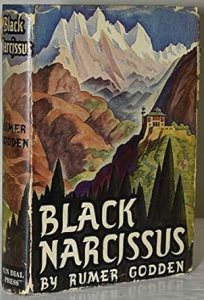
In her introduction to the new edition of Black Narcissus, Amanda Coe describes it as a “perfect novel” that “has the atmosphere and self-sufficiency of a dream.” It belongs to the genre of the “nun novel,” if there is such a thing (there’s The Corner That Held Them, of course, and Matrix, and Stoneyard Devotional, just for starters), but it also belongs to the broader category of novels about struggles between faith and feeling, or desire and duty, and it is a novel about empire, and about Englishwomen abroad.
 The nuns in this case have traveled to India to set up shop in what was previously St Saviour’s School, run by “the Brotherhood,” but which earlier had been known as “the House of Women,” meaning women with very different roles and habits (!) than those under the leadership of the staunch and upright Sister Clodagh. As they make their way to their new establishment, one of them, Sister Ruth, comments that she would like to know “why the Brothers went away so soon.” Sister Clodagh cannot give a direct answer, and she keeps her own doubts to herself: “she had lain awake thinking that they should not have come.”
They begin their mission full of confidence and “a kind of ecstasy” at the beauty of the setting:
They woke in the late October mornings before the sun had reached the hills, and saw its light travel down from snow and cloud over the hills, until it reached the other clouds that lay like curds in the bottom of the valley. The mountain stood out, glittering into the air.
About China Court, which I have not read, Drabble says “the tone is too floral, not to say florid”; I did not think that at all about Black Narcissus, which has a lot of vividly descriptive language that is typically, as in this example, held in check by a note of unease or discomfort (“curds” is a jarring simile here!). Also, it seems essential to the underlying conflicts in Black Narcissus that the landscape be sensual as well as strange—that we feel something of the same push and pull it creates in the nuns, who find the sheer drama of the views from their new home distracting:
At recreation they walked on the terrace and sat on the block to watch the views, but that was not enough. Sister Honey would stop with a needle in one hand and the cotton in the other, gaping out of the window, and sometimes Sister Philippa would find that it had taken her an hour to pick the cosmos for the altar vases. She was standing in the flowers, red and clove pink and ivory as high as her breast, and her hands were empty.
‘Even in my thoughts I’m discourteous and ungrateful,’ she sighed. ‘We came here to work for God and here I am already neglecting the smallest things I have to do for him.’
‘I think you can see too far,’ Sister Philippa says;
‘I look across there, and then I can’t see the potato I’m planting and it doesn’t seem to matter whether I plant it or not.’
There are also human distractions. Chief among them is Mr. Dean, the agent of the General whose property their new home is. Mr. Dean, with his “charming dissipated face” and too much skin showing through the tatters of his shirt, embodies the slide into dissolute sensuality that threatens the nuns’ holy intentions. He helps the nuns, but also warns them: “It’s no place to put a nunnery.” His presence stirs up memories in Sister Clodagh of a lost love, and more immediate feelings in some of the other sisters that become the main engine of the novel’s plot, along with the disruptive presence of a beautiful young girl and the General’s handsome nephew Dilip Rai, who (in spite of their misgivings) joins the nuns as a pupil. “Won’t you be letting a cuckoo into your nest,” asks Mr. Dean, which is both stating the obvious and a sign that he knows better than the nuns do that they may not be strong enough to resist the instincts they have chosen to deny. Once all these plot pieces are in place, the story plays out with a kind of inevitability that still manages to be surprising in its details—which I won’t give away, except to say that the novel’s structure is elegant, bringing us back to where we began with a powerful awareness of what has changed, and perhaps been learned, in the meantime.
 There are lots of interesting aspects to Black Narcissus. It trades in some familiar tropes around the “exotic east,” but I basically agree with Coe that Godden seems very in control of these, aware and critical of rather than acquiescent in them:
Godden, who grew up in India at the beginning of the twentieth century, is unflinchingly contemptuous of the knee-jerk assertions of colonial superiority espoused by Clodagh and her nuns. Her sympathies clearly lie with the would-be colonised, who have no desire to be taught or interfered with.
In this respect the novel reminded me of A Passage to India, which I think takes a similar risk in appearing to indulge while really undermining its English characters’ world views.
I was particularly struck by Mr. Dean’s criticisms of the nuns’ version of religion, which he explicitly finds (pun intended!) cloistered and stifling. When he sees the plans for their new chapel, to be built on the exact model of the Order’s English chapel, including imported stalls and carpets and tiles and reproductions of the stained glass windows, he is disdainful and makes them an alternative design, open to the air and sky, “made so that the path comes right through it, and the people are going and coming through it all day long.” “A chapel shouldn’t be sacred,” he yells, when they dismiss his plan as inappropriate, “but as free and as useful as the path I put it on.” It’s not just that their English chapel is an imposition but that it fundamentally misrepresents what he thinks religion should be. His chapel, in contrast, will be “‘for all life. All life,’ he repeated, reverently, ‘which is God.'”
I really liked Black Narcissus, enough that now I want to read another of Godden’s nun novels, In This House of Brede: “Bruised by tragedy,” says the Virago blurb,
Philippa Talbot leaves behind a successful career with the civil service for a new calling: to join an enclosed order of Benedictine nuns. In this small community of fewer than one hundred women, she soon discovers all the human frailties: jealousy, love, despair. But each crisis of heart and conscience is guided by the compassion and intelligence of the Abbess and by the Sisters’ shared bond of faith and ritual. Away from the world, and yet at one with it, Philippa must learn to forgive and forget her past . . .
How great does that sound? Unfortunately (or not), Bookmark is closed today, but they’ll be open again tomorrow!
 Novel Readings