Novel Readings are Good for You

The Globe and Mail‘s books section this weekend includes an “endpaper” by Liam Durcan touching on some of the recent research into the benefits of reading fiction:

In a recent study conducted by University of Toronto psychologists, subjects who read a short story in The New Yorker had higher scores on social reasoning tests than those who had read an essay from the same magazine. The researchers concluded that there was something in the experience of reading fiction that made the subjects more empathetic (or at least take a test more empathetically). The study provided some proof for what has often been intuitively argued: Fiction is, in some very important ways, good for us. (read the rest here)

I’m reasonably confident that the “University of Toronto psychologists” involved would include the authors of the interesting blog On Fiction. Inquiring into the and why of these effects, Durcan also cites Lisa Zunshine’s Why We Read Fiction, which explores literary reading in the context of developmental psychology, particularly “theory of mind”:

Zunshine, who is part of a growing school of cognitive literary theorists, goes so far as to describe the novel as a “sustained theory of mind exercise.” As we read the multilayered intentionalities of Virginia Woolf or James Joyce, we not only experience complex and contingent mental states, but we evaluate them as well, and as the narrative moves forward, we use our skills as mind readers, constantly testing our hypotheses about this fictional world and its experimental personalities.

Using Nabokov’s Pale Fire as an example, Zunshine relates how severely our theory-of-mind abilities can be tested and how ably we respond when she describes the creeping unease and perverse thrill, well known to any reader, that come with the unmasking of an unreliable narrator. The ambiguities and psychological nuances that characterize fiction provide an unrivalled training ground for our abilities as readers of mental states.

Durcan raises the inevitable and important point that, while “a taste for fiction” may contribute to the development of empathy and thus, we might hope, morality, it is neither a necessary nor a sufficient condition for either: “the list of highly cultured and well-read despots is depressingly long.” (Richard Posner emphasizes this problem in “Against Ethical Criticism,”responding to Wayne Booth and Martha Nussbaum, the latter of whom in particular has made strong claims, in works such as Poetic Justice, for the social and other goods that reading fiction might enhance.) Nonetheless, as Durcan concludes,

Fiction offers the transformative experience of getting out of our heads and into the head of “the other.” And from that privileged vantage point, anything is possible. Perhaps even the chance to see ourselves more clearly.

One of the strongest proponents of this theory is, of course, George Eliot:

The greatest benefit we owe to the artist, whether painter, poet, or novelist, is the extension of our sympathies. Appeals founded on generalizations and statistics require a sympathy ready-made, a moral sentiment already in activity; but a picture of human life such as a great artist can give, surprises even the trivial and the selfish into that attention to what is apart from themselves, which may be called the raw material of moral sentiment.

Her novels, which she called “experiments in life,” are also experiments in bringing about such “transformative” experiences by knocking her readers askew from their usual “vantage points” and into the heads of others.

I do think one of the challenges of these hopeful approaches to fiction is figuring out how it matters which fiction in particular people read. Even empathy, after all, is not a universal good; I’m reminded of Wayne Booth’s comments on Robbe-Grillet’s The Voyeur (in The Rhetoric of Fiction):

The book is a brilliant culmination of more than a hundred years of experimentation with inside views and the sympathetic identification they can yield. It does, indeed, lead us to experience intensely the sensations and emotions of a homicidal maniac. But is this really what we go to literature for?

A fair question! And presumably it also matters how we read what we read–an inquiry which might go some way towards explaining the “cultured despots” phenomenon.

Peeping into Victorian Writers’ Rooms

Like the Victorian Peeper, I enjoy the Guardian’s series on writers’ rooms. On her site, she has kindly assembled a list of the featured Victorian Writers’ Rooms, including “The spartan shed behind a modest house in Ayot St Lawrence, built on a platform that rotated with the sun, in which George Bernard Shaw churned out his voluminous correspondence” and “the ‘perfection of warmth, snugness, and comfort’ that was the Haworth Parsonage parlour in which Charlotte Brontë wrote,” as well as the rooms of “Contemporary writers of particular interest to Victorianists.”

I looked around online a bit to see if I could find any images of George Eliot’s rooms to add to this collection, but I couldn’t seem to come up with one, though I learned that the museum in Nuneaton, Coventry has a “recreated drawing room” in which “they display her grand piano and writing desk.”

I find it interesting the particular kind of attachment different writers inspire in their readers. George Eliot certainly has many devoted readers (and a virtual visit to her grave provides evidence that they can be as passionate or as sentimental as, say, the average Bronte devotee–and, as a side note, apparently indifferent to the irony of leaving Bible verses as tributes to a famous non-believer). But I think it’s safe to say that she is not cherished by the general reading public the way Dickens is, or the Brontes are, and certainly not the way Jane Austen is. If the threatened promised big-screen version of Middlemarch ever comes out, maybe there will be a wave of Eliot-mania. But then, she was ambivalent about popular success herself, remarking in a letter that “if too many people like my novels, I must be doing something wrong.”

Read On: Adam Bede Chapters 17-21


Our Adam Bede reading project at The Valve continues; this week’s installment includes the famous Chapter 17, with its credo of realism:

All honour and reverence to the divine beauty of form! Let us cultivate it to the utmost in men, women, and children–in our gardens and in our houses. But let us love that other beauty too, which lies in no secret of proportion, but in the secret of deep human sympathy…. [D]o not impose on us any aesthetic rules which shall banish from the region of Art those old women scraping carrots with their work-worn hands, those heavy clowns taking holiday in a dingy pot-house, those rounded backs and stupid weather-beaten faces that have bent over the spade and done the rough work of the world–those homes with their tin pans, their brown pitchers, their rough curs, and their clusters of onions. In this world there are so many of these common, coarse people, who have no picturesque, sentimental wretchedness! It is no needful we should remember their existence, else we may happen to leave them quite out of our religion and philosophy, and frame lofty theories which only fit a world of extremes. Therefore let Art always remind us of them; therefore let us always have men ready to give the loving pains of a life to the faithful representing of commonplace things….

Comments welcome.

Adam Bede at The Valve

OK, it’s up: the first invitation to post comments about Adam Bede as part of The Valve‘s “summer reading project.” I couldn’t resist pasting in a nice long excerpt from “The Natural History of German Life” as a prelude. Hey, it’s my party, and I’ll drone on and on if I want to… Click over and speak your piece about Chapters I-V.

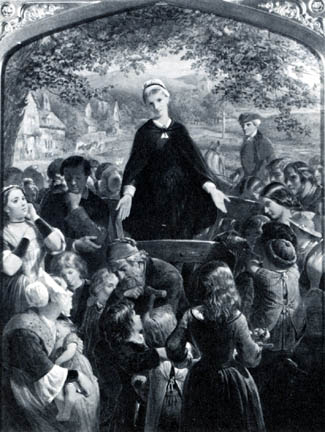
Corbould, Dinah Morris Preaching on Hayslope Green

Adam Bede at The Valve

At my instigation, The Valve is hosting a Reading Project this summer. We’ll be collectively working our way through George Eliot’s Adam Bede; here’s the schedule:

June 17 Book 1 Chapters 1-5June 24 Book I Chapters 6-11

July 1 Book I Chapters 12-16

July 8 Book II (Chapters 17-21)

July 15 Book III (Chapters 22-26)

July 22 Book IV (Chapters 27-35)

July 29 Book V (Chapters 36-48)

August 5 Book VI and Epilogue

August 12 General Discussion

Anyone interested is welcome to read along. The idea is to complete the specified chapters by the date given. A post will then go up at The Valve soliciting comments. People who keep their own blogs are free to do their posts at ‘home’ and put links to them in the Valve threads. At least to begin with, there are really no other rules. Come over and play!

Related Links:

The Victorian Web’s George Eliot page

George Eliot Resource Page (Mitsuharu Matsuoka, Nagoya)–includes information about the George Eliot Fellowship

BBC Warwickshire George Eliot Photo Archive

George Eliot biography (from a nice student project at the University of Virginia)

Adam Bede searchable etext (Princeton)

Adam Bede etext (Adelaide)

“George Eliot” by Virginia Woolf

Buy the Book:


From the Book Depository (UK)

From Chapters.Indigo.Ca

From Amazon.Com

For your Kindle

Zadie Smith on George Eliot: the “Secular Laureate of Revelation”

In The Guardian this weekend, there’s a nice long piece by Zadie Smith on George Eliot. (Thanks to Nigel Beale for making sure I didn’t miss this.) Though I would quibble over some details (I don’t agree, for instance, with the characterization of Middlemarch as “messy”), I am impressed at the level of detail and thoughtfulness in Smith’s discussion. She starts with Henry James’s assessment of the novel–well-travelled territory, but she finds her own way through his specific obtuseness about the significance of Fred Vincy. “[Y]ou can see why Henry didn’t have much time for Fred,” she says, but she offers a compelling analysis of Fred’s significance to both the philosophy of the novel (which she carefully addresses in terms of Eliot’s affinities to Spinoza) and to its form, in which there are of necessity many centers, not just one. A sample:

Fred is in love with a good girl; a girl who does not love him because he is not worthy; Fred agrees with her. Maybe the point is this: of all the people striving in Middlemarch, only Fred is striving for a thing worth striving for. Dorothea mistakes Casaubon terribly, as Lydgate mistakes Rosamund, but Fred thinks Mary is worth having, that she is probably a good in the world, or at least, good for him (“She is the best girl I know!”) – and he’s right. Of all of them Fred has neither chosen a chimerical good, nor radically mistaken his own nature. He’s not as dim as he seems. He doesn’t idealise his good as Dorothea does when she imagines Casaubon a second Milton, and he doesn’t settle on a good a priori, like Lydgate, who has long believed that a doting, mindless girl is just what a man of science needs. What Fred surmises of the good he stumbles upon almost by accident, and only as a consequence of being fully in life and around life, by being open to its vagaries simply because he is in possession of no theory to impose upon it.

A bit later on,

If Fred didn’t love Mary, he would have no reason to exercise his imagination on her family. It’s love that makes him realise that two women without their savings are a real thing in the world and not merely incidental to his own sense of dishonour. It’s love that enables him to feel another’s pain as if it were his own. For Eliot, in the absence of God, all our moral tests must take place on this earth and have their rewards and punishments here. We are each other’s lesson, each other’s duty. This turns out to be a doctrine peculiarly suited to a certain kind of novel writing. Middlemarch is a dazzling dramatisation of earthly human striving.

I don’t feel Smith is as smart about the form of Middlemarch as she is about some of its themes and philosophical interests. Near the end she remarks that the novel “seems to hint at those doubts in the efficacy of narrative that were to follow in the next century. Why always Dorothea, why heroes, why the centrality of a certain character in a narrative, why narrative at all? Eliot, being a Victorian, did not go all the way down that road.” I don’t see “why narrative at all?” as one of Eliot’s questions–which may, perhaps, have something to do with being Victorian, but Smith’s phrasing has the patronizing undertones of modernism. Eliot was not trying to get away from narrative (is that even possible?) but to revise it, and particularly to get away from linearity (which may, in fact, be what Smith means by “narrative”). She tackles the problem Carlyle identified (a century before the “next century” Smith refers to) about the “efficacy of narrative”–“narrative is linear, action is solid”–with a construction full of complex returns, repetitions, and doubling back, as well as the famous shifts in point of view epitomized, as Smith notes, in the question “But why always Dorothea?”

I also think Smith is not being careful enough when she moves, at the end of her piece, to make Middlemarch a stand-in for a totalizing category of the “19th-century English novel.” Middlemarch does things no other novel did in the 19th century. But so, in a very different way, did Vanity Fair or Bleak House or Barchester Towers. She wants to lump them all in together for her own polemical purposes, to reject what she sees as a lingering Victorianism and call for something new:

That 19th-century English novels continue to be written today with troubling frequency is a tribute to the strength of Eliot’s example and to the nostalgia we feel for that noble form. Eliot would be proud. But should we be? For where is our fiction, our 21st-century fiction?

These objections seem a bit odd coming from someone who has often been labelled “Dickensian,” though (as I’ve briefly discussed before) this label seems only loosely applicable in her case. What exactly does she mean by it? Presumably she means that many novelists today use techniques and conventions also used in the 19th century–but surely this does not a 19th-century novel make. Victorian novelists have been understood as writing historical novels about their own present–this investigative impulse may also continue in the work of contemporary novelists. But the world itself has changed; isn’t there novelty in that alone? Eliot talks about the effects of a “microscope directed on a water drop”–but changing the slide, while keeping the equipment, is not necessarily a conservative or nostalgic choice. You use the tools you need to get the job done. Can’t novelists read their world and craft their insights into narrative without losing credibility? To me, this call to ‘make it new’ is an unnecessary polemical flourish at the end of a good piece, the most important talking point of which should really be,

It’s a mistake to hate Middlemarch because the pollsters love it. That would be to denude oneself of one of those good things of the world that Spinoza advised we cling to.

Reading George Eliot Well

(cross-posted to The Valve)

I’ve been rereading Edward Dowden’s 1872 review essay on George Eliot and appreciating it very much. For no other reason than that, here are some excerpts (think of them as teasers for my forthcoming Broadview anthology).

When we have passed in review the works of that great writer who calls herself George Eliot, and given for a time our use of sight to her portraitures of men and women, what form, as we move away, persists on the field of vision, and remains the chief centre of interest for the imagination? The form not of Tito, or Maggie, or Dinah, or Silas, but of one who, if not the real George Eliot, is that “second self” who writes her books, and lives and speaks through them. Such a second self of an author is perhaps more substantial than any mere human personality; encumbered with the accidents of flesh and blood and daily living. It stands at some distance from the primary self, and differs considerably from its fellow. It presents its person to us with fewer reserves; it is independent of local and temporary motives of speech or of silence; it knows no man after the flesh; it is more than an individual; it utters secrets, but secrets which all men of all ages are to catch; while, behind it, lurks well pleased the veritable historical self secure from impertinent observation and criticism. With this second self of George Eliot it is, not with the actual historical person, that we have to do. And when, having closed her books, we gaze outward with the mind’s eye, the spectacle we see is that most impressive spectacle of a great nature, which has suffered and has now attained, which was perplexed and has grasped the clue–standing before us not without tokens on lip and brow of the strife and the suffering, but resolute, and henceforth possessed of something which makes self-mastery possible. The strife is not ended, the pain may still be resurgent; but we perceive on which side victory must lie.

This personal accent in the writings of George Eliot does not interfere with their dramatic truthfulness; it adds to the power with which they grasp the heart and conscience of the reader. We cannot say with confidence of any one of her creations that it is a projection of herself; the lines of their movement are not deflected by hidden powers of attraction or repulsion peculiar to the mind of the author; most noteworthy is her impartiality towards the several creatures of her imagination; she condemns but does not hate; she is cold or indifferent to none; each lives his own life, good or bad; but the author is present in the midst of them, indicating, interpreting; and we discern in the moral laws, the operation of which presides over the action of each story, those abstractions from the common fund of truth which the author has found most needful to her own deepest life. We feel in reading these books that we are in the presence of a soul, and a soul which has had a history.

At the same time the novels of George Eliot are not didactic treatises. They are primarily works of art, and George Eliot herself is artist as much as she is teacher. Many good things in particular passages of her writings are detachable; admirable sayings can be cleared from their surroundings, and presented by themselves, knocked out clean as we knock out fossils from a piece of limestone. But if we separate the moral soul of any complete work of hers from its artistic medium, if we murder to dissect, we lose far more than we gain. . . .

Of rights of man, or rights of woman, we never hear speech from George Eliot. But we hear of the duties of each. The claim asserted by the individual on behalf of this or that disappears, because the individual surrenders his independence to collective humanity, of which he is a part. And it is another consequence of this way of thinking that the leadings of duty are most often looked for, not within, in the promptings of the heart, but without, in the relations of external life, which connect us with our fellow-men. Our great English novelist does not preach as her favourite doctrine the indefeasible right of love to gratify itself at the expense of law; with the correlative right, equally indefeasible, to cast away the marriage bond as soon as it has become a painful incumbrance. She regards the formal contract, even when its spirit has long since died, as sacred and of binding force. Why? Because it is a formal contract. “The light abandonment of ties, whether inherited or voluntary, because they had ceased to be pleasant, would be the uprooting of social and personal virtue.” Law is sacred. Rebellion, it is true, may be sacred also. There are moments of life “when the soul must dare to act upon its own warrant, not only without external law to appeal to, but in the face of a law which is not unarmed with Divine lightnings–lightnings that may yet fall if the warrant has been false.” These moments, however, are of rare occurrence, and arise only in extreme necessity. When Maggie and Stephen Guest are together and alone in the Mudport Inn, and Maggie has announced her determination to accompany him no farther, Stephen pleads:–“‘We have proved that it was impossible to keep our resolutions. We have proved that the feeling which draws us to each other is too strong to be overcome: that natural law surmounts every other; we can’t help what it clashes with.’ ‘It is not so, Stephen. I’m quite sure that is wrong. I have tried to think it again and again; but I see, if we judged in that way, there would be a warrant for all treachery and cruelty. We should justify breaking the most sacred ties that can ever be formed on earth. If the past is not to bind us, where can duty lie? We should have no law but the inclination of the moment.’” . . .

“If the past is not to bind us, where can duty lie?” As the life of the race lying behind our individual life points out the direction in which alone it can move with dignity and strength, so our own past months and years lying behind the present hour and minute deliver over to these a heritage and a tradition which it is their wisdom joyfully to accept when that is possible. There are moments, indeed, which are the beginning of a new life; when, under a greater influence than that of the irreversible Past, the current of our life takes an unexpected course; when a single act transforms the whole aspect of the world in which we move; when contact with a higher nature than our own suddenly discovers to us some heroic quality of our heart of the existence of which we had not been aware. Such is the virtue of confession of evil deeds or desires to a fellow-man, it restores us to an attitude of noble simplicity; we are rescued from the necessity of joining hands with our baser self. But these moments of new birth do not come by intention or choice. . . .

. . . All that helps to hold our past and present together is therefore precious and sacred. It is well that our affections should twine tenderly about all material tokens and memorials of bygone days. Why should Tito keep his father’s ring? Why indulge a foolish sentiment, a piece of mere superstition, about an inanimate object? And so Tito sells the ring, and with it closes the bargain by which he sells his soul. There is, indeed, a noble pressing forward to things that are before, and forgetting of things that are behind. George Eliot is not attracted to represent a character in which such an ardour is predominant, and the base forgetting of things behind alarms and shocks her. It is noted, as characteristic of Hetty’s shallow nature, that in her dream of the future, the brilliant future of the Captain’s wife, there mingles no thought of her second parents, no thought of the children she had helped to tend, of any youthful companion, any pet animal, any relic of her own childhood. “Hetty could have cast all her past life behind her, and never cared to be reminded of it again. I think she had no feeling at all towards the old house, and did not like the Jacob’s ladder and the long row of hollyhocks in the garden better than any other flowers–perhaps not so well.” Jubal, after his ardent pursuit of song through the world, would return to Lamech’s home, “hoping to find the former things.” Silas Marner would see once more the town where he was born, and Lantern Yard, where the lots had declared him guilty. But Hetty is like a plant with hardly any roots; “lay it over your ornamental flower-pot and it blossoms none the worse.”

This is the life we mortals live. And beyond life lies death. Now it is not hard to face it. We have already given ourselves up to the large life of our race. We have already died as individual men and women. And we see how the short space of joy, of suffering, and of activity allotted to each of us urges to helpful toil, and makes impossible for us the “glad idlesse” of the immortal denizen of earth. . . .

I feel about this commentary the way I have felt about some of James Wood’s reviews: it offers a sympathetic, rather than a suspicious or symptomatic reading, one that helps us move into the artistic, intellectual, moral, and emotional world created by the author, clarifying, amplifying, and illustrating what’s on offer there. There is something to be gained by reading with the grain sometimes. And there are some real critical insights here, too: for instance, Dowden’s idea of the authorial ‘second self’ anticipates by nearly a century Wayne Booth’s concept of the ‘implied author.’ I like the way Dowden insists on the significance of Eliot’s dramatic and aesthetic form, even as he acknowledges and then dedicates much of his analysis to her ethics. He shows the stringency of the demands she makes, explicitly on her characters and implicitly on her readers, to let go their “baser self.” He also helps explain why Eliot’s novels are not easy fodder for Hollywood adaptations: love is too often not the answer, or not the right answer, or not the only answer.

George Eliot in 2009?

Speaking of contemporary interest in George Eliot, here’s a question on a much smaller scale than my previous one: which George Eliot novel would you assign for a seminar on ‘Victorian Literature of Faith and Doubt’? I’m scheduled to teach such a class in Winter ’09 and though book orders won’t be due until the early fall, I always prefer to plan ahead. Plus as this will be a new class for me, it will take substantial preparation–which I can’t entirely do unless I know what I’m doing, if you see my point. Much of the reading list will be non-fiction and poetry (this will be my first chance to teach In Memoriam in several years, which will be a great treat). I expect to close out the term with Jude the Obscure; my very rough preliminary schedule suggests I have room for one more full-length novel. The Mill on the Floss, which will read particularly resonantly right after our ‘unit’ on Darwin, is my current first choice, but issues of ‘faith and doubt’ are perhaps more obviously front and center in Daniel Deronda. Or there’s Silas Marner, which would leave me room for another short work of fiction–or, with some shuffling of other readings, even for Jane Eyre, which I don’t usually teach with a religious emphasis. Or what about Scenes of Clerical Life? It’s striking that one of the period’s most profound thinkers about religion (in both its theological and its sociological aspects) actually treats the subject quite obliquely in her major works.

Suggestions?

Middlemarch in the 21st Century?

(cross-posted to The Valve)

I’ve been going through a book of essays called Middlemarch in the 21st Century. It’s an interesting enough collection, with contributions by a lot of the big names in current George Eliot scholarship. It is also at least as much about criticism in the 21st century as about Middlemarch. Of course, it is self-consciously so (in these metacritical days, how could it not be?); the editor is intelligently expressive on the intevitable interplay between text and (our) context:

The essays in this volume attach Middlemarch to the twenty-first century by way of their aesthetic, ethical, and social concerns, but each reading also dwells within the confines of the pages of the novel and its communities. We move constantly between the early and later nineteenth century and to the start of the twenty-first century, respecting the differences without allowing them to become obstacles in our way. (4)

That’s all fine, and so are the essays I’ve read, though to be sure I find some of them more engaging than others. What I’ve been thinking as I read, though, is that really none of them really presents a version of Middlemarch for the 21st century: that is, none of them addresses ways Middlemarch (or, for that matter, any other past literary work) might have special relevance in the 21st century beyond those interpretive contexts selected by the contributors–none of which contexts, in turn, seems pointedly or necessarily fixed in the 21st century (except by accident of critical history, e.g. “this year, we’re doing materiality,” or “Lacanian readings are so 1990s”). I think it’s accurate to say that typically we take our “aesthetic, ethical, and social concerns” to our texts and see how they answer back. Is there a way to “attach” them to our century starting, as it were, from the other direction? How might Middlemarch, for instance, “read” the 21st century? What “aesthetic, ethical, and social concerns” might it bring to us? What would such a criticism look like? What (or who) would it be for?

I tried my hand at something of the sort for a panel called (coincidentally) “George Eliot in the 21st Century” at ACCUTE a couple of years ago. My presentation was called “George Eliot: Moralist for the 21st Century”; its major contention (stripped of nuance) was that her secularized morality offers a philosophical perspective of great potential benefit to our times, and that its presentation in compelling fictional form could help her stand as “the friendly face of unbelief.” Now, on the one hand, I realize there is something reductive about such an approach. At the same time, we know that George Eliot herself conceived of her work as fundamentally ethical, which means (as I argued in my paper) that she offered it as (in part) an answer to the basic question of moral philosophy, namely “how ought I to live?” Many (though certainly not all) of the academic approaches now in vogue have little in common with this project. At this moment, (well, not at this moment, as clearly I am procrastinating by writing this instead) I am working on a proposal for a conference paper about Ahdaf Soueif’s In the Eye of the Sun; Soueif has been called “Egypt’s George Eliot,” and In the Eye of the Sun takes the “squirrel’s heartbeat” passage as its epigraph (and refers to Middlemarch at many other points as well). Although I am still in the early stages of thinking through the relationship between the two novels, my feeling is that part of what Soueif does is bring the ethos of Middlemarch forward into a very different historical and cultural context, almost as if to ask, herself, “Can Middlemarch help us with this?” (The other part of what she does, I think, works in the other direction, testing that ethos against these new contexts; that Soueif uses a radically different form of novel suggests that, in some respects, “it won’t do, you known, it won’t do.”)

Thoughts? Do I exaggerate the difference between taking our concerns to the text and bringing the text’s concerns to us? Do I underestimate the risks or wrongs of the approach I took in my earlier paper? Or, in the spirit of the “public academic workbench,” if you’ve read In the Eye of the Sun, any ideas about the direction I’m taking in the new one? (Or about whether working on an Egyptian novelist writing in a post-colonial context necessitates using post-colonial theory? Just wondering…)

Dickens and “The Limitations of Anguished Humanism”

(Expanded version.)

Here’s some context for the post I quoted on Friday from The Sharp Side. The discussion begins with a piece in The Guardian by Ronan Bennett criticizing “Islamophobic” statements by Martin Amis and broadening into a more general indictment of hostile expressions and actions towards Muslims, particularly by “writers claiming to be the champions of true liberalism.” Towards the end of the piece, Bennett asks how novelists have behaved in this context, and he recalls the essays Ian McEwan wrote for The Guardian immediately after 9/11:

Four days after the Pentagon and the twin towers were attacked, the novelist Ian McEwan wrote on these pages: “Imagining what it is like to be someone other than yourself is at the core of our humanity. It is the essence of compassion, and it is the beginning of morality.” As an expression of outraged, anguished humanism, McEwan’s formulation was truthful, moving and humbling, and can hardly be bettered. But it seems to me the compassion is flowing in one direction, the anger in another. I can’t help feeling that Amis’s remarks, his defence of them, and the reaction to them were a test. They were a test of our commitment to a society in which imaginative sympathy applies not just to those like us but to those whose lives and beliefs run along different lines.

And I can’t help feeling we failed that test. Amis got away with it. He got away with as odious an outburst of racist sentiment as any public figure has made in this country for a very long time. Shame on him for saying it, and shame on us for tolerating it.

(McEwan’s essays can be found here and here.) The Sharp Side posted a response that pointed to “the limitations of anguished humanism” the author sees in responses such as McEwan’s:

McEwan’s brand of compassion is oddly reminiscent of George Eliot’s. Her solution to working-class unrest was a change in the human heart. Instead of nonsense like trade unions and an 8 hour day, she advocated that everyone should just be nicer to each other. Compassionate understanding – not social equality.

“Imagining what it is like to be someone other than yourself is at the core of our humanity.” According to McEwan, this is the novelist’s gift. And who was better at imagining a whole cast of characters than Charles Dickens? And what happened when the Indian mutiny broke out? Did Dickens use his prodigious imaginative gifts to understand why there was resistance to the British occupation of India? He certainly dreamed of being Commander in Chief of the British army of occupation. In this role, he assured his dear friend Baroness Angela Georgina Burdett-Coutts, he would “do my utmost to exterminate the [Indian] Race” and “with all convenient dispatch and merciful swiftness of execution…blot it out of mankind and raze it off the face of the Earth.”

This is the post remarked by This Space, who concludes “Again, Kafka is proved right to recognise “a heartlessness behind [Dickens’] sentimentally overflowing style”. Then came the longer “indictment” of Dickens at The Sharp Side, which has since followed up with further contextual information; follow-up discussion can also be found here.

I wanted to at least begin sorting out my thoughts on this exchange. There are a number of issues mingling in these discussions, probably the least interesting of which (from a literary standpoint) is the biographical question of Dickens’s racist / imperialist views. One question is how far admiration of writers’ work commits someone to admiration of the writers personally–or, coming at it from the other direction, whether distaste for a writer’s character (personality, values, politics, etc.) ought to affect our estimation of his or her work. (Do we also wonder whether whole-hearted endorsement of writers’ values or politics ought to motivate us to value their literary productions especially highly? I think we allow, in such cases, for plenty of “yes, but…” responses.)

A further question is whether writers’ work inevitably (if not explicitly) reflects or reproduces their stated values, so that if we learn something distasteful about a writer, we should re-examine our understanding of their work expecting to find traces of that quality. If Dickens was racist, is it inevitable that his works are, in some way, also racist? Do we–must we–read them differently once this biographical aspect is known? Does an indictment of Dickens’s ideology lead us towards an indictment of his fiction? The initial Sharp Side post suggests that the answer is yes: that the stance of “anguished humanism” attributed to his novels is inevitably a flawed or inadequate attitude, as we should expect from someone who could express “genocidal” sentiments. So the biographical criticism is meant to affect our literary criticism (at least insofar as that criticism is political).

Not wholly ‘by the way,’ I think the above account of George Eliot’s “compassion” is not just reductive but inaccurate. “A change in the human heart” is not a bad summary of Dickens’s proposed solution to class conflict, but GE (while admittedly a skeptic about rapid social transformation by way of mechanical devices such as suffrage–see Felix Holt, for instance) has much more complicated and demanding views on sympathy. She is certainly one of those who believe fiction can (and should) help us “imagin[e] what it is like to be someone other than [ourselves],” though. From “The Natural History of German life”:

The greatest benefit we owe to the artist, whether painter, poet, or novelist, is the extension of our sympathies. Appeals founded on generalizations and statistics require a sympathy ready-made, a moral sentiment already in activity; but a picture of human life such as a great artist can give, surprises even the trivial and the selfish into that attention to what is apart from themselves, which may be called the raw material of moral sentiment.

Perhaps it is helpful to consider that this sympathetic imagination of others is a necessary, but not a sufficient, condition for morality (“raw material,” as GE says). This essay also contains her well-known criticism of Dickens for the “transcendent unreality” of some of his representations, which limit, she argues, his contribution to the “awakening of social sympathies.” The two of them can’t be quite so simply lumped together.

Addendum: I think bloggers need a code that indicates something like ‘had I but world enough and time’–it would be at least as useful as LOL, at least for academic types. But HIBWEAT is unwieldy… suggestions welcome. In any event, I do want to add some bits and pieces to what I’ve been able to post so far. The questions Sharp’s post provokes are not new ones, of course, but they continue to be difficult ones, and (HIBWEAT) I think it would be worth working through them more patiently with reference to some of the thoughtful contributions made by those working at the intersection of literature and ethics or moral philosophy. (The discussion would also bring in the question recently raised at A Comfortable Place about why, if we can no longer be sure that the humanities “improve us,” we should continue to study them.) In Philosophy and Literature a few years back, for instance, there was a piece by Richard Posner called “Against Ethical Criticism” (21:1, 1997); it was followed by responses from Wayne Booth and Martha Nussbaum, and then Posner’s reply (22:2, 1998). Among the topics they debated were the relevance of an “author’s moral qualities or opinions” to our “valuations of their works” (they basically agree that no, it should not–which, for what it’s worth, seemed to be the consensus in my afternoon class today when I asked whether it changed their view of Dickens’s novels to learn of his “genocidal” views). Here’s Booth, right on topic:

Should the moral qualities of the flesh-and-blood author affect our evaluation of any work? For example, should a brilliant story celebrating the triumph of compassion be dismissed when we discover that the author actually beats his wife? Should my judgment of the literary worth of the novels by the Marquis de Sade be determined by learning that he committed atrociously sadistic acts, or, in the opposite direction, that Sade could behave generously, however rarely?

I hope we would all answer “no.” Moralistic criticism that answers “yes” is dangerous. Authors whose daily behavior is scandalous can compose stories of wondrous moral richness, sometimes actually realizing, as Samuel Johnson liked to insist, their own genuine ethical aspirations better than they ever do in “real life.” As he says, “a man writes much better than he lives.” I love living with the Tolstoy I meet in his novels. But I would certainly not want to live with the man that his mistreated wife had to live with. Does this view of the man change my judgments of War and Peace? Absolutely not. On the other hand, a perfect angel might write a tale exhibiting every conceivable fault, including a lot of ethical balderdash. (“Why Banning Ethical Criticism is a Serious Mistake”)

Readers who can’t reconcile their readerly experience of Dickens via his novels with revelations about his personal prejudices can be helped out with Booth’s idea of the “implied author”: “the full engagement is with the chooser, the molder, the shaper” of the story–“it is that chooser who constitutes the full ethos of any work” and Booth argues (persuasively, I think) that it is “that chooser” with whose ethics we must engage. Of course, the question of whether Dickens’s novels are morally admirable or objectionable begins, not ends, here. Both Booth and Nussbaum provide extensive examples of how we might pursue such an ethical inquiry through attentive reading of literary form, while Posner defends a version of aestheticism according to which “the moral content and consequences of a work of literature are irrelevant to its value as literature” (“Against Ethical Criticism”). (Interested readers will find Booth’s The Company We Keep: An Ethics of Fiction a particularly rich and engaging source of ideas and questions.) This cluster of essays also includes discussion of what Nussbaum calls “the empathetic torturer” and the “bad-litterati” arguments, including the example raised at A Comfortable Place of the art-and-music-loving-Nazis. I think among the most salient points to be made in this context is that there are ways and ways of reading (and listening). Here’s a sound-bite from Nussbaum to indicate how such an argument might get going: “reading can only have the good effects we claim for it if one reads with immersion, not just as a painful duty.” Both she and Booth are great advocates of the reader’s responsibility to give the story “a fair chance”: “only after such an effort to understand should we engage in overstanding” (Booth). “I am not aware,” Nussbaum also notes–a bit deadpan?–“that Nazis were great readers of Dickens”–thus returning us more or less to where we began, and certainly running me out of time for tonight.

Further Addendum: Finally, HIBWEAT, I think the next step, and the one that perhaps goes to the heart of Sharp’s criticism (I don’t know the character of the blog well enough to be sure, but the Dickens posts certainly point in this direction), is to consider some arguments against the idea that humanism itself is an inadequate literary or moral stance. After all, the post points to the “limitations of anguished humanism” and then uses Dickens as an example of that theory apparently running up against its inherent limitations. Included in this discussion would be critiques of literary criticism that, like Booth’s and Nussbaum’s, is itself essentially humanistic (though terms would need to be defined, historicized, etc.). As this post is already too long for almost any blog reader to make it to the end (see previous discussions about the limitations of the blogosphere…), I’ll just say that it does not go without saying that humanism has lost all credibility. Interesting sources on what a modern, theoretically-aware critical humanism would involve include Richard Freadman and Seamus Miller’s Re-Thinking Theory: A Critique of Contemporary Literary Theory and an Alternative Account, Daniel R. Schwarz, The Humanistic Heritage: Critical Theories of the English Novel from James to Hillis Miller, and Charles Altieri, Canons and Consequences: Reflections on the Ethical Force of Imaginative Ideals. It’s not that the arguments of these (and other related) books are conclusive; it’s just that it often seems too readily assumed that once you’ve named Arnold and Leavis as the elder statesmen of literary humanism, you’ve killed it off as a viable option.

I hope it’s obvious that the point here is not to defend Dickens the man but to complicate the moves that people might make from feeling “shocked and utterly appalled” at learning he said such things to feeling that this negative judgment automatically extends to his novels. Maybe most readers would (like my students) shrug off that suggestion. I hope so. The thing is, most people who would say something like “I love Dickens” really mean they love what they experience as readers of his novels. Unless that experience is itself somehow caught up in his “genocidal” views, those people have nothing to worry about, and the test of that possibility is in re-reading the novels. For the record, then, I love Dickens…though I don’t agree that Great Expectations is his greatest novel. This year anyway, my vote is for Bleak House. And if anyone is still reading, I think we’ve proved that we can use a blog for something fairly sustained after all.