Look Who’s Talking in Middlemarch: Quiz Show Version

Sorting through a file of old teaching materials for Middlemarch this morning, I came across a worksheet I put together a few years ago when I assigned the novel for a course on ‘close reading.’ One of my goals was to help the students see the language of the novel up close, to appreciate how it hums with life, for all the philosophical, historical, and other wisdom it carries. One particular aspect of Middlemarch that gets more fun (and more impressive) the closer you look is the dialogue. Andrew Davies, who adapted the novel for the BBC production, talks in the DVD special features about just how good GE’s dialogue is: “her posh characters aren’t just posh, they’re posh in different, distinct ways,” he notes. Back in 1871, John Blackwood wrote to GE, on reading the second vlume, “I had quite forgotten Mr Brooke, but I knew his voice the moment he came into the room.” In 1919, Virginia Woolf wrote, “one can muse and speculate about the greater number of George Eliot’s characters and find, even in the least important, a roominess and margin where those qualities lurk which she has no call to bring from their obscurity.” Hoping to stir up some appreciation for the craft involved in making characters speak, as it were, for themselves, I put together a mix-and-match exercise, asking the students first to see if they could identify the speaker in each case, and then to see if they could identify how they “knew [the] voice”–was it the tone, the diction, the sentence structure, the subject, the emotion, or lack of it? (It’s worth considering which speakers sound like or unlike each other, too, and how that hints at possible relationships between them.) Think you know your Middlemarchers? Give it a try! Be sure to say something about what gives it away.

Quotations

A. “I am glad you have told me this, Mr Lydgate. I feel sure I can help a little. I have some money, and don’t know what to do with it—that is often an uncomfortable thought to me. How happy you must be, to know things that you feel sure will do great good! I wish I could awake with that knowledge every morning. There seems to be so much trouble taken that one can hardly see the good of!”

B.“You can, if you please, read the letter. But I may as well say beforehand, that I must decline the proposal it contains to pay a visit here. I trust I may be excused for desiring an interval of complete freedom from such distractions as have been hitherto inevitable, and especially from guests whose desultory vivacity makes their presence a fatigue.”

C. “You talk as if you had never known any youth. It is monstrous—as if you had had a vision of Hades in your childhood, like the boy in the legend. You have been brought up in some of those horrible notions that choose the sweetest women to devour—like Minotaurs. And now you will go and be shut up in that stone prison at Lowick: you will be buried alive. It makes me savage to think of it! I would rather never have seen you than think of you with such a prospect.”

D. “Young ladies don’t understand political economy, you know. I remember when we were all reading Adam Smith. There is a book, now. I took in all the new ideas at one time—human perfectibility, now. But some say, history moves in circles; and that may be very well argued; I have argued it myself. The fact is, human reason may carry you a little too far—over the hedge, in fact. It carried me a good way at one time; but I saw it would not do. I pulled up; I pulled up in time. But not too hard. I have always been in favour of a little theory: we must have Thought; else we shall be landed back in the dark ages. But talking of books, there is Southey’s ‘Peninsular War.’ I am reading that of a morning. You know Southey?”

E. “We are all disappointed, my dear. Young people should think of their families in marrying. I set a bad example—married a poor clergyman, and made myself a pitiable object among the De Bracy’s—obliged to get my coals by strategem, and pray to heaven for my salad oil. However, Casaubon has money enough; I must do him that justice. As to his blood, I suppose the family quarterings are three cuttle-fish sable and a commentator rampant.”

F. “Excuse me, mamma—I wish you would not say, ‘the pick of them.’”

G. “Lord, you made a pretty thing out of me, and I got but little. I’ve often thought since, I might have done better by telling the old woman that I’d found her daughter and her grandchild: it would have suited my feelings better; I’ve got a soft place in my heart. But you’ve buried the old lady by this time, I suppose—it’s all one to her now. And you’ve got your fortune out of that profitable business which had such a blessing on it. You’ve taken to being a nob, buying land, being a country bashaw. Still in the Dissenting line, eh? Still godly? Or taken to the Church as more genteel?”

H. “[James] says it is abominable, and not like a gentleman. And there never was a better judge than James. It is as if Mr Casaubon wanted to make people believe that you would wish to marry Mr Ladislaw—which is ridiculous. Only James says it was to hinder Mr Ladislaw from wanting to marry you for your money—just as if he ever would think of making you an offer. Mrs Cadwallader said you might as well marry an Italian with white mice! But I must just go and look at baby.”

I. “I could not love a man who is ridiculous. Fred has sense and knowledge enough to make him respectable, if he likes, in some good worldly business, but I can never imagine him preaching and exhorting, and pronouncing blessings. His being a clergyman would be only for gentility’s sake, and I think there is nothing more contemptible than such imbecile gentility.”

J. “You must be sure of two things: you must love your work, and not be always looking over the edge of it, wanting your play to begin. And the other is, you must not be ashamed of your work, and think it would be more honourable to you to be doing something else. You must have a pride in your own work and in learning to do it well, and not always be saying, There’s this and there’s that—if I had this or that to do, I might make something of it. No matter what a man is—I wouldn’t give twopence for him—whether he was the prime minister or the rick-thatcher, if he didn’t do well what he undertook to do.”

K. “I just do what comes before me to do. I can’t help people’s ignorance and spite, any more than Vesalius could. It isn’t possible to square one’s conduct to silly conclusions which nobody can foresee.”

L. “I am perhaps talking rather superfluously; but a man likes to assume superiority over himself, by holding up his bad example and sermonising on it.”

M. “With memory set smarting like a reopened wound, a man’s past is not simply a dead history, an outworn preparation of the present: it is not a repented error shaken loose from the life: it is a still quivering part of himself, bringing shudders and bitter flavours and the tinglings of a merited shame.”

Speakers

1. Mr Brooke
2. Dorothea Brooke
3. Celia Brooke
4. Mrs Cadwallader
5. Mr Casaubon
6. Will Ladislaw
7. Tertius Lydgate
8. Rosamond Vincy
9. Raffles
10. Mr Farebrother
11. Mary Garth
12. Caleb Garth
13. the narrator

The first one to get them all right wins–hmmm–I guess a copy of Middlemarch would be redundant.
The Wit and Wisdom of George Eliot (III)

Wit

What does it say about the political tendency of a novel when Mr Brooke is its “Reform” candidate? Whatever it means at that interpretive level, for us as readers it means we get to enjoy his speeches:

When Mr. Brooke presented himself on the balcony, the cheers were quite loud enough to counterbalance the yells, groans, brayings, and other expressions of adverse theory, which were so moderate that Mr. Standish (decidedly an old bird) observed in the ear next to him, ” This looks dangerous, by God! Hawley has got some deeper plan than this.” Still, the cheers were exhilarating, and no candidate could look more amiable than Mr. Brooke, with the memorandum in his breast-pocket, his-left hand on the rail of the balcony, and his right trifling with his eye-glass. The striking points in his appearance were his buff waistcoat, short-clipped blond hair, and neutral physiognomy. He began with some confidence.

“Gentlemen — Electors of Middlemarch!”

This was so much the right thing that a little pause after it seemed natural.

“I’m uncommonly glad to be here — I was never so proud and happy in my life — never so happy, you know.”

This was a bold figure of speech, but not exactly the right thing; for, unhappily, the pat opening had slipped away — even couplets from Pope may be but ” fallings from us, vanishings,” when fear clutches us, and a glass of sherry is hurrying like smoke among our ideas. Ladislaw, who stood at the window behind the speaker, thought, ” it’s all up now. The only chance is that, since the best thing won’t always do, floundering may answer for once.” Mr. Brooke, meanwhile, having lost other clews, fell back on himself and his qualifications — always an appropriate graceful subject for a candidate.

“I am a close neighbor of yours, my good friends — you’ve known me on the bench a good while — I’ve always gone a good deal into public questions — machinery, now, and machine-breaking — you’re many of you concerned with machinery, and I’ve been going into that lately. It won’t do, you know, breaking machines: everything must go on — trade, manufactures, commerce, interchange of staples — that kind of thing — since Adam Smith, that must go on. We must look all over the globe: — ‘Observation with extensive view,’ must look everywhere, ‘ from China to Peru,’ as somebody says — Johnson, I think, ‘ The Rambler,’ you know. That is what I have done up to a certain point — not as far as Peru; but I’ve not always stayed at home — I saw it wouldn’t do. I’ve been in the Levant, where some of your Middlemarch goods go — and then, again, in the Baltic. The Baltic, now.”

Plying among his recollections in this way, Mr. Brooke might have got along, easily to himself, and would have come back from the remotest seas without trouble; but a diabolical procedure had been set up by the enemy. At one and the same moment there had risen above the shoulders of the crowd, nearly opposite Mr. Brooke, and within ten yards of him, the effigy of himself: buff-colored waistcoat, eye-glass, and neutral physiognomy, painted on rag; and there had arisen, apparently in the air, like the note of the cuckoo, a parrot-like, Punch-voiced echo of his words. Everybody looked up at the open windows in the houses at the opposite angles of the converging streets; but they were either blank, or filled by laughing listeners. The most innocent echo has an impish mockery in it when it follows a gravely persistent speaker, and this echo was not at all innocent ; if it did not follow with the precision of a natural echo, it had a wicked choice of the words it overtook. By the time it said, “The Baltic, now,” the laugh which had been running through the audience became a general shout, and but for the sobering effects of party and that great public cause which the entanglement of things had identified with ” Brooke of Tipton,” the laugh might have caught his committee. Mr. Bulstrode asked, reprehensively, what the new police was doing; but a voice could not well be collared, and an attack on the effigy of the candidate would have been too equivocal, since Hawley probably meant it to be pelted. (Ch. 51)

Poor Mr Brooke. In some ways he has exactly the qualities a politician needs, including an elasticity of principle and a thick layer of self-satisfaction to repel barbed remarks, but even he is no match for this mischievous effigy and its refrain of pelted eggs. It’s interesting to consider why GE didn’t make Will her candidate at this point, instead of deferring his political career until after the action of the novel. He would have made a far more dynamic figure of a radical than Felix Holt.

The confrontaton of Caleb, the man of “business,” with the limits of a gentleman’s education is also good for a wry chuckle, of the “kids these days!” kind:

“Let us see,” said Caleb, taking up a pen, examining it carefully and handing it, well dipped, to Fred with a sheet of ruled paper. “Copy me a line or two of that valuation, with the figures at the end.”

At that time the opinion existed that it was beneath a gentleman to write legibly, or with a hand in the least suitable to a clerk. Fred wrote the lines demanded in a hand as gentlemanly as that of any viscount or bishop of the day: the vowels were all alike and the consonants only distinguishable as turning up or down, the strokes had a blotted solidity and the letters disdained to keep the line — in short, it was a manuscript of that venerable kind easy to interpret when you know beforehand what the writer means.

As Caleb looked on, his visage showed a growing depression, but when Fred handed him the paper he gave something like a snarl, and rapped the paper passionately with the back of his hand. Bad work like this dispelled all Caleb’s mildness.

“The deuce!” he exclaimed, snarlingly. ” To think that this is a country where a man’s education may cost hundreds and hundreds, and it turns you out this!” Then in a more pathetic tone, pushing up his spectacles and looking at the unfortunate scribe, ” The Lord have mercy on us, Fred, I can’t put up with this!”

“What can I do, Mr. Garth?” said Fred, whose spirits had sunk very low, not only at the estimate of his handwriting, but at the-vision of himself as liable to be ranked with office clerks.

“Do? Why, you must learn to form your letters and keep the line. What’s the use of writing at all if nobody can understand it?” asked Caleb, energetically, quite preoccupied with the bad quality of the work. ” Is there so little business in the world that you must be sending puzzles over the country? But that’s the way people are brought up.”

Wisdom

Here are some moments from the narrator’s searching analysis of the evangelical Mr. Bulstrode, unmatched in the novel (and thus perhaps in almost any English novel) for its psychological subtlety as well as for its blend of compassion and ruthless exposure:

Even without memory, the life is bound into one by a zone of dependence in growth and decay; but intense memory forces a man to own his blameworthy past. With memory set smarting like a reopened wound, a man’s past is not simply a dead history, an outworn preparation of the present: it is not a repented error shaken loose from the life: it is a still quivering part of himself, bringing shudders and bitter flavors and the tinglings of a merited shame. (Ch. 61)

There may be coarse hypocrites, who consciously affect beliefs and emotions for the sake of gulling the world, but Bulstrode was not one of them. He was simply a man whose desires had been stronger than his theoretic beliefs, and who had gradually explained the gratification of his desires into satisfactory agreement with those beliefs. If this be hypocrisy, it is a process which shows itself occasionally in us all, to whatever confession we belong, and whether we believe in the future perfection of our race or in the nearest date fixed for the end of the world; whether we regard the earth as a putrefying nidus for a saved remnant, including ourselves, or have a passionate belief in the solidarity of mankind.

There is no general doctrine which is not capable of eating out our morality if unchecked by the deep-seated habit of direct fellow-feeling with individual fellow-men. (Ch. 61)

This last quotation is one of the most important hints we ever get (along with the ‘men of maxims’ passage in The Mill on the Floss) at both the method and the purpose of George Eliot’s moral philosophy–it indicates, for instance, why fiction rather than treatises was the form she chose.

Tenderness

The moral effort with which Middlemarch is most concerned is the movement of sympathy towards those whose faults make them most difficult to forgive or love. Thus there is often a poignant intermingling of judgment with tenderness, as in this description of Will Ladislaw recoiling, understandably, from Bulstrode’s profferred atonement:

He was too strongly possessed with passionate rebellion against this inherited blot which had been thrust on his knowledge to reflect at present whether he had not been too hard on Bulstrode — too arrogantly merciless towards a man of sixty, who was making efforts at retrieval when time had rendered them vain.

That the capacity of such tenderness makes one vulnerable is the great tragedy of Lydgate’s marriage, as here:

Lydgate drew his chair near to hers and pressed her delicate head against his cheek with his powerful tender hand. He only caressed her; he did not say anything; for what was there to say? He could not promise to shield her from the dreaded wretchedness, for he could see no sure means of doing so. When he left her to go out again, he told himself that it was ten times harder for her than for him: he had a life away from home, and constant appeals to his activity on behalf of others. He wished to excuse everything in her if he could — but it was inevitable that in that excusing mood he should think of her as if she were an animal of another and feebler species. Nevertheless she had mastered him.

But he could not spurn her without ceasing to be his own best self–this is, of course, the dilemma Dorothea faces when Casaubon asks her to promise that she will continue his work after his death. And just as such moments of “resolved submission” can be the first steps towards a life at a “lower stage of expectation” (Ch. 54), so too they can be the expression of the moral generosity of trueloving selflessness, as we see with Mrs Bulstrode’s response to her husband’s disgrace:

But this imperfectly taught woman, whose phrases and habits were an odd patchwork, had a loyal spirit within her. The man whose prosperity she had shared through nearly half a life, and who had unvaryingly cherished her — now that punishment had befallen him it was not possible to her in any sense to forsake him. There is a forsaking which still sits at the same board and lies on the same couch with the forsaken soul, withering it the more by unloving proximity. She knew, when she locked her door, that she should unlock it ready to go down to her unhappy husband and espouse his sorrow, and say of his guilt, I will mourn and not reproach. But she needed time to gather up her strength; she needed to sob out her farewell to all the gladness and pride of her life. When she had resolved to go down, she prepared herself by some little acts which might seem mere folly to a hard onlooker; they were her way of expressing to all spectators visible or invisible that she had begun a new life in which she embraced humiliation. She took off all her ornaments and put on a plain black gown, and instead of wearing her much-adorned cap and large bows of hair, she brushed her hair down and put on a plain bonnet-cap, which made her look suddenly like an early Methodist.

Bulstrode, who knew that his wife had been out and had come in saying that she was not well, had spent the time in an agitation equal to hers. He had looked forward to her learning the truth from others, and had acquiesced in that probability, as something easier to him than any confession. But now that he imagined the moment of her knowledge come, he awaited the result in anguish. His daughters had been obliged to consent to leave hi-m, and though he had allowed some food to be brought to him, he had not touched it. He felt himself perishing slowly in unpitied misery. Perhaps he should never see his wife’s face with affection in it again. And if he turned to God there seemed to be no answer but the pressure of retribution.

It was eight o’clock in the evening before the door opened and his wife entered. He dared not look up at her. He sat with his eyes bent down, and as she went towards him she thought he looked smaller — he seemed so withered and shrunken. A movement of new compassion and old tenderness went through her like a great wave, and putting one hand on his which rested on the arm of the chair, and the other on his shoulder, she said, solemnly but kindly —

“Look up, Nicholas.”

He raised his eyes with a little start and looked at her half amazed for a moment: her pale face, her changed, mourning dress, the trembling about her mouth, all said, ” I know; ” and her hands and eyes rested gently on him. He burst out crying and they cried together, she sitting at his side. They could not yet speak to each other of the shame which she was bearing with him, or of the acts which had brought it down on them. His confession was silent, and her promise of faithfulness was silent. Open-minded as she was, she nevertheless shrank from the words which would have expressed their mutual consciousness, as she would have shrunk from flakes of fire. She could not say, ” How much is only slander and false suspicion?” and he did not say, ” I am innocent.”

Such a moment is one of the few in the novel that represent the ideal, rather than the real, yoke of marriage.

The Wit and Wisdom of George Eliot (II)

I just figured out that I’ve turned around approximately 150 student assignments already this term. No wonder my own wit and wisdom feel a bit strained and it’s so refreshing to spend time with someone whose fund of both seems inexhaustible. And so, without further ado, some more treats from this year’s reading of Middlemarch.

Wit

Another candidate for high honours in this category is Uncle Featherstone, though he’s another who furnishes us with amusement without altogether intending to do so. One of the best such occasions, I think, is Chapter 34, in which we get our own chuckle out of his perversely gleeful anticipation of his own funeral:

We are all of us imaginative in some form or other, for images are the brood of desire [there’s a nice little bit of wisdom tossed in for good measure]; and poor old Featherstone, who laughed much at the way in which others cajoled themselves, did not escape the fellowship of illusion. In writing the programme for his burial he certainly did not make clear to himself that his pleasure in the little drama of which it formed a part was confined to anticipation. In chuckling over the vexations he could inflict by the rigid clutch of his dead hand, he inevitably mingled his consciousnss with that livid stagnant presence, and so far as he was preoccupied with a future life, it was with one of gratification inside his coffin. Thus old Featherstone was imaginative, after his fashion.

His whole family is actually a barrel of laughs and provides many opportunities for the narrator’s sly wit. Here they are heading in to hear his will read (and to discover that his ‘dead hand’ does indeed distribute unexpected ‘vexations’):

When the animals entered the Ark in pairs, one may imagine that allied species made much private remark on each other, and were tempted to think that so many forms feeding on the same store of fodder were eminently superfluous, as tending to diminish the rations. (I fear the part played by the vultures on that occasion would be too painful for art to represent, those birds being disadvantageously naked about the gullet, and apparently without rites and ceremonies.)

The same sort of temptation befell the Christian Carnivora who formed Peter Featherstone’s funeral procession; most of them having their minds bent on a limited store which each would have liked to get the most of. (Ch. 35)

That’s a good point about the vultures, just btw.

Wisdom and Tenderness

One of the ways in which I think George Eliot is wisest is in her insight about the moral consequences of the kind of sympathetic understanding her novels all (and Middlemarch most particularly) both model and inspire. The famous pier glass passage from Chapter 27 cautions us that our egocentric perceptions of the world are just ‘flattering illusions,’ but reaching the crucial insight that everyone else has an “equivalent centre of self, whence the lights and shadows must always fall with a certain difference” brings us not into a condition of liberated enlightenment but into a much more complicated realm of duty and obligation. Through the first half of the novel, Dorothea moves from the youthful and idealistic, but still self-centred, illusion that Mr. Casaubon has arrived on the scene to fulfill her own dream of leading “a grand life here–now–in England,” through the inevitable process of disillusionment that is the essence, in many ways, of George Eliot’s realism. On their honeymoon, poor thing, she discovers that “the large vistas and wide fresh air which she had dreamed of finding in her husband’s mind were replaced by anterooms and winding passages which seemed to lead nowhither” (Ch. 20). The crucial question is, will she be able to move from this more realistic perspective to sympathy, following, for instance, the narrator’s pressure to consider

what is the report of his own consciousness about his doings or capacity: with what hindrances he is carrying on his daily labours; what fading of hopes, or what deeper fixity of self-delusion the years are marking off within ihim; and with what spirit he wrestles against universal pressure, which will one day be too heavy for him, and bring his heart to its final pause? (Ch. 10)

Will she be capable of her own “but why always Dorothea?” moment? By Chapter 42 (which is about where I’ve tried to bring my class up to this week), we can’t be sure, but we do see signs that she is struggling to turn her own hard-won wisdom into tenderness. For instance, here she is in Chapter 37, listening to Will take another careless “pinch at the moth-wings of poor Mr. Casaubon’s glory”:

But Dorothea was strangely quiet–not immediately indignant, as she had been on a like occasion in Rome. And the cause lay deep. She was no longer struggling against the perception of facts, but adjusting herself to their highest perception; and now when she looked steadily at her husband’s failure, still more at his possible consciousness of failure, she seemed to be looking along the one track where duty became tenderness.

Still, Mr. Casaubon (albeit unintentionally) does what he can to turn her aside from that track, as when he rebuffs her offered comfort after his interview with Lydgate in Chapter 42. To Dorothea, there is “something horrible” in his “unresponsive hardness,” and in the throes of a “rebellious anger stronger than any she had felt since her marriage,” she retreats to her boudoir and struggles with her feelings of rejection and resentment. “In such a crisis as this,” the narrator points out, “some women begin to hate,” but she thinks hard about his feelings, convinced “that he had been asking about the possible arrest of all his work”–“the answer must have wrong his heart.” Thus “the resolved submission did come,” and she goes out once more to meet him as he comes upstairs from the library. Her tenderness here is a kind of wisdom, and does finally elicit a sympathetic connection, beautiful in its understated simplicity:

‘Dorothea!’ he said, with a gentle surprise in his tone. ‘Were you waiting for me?’

‘Yes, I did not like to disturb you.’

‘Come, my dear, come. You are young, and need not to extend your life by watching.’

When the kind quiet melancholy of that speech fell on Dorothea’s ears, she felt something like the thankfulness tha tmight well up in us if we had narrowly escaped hurting a lamed creature. She put her hand into her husband’s, and they went along the broad corridor together.

This Week in My Classes (November 3, 2009)

In Nineteenth-Century Fiction this week, we get to look at two of my favorite chapters in Middlemarch. Our general theme is the importance of looking at things from different perspectives–a simply idea but one that gets refracted in a number of different ways in the novel. On Monday I brought up the problem of achieving solidity in narrative. As Carlyle pointed out, “narrative is linear, but action is solid”: in life, many things happen at once, and what happens means different things to everyone involved because each ‘event’ is in fact part of many different stories, all overlapping but which you can only coherently narrate one at a time. What’s a novelist to do? One of Eliot’s techniques is to revisit moments in time, presenting them and then circling around to come at them again and make us consider them as part of a different story than we were following the first time. A good example occurs, for the first time, at the very end of Chapter 27–appropriately enough, as this is the chapter that opens with the famous pier glass parable, making explicit that the ‘scratches’ (events) take on their meaning depending on where we place our ‘candle’ to cast its light. The story we are with in this chapter is the developing relationship between Lydgate and Rosamond (the latter, of course, believes it is a developing romance). Lydgate’s practice is picking up, and one day, “when he had happened to overtake Rosamond on the Lowick road,” he is

stopped by a servant on horseback with a message calling him in to a house of some importance where Peacock [his predecessor in the practice] had never attended; and it was the second instance of this kind. The servant was Sir James Chettam’s, and the house was Lowick Manor [Mr Casaubon’s home, and aptly named].

In the Oxford edition, this is on page 256. The next chapter begins immediately, but earlier in time and with another story, that of Dorothea and Casaubon’s return to Lowick from their honeymoon. We follow them until we learn why Casaubon needed medical attention,on page 267, when “Mr Lydgate was sent for and he came wonderfully soon, for the messenger, who was Sir James Chettam’s man and knew Mr Lydgate, met him leading his horse along the Lowick road and giving his arm to Miss Vincy.” It’s a nice exercise to work out what the fetching of Lydgate by Sir James’s servant means for a range of different characters involved, especially Rosamond and Lydgate (both of whom take it as evidence that Lydgate will prosper professionally), Dorothea (who is coming to realize that Casaubon’s demands on her, or his need for her, will not be of the kind she imagined before their wedding), and of course Casaubon himself, whose confrontation with his own mortality sets him up for Chapter 42, which may be the greatest in the book–next to Chapters 19-21, maybe, which we also looked at (here, we tried comparing the order of events as plotted in the novel to the order of events in the story, or chronologically)–or maybe Chapters 80-81…

Tomorrow I want to look first at another pattern of revisiting, this time not circling around in time but coming back to a familiar setting with new information. For this, I’ll focus on Dorothea’s blue-green boudoir, which changes dramatically (but, of course, not really at all) from when she first sees it and thinks it needs no alteration to her return from Rome, when “the very furniture in the room seemed to have shrunk since she saw it before.” Later still, “the bare room had gathered within it those memories of an inward life which fill the air as with a cloud of good or bad angels” and the portrait of Casaubon’s Aunt Julia has become yet more interesting because of its association with Will Ladislaw. If we have time, we’ll start looking at examples of people who look different as your experience changes, which will bring us to Dorothea’s mighty struggle with her lesser self at the end of Chapter 42. This is the culmination, or nearly so, of the struggle that begins in Rome and reaches a new stage in Chapter 28, when she “was no longer struggling against the perception of facts, but adjusting herself to their clearest perception.” This movement, of course, is the essential one towards realism, but the next great step must be towards sympathy. Can she take it? What will be the consequences? As the narrator says in Chapter 42, when Dorothea’s picture of Casaubon becomes nearly (but not yet quite) as clear as ours, “In such a crisis as this, some women begin to hate.”

In Victorian Sensations, we’re still working our way through East Lynne. The sheer improbability of the plot is such a delight in this half of the book that despite the mounting pathos of the plot, it’s hard not to find it comic. On Monday I had the students work in groups on some key passages looking at Lady Isabel’s condition after the train wreck that literalizes her symbolic death to the world (the price of her moral fall)–but then doesn’t, since she doesn’t actually die but returns like the ghost of her former self, unrecognizable because, well, here’s how she looks now:

Look at the governess, reader, and see whether you know her. You will say “No.” But you do, for it is Lady Isabel Vane. But how strangely she is altered! Yes, the railway accident did that for her, and what the accident left undone, grief and remorse accomplished. She limps as she walks, and slightly stoops, taken from her former height. A scar extends from her chin above her mouth, completely changing the character of the lower part of her face; some of her teeth are missing, so that she speaks with a lisp, and the sober bands of her gray hair–it is nearly silver–are confined under a large and close cap. She herself tries to make the change greater, so that all chance of being recognized may be at an end, and for that reason she wears disfiguring spectacles, and a broad band of gray velvet, coming down low upon her forehead. Her dress, too, is equally disfiguring. Never is she seen in one that fits her person, but in those frightful “loose jackets,” which must surely have been invented by somebody envious of a pretty shape. As to her bonnet, it would put to shame those masquerade things tilted on to the back of the head, for it actually shaded her face; and she was never seen out without a thick veil. She was pretty easy upon the score of being recognized now; for Mrs. Ducie and her daughters had been sojourning at Stalkenberg, and they did not know her in the least. Who could know her? What resemblance was there between that gray, broken-down woman, with her disfiguring marks, and the once loved Lady Isabel, with her bright color, her beauty, her dark flowing curls, and her agile figure? Mr. Carlyle himself could not have told her. But she was good-looking still, in spite of it all, gentle and interesting; and people wondered to see that gray hair in one yet young. (Ch. 39)

The brilliant part is that she goes back to her former home to serve as governess to the children she abandoned when she ran away with her lover (sorry for the spoilers, but really, none of you were ever going to read this novel, right?)–and nobody recognizes her as long as she has on those spectacles. I am fascinated by the comment that she is “good-looking still.” We discussed this for a while in class, and the students who very able worked up this passage made the point that it suggests beauty is a matter of character as well as appearance. It also seems to be a gesture towards keeping our sympathy for her alive: she’s not so hideous we look away. Tomorrow we’re going to try to figure out how the election that figures, quite suddenly, in the late part of the novel makes any sense–how is it connected, or how does it enhance, the other themes or conflicts we’ve been considering? My opening gambit is that it directs our attention away from the duelling female protagonists, Isabel and Barbara, and does something with our thinking about the male antagonists, Carlyle and Francis Levison. But what exactly? I think the students will enjoy the ducking scene.

The Wit and Wisdom of George Eliot (I)

In 1871 an enthusiastic young reader named Alexander Main received George Eliot’s permission to publish a collection of inspirational excerpts from her works; the volume was put out in 1872 by her usual publisher, John Blackwood (who nicknamed Main “the Gusher”), under the title Wise, Witty, and Tender Sayings of George Eliot. As I make my way through Middlemarch yet again, I sympathize with his project: I am, as always, struck repeatedly by the sheer pleasure the novel affords, precisely because it is so wise, witty, and tender. It’s endlessly tempting to grab anyone who happens to be nearby and say, “just listen to this bit!” Alas, too often there’s nobody nearby, or at least nobody with time and attention to spare. But on the internet, there’s always somebody around–or at least so I can fondly imagine. So, as a self-indulgent supplement to my teaching posts, I’m going to do a little series of favorite “wise, witty, and tender” excerpts as I go along. I hope that they will give you, too, some pleasure, whether by reminding you of your own experience of reading Middlemarch or by introducing you to some more of the reasons why so many people love this novel. The challenge will be choosing just one or two excerpts for each category!

Wisdom

I’m overwhelmed by choices here, from the epigrammatic to the philosophical and reflective. For now, here are passages representing each of those extremes:

Mr Bulstrode had also a deferential bending attitude in listening, and an apparent fixed attentiveness in his eyes which made those persons who thought themselves worth hearing infer that he was seeking the utmost improvement from their discourse. Others, who expected to make no great figure, disliked this kind of moral lantern turned on them. If you are not proud of your cellar, there is no thrill of satisfaction in seeing your guest hold up his wine-glass to the light and look judicial. Such joys are reserved for conscious merit. (Ch. XIII)

We are not afraid of telling over and over again how a man comes to fall in love with a woman and be wedded to her, or else be fatally parted from her. Is it due to excess of poetry or of stupidity that we are never weary of describing what King James called a woman’s “makdom and her fairnesse,” never weary of listening to the twanging of the old Troubadour strings, and are comparatively uninterested in that other kind of ” makdom and fairnesse ” which must be wooed with industrious thought and patient renunciation of small desires? In the story of this passion, too, the development varies: sometimes it is the glorious marriage, sometimes frustration and final parting. And not seldom the catastrophe is bound up with the other passion, sung by the Troubadours. For in the multitude of middle-aged men who go about their vocations in a daily course determined for them much in the same way as the tie of their cravats, there is always a good number who once meant to shape their own deeds and alter the world a little The story of their coming to be shapen after the average and fit to be packed by the gross, is hardly ever told even in their consciousness; for perhaps their ardor in generous unpaid toil cooled as imperceptibly as the ardor of other youthful loves, till one day their earlier self walked like a ghost in its old home and made the new furniture ghastly. Nothing in the world more subtle than the process of their gradual change! In the beginning they inhaled it unknowingly: you and I may have sent some of our breath towards infecting them, when we uttered our conforming falsities or drew our silly conclusions: or perhaps it came with the vibrations from a woman’s glance. (Ch. XV)

Wit

One of the great delights of reading Middlemarch aloud is that for some reason doing so really brings out the humour of the novel, which ranges from laugh-out-loud funny to wryly acerbic, from rueful to pointedly cruel. First honours in this category has to go to Mrs Cadwallader, who has the privilege of delivering most of the novel’s best one-liners. Here she is, with her straight man, Sir James Chettam, on the Reverend Mr Casaubon (whose ‘family quarterings,’ she earlier proposes, must be ‘three cuttle-fish sable and a commentator rampant’):

‘He has got no good red blood in his body,’ said Sir James.

‘No. somebody put a drop under a magnifying-glass, and it was all semicolons and parentheses,’ said Mrs Cadwallader.

‘Why does he not bring out his book, instead of marrying?’ said Sir James, with a disgust which he held warranted by the sound feeling of an English layman.

‘Oh, he dreams footnotes, and they run away with all his brains. They say, when he was a little boy, he made an abstract of “Hop o’ My Thumb,” and he has been making abstracts ever since.’ (Ch. VIII)

Mr Brooke runs her a close second, though his comedy is largely inadvertant and thus puts us in a more Austen-like attitude of knowing superiority (which, of course, is entirely compatible with warm affection). Who could resist the picture of his talking theology with the erudite Mr Casaubon, telling him ‘that the Reformation either meant something or it did not, that he himself was a Protestant to the core, but that Catholicism was a fact; and as to refusing an acre of your ground for a Romanist chapel, all men needed the bridle of religion, which, properly speaking, was the dread of a Hereafter’? The narrator is relentless about Mr Brooke’s vagaries, but never harsh. After all, aren’t we all foolish and inconsistent in our own ways? Here is her commentary, for instance, on Mr Brooke’s cheerful anticipation that Casaubon is likely to be made a bishop:

And here I must vindicate a claim to philosophical reflectiveness, by remarking that Mr. Brooke on this occasion little thought of the Radical speech which, at a later period, he was led to make on the incomes of the bishops. What elegant historian would neglect a striking opportunity for pointing out that his heroes did not foresee the history of the world, or even their own actions? — For example, that Henry of Navarre, when a Protestant baby, little thought of being a Catholic monarch; or that Alfred the Great, when he measured his laborious nights with burning candles, had no idea of future gentlemen measuring their idle days with watches. Here is a mine of truth, which, however vigorously it may be worked, is likely to outlast our coal.

But of Mr. Brooke I make a further remark perhaps less warranted by precedent — namely, that if he had foreknown his speech, it might not have made any great difference. To think with pleasure of his niece’s husband having a large ecclesiastical income was one thing — to make a Liberal speech was another thing; and it is a narrow mind which cannot look at a subject from various points of view.

Finally, I have to make a little room for Celia, who has cracked me up several times already, on her own or with the narrator’s help. Here’s Celia discovering that even Mr Casaubon has his human side (she’s contemplating the miniatures of Mr Casaubon’s mother and Aunt Julia):

‘The sister is pretty,’ said Celia, implying that she thought less favourably of Mr Casaubon’s mother. It was a new opening to Celia’s imagination, that he came of a family who had all been young in their time–the ladies wearing necklaces. (Ch. IX)

Doesn’t that capture perfectly the solipsistic attitude of the young towards their elders? I remember my grandmother once saying, quite tartly, that what young people don’t realize when they look at ‘some old man’ on the bus is that he has already done everything they are doing, or are dreaming of doing–‘sex and everything!’ (Whether Mr Casaubon has sex is a topic for another post.)

Tenderness

Though Middlemarch is full of tenderness towards its people, one feature of George Eliot’s writing for which she was justly beloved in her own time was her evocation of the English landscape. Her descriptions of the countryside are suffused with the affection her characters, too, feel for the places that are bound up with our most precious memories, “dear,” as she says here, “to the eyes that have looked on them from childhood”:

The ride to Stone Court, which Fred and Rosamond took the next morning, lay through a pretty bit of midland landscape, almost all meadows and pastures, with hedgerows still allowed to grow in bushy beauty and to spread out coral fruit for the birds. Little details gave each field a particular physiognomy, dear to the eyes that have looked on them from childhood: the pool in the corner where the grasses were dank and trees leaned whisperingly; the great oak shadowing a bare place in mid-pasture; the high bank where the ash-trees grew; the sudden slope of the old marl-pit making a red background for the burdock; the huddled roofs and ricks of the homestead without a traceable way of approach; the gray gate and fences against the depths of the bordering wood; and the stray hovel, its old, old thatch full of mossy hills and valleys with wondrous modulations of light and shadow such as we travel far to see in later life, and see larger, but not more beautiful. These are the things that make the gamut of joy in landscape to midland-bred souls — the things they toddled among, or perhaps learned by heart standing between their father’s knees while he drove leisurely. (Ch. XII)

This Week in My Classes (October 26, 2009)

In Nineteenth-Century Fiction it’s (finally) time for Middlemarch. I’ve posted pretty often about teaching Middlemarch (see, for instance, here, here, and here), and you can hear me talk (fast) about it here, too, in an interview with fellow blogger and bibliophile Nigel Beale. For something just a bit different this time, I thought I’d post the PowerPoint slides I used for my introductory lecture today. The file conversion seems to have affected the layout and font color for the worse, but the slides illustrate my initial approach, which is to woo students into being interested in the novel by way of, as I say, “The Interesting Life of Mary Ann Evans.” In the spirit of one of her contemporaries, who regretted the way her husband John Cross’s biography took the “salt and spice” out of her “entirely unconventional life,” I show them just what a remarkable (and spicy) person she was–so that they will read the novel with more appreciation for the ways in which it, too, is “entirely unconventional.”

GE Slides http://d1.scribdassets.com/ScribdViewer.swf?document_id=21651620&access_key=key-gwli9tgqyramszy7oh5&page=1&version=1&viewMode=slideshow

In Victorian Sensations, we’re starting up with Ellen Wood’s East Lynne, the last in the sequence of four primary texts for our course before we turn our attention to critical work (both 19th-century and current) and then to Fingersmith. When I’ve taught East Lynne before, I’ve found myself preoccupied with questions of literary evaluation (see here, for instance). For whatever reason–perhaps because I’ve just been over similar ground in working my way through Aurora Floyd–I’m less interested in that question at this point than I am in just thinking about the book on its own terms. What is it interested in? What is it up to? (I realize that it can sound odd to attribute agency to a novel, so another way of asking these questions would be by way of the novel’s implied author.’ I think the result is the same, though: you are trying to figure out how literary strategies and devices, from plot and character through setting, imagery, metaphor, theme, and so on, are being used to achieve effects or communicate ideas–aesthetic, political, or other.)

On this reading so far, East Lynne strikes me forcibly for its interest in money. It is almost as specific as a Jane Austen novel about the financial situation of its characters, especially the spendthrift earl who has somehow managed to burn through enough capital to have underwritten an income of L60,000 / year–at a time when, as the footnotes to our edition tell us, a middle-class family needed something like L300 / year for a comfortable life. Even accounting for inflation, that makes Mr Darcy look shabby, and yet Lord Mount Severn has not only spent it all, but left absolutely nothing for his angelically beautiful, sweet-eyed, if brunette, daughter Isabel. So pinched for cash is Isabel that after his sudden death she doesn’t even have enough to move to her new home, where she will be living on the charity of the new earl and his wife. The smitten lawyer Archibald Carlyle tries to help by dropping a crumpled L100 note on her lap as she drives away. The ambiguity of this gesture (is it romantic? chivalric? forward, even vaguely compromising?) nicely represents the complex interrelationships in the novel between emotions and economics. When he eventually proposes, it’s as much to save her from physical as well as financial vulnerability as anything, and in fact what he offers her, explicitly, is the chance to return to her former home as its mistress–that is, he offers her security, as well as his love (which we are led to believe is really a kind of infatuation–“Beware your senses, Mr. Carlyle,” the narrator warns). She admits she does not love him (she too is infatuated, with the handsome ne’er-do-well Francis Levison, who fortunately, or not, is not the marrying kind, as he is quick to warn her–we know he would feel differently, of course, if she still had her fortune). So she trades her self for his money, a transaction that in some contexts, in some novels, is shown up as little better than prostitution. We might even think of Austen’s Charlotte Lucas in this way (how much money would you consider reasonable in return for sleeping with Mr Collins?)–but both Austen and Wood are clearly pragmatists, refusing the most stringent moral judgment because they, and their novels, are so aware that their women simply can’t afford (literally) to be squeamish.

“The True Genius of Her Writing”

Putting together some introductory notes for next week’s Middlemarch lectures, I was reminded (by Rosemary Ashton’s excellent biography) that Marian Evans’s 1855 essay “Evangelical Teaching: Dr. Cumming” was the piece that convinced her ‘husband,’ George Henry Lewes, “of the true genius of her writing.” Ashton suggests the essay “has one of the most arresting openings in all periodical literature–though she acknowledges it lacks the devastating brevity of Francis Jeffrey’s “This will never do” (about Wordsworth’s The Excursion). What it lacks in “succinctness” it makes up in venom:

Given, a man with moderate intellect, a moral standard not higher than the average, some rhetorical affluence and great glibness of speech, what is the career in which, without the aid of birth or money, he may most easily attain power and reputation in English society? Where is that Goshen of mediocrity in which a smattering of science and learning will pass for profound instruction, where platitudes will be accepted as wisdom, bigoted narrowness as holy zeal, unctuous egoism as God-given piety? Let such a man become an evangelical preacher; he will then find it possible to reconcile small ability with great ambition, superficial knowledge with the prestige of erudition, a middling morale with a high reputation for sanctity.

The essay’s conclusion does little, if anything, to soften the sting of her analysis, though it does return us to something more like the meliorative tone we expect from the novelist who would later anatomize the troubled conscience of the evangelical Mr. Bulstrode so much more compassionately, if no less stringently:

Before taking leave of Dr. Cumming, let us express a hope that we have in no case exaggerated the unfavourable character of the inferences to be drawn from his pages. His creed often obliges him to hope the worst of men, and to exert himself in proving that the worst is true; but thus far we are happier than he. We have no theory which requires us to attribute unworthy motives to Dr. Cumming, no opinions, religious or irreligious, which can make it a gratification to us to detect him in delinquencies. On the contrary, the better we are able to think of him as a man, while we are obliged to disapprove of him as a theologian, the stronger will be the evidence for our conviction, that the tendency towards good in human nature has a force which no creed can utterly counteract, and which ensures the ultimate triumph of that tendency over all dogmatic perversions.

Much as I enjoy the pungency of her rhetoric, I like even better the idea of a romance nourished on such intellectual substance. I’m not the only one (though perhaps I am rare in appreciating it without irony?)–from Cynthia Ozick’s “Puttermesser Paired,” we get this picture of modern lovers inspired by “the two Georges”:

They read until they were dried up. They read until their eyes skittered and swelled. The strangeness in it did not elude them: where George Eliot and George Lewes in their nighttime coziness had taken up Scott, Trollope, Balzac, Turgenev, Daudet, Sainte-Beuve, Madame d’Agoult (Lewes recorded all this in his diary), she and Rupert read only the two Georges. Puttermesser discussed what this might mean. It wasn’t for “inspiration,” she pointed out–she certainly wasn’t mixing herself up with a famous dead Victorian. She was conscious of her Lilliputian measur: a worn-out city lawyer, stunted as to real experience, a woman lately secluded, eaten up with loneliness, melancholia ground into the striations of her face. The object was not inspiration but something sterner. The object was just what it had been for the two Georges: study. What Puttermesser and Rupert were studying was a pair of heroic boon companions. Boon companions! It was fellowship they were studying; it was nearness.

Oprah Producer Reads Starts Middlemarch

Back in June, I noted that one of the producers of Oprah’s Book Club was planning to read Middlemarch this summer. Then her blog went completely silent. Now we learn that although she “hit the beach” with several versions of the novel and good intentions, she didn’t manage to read it, but she’s still trying. Maybe I should send her a link to my interview with Nigel–although I’m not sure I inspired him to finish it either. The good news is that other people have been reading the book because of her. I always think that the more people who read Middlemarch the better!

Nota Bene: Interview on Middlemarch

Back in May I made a trip to Ottawa to present a version of my work on Ahdaf Soueif at the Congress of the Humanities and Social Sciences. While I was there I enjoyed meeting up with Nigel Beale; we had a good dinner and talked a lot about books and reading and criticism, and then recorded a conversation about Middlemarch for Nigel’s “Biblio File” collection. The interview is now available at Nigel’s site. As I’ve mentioned here before, I have a bit of a reputation for talking fast, which I admit is (ahem) confirmed by this recording (I think I get a bit better as we go along, so if you do tune in, bear with me…). On the other hand, I also speak more or less in complete sentences, which I suppose counts in my favour. Ironically, I wondered before we started if I’d be able to think of much to say, as the set-up was informal and we didn’t prepare at all; as it turned out, Nigel was probably wondering if he’d be able to get me to shut up. But then, isn’t it the mark of a good interviewer that he keeps his subject talking? Thanks, Nigel, for giving me a chance to talk (and talk) about my favourite book–after listening to us, I feel charged up about teaching it again this year. I stand by my closing comments: it never disappoints.

Wherefore art thou, Romola?

This just in: the Oxford World’s Classics edition of Romola is out of print. Does that mean it is losing (or should I say winning?) the battle for “least read George Eliot novel”? Admittedly, it does contain the truly terrible line of dialogue “you are as welcome as the cheese to the macaroni” (an Italian friend of mine assures me that in Italian, this idiomatic expression does not sound nearly so, well, cheesy)–but Romola is a truly extraordinary novel in many ways. Romola herself can be a bit tiresome in her pursuit of virtue (she’s a bit like a trial run at Dorothea Brooke), but even she has some great dramatic moments–the encounter with Savonarola when she’s finally seized the courage to run away from her unworthy husband among them. And that unworthy husband, Tito Melema, may be George Eliot’s greatest portrait of an egotist whose small concessions to self-interest accumulate until he achieves a truly villainous status. And the “dead hand” that in Middlemarch is a metaphor for men’s grasping efforts to control events from beyond the grave, is literalized in Romola in this extraordinary scene between Tito and the adoptive father he believed long dead and thus unable to expose his self-serving lies:

“An escape of prisoners,” said Lorenzo Tornabuoni, as he and his party turned round just against the steps of the Duomo, and saw a prisoner rushing by them. “The people are not content with having emptied the Bargello the other day. If there is no other authority in sight they must fall on the sbirri and secure freedom to thieves. Ah! there is a French soldier: that is more serious.”

The soldier he saw was struggling along on the north side of the piazza, but the object of his pursuit had taken the other direction. That object was the eldest prisoner, who had wheeled round the Baptistery and was running towards the Duomo, determined to take refuge in that sanctuary rather than trust to his speed. But in mounting the steps, his foot received a shock; he was precipitated towards the group of signori, whose backs were turned to him, and was only able to recover his balance as he clutched one of them by the arm.

It was Tito Melema who felt that clutch. He turned his head, and saw the face of his adoptive father, Baldassarre Calvo, close to his own.

The two men looked at each other, silent as death: Baldassarre, with dark fierceness and a tightening grip of the soiled worn hands on the velvet-clad arm; Tito, with cheeks and lips all bloodless, fascinated by terror. It seemed a long while to them–it was but a moment.

The first sound Tito heard was the short laugh of Piero di Cosimo, who stood close by him and was the only person that could see his face.

“Ha, ha! I know what a ghost should be now.”

“This is another escaped prisoner,” said Lorenzo Tornabuoni. “Who is he, I wonder?”

Some madman, surely,” said Tito.

He hardly knew how the words had come to his lips: there are moments when our passions speak and decide for us, and we seem to stand by and wonder. They carry in them an inspiration of crime, that in one instant does the work of long premeditation.

The two men had not taken their eyes off each other, and it seemed to Tito, when he had spoken, that some magical poison had darted from Baldassarre’s eyes, and that he felt it rushing through his veins. But the next instant the grasp on his arm had relaxed, and Baldassarre had disappeared within the church. (full text here)

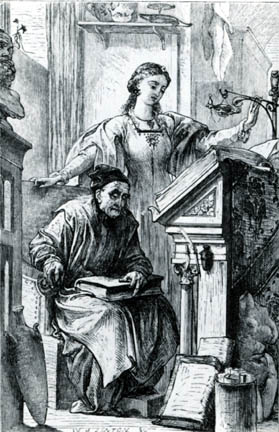
I think Oxford is missing a bet in letting this one slip out of its catalogue. All is not lost, however. The Penguin Classics edition is still available, as is the Broadview edition which, though it has two columns of tiny print and so is not kind to the weak-eyed among us, includes Frederick Leighton’s gorgeous illustrations: