Middlemarch for Book Clubs: the beta launch

OxfordJust over a year ago, I got somewhat exercised over a news story claiming that Middlemarch is the kiss of death for book clubs. My annoyance was exacerbated by the number of links it got from other sources, which added up to quite the anti-Middlemarch buzz for a while.

My first response was a post on this blog that included a list of 10 tips to help book clubs that wanted to read Middlemarch but felt they could use a little support. In that post I also made a bold pronouncement: “I’ve decided, therefore, to put together an online site to encourage and support reading Middlemarch–whether in book clubs or on your own.” I was and am well aware that there’s no shortage of information about George Eliot and Middlemarch already available, but the work of finding and filtering with an eye to what might be useful and illuminating for book clubs (rather than, say, scholars) is not insignificant, and having relevant basics gathered in one place might — or so I thought and hope — simply be convenient.

middlemarchsite

At long last, I have a full (if not necessarily finished) version of that site now up for people to take a look at. As you’ll see if you visit it, it’s not a very fancy thing — it’s just a free WordPress site. I chose what I hope is a clean, easy-to-read theme and set up what seemed to me like simple but useful categories. At this point I feel very aware of what is not there (many more topics could be covered under ‘contexts,’ for instance) and also of how what is there reflects my own interests and idiosyncrasies as a reader and teacher of the novel. Depending on the response to this draft version, I could certainly end up adding more material. But I’m not sure I want to try to neutralize my own perspective: good discussions arise from encounters between different people’s minds, and I wanted the site to convey the sense that there’s a person behind it. That’s why I let myself be kind of chatty, including in the questions.

There are lots more excuses explanations I could offer for what I’ve done so far, but I think I’ll leave it at that for now. I welcome feedback, here or at the site, particularly from people who might some day — or have already — chosen Middlemarch for reading with their own book clubs!


Middlemarch for Book Clubs: Preview #1 – Choosing an Edition

I’ve been working industriously on my Middlemarch for Book Clubs website. I hope to have a “beta” version of the whole site ready to make public by the end of June, but I thought it would be helpful for me to get some feedback on a couple of pages sooner rather than later. One reason is that I’m especially concerned about finding the right tone (not too didactic, but clear and practical; enthusiastic but not gushing), as well as the right balance between too much and not enough information. But also — and this is particularly important for a page like this one on choosing an edition — I can’t be sure if I’m providing the right information. I’d be glad to know if you think I’m on the right track, or, if not, what changes or corrections or additions you’d suggest.

Middlemarch for Book Clubs: Choosing an Edition

GENERAL CONSIDERATIONS

The first thing to consider is whether you want everyone in your group to use the same edition of Middlemarch. Even if you think that this would be a good thing, it may prove impractical, as people may already own copies, or may prefer one version over another for their own reasons. My classroom experience (as well as experience in my own book club) has taught me that it can be frustrating trying to talk about a long book when people quite literally can’t get on the same page. This is one reason to encourage people to use some system of navigational aids, like post-it notes! However, because Middlemarch is divided into Books and then into chapters, it’s not that hard to find common reference points.

The next question is whether you want to use a ‘popular’ or a scholarly edition. With a novel like Middlemarch, I think it’s a good idea to have a reliable, well-edited text with thorough annotations–not because you must consult them, but because you may want to. Scholarly editions not only include thoughtful introductions and explanatory footnotes (helpful for everything from literary allusions to historical contexts) but also point out changes made to the novel over its publishing history. One of the most interesting of these in Middlemarch is a tweak to its Finale that might spark some debate among the members of your book club, especially if you’ve talked along the way about how far Dorothea is responsible for her own bad choices.

RECOMMENDED EDITIONS OF MIDDLEMARCH

Oxford

Oxford World’s Classics: This is the edition I usually assign in my classes. It’s readily available, Felicia Bonaparte’s introduction is illuminating, the notes are good but not overwhelming, and the layout is readable and leaves enough room for annotations. In the current printing, there are two paragraphs out of order: bonus points for the person in your group who spots them! (I’ve notified the press and subsequent printings may be corrected.)


penguinPenguin Classics
: This is another fine, reliable edition, with a good introduction by Rosemary Ashton; it has the benefit of also being available as an e-book, which may be an advantage if some of your members use e-readers.


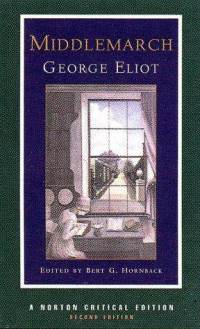
nortonNorton Critical Edition:
This edition is the most scholarly of the options, in that it conveniently packages a scrupulous edition of the novel with a selection of critical essays about it. If that’s the kind of thing your book club likes, this is the edition for you. If you doubt you’ll want to read the criticism, however, I recommend an edition with larger type!


broadviewBroadview Press Edition:
This handsome edition of Middlemarch is supplemented by contemporary reviews and documents (rather than the mostly 20th-century critical materials included in the Norton). It is annotated in great detail, with special attention paid to the role of the visual arts in the novel; it is the only one of these editions that includes illustrations. The footnotes do occasionally almost overwhelm the novel itself. This edition is also available as an e-book.

There are [will be] links to some free electronic full-text editions of Middlemarch on the ‘Links’ page. I don’t particularly recommend these for reading the whole novel, though of course you may find them fine for your purposes. The searchable e-texts are great, however, for finding lines you remember but forgot to mark with post-its!

“Not Fitted to Stand Alone”: Deborah Weisgall, The World Before Her

weisgallI had a deeply and perhaps irrationally ambivalent response to Debora Weisgall’s The World Before Her. I think that on its own terms, it’s quite a good novel. It’s atmospheric, interesting, and thought-provoking, especially about the pressure marriage puts on identity: like so many characters in Middlemarch, Weisgall’s protagonists are struggling in relationships with partners who don’t want them to be themselves — and of whom they too had what turns out to be imperfect knowledge and thus wrong expectations. How much do you owe such a partner? How far should you bend, contort, or submit in order to make the marriage a “success”? How do you balance duty to yourself against duty to others, or to promises, or to principles you revere in theory even as, in practice, they exact a price you can hardly bear to pay? These are central questions of Middlemarch.

The comparison to Middlemarch is not just apt but crucial, because one of Weisgall’s protagonists is George Eliot herself: the novel opens in Venice during her honeymoon with John Cross. I should really say that one of her characters is “Marian Evans,” or “Mrs. John Cross,” because Weisgall focuses on the inner life and personal feelings of the woman, not on the mind, ideas, or literary accomplishments of the writer. Not that this bifurcation is absolute, or even intelligible, of course: Marian Evans was George Eliot, and Weisgall actually does a good job weaving in references to her writing life as well as allusions to her novels. By setting the novel at the end of Eliot’s career, though, she has put that writing life in the background. The novel moves often, through flashbacks, out of 1880 into memories of Eliot’s earlier life, but these are primarily personal episodes, from her “Holy War” to her failed romance with Herbert Spencer and then her liaison with George Henry Lewes.

The World Before Her makes the relationship with Lewes the central feature of Eliot’s life, and this is where my ambivalence came in. Weisgall effectively summons up both the risks and the joys of their elopement: the fulfillment, both intellectual and sexual, that it brought Marian, the anxiety of their return to England, the struggle of their early isolation, the loving support that prompted and then protected her as she became a novelist. Against this is juxtaposed her marriage to Johnnie, who shows her reverential tenderness but suffers again and again by comparison to George’s bright, beloved presence. Marian’s mourning suffuses the novel as well as her second marriage, and Weisgall emphasizes the internal conflict for Marian as she struggles to reconcile her desires (again, both intellectual and sexual) with the reality of the man she’s now with. Johnnie, in his turn, is only too aware that in ways he can only partially comprehend, he is a disappointment to the woman he idealizes — and yet he can do no more than apologize for his failures. He isn’t interested in the fossils or the art, and he isn’t interested in her, either. On Weisgall’s telling, his jump into the canal is his attempt to free her: “Marian, I did this for you.” He married her to bring her comfort and peace, only to find her full of “dangerous energy”:

He had imagined her ardor would be spiritual, quiet, a concentrated stillness, but instead she had displayed a physical eagerness and appetite that troubled him and left him confused and even frightened. She was, as she said, indefatigable.

Weisgall gives us a Johnnie who is not (just) unresponsive to his wife’s ardor but more generally lacking in sexual drive. The physical incompatibility, however, is not played up pruriently but is part of a more complete mismatch between them: her “eagerness” is for art, knowledge, music, debate — for a life of the mind complemented by love of the body. She and George achieved this ideal, but with kind, pragmatic,conventional,  boyish Johnnie she realizes she will have to dissemble in order to be the woman he thought he married. Though Weisgall does not overtly play this card, it’s tempting to see Marian’s death so soon after their return to the life and house Johnnie prepares for her (“she felt imposed upon; an edifice was being constructed around her”) as her own jump towards a desired liberation, but of course, as she says peevishly to Johnnie, “My life — any life — is not a plot.”

The telling of these stories is smart and often affecting; though (and does this really need saying?) Weisgall does not write with the historical or philosophical richness of her subject, there’s art in the construction and grace in the style of The World Before. The counterpoint of Eliot’s story with the contemporary one is also thought-provoking (though you’ll notice I’m not engaged enough in the other plot to discuss it in any detail). So what is there to be ambivalent about, I hear you asking?

Well, here it is, and I’m sure you’ll tell me if you think I’m being unreasonable: I didn’t like the Marian Evans I met here. The problem may be that I wanted George Eliot instead: this woman — grief-stricken, irascible, compromising — may be true to the letters and journals, true, as far as we can infer, to the biography — but she isn’t true to the novels. She has no wit, no spark. She reminded me of the Virginia Woolf of The Hours: so melancholic you wonder how such a woman could have written with such verve, such iridiscent irony. Presumably these qualities too are sacrificed to Weisgall’s decision to focus on this final stage of Eliot’s life: she was in mourning, she was aging and tiring, she was struggling with a new role — that of “married woman.” But there are other decisions here too, including the emphasis on personal feelings, on the motif that Marian is “not fitted to stand alone” (reinforced here by Marian’s own manifest emotional neediness), and on the artistically enabling power of love: “she had had great good luck in love. It had permitted her to look outward — and see her stories.”

Maybe what I’m reacting negatively to, in other words, is simply the difference between Marian Evans and the voice she created in her novels. As a matter of principle, of course, I always insist on the gap between author and speaker, but in her case the narrative persona has such presence and personality it confuses this theoretical rule. It has always been the novels that I love: though I have read a number of biographies, I have never been as interested in the minutiae of Eliot’s actual life as I have been in her writing; I have never been drawn to any kind of biographical project (an impediment as I try to imagine my own version of a “cross-over” book); it’s her intellectual fearlessness and, again, her novels that inspire me — I’ve never been “fannish” about her (though it was moving to stand outside her house on Cheyne Walk). Maybe what I don’t like is that this novel imagined a way into her head, while the head I’ve aspired to get inside has always been her narrator’s. I think, though, that I also don’t like the emphasis on her weakness rather than her strength, or on the costs of her ambitions rather than their triumphant realization. Though The World Before Her is nowhere near as belittling as Brenda Maddox’s horrifying biography, it isn’t as different as I would wish, especially in its preoccupation with Marian’s (lack of) beauty. That said, I appreciated Weisgall’s (fictional) encounters between Marian and Whistler, who is struck by her combination of ugliness and grace when he sees her from a distance in Venice. The sketch he makes of her becomes a symbol of her paradoxical character. Johnny finds it improperly “intimate,” and, finding it among Marian’s papers after her death, crumples it up and burns it. The unifying thread in the novel — not just in the Eliot parts but in the modern story too — is the difference between an artist’s eye and everyone else’s. I only wish Weisgall had written a novel that made the most of George Eliot as an artist, rather than showing her to us as a woman barely able to go on, and certainly unable to write — even if that is the truth of her final days.

The Stage Swarmed with Maggies: Helen Edmundson’s The Mill on the Floss

Last night I attended the Dalhousie Theatre production of The Mill on the Floss that I mentioned here: I was invited to give a short talk to the “Patrons” on opening night. As I explained to the attendees, I wasn’t there as an expert on Helen Edmundson’s adaptation, though I had read through most of it in preparation for the night. So, rather than pretending to explain things about the play, I tried to set up what I take to be some of the central problems of the novel so that we could all have them in mind as we watched — not to see if Edmundson “got it right” or anything as reductive as that, but to see what she did with the material, how she reworked or rethought it for a different form.

As I worked on my notes (and it isn’t easy deciding what you’ll use your precious 20 minutes on, when you love a novel as I love The Mill on the Floss), it was form that I kept thinking about. So many things about The Mill on the Floss make it seem such an unlikely choice for the theatre. There’s the ending, for one thing, but of course there are ways of evoking large-scale natural phenomena on stage: nobody expects torrents of actual water to sweep the scenery away. But what about the narrator? Though she does plot and dialogue with the best of them, so much of the wit and wisdom of George Eliot resides in her masterful exposition. What is The Mill on the Floss without my favourite chapter, “A Variety of Protestantism Unknown to Bossuet” (which contains not one line of dialogue, not one step forward for the plot) or without the great meditation on “the shifting relation between passion and duty” and the moral failure of the “man of maxims”? How will we understand Maggie’s dilemmas, her “labour of choice,” without the reminder that our striving for something better might lead us astray “if our affections had not a trick of twining round those old inferior things — if the loves and sanctities of our life had no deep immovable roots in memory”?

The narrator of The Mill on the Floss is someone special, to be sure, and the novel is inconceivable without her.  But the play is its own thing; it has its own structure and logic. It offers no substitute for the historical and philosophical commentary (for instance, it doesn’t, as far as I noticed, give any of the narrator’s best lines to characters, the way the famous opening line of Pride and Prejudice becomes Elizabeth Bennet’s line in the BBC adaptation). It does draw a lot of its dialogue directly from the novel, and noticing how much of the script is right out of the novel is a good reminder of just how great George Eliot is at voices (her characters, as I’ve talked about here before, have wonderful specificity: there’s no mistaking any one of them for any other one). It was particularly delightful seeing the Dodson sisters completely embodied (go, Mrs Glegg!). In a more general way, seeing not just familiar people but familiar objects (such as Mrs Tulliver’s tea pot) appear in front of me, in tangible form, was both disorienting and quite moving. For all the vividness and intensity of the novel, my engagement with it is often quite abstract, so that even its tragedies over time lose their visceral clutch. Though watching a play is not, for me, ever as immersive or total as watching a film can be (it’s just harder to lose the awareness that this is acting — which is not a criticism, just a difference in the experience), seeing the physical objects right there, hearing people actually say the words, makes the novel’s truths that much more real. And while we joked a bit in the introductory session about how the play is the Twitter version of the 500-page novel, its minimalism also made some aspects of the story particularly, affectingly, stark, especially Maggie’s suffering and isolation as an unconventional girl. She seemed so beleaguered, throughout the play: I wanted to jump out of my seat and go be on her side!

The most interesting feature of the adaptation is its use of multiple Maggies. It’s not that surprising a gimmick to have different actresses play Maggie as a child, a teenager, and then a woman. But Edmundson goes further: rather than replacing each other in chronological order, the Maggies coexist — not literally, in the action of the plot, but on the stage. This device allows Edmundson to dramatize the moral and emotional conflicts that Maggie faces as she grows up. Young Maggie retains her passionate impetuosity and her painful devotion to Tom; ascetic Maggie struggles between the yearning of her conscience towards an idealized right and the fellowship offered by Philip; grown-up Maggie responds to Stephen in spite of herself. The multiple Maggies literally push and pull each other according to their own loves and loyalties. What ending could possibly be right for any of them, never mind for all three of them? When the ending finally came, one of them lay with Tom, while the other two were flung aside. Again, the physicality of their bodies made the tragedy George Eliot imagined for us more real, even as their overtly symbolic roles neatly laid out the thematic lines of the conflict.

Overall, then, it was a thoroughly stimulating evening. The cast all played their parts with commitment, and they did an impressive job with what I imagine is a pretty challenging script. The three Maggies in particular were busy all the time. By the time the final trial by water came, I felt that everyone in the theatre was thoroughly engaged, and then shocked by the concluding catastrophe. (“It’s so sad! I feel like crying!” said my immediate neighbour.) My only disappointment was that we only got to give them all one round of applause: I thought they deserved at least one more curtain call, if only to let us catch our breath and remember that life goes on and “nature repairs her ravages.”

Ahdaf Soueif: “We all seem to have given up – for the moment – on fiction”

Ahdaf Soueif had a thought-provoking essay in the Guardian recently about fiction and activism in general, and the effect of the Egyptian revolution on Egyptian novelists in particular:

 In Egypt, in the decade of slow, simmering discontent before the revolution, novelists produced texts of critique, of dystopia, of nightmare. Now, we all seem to have given up – for the moment – on fiction.

Fiction will come again, I hope …

Attempts at fiction right now would be too simple. The immediate truth is too glaring to allow a more subtle truth to take form. For reality has to take time to be processed, to transform into fiction. So it’s no use a story presenting itself, tempting, asking to be written, because another story will – in the next minute – come roaring over it, making the same demand. And you, the novelist, can’t grab one of them and run away and lock yourself up with it and surrender to it and wait and work for the transformation to happen – because you, the citizen, need to be present, there, on the ground, marching, supporting, talking, instigating, articulating. Your talent – at the time of crisis – is to tell the stories as they are, to help them to achieve power as reality not as fiction.

 It’s not that she thinks writing fiction is itself apolitical, or that it can’t be a form of activism: “A work of fiction lives by empathy – the extending of my self into another’s, the willingness to imagine myself in someone else’s shoes. This itself is a political act: empathy is at the heart of much revolutionary action.”  But Soueif doesn’t think great art can come from a sense of deliberate activism: “it may be a good cause and a just cause, but what you get will not be a novel – it will be a political tract with a veneer of fiction.” “Ah yes, Mary Barton,” says the sage Victorianist, nodding … and yet that doesn’t seem quite fair to Mary Barton, actually, which has more than a veneer of artistry even as it is an overt act of advocacy. Its art, we might say, is its advocacy.

Maybe the moment for such “novels with a purpose” has simply passed: today we want our fiction to intervene obliquely or ironically, rather than to confront us (Uncle Tom’s Cabin, anyone?) with demands, to raise questions rather than blandish prescriptions. Our tolerance for didacticism in art is very low. And yet maybe we underestimate the effects of that veneer of fiction, or overestimate the importance of aesthetic ineffables over social deliverables. Would anyone make a case for the artistry of Uncle Tom’s Cabin? I didn’t think so–but would we wish it unwritten? It played its part in the revolutions of its time. But then, if we had to choose between Mary Barton and another novel pretty much contemporary with it that had no immediate interest in “the problems of its day,” Wuthering Heights, which would be the greater loss?* We don’t blame Emily Brontë, surely, for not rushing off to Manchester to see what she could do about relations between master and men; we don’t suggest that she chose to “absent [herself] from the great narrative of the world.” But what difference did her book make, compared to Gaskell’s or Stowe’s? Do we care? Should we care? ‘Tis a muddle.

And so, like Soueif in her essay, we don’t take a stand one way or the other on whether the artist can or should, in general, “do one or the other.” But “at the time of crisis,” “if you cannot or will not remove yourself from the situation,” Soueif suggests, you lose the luxury of distance, the luxury of choice. At such a time, your responsibility “as a citizen of the world” is to turn your efforts and talents to things that are not made up. Thus, for the time being, she at least is no longer a novelist.

I found her reflections interesting not just because of the questions they raise about a novelist’s obligations, but because they reminded me of her comments last year about whether the revolution had rendered her (then) in-progress novel obsolete–and of my own dissatisfaction with doing literary criticism about her novels when world events made such a project seem pretty trivial. In the intervening time she has published one book of non-fiction, Cairo: My City, Our Revolution. This was clearly, as I said in my review, “a book Soueif felt compelled to write”: this recent piece suggests that we will see more writing of this kind before we see another novel. A part of me is sorry, because I want to see what kind of fiction she writes next, but I accept that what she’s doing right now is much more important. I’m glad that she’s still invoking George Eliot, anyway.

*There’s the complicating factor that perhaps Mary Barton, which to be sure is a bit creaky around the plot points and shamelessly sentimental to boot, was important preparatory work for Gaskell’s later, better novels, but that just muddies up my attempt at a provocative comparison, so never mind that for now.

Middlemarch for Book Clubs: Update

I have started building the ‘Middlemarch for Book Clubs’ site I boldly promised to create in response to the whole ‘Middlemarch kills book clubs’ story that got so much linkage a week or so ago. Here is a list of the pages and subpages I’ve set up so far. Let me know if you think they look sensible, and also if (based on your experience either as a reader or as a member of a book club) you think I should include something else or go in a different direction altogether. As part of my preparation, I’ve been looking around at other online book club guides, and Amateur Reader is right that the Faulkner site for Oprah’s Book Club is pretty nice. (The ‘How to Read Faulkner’ section is actually fairly similar in spirit and even in some specifics to the ‘top 10 tips’ I posted before, some of which, of course, will show up on the new site.) My own instinct is that the tone of such a site will be at least as important as the content, and then after that what matters most is the organization: after all, it’ s not hard to find information on all of these topics on your own if you go looking. So my goal is not to create original content so much as an atmosphere that’s inviting and a structure that’s useful. That’s a project that plays to my strengths, at least based on my recent course evaluations: apparently I am both conspicuously enthusiastic and unusually well organized.

Middlemarch for Book Clubs: A Preliminary Outline

Welcome

Getting Started

Tips for Success

Choosing an Edition

George Eliot

Life

Ideas

Contexts

Politics

Religion

The ‘Woman Question’

Discussion Questions

The Big Picture

One Book at a Time

Forum

Links

Electronic Editions of Middlemarch

Other Writing by George Eliot

Writing About George Eliot and Middlemarch

Other Related Resources


Madame Bovary II: The Doctors and Their Wives

It’s difficult to compare two books that are very, very good at what they do but that do very different things.

Must such a comparison be evaluative, hierarchical? Of course not. Does it often end up that way? Of course. We’re only human! We like different things, for reasons that often say more about us than about the objects of our inquiry. Is it a cheap dodge, though, to hide behind the unassailable (because ultimately indefensible) assertion of taste when you strongly prefer one great novel to another? Yes, probably. Maybe it’s better not to go there, then, but to stick with “these books do two very different things”–with the what, the fact of the matter, the precise depiction, and leave the rest unsaid, implicit.

It would be ironic for me to do that when comparing Madame Bovary and Middlemarch, though, because when I try to fix on what it is that I didn’t like about reading Madame Bovary, what I come up with is the way that novel is so relentlessly about the ‘what.’ There are a lot of things the novel just doesn’t do, things Flaubert just won’t do. To quote Lydia Davis’s introduction again, “his technique is to present the material without comment.” There’s nothing trivial or superficial about his “painstaking objective description,” which is often devastatingly perceptive, but “without comment,” it felt somehow unmoored to me. The ‘what’ is very meticulously rendered, but Madame Bovary is not a novel that deals very much in the ‘why?’ (broadly conceived), or the ‘what about it, then?’ Things and people in the novel are what they are in themselves: they are intensely specific, and it’s only indirectly, if at all, that the novel attaches them to anything general, from historical context to moral or philosophical ideas.

Middlemarch, by contrast, is fundamentally about connecting the specific to the general, about seeing the particular in as broad and varied a context as possible. Middlemarch “without comment” is all but inconceivable: how depleted, how deflated, it would be! The wisdom of Middlemarch–the excellence of Middlemarch–resides in its comments. The excellence of Madame Bovary lies (perforce) somewhere else: in its perfect realization of its own concept, perhaps? G. H. Lewes famously called Jane Austen “the greatest artist who ever lived” because she displayed, he thought, “the most perfect mastery over the means to her ends”: that seems true of Flaubert as well, at least in this case, and at least as far as I understand his ends and means. Where, though, is the wisdom of Madame Bovary? The novel itself makes this question seem foolish, misguided, naive. Nobody in the novel really learns anything, after all: “Since the events that are about to be recounted here, nothing … has changed in Yonville.” If you don’t think anybody can learn anything, no wonder you refrain from commenting. What would be the point? Middlemarch, in contrast, is profoundly pedagogical, and so its narrator balances wry awareness of her students’ inadequacies and limits with utter commitment to helping them understand and grow. This is not work that can be done by keeping out of the way.

Different means serving different ends: different visions, different aesthetics, different novels. And the reason it is so obvious how different the two novels are is that they have so much in common. There’s the basic premise: both are about ‘provincial life’ (and both, I think, see its limitations and defects in quite similar ways). Both also take a doctor and his discontented wife as main characters, a plot parallel that nicely sets me up to illustrate the authors’ contrasting approaches.

Doctoral Education

Charles Bovary

It would be impossible by now for any of us to recall a thing about him. He was a boy of even temperament, who played at recess, worked in study hall, listening in class, sleeping well in the dormitory, eating well in the dining hall. He had as local guardian a wholesale hardware dealer in the rue Ganterie, who would take him out once a month, on a Sunday, after his shop was closed, send him off to walk along the harbor looking at the boats, then return him to school by seven o’clock, before supper. In the evening, every Thursday, he would write a long letter to his mother, with red ink and three pats of sealing wax; then he would review his history notebooks or read an old volume of Anacharsis that was lying around in the study hall. Out walking, he would talk to the servant, who, like him, was from the country.

By dint of applying himself, he stayed somewhere in the middle of the class; once he even earned a first honorable mention in natural history. But at the end of his third year, his parents withdrew him from the school in order to have him study medicine, convinced that he would be able to go on alone to the baccalaureate. . . .

The curriculum, which he read on the notice board, made his head swim: a course in anatomy, a course in pathology, a course in physiology, a course in pharmacy, a course in chemistry, and one in botany, and one in clinical practice and one in therapeutics, not to mention hygiene and materia medica, names with unfamiliar etymologies that were like so many doors to sanctuaries filled with solemn shadows.

He understood none of it; though he listened, he did not grasp it. He worked, nonetheless, he possessed bound notebooks, he attended all the lectures, he never missed a hospital round. He accomplished his little daily task like a mill horse, which walks in circles with its eyes covered, not knowing what it is grinding. (Part I, Chapter  1)

Tertius Lydgate

He had been left an orphan when he was fresh from a public school. His father, a military man, had made but little provision for three children, and when the boy Tertius asked to have a medical education, it seemed easier to his guardians to grant his request by apprenticing him to a country practitioner than to make any objections on the score of family dignity. He was one of the rare lads who early get a decided bent and make up their minds that there is something particular in life which they would like to do for its own sake, and not because their fathers did it. Most of us who turn to any subject we love remember some morning or evening hour when we got on a high stool to reach down an untried volume, or sat with parted lips listening to a new talker, or for very lack of books began to listen to the voices within, as the first traceable beginning of our love. Something of that sort happened to Lydgate. . . . one vacation, a wet day sent him to the small home library to hunt once more for a book which might have some freshness for him: in vain! unless, indeed, he took down a dusty row of volumes with grey-paper backs and dingy-labels — the volumes of an old Cyclopaedia which he had never disturbed. It would at least be a novelty to disturb them. They were on the highest shelf, and he stood on a chair to get them down. But he opened the volume which he first took from the shelf: somehow, one is apt to read in a makeshift attitude, just where it might seem inconvenient to do so. The page he opened on was under the heading of Anatomy, and the first passage that drew his eyes was on the valves of the heart. He was not much acquainted with valves of any sort, but he knew that valvae were folding doors, and through this crevice came a sudden light startling him with his first vivid notion of finely adjusted mechanism in the human frame. A liberal education had of course left him free to read the indecent passages in the school classics, but beyond a general sense of secrecy and obscenity in connection with his internal structure, had left his imagination quite unbiassed, so that for anything he knew his brains lay in small bags at his temples, and he had no more thought of representing to himself how his blood circulated than how paper served instead of gold. But the moment of vocation had come, and before he got down from his chair, the world was made new to him by a presentiment of endless processes filling the vast spaces planked out of his sight by that wordy ignorance which he had supposed to be knowledge. From that hour Lydgate felt the growth of an intellectual passion.

We are not afraid of telling over and over again how a man comes to fall in love with a woman and be wedded to her, or else be fatally parted from her. Is it due to excess of poetry or of stupidity that we are never weary of describing what King James called a woman’s “makdon and her fairnesse”, never weary of listening to the twanging of the old Troubadour strings, and are comparatively uninterested in that other kind of “makdom and fairnesse” which must be wooed with industrious thought and patient renunciation of small desires? In the story of this passion, too, the development varies: sometimes it is the glorious marriage, sometimes frustration and final parting. And not seldom the catastrophe is bound up with the other passion, sung by the Troubadours. For in the multitude of middle-aged men who go about their vocations in a daily course determined for them much in the same way as the tie of their cravats, there is always a good number who once meant to shape their own deeds and alter the world a little. The story of their coming to be shapen after the average and fit to be packed by the gross, is hardly ever told even in their consciousness; for perhaps their ardour in generous unpaid toil cooled as imperceptibly as the ardour of other youthful loves, till one day their earlier self walked like a ghost in its old home and made the new furniture ghastly. Nothing in the world more subtle than the process of their gradual change! In the beginning they inhaled it unknowingly; you and I may have sent some of our breath towards infecting them, when we uttered our conforming falsities or drew our silly conclusions: or perhaps it came with the vibrations from a woman’s glance. (Book II, Chapter 15)

Romantic Dreams

Emma Bovary

Then she recalled the heroines of the books she had read, and this lyrical throng of adulterous women began to sing in her memory with sisterly voices that enchanted her. She herself was in some way becoming an actual part of those imaginings and was fulfilling the long daydream of her youth, by seeing herself as this type of amorous woman she had so much envied. Besides, Emma was experiencing the satisfaction of revenge. Hadn’t she suffered enough? But now she was triumphing, and love, so long contained, was springing forth whole, with joyful effervescence. She savored it without remorse, without uneasiness, without distress. (Part II, Chapter 9)

Rosamond Lydgate

[T]his result, which she took to be a mutual impression, called falling in love, was just what Rosamond had contemplated beforehand. Ever since that important new arrival in Middlemarch she had woven a little future, of which something like this scene was the necessary beginning. Strangers, whether wrecked and clinging to a raft, or duly escorted and accompanied by portmanteaus, have always had a circumstantial fascination for the virgin mind, against which native merit has urged itself in vain. And a stranger was absolutely necessary to Rosamond’s social romance . . . . Now that she and the stranger had met, reality proved much more moving than anticipation, and Rosamond could not doubt that this was the great epoch of her life. She judged of her own symptoms as those of awakening love, and she held it still more natural that Mr. Lydgate should have fallen in love at first sight of her. These things happened so often at balls, and why not by the morning light, when the complexion showed all the better for it? (Book I, Chapter 12)

Desperate Housewives*

Emma Bovary

Meanwhile, acting upon theories that she believed to be sound, she kept trying to experience love. By moonlight, in the garden, she would recite all the passionate rhymes she knew by heart and would sing melancholy songs to him, with a sigh; but she would find that she was as calm afterward as she had been before, and Charles seemed neither more loving nor more deeply moved.

When in this way she had made some attempt to strike the tinder against her heart without causing a single spark to fly from it, incapable, in any case, of understanding something she was not experiencing herself, just as she was incapable of believing in anything that did not manifest itself in a conventional form, she easily persuaded herself that Charles’s passion was no longer extraordinary. (Part I, Chapter 7)

So now they were going to continue one after another like this, always the same, innumerable, bringing nothing! Other people’s lives, however dull they were, had at least the possibility that something would happen. A chance occurrence would sometimes lead to an infinite number of sudden shifts, and the setting would change. But for her, nothing happened. God had willed it! The future was a dark corridor, with the door at its end firmly closed. (Part I, Chapter 9)

Rosamond Lydgate

Poor Rosamund for months had begun to associate her husband with feelings of disappointment, and the terribly inflexible relation of marriage had lost its charm of encouraging delightful dreams. It had freed her from the disagreeables of her father’s house, but it had not given her everything that she had wished and hoped. The Lydgate with whom she had been in love had been a group of airy conditions for her, most of which had disappeared, while their place had been taken by everyday details which must be lived through slowly from hour to hour, not floated through with a rapid selection of favourable aspects. The habits of Lydgate’s profession, his home preoccupation with scientific subjects, which seemed to her almost like a morbid vampire’s taste, his peculiar views of things which had never entered into the dialogue of courtship — all these continually-alienating influences, even without the fact of his having placed himself at a disadvantage in the town, and without that first shock of revelation about Dover’s debt, would have made his presence dull to her. There was another presence which ever since the early days of her marriage, until four months ago, had been an agreeable excitement, but that was gone: Rosamond would not confess to herself how much the consequent blank had to do with her utter ennui. . . (Book VII, Chapter 64)

 [Will] would have made, she thought, a much more suitable husband for her than she had found in Lydgate. No notion could have been falser than this, for Rosamond’s discontent in her marriage was due to the conditions of marriage itself, to its demand for self-suppression and tolerance, and not to the nature of her husband; but the easy conception of an unreal Better had a sentimental charm which diverted her ennui. She constructed a little romance which was to vary the flatness of her life: Will Ladislaw was always to be a bachelor and live near her, always to be at her command, and have an understood though never fully expressed passion for her, which would be sending out lambent flames every now and then in interesting scenes. His departure had been a proportionate disappointment, and had sadly increased her weariness of Middlemarch; but at first she had the alternative dream of pleasures in store from her intercourse with the family at Quallingham. Since then the troubles of her married life had deepened, and the absence of other relief encouraged her regretful rumination over that thin romance which she had once fed on. Men and women make sad mistakes about their own symptoms, taking their vague uneasy longings, sometimes for genius, sometimes for religion, and oftener still for a mighty love. (Book VIII, Chapter 75)

These examples aren’t offered in a tendentious spirit. They all display, I think, mastery as Lewes defines it. Yet I can’t imagine ever loving one novel as I love the other. Sorry, Gustave: it’s not you, it’s me! But I’m looking forward to the discussion that I hope these juxtapositions provoke.

*Don’t blame me! If the blurb for the Davis translation can call Emma “the original desperate housewife,” how am I supposed to resist?

Your Book Club Wants to Read Middlemarch? Great Idea!

OUPMmA stupid article about how Middlemarch is the kiss of death for book clubs has been getting a disappointing amount of linkage in the past couple of days, including from sites you’d expect to be above that kind of pandering to the lowest common denominator (I’m looking at you, New Yorker!). I’d like to think at least some of that is ironic linkage: the entire article is so anti-intellectual and so condescending to book clubs, not to mention to Middlemarch, that maybe people are linking to it in the same spirit that they’d rubberneck when passing a traffic accident. Or maybe they think it’s from The Onion. You’ll notice that I’m not linking to any of its iterations: it doesn’t deserve any more attention. Maybe it doesn’t deserve any reply, either, but it’s frustrating to see something like that circulating so widely, and I absolutely hate the thought that people might actually decide not to read Middlemarch because of it!*

I’ve decided, therefore, to put together an online site to encourage and support reading Middlemarch–whether in book clubs or on your own. I’ll be thinking a lot about what to put on the site, and I’d welcome suggestions. I should say that I think there’s something uncomfortable about implying that you can’t just read Middlemarch on your own and have a great experience. The first time I read it, I was eighteen and backpacking across Europe. I loved it. I read it differently then than I do now, but I did not find it dry, long, confusing, boring, or in any way the kiss of death for my reading pleasure, and at that time I had no special qualifications beyond having been a bookworm ever since I learned to read with Robert the Rose Horse when I was about five. I wasn’t even intending to be an English major. When I read Middlemarch again for a course on the 19th-century novel, I loved it again, so much that I decided to write my Honours thesis on it, and eventually it also made up part of my Ph.D. thesis, and now I teach it in my own courses as often as I can. It’s the kind of novel that rewards that kind of long-term relationship: it’s rich with ideas and characters and it’s brilliantly constructed and includes passages of such extraordinary intelligence that it can leave me breathless, as well as passages of great pathos, sly hilarity, and even unashamed melodrama and romance. It’s long and, in some ways, intricate, but there’s no reason why it should be singled out as the book of all books that people can’t read if they want to, with or without someone else’s help–especially people who love reading enough to be in book clubs in the first place.

Why put together any kind of reading guide for Middlemarch, then? Why not just let people take their chances with it? Good question. Is there really a need for such a thing? Is there any demand for it? I’m not sure, though I guess I’ll find out about the demand part at least, when I get the site up and running. It is certainly common to include guides and discussion questions for book clubs in contemporary novels, though I often think they don’t promote very thoughtful discussion of the book itself (and sometimes, as with the question set included with my edition of The Siege of Krishnapur, the questions are just plain odd.) As a teacher, I have found that students both appreciate and benefit from having some context provided and some suggestions for things to think about when they read: if you’re going to talk about a book, especially a long and complex book, the conversation will be better (more focused, more specific, less impressionistic) if you have some common starting points. Also, if you are reading something for the first time, it can be challenging to sort out all the details you are taking in. ‘One cannot read a book, one can only reread it,’ Nabokov famously pronounced, but if you don’t have time to do a thorough rereading yourself, it can help a lot for another, more experienced reader to give you some ideas about patterns and problems to be alert to. Indeed, if I didn’t think it was possible for there to be some “value added” to people’s reading experience, I would have a hard time showing up for work every day.

So I’ll putter away at the site for a bit and then make it public and solicit feedback on whether it strikes the right note and seems useful. I know there are lots of literature guides online already, many aimed at the high school and college market. I hope to do something a bit different–though exactly what, I’m still thinking about.

In the meantime, here are my top ten tips for any book clubs that have had the great idea to read Middlemarch.

  1. Yes, do! Why would anyone want to talk you out of it?
  2. Remember: it’s just a novel. It’s a great novel, and a long novel, and a Victorian novel, but these are not reasons to approach it with the preconception that it is difficult or inaccessible, an obstacle to be overcome like some kind of fictional Mount Everest. Novels are for reading–Victorian novels more than most! It’s also a very funny novel, though its humor is rarely of the knee-slapping kind. Just because it’s a “classic” doesn’t mean it’s dead serious, or that you have to be.
  3. Don’t rush it. It was originally published in installments; consider reading it this way, one or two books at a time, over several meetings. Every page has its share of details to savor.
  4. Mark it up! You’ll want to be able to find the good bits later. I think that what actually kills a book group–or at least makes it a lot less worthwhile than it could be–is people airing unsubstantiated opinions and gesturing vaguely towards the whole book as “evidence” (or insisting “that’s just my opinion”). Talk about the actual book–the words on the page–as specifically as you can. The longer the book, the more challenging that is, for sure, but you chose Middlemarch, after all. So do your best to learn your way around it, and leave yourself a helpful trail of crumbs. I’m a big fan of the Post-It for this purpose (here’s what my teaching copy looks like), but do what works for you. E-books allow highlighting and bookmarking; for some people, an old Penguin paperback and a pencil in hand is all they need or want.
  5. You don’t have to read up on George Eliot to appreciate Middlemarch, but she was a remarkable woman who lived a truly unconventional life. She also had strong ideas about the role of fiction in our lives. Consider finding out about her–just don’t start with Brenda Maddox’s terrible George Eliot in Love. The Victorian Web has some useful material.
  6. Middlemarch is a “multi-plot” novel–though, as you’ll discover, eventually the various plots converge around a shared crisis, and along the way there are many points of intersection. Still, there are a lot of people to keep track of! Consider making your own list of dramatis personae as you go along.  I actually think it’s fun to construct family trees, especially of the Vincy-Garth-Featherstone-Bulstrode connections (not to mention the Casaubon-Ladislaw-XXX connection–I’ve avoided a bit of a spoiler there!). Just as useful is to think about things the different plots have in common: what themes or problems do the characters share, across the various storylines? Why, for instance, do Dorothea and Dr. Lydgate belong in the same book although for most of it they spend very little time in the same plot?
  7. As you read, keep in mind that one of the most important ideas behind both the plot and the form of Middlemarch is that things look different from different points of view. (A great early example is the number of different perspectives we get on Mr. Casaubon.) This is a simple enough idea but it has significant consequences for the novels’ characters (who often aren’t very good at imagining how the world looks to other people), for us as readers (and as human beings), and for the form of the novel: once you take this idea really seriously, you’ll stop asking why the novel is so long and start thinking that it should have been even longer.
  8. Another thing to keep an eye on is the novel’s chronology. Because you aren’t rushing, you will notice the many times the story backtracks and brings us up to the same moment from a different starting point or following a different character.  I talk about Eliot’s manipulation of chronology a lot when I teach the novel, because it’s technically impressive as well as closely related to the issue of seeing things from different points of view (see, for instance, this post).
  9. Persist! Any long book–really, any book at all–may occasionally lose its grip on you, and then you start setting it aside in favor of other things to read, and the next thing you know you’ve lost all your momentum, which in turn becomes a reason not to pick it up again. The best way out of that slump is to pick the book up, settle yourself in your most comfortable chair, and read for a solid hour until you are back in the groove. Often (though of course not always) focusing thoughtfully on a book will really improve your relationship with it: you will find the rhythm of its language, and regain your traction with its plot and characters. The external motivation of reading for a class or a book club is good for inertia too. (I’m speaking from experience here. I’ve just finished Madame Bovary. I started it two years ago and put it aside “just for a while,” and only came back to it this month because my book club chose it for our next read. I didn’t end up loving the book, but I’m very glad I read it: reading is not all about my personal taste, after all, and that taste is also not immutable. But I had to get myself to focus. Needing to put a little discipline in your reading is not a sign that the book is a failure.)
  10. Watch the BBC adaptation if you want to. The article-which-shall-not-be-linked-to warns strongly against watching film versions, apparently because the author thinks you are lazy children who will always look for the easiest option. Of course you don’t want to end up talking about the adaptation and the book as if they’re interchangeable, or talking exclusively about the film–it’s a book club, right? But you can handle that. In my opinion, the BBC Middlemarch is not a great adaptation, though it’s a good effort. It does a decent job at putting together the main plot lines, and some of the casting is perfect (Mr. Brooke and Mr. Casaubon especially), so it might help animate the story lines for you, or help you remember who people are. (I usually show some clips to my classes, mostly for this reason.) The novel has a lot more to offer than the adaptation, though, as you’ll quickly realize if you have been listening to the narrator, thinking about point of view, or puzzling over chronology while you read. The film version is very linear and also very literal: it has nothing like the structural complexity and interest of the original, and thus does nothing to get us thinking about the larger problems raised in the novel about interpretation, point of view, sympathy, or morality–not to mention science, or aesthetics, or history… The major loss, though, really is the narrator–a loss it has in common with pretty much all film adaptations of Victorian novels. They always send me back to the original novels with renewed appreciation for the novel as an art form.

Those of you who have already read Middlemarch, or who are in book groups (or both!): please add any further tips  in the comments!

*I realize the original article is at least partly tongue-in-cheek, or at any rate mildly satirical. But still!

This Week in My Classes: Middlemarch Everwhere!

After all that concentrated activity in February, I found myself quite out of energy at the end of last week. I deliberately took it fairly easy over the weekend, to help myself recharge, and it was nice to putter. I did some reading–my book club is discussing Tender is the Night on Saturday, so I worked on getting into that (I’m not loving it–the self-absorbed and over-emotional characters are having something of the same effect on me as the crew in The Good Soldier–I think I’ll try to steer us in some new direction for our next read), and I had a nice trip to the public library with Maddie where I picked up Helen DeWitt’s Lightning Rods from the ‘new fiction’ display (I’m already nearly finished reading it, as it moves along quite fast, and I have really no idea at this point what to say about it except that if it weren’t by the author of The Last Samurai I never would have tried it). I finished the King Tut jigsaw puzzle we got for Christmas, I played MarioKart and Life with the kids…and I read Books III and IV of Middlemarch and organized lecture notes for today’s classes.

Yes, that’s right: reading Middlemarch was preparation for both classes! This week and next it’s Middlemarch everywhere! This is partly great, because the more time on Middlemarch the better, and it’s convenient to have my class reading do double duty. It is also partly difficult, because the classes have different purposes, so I can’t just use the exact same materials for both of them even if I wanted to–which I don’t anyway. There has to be some overlap, because after all, it’s the same book, and one little challenge is remembering what I’ve said to which group. But I’ve been thinking that this time around especially, because there are quite a few students who are in both classes, I should really try to address some different issues in the 19th-century fiction class than I do in Close Reading.

In Close Reading I’m spending a lot of time on the structure of the novel. In Friday’s tutorial and again today we worked on chronology, looking at episodes in which there is significant backtracking or circling around to return us to the same moment in time from a different point of view. I asked the students to look especially closely at Chapters XIX-XXII and then at Chapters XXVII-XXIX. Not only do these chapters include some of the novel’s greatest passages (the squirrel’s heartbeat passage, for one, and the equivalent centers of self, and the pier glass passage, and then ‘But why always Dorothea?’) but they are beautiful examples of that chronological manipulation. The main point I try to get across is that Eliot is dealing artistically with the problem Carlyle identifies in his essay on history: “narrative is linear but action is solid.” How do you deal with simultaneity, especially if you are committed (for moral as well as artistic reasons) to showing things (objects, people, events, histories) from different points of view? Chapter XXII, which deals mostly with the developing romance between Lydgate and Rosamond, ends with Sir James Chettam’s servant meeting Lydgate and Rosamond on the road (they are out for a walk) and summoning Lydgate to Lowick. The next two chapters take us back in time and bring us up to this same moment as it occurs in Dorothea and Casaubon’s story. To Lydgate and Rosamond, the servant’s arrival is a positive sign of Lydgate’s advancing career (which, for Rosamond, is also welcome confirmation that Lydgate is just the man she imagines him to be and will play just the role she wants in her fantasy). To Dorothea, Casaubon’s attack is key to her developing pity for him, and to redefining her married life in terms that have little to do with fulfilling her own aspirations. To Casaubon, his illness is a painful reminder of his mortality–and thus we end up, later on, with Chapter 42, my favorite in the whole novel.

We’re spending a lot of time on technical things in Close Reading–we’ve talked about point of view, narration, theme, plot, characterization, allusion, and figurative language as important parts of the craft of the novel. Of course I want to address some of these same things in 19th-Century Fiction (you can hardly read, much less teach, Middlemarch without addressing point of view, for instance!) but I’ve been thinking that my usual approaches tend to shortchange stories outside the Dorothea-Casaubon-Will and Rosamond-Lydgate axes. Fred and Mary don’t get nearly the attention they deserve, and neither does Bulstrode, or Farebrother. I’d also like to spend time on the novel’s political contexts and Mr Brooke’s run for Parliament, which I probably won’t have time for in Close Reading. There’s never enough time to talk about everything! It would probably be good for me, too, to back off a bit and see what the class wants to talk about. I’ll try. It’s hard, when my own enthusiasm is high and also when the challenge for them of just doing the reading seems pretty great. I scheduled four weeks for the novel in Close Reading, so we aren’t exactly rushing; we have almost but not quite that much time for it in 19th-Century Fiction. All of this planning may be up-ended, mind you, as the Dalhousie Faculty Association is currently in a strike position as of Saturday, and conciliation does not seem to be going well. But as I told my students, whatever happens you’ll be doing some kind of assignment on Middlemarch, and you can’t go wrong during any disruption of regularly-scheduled classes if you just keep reading…and reading.

This Week in My Classes: Close Reading Middlemarch

You can’t really do it, of course, or not and finish the novel in a few short weeks. I’ve been rereading it for years and I know I still haven’t read it closely enough. Still, if you can slow down and really pay attention, I don’t know a book that’s more fun to try reading closely than Middlemarch–which is why I’ve been crazy enough to assign it in my Close Reading class.

We’re just starting up the novel this week, so on Monday I gave an introductory lecture on ‘The Interesting Life of Mary Ann Evans,’ part of my belief that humanizing the author will help give the students courage as they stare down what is one of the longest books they’ll probably be assigned during their degree. In that lecture I also lay out some general principles that are important to George Eliot’s philosophy of fiction in general and to Middlemarch in particular–ideas about realism and sympathy and morality. Though I worry a bit that starting with big abstractions will put students off the novel or make them approach it with something less than their usual enthusiasm for plot and character, I think it’s not a good idea to assume we can work inductively with such a big text. In this class especially, our work is on understanding and appreciating the literary techniques at work and how they support or convey such large-scale ideas. We will be able to talk better about what’s going on at the level of literary devices if I give them some shortcuts to themes and patterns.

On Wednesday, we worked on ways the novel teaches us how to read it. We talked about the title and subtitle, for instance, and how they let us know that we’re in kind of a middling community, marching along rather than wandering according to impulse (certainly not dancing!). We’re reading a “study of provincial life,” not, say, an exposé of the seamy underside of London: that sets up some expectations too, and it begins our education about the narrator, a learned observer, perhaps a scientist or philosopher, someone outside or above the action. That’s a good place to talk about what omniscient and intrusive narrators are good for: with other texts (such as Updike’s “A & P”) we had talked quite a bit about the advantages of first-person narration, but also about what a first-person narrator can’t usually do, such as provide historical background or critical perspective on himself. Exposition (or “telling”) sometimes gets a bad rap in contemporary talk about fiction, so it’s good to spend a little time on its  uses. One of the overall goals I have for the course is precisely this kind of attention to what different choices enable. In Middlemarch, one result of Eliot’s narrative strategies–not just her particular kind of narrator but also her attention to multiple points of view–is a lot of dramatic irony. We know a lot that the characters don’t know, or see things in ways they don’t. In the first chapters, we especially see more than, or differently from, Dorothea: we know that her marriage to Casaubon is a dreadful idea, and knowing that, we watch with shock and horror as she rushes ardently into it. But because we also get a lot of information from, and about, her point of view, we understand why she does it.

Today we had our first tutorial sessions on the novel. One of my goals was to get people started talking more about the novel, just to loosen everyone up. There’s a certain intimidation factor with such a big book, and we need to get past that and just start reading it and discussing it as soon as possible. But this is not a class on 19th-century fiction as such (in that class, we start Middlemarch next week, though, so yay, more!) but a class on close reading, so today I also wanted to help them see how and why to really pay attention. One of the most important stylistic features of the novel is precisely its constant shifting among different points of view, which happens at the level of individual sentences as well as paragraphs, chapters, and entire volumes. Eliot uses a lot of free indirect discourse, so some of the shifts are subtle. It can be fun but is also sometimes crucial to tease them out. If you aren’t paying attention to point of view, you might wrongly attribute observations or conclusions to the narrator, for instance (and thus take them to be the ‘position’ of the novel overall) that properly belong to specific individual characters or groups or communities.

Here’s one of the passages we read through today:

And how should Dorothea not marry? — a girl so handsome and with such prospects? Nothing could hinder it but her love of extremes, and her insistence on regulating life according to notions which might cause a wary man to hesitate before he made her an offer, or even might lead her at last to refuse all offers. A young lady of some birth and fortune, who knelt suddenly down on a brick floor by the side of a sick laborer and prayed fervidly as if she thought herself living in the time of the Apostles — who had strange whims of fasting like a Papist, and of sitting up at night to read old theological books! Such a wife might awaken you some fine morning with a new scheme for the application of her income which would interfere with political economy and the keeping of saddle-horses: a man would naturally think twice before he risked himself in such fellowship. Women were expected to have weak opinions; but the great safeguard of society and of domestic life was, that opinions were not acted on. Sane people did what their neighbors did, so that if any lunatics were at large, one might know and avoid them.

Much of that paragraph reflects the perspective of that “wary man”; it’s certainly not the narrator who thinks it’s “natural” to think twice about marrying unconventional women, or who sees it as the “great safeguard of society” that women not act on their weak opinions–or, if these are the narrator’s views, they are ironically inflected ones, as the rest of the novel might reveal. Unconventional people and ideas are, after all, disruptive.

Here’s another paragraph just a little bit further on:

She was open, ardent, and not in the least self- admiring; indeed, it was pretty to see how her imagination adorned her sister Celia with attractions altogether superior to her own, and if any gentleman appeared to come to the Grange from some other motive than that of seeing Mr. Brooke, she concluded that he must be in love with Celia: Sir James Chettam, for example, whom she constantly considered from Celia’s point of view, inwardly debating whether it would be good for Celia to accept him. That he should be regarded as a suitor to herself would have seemed to her a ridiculous irrelevance. Dorothea, with all her eagerness to know the truths of life, retained very childlike ideas about marriage. She felt sure that she would have accepted the judicious Hooker, if she had been born in time to save him from that wretched mistake he made in matrimony; or John Milton when his blindness had come on; or any of the other great men whose odd habits it would have been glorious piety to endure; but an amiable handsome baronet, who said “Exactly” to her remarks even when she expressed uncertainty, — how could he affect her as a lover? The really delightful marriage must be that where your husband was a sort of father, and could teach you even Hebrew, if you wished it.

Again, we start with the narrator, but if you miss the slide into free indirect discourse at the end, imagine what an odd idea of the narrator’s values you’d have! The more familiar we get with the characters as well as with the narrator, the more assured our attributions become (different characters speak very differently, as we’ll get to have some fun with in class when we do my “Look Who’s Talking in Middlemarch” handout (if you follow the link and do the quiz, let me know!).

The other topic for today’s tutorials was diction–a small word with big implications for Middlemarch. Our textbook introduced the concept of “semantic fields” in the section on poetic vocabulary, and I’ve been encouraging students to work with the same idea here, starting with the vocabulary associated with Dorothea and Mr. Casaubon. I gave them one direct hint (watch for uses of “ardent”) and we’ve already started running into “petty”: those two words define one of the novel’s central thematic conflicts, so if they start paying attention to them–to who uses them or where they apply–they will start to find that the initial impression the novel gives of information overload is offset by an awareness of patterns the information falls into. I hope.

You see, this is why I think Middlemarch is a good choice for a class on close reading: it just gets better the more closely you read it. It’s not a book for rushing through (though I do remember reading along breathlessly to the end on my first time with it!).