 The publication of Menewood, the long-awaited sequel to Hild, made this seem like a good time to re-run this earlier post on Griffith’s wonderful novel.
I found Hild shelved in the Fantasy and Science Fiction section at Bookmark, which means I almost didn’t realize they had it in stock, as I don’t usually browse that section. (I was poking around in case they had John Crowley’s Little, Big, which Tom had got me interested in.) I can see why the staff had put it there: the front cover blurb compares it to The Lord of the Rings and Game of Thrones. But it isn’t fantasy: it’s historical fiction, if based, Griffith says in her Author’s Note, on a particularly scanty record: “We have no idea what [Hild] looked like, what she was good at, whether she married or had children.” “But clearly,” Griffith goes on, “she was extraordinary,” and that’s certainly true of the protagonist Griffith has created from the sparse materials available.
Maybe, though, considering Hild “fantasy” is not altogether a category mistake. “I made it up,” Griffith says about her story, while explaining that it is also deeply researched: “I learnt what I could of the late sixth and early seventh centuries: ethnography, archaeology, poetry, numismatics, jewellery, textiles, languages, food production, weapons, and more. And then I re-created that world . . . ” — that is, she engaged in “worldbuilding,” which is a fundamental (perhaps the fundamental?) task of the fantasy or science fiction author. Of course, her world is built out of real pieces, but it’s an artificial construction nonetheless. I suppose this could be said of any historical fiction, or any fiction at all, so maybe I’m trying to blur a line that’s already indistinct. But there’s something about Hild — the strangeness of its world, but also of Griffith’s evocation of it — that makes it haunting and uncanny, as if we are not so much in an earlier version of our own world but in an alternative version.
It’s mostly Hild herself who’s responsible for that sense that we’re looking through, rather than at, the world: she is the king’s “seer,” the “light of the world,” and thus it is her job, her destiny, her “wyrd” or fate, to perceive the world differently than others. She is constantly seeking patterns, in nature and in the shifting relationships of the court and the kingdom. Her powers of perception set her apart: she is admired, revered, and feared. Her gifts are not necessarily supernatural, though: her “visions” are the results of long thought and sharp intelligence, and sometimes they are also simply predictions shaped to suit what her listeners (especially the King) want most to hear or do. Signs and omens must be interpreted, and that too requires political savvy and deft diplomacy more than any preternatural insight. Hild’s status as the King’s “light” defines her from birth and shapes both how she is treated and how she must behave: it is a burden, a responsibility, a terrible risk and a great liberation, because it exempts her from the ordinary constraints of a woman’s life. 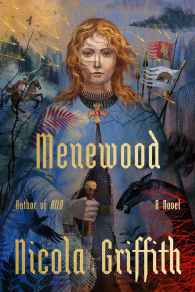
Hild is an extraordinary character: strong, charismatic, intelligent, intensely physical, remarkably whole and convincing. One of the most interesting aspects of her characterization is the novel’s certainty about her woman’s body: it’s a central fact of her life and Griffith makes that clear without apology, voyeurism, or special pleading. I can’t think, for instance, of another novel in which starting to menstruate is a plot point in quite the way it is here — incorporated with perfect naturalness into the ongoing story of the heroine’s physical and psychological maturation, experienced as an initiation into an alliance of other women, associated with independence from authority rather than readiness for male sexual attention. That’s not to say that sexuality isn’t also an important part of Hild’s story, but though there is a love story of sorts running through the novel, her desires are hers, physical feelings she can satisfy on her own, or with women: they are not (or not just) ties that bind her emotionally to a man, and they certainly do not define her ambitions or determine the arc of her story.
The shape of that story is only partially revealed by the end of Hild. (Griffith is working on the sequel now, but I almost wish she’d waited and published one epic novel, as Hild so obviously stops rather than concludes.) Hild eventually becomes Saint Hilda of Whitby, but she isn’t there when we leave her this time. What we have seen to this point, though, is her development from an uncanny child into a fierce woman. The overall trajectory of Hild is all upward in that way: not just Hild herself, but the world she lives in is taking on a different form over the novel. The most important change is the rise of Christianity, which is gradually replacing the old forms of worship which Hild, as a seer, initially represents and serves. The transition is an uneven and not entirely welcome one. For one thing, people are reluctant to give up their old beliefs, and the representatives of the new God are not altogether persuasive. The God they represent, too, is very different from the old gods, who were more personal and more fun. “They don’t like jokes,” says one of Hild’s women about the Christians; “I don’t think their god does either.” And the new God is demanding in unfamiliar ways, insisting on obedience and reverence, and preoccupied with the unfamiliar notion of original sin. He’s also “squeamish,” inexplicably hostile to women’s bodies: “No blood in the church. No woman with her monthly bleeding. It makes no sense,” says Hild’s friend.
Will this new God diminish or invalidate Hild’s power, as a seer or as a woman? Will He punish her, perhaps, for the evils she has committed as a warrior or a prophet of other gods? Hild approaches her own baptism with trepidation, but then feels renewed courage:
She breathed deep. She was Anglisc. She would not burn. She would endure and hold true to her oath. An oath, a bond. A truth, a guide, a promise. To three gods in one. To the pattern. For even gods were part of the pattern, even three-part gods. The pattern was in everything. Of everything. Over everything. . . .
Her heart beat with it, her tears fell with it, her spirit soared with it. Here, now, they were building a great pattern, she could feel it, and she would trace its shape one day: that was her wyrd, and fate goes as ever it must. Today she was swearing to it, swearing here, with her people.
I wondered (given that she becomes a Christian saint) whether Hild’s baptism would stand as an epiphanic moment of faith — as a revelation. While the language and the mood here is uplifted, though, the strongest sense is one of continuity: “she was still herself,” the scene concludes. Christianity never seems to be the one right way: it’s just another way, and one that is as prone as the old ways to express the will, greed, and ambition of its adherents rather than any divine plan. Hild’s strength continues to be herself — her limbs, trained for fighting, and her mind, astute and endlessly observing.
The other thing that’s rising in the world of the novel is literacy. This is tied to Christianity, in that it’s the priests who are usually the most ‘lettered’ of the characters. But Hild quickly perceives the value of writing as a way of maintaining networks across distances. Her ability to read and write is valuable to her politically, as her success and survival as a seer depends on good and abundant information. But it means most to her personally, as the typical fate of women is to be sent far from home and family in their roles as “peaceweavers,” cementing alliances as wives then securing kingdoms with their heirs. Hild realizes that if she could write, for instance, to her married sister Hereswith, Hereswith “wouldn’t be lost to her”: for someone in Hild’s anomalous and therefore lonely position, letters would be a lifeline, bringing her news and also preserving her own private identity while living among those to whom she is “the maid who killed, the maid who felt nothing. The maid with no mother or sister or friend.”
 The novelist Griffith most reminds me of is Dorothy Dunnett. She luxuriates in tactile details the way Dunnett does, for one thing, as in this description of a waterfront marketplace:
Rhenish glass: cups and bowls and flasks. Wheel-thrown pottery, painted in every colour and pattern. Cloth. Swords — swords for sale — and armor. Jewels, with stones Hild had never seen, including great square diamonds, as grey as a Blodmonath sky. Perfume in tiny stoppered jars, and next to them even smaller jars — one the size of Hild’s fingernail — sealed with wax: poison. . . . A six-stringed lyre inlaid with walnut and copper, and the beaver-skin bag to go with it. A set of four nested silver bowls from Byzantium, chased and engraved with lettering that Fursey, peering over her shoulder, said was Greek. But Hild barely heard him: Somewhere a man was calling in a peculiar cadence, and he sounded almost Anglisc. Almost. Instead of the rounded thump of Anglisc, these oddly shaped words rolled just a little wrong. Not apples, she thought. Pears. Heavy at the bottom, longer on the top.
The extraordinary complexity of the created world is also reminiscent of Dunnett — the intricate family trees, the tangled web of alliances, the unfamiliarity of the names and vocabulary, and thus the associated down side of such authorial mastery: our (or at any rate, my) difficulty keeping track of who’s who, of who’s doing what to whom and why. Like King Hereafter, for example, Hild is full of passages that perplex rather than clarify the action:
As the weather improved, messages began to come in from all over the isle. Two, from Rheged and from Alt Clut, said the same thing: Eochaid Buide of the Dál Riate was sending an army to aid the Cenél Cruithen against Fiachnae mach Demmáin of the Dál Fiatach, and chief among the Dál Riatan war band were the Idings — though the man from Rheged thought two, Oswald and Osric, called the Burnt, while the messenger from Alt Clut thought three, Oswald, Osric the Burnt, and young Osbald.
Or how about this one;
The murdered Eorpwald had been the godson of Edwin. Sigebert was of a different Christian lineage. he had spent his time across the narrow sea at the Frankish court of Clothar, and now Dagobert. If Sigebert was bringing threescore men, they would be Dagobert’s. If he won with their help, he would be obliged to align himself with the Franks. What would that mean for Edwin? Where was Dagobert in relation to the growing alliances of the middle country and the west — Penda and Cadwallon — and the men of the north: Idings, Picts, Scots of Dál Riata, Alt Clut, perhaps Rheghed?
Where was Dagobert, indeed? It helped a bit when I found a partial guide to pronunciation in the back of the book, and a glossary, and there’s a family tree too, but my experience reading Dunnett helped the most, particularly my conclusion that I don’t need to keep up with all the details to stay interested. Both authors are good enough story tellers that the necessary drama rises above the morass of confusing specifics. If I didn’t always know exactly why Hild was fighting someone in particular, it was enough to know that she had her reasons: the heat and blood of the battle was no less intense because I had to suspend, not disbelief, but my desire for perfect comprehension. The absolutely key characters — her mother Breguswith, her best friend, sparring partner, half-brother, and eventual husband Cian, or her “gemaecce” (“female partner”) Begu, for instance — are wholly distinct, and above it all is always Hild herself, “the pattern-making mind of the world.”
As you might expect, I am very much looking forward to reading Menewood!
This post was first published on May 31, 2015.
 As my ‘Victorian Woman Question’ seminar makes its way through The Mill on the Floss, I am very much missing the opportunity to engage in face to face discussion with everyone. It’s a novel that provokes delight, frustration, sorrow, and thought in so many ways–that raises so many complications for us, thematically and formally: it feels more difficult to choose topics and shape conversations for our online version of the class for The Mill on the Floss than it has felt for some of the other novels I have taught this way in the last few months, including (perhaps surprisingly) Middlemarch. But of course the novel itself is as wonderful as usual, and our readings for this past week included one of my favorite incidents: Mrs. Tulliver’s poignant attempt to hang on to her “chany.” It moved me even more this time: as the one-year anniversary of our COVID-inflicted isolation approaches, the things that connect us to each other and to our histories seem to me to be carrying more and more emotional weight. Here’s a post I wrote about Mrs. Tulliver’s “teraphim” almost a decade ago.
 One of the many things that make reading George Eliot at once so challenging and so satisfying is her resistance to simplicity–especially moral simplicity. It’s difficult to sit in judgment on her characters. For one thing, she’s usually not just one but two or three steps ahead: she’s seen and analyzed their flaws with emphatic clarity, but she’s also put them in context, explaining their histories and causes and effects and pointing out to us that we aren’t really that different ourselves. Often the characters themselves are in conflict over their failings (think Bulstrode), and when they’re not, at least they can be shaken out of them temporarily, swept into the stream of the novel’s moral current (think Rosamond, or in a different way, Hetty). But these are the more grandiose examples, the ones we know we have to struggle to understand and embrace with our moral theories. Her novels also feature pettier and often more comically imperfect characters who are more ineffectual than damaging, or whose flaws turn out, under the right circumstances, to be strengths. In The Mill on the Floss, Mrs Glegg is a good example of someone who comes through in the end, the staunch family pride that makes her annoyingly funny early on ultimately putting her on the right side in the conflict that tears the novel apart.
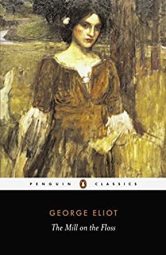 Then there’s her sister Bessy, Mrs Tulliver, who is easy to dismiss as foolish and weak, but to whom I have become increasingly sympathetic over the years. Mrs Tulliver is foolish and weak, but in her own way she cleaves to the same values as the novel overall: family and memory, the “twining” of our affections “round those old inferior things.” In class tomorrow we are moving through Books III and IV, in which the Tulliver family fortunes collapse, along with Mr Tulliver himself, and the relatives gather to see what’s to be done. The way the prosperous sisters patronize poor Bessy is as devastatingly revealing about them as it is crushing to her hopes that they’ll pitch in to keep some of her household goods from being put up to auction:
 Early in these scenes Maggie finds that her mother’s “reproaches against her father…neutralized all her pity for griefs about table-cloths and china”; the aunts and uncles are pitiless in their indifference to Bessy’s misplaced priorities. I used to find her pathetic clinging to these domestic trifles in the face of much graver difficulties just more evidence that she belonged to the “narrow, ugly, grovelling existence, which even calamity does not elevate”–the environment that surrounds Tom and Maggie, but especially Maggie, with “oppressive narrowness,” with eventually catastrophic results. She also seemed a specimen of the kind of shallow-minded, materialistic woman George Eliot’s heroines aspire not to be. But she’s not really materialistic and shallow. She doesn’t want the teapot because it’s silver: she wants it because it’s tangible evidence of her ties to her past, of the choices and commitments and loves and hopes that have made up her life and identity. She’s not really mourning the loss of her “chany” and table linens; she’s mourning her severance from her history.
 I think I understand her better than I used to, and feel more tolerant of her bewildered grief, because I have “teraphim,” or “household gods,” of my own, things that I would grieve the loss of quite out of proportion to their actual value. They are things that tie me, too, to my history, as well as to memories of people in my life. I have a teapot, for instance, that was my grandmother’s; every time I use it, or the small array of cups and saucers and plates that remain from the same set (my grandmother was hard on her dishes!) I think of her and feel more like my old self. I have a pair of Denby mugs that were gifts from my parents many years ago, tributes to my childhood fascination with English history: one has Hampton Court on it, the other, the Tower–these, too, have become talismanic, having survived multiple moves. If I dropped one, I’d be devastated, and not just because as far as we’ve ever been able to find out, they would be impossible to replace. “Very commonplace, even ugly, that furniture of our early home might look if it were put up to auction,” remarks the narrator with typical prescience, shortly before financial calamity hits the Tullivers, but there’s no special merit in “striving after something better and better” at the expense of “the loves and sanctities of our life,” with their “deep immovable roots in memory.” Sometimes a teapot is not just a teapot.
 It is,” as the narrator says, “the old, old battle of the room with the view,” and the joy of the novel is that even as we feel the horror of violence and death and the lesser but equally inexorable horror of everything Lucy must overcome, we see the view open up, we see the light and the violets and the sunshine, we heed the driver’s cry of “Courage and love!”
 From the Novel Readings Archives: Since I started this blog almost ten years ago, one of its most important roles for me has been as

 They aren’t standing in Chartres cathedral unmoved. I’m slamming the door of Chartres cathedral in their face. They might well have been feeling all the excitement I could hope for, or at least those who actually did the reading for the day might have. But it wouldn’t be their fault if they thought the CIBC Auditorium was no place to bring it up. It wouldn’t be Mark’s fault either, or mine. We do show enthusiasm and appreciation for the literature we’re covering, to be sure, but it’s not of the viscerally rapturous variety, or even the aesthetically transcendent variety. It’s a heavily intellectualized variety, and while I don’t think that makes it inauthentic, it isn’t something they are quite ready to emulate, not yet. I want them to feel the readings, and to show that they feel them, but there’s really no appropriate way for them to express that feeling in the ways they would find natural.
 From the Novel Readings Archives: I still find myself thinking a lot about the questions raised by Brian McCrea’s book Addison and Steele Are Dead, which I wrote about during my first year of blogging. Apparently I’m in something of a minority, or presumably I’d be able to find the actual cover image online somewhere! But rereading this post nearly a decade later, McCrea’s theory about the relationship between literature, professionalism, and teaching still seems well worth considering.
 As he develops his argument, McCrea offers an interesting overview of the 19th-century and then 20th-century critical reception of Addison and Steele. He explains the Victorians’ admiration for these 18th-century predecessors largely in terms of the different understanding that prevailed about the relationship of literature, and thus of the literary critic, to life. Rightly, I’d say (based on my own work on 19th-century literary criticism), he sees as a central Victorian critical premise that literature and criticism are public activities, that their worth is to be discussed in terms of effects on readers; hence the significance attached, he argues, to sincerity as well as affect. Especially key to McCrea’s larger argument is his observation that the 19th-century writers were not “academicians” or “specialists in a field”:
 While we can all share a shudder at the very idea, to me one strength of McCrea’s discussion is his admission that marginalizing affect, pleasure, and aesthetic response is, in a way, to be untrue to literature, and that the professional insistence on doing so also, as a result, marginalizes our conversation, alienating us, as McCrea says, “from our students, our counterparts in other academic departments, our families [unless, he allows, they include other professional critics–otherwise, as he points out, even they are unlikely to actually read our books and articles], and, ultimately, any larger public.” (In Democracy’s Children, John McGowan makes a similar point: “There remains a tension between the experience of reading literature and the paths followed in studying. . . . To give one’s allegiance to the academic forms through which literature is discussed and taught is to withdraw [at least partly] allegiance to literature itself”).
 It comes back to the geese, in the end. I hoped it would, because of all the marvellous episodes in Wart’s education (the tyrannical pike, the totalitarian ants, the philosophical badger), his time with the geese is the most sublime. It’s beautifully written, for one thing, detailed and evocative, freely fanciful:
 From the Novel Readings archives, a post that addresses issues still very much on my mind: what we mean by the terms “research” and “scholarship,” and what we take to be the duties of professors and the work of the humanities.
 Drawing on the Handbook published by the CAUT (invoked by his Dean in response to Drummond’s appeal of the Committee’s decision), Drummond himself brings in the vocabulary of knowledge “dissemination” which is once again very current in discussions of our aims:
 Again, it’s not that I think we should not do research, or publish what it teaches us–but it’s a shame that the system is so rigged in favor of hurrying it along and rushing it into print–not to mention aiming it at a specific (and very narrow) audience. “I know for a fact,” Drummond observes, “that policies of forced publication never brought into being–nor could ever have brought into being–those critical books that have been to me most valuable.” That’s certainly true of my reading as well. The narrow concept of research and the pressure to publish also, when made the primary measures of professional success, marginalize undergraduate teaching. (The emphasis in grantsmanship on teaching and funding graduate students, or “HQP” [Highly Qualifed Personnel] is another whole area of trouble.) Finally, it seems to me paradoxically retrograde to be urging or following a model that measures productivity by grant size or output of peer-reviewed publications at a time when the entire landscape of scholarly communication is changing. We can circulate our ideas, enhance our and others’ understanding, pursue our inquiries and disseminate our knowledge in more, and often cheaper, ways than ever before. As long as we are all using our time in service of the university’s central mission–the advancement of knowledge, including through teaching–by the means best suited to the problems we think are most important and interesting to pursue, aren’t we doing our duty as professors?
 All Quiet on the Western Front is as bleak and compelling a version of the “lost generation” narrative of World War I as I’ve read. In fact, Paul Bäumer, the novel’s narrator, comments explicitly, repeatedly, and bitterly on the chasm between the generation fighting in the trenches and the older generation far away from the front lines. “We agree that it’s the same for everyone,” Paul and his comrades conclude;


 Novel Readings