 The publication of Menewood, the long-awaited sequel to Hild, made this seem like a good time to re-run this earlier post on Griffith’s wonderful novel.
I found Hild shelved in the Fantasy and Science Fiction section at Bookmark, which means I almost didn’t realize they had it in stock, as I don’t usually browse that section. (I was poking around in case they had John Crowley’s Little, Big, which Tom had got me interested in.) I can see why the staff had put it there: the front cover blurb compares it to The Lord of the Rings and Game of Thrones. But it isn’t fantasy: it’s historical fiction, if based, Griffith says in her Author’s Note, on a particularly scanty record: “We have no idea what [Hild] looked like, what she was good at, whether she married or had children.” “But clearly,” Griffith goes on, “she was extraordinary,” and that’s certainly true of the protagonist Griffith has created from the sparse materials available.
Maybe, though, considering Hild “fantasy” is not altogether a category mistake. “I made it up,” Griffith says about her story, while explaining that it is also deeply researched: “I learnt what I could of the late sixth and early seventh centuries: ethnography, archaeology, poetry, numismatics, jewellery, textiles, languages, food production, weapons, and more. And then I re-created that world . . . ” — that is, she engaged in “worldbuilding,” which is a fundamental (perhaps the fundamental?) task of the fantasy or science fiction author. Of course, her world is built out of real pieces, but it’s an artificial construction nonetheless. I suppose this could be said of any historical fiction, or any fiction at all, so maybe I’m trying to blur a line that’s already indistinct. But there’s something about Hild — the strangeness of its world, but also of Griffith’s evocation of it — that makes it haunting and uncanny, as if we are not so much in an earlier version of our own world but in an alternative version.
It’s mostly Hild herself who’s responsible for that sense that we’re looking through, rather than at, the world: she is the king’s “seer,” the “light of the world,” and thus it is her job, her destiny, her “wyrd” or fate, to perceive the world differently than others. She is constantly seeking patterns, in nature and in the shifting relationships of the court and the kingdom. Her powers of perception set her apart: she is admired, revered, and feared. Her gifts are not necessarily supernatural, though: her “visions” are the results of long thought and sharp intelligence, and sometimes they are also simply predictions shaped to suit what her listeners (especially the King) want most to hear or do. Signs and omens must be interpreted, and that too requires political savvy and deft diplomacy more than any preternatural insight. Hild’s status as the King’s “light” defines her from birth and shapes both how she is treated and how she must behave: it is a burden, a responsibility, a terrible risk and a great liberation, because it exempts her from the ordinary constraints of a woman’s life. 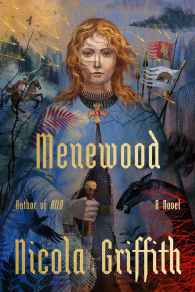
Hild is an extraordinary character: strong, charismatic, intelligent, intensely physical, remarkably whole and convincing. One of the most interesting aspects of her characterization is the novel’s certainty about her woman’s body: it’s a central fact of her life and Griffith makes that clear without apology, voyeurism, or special pleading. I can’t think, for instance, of another novel in which starting to menstruate is a plot point in quite the way it is here — incorporated with perfect naturalness into the ongoing story of the heroine’s physical and psychological maturation, experienced as an initiation into an alliance of other women, associated with independence from authority rather than readiness for male sexual attention. That’s not to say that sexuality isn’t also an important part of Hild’s story, but though there is a love story of sorts running through the novel, her desires are hers, physical feelings she can satisfy on her own, or with women: they are not (or not just) ties that bind her emotionally to a man, and they certainly do not define her ambitions or determine the arc of her story.
The shape of that story is only partially revealed by the end of Hild. (Griffith is working on the sequel now, but I almost wish she’d waited and published one epic novel, as Hild so obviously stops rather than concludes.) Hild eventually becomes Saint Hilda of Whitby, but she isn’t there when we leave her this time. What we have seen to this point, though, is her development from an uncanny child into a fierce woman. The overall trajectory of Hild is all upward in that way: not just Hild herself, but the world she lives in is taking on a different form over the novel. The most important change is the rise of Christianity, which is gradually replacing the old forms of worship which Hild, as a seer, initially represents and serves. The transition is an uneven and not entirely welcome one. For one thing, people are reluctant to give up their old beliefs, and the representatives of the new God are not altogether persuasive. The God they represent, too, is very different from the old gods, who were more personal and more fun. “They don’t like jokes,” says one of Hild’s women about the Christians; “I don’t think their god does either.” And the new God is demanding in unfamiliar ways, insisting on obedience and reverence, and preoccupied with the unfamiliar notion of original sin. He’s also “squeamish,” inexplicably hostile to women’s bodies: “No blood in the church. No woman with her monthly bleeding. It makes no sense,” says Hild’s friend.
Will this new God diminish or invalidate Hild’s power, as a seer or as a woman? Will He punish her, perhaps, for the evils she has committed as a warrior or a prophet of other gods? Hild approaches her own baptism with trepidation, but then feels renewed courage:
She breathed deep. She was Anglisc. She would not burn. She would endure and hold true to her oath. An oath, a bond. A truth, a guide, a promise. To three gods in one. To the pattern. For even gods were part of the pattern, even three-part gods. The pattern was in everything. Of everything. Over everything. . . .
Her heart beat with it, her tears fell with it, her spirit soared with it. Here, now, they were building a great pattern, she could feel it, and she would trace its shape one day: that was her wyrd, and fate goes as ever it must. Today she was swearing to it, swearing here, with her people.
I wondered (given that she becomes a Christian saint) whether Hild’s baptism would stand as an epiphanic moment of faith — as a revelation. While the language and the mood here is uplifted, though, the strongest sense is one of continuity: “she was still herself,” the scene concludes. Christianity never seems to be the one right way: it’s just another way, and one that is as prone as the old ways to express the will, greed, and ambition of its adherents rather than any divine plan. Hild’s strength continues to be herself — her limbs, trained for fighting, and her mind, astute and endlessly observing.
The other thing that’s rising in the world of the novel is literacy. This is tied to Christianity, in that it’s the priests who are usually the most ‘lettered’ of the characters. But Hild quickly perceives the value of writing as a way of maintaining networks across distances. Her ability to read and write is valuable to her politically, as her success and survival as a seer depends on good and abundant information. But it means most to her personally, as the typical fate of women is to be sent far from home and family in their roles as “peaceweavers,” cementing alliances as wives then securing kingdoms with their heirs. Hild realizes that if she could write, for instance, to her married sister Hereswith, Hereswith “wouldn’t be lost to her”: for someone in Hild’s anomalous and therefore lonely position, letters would be a lifeline, bringing her news and also preserving her own private identity while living among those to whom she is “the maid who killed, the maid who felt nothing. The maid with no mother or sister or friend.”
 The novelist Griffith most reminds me of is Dorothy Dunnett. She luxuriates in tactile details the way Dunnett does, for one thing, as in this description of a waterfront marketplace:
Rhenish glass: cups and bowls and flasks. Wheel-thrown pottery, painted in every colour and pattern. Cloth. Swords — swords for sale — and armor. Jewels, with stones Hild had never seen, including great square diamonds, as grey as a Blodmonath sky. Perfume in tiny stoppered jars, and next to them even smaller jars — one the size of Hild’s fingernail — sealed with wax: poison. . . . A six-stringed lyre inlaid with walnut and copper, and the beaver-skin bag to go with it. A set of four nested silver bowls from Byzantium, chased and engraved with lettering that Fursey, peering over her shoulder, said was Greek. But Hild barely heard him: Somewhere a man was calling in a peculiar cadence, and he sounded almost Anglisc. Almost. Instead of the rounded thump of Anglisc, these oddly shaped words rolled just a little wrong. Not apples, she thought. Pears. Heavy at the bottom, longer on the top.
The extraordinary complexity of the created world is also reminiscent of Dunnett — the intricate family trees, the tangled web of alliances, the unfamiliarity of the names and vocabulary, and thus the associated down side of such authorial mastery: our (or at any rate, my) difficulty keeping track of who’s who, of who’s doing what to whom and why. Like King Hereafter, for example, Hild is full of passages that perplex rather than clarify the action:
As the weather improved, messages began to come in from all over the isle. Two, from Rheged and from Alt Clut, said the same thing: Eochaid Buide of the Dál Riate was sending an army to aid the Cenél Cruithen against Fiachnae mach Demmáin of the Dál Fiatach, and chief among the Dál Riatan war band were the Idings — though the man from Rheged thought two, Oswald and Osric, called the Burnt, while the messenger from Alt Clut thought three, Oswald, Osric the Burnt, and young Osbald.
Or how about this one;
The murdered Eorpwald had been the godson of Edwin. Sigebert was of a different Christian lineage. he had spent his time across the narrow sea at the Frankish court of Clothar, and now Dagobert. If Sigebert was bringing threescore men, they would be Dagobert’s. If he won with their help, he would be obliged to align himself with the Franks. What would that mean for Edwin? Where was Dagobert in relation to the growing alliances of the middle country and the west — Penda and Cadwallon — and the men of the north: Idings, Picts, Scots of Dál Riata, Alt Clut, perhaps Rheghed?
Where was Dagobert, indeed? It helped a bit when I found a partial guide to pronunciation in the back of the book, and a glossary, and there’s a family tree too, but my experience reading Dunnett helped the most, particularly my conclusion that I don’t need to keep up with all the details to stay interested. Both authors are good enough story tellers that the necessary drama rises above the morass of confusing specifics. If I didn’t always know exactly why Hild was fighting someone in particular, it was enough to know that she had her reasons: the heat and blood of the battle was no less intense because I had to suspend, not disbelief, but my desire for perfect comprehension. The absolutely key characters — her mother Breguswith, her best friend, sparring partner, half-brother, and eventual husband Cian, or her “gemaecce” (“female partner”) Begu, for instance — are wholly distinct, and above it all is always Hild herself, “the pattern-making mind of the world.”
As you might expect, I am very much looking forward to reading Menewood!
This post was first published on May 31, 2015.

 I love that, but I’ve also seen it before, or very nearly. This time it’s Cyprus, but before it has been Bruges, or Venice, or Trebizond. The particulars vary, but the effect doesn’t, really. And we also get many examples of another kind of passage that to me is a lot less inviting — the kind that traces out the loyalties and lineages and special interests that are the warp and woof of Dunnett’s plots. I’ve admitted more than once that these very complicated plots are hard for me to follow. In the Lymond books, that has never bothered me much because the melodrama carries me along and because they are dominated by a few highly charismatic figures: Lymond himself, of course, Margaret Lennox, Gabriel, Philippa, Sybilla, Guzel. The supporting cast in Nicholas’s life is appealing, but not one of them really stands out to me at this point. (Greater familiarity with the series would probably change this perspective, as, perhaps, would reading the books closer together. I had trouble recalling who everybody was when I began Race of Scorpions, never mind what exactly they had been up to before.) By the end of this book, I had stopped even trying to grasp what exactly Nicholas is up to and why, besides whatever was immediate and obvious in the moment.
 This is not to say there weren’t some great, even thrilling moments in Race of Scorpions: Katelina and the moths, for example, which is a scene I’ll remember for a long time, or, in a more violent register, the long-deferred confrontation with Tzani-Bey (who did what, exactly, to Nicholas, by the way? am I right to infer that his “mistreatment” was sexual?). I was also struck — not for the first time — by the ease with which Dunnett’s world incorporates a range of sexualities. This is something that’s very prominent in Race of Scorpions, because of Zacco, but the variety and fluidity of desire is a feature of the Lymond books too. It’s certainly not typical of other mainstream historical novels I’ve read set in the Renaissance: they tend, overwhelmingly, to be organized around heterosexual romance plots, without even a hint of other possibilities. And something else that Race of Scorpions has in common with the Lymond series is an emphasis on powerful women — here, Marietta of Patras or, as she is less elegantly called, “Cropnose” (because hers has been bitten off), and her foil, at least in beauty, Primaflora. So often in Dunnett’s books, while it’s the men out in front taking action, seemingly in charge, it turns out to be the women who, behind the scenes, are pulling the strings, plotting — like Dunnett herself.
 A few days ago I picked Dorothy Dunnett’s The Ringed Castle off my bookshelf to look up a particular scene and ended up not just reading to the end (again) but following up with a reread of the next novel in the Lymond Chronicles, Checkmate.
 First, they are both fundamentally about leadership, and particularly the cost it exacts on “the chosen one.” Francis Crawford, of course, is not chosen in the supernatural way that Buffy is — though there are many hints through the novels of forces and purposes beyond the understanding and control of individual human actors, through characters like the Dame de Doubtance and the recurrent appearances of Nostradamus and John Dee bearing astrological charts and prophesies. Even setting aside fate or destiny as factors, though, Dunnett emphasizes that extraordinary gifts such as Lymond’s bring responsibilities: to be both extremely talented and highly charismatic is to invite discipleship, and much of the drama of the series turns on Lymond’s struggles to find the right use of his exceptional self. For him as for Buffy, leadership means isolation, risk, and hard choices — which we watch him make over and over, often amid the burden of other people’s misunderstanding, jealousy, or hatred. Morally, he is a much more complicated figure than Buffy, but beneath his often flamboyant disregard for conventional propriety or morality, there’s an absolute integrity that we come, as readers, to trust as much as Archie Abernethy does. And Archie isn’t the only one: there’s a parade of people across the novels who end up giving Lymond their loyalty, even their love, as they learn to see past the distracting sparkle of his brilliant, ruthless surface. (Did I mention Christian Stewart? That relationship establishes something absolutely vital to the rest of the series.) For Lymond, as never really for Buffy, the question is whether he can remain worthy of his own rather extraordinary Scooby gang, or whether his excesses will finally destroy it, and him.
 The other thing I found myself thinking about is how far both series rely on the power of storytelling and especially of great characterization to get us to accept features that might otherwise seem ridiculous. I’ve been watching
 Inspired by my excitement about King Hereafter, I have finally started reading Dorothy Dunnett’s other big series, The House of Niccolò. I’ve actually owned Niccolò Rising for many years, and I’d started it a few times before, but it is another story with a slow burn and I’d never made it past Chapter 2. If I hadn’t been schooled in this trick of Dunnett’s so recently, I think I would have bogged down once more, and it did take a bit of determination to keep on. I remembered, this time, that I have to trust her and that if I do, I won’t be disappointed.
 Novel Readings