Book Club Update: Moby-Dick Contains Multitudes

moby-dick-penguinMy book club met last night for the first of two sessions on Moby-Dick. For this one we read only about half way through, so a lot of our discussion either began or ended with some variation on “I wonder where this goes.” Does the novel as a whole uphold Ishmael’s endearing open-mindedness – or, for that matter, does Ishmael himself continue in the same tolerant spirit he initially shows towards Queequeg’s “Pagan” predilections? Does Ahab’s single-minded quest for the white whale turn out to be in any way noble, or is this model of ruthless heroism thoroughly undermined? When we finally see Moby-Dick for ourselves, what picture do we get, to put up against those described in Chapters 55-57? How far can — or should — we read the novel symbolically or allegorically? What theory of fiction makes sense of the novel’s extraordinary blend of realism and prophesy, concrete detail and metaphorical reach — what kind of book is it? Will there ever be an important woman character (we’re guessing not), how far is women’s absence part of what, for some, has defined its story as great and universal, and what does that mean about the American literary tradition or cultural imagination?  What is it about this book, anyway, that accounts for its having been invested with so much cultural significance? And so on.

We’re pretty unlikely to answer these questions in a really substantial, much less very original, way over a couple of dinners. (However, if you want to talk about seafaring, there are worse times and places to do it than at Shuck Seafood on a foggy Maritime night. The food was so good and the atmosphere and service so pleasant we might do our follow-up Moby-Dick meeting there too!) I’m not going to hazard any answers here now, either. What I wanted to comment on at this point is just a feature of our Moby-Dick discussion that seemed to me different than some, maybe most, of our other bookish conversations. I can’t remember another book in which it wasn’t so much general opinions that differed but the specifics that won or lost us as individual readers. One of us, for instance, particularly loved the details about New Bedford and Nantucket life but was impatient with the “digressions” that impeded the story of the Pequod’s voyage; one (the scientist) was fascinated by the taxonomies of the “Cetology” chapter and Melville’s obvious interest in replacing (or maybe supplementing) myths about sea monsters with whatever facts could be gleaned, often at great cost, about actual whales; one was won over by the humor, such as the good-cop bad-cop scene with Peleg and Bildad in Chapter 16; one (you’ll never guess which) kept bringing up some guy called Carlyle. Moby-Dick offered every one of us something to fascinate or frustrate, and while there was some overlap (interest in Ishmael’s narrative voice, for instance — though again, some of us loved it while others were impatient with it), it sometimes seemed as if we’d all been reading different versions of the novel. (We all brought literally different editions, but that’s a separate issue.)

moby-dick-penguin-4This dispersed effect no doubt stems from the book’s chaotic-seeming and inclusive structure, which has led critics to call it things like an “intellectual chowder” or a “magnificent mess” (that’s Nathan Philbrick, in Why Read Moby-Dick). It seems to be built on a premise of embracing capaciousness: it includes everything Melville finds interesting or significant to his subject, rather than pursuing an aesthetic of elegant perfection. This blotchiness could easily be seen as a fault. (I’d love to know what, if anything, Henry James said about Moby-Dick, given his dismissive view of Middlemarch‘s formal construction. No golden bowl here — more an ungainly pitcher!) It’s certainly risky: surely no self-respecting MFA instructor would dare encourage anyone to write such a book! But I think our group’s diverse responses point to one aspect of the book’s greatness: there was something in it for — and against — all of us. It’s not one thing: it’s all kinds of things (though it’s not everything, though Philbrick’s little book suggests he might think so).  The challenge for a first-time reader is dealing with the bits that don’t immediately suit: we all admitted to having skimmed one part or another, but, again, not usually the same parts. Listening to people pointing out the aspects that most interested them made me want to reread: it made me aware, not just of the book’s mulititudinousness, but of my own limitations (which, in the context of Moby-Dick, are many). That can be off-putting, but it’s part of Melville’s magic to have made it inspiring instead.

“Boldly Launched” — On My First Reading of Moby-Dick

moby-dick-penguin

Already we are boldly launched upon the deep; but soon we shall be lost in its unshored, harborless immensities.

When I wrote about Madame Bovary here a couple of years ago, I commented that reading a very famous novel for the first time is

like meeting a celebrity in person (or so I imagine). It is intensely familiar and yet strange at the same time: it is exactly what it always appeared to be, and yet it is no longer an idea of something but the thing itself.

That certainly applies in this case too — more so, perhaps, because I think Moby-Dick has a larger presence in the popular imagination than Madame Bovary. And not just the things everyone “knows” about it (the white whale! Captain Ahab! “Call me Ishmael”!) but the book itself, which is a kind of legendary object, so deep and vast that reading it (or so you’d think) is itself a kind of fantastical quest.

So, once again, I find myself reading something that I already knew a lot about, and in the process discovering how little I really knew about it. So far, anyway, the surprise factor is much greater with Moby-Dick than it was with Madame Bovary (which really was the perfection of the sort of thing I expected it to be). I didn’t really know what Moby-Dick would actually sound like, and I especially had no idea (I don’t know why, but I really didn’t) that Moby-Dick would be so much fun. I also thought it would be much longer! I ended up getting the Penguin Classics edition — a choice I’m very happy with, as the font is very readable and the notes are helpful but not overwhelming — and it’s under 700 pages, which for someone who reads Vanity FairMiddlemarch, and Bleak House regularly is not scary at all.

moby-dick-penguin-2I decided against the highly- recommended Norton Critical edition because I wanted to approach this first reading not as a chore to be done diligently but as a reading experience to be, well, experienced! No doubt I will finish the novel without having plumbed its depths, and if I weren’t enjoying Melville’s prose so much first-hand, I might have changed my mind (and in fact I do have a copy of the Norton out from the library, ready to turn to if the need arises). I feel like Herman and I are doing pretty well so far, however.

One reason for that, I’m quite sure, is that I’ve read Carlyle, which makes a lot of the wackier features of Moby-Dick (its rapid changes of register, from the prophetic to the bathetic; its elliptical allusions; its delight in the grotesque and the absurd; its insistence that everything — everything — is not just literal but symbolic) seem, if not necessarily reasonable and explicable, at least familiar. Here’s one of many examples of a moment that wouldn’t be out of place in Sartor Resartus:

Men may seem detestable as joint-stock companies and nations; knaves, fools, and murderers there may be; men may have mean and meagre faces; but man, in the ideal, is so noble and so sparkling, such a grand and glowing creature, that over any ignominious blemish in him all his fellows should run to throw their costliest robes. That immaculate manliness we feel within ourselves, so far within us, that it remains intact though all the outer character seem gone; bleeds with keenest anguish at the undraped spectacle of a valor-ruined man. Nor can piety itself, at such a shameful sight, completely stifle her upbraidings against the permitting stars. But this august dignity I treat of, is not the dignity of kings and robes, but that abounding dignity which has no robed investiture. Thou shalt see it shining in the arm that wields a pick or drives a spike; that democratic dignity which, on all hands, radiates without end from God; Himself! the great God absolute! The centre and circumstance of all democracy! His omnipresence, our divine equality!

All it needs is some more capital letters and it could be part of the unfolding of the Clothes Philosophy — or at any rate some kind of appendix to it.

moby-dick-penguin-3I know from experience that not every reader finds Carlylean prose exhilarating, but I do: I have ever since I read The French Revolution as an unsuspecting undergraduate. What I loved about The French Revolution then (before I knew anything at all about Carlyle) was that it exuded the conviction that its writing absolutely mattered — that it was about something hugely important and written in a style meant to convey and to reproduce that significance. It was daring and unconventional because it had to be. I get the same feeling from Moby-Dick. Even when it’s going along a bit more quietly than in the passage I quoted, it has the humming energy of a book with something (many things!) it really, really wants to say, and to say in a memorable way. It doesn’t feel artful, if that means constructed to create an aesthetic effect: it feels spiritual — meaning not religious in any doctrinal way but about the spirit, about what matters, what drives us, what scares us, what means something to us. It’s exciting! I’d really rather quote from it (or read it aloud) than write about it!

That said, so far I can’t disagree with the contemporary opinion I’ve read that the book is an “intellectual chowder.” Up to the half-way point I’ve reached (Chapter 60) there has certainly been (off and on) a forward-moving narrative — I hesitate to call it a “plot” when really all that’s happened, in terms of events, is that Ishmael and Queequeg have met, signed on to the Pequod and been at sea for a while, including one “lowering” of the boats. That through-line is enough, but barely enough, to give some coherence to what is otherwise rather a jumble of anecdote, sea lore, nautical trivia, character sketches, and poetic outbursts. I like the divisions into short chapters, though: that helps each of those ingredients have a certain distinctness, and also mostly prevents them from feeling like digressions, because they are so clearly puzzle pieces. In fact, a metaphor that might work as well as the chowder one is patchwork: I wonder if anyone has worked up a theory of Moby-Dick as literary quilting.

moby-dick-penguin-4I doubt it, because something else that’s hard to miss even on a first reading is just how very masculine the book is. I don’t recall that any women have even had any speaking parts at all in the novel so far — though I may be forgetting something, perhaps from back at the Spouter Inn. Certainly at sea it’s a man’s world. What does that mean for the oft-invoked universality of the novel’s mythos? Coincidentally, we’re watching Season 2 of The Affair, and last night’s episode featured a long scene between Noah and his therapist (played by Cynthia Nixon, which kept confusing me — why is Noah talking to Miranda?) in which Noah expounds a theory of greatness founded on abandoning ties — isn’t it more important to do (write) something great than to respect constraints like family and fidelity? What does it matter if other people suffer through your pursuit of greatness, especially if you achieve it? Obviously, in his case there’s a lot of wishful self-justification at work there, but what struck me was how much power that myth of greatness at any cost still has … when it’s a man talking, anyway. Not that Ahab (who is the most single-minded one in Moby-Dick) comes across as great; if he’s heroic, he is dangerously so, and presumably one thing the rest of the novel does is explore what is noble and what is disastrous about his quest for the white whale. (“And of all these things the Albino whale was the symbol. Wonder ye then at the fiery hunt?”)

I’m reading Moby-Dick because my book club chose it; we’re meeting next week to discuss the first 60 chapters, so I’m going to set it aside for other reading in the meantime so as not to muddle the conversation. I’ve already discovered that the fragmented structure makes putting it down and picking it up again easier than with books whose plots are more intricately woven (which is not to say that there aren’t continuities and patterns unifying Moby-Dick, particularly metaphorical ones). I’m really glad we did choose it: the suggestion was quite unexpected, and I was kind of skeptical about it when it was made, but now I’m grateful to have been giving that extra push. One more thing I’ll be able to cross off my ‘Humiliation’ list! (Maybe next I can suggest we read Ulysses … )

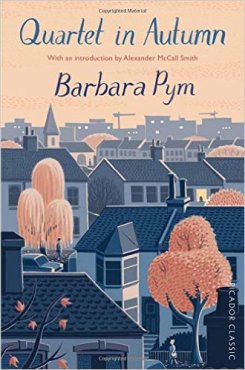
Dubious Comfort: Barbara Pym, Quartet in Autumn

quartet

There was something to be said for tea and a comfortable chat about crematoria.

Early in Quartet in Autumn, Letty — one of the novel’s quartet of main characters — reflects on her past as an “unashamed reader of novels”: “she had come to realize,” we’re told, “that the position of an unmarried, unattached, ageing woman is of no interest whatsoever to the writers of modern fiction.” They are of great interest, of course, to Barbara Pym, who could be considered the patron saint of all such overlooked and underestimated women.

Quartet in Autumn actually balances our attention between two more in Pym’s panoply of spinsters and two — what to call them? what is the male equivalent of a ‘spinster’? That we don’t really have one is suggestive of the ways in which aging alone is different for women than it is for men. Still, terminology aside, the characters have a lot in common besides having worked for many years in the same office (that we never learn anything about where they work or what they actually do becomes one of the novel’s tragi-comic aspects). Though one of the men is a widower, now they are all equal in their mutual isolation, and if that sounds like a paradox (how can they be so alone if they’re all together so much?), I think that’s one of Pym’s points: that simply sharing time and space, even over many years, does not in itself create meaningful connections between disparate people. And yet by the end of the book, which is certainly one of the gloomier Pym novels I’ve read, the connection between them has become something just slightly more than any of them thought or expected, and therein lies what small comfort a book about aging, retiring, losing one’s strength and faculties, and dying unmourned can offer.

I thought Pym was especially good — meaning both funny and painful — about retirement, which for many working people surely seems as much a looming threat as an anticipated promise. When Letty and Marcia retire, they are not replaced: “indeed,” we’re told, “the whole department was being phased out,” which raises discouraging questions for them about the value of the work they’ve done for all those years, and even about the reality of their entire working lives:

It seemed to Letty that what cannot now be justified has perhaps never existed, and it gave her the feeling that she and Marcia had been swept away as if they had never been.

This gives her, understandably, a “sensation of nothingness” that is hard to overcome despite the opportunity retirement affords “to do all those things she had always wanted to do” — “unspecified” things that turn out not to be all that fulfilling after all, and which hardly take up all the time she now has. Her first day of retirement is “as tiring as a working day” from the very effort to occupy herself, including during “a period between tea and supper which she did not remember as having existed before.” Perhaps because retirement is much in the air at my own workplace, with similar non-replacement policies raising questions both practical and principled, personal and existential, for all of us, her experience seemed particularly poignant to me: I know how much it can hurt someone to get the message the institution they have devoted themselves to can treat them as an expensive redundancy, someone to be urged out and happily done without.

Sad as the novel’s premise is — it is, indeed, autumnal, with its focus on unwelcome but inevitable changes in all facets of its characters’ lives — it is somehow never, or never completely, melancholy: Pym is too funny for that. There’s the saga of the misfit milk bottle, for instance, which I won’t spoil by relating — it’s not so much that I would ruin any suspense about it as that I could never capture quite why it is so daftly comical, but also so spot on about human nature. Alexander McCall Smith is quite right, in his introduction, to say that “we all have something that is the equivalent of that symbolic milk bottle.” It’s a smaller-scale comedy here than we get in Kingsley Amis’s Ending Up (which is the earlier book club choice that led us here), but it’s also kinder: wry, rather than bitter. Though Pym gives us one truly depressing story about ending up alone, she softens the blow by helping us realize that even in age there are choices, and as long as you have a little life left in you, there are still “infinite possibilities for change.” The novel ends up feeling like a calming cup of tea on an otherwise bad day: it can’t really fix anything, but in its own way, it is bracing.

“That Silent Creature”: Elizabeth Jane Howard, The Beautiful Visit

howardcoverLike a lot of other early – to mid- 20th-century women’s fiction I’ve read (Elizabeth Taylor’s A Game of Hide and Seek comes to mind, or Rose Macaulay’s The Towers of Trebizond, or most of Winifred Holtby’s novels, or Margaret Kennedy’s) Elizabeth Jane Howard’s The Beautiful Visit was a disorienting reading experience: I finished it feeling I did not have the right critical apparatus to make interpretive sense of it. Although my interest never flagged, I could not see where it was going or what it was meant to be about: though the experiences related are often emotionally intense, the tone is generally flat, almost affect-less, while the plot is not really a plot so much as a series of random incidents connected only by a general pattern of faint hopes raised and then dashed. Though it tells the story of a young girl’s maturation, it lacks the momentum of a bildungsroman; though it turns out to be a story of artistic development, or at least emergence, it lacks the inspiration of a kunstlerroman. What is its point? Where is it meant to take us, intellectually and imaginatively?

howardI ended up thinking that its lack of direction and energy was its governing idea. The narrator is stifled by her family life and by the social constraints on her behavior as well as her options: she would like to have a vocation, but she can’t really imagine what it might be. The visit that changes everything by showing her how other people live actually changes very little, at least about how she can live: its effects arise only through the new connections she makes, most of which turn out to be far less consequential than she expects. Even when they do lead to something significant (like a marriage proposal), the promised transformation ultimately has no appeal. The one big change that finally occurs at the novel’s end is so artificial, so unanticipated, that it doesn’t seem to solve or promise anything either, except perhaps that it is the beginning of the real bildungsroman, the real story of her life, which we don’t get because our novel is the story of the stuttering, inchoherent, mostly pathetic existence that preceded it. (Is it also factitious? There’s an odd moment when she frankly remarks her difficulty in figuring out how to end the autobiographical novel she’s writing / we’re reading.)

I can see that the novel is in part a critique of women’s stifled lives, and of the marriage plot they are so relentlessly expected to embrace. The narrator’s mother is a sad example of the error of living for someone else: “Your father believed in music,” she tells her daughter,

and I believed in your father. By the time he died, I don’t think he believed in anything, and now I find it very difficult to believe in him.

The story of beautiful Deb and her disappointments is another striking case in point: “life stops when one is married,” she says as she urges the narrator towards her own engagement, “and one ought to take care that it stops in a very good place.” The narrator (nameless, as befits her unformed identity) doesn’t want to marry, at least not just for the sake of marrying. “What will happen to you, if you don’t marry him?” demands Deb; “You surely do not intend spending the rest of your life doing those dreary jobs, do you?”

This seems a fair enough question, in the circumstances, so there’s something at least potentially heroic about our protagonist’s determination to resist her seemingly inevitable fate. She’s hardly rewarded for choosing independence, though, until she’s rescued improbably with a scheme to travel the world and determine its shape — a symbolic quest, I assume, meant to invoke visions of exploration and discovery, of new horizons both literal and metaphorical. Her previous inability to make any real changes is not really her fault, though it is her tragedy (more even than her sad but almost accidental wartime love affair). Her unexpected savior rightly observes that for all her attempts to escape, she has carried her “family atmosphere” along with her. I wonder why it doesn’t feel more triumphant, then, when she seizes opportunity to do, and be, something else: “On board a great deal of unpacking was necessary,” she reports without excitement; “I was given a cabin to myself with a good small table for writing.”

visitcoverThat she is well-suited to be a writer is often asserted by people she meets, mostly because she is so observant. I suppose The Beautiful Visit does give us some evidence of that: mostly silent herself, the narrator watches those around her with a sharp, if often somewhat puzzled, eye. Her lack of experience limits her insights into others as well as herself, but what she sees, she describes. That her account is so episodic suggests her own lack of direction. Other people find her more interesting than I did: when the young man she met on the initial visit reappears and declares his passionate love for her, I wondered if he had mistaken her for someone else because she seemed such a shadow of an actual person. Is that the necessary quality of a writer, to be self-effacing enough that they elude our attention even as they claim it?

My book club chose The Beautiful Visit in December, as a follow-up to Kingsley Amis’s Ending Up. Not for the first time, we accidentally coincided with the zeitgeist, as just last week a piece by Hilary Mantel championing Howard ran in The Guardian. Mantel skips quickly past The Beautiful Visit (though she notes it was a prize winner) and focuses primarily on the Cazalet Chronicles:

The novels are panoramic, expansive, intriguing as social history and generous in their storytelling. They are the product of a lifetime’s experience, and come from a writer who knew her aim and had the stamina and technical skill to achieve it.

longviewMantel makes the Cazalet Chronicles sound well worth reading. I’m not sure how convinced I am, however, by her broader argument that Howard is relatively unknown “because she’s a woman” writing what were perceived of as “woman’s books.” “Good books by women,” Mantel rightly  notes, “fell out of print and vanished into obscurity: not just because, as in the case of male writers, fashion might turn, but because they had never been properly valued in the first place.” But I’d have to read more of Howard’s novels to see if I think they are as good as Mantel does. “Her virtues are immaculate construction,” she asserts, “impeccable observation, persuasive but inexorable technique.” I didn’t discern these qualities in The Beautiful Visit: nothing about it seems to justify falling into critical rhapsodies. I’m quite prepared to believe I am missing something about it, though — that I could learn to read it better. I’m looking forward to our discussion on the weekend.

Dogs and Cats

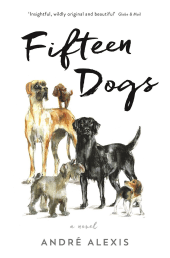
alexisI’m back! It has been quite a week, and I still have work to do to finish up the term, but I can see my way through it now — and really, it hasn’t been that bad compared to terms when I’ve had more or bigger classes and no teaching assistants. Still, it feels good to have everything under control, and thus to be able to contemplate the stacks of books around my desk with anticipation rather than anxiety or guilt. Hang in there, Isabel: you’re next! (Egad, was it really a whole month ago that I started The Portrait of a Lady?)

The one book I have managed to get to the end of recently is Andre Alexis’s Fifteen Dogs, which was my book club’s latest selection. Usually we try to follow some kind of link from one book to the next, but we settled on Fifteen Dogs a bit randomly because a few people had heard about and thought it sounded interesting. A few days after we chose it, it won the Giller Prize, so that seemed like validation! (Coincidentally, it did turn out to resemble Ending Up in one respect: all of its main characters end up the same way Amis’s do.)

I didn’t like Fifteen Dogs. The premise was initially interesting, and I have nothing in principle against adapting old forms (in this case, the apologue) for contemporary use. But Alexis’s choice to write the book in stiltedly formal diction as if to recreate the form’s antiquity really didn’t work for me: to my ear, it just sounded artificial, and it kept me from ever feeling anything about the dogs. Perhaps that was the intent: to keep it intellectual, to give it the (supposed) objectivity of a philosophical exercise. Or perhaps (and equally likely) I just wasn’t the right reader for the book, as at least one other member of my book club said it made her cry.

Was I unmoved by Fifteen Dogs because I’m a cat person and have never been particularly comfortable around dogs, which usually strike me as loud, messy, and intrusive? I wondered about that a lot while I was reading Alexis’s book. I wan’t convinced by his dogs as either dogs or dogs-with-human-consciousness, but I thought that might be because I don’t have an intimate knowledge of what he repeatedly calls “the canine.” I think Alexis does manage not to simply anthropomorphize his dogs once they can think and talk — he works hard to keep them still dog-like (as he understands that) and then to animate the strange hybrid his thought experiment has created. (There’s a pretty funny bit about a dog watching a movie who, despite being otherwise pretty interested in it, gets frustrated that he can’t smell anything in it.)

alexis2But it turned out that although I am the only person in my book club who doesn’t own (and love) dogs, most of the others also didn’t like the book much. One was offended by it because she loves dogs and thought the book showed Alexis doesn’t actually like them: his version of them is negatively selective, uncharitable, she proposed. The nobility of the dog who waits years for his owner to come back struck a chord with some of the others (though why this dog, in spite of his grasp of human language and motives, never figures out that she has died did bother us). We all agreed with the one who cried that the last dog’s death was very pathetic — but she recently lost her own dog, so she thought she might have also been emotionally vulnerable. I was the only one who had gotten both distracted and annoyed by the weirdly specific allusions to Victorian novels (if you were going to train your preternaturally talented dog to recite just one 19th-century novel, would you choose Vanity Fair? and what is it exactly that makes Mansfield Park the pooch’s preferred Austen?). In general, the complaint was simply that it wasn’t very engaging, though as is often the case, as we talked we found it getting more interesting, at least theoretically: why does the acquisition of language so immediately cause such a deep rift? what is it about poets that makes them both outcasts and – or so Alexis proposes – the only ones likely to find happiness? We had a little fun going through the poems, too, looking for the hidden dog names that we’d missed the first time.

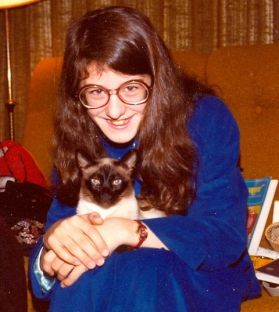
Their tepid response to Fifteen Dogs notwithstanding, there’s no doubt that I was surrounded by dog lovers, and the book prompted some impassioned discussion of their dogs, which naturally made me feel both left out and a bit defensive. I have met some individual dogs over the years that I’m fine with, and every once in a while I think it might be nice to be met with panting enthusiasm when I come home from work, but really, if getting a pet were an option for me, I’d absolutely get a cat, not a dog. As a child, I longed for a cat above all things, but my father and both siblings are allergic, so it always seemed like an impossible dream. Then on Christmas Day in 1977, a mysterious basket was delivered that seemed to be making a sad mewling noise — and inside was an absolutely beautiful seal point Siamese kitten. This very old and sadly discolored photo shows us on our very first day together:

scan0001 (2)

I was at once completely in love and completely petrified! And I was deep into my Mary, Queen of Scots phase, so I named him “Bothwell,” an aristocratic title he quickly grew into:

scan0003

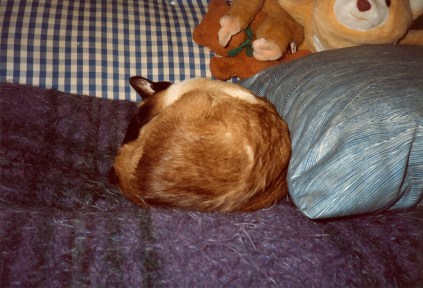
Bothwell was a truly splendid cat: smart, elegant, expressive, loyal. In retrospect, I wasn’t the greatest owner: I didn’t clean out the litter box as often as I should have, and sometimes I just dumped new food in without cleaning out his bowl. But he was definitely mine — or, since cats do tend to resist being possessed, he was definitely my friend more than anyone else’s. I spent many hours reading in my comfy chair with him curled on my lap, and when I wasn’t in the chair, he kept it warm for me:

scan0008

When I moved into my first apartment, the hardest part was not being able to bring him with me; I was at Cornell when he died, and though it had been a few years at that point since I’d lived with him, I felt completely bereft.

scan0004

My husband is allergic to cats; I wouldn’t be surprised if my children were too. So it seems unlikely I’ll ever get another one: I’m back where I was long ago, dreaming of the perfect feline companion!

After reading Fifteen Dogs, I thought my book club might want to try a different dog book, so I looked around for possibilities and there are lots of them. In the end, we went a different way (in fact, we went back to Kingsley Amis to find our thread, and chose Elizabeth Jane Howard’s The Beautiful Visit). But my search got me wondering what the great cat novels are. I got a number of good suggestions on Twitter including May Sarton’s The Fur Person, Takashi Haraide’s The Guest Cat, Paula Fox’s Desperate Characters, and Natsume Soseki’s I Am a Cat. Maybe I can talk all those dog lovers into reading one of these soon: fair’s fair! In the meantime, it’s probably time I read “The Cat That Walked By Himself.”

Update: I realized right after I published this that I have posted about cats once before: see here for my daughter’s memorable poem CATS.

Amis and Spenser and Scandal, Oh My!

amisIt seems like too long since I wrote a detailed, thoughtful book post. Sadly, that’s not about to change! My activities for the past week or so have just been too miscellaneous, including my reading. I can’t really blame Joseph Anton, as I mostly turn to that late in the evening when I might otherwise be watching TV. I am starting to wonder how much longer I will persist with it, though, because I’m starting to feel a bit bogged down in it. After all these hours we’re barely a year past the fatwa: much as the whole situation engages and enrages me, there’s a fair bit of repetition in the day-to-day details, and I’m not sure if there are any more big twists to come. (I feel petty for saying that! I don’t mean to underestimate the outrage and personal devastation involved. But there’s definitely a blow-by-blow quality to the account of it all at this point.)

The slump in my extra-curricular reading is really more a function of being generally busy, though. It’s a point in the term when a lot is going on at once, and when marking essays takes over what would otherwise be class prep time, which in turn moves class prep into what would be reading time. We also had some things to do for family and fun last week: a chamber music concert on Wednesday, the fundraising “Coffee House” and auction at Maddie’s school on Friday, and then the Christmas craft fair on Saturday, which Maddie now accompanies me to. Considering what hermits we mostly are, this seemed like a lot of social activity in a hurry!

To top it all off, my book group met yesterday to discuss Kingsley Amis’s Ending Up. What a nasty little book it is! But it’s pretty funny, which is of course a particularly uncomfortable combination. We had chosen it as our follow-up to Elegy for Iris but for me at least Elegy for Iris (though infinitely sadder, because, after all, it’s not fiction) was a much more humane book. Ending Up did prompt some intense discussion, but less of the book (which none of us particularly liked) and more of the general topics of aging and death. Ending Up certainly does not indulge in any sentiment about either!

I was startled to realize that as of this month my book club has been meeting for five years! Our membership has shifted around a bit since our first session on Morley Callaghan’s Such Is My Beloved, but not by much, and I think we have developed a good personal rapport as well as a satisfying standard of discussion. A lot of my initial skepticism about book clubs has been worn away by the experience, mostly because we are all enthusiastic readers and everyone is committed to actually talking about the books: our meetings have never been just excuses for socializing. I have come to really enjoy hearing such a range of opinions and observations about everything we read. I do still feel frustrated sometimes by the scattershot nature of the discussion. I’m reminded every time, in fact, just how much managerial work goes into even the most wide-ranging seminar discussion, where questions are usually pursued to specific examples and at least provisional conclusions before a change of topics. Nobody’s in charge at our book club meetings, and it would be terrible for the overall dynamic if anybody were. For me in particular, too, it’s been a good thing to practice not being in control and going with the flow! We just have to give each other room, and bring things up again if we are still puzzling over them. I often write the books up here, too, which gives me a chance to put my own thoughts in better order.

15dogsNobody wanted to read more Kingsley Amis, and in fact none of the threads we followed from Ending Up (our usual method for picking our next book) took us to a choice we could agree on. (I’m a bit sorry nobody seconded me on Elizabeth Jane Howard — I might try her on my own anyway.) So we’re taking a bit of a leap outside the box and reading Andre Alexis’s Fifteen Dogs for our next meeting. It strikes me as the kind of book that could go horribly wrong if the philosophy is too facile — plus I’ve always been more of a cat person! But what’s a book club for if not to push me outside my comfort zone sometimes.

I also managed to read two Spenser novels this weekend. They go so fast! The first was Cheap Shot — the first I’ve read by Ace Atkins, who took over the series when Robert B. Parker died. I was dubious going into it, and once in a while I thought there was a line that lacked the usual Parker pith, but generally I was impressed at how smoothly it went, and at how little difference I detected when I followed it up with Sixkill, one of Parker’s own last offerings. I can’t decide if that reflects well or badly on either author. To be so imitable suggests, perhaps, that Parker was more style than substance, and there’s no doubt that both his plots and his prose are extremely … consistent. I have always thought his formula supports a lot of really interesting and subversive ideas, though. I’ve written about him once or twice here before and have often been tempted to give him the full Dick Francis treatment. One of these days …

Finally, I have been watching Scandal, which is really very bad but addictive in the way that high melodrama and ridiculous conspiracies can be. The overacting! The gratuitous blood-splattering torture scenes with drill bits! The astonishingly cynical perspective on politics and politicians! It makes me yearn for The West Wing, which I may have to watch all over again just to counteract the horrors of Scandal with some fast-talking (if slick) idealism. I miss Josh and Toby! I miss MI-5 too, which was similarly absurd in many respects but both tidier in its plots and much better acted. Compared to ScandalMI-5 looks almost subtle! But Scandal is a perfect treadmill show, and it’s not bad for Friday nights, either, when I’ve had enough of taking things seriously.

Things may be picking up on the bookish front. Ending Up reminded me of Amsterdam, which I read way back in the days Before Blogging and so barely remember — so I’ve started rereading that. It’s quick enough, but also smart enough, that there may well be a proper blog post in it. In the meantime, it feels good to clear away all these miscellaneous pieces that have been cluttering up my head.

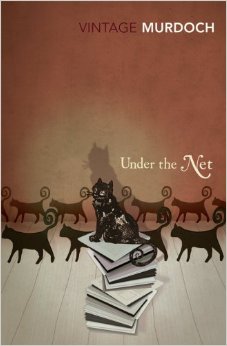
“Ragged, Inglorious, and Apparently Purposeless”: Iris Murdoch, Under the Net

murdoch

Like a fish which swims calmly in deep water, I felt all about me the secure supporting pressure of my own life. Ragged, inglorious, and apparently purposeless, but my own.

In the very last chapter of Under the Net, I finally arrived at a passage that was the kind of writing I’d expected from Iris Murdoch:

Events stream past us like these crowds and the face of each is seen only for a minute. What is urgent is not urgent forever but only ephemerally. All work and all love, the search for wealth and fame, the search for truth, life itself, are made up of moments which pass and become nothing. Yet through this shaft of nothings we drive onward with that miraculous vitality that creates our precarious habitations in the past and the future. So we live; a spirit that broods and hovers over the continual death of time, the lost meaning, the unrecaptured moment, the unremembered face, until the final chop chop that ends all our moments and plunges that spirit back into the void from which it came.

OK, “the final chop chop” is unexpectedly colloquial, but overall this is more or less what I thought a “philosophical novelist” would sound like, or write about.

I’m not sorry Under the Net was not like that all the way through. In fact, I’m thrilled and relieved that it wasn’t, because imagine how dreary and pretentious it would have been! I am sorry, though, that I had so little understanding in advance of what Under the Net actually is like, or is about, because most of the time while I was reading it I felt quite adrift — not in an angrily puzzled way, but in an off-balance, faintly delirious way. I could tell that the novel was some kind of kunstlerroman — that Jake was somehow becoming something more or other, especially as a writer, than he was at the start. It felt like a quest plot, too, though a strangely erratic one, as Jake rushed off in one direction and then another, each time quite sure of what he was doing but rarely of exactly why or to what larger end. “There was a path which awaited me,” Jake says at one point, “and which if I failed to take it would lie untrodden forever.” His challenge, and thus our challenge, is first to discern it, and then to follow it.

For a while I concluded that the aimlessness, the fits and starts, were themselves the point: that Jake’s peripatetic misadventures stood in for a vision of life as itself without direction or purpose. I’m still not entirely sure that’s not the point — but at the end of the novel there’s a sense, not of everything coming together into a shapely unity, but of Jake gathering up the loose ends and preparing to make something more out of them. If I’d read the Introduction first, rather than last, I would have  seen this coming. Instead, the Introduction confirmed it for me: “In a nutshell,” says Kiernan Ryan helpfully, “Under the Net is Jake Donaghue’s account of how he became the writer who wrote Under the Net.” Aha! Although where, in Under the Net itself, qua novel, is the evidence of that slow-growing self-awareness and control? Maybe that’s to imagine Jake becoming a different kind of writer — the kind Pip is, for instance, in Great Expectations, one who infuses the story of his past inadequacies with the wisdom they helped him acquire. Maybe Jake has not acquired any wisdom, or maybe he doesn’t believe in art with such a moralizing bent. Ryan notes the novel’s affinity with a literary tradition I don’t know well at all: “the French surrealist Raymond Queneau, to whom the novel is dedicated, and the novels of Samel Beckett,” for instance. My disorientation arose, that suggests, from my associating the idea of a “philosophical novelist” with a different tradition — with George Eliot and Henry James, for instance, not just in their realism and moral seriousness but in their overt designs on their readers. What in either of them could have prepared me for the Marvellous Mister Mars?

Ryan’s introduction points out a whole range of things that I really didn’t grasp about Under the Net and philosophy — or as philosophy. If I reread Under the Net, I would try to focus on the meanings he sets out for its motley array of characters and its bizarre, seemingly haphazard events. That would be the way to a good reading of the novel, or at least a better one than I managed this time. In my defense, though, I don’t think that happy confusion is an illegitimate first response to Under the Net. Murdoch’s choice of an unaware first-person narrator means that we are necessarily in a different position than we are with Eliot or James: short-sighted or deluded where he is, hampered by his limitations of perception and insight. This doesn’t mean we can’t tell when he’s screwing up, but it does make it more of a pleasant surprise when he arrives at some self-knowledge, as when it occurs to him that his former lover Anna “really existed now as a separate being and not as part of myself”:

Anna was something which had to be learnt afresh. When does one ever know a human being? Perhaps only after one has realized the impossibility of knowledge and renounced the desire for it and finally ceased to feel even the need of it. But then what one achieves is no longer knowledge, it is simply a kind of co-existence; and this too is one of the guises of love.

There he goes again, being philosohical! And this, too, is near the end of the book, so it feels like somewhere Jake has arrived after some effort. The puzzle of Under the Net is how exactly he figured this out — and also how seriously we are  supposed to take it, given how bad Jake’s understanding of himself, of others, of life, has been up to this point. It feels more like a revelation than like any form of Bildung, and simply happening upon a significant idea is not a particularly philosophical method.

I could quote more of the introduction about how this all actual reflects “the fundamental wisdom that suffuses Iris Murdoch’s fiction,” and how the novel is “the imaginative embodiment of Murdoch’s artistic creed,” but that would be to borrow someone else’s comprehension as a mask for my own ongoing bemusement. Under the Net is the first Murdoch I’ve read. Maybe the pieces will fall into place as I read more! In the meantime, I look forward to my book club’s discussion tomorrow.

Comrades or Hooligans? Doris Lessing, The Good Terrorist

good-terrorist

There was nothing there about their exploit! Not a word. They were furious. At last Faye found a little paragraph in the Guardian that said some hooligans had blown up the corner of a street in West Rowan Road, Bilstead.

“Hooligans,” said Jocelin, cold and deadly and punishing, her eyes glinting. And she did not say — and there was no need, for it was in all their minds — We’ll show them.

Like the subtitle Hardy chose for Tess of the d’Urbervilles, the title of this book promises challenges to readers’ moral assumptions: if Tess is a “pure woman,” then female purity must not be defined by sexual innocence; if Alice is a “good terrorist,” then there must be a way to reconcile goodness with terrorism — either terrorism itself is sometimes a good thing, or being a terrorist doesn’t necessarily make you a bad person, even if you commit an evil act. Unless, of course, the title is ironic, or descriptive of competence, not virtue, as it is applied, in fact, to one of Alice’s co-conspirators, who “was studying handbooks on how to be a good terrorist.”

I spent most of my time reading The Good Terrorist trying to orient myself in these possibilities. Is the novel at any level about the necessity, the justice, the virtue of terrorism? It certainly does not paint an encouraging picture of modern England: “The relentlessness of it,” Alice thinks, “the fucking shitty awfulness of it.” But though we see plenty of ways in which the “system” is failing, it’s hard to take the “comrades” seriously, with their ideological vagaries, their bumbling incompetence, and their high-flown rhetoric, indistinguishable from parody:

All over the country were these people — networks, to use Comrade Andrew’s word. . . . Unsuspected by the petits bourgeois who were in the thrall of the mental superstructure of fascist-imperialistic Britain, the poor slaves of propaganda, were these watchers, the observers, the people who held all the strings in their hands.

It’s also impossible to take Alice as she would like to be taken: as a revolutionary. Her commitment to the cause is hard to distinguish from her feelings for Jasper, who is not exactly her boyfriend, certainly not her lover, but whom she idolizes and yearns for, whose approval she craves but who actually seems to depend almost entirely on her for money and all domestic arrangements. Her revolutionary zeal is also constantly challenged by her nostalgia for the home and family of her childhood (though one of the novel’s more interesting developments is her realization that maybe things never really were the way she remembered them). How good a terrorist can someone be who steals her mother’s brocade drapes to make her “squat” more cozy, who runs home hoping to make off with the really big soup pot, who can’t bear it when her mother comes down in the world (thanks in large part to her, Alice’s, interference) and ends up in a sad little flat with no one to talk to about books?

So is The Good Terrorist a satire about people who imagine themselves to be both good and terrorists but are really just playing at revolution, for whom épater le bourgeois is more the goal than real political transformation? Is the novel told at Alice’s expense, to expose her as what her mother calls her, a spoiled child? Alice loves to shock her parents, to steal from them and throw rocks at their middle-class suburban windows, but she also runs to them for money (and soup pots) and expects them to stand as references when she applies for permits and loans. She loves to demonstrate and run from the police, but more often she stays behind, transforming the “squat” into as close an approximation as she can of a respectable home. It’s necessary camouflage, she argues to her comrades: keeping up appearances keeps the inspectors and the cops at bay. She’s right, but it’s not easy to tell which goal is, ultimately, the pretense for her.

The house itself is tempting to read symbolically, but of what? Does it stand for England, with its solid foundation but shameful state of disrepair, its squandered capacity to welcome and shelter, its rotting beams at the top that need replacing by stalwart workers? Or is it more specific to the revolution, with its shared spaces regressing into private territories, its pretense of civility barely concealing its buried sewage, its susceptibility to external attack as well as internal rot? Or maybe it’s just the site on which the novel’s conflict between the desire to build up and the forces that tear down is rendered most literally — with a deliberate ambiguity about which side the comrades are on.

I did get mildly interested, by the end, in what kind of terrorist Alice would turn out to be. (I would say that she’s not in fact a “good” one in either sense of the word.) But I didn’t find her a very consistent or believable character: she fluctuates too wildly between cool self-control when dealing with bureaucrats and wild emotional ups and downs in other contexts. I couldn’t piece together, either, a coherent idea about how she ended up where she is when the book begins — not in terms of plot and events, but in terms of motivation. That was one of many things I ultimately found dissatisfying about The Good Terrorist. It seems like a book that could have done something much deeper and more interesting about modern values and political violence. Instead of probing, though, it skipped along the surface, describing in painstaking detail and what sometimes felt like real time what is happening, but not why, not itself entering into the problems its characters are, however superficially or solipsistically, going on (and on) about — and trying, however wrongheadedly and ineffectually, to do something about. I didn’t enjoy Lessing’s writing style, either, which is more an absence of style combined with a failure of selectivity: I really couldn’t see why the book had to include quite what, or quite as much, as it did.

theterroristsThe book I found myself comparing it with is Sjöwall and Wahlöö’s The Terrorists. To my mind, the advantage is all with Sjöwall and Wahlöö. They tell a much tighter story that does a much better job at making us think about what it means to be a “terrorist,” or who we label “terrorists.” Rather than being a book about (wannabe) socialists, it’s a book that is, itself, socialist in its reading of society and especially its analysis of the operations of state power, class, and gender. In Rebecka Lind Sjöwall and Wahlöö also offer us someone who really deserves the label “good terrorist,” and in doing so they draw us effectively into the moral paradoxes that label provokes. If we sympathize with her — if we concede that her act of political violence is understandable in the circumstances, though not necessarily excusable — we have come a lot closer to revolution than is entirely comfortable. Lessing clearly did not have that kind of political goal for her novel,* but what exactly The Good Terrorist offers us instead has not only eluded me but also doesn’t much interest me.


*I don’t believe authors are necessarily authoritative on what their books do or are about, but after mulling over The Good Terrorist for a while on my own I poked around online a bit and came across Lessing’s Paris Review interview, in which she says she thinks it’s “quite a funny book” and that she wanted to “write a story about a group who drifted into bombing, who were incompetent and amateur.” The humor was pretty much lost on me. Would I have read the novel differently if I’d known it was supposed to be funny? Shouldn’t I have been able to tell it was funny?

“Encircled by Invisible Emotion”: Damon Galgut, Arctic Summer

galgut

This kind of companionship had far more value to Morgan than their few, fumbling physical encounters. Sex could be forgotten, or made into something that it wasn’t, but feelings were much harder to erase. There had been moments, from their time in Alexandria, when they had simply sat together talking quietly, or smoking cigarettes in brotherly contentment, when he’d felt that they were removed from other people. Paired off. And it had come to him then that there might be many men like them, in the past as well as the present, who had been together in a similar uncelebrated way, encircled by invisible emotion.

My book club chose Damon Galgut’s Arctic Summer to follow Howards End. Not only did I enjoy Howards End so much that I liked the idea of hanging around with Forster a bit longer (which is also why I reread A Room With a View), but I’ve been curious about Arctic Summer since I read Steve’s review in Open Letters Weekly, and got even more interested when it made the Stevereads “Best of 2014: Fiction” list.

I enjoyed Arctic Summer quite a bit — though maybe “enjoyed” is the wrong word, as it’s such a low-key, melancholy novel. Unlike Steve, who has always already read everything else (in this case, specifically the Forster biographies on which Galgut’s novel is heavily dependent), I knew little about Forster the man before I started, and now I feel that I have gotten to know him pretty well. I like him, too, though I think there’s a side of him I might like even better than the somewhat mopish, solitary man we mostly see here, where we hardly ever spend time with him when he’s actually having fun. “On a surface level, he was quite sociable,” we’re told at one point, “seeing a great many people and acquitting himself well in company, but an essential part of him had become deeply withdrawn, hardly noticing the outside world.” It’s that withdrawn man, steeped in reticence, who is Galgut’s main character, not (or only very rarely) the man who holds his own (just for instance) in conversation with the Woolfs and their friends at Monks House. That his reserve is in many respects a necessity only makes it more poignant: Galgut’s muted tone nicely matches the emphasis he puts on the emotional costs, to a man as hesitant and sensitive as Forster, of a life so shrouded in secrecy.

It’s that “surface level,” I guess, so much more confident, assertive, and optimistic, that comes across in Howards End or A Room with a View, or in The Art of Fiction or the radio broadcasts Zadie Smith discusses in her wonderful essay “E. M. Forster, Middle Manager.” Because this is the Forster I knew, I was surprised to find Arctic Summer so sadly yearning. “Only connect” seems a more wishful (or wistful) credo here — but connection is certainly what Galgut’s Forster longs for. He does achieve it, but only equivocally, in both of the two friendships that dominate the novel: with his Indian friend Masood, to whom A Passage to India is ultimately dedicated, and his Egyptian friend Mohammed, with whom he comes closest to the kind of intimacy he most desires (“To touch, to hold. To be touched. The yearning was so strong that sometimes it hurt. The more so because it could not be spoken”). His final affirmation is also equivocal, hardly a happy ending but not unhappy either: “I have loved. That is, I mean to say, lived. In my own way.”

Mark Athitakis has a really smart, eloquent review of Arctic Summer in the Barnes and Noble Review in which he discusses the relationship between Galgut’s novel and A Passage to India:

Misunderstanding, prejudice, and power are the lenses through which Galgut tries to position a sexually repressed Forster, introduced in 1912 making his first trip to India. Though he’d written four novels attuned to the relationships of men and women, he struggled to apply his plea to “only connect” to his own life. His homosexuality was unspeakable: “He could not refer to his condition, even in his own mind, with too direct a term; he spoke of it obliquely, as being in a minority. But via Galgut, unspoken lusts abound within him, especially for Masood, a young Muslim he met as a Latin tutor in London six years earlier. The opening pages capture the first stirrings of that repression becoming unlocked. The sentences are thick with heat and lust, felt by a man fit to burst.

That Forster — Morgan as his friends call him — will be liberated over the course of the novel isn’t in doubt. The tension within Arctic Summer is how much, and how that urge for sexual liberation was sublimated into the novel. To the second point, Galgut cannily invests picayune details from Passage into his own novel and invests them with a sensual weight: help with a collar stay, for instance, or Masood’s observation of Forster’s “pinko-gray” skin. But the novel’s engine is Morgan’s broader anxieties.

It has been too long since I read Passage for me to add anything to Mark’s analysis, though now of course I want to reread it, partly to complement Arctic Summer, partly to test Mark’s comment that Passage “is showing signs of age.” (I read The Jewel in the Crown not that long ago, however, and got intermittently confused by recollections of it that surfaced during discussions of Passage. Parts of Arctic Summer also reminded me of J. G. Farrell’s The Siege of Krishnapur, particularly the descriptions of Bapu Sahib’s chaotic household.)

passageBecause I couldn’t sustain a properly intertextual reading, what I found myself thinking about the most with Arctic Summer was the question of genre. In his original OLW review, Steve describes it as a “mildly inert reading experience” because of “the novel’s curiously timid approach to its own novelhood.” He concludes with dissatisfaction, but clearly reconsidered by the time he was assembling his ‘best of’ list. Maybe because I didn’t have the “two great templates” mentally to hand, I didn’t find Arctic Summer thin in the way he describes, but I agree that, interesting and touching as I found it as biography, it doesn’t ever really take off as a novel, so I ended up wondering what is really gained, or lost, or intended, in rendering Forster’s life story in fiction in this way. If it doesn’t break any new ground (and I have to take Steve’s word for it that it “virtually never strays from Furbank’s biography in its details”), and it doesn’t do anything striking formally or artistically (though it is certainly well written and crafted) — is it really just taking Forster’s story and making it more accessible, more digestible? Is it the novelistic equivalent of a docu-drama or a re-enactment?

Not that there’s anything wrong with that, of course, especially since I’m someone who is (evidently!) much more likely to read about someone’s life in a novel than in a full-fledged biography. (The opposite is true of my husband, who very much enjoyed Robert Kanigel’s The Man Who Knew Infinity: A Life of the Genius Ramanujan but has repeatedly declined offers of David Leavitt’s The Indian Clerk.) But somehow in this case I was left fretting about whether reading fiction in lieu of fact was such a good idea: Arctic Summer seems so much like straight-up biography that I might be misled into believing things about Forster that weren’t really true.

What kind of concern is this, though? It’s not something that bothers me at all about Wolf Hall, where surely the odds are much greater that I’m getting a Cromwell wholly unlike the man who actually lived. Wolf Hall is “historical fiction”: is it just the longer expanse of time between us and its subject that changes the terms on which we read it? I’m not saying it doesn’t matter whether Mantel did her research: it does, and she did. Wolf Hall is anything but timid as a novel: is that what makes me feel differently about it? You couldn’t read it and forget you were getting an artistically-shaped treatment: maybe it’s Arctic Summer‘s semblance of transparency that provokes this line of questioning. Just by being a novel, though, it’s setting aside its claims to be telling the truth. Furbank’s biography, which is also, inevitably, made up (because, as we all know, narratives must always be imposed on chaotic, amorphous reality, or carved out of it) probably presents itself much more authoritatively. In retelling Forster’s story as a story, maybe that’s Galgut’s signal contribution: a reminder that however scrupulous we are about the facts, the result will always in some sense be fiction.

“It feels ours”: E. M. Forster, Howards End

MAO.7375.cvr compI know of things they can’t know of, and so do you. We know that there’s poetry. We know that there’s death. They can only take them on hearsay. We know this is our house, because it feels ours. Oh, they may take the title-deeds and the doorkeys, but for one night we are at home.

I have been in a real reading slump lately. For a while nothing I’ve started and stopped (or even the few that I’ve started and finished) has felt very satisfying, and one reason has been that they’ve felt too slight — that essential quality that (thanks to a friend who studied library science) I’ve come to call “aboutness” has been elusive, simplistic, or (as far as I’ve been able to tell) just missing. This is one way, I suppose, that my quest for novels that are “teachable” lines up with my quest for novels that really excite me as a reader: my ideal novel satisfies both head and heart, appeals to both the aesthete and the ethical explorer in me, gives me language and stories but also ideas that engage me.

I think Howards End is one of those ideal books for me. I hesitate only because I’ve just read it for the first time — astonishing, I know — and so I’m still thinking it over, and not feeling entirely up to the task. (I don’t think Howards End is a novel for beginners,* exactly, though it certainly offered some immediate readerly pleasures.) Until now I didn’t even really know what the novel was about, though I had miscellaneous tidbits stored away from having heard about it so often — “Only connect,” of course, and something about Schlegels and Wilcoxes, and a house that obviously stood for something more than a nice place to live. I probably knew a bit more about it than that, in some minimal sense of “knew,” because I’ve read and admired Zadie Smith’s essay on Forster in Changing My Mind and also researched Forster a bit myself when teaching A Room With a View (long one of my favorite novels). But unless I’m reading really purposefully, not much sticks with me when I read about a novel I don’t know myself. It’s a kind of self-protective selective amnesia, perhaps, so that I remain open-minded when I finally get around to it.

So I started Howards End with a lack of specific expectations that was at once liberating and, ultimately, somewhat disabling. It’s nice to read along and feel you are discovering for yourself what a book is about (notations on the back page of my edition include “politics,” “Beethoven!” “Monet vs. the umbrella,” “odd narrator,” “house = a spirit,” “Schlegels vs. Wilcoxes,” “men don’t know” / “his superiority,” and “only connect!”). But it’s also frustrating — if provoking, in a good way — to reach the end and know there has been more going on than you knew to keep track of from the beginning, and so this reading is, even more than usual, only a preliminary one.

Reading is always a work in progress, though, right? And you have to start somewhere. I’ll start with those notations, then, as they indicate the issues that revealed themselves to me during this first reading. It wasn’t hard to identify as the (or, perhaps, a) central conflict the difference between the world as the Schlegels see and experience it and the world of the Wilcoxes. “The truth is,” Margaret says to her sister, with a combination of surprise and confusion,

that there is a great outer life that you and I have never touched — a life in which telegrams and anger count. Personal relations, that we think supreme, are not supreme there. There love means marriage, settlements, death, death duties. So far I’m clear. But here my difficulty. This outer life, though obviously horrid, often seems the real one — there’s grit in it. It does breed character. Do personal relations lead to sloppiness in the end?

They do, in fact, and that sloppiness is one thing the novel makes (paradoxically) perfectly clear. I think this is part of what Zadie Smith means when she talks about Forster’s “infamous muddle,” that personal things (feelings, relationships, needs, demands, desires, love, jealousy, betrayal, even the passivity of indifference) don’t line up in organized ways, or lead to elegant solutions, no matter how good our intentions, or the novelist’s. It’s the outer life that has form and structure, and the interplay between these forces of order and disorder is the sum of life — though not of any individual life, since for Forster those mostly seem to fall on one side or the other.

I saw, then, though I’m sure didn’t entirely understand, this aspect of Howards End: the opposition between that Wilcox life of “telegrams and anger” and control, and the Schlegel life of art and ideas and impulses. What I didn’t see until fairly far along was that Howards End is a ‘condition of England’ novel: this didn’t occur to me until people in the novel starting talking very explicitly about England — its past, its future, its empire. The version of this question that I’m familiar with, from novelists like Dickens and Gaskell, is a much more literal one than Forster’s, at least in its framing. His questions seem more abstract or theoretical than material, though they do have practical dimensions (as shown by the elaborate game of “how should the millionaire leave his money,” or the eventual distribution of resources among the characters). The Wilcox / Schlegel antagonism embodies this social and political question, which is about which values will come to define “the way we live now.” It may be an extension of the Dickens – Gaskell version, actually, because they are also worrying about the attitudes and feelings that lead to social and political conditions and reforms. But I’m not used to Forster’s way of posing the question: there’s a good starting point for my next reading.

howardsendLeonard Bast seems like a key (if a cryptic one) to Forster’s “condition of England” question. Not that he’s the answer to it: far from it! He seemed utterly pathetic to me for some time, and then I recoiled from my own snobbery and, as a result, also from the Schlegels, who really treat him very oddly from beginning to end. Leonard makes sure that we don’t oversimplify the Wilcox – Schlegel conflict — by assuming, for instance, that, in contrast to the Schlegels’ free-spirited life of the mind, the Wilcoxes are the unequivocal villains of the piece. Again, far from it, which is something even Margaret acknowledges when she observes that the privileges she and her sister enjoy have been won and protected for them by Wilcoxes who have “worked and died in England for thousands of years.” I thought it would be Margaret and Henry’s son who became heir to Howards End, because that would neatly balance their two worlds. But it turns out it’s Helen and Leonard’s, and I’m not really sure what to make of that. I can’t see what Leonard brings to the future, to be honest! Another place, then, for further reflection.

I was interested that Forster’s critique of the Wilcoxes was so gendered. Clearly Margaret and Helen are liberated from some specific constraints of sex (is either of them a ‘New Woman‘?), and there are moments of direct feminist assertion (“A new feeling came over her; she was fighting for women against men.”). And Mr. Wilcox’s inability to “connect” (“you cannot connect,” Margaret exclaims in her wonderful denunciation) seems tied to the particular kind of masculinity he embodies: strong, decisive, pragmatic, but also unreflective, controlling, possessive (as literalized in the way he overrides his wife’s attempt to will Howards End to Margaret). We seem to be in Three Guineas territory here, with the intertwining of manliness, despotism, capitalism, and imperialism.

I seem to have said a lot already for someone who admits to being a novice with this famous novel! The last thing I’ll comment further on for now, then, is that scribbled notation “odd narrator.” There is something very casual, almost artless, about the way the story is told, from the shoulder-shrugging opening line (“One may as well begin with Helen’s letters to her sister”) through the many equally haphazard intrusions, but also the apparent uncertainty of the narrator about what even happens (“The friendship between Margaret and Mrs. Wilcox … may perhaps have had its beginning at Speyer” — what, don’t you know? What kind of narrator are you?). The pacing is odd too: the plot moves ahead in fits and starts, building momentum then slowing for meticulous detail then jumping across crucial events with no explanation or transition (Mrs. Wilcox walks out of Chapter X just fine, only to turn up as the corpse at the funeral that opens Chapter XI). By the end, though, the novel turns out not to have been random or careless at all but to have a strong and quite balanced structure: what could be neater than that long-delayed revelation about Mrs. Wilcox’s thwarted will and the discovery by the Schlegel sisters that the house they have (from the Wilcox point of view) invaded and colonized, was always already, in some moral sense, theirs — not to mention always theirs in spirit? What’s at stake in Forster’s denial of the control he obviously has? What could be less muddled than the sense he gives us of being in a muddle? If, as Zadie Smith suggests, this is art in service of an ethical vision, it’s a far different one (I’m pretty sure) than Stephen Blackpool’s “‘Tis a muddle.'”

And with that, off I go to reread Zadie Smith, who seems to have sorted a lot of this out. Imperfect as my own understanding of Howards End is, I’m really glad I’ve finally read the novel for myself so that (with her help and others’ – including many of yours, I expect) I can begin the process of figuring out what it means.

*Update: It has been brought to my attention that this phrasing seems to suggest that I think you need to be some kind of expert to read Howards End — that only, perhaps, “superior” readers should attempt it at all. That is not what I meant (I hope readers who know me at all would not have thought so, either!), but I can see that my wording was inept. I meant that it struck me as a novel that, for first-time readers of it (beginners) like me, is hard to make sense of and maybe even, as a result, to take unqualified pleasure in. Other novels (A Room with a View, to pick another Forster example) seem to me much more immediately intelligible on a first reading. Obviously, with any novel YMMV, and no doubt there are readers who appreciated Howards End unreservedly on a first reading. I am not among them, as I often felt mildly thwarted by my own ignorance or uncertainty about what was going on. I was trying to articulate both what that experience felt like and what I thought its causes were. “I think Howards End is not a novel that’s very welcoming to newcomers” would perhaps have been a better way to put it.